"The Secret To Truly Living" - Matthew McConaughey.
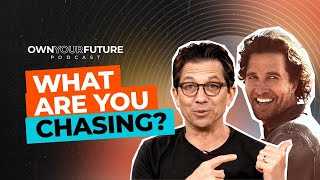
This is a recorded interview (Apr 10, 2023) where Dean Graziosi and Matthew McConaughey explore wholehearted living. McConaughey shares personal anecdotes (a Peru vision-quest that produced the line "it's okay to have a beer on the way to the temple"), contrasts joy (a process/art) with happiness (an outcome/science), and recounts his career pivot from rom-coms to dramatic roles — deliberately unbranding himself by moving to Texas and refusing high-paying rom-com offers, which led after ~20 months to breakthrough dramatic work (Lincoln Lawyer, True Detective, Dallas Buyers Club). He describes writing Greenlights from 35 years of journals to extract patterns and choices, and promotes a free "Art of Living" live event (livin2023.com) intended to teach process and decision tools (how to read green/yellow/red lights). The tone is conversational, motivational, and practical: emphasizing making choices, seeking meaning, and developing habits that support joy.
Chapters
It's okay to have a beer on the way to the temple.
I think the biggest regret of our lives could be, you know, getting to the end of it and somebody playing a movie of a man or the woman you could have been.
And then sometimes we gotta just go, man, I'm banging my head on this thing. My head's bruised and bloody. I raised the white flag. I'll fight another battle, man. You got that one. I'm gonna spend some more time on some other problem.
Own your future. Because if you don't, someone else will. My guest today, you've seen him in over 50 movies, some of my favorite of all time. Avid Airstream collector. Yeah, you know him for his best selling book, came out in the last couple years. But I gotta tell you, this isn't like an interview where you haven't seen each other. We've been working together for about a week, every night till about midnight.
We've gotten to know each other real.
Well this week, really well. And I want to tell you before we start this interview, very rarely get to know somebody before you do an interview like this. And what I got to learn is someone with an amazing work ethic, someone who looks at his wife in a way that I know I look at mine. And it's pretty damn special to see a connection between a couple that have been together for a long time and still have that respect and love with each other and the way he talks about his kids. So I took from really respecting this guy and loved his work ethic to a whole nother level. And I'm so happy to have him here. Everybody. Matthew McConaughey.
Dean. Thanks for having me.
Thanks for learning. I'd shake your head like we just met, but that would be so crazy since we just spent.
We shook hands. I haven't had many hugs in the last week.
Yeah, it's so good. Good to have you here.
Good to be here.
And I meant what I said. It's been fun. You know, sometimes you know the actor and you know the person behind, but I get to see, get to peek behind the curtain and way more respect when you realize that this is who you are. And what I love the most is your desire to serve. We're in a time in history where people are uncertain, they're scared. Three years of turmoil, as you said, moving the goal post. And I think it'd be a great time to talk about some of the things that can anchor them in, give them some hope. Like, the dust is clearing. How do you go now? But I Figured we'd lighten it up a little bit. And before we get into some of those, we've been talking about a lot of stuff for the last week and going through. And I love the project you're working on. I got something really cool to share here in a little bit, but there's something that I've been laughing over for two days is have a beer on the way to temple. Can we just start there?
It's okay to have a beer on the way to the temple. Thank goodness. That came to me on a walkabout in Peru. I was on a vision quest. It was a 21 day trip where I went to find the Amazon. And I was stripping all the sort of symbols that I had had in my life. I just gotten famous in Hollywood. So I was going through some very kind of confusing times. A little information overload about what was real and what wasn't. And it was about day 15 and I had been thinking about. I've always gone through times in my life where I abstained from certain things. From celibacy or not having a drink or what have you. Even entertainment. And they had this, I think it was. I forget the name of the damn beer, but it came in one of those big. It's one of the big bottles, 44 ouncers. And I had it on a trail walking where I ended up drinking it while I was writing in a journal. And I wrote some of my greatest journal entries in it. And I was that. I don't think I would have written as good of entries if I wouldn't have had that beer right then. And I was like, man, this. The truth is crossing me right now. And this beer's got something to do with that. Thank you. That's right. It's okay. I was shaking a lot of guilt at the time too. One of them was like, hey man, it's all right to have a beer on the way to the temple. And I remember writing that down. So that was a line. But.
Yes, but it's such a great metaphor. Yeah, it's such a great metaphor. And why is it, you know, we've been talking about a lot of stuff last couple weeks. I love the difference that how you describe joy versus happiness.
Right.
You know, the simple. The process of joy compared to happiness.
Yep. I mean, that's what we all say. Right. What do you want to do? I just want to be happy. What can I do? What can I do to be happy?
Right.
But already those two questions you're saying, what is that thing out there that Outcome, that result that I can get to. So therefore I can be happy. And you and I've talked about this. What happens when we do get that thing that we think going to make us happy? Well, we usually get it and we up the ante right away and we go, oh, well, look, there's 50 more mountains on the other side I want to climb that I didn't see before I got this. So I'm not happy again. I need to get that. Get happy or you do get there and it's kind of like this isn't as kind of as cool as I thought it was going to be. It's not really fulfilling me like I thought it was something different than I thought it was going to be. But joy is a different thing because it's not predicated. It's not reliant on that outcome or that result or the attachment or the ownership and capture that thing. It's, as my pastor says, the process of enjoying the doing of what you're fashioned to do. Yeah. So that when I say process is this, that's life, this living thing, we're.
Going to do it.
We're on our way. And I would also argue this. If we have more joy on the way, we get those things that make us happy more often. I would say, and again, if we don't get those things, we can all say, well, at least I had a damn good time getting there or trying, you know what I mean?
And we forget like we were talking about, when you find that happiness thing, we go by it so quick. I had a couple stand up one time. They were in the audience, an event I was doing. She said that their whole dream was to move to California and watch sunsets. And they did everything. They said, someday they live in the Midwest. Someday we're gonna get to California. Someday. Someday it's gonna make us happy. That's the dream saved up. When they're in their 50s, they move to California, Northern California. They get a place on the beach and they're watching the sunset go down every day. She goes, I don't know when it happened, she said, but we are a year in, maybe a year and a half in. And my husband looked over at me and said, God damn it, close the blinds. That damn sun is right in my face. And she said, at that moment, their life changed. That's why they were at an event like this. They realized they looked at each other and went, son of a bitch. We worked our whole life. We've been chasing sunsets at night with a glass of wine. Yeah. And this is where we are.
And that's. That's a good metaphor for a lot of the stuff that we've been. We've been talking about that I know you talk about and I know I talk about. We got a lot of horizons, a lot of sunsets in life that we all chase, that I think what we got to remember is that we don't really catch them.
Never.
Not while we're here in this life. I don't know. We're going to find out what we catch once we take our last nap and we move on from this life. But in this life, we don't ever catch those things. And I don't know about you, ma', am, but when I do feel like I catch them, well, I'm kind of ready to go. That's over. I want to get back on the road. I want to get back on another chase. But if it. So I think we realize, hey, it's the. It's okay to chase that sunset, to chase that horizon. But go. I'm not going to get there. My hunch is that we, at the end of our lives, can we look back and go, well, how many staircases did I get up? I never got to the top. Never got up. B. But what did I do? And were those steps vertical? And how were those steps wide? Maybe a lot of those steps weren't about quantity. Maybe a lot of them were. Like, I had deep relationships and roots and I scaled outward as well. And there's a lot that's worth the measurement and that's the stuff. We don't measure as much.
Exactly.
Or the world doesn't measure as much. Exactly.
And why I love this difference between happiness and joy, because joy is being in the journey, enjoying it as you're going, not the end result. And I love the fact of. We talked about looking in the rearview mirror sometimes so you can see how far you've come. Because a lot of times we're looking. I should be here. Yeah, I made this mountain. But look, I'm not in the best shape or I'm in good shape, but I'm not making the money. Right. Especially in today's world. We're measured against social media, the fake relationships. I don't want to be negative, but we only see a glimpse on social. So we start comparing. I don't have intimacy, I don't have real love. I don't have the six pack abs. And we forget to look in the mirror and say, wow, I've done some amazing things. I've accomplished a lot.
I'd argue that most midlife crisises are more about not appreciating where we've been. Yeah, maybe not appreciating. Giving respect to what we have done or what we already have built again because we thought they were happy. Oh, we get there and it's done. It's like. So we don't give them credit. No, we built some. Look at the things in our past that we built and I think in those times where our future is uncertain, that's a great place to look and go, what have I built here? Yeah, already. And I want to give myself respect. Not a big pat on the back, but I want to go ahead enough.
Right there, little nudge.
It also defines. Well, I know this going forward, I've built some stuff that's non negotiably going with me. You know what I mean? So I got to tend to those things. No matter what new horizon I'm chasing or new place I'm going, I got some stuff going with me, my family, my kids, this part of my career that's not negotiable. So even though I may be uncertain of where I'm going in the future, I got some baggage, I got some luggage that's going with me no matter what and that's giving respect to those things. I think that's where a lot of us get in a crisis, sometimes even a typical midlife crisis. We don't respect what we've done and what we've built and appreciate where we've been.
Maybe enough, yeah, maybe it's time to take a moment, just think about that. Like we're always looking forward to that horizon. You can never catch it no matter how fast you run west. But looking back on what you accomplished and just really differentiating happiness and joy, you know, it is a time of craziness. Right. I've been in this industry and been around for, in business for 30 something years and I've never seen a time where people are so unsure they want to do something, but they're just not sure which way they're going to go. I think it's a time where the world is kind of pushing us apart, that we should be way more unaliked than we are alike. And that just to me, that just robs your confidence. And if your confidence is down, I guess you can call it uncertainty. But then you're not courageous to do the thing you wanted to do. And I would bet to say when people see you, Matthew, 50 movies, Academy Award, amazing family, all the things they wouldn't think of some of the struggles they're going through at home right now that you experience. And there's one story, and I know you've shared it before, but maybe we could dig a little deeper. Is when you decided not to do rom coms anymore. Right. And I'm switching into this because no one would ever think that we talked about that. Self doubt, right? I'm not doing rom coms. I want dramas.
Yeah.
And that was a good idea. And you bailed out of California, Right. You moved to Texas, moved to Austin, and you told your family. And I think that's some of the things I don't think I've ever heard before. Talking about that craziness feel and what it felt like at six months and then eight months and 12 months.
So, yeah, I had been doing wonderful and romantic comedies. I loved doing them. They paid well, I enjoyed them. But I was at a time in my life that was extremely vital. Vital and I would say really dramatic in a good way. Fall in love with a woman that was going to become my wife, who I have a family with. She was pregnant with our first child. My only dream of my life had always been to be a father. And oh, I hear it was about to happen. Man, I was. I mean, I was laughing harder, crying harder, feeling more rage, feeling more joy. It was just. Life was vital. But my work kind of felt like, yeah, kind of do that again. And I wanted my work to challenge the vitality of my life. I do remember this. I did look in the mirror and go, don't you being arrogant, son of a bitch. Be glad that you're feeling like your life's more vital than your work and it's not the other way around. We've all been there, too.
We've been there, too. Yeah.
But I said, well, can I do some work that could maybe challenge the vitality of my life? And that was the dramas I wanted to do. But Hollywood wasn't offering me those dramas. No matter how big of a pay cut I would say I'd take. They weren't offering them.
So.
So I said, well, if I can't do what I want to do, I'm going to quit doing what I've been doing. Which was the rom coms packed up, moved Texas. All right, here we go. Camilla's on board. I'm on board, my agent's on board. We'll show them. You guys know where to find me. But they weren't looking for him. They weren't trying to find McConaughey. It was just fine that McConaughey had left town. Right? So a few romantic comedy offers came in early. I mean, was like immediately like, nope, nope, nope, nope. Then nothing started to come in. We get to about six months, no work. I'm still feeling strong, but I'm feeling like, huh, I might have just written my ass a one way ticket out of Hollywood. You know, I might need to think about other vocations. I don't know. Let's get a little off balance. So those don't come in. I call my agent doing that six months and 12 months. And every call he's like, mcconaughey, I hadn't heard your name in two weeks. One month. Two months. Now I'm kind of Persona non grata there for a while. I'm like, they forgot me. Well, another rom com comes in. This is like month, I don't know, 16, 18. Don't work with an $8 million offer. It's a nice ass offer. I read it. It's not bad. It's rom com say, no, thank you. They come back, $10 million offer. I said, I said, no, thank you. They come back with a $12.5 million offer.
Kind of no, thank you.
No, thank you. They come back with a $14.5 million offer. What did I say? Let me read that thing again.
Got a little funny.
Hang on a second. I did read it again.
Did it seem funny?
Same script. It was funnier. The same exact words as the first statement offered. But it was a better written script, right? And I could see how it might be right for me or so. But I ultimately said no. And that was a big seminal moment, I think, to Hollywood because that's when Hollywood goes, oh, he's not bluffing.
Yeah.
Oh, it sort of sent like a little trigger through Hollywood. It was like, what's he doing? He's actually committed to his choice, so he's got something. Something about it made me more attractive, I think, to them. And then being 18 months where I hadn't been in the business, it simultaneously was around the time where I'd been gone long enough, where I was kind of becoming a novel, possibly good idea for one of these dramas that I wanted. And at 20 months, that's when I got the call and I started, went on that run with Lincoln Lawyer and Killed Joe and Paper Boy and True Detective and Mud and it was Dallas Buyers Club. And I just. Everything that I wanted came. And it wouldn't have come. No way. It would have come if I wouldn't.
Have.
Stopped Said, no, put myself in the desert and just unbranded myself.
And that's why this story is so intriguing. Because when you're in it, you tell the story now because you're on the other side. But when you're in it and you're getting down to the. There's so many people watching right now, dying to pivot. They're just afraid to start small. They're afraid to give up on the thing that their family friend said, you should be lucky to have this job. I know you don't love it, but it pays the bills. So think of in that same. Going from rom coms to dramas is the same of saying, hey, I'm finally quitting that job and starting my own thing. And in that, your family thinks you're nuts.
My brothers thought I was completely off my rockers, completely mentally meditated. Boy, what is your major malfunction? But they knew me well enough that I had made the decision. They were like, you're crazy. Okay? My wife and I had already made the covenant together. We shared the tears before the decision was ever made. We had long nights, sleepless nights of me going through the gravel, of, what do I got to do? What do I got to do to make the decision? So she was in with me the whole way, and she was there to support going, we know we're not going back. She never questioned. Like, she questioned less, probably than I did. Oh, do we ever go back on this decision? Like I said, I had days, a lot of them, where that bottle, what I like to drink, was looking better and better earlier and earlier in the day. The days were getting long, man. I didn't have purpose. I was like, what's my significance? I don't feel significant. What am I doing?
And I think that's so important for people to hear because you would never think that Matthew McConaughey, you did the Dallas Buyers Club, everything you've done, but no one sees that two year window where you, you literally thought of being a coach.
Thought of being a high school football coach. I thought of being an orchestral conductor. I think I thought of a wildlife expedition guide. Thought about going back to law school, possibly. Wow. And they were serious considerations because the signal from Hollywood was, thanks. Later. Enjoy why you're here. You got out of your lane, should have stayed in it. Too bad.
And before we move on to that, what do you think is the thing that kept driving you to say no to 14.5 million when you didn't know your agent was probably saying, hey, McConaughey, come on.
I gotta give. You gotta give a big ups to my agent at that time.
He stayed with you.
I got it. When I first called that son of a gun and said, this is what I'm going to do. No rom coms. He immediately goes, okay, no problem. And I said to him, what do you mean, no problem? You can't just throw that out here like, no problem. What are you. What's your boss is going to say Monday morning when you go in your boss of your age and you tell them McConaughey's not doing ROM coms anymore? I've been giving a pretty good 10% tithe commission to you guys for a while. They're not going to go, no problem. Because I don't work for them. I work for you.
Wow. Good, dude.
And so when that $14,500 came, he didn't go, great. He went, okay, yeah.
You know, all right, so let's. Let's take this transition. Movies, acting, romcoms, the Drama Academy Award. You decide to write a book called Green Lights. That's why we're here. I read Green Lights. I listened to Green Lights. I read it first, then I listened to it. And I just felt. I said it was beyond anything I expected for I expected a great story of inspiration. And there was a lot of transformative stuff in there. And I watched the comments, and I know everybody who read the book. That transition into that, you took one deeper step than just writing a book about your life. You gave us things to contemplate, things to put in our own lives, things that could shift and not in an arrogant way. Like, look at me, I'm up on the hill. Look how good I did. Felt like you were down in the ditch with us, saying, hey, I've been up there. Let's go up together. Here's some things I found along the way. I mean, the movie career, amazing impact you made. Amazing. What is. What is this new kind of not a career, but a new path you're on?
Yeah.
What does it mean to you?
Well, the book was something we talked about earlier, about looking to the past. Understand. Understand where we're going, hence helps us understand kind of where we are. I'd never been a rear view mirror, look over my shoulder kind of guy. I like to do things. I think I said earlier, before we were recording, I've made 54 movies. I hadn't seen all of them. I like making them more than watching them. I just don't even. I'm like, done. Got it. Move on. The book was A two, three year process of looking back over journals I had kept for 35 years and seeing consistencies in behavior that I had that led to my success and choices I made in life that I engineered, things that got to get what I wanted. Also seeing places where I stepped in piles of shit and had bright ideas that were way out of bounds and did not work at all and did not feed me. So that was a great exercise for me to do that and then to put it out and then hear things like that. Here's what I got from it. You're not me. I've had people come up and go, hey, man, I see my story and your story. I'm taking risk now to do things that I didn't quite have the courage to do before. Because I'm like, I saw that in your book. You did that and it paid off. Or you did that and it didn't pay off, but you were able to laugh it off and move on. And to have people come up and say that to me that they saw themselves through, it's addicting, isn't it? Yeah.
Listen, I was in a conference room doing a business deal six months ago, and someone said in the middle of just not even knowing you and I were talking, considering doing some work together, and somebody says, you know, this contract, this deal was a red light, and I see it's a green light now, just like that. And it was referencing. And I was like, that is damn cool.
It is cool to hear.
I mean, there's a. You know, Wooderson had some. Had some good comments, too, but this one's a little more positive like this.
Yes, indeed. I mean, so now, part of the reason that I'm in this part of my life and part of the reason that I wrote the book was I think we all want to do this in our life in some ways. Mega movies, which I love to do and always love to do. It's still four filters removed from my direct expression. Yeah, it's someone else's script. It's someone else's character. It's recorded with someone else's lens. It's edited by someone else before it's put out there.
Yeah.
And people see it and see your work. Love it. But it's four filters from the original.
Never thought of it that way.
The book got rid of three filters.
Yeah.
It's still a written word, but it's yours. But it's mine. I'm the character. I wrote the script. I did the editing, so to speak, you know, and. But it's still A written word. This, the live interaction. This is no filter.
Yeah.
This is where it's really at. So I'm always, like, always challenge myself, going, well, what do you. Action's been called in life one time the day we were born. And cut's going to be called one time the day we leave this life. So what are we doing? And if, you know, God or the prime mover, the way makers, the director, the. The camera's been rolling.
Yeah.
History will tell the story. Our story will be there, you know, so. And it's live. We're in it. We're living it right now. So what are we doing? Who are we going to be? That's kind of the challenge. I would say to myself, get rid of the filters. As much as I love to go play someone else, and as much as I also believe that we in our lives can be whoever we want to create ourselves to be, there's nothing wrong with that at all. It's awesome to do that. What am I doing when it's live? And that's the challenge. I'm putting myself. No, I love it in this life that is live. And the camera is rolling. It is being recorded.
Dale Carnegie said, the biggest plight of the human race is knowing you have more potential and then not utilizing it. Right, right. And.
And knowing.
Knowing you have and not utilizing just. Just what you've written about a lot is just the not knowing of what's on the other side. Right. I think.
Yeah.
I think the biggest regret of our lives could be, you know, getting to the end of it and somebody playing a movie of the man or the woman. You could have been. Right. That would be the. Like, it's only.
I think. Oh, yeah, I think I'm gonna have. I mean, maybe. I think. Do we all have maybe a little bit of that? Maybe some shorter.
Let's hope it's just shorter. Let's just hope it's. But also, isn't it a. You play it and somebody goes, that crazy bastard. Like, there was nothing. You can try. You know, you just said something, though, I really didn't think about. Even when you do interviews and if it's about a movie you're on, if there's an interview, you're promoting the movie. Not Matthew McConaughey. I mean, it's still. They're getting to know you a little, so it's been great. And I want to tell you, when you were looking back, when there's certain things that you do when you're in it, at least I noticed this. I'VE written a few books myself. When you look back, oh, my God. That's a pattern that got me through the hardships. Oh, my God. I do focus on solutions when you're in it, and it's something to think about when you're in it. You're not like, I'm a solution focused person. Right. I love the movie or the, the story you told about when you shaved your head. Right?
Yeah.
Like, that just showed to me the night we were talking about. I was like, damn, you're just an immediately solution oriented person. You didn't come up with a script and say, this is who I am. It's just what you did. And now it's a pattern and you're teaching other people.
Right?
Right.
Yeah. I think that's a key for all of us is. And I call this. Once we are faced with the inevitable, get relative meaning. The quicker we are faced with a struggle or a problem that we need to solve, the quicker we go, all right, is this real? Yep, it's real. All right. What am I going to do about this? Yeah. Instead of going, I can't.
Whose fault it is. Why me?
Is this really real? It's real again. It's real again. Tomorrow.
It's real again.
It's been real for a day. It's been real for. It's been. It's been real for a year. It's been real for a decade.
Yeah.
It's been real my whole life. The quicker we go, no, it's real. Let's get on with keeping our eyes open for solutions. How can I sometimes. How can I out hustle this situation sometimes? How can I out endure this situation sometimes? It's whoop. Need to pivot. Need to change the old aperture. Chain lenses on the way I'm looking at this position. I've been banging my head on this door only to find out that if I backed up 10ft, I could see there's a. There's a opening over there and I can walk around the damn door.
Yeah.
And then sometimes we got to just go, man, I'm banging my head on this thing. My head's bruised and bloody and I've looked all around it from every angle. I don't see a solution. I raise the white flag, I'll fight another battle. You got that one? I'm gonna spend some more time on some other problem.
Yeah. And as simple as that sounds, most people will jiggle the door of a locked door for so long. Right. Hence the simple book who Moved My Cheese? Right.
Yeah.
It's like, no, no, no. This cheese is supposed to be coming back every day. I'm just gonna wait for it to come back, and if not, I'm gonna blame somebody and keep blaming them until it comes back. And the little men were like. Little mice were like, hey, I'm just go look for some more cheese. Right?
Yeah.
So what does. I love it throughout the entire book, and I can't wait to share what you got coming up here in a little bit. But what does the art of living mean to you? I kind of know, because the art.
Of living, it's a big question, but.
People are like, what is that?
Yeah. So let's start with some science first, which we were talking about choices you can make that can engineer success, engineer ways. We get more of what we want in life. Going back, seeing habits, patterns that we have. Oh, this led to success. I was healthier, I was happier. My relationships were stronger. There were certain things I was doing. We look at our life, we'll find certain consistencies. It may be diet. It may be who we're hanging out with. It may be what we do right before we go to bed or what we do, how we start our day, and we start to forget them along the way. Right. We can go back and go, oh.
Yeah, I got to do work. Yeah.
Life was. I was embracing it, and life, I was getting what more what I wanted from life. There's some scientific things about that we can do. So what. What, you learn the science, like, any knowledge.
Yeah.
Go to school, you learn something, you're not good at it while you're learning it, not good at anything. When it's from the neck up.
Right.
When it starts to go down through the body and gets in your heart and your soul and becomes instinctual, that's where the art comes in. That's where the knowledge turns to wisdom. That's where you start to see. I think that this thing we're in in life is a game. It's a dance, man. There's an ebb and a flow. There's context. It's a paradox. This can be true, and that can be true. For every credit, I got a debit. There's an exchange rate with everything, and you can go in. And now you're kind of painting. And it's also, I think, realizing joy is more of an art than happiness. Yeah, Happiness is more of a science.
Science. If I get this, I'll be happy. Joy is like, I'm just gonna be happy along the way.
Joy's the. The art. It's an art. We don't. It's not. I always say this life's a verb.
Yeah.
We're all these things in our life, good and bad, happy and sad. They're commas, not periods in our life.
Yeah.
You know, it's the. It's a big change. Can be what a new chapter. But it's only one book. The one that we first started writing the day we were born. The one we'll stop writing when we leave the site. It's only one book.
Right.
Can't switch books. You know. And there's. That's where the art, I believe lives. Now look, that's in intuition. A lot of non. Non scientific things come. Come into that. And you. I can't. I'm not gonna even try to say oh here's exactly what that is. But you can define the science first. I think we're gonna be better at becoming masters of the art or better artist after that. So it's preparation leading to freedom.
Yeah.
Freedom's an art. Preparation is science.
And you're saying choose one. I love the way you talk about choices and choosing. I know you had the choice challenge and we just spent some time on choose. Why is making a choice not choices? But why is making a choice so important Making and I know it's an obvious question. So many important. Because I believe there's more people than I wish watching right now that have been thinking about something for too long.
Well. And let's revisit what you said earlier about our specific time where we are right now.
Yeah.
Just had three big years of COVID man. Talk about uncertainty. That's a disruption that wherever you stood on it and however much you, you, you, you, you quarantined or didn't it disrupted everybody. You couldn't trust a plan forward. I don't know more than freaking 48 hours.
True story.
So we were all in limbo. Didn't know what to try. You didn't. The future was not clear for really anybody.
Yeah.
Even if it was for ourself, you couldn't depend on the rest of the world kind of being in accordance with that to a certain extent. You know. So now that we're coming out in this time where hey to some extent I think that some dust is settled, the horizon is out there to go on and now's the time to start making plans and make choices that we can rely on a little bit more.
True.
The importance of the choice. Especially after coming out of three in a limbo where we're like, well I'M kind of stagnant. I don't know which one to one to weigh consequences of each choice. But to get back to your point, the choice, sometimes it's just more important to make the damn choice.
That was the whole.
Commit to it and go forward and find out so you don't find yourself after three years of limbo. We've been in four years, five years, six years, a decade of limbo. And you look back and you go, oh, I'm still walking the tightrope.
Yeah.
Why didn't I just jump? Because what happens when we. What happens when we jump and just make a choice? If we fail, it very seldom hurts as much as we thought.
Absolutely. And we don't have any regrets about the choice.
Found out. And all the people that went down and boo, boo, you didn't want them being in your life anyway story, you know what I mean? So good we define them, you know? But the people that when you fail after you make a choice that come over and go, hey man, me too. I did the same thing. You're like, hey, you found a good friend, you found a good soldier, you found a good acquaintance, you found somebody that's on your side. That's the people you want in your life anyway. But you to go find out what happens is this. You make a choice. It's the right choice. Not necessarily always because it gives you that outcome of happiness that you want. But you got on the path and something better, something else got introduced to you because you've got in action. It's the inaction of uncertainty that can paralyze us, that we got to watch sometimes, man, just make it find out. And if you don't forgive yourself and guess what? The world will too.
And the thing is when, when a choice is hard, congratulations for being human. Like, yeah, the choices that are hard, usually the next level of our life or experience is on the other side of that choice. Yeah, like you choosing to give up on. You never would have discovered dramas, right. You never would have got Dallas Buyers Club. You might not have written the book at the time you did all those things might not have happened, but you had to choose to stick with something that was scary. And people are afraid sometimes to start small, start new pivot. All those things, they're choices that are scary. And I think what you did so well in greenlights, and I want to talk about the live event you got coming up here, but you did so well in greenlights, and I'm not sure you even. Maybe you realized it when you started Is it's an empowerment book because you write in a way you share in a way you talk in a way that it doesn't feel like you're talking at everybody. You're talking with us, the royal we, as you say. But that's. It's not calculated on your side. That's who you are. Right. And what I see, what I love about this relationship and watching what you're doing is your depth of caring for people. Is the reason that book went so viral and the reason I'm so excited about Amen. And it's a true story and I'm super excited. So I'd love to talk about the Art of Living live event. So what? So why should everybody be signing up and going to the Art of Living?
Well, we're going to get under the hood of Green Lights. A lot of things we've been talking about, you know, Green Lights was, we said, an approach.
Yeah.
But the biggest questions I've gotten through the years since writing is, okay, okay, but. But how do I know what to do at a yellow light? Or how do I know when to trust a green? Or how do I know that is.
The buzz behind it? It's like, I love the green lights, but how do. But kind of. How do I get through the reds?
Yeah, yeah, yeah. And how do I trust that I'm on the right following the right greens? And how do I know I made the right choice at the yellows, you know? So what we're gonna do on the fourth is start to get under the hood of. Okay. There's a. There's where Green Lights was an approach book. Let's talk about some process.
Yeah.
That each of you individually can go. Oh, I see. That's how. What I can do in my life. Oh, okay. I've been in that same decision making paradigm. Oh. And there's a few new measurements maybe that I can calculate that I didn't ever think about before. On what choice is going to give me more of what I want and need. That's what we're going to be getting.
I'm stoked and I love that I get to be a part of it. So this is a URL. Go to living20023.com live in2023.com L I.
V I N no G on the end. Because life is a.
Life is a verb. And here's the cool part. You're doing it for free, which is amazing. The cool part. Myself, Tony Robbins, some other special guests are coming. And this is Matthew's desire To serve, to give back, to give you some more process in this shifting time. Because the fact of the matter is there can't be any more delays. This is not a time to wait for the next president, wait for the next Congress or Senate or something's going to shift. In all of my years, one of the greatest gifts I've ever had, and it came from my grandmother, is that no one's coming to save us. We got to take ownership. We have to gain new skills. If your best thinking got you to where you are today, maybe you just need a spark, a shift, a metaphor, a poem, a rhyme, a message that makes you go, I got to shift that. Yeah, I got to make that choice. I got to make that change. And that's why I love that you're doing this.
Well, everyone's here. And you know, this. This is what you do. It's what you've been doing and selling and giving for lot longer than I have it. These. These. This life that we're living, who. Who better to get to know than ourselves?
Than ourselves?
Who. We're the most entertaining subjects we got and.
And. And. And the only one we got and.
The only one we're stuck with forever, no matter what. No matter what, right? So those things. The world's going to change. There'll be new leadership and presence. Those things will change. Keep our system on them. But the one way to navigate and be no one is coming to save us is ourselves. And, boy, we can all use some tools and some help along the way if that's what we're looking for. We got job security for our lives.
Yeah, exactly. I'm laughing because you gave me a new term that's dusty. Something's old, worn out, used too much, so my team's gonna get them. Like, that's a dusty idea, but I was thinking of a dusty idea of. With so much uncertainty in the outside world, sometimes we're waiting for the outside world to get better, to give us permission to say, here's your lane. You can do it. And that's kind of. This is. The dusty thought is. It's the difference between the thermometer and the thermostat, right? We don't realize in uncertain times, we're like a thermometer. We go up and down with the news. It's good news, bad news, Good president, bad president. I hate the last one. I hate the current one. I hate both of them. And we're watching, waiting for this to come to, like, a temperature that's good for us. And every Once in a while we feel it and like nah. So. But when you're the thermostat, you just put that thing on 70 or 68 or 72, it's like, that's me. But sometimes we need that spark that's finding our frequency. Yeah.
That's also not just finding our frequency. That's you said just a second ago.
Rhythm or degrees like our temperature.
Oh, what was it? Well, it's finding our frequency. But that's the art that's becoming an artist. That's becoming the artist that's becoming the art of living right there. When all these things change. But you've got things you can trust in through it all where your temperature, it's gonna get hotter, it's gonna get cooler, but it's not gonna spike because.
You got your hand on it. It might get a little shaky like you said. But when you let someone else in control, there's nobody gonna take you to where you wanna go. No one coming to save you. And I just, I think that's one of the greatest gifts my grandmother gave me. It's like you, you make it son. You do as well. Go to livin because it's a verb. L I v I n2023.com free event it's going to be absolutely amazing. I feel honored to be helping you craft this and make it a special day.
You and your team been great. We've been. We've been getting after it.
We've been getting after it.
I am. I was so excited the beginning of this process, the proposition. Thank you. And the opportunity. Really excited when we got into it a week ago. But I'm at least 10 times more excited about it now after a week and the work we've done and what this is going to be and what it can be. I'm as excited about this as any project I've ever worked on. I'm really excited to be sharing what we're doing.
Yeah. And the last thing I'll say as we wind down here is it's been amazing watching your. Not only your excitement but your work ethic. What Matthew has planned for you guys isn't five minutes. Hey, let's turn on the camera and I'll talk about some stuff from Green Lights. Every single bit of his thought through to meet you where you are today. And like the royal we, we're all going to experience this together. Like I think you just wrote a few minutes ago, sometimes I'll take the driver's seat. Sometimes I'll be shotgun with you. Let's. Let's go together to go from where we are to where we want to be. Right? Any last words?
Just keep living. That's what we're here to do. Let's do it.
What a great way to end this episode. Just keep living from Matthew McConaughey. And if you love this episode, why not share it with three friends right now? And heck, go back and watch or download the last three. And if you'd like to be a part of our newsletter so you can get reminders of amazing interviews like this, go to deansnewsletter.com thanks so much for tuning in, and we'll see you next time on the Own youn Future Podcast.









