Why Matthew McConaughey Almost Walked Away From Acting Forever
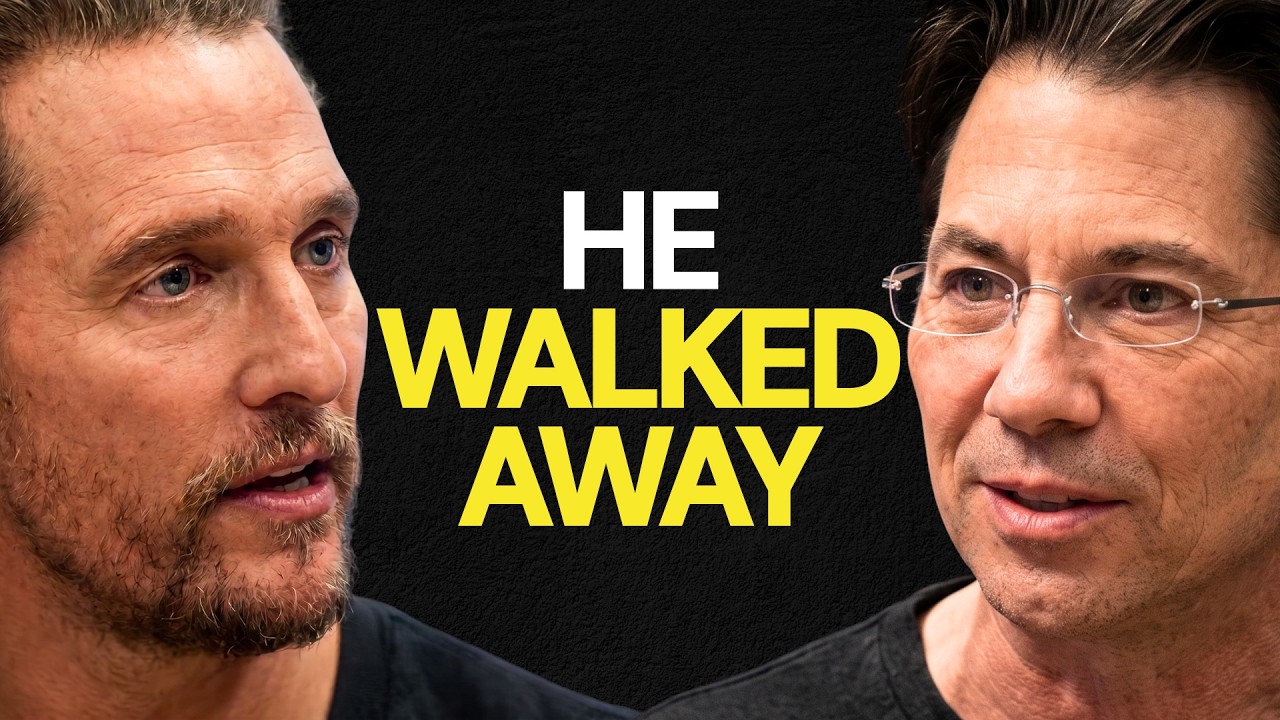
In this interview, Dean Graziosi sits down with actor Matthew McConaughey to explore the pivotal moments that nearly led him to abandon his acting career. McConaughey opens with a vivid anecdote from a 21‑day vision quest in Peru, where he drank a beer on the way to a temple, using the story as a metaphor for balancing pleasure and purpose. He contrasts joy—a process‑oriented, present‑moment experience—with happiness, which he describes as outcome‑driven and fleeting. The conversation moves to mid‑life reflection, noting how social media comparison can obscure personal achievements. McConaughey recounts his deliberate decision to quit romantic comedies, despite lucrative offers, to pursue more meaningful dramatic work. He describes a two‑year hiatus where Hollywood ignored him, during which he considered alternative careers such as coaching, conducting, wildlife guiding, and law school. After steadfastly saying no to repeated rom‑com offers, he finally received dramatic roles (Lincoln Lawyer, Dallas Buyers Club, True Detective, Mud) that aligned with his values. The interview ties these personal turning points to broader themes of decision‑making in uncertain times, especially post‑COVID limbo, emphasizing that making a committed choice—despite fear of failure—creates momentum, reveals supportive relationships, and ultimately leads to growth.
Chapters
My guest today, you've seen him in over 50 movies, some of my favorite of all time. I took from really respecting this guy and loved his work ethic to a whole nother level, and I'm so happy to have him here. Everybody, Matthew McConaughey.
Dean, thanks for having me.
Good to have you here.
Good to be here.
And I meant what I said, it's been fun. You know, sometimes you know the, the actor and you know the person behind, but I get to see, get to peek behind the curtain, and, uh, way more respect when you realize that this is who you are. There's something that I've been laughing over for 2 days is Have a beer on the way to temple. Can we just start there?
It's okay to have a beer on the way to the temple. Thank goodness. That came to me on a walkabout in Peru. I was on a vision quest. It was a 21-day trip where I went to find the Amazon. And I was stripping all the sort of symbols that I had had in my life. I had just gotten famous in Hollywood, so I was going through some very kind of confusing times, a little information overload about what was real and what wasn't. And it was about day 15, and, uh, um, I had been thinking about— I've always gone through times in my life where I abstained from certain things, from celibacy or no, have not having a drink or what have you, even entertainment. And it— they had this, I think it was, I forget the name of the damn beer, but it came in one of those big— it's one of the big bottles, 44-ouncers.
Yeah.
And I had it on a trail, um, uh, walking where I ended up drinking it while I was writing in a journal, and I wrote some of my greatest journal entries in it. And I was that— I don't think I would have written as good of entries if I wouldn't have had that beer right then. And I was like, man, this— the truth is crossing me right now, and this beer's got something to do with that. Thank you. That's right, it's okay. I was shaking a lot of guilt at the time too.
Yeah, yeah.
One of them was like, hey man, it's all right to have a beer on the way to the temple. And I remember writing that down. So that was a line, but yes.
But it's such a great metaphor.
Yeah.
It's such a great metaphor. I love the difference that how you describe joy versus happiness.
Right.
You know, the simple— the process of joy compared to happiness. Yep.
I mean, that's what we all say, right? What do you want to do? I just want to be happy. What can I do? What can I do to be happy? But already those 2 questions, you're saying, what is that thing out there, that outcome, that result that I can get to so therefore I can be happy? And you and I have talked about this. What happens when we do get that thing that we think is going to make us happy? Well, we usually get it and we up the ante right away and we go, oh, well, look, there's 50 more mountains on the other side I want to climb that I didn't see before I got this. So I'm not happy again. I need to get that.
Yeah.
To get happy. Or you do get there and it's kind of like, this isn't as kind of as cool as I thought it was going to be. It's not really fulfilling me like I thought. It's something different than I thought it was going to be. But joy is a different thing because it's not predicated, it's not reliant on that outcome or that result or the attachment or the ownership and capture of that thing. It's, as my pastor says, the process of enjoying the doing of what you're fashioned to do. So that, when I say process, is this— that's life, this living thing. We're going to do it no matter what. We're on our way. And I would also argue this, if we have more joy on the way, We get those things that make us happy more often, I would say.
Yeah.
And again, if we don't get those things, we can all say, well, at least I had a damn good time getting there or trying.
And why I love this difference between happiness and joy, because joy is being in the journey, enjoying it as you're going, not the end result. And I love the fact of we talked about looking in the rearview mirror sometimes so you can see how far you've come. Because a lot of times we're looking, I should be here. Yeah, I made this mountain, but look, I'm not in the best shape. Or I'm in good shape, but I'm not making the money. Right, especially in today's world, we're measured against social media, the fake relationships. I don't want to be negative, but we only see a glimpse on social. So we start comparing. I don't have intimacy. I don't have real love. I don't have the 6-pack abs. And we forget to look in the mirror and say, wow, I've done some amazing things. I've accomplished a lot.
I'd argue that most midlife crises are more about not appreciating where we've been Yeah. Maybe not appreciating, giving respect to what we have done or what we already have built. Again, because we thought they were happiness. Oh, we get there and it's done. It's like, so we don't give them credit. No, we built some— look at the things in our past that we built. And I think in those times where our future is uncertain, that's a great place to look and go, what have I built here already? And I want to give myself respect. Not a big pat on the back, but I'm going to go, hey, good job right there.
A little nudge.
It also defines Well, I know this going forward. I've built some stuff that's non-negotiably going with me.
Yeah.
You know what I mean? So I gotta tend to those things no matter what new horizon I'm chasing or new place I'm going. I got some stuff going with me— my family, my kids, this part of my career— that's not negotiable. So even though I may be uncertain of where I'm going in the future, I got some baggage, I got some luggage that's going with me.
Yeah.
No matter what. And that's giving respect to those things. I think that's where a lot of us get in a Crisis sometimes, even a typical midlife crisis. We don't respect what we've done and what we've built, appreciate where we've been maybe enough. So yeah, I'd, I'd been doing wonderful romantic comedies. I loved doing them. They paid well. They— I enjoyed them. But I was at a time in my life that was extremely vital, vital, and I would say really dramatic in a good way. To fall in love with a woman that was become my wife, who I now have a family with. She was pregnant with our first child. My only dream in my life had always been to be a father, and oh, here it was about to happen, man. I was— I mean, I was laughing harder, crying harder, feeling more rage, feeling more, um, joy.
Yep.
Um, it was just— life was vital. But my work kind of felt like, yeah, kind of do that again. And I wanted my work to challenge the vitality of my life. I do remember this. I did look in the mirror and go, don't you be an arrogant son of a bitch. Be glad that you're feeling like your life's more vital than your work and it's not the other way around.
Exactly.
We've all been there too.
We've been there too, yeah.
But I said, well, can I do some work that could maybe challenge the vitality of my life? And that was the dramas I wanted to do, but Hollywood wasn't offering me those dramas. No matter how big of a pay cut I would say I'd take, they weren't offering them. So I said, well, if I can't do what I want to do, I'm going to quit doing what I've been doing, which was the rom-coms. Packed up, moved to Texas. All right, here we go. Camilla's on board, I'm on board, my agent's on board. We'll show them. You guys know where to find me. But they weren't looking for me. They didn't. They weren't trying to find McConaughey. It was just fine that McConaughey had left town, right? So a few, uh, romantic comedy offers came in early. I was like immediately like, nope, nope, nope, nope. Then nothing started to come in. We get to about six months, no work. I'm still feeling strong, but I'm feeling like, huh, I might have just written my a one-way ticket out of Hollywood. You know, I might need to think about other vocations. I don't know. It's good. A little little off balance. So. Those don't come in. I call my agent between that 6 months and 12 months, and every call he's like, McConaughey, I hadn't heard your name in 2 weeks, 1 month, 2 months. Now I'm kind of persona non grata there for a while.
Yeah.
I'm like, they forgot me. Well, another rom-com comes in. This is like month, I don't know, 16, 18 of no work. It's an $8 million offer. It's a nice-ass offer. I read it. It's not bad. It's rom-com. I say, no, thank you. They come back, $10 million offer. I said, I said no, thank you. They come back with a $12.5 million offer.
Kind of no thank you.
No thank you. They come back with a $14.5 million offer. What did I say? Let me read that thing again. Got a little funny with you.
Yeah, hang on a second.
And I did read it again.
Did it seem funny?
Same script. It was funnier. The same exact words as the first day we got offered, but it was a better written script, right? And, and, and I could see how it might be right for me more so. And, and, uh, um, but I ultimately said no. And that was a big seminal moment, I think, to Hollywood, because that's when Hollywood goes, oh, he's not bluffing.
Yeah.
Oh, it sort of sent like a little trigger through Hollywood. It was like, what's he doing? He's actually committed to his choice. So he's got something— something about it made me more attractive, I think.
Yeah.
To them. And then being 18 months where I hadn't been in the business, it simultaneously was around the time where I'd been gone long enough where I was kind of becoming a novel, possibly good idea.
Yeah.
For one of these dramas that I wanted. And at 20 months, that's when I got the call. And I started, went on that run with Lincoln Lawyer and Kill Joe and Paperboy and True Detective and Mud, and it was Dallas Buyers Club. And I just— everything that I wanted came. And it wouldn't have come, no way it would have come, if I wouldn't have stopped, said no, put myself in the desert, and just unbranded myself. My wife and I had already made the covenant together.
Yeah.
We shared the tears before the decision was ever made. We had long nights. sleepless nights of me going through the grovel of what do I got to do, what do I got to do to make the decision. So she was in with me the whole way, and she was there to support, going, we know we're not going back. She never questioned— like, she questioned less probably than I did of, oh, do we ever go back on this decision? Um, like I said, I had days, a lot of them, where that bottle of what I like to drink was looking better and better earlier and earlier in the day.
Yeah.
The days were getting long, man. I didn't have purpose. I was like, what's my significance? I don't feel significant. What am I doing?
And I think that's so important for people to hear because you would never think that. Matthew McConaughey, you did the Dallas Buyers Club, everything you've done, but no one sees that 2-year window where you, you literally thought of being a coach.
I thought of being a high school football coach. I thought of being an orchestral conductor. I think I thought of a wildlife expedition guide. Thought about going back into law school, possibly.
Wow!
And they were serious considerations because the signal from Hollywood was thanks later. Enjoyed while you're here. You got out of your lane. Should have stayed in it. Too bad.
Why is making a choice not choices? But why is making a choice so important? Making and I know it's an obvious question, but so many important because because I believe there's more people than I wish. watching right now that have been thinking about something for too long.
Well, and, and, and let's, let's revisit what you said earlier about our specific time where we are right now. Yeah, just had 3 big years of COVID man. Talk about uncertainty. That's a disruption that wherever you stood on it and however much you, you, you, you, you quarantined or didn't, it disrupted everybody. You couldn't trust a plan forward, I don't know, more than freaking 48 hours.
True story.
So we were all in limbo. Didn't know what to try. You didn't— the future was not clear for really anybody.
Yeah.
Even if it was for ourselves, you couldn't depend on the rest of the world kind of being in accordance with that to a certain extent.
True story.
So now that we're coming out in this time where, hey, to some extent, I think some dust has settled. The horizon is out there to go on now. Now's the time to start making plans and make choices that we can rely on a little bit more.
True.
The importance of the choice, especially after coming out of 3 years of limbo where we're like, well, I'm kind of stagnant, I don't know which one to— one, to weigh consequences of each choice. But to get back to your point, the choice, sometimes it's just more important to make the damn choice.
That was the whole point.
Commit to it and go forward and find out so you don't find yourself after 3 years of limbo we've been in, 4 years, 5 years, 6 years, a decade of limbo, And you look back and you go, oh, I'm still walking the tightrope.
Yeah.
Why didn't I just jump? Because what happens when we— what happens when we jump and just make a choice? If we fail, it very seldom hurts as much as we thought.
Absolutely. And we don't have any regrets about the choice.
Found out. And all the people that went, na na na na boo boo, you didn't want them being in your life anyway. True story. You know what I mean? So good. We define them, you know. But the people that when you fail after you make a choice that come over and go, hey, man. Me too. I did the same thing. You're like, hey, found a good friend. You found a good soldier. You found a good acquaintance. You found somebody that's on your side. That's the people you want in your life anyway. But you— to go find out, it all— what happens is this. You make a choice. It's the right choice. Not necessarily always because it gives you that outcome of happiness that you wanted, but you got on the path.
And something better came.
And something else got introduced to you because you got in action. It's the inaction of uncertainty that can paralyze us that we gotta watch. Sometimes, man, just make it, find out. And if you don't, forgive yourself. And guess what?
Keep moving.
The world will too.









