Finding Genius: Delian Asparouhov, co-founder of Varda Industries & investor with Founders Fund
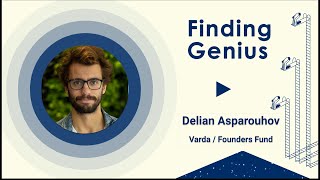
Delian Asparouhov, co-founder of Varda Space Industries and investor at Founders Fund, talks about building orbital factories. The company aims to manufacture materials in space that can't be made on Earth, exploiting microgravity to create products with properties impossible under normal gravity.
Good afternoon everyone. Welcome back to the Finding Genius video series. I'm here with Delian. Delian's a principal with Founders Fund, but more importantly a co founder of Varda Space Industries, which we'll be spending more time talking about today. Dillian, thanks for joining us.
Thanks for having me on and excited to chat about Varda today.
So could you go before we get into Varda, talk a bit more about your background. I know you're from Bulgaria, you went to mit, you had a health tech startup before this were at Khosla. So you've been around for a while. Could you go into some of that and just tell us a bit more about how you landed at Founders Fund?
Yeah, so yeah, grew up in a very Eastern European Bulgarian household. Both my parents have PhDs. Ended up like growing up on Caltech's campus since that's where they Both did their PhD. I'd say I always thought that I was going to be kind of an academic type. I thought I was going to do math at first, but realized that I wanted to do something better than my dad did and he was an IMO gold medalist and so I didn't feel like I could quite reach that as a mathematician. So I decided to get to the world of sort of robotics hardware space and so thought that I was going to eventually just become the sort of academic equivalent of my dad. But in the space world I work at JPL and then freshman year at mit, ended up sort of taking a hard left turn, started to discover the world of startups, entrepreneurship. Ended up doing an internship at Square back in summer of 2012. That was the sort of summer between my freshman and sophomore year. I ended up just totally falling in love and realized that I needed to get out to Silicon Valley basically as fast as possible, possible. And so ended up being friends, roommates with a guy that was friends with the Thiel Fellow and sort of learned about that program. And so I applied for the Thiel Fellowship the winter of basically my sophomore year and ended up basically dropping out after my sophomore year at MIT to basically start working at my company. Got the Thiel Fellowship, ended up running that company for about three and a half, four years. We did it okay. Not amazing. Like, you know, I think got to like our peak month was around like 15k mrr. Roughly there.
Before you go into that, what did you write in your fellowship application to get in?
It was, you know, back then it was a little bit more of like fun to the person rather than like fun to the like, you know, company or idea, basically. So, you know, I kind of pitched them on just like, hey, I'm Delian, here's like kind of my background. And then like, you know, I want to do something in the world of like healthcare plus startups. And like, here are a couple of different ideas that I have at the time. Like, the idea was more around like medication adherence and reminders around that and trying to create some like, you know, some smart hardware around that. But a lot of it was just like, hey, I work at Square. I know how startups work. Here are the connections that I've made. I'm excited to drop out. I'm dropping out either way and so I think you guys should be along for the ride. And so that was kind of it. And I had a kind of funny presentation in front of the whole like, you sort of get invited out for this interview weekend and you do a presentation in front of all the like previous Thiel fellows. And you know, a handful of the Thiel fellows, including some that now run sort of large unicorn companies that I'm since friends with came up to me afterwards and said, said like, hey, that was like a fucking terrible presentation. You're not a Thiel fellow. But it turns out they ended up being wrong. So it turned out to get the Thiel fellowship and friends with some of those guys. But yeah, it was definitely. That interview process has changed a lot since I did it and it was definitely a little crazy.
Nice.
Nice.
So, sorry. So you were working on the company?
Yeah, so I ended up dropping out. We started working on this company. We ended up pivoting sort of from like medication adherence to being this kind of like autism therapy EMR workflow tool. So we sort of sold to small clinics that say, you know, three to five clinicians, you know, 35 to 50 patients. We ended up sort of, you know, going through Y Combinator, raising like a $600,000 seed round, you know, building out sort of a team. We, you know, got to kind of like ramen profitability, you know, enough to pay for almost like me and my co founders, like sort of rented salaries and stuff, but like, sort of wasn't enough to really like go off and like raise series A, you know, have a whole long tale about sort of all the things that I did wrong as a, you know, 19 and 20 year old MIT dropout trying to sell into like enterprise healthcare systems. Turns out like not the perfect sort of skill set and personality fit for that problem, but a lot of ways that I would have done it differently now. And I think I could do it much more successfully now. But yeah, after about three and a half, four years of that, I was kind of getting a little bit burnt out. The company was kind of flatlining and so I ended up joining this company, Teespring as the VP of Growth. The way that I sort of got hooked into that was Keith Rabbois who had been a COO at Square when I was there, when I was an intern, had then convinced him to angel invest in my company, was on the board of Teespring. And so as I started debating what to do next after the company, he kind of convinced me like, hey, here's a great opportunity of like, you know, Teespring at the time was sort of a Titanic. Like they'd gone from sort of the hottest company in Silicon Valley to you know, just consistently declining revenues and you know, quickly running out of Runway. And so was invited to, you know, come in to partake as a part of like kind of the rescue crew. And so because that, you know, a 22 year old sort of failed one time founder, you know, got the title of like, you know, VP of Growth, you know, while I was there and so was there for about a year, was ready to kind of start a company again. Had a couple of different ideas. One of them was around the sort of cybersecurity insurance space that I kind of debated doing with the now founders of New Front Insurance, Spike and Gordon. They ended up, you know, wanting to go do something like New Front. And I wasn't maybe as enthusiastic about that. I was pretty focused on this like cybersecurity insurance idea. And so as that sort of founding team kind of fell apart, I went to Keith and I was like, hey, like what do you think I should do? Who should I co found this with? And he ended up sort of convincing me that I should instead come work with him at Coastal Ventures for a year and use that as a way to sort of learn a little bit about venture, maybe do a little bit kind of EIR type program, start a company, you know, and would have a much sort of better launch off point, you know, from there as opposed to like trying to do it entirely on my own. And so I was like, that sounds interesting. And yeah, I ended up, you know, maybe six or seven months in, kind of getting hooked into the world of retro. Just kind of realizing like my personality and sort of skill sets and attributes were much better fit for being an investor than they were for being a founder. You know, super add, intellectually curious, like jumping all over the place, context, switching as an investor, those are all huge pros. As a founder, those are all huge cons. And so I tend to believe in like, just lean into your strengths rather than like trying to mitigate, let's say, your weaknesses. And then, you know, most importantly, this eventually kind of leads to Varda. Realized that I could have a much shorter term or shorter timeframe impact on the commercial space industry. I used to think that like in order to work in space, you had to become rich in normal tech and then you could work on space stuff versus in sort of month six or seven at Coastal Ventures. I ended up like meeting this commercial space company at Koch Systems that just sort of Ganon diamond satellite radios, bringing them to Vinod. Vinod being excited enough that he wanted to invest and actually helping basically lead that seed round. And so I sort of had this aha moment where I was like, damn, I can be better at investing than I can at being a founder. And then also I can now do the space stuff, which is what I've always wanted to do in the long term and now I can do it today. And so I tend to in sort of shortcutting to whatever you'd like to do in your career earlier rather than later. And so yeah, started to get to know the world of the world of commercial space investing and over the course of the following four years ended up switching over to Founders Fund mostly because Keith was getting recruited by Peter Thiel to sort of leave the early stage arm. And Keith was like, hey, I really like working with this guy Delian. If you want to recruit me, you got to bring him along as a package deal. Little do the Founders Fund guys know what they're getting themselves into, but I think it's turned out, turned out okay so far and have continued to sort of focus on commercial space since then. You know, I've led a handful of, you know, rounds, you know, doubled down on a cautious homes here from Founders Fund. More recently did this small sample propulsion company called MagDrive. And then obviously most importantly, you know, sort of incubating, co founding, you know, Varda as a part of that and you know, thankful, you know, that's part of the, you know, thesis or excitement around joining Founders Fund originally was we like to do incubations here and especially in these sort of like deep tech areas. And so was excited. That was partially why I was excited to join, was to eventually have the opportunity to do something like Varda.
And you recruited Will. I don't know if I'm pronouncing his last name correctly. Brui, to be the CEO of Varda. Could you talk a little bit about Founders Fund's interactions with SpaceX and how you were able to recruit him and why him to lead that operation for the company?
Yeah, yeah. Founders Fund is one of the earliest backers of Space X. I believe one of the largest shareholders even continued to be extremely bullish on SpaceX, especially with the progress of Starlink. So Will had actually already left, decided to leave Space X several years ago with some of his sort of own entrepreneurial ambitions. He started a sort of aerospace consulting shop, is kind of how to describe it. And then after that actually briefly went back to SpaceX and then left again to actually go ahead into finance and try to learn about what he called the quote unquote business world. And so, yeah, definitely bullish enough on SpaceX that we're not trying to rip people from there since we're very happy with our investment and bullish on the company. But Will was already starting to think about how to leave the world of finance and actually now finally start the startup. And that was sort of always his long term goal. He was going to do some stuff that was actually unrelated to space. He was just going to apply his engineering skills. But thankfully I had a fraternity brother, very luckily that was my same year at MIT that ended up going straight to SpaceX out of school in 2015 and then since then has really done a phenomenal job there, has sort of risen through the ranks. He actually now works in the Starship project and reports to the VP of Starship. So he's like sort of skip level to Elon on Elon's most important project. Like get yelled at by Elon on a weekly basis. My favorite question that he relayed to me recently was Elon Eskim, if there was a bomb strapped to your head that no matter what was going to explode in six months if Starship isn't in orbit, what decisions would you make differently? And so, you know, I like it when you kind of hear those kind of inside stories of like how Elon really likes to push his engineers. But anyway, so I thankfully like very luckily had this fraternity brother that has extremely high credibility within SpaceX because of the work that he's done. And so I kind of went to him and I was like, hey, I know you're a badass. Introduce me to a badass that can be the CEO of this company that I want to start and I'm not going to be able to find them on my own. Like I can't go as a VC and be like, I need a technical co founder for this company. It's just like that'd be sort of doomed to fail. And so I made sure to start with him and then yeah, he basically introduced me to Will. We met like last week of August. I think it's now, you know, roughly day 161, 162. And so we've gone pretty quickly from literally, you know, cold email introduction straight to founding a company. But yeah, thankfully sort of got along maybe a lot better than expected and you know, they just both, you know, think really similarly, let's say about the world, but actually a very sort of different skill sets, personalities and et cetera that actually like mesh together pretty well.
I mean it sounds like you have a pretty technical background too. So what, what sort of skills were you trying to supplement by bringing in Will?
Yeah, I am a former like, you know, yeah, I'm a former engineer but like, you know, I haven't like built the Dragon. Like you know, Will's, Will's on like, you know, I'm competent enough to be able to speak engineering with founders that I talk to and I've like built like websites and like sure some embedded software stuff and some like small robotics and things like that. But like, you know, the level of complexity for that is like, for sure way more technical than most like let's say VCs or how even most people in Silicon Valley that are even like software engineers but you know, let's say your average PM at Google who's completely non technical. The delta of like that to me is the same level of delta from me to like Will, let's say. Right. He was the lead hardware engineer on the crew Dragon. He was head of mission control for eight of the cargo ISS missions. So not only has he built the spacecraft, but he's flown the spacecraft and dealt with the intensities of like, you know, you know, mission failure at mission control. So yeah, just you know, extreme technical depth both on the actual design construction of spacecraft, but the actual like technical operations of a spacecraft which is in some ways like just as complicated as the actual design process. So yeah, extreme sort of, you know, extremely deep technical background in sort of building an operating spacecraft. And it was going to be critical for something like Varda where like, you know, space factories are in some ways an even more complicated spacecraft than you know, Dragon. In other ways there's easier because there's no humans on board. But I realized that basically as you know, somebody in the, for the CEO position, I wanted somebody that sort of had been at SpaceX and specifically on Dragon in particular, because we have a sort of re entry problem that we're trying to solve. And you know, the Dragon is basically the only commercial reentry vehicle that's ever been built. And so, you know, it felt like sort of the natural group to go after, to find somebody who had left that group, ideally had left SpaceX and had entrepreneurial ambitions and yeah, will literally perfectly, perfectly fit that. So I did not think when I first started off in July, kind of, I remember talking to my girlfriend being like, you know, I'm thinking about like doing this thing. I would need these. Like, you know, I need the CEO that has this background and a chief scientist that has this background. But like my ability to pull that off is very unlikely. These are gonna be like long, long conversations. There's just like no way that I pull this off in any year timeframe. And then all of a sudden by like, you know, mid September, I felt like I was like staring down the like barrel of a shotgun where I was like, oh shit, like I found them. And so I have to like, now I got to go do it. Like I can't not do it now that I found them.
Can you talk? So before we get into a little bit, I spent the last few weeks reading about Varda and it's fascinating, but can you talk a bit more about the ambitious vision of what Varda actually is and where the name comes from?
Yeah, you know, the, the way this all came about, which is like a decade ago, seeing a couple of companies like launch and research projects that sort of showed the promise for a variety of different, like high value materials that had benefit from being manufactured outside of a gravity field.
Like what would be an example of that?
Let's, let's get back to that a little bit later. And then like, let me, let me talk a little bit more about like these sort of like let's say ambitions of art and the naming. Once I sort of realized that there were these materials, the analogy that always sort of like stuck with me. And the thing that is like really captivated in my mind over the past decade is thinking about how did California, or let's say, how even did San Francisco become San Francisco? It wasn't through like the government, you know, subsidizing Lewis and Clark Expeditions or the defense industry paying for those. It was through the Gold rush and that the sort of low Earth orbit manufacturing sort of feeling like that gold Rush where you could actually much more quickly expand humanity's reach. Into the stars by focusing on orbital manufacturing and establishing that supply chain. Because the scale that that could get to on the order of like, let's say if Varda works, we could have something that's 10, 100 times larger than the International Space Station, Regularly manufacturing things up there and bringing them back down. Having something like that operating and commercially viable just allows for scale of exploration into the stars. That's much more viable than just trying to go directly there today. Right? There's a reason why the, let's say defense industry has never been able to like, you know, build an RFP for like something like an iPhone versus the commercial industry, because there's just such massive scale and continuous innovation around it. Eventually get something that, you know, back in, you know, whatever, you know, 2005 would have cost like, you know, $100 billion to have something like this. Right. And so by sort of focusing on the commercialization of space, that actually significantly enables and makes everything so much more cheaper, you know, in terms of. In terms of exploration. And then the actual sort of name, you know, behind Varda sort of originally came from. I'm not necessarily a huge Lord of the Rings fan myself, but every founders fund incubated company so far has been a Lord of the Rings reference with, you know, Palantir being the like. I think it's like all seeing Eye, Andral being like the sword. And then Varda is named after an elvish queen that was known for basically making the stars in the sky from the morning dew. So manufacturing stars, manufacturing in space, you know, relatively similar ambitions. And then in terms of types of materials, there's a wide array of materials. Anything to do with high value, lightweight materials, where you need to control crystals, whether they exist or the shape of the crystals in the material matters a lot. That can be everything from, you know, semiconductors, that can be cancer drugs, that can be fiber optic cables. There are a ton of different sort of material applications. The physics of it that's maybe easiest to understand that isn't necessarily one of those that I just mentioned is around sort of human organ 3D printing. The reason it's sort of valuable to be outside of the gravity field is like really easy to understand in this particular use case, because the way that these types of organs get printed and these are very sort of like, let's say complex shapes with very thin walls. As you can imagine. If you start to do that on Earth, instead of gravity field, as you start to sort of print up, right. The way the 3D printing works is you go around and build it layer by layer. And as you get like halfway up the layer of a wall, gravity effectively starts making those very thin walls flop over. And typically what we do in metal 3D printing is you try and build structures underneath to hold up those walls and you cut those out. But it's really hard to do that with natural tissue versus imagine doing that sort of same physical process outside of gravity field. As you start to print up those very thin walls, there's no gravity, there's nothing affecting it, so there's no flopping over. You can very easily sort of constrain something and hold it in a very particular shape because there's just no forces being enacted on it. And so the way that you kind of think about Varda is like we're a factory where the laws of physics are in our factory are completely different than every other factory on Earth. Right. Every manufacturing process on Earth today is designed and predicated upon operating inside of a gravity field. And for some, sometimes it's beneficial. Right. You want the ball to roll down the hill. Helpful. But sometimes we just want the ball to stay down at the top of the hill, irrespective of how the hill tilts. You know, it's helpful to be outside of a gravity field.
And what does the day to day at Varda currently look like in order to make that more a reality? Like what are the building blocks that need to happen in order for that to exist?
Yeah, thankfully there's been a lot of the like, science that has been already sort of proven on the International Space Station over the past decade in terms of the viability of these materials. However, the International Space Station and NASA are not commercial organizations. Right. NASA's explicit, you know, goal is to further the research of space, not further the commercialization of space. And so they have no interest in turning the ISS into like a large scale factory, nor is it like particularly well designed for that. And by the way, for most, you know, factories, you want them to just be fully automated and have no humans on board since like engineering for humans in space is a much more complicated problem than engineering just for a factory in space. And so what we're primarily focused on is thinking about sort of how, what it, what is the infrastructure, supply chain logistics that are necessary, you know, for orbital manufacturing. And so that has everything to do with the actual, you know, spacecraft and factory that goes up there. How do the materials move about and then how do you actually return those high value materials back down to Earth and then eventually pick them up all those various, you know, aspects of the supply chain is like, what we're effectively working on day to day in Varda is, you know, sort of testing those out on the ground and then, you know, starting to also test those in sort of microgravity environments here on Earth, for example, with like, the vomit comet, where you can at least these sort of brief periods of microgravity testing to, you know, ensure those systems. And then eventually it's basically, you know, sending up a sort of mvp, you know, space factory.
And what would be the benefit for companies in telecommunications or pharmaceuticals? You just mentioned, like, 3D printing. But how do they benefit from these microgravity environments?
Yeah, at the end of the day, some of these are, you know, materials that just aren't available to be done on Earth whatsoever. So for example, with like, you know, a human heart, it's just like right now we're entirely limited on, you know, the supply of human hearts from, you know, organ donors, from, you know, car crashes and things like that. And so the benefit there is just like significantly increasing, you know, the supply of human hearts, that the, you know, waiting lists for an artificial heart go from, you know, nine months down to effectively, you know, a day or two as you're just waiting for the production of your heart in space to come back down to Earth. For example, the telecommunications and the fiber optic cables, it just comes down to. It's just a cheaper dollar per bit. You know, the sort of quality of the cables you can make in space is far better than you can on Earth. And that just means cheaper Internet for semiconductors. It's just, you know, higher yield.
Is that all because of this micro gravity environment?
Exactly, yeah. So the thing that sometimes I think people don't realize is, like, the reason that you're manufacturing in space isn't for the vacuum. We can very easily simulate a vacuum down here on Earth. Right? You can literally just use a pump and pump out the air and you can create yourself a vacuum chamber. However, I could give, you know, Elon Musk, Mark Zuckerberg, and Bill Gates like, $5 trillion each and the next two decades if I wanted. And I just would tell each of them, like, hey, I need you to make it so that, like, when I drop this phone, it doesn't hit this desk right here. There's just zero chance. We are nowhere even close to being able to manipulate gravity fields. And so the only way to remove yourself from a gravity field is to go into orbit. And so there's just basically a lot of processes and manufacturing processes that benefit from the Lack of gravity. And the only place where we can have no gravity is in space right now for sure. Maybe one day we'll be able to control gravity and great, we'll move all those, all that zero gravity manufacturing back down here on Earth. But if we're manipulating gravity fields, like, you know, we'll have warp drives and wormholes and stuff like that. So we're a ways away. The other way to think about it is like we just discovered gravity waves, right? Like we just for the first time observe gravity. That's like basically going to the caveman that just saw fire for the first time and telling them, hey, like you now need to manufacture lasers because like you need to not only, you know, observe photons, but you now need to control them. Like we're roughly there, right? We just saw photons for the first time and now we have to like, you know, manipulate them and we're, we have no, we have no, nobody even knows how one would do that.
And beyond that, do you intend on sourcing materials as well? From I was reading the post from the asteroid mining and building infrastructure for that. Is that something that your team intends to do?
If we succeed, we will be by far the most natural sort of company to pursue that, you know, type of material gathering or to partner with right now. If one were to bring an asteroid from space into orbit above Earth, even if had a very high value materials, we'd have no fucking clue what to do with it. Like what are you gonna do? Like one, you can't break it down and just deorbit it. You're just gonna, you know, crash and create like literally an asteroid, like you know, crash site and like potentially destroy a lot of life on Earth? Or it's like, what are you gonna do? Like strap a dragon to it and then like have some astronauts go out with like some, you know, shovels and picks? Like we wouldn't even know what to do with asteroid materials right now, even if they were in orbit above Earth right now. Even if we had plane, platinum, zinc, water, etc. Up there, nobody would know what to do with it. However, if you have something that's like 10 times the sky, the size of the ISS, you know, orbiting Earth and regularly consuming materials, we're pretty incentivized to figure out like what's the cheapest way for us to get raw materials, including you know, water, rare Earth to, etc. And so we're going to be highly incentivized to like, rather than constantly sending it up from like the, you know, Very expensive, you know, deep gravity well that Earth is in to instead bring that from outside of the gravity well, like from an asteroid. And then we'll be much more highly incentivized to go after that. And so whether it's like lunar ice mining, whether it's asteroid mining, all this stuff is like much more commercially viable. This is why I talk about the way to accelerate humanity's path into the stars is by focusing on step by step, near term commercialization and supply supply chains. If we establish the low Earth orbit factories, then it makes lunar ice mining and asteroid mining much more viable. And so now VCs can invest in that versus if you try to go straight to Ashley Mining. It just doesn't make any sense. Like what would one even do with an asteroid right now? Nobody would have any idea what to do. There's no customers for that, right? Or if you pitch me on lunar ice mining, I'm like, even if you had the lunar ice mine set up and you had water there, who's paying you? There's nobody there. Like NASA's not there, like nobody's ready for that. Versus like at some point, if I've got my factory running, I'd be like, yeah man, railgun me some water from the moon straight to my factory, like super into that.
I think what a lot of folks don't realize, which I realized while doing the reading up on this, is that there are larger pharmaceuticals that have been experimenting with this as well. So Merck and other companies have done work in the space. What sort of foundation have others set up for you to build upon? Or how much of it is just building right from scratch? I mean, I know SpaceX is making it cheaper to get into orbit, but the actual building, the infrastructure piece of it.
Yeah, I mean, for sure, you know, SpaceX is a huge contributor to this, but in terms of the underlying science of the materials that have benefit from microgravity, there's been a lot of research that's been done on the iss, you know, including, you know, let's say cancer drugs. That wasn't one that for example, I touched on earlier. But like, the benefit for cancer drugs is you can specify the way that a particular chemical reaction happens in a much more controlled fashion in microgravity because you basically don't have any entropy or molecules moving around too much. There's no convection or sedimentation or anything like that. Right. Like imagine you have some set of molecules and some are heavier than others on Earth. Like the heavier ones fall, right? Or you know, the other Classic example is like, hot air rises in space. There's no. There's no hot air rising or heavier things falling. There's no gravity. So hot air just stays in place because why would it rise versus why would it fall? Right. It just disperses kind of evenly. And so these types of chemical processes are much more easy to control, which can lead to basically much more potent, higher yields, much more effective, basically cancer, you know, drug production as an example. There's a lot of foundation across a wide variety of materials where the science has gotten to a decent level of provability. But there's still work to go from like a science project on the International Space Station that looks, you know, cool to like, hey, Pfizer needs like, you know, 10,000 gallons of this drug, you know, delivered every single, you know, year. Those are, you know, wildly, you know, sort of, sort of wildly different scales of problems. And so it's great that we have the like fundamental, let's say, science foundation built upon such that we can describe that to investors and show them why there's not. There's signs of significantly de risk, but there's still like real sort of engineering that goes into bringing that stuff to market at scale.
So talk to me about, I guess, your vision to investors. I mean, this is one of those moonshot ideas that returns a couple of funds over. But if how do you convince them on the vision that this is possible, which is, which it seems like you're doing, but even the longer term commercial viability and how much money it will take for them to get there and how many years, how do you draw out that vision for them?
Yeah, I mean, you know, my favorite terms here are from, you know, Josh Wolf at Lux, where like, you know, his whole thesis, like, look, darling, in seven years there are going to be a wide variety of materials that are manufactured in orbit. That's just not even a question. Like, all the trend lines point towards it. Launch costs have gotten cheaper. These materials clearly have viability. These materials are extremely valuable to people here on Earth. And so there's going to be extreme commercial incentive to be bringing things to market. Like whether it's you, somebody's going to be doing this. Therefore, if you start doing this now, it's almost certainly going to be you that's bringing all those things to market. Because there's a lot of expertise beyond just each individual material that just goes into understanding how to do microgravity manufacturing and supply chain and logistics of that. And the way that we sort of pitch Varda and the vision of that is like we're the contract manufacturer for space where ideally we're going to build in house, you know, expertise for the first handful of materials that we're bringing to market. But over time we'd ideally like to partner and form JVs or you know, partner with external organizations that have more expertise in cancer drugs or you know, human heart organs or you know, carbon nanotubes and instead just act as a contract manufacturer where we work with them jointly on a manufacturing process. And typically with a lot of these manufacturing and supply chains, it's not like every step needs to happen in microgravity. Typically there's some pre processing of the material, then it's delivered to us. We do one very particular step in microgravity and then we send it back to that ideally partner. And so ideally where there's a lot of the supply chain for some of these, including let's say cancer drugs. Like I have no interest in Varda having to like get FDA clearance. What I'd much prefer to do is like work with Pfizer and say Pfizer, you're going to deal with the design of the drug and you're going to deal obviously with like the, you know, go to market and like you know, getting, you know, FDA approval, et cetera. We're just going to focus on that one particular step where like, you know, space has a ton of benefit and we're just going to be the like space contract manufacturer that everybody goes to. And so that's kind of the vision. Thankfully in some ways this is actually like much less capital intensive than a lot of the deep tech projects that have been started over the past like five to six years. Whether it's you know, batteries, solar panels, self driving cars, you know, all those sort of needing, you know, north of a billion of dollars of capex and R and D before you even like start to think about revenue, you know, we're much more on the order of like, you know, 100 to 200 million dollars before we can actually get to the point of actually potentially having significant revenues. So this isn't some sort of crazy farther thing that needs tons and tons of capital, you know, sort of to become commercially viable. And at that point, the moment that we start to prove out, hey, the space factory works here, these materials that we're producing, this is also like very, you know, fundable by debt. It's just like here's this vehicle, like you know, this is now like a capital equipment purchase. Much more so than it is like you know, true R and D and so this very rapidly, I think becomes actually quite, you know, efficient on the.
Equity dollars and what other talent is will looking for at the moment to keep building this out? Whereas does that talent not exist right now? How much more do you need?
Yeah, I mean this is, you know, thankfully we don't need like a thousand person team to go after this like one would have like a decade ago. But for sure there's a lot of just different engineering problems that we're going after that just need, you know, raw horsepower. You know, mechanical engineers, electrical engineers, more material scientists. At some point, as we start to expand beyond our first handful of materials, we'll want sort of like a, you know, synthetic biologist that can start to think about the sort of, you know, drug production and you know, human organ production in space. But that one's like further out. Most of like this stuff right now is just kind of traditional sort of like spacecraft engineers, mission operations, you know, supply chain purchasing finance. In some ways, like, our company actually looks like quite similar to like the, you know, underlying, let's say, talent of like Planet Labs for example, or, yeah, SpaceX. In some ways a lot of the engineering problems that we're solving are actually quite, quite similar. It's just with a very different lens and market approach.
Last question, because I know we're up in time, but what in seven years from now, which is Josh's prediction of when this is working and operational and all the work you guys are doing? What does that world look like when you have this infrastructure built and you are transporting materials and the products back and forth? What else is going on in that ecosystem? What are the other opportunities that some of the founders are building that you're also funding? A founders fund?
Yeah. The other things that I constantly think about is just what does that low Earth orbit economy look like beyond just manufacturing? Whether it's basically like gas stations, supply depots that are in orbit. It's a lot cheaper and easier to just send up one super large basically gas depot and then have microsatellites, you know, dock in with that, refuel, then dock back out. There are like the space taxis that I'm super excited about where it's, you know, rather than having each individual satellite have to have significant propulsion to move itself around, you basically have like space tugs that are much larger that you could dock with, you can dock with and then maybe transport you to the gas station and transport you back to, you know, your station keeping area in orbit. Yeah, I think once you have a factory that's the size of, you know, the ISS or 10 times larger at that point. It's also much easier to think about sort of super cheap sort of space tourism. Like the idea of building a space hotel today, quite infeasible. The idea of like building a space hotel is just like one wing of our space factory actually quite doable. And so, you know, I think space tourism gets a lot easier. What's like if you have, you know, you know, flights going up and down every like week that are doing thousands and thousands of kilograms of resupplying fuel and things like that, then it's a lot easier to imagine like tacking on a couple, you know, a couple humans as well. So I think yeah, there's a ton that gets built out. But you have to start with this like, you know, initial commercial use case. And the way that I sometimes think about Varda is like Florida is doing stuff in space, but it's doing it for Earth, right? Like we're not going to space just for sake of like building stuff in space because like there's not that many people up there. It's not a big market yet.
Right.
We're building stuff in space for being your back down on Earth. But then that's what makes the actual space ecosystem bigger in a bigger market. Such that eventually again, whether it's the low Earth orbit economy, like the sort of gas stations like the taxis, which I think are much more near term viable, and then further out eventually the lunar ice mining, the, you know, asteroid mining, that type of stuff, you know, becomes viable as well. And so yeah, we're operating space but for sake of improving quality of life here on Earth. Since improving the quality of life here on Earth is a much larger market than doing anything in space.
Right. Dalian, thank you so much. I appreciate this, it was really interesting.
Thanks for having me. Kunal, excited to always chat about Vardo with anybody that is interested. Great.
More from Delian



Vinod Khosla & Delian Asparouhov | Venture and Valor: Building the Future from Silicon to Steel


Delian Asparouhov & Nadia Asparouhova on building a relationship, family, and legacy



Delian Asparouhov: Inside the Walls of Founders Fund: What the World Does Not See | E1183


Varda's Landing, Peter Thiel, & the Future of El Segundo, Delian Asparouhov, Founders Fund
