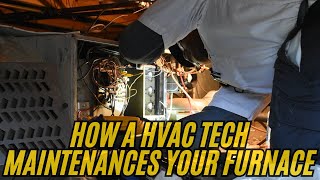
An HVAC technician walks through furnace maintenance on a propane system in a crawl space. He checks gas pressure (reading 11 in. H₂O), inspects for hazards, and documents problems: a dirty blower wheel, rusted heat exchanger, high amp draw on the inducer motor, and a defective condensate pump. He emphasizes taking photos and labeling parts for the next technician.
Chapters
See what am I dealing with. Okay, it's not too bad. Opens up as you get under there, so it's not too bad. I think in this case I probably gonna start from the inside out since you got the furnace running. I turn it on on the inside so I can check it while the system is running. So I'm gonna start at the furnace and work my way back outside. Okay, one of the key important things when you go into a crawl space is check your surroundings above anything else. Safety. You never know what you're walking into. So I always try to spend a couple seconds just to observe, to make sure I'm clear, there's no dangers I'm going into. Yeah, pretty much just checking for any burn marks or any burnt wires. Anything loose, anything stand out? 5, 5.2, let's go. So I like to put a writing on it. Sometime if it was there, it will save me the problem of taking it off so the next tech that come along can't see what it's supposed to be because it's always covered up, and I save you one step. So typically, I just like to put it there. Basically, all I'm doing is getting set up to check the gas pressure on the system to make sure we have a perfect combustion. So each maintenance, we make sure, verify if we have natural gas or propane. In this case, we have propane. You see that propane tank in the back of the yard. So basically, you have to look on the data plate inside the system, and once you fire the furnace up, you check to ensure to make sure you have the right gas pressure coming in, and then adjust to make sure you have the right pressure going to the burner to create the perfect combustion. That way, you know, the system burns right and you have good fuel efficiency on the system. The blower wheel is extremely dirty, so we got to document that and get pictures. As you can tell, I do not in no circumstances like crawl spaces. I don't know who does, but I haven't met the tech so far that like a crawl space. And also by checking the combustion at the same time, we're able to check the the gas shutoff valve to make sure it's working. Once I put on my gauges on this, zero my scale, sit for a couple, a minute, you determine if your pressure changed, then you know if your shutoff valve is working, yes or no. So that's another step in the process of, you know, doing a proper maintenance and checking the system thoroughly. Safety is of utmost importance. So we verified no leak from the shutoff valve, so now release the gas pressure and, and verify my incoming pressure to the system. My data plate recommend 11.5 to 13. I'm dead on at 11 coming in, so I'm where I'm supposed to be as far as incoming pressure. Basically what I'm doing at this point is the thermostat may have been satisfied on the inside, so the furnace is not turning on. So what I'm basically doing is, you know, overriding and doing the process of the thermostat. So I'm closing the circuit for the heat side of it to get the furnace to start, so that way I can check the fuel pressure and the combustion on it. So, blow. Amp draw was 4.5. Yeah, flame sensor is dirty. Blower wheel is dirty. Induce a motor. High-end draw. And the coil, heavy rust. And our condensation pump, defective. All right, so we covered Gas pressure is okay, diesel motor switch is okay, flame sensor is dirty, capacitor was okay. Alright, pretty much covers up inside here.