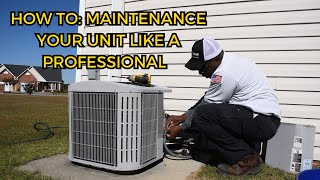
Three HVAC technicians walk through a complete maintenance routine: checking for leaks and electrical safety, verifying compressor specs against online ratings, cleaning condenser coils (different methods for Carrier vs. Goodman units), and clearing the condensate drain with a vacuum and nitrogen tank.
Chapters
Typically, before you start your cleaning, it's always a good idea to check for signs of refrigerant leak, which typically is oil residue, maybe on the pipe, on the coil. So it's a good practice to observe, to do a visual check of the system, pretty much. Of course, check for ants. Yep, so I always like to check my shredders. Sometimes if they're showing signs of leak, you will still see oil residue inside the cap.
Sometimes so.
It's a good practice to check, check for loose connections, just to make sure your wire nuts are good, nothing is frayed, loose. Your power wire coming in on your circuit, just to check to make sure it's nice and tight. Inspect your contact. Yeah, this one a little bit pitted. Let me take a picture of that so I can document it.
So the cap is slightly low. Supposed to be 35, I'm hitting 29, and the fan is supposed to be 5, I'm hitting 4.5.
She got a bird wire in there. Just noticed that too. Did not see that before.
What are you checking for now?
Checking for the amp draw. So what we do to determine the, the condition the compressor and the fan is in, we take what is called startup amp draw and a running amp draw to determine the stress load and the life expectancy of the compressor and the condenser fan itself. So there's a data plate that always comes on this. In this case, the data plate is all burnt and missing, so there's no information for us to go by. So typically, when I can't find information, I have to turn to good old Google, try to find, um, the information on this particular system. Fortunately, someone here wrote the model and serial number, so it kind of gives me a base to go by. Because without this, you're pretty much lost as to, you know, what's the— what you can use to determine the specs of the system itself. So having the model and serial number, now I can go online and try to pull up to see what my starting amp, my running amp of my compressor and my condenser fan is supposed to be, and to verify that the capacitor is the right size, because an older system that has been repaired multiple times, you'll find that, you know, a technician would be out and don't have the correct size capacitor, but just put one on it that will work to get by. So we have to verify to make sure that, okay, it was the right size capacitor to begin with. So pretty much now I got to go online now to see if I can find some information as far as the, the data that I need to compare my reading to.
It's a 12-sear system. Startup amp is supposed to be 58. I was getting 46, so it's on the higher side. Blower motor is 1.5. I was getting 0.7, so that's okay.
And I covered that.
So, compressor start up 46, max supposed to be 53. My condenser fan supposed to be 1 0.5, are we getting 0.75? So we know that was good.
So typically, next thing is to pretty much just button it up and clean my condenser coil. Now, on most systems, we need to remove— this is called the hail guard— so you can expose the coil itself. But typically, in most Carrier brand system, um, it's just these rebars, which it doesn't make a big— any point of removing these because you can actually get to clean the coil through these. So I typically don't remove these on a Carrier unit, but a typical one that we always do, which is Goodman, those you have to remove the hail guard to get access to the coil to clean it properly, basically. Not a reason for dust in this section, but this section is supposed to stay dry. Um, you actually can't apply any water to the electronics here, so we kind of do what is called a dry cleaning for this section, get rid of any excess dust and dirt that may be collected inside here. Basically, it's honestly the way I normally perform the cleaning on a condenser, I do it the other way around. Typically what I normally do is pretty much shut the power off, clean the condenser coil. Once I clean the condenser coil and apply my shine on the outside to protect the paint, then I open the panel and test my component. Now in order to check for your compressor reading and your condenser fan reading, you have to turn your disconnect switch at that point on. So at that point, I have no reason to turn it back off. So that will guarantee that I will not forget to turn it on, basically. So that's normally my due process of ensuring that I don't leave it off. One of the most critical components of doing the maintenance, especially in the summer, but like right now it's not such a big deal. In this case it is though, is to clear your condensation drain. Now because this particular customer have a furnace and an AC on the outside, Now typically at this point we're going to the winter and she's just using straight furnace, so there won't be any condensation being formed. Now was there— if it was a 90% furnace, then yes, they were still having condensation coming out. But in this case, she's an 80% furnace, so typically there's no condensation that would be produced from the condensation line from here on out. But what I did anyway, just to make sure that once the summer come around and they start using the HVAC system, the drain is cleared. When I perform my cleaning on the indoor unit, I poured some additional cleaner inside the drain line so I can be able to flush it and put a vacuum to make sure the drain stays clean, pretty much. So at this point, I'm just going to go ahead and just check and just pull a vacuum on the condensation drain line, pretty much. Now sometimes they don't make it easy on us, like in this case. They have this with the elbow turning down, you can't put your vacuum, you can't put stuff on it. So I keep my little setup with me, that way I can get a little bit of access so I can put a vacuum on it. Now in the summer, it is a case of when I check the unit on the upstairs, I had noticed that there was a lot of sludge and, you know, dirt and stuff collecting in the drain. I typically would have used what we call is a sludge sucker. So this device that I use, and I would hook it up to my nitrogen tank, and this creates a much stronger suction to clear the drain than, uh, a vacuum pump would, um, pretty much. But in this case, I know I just inspect the drain line upstairs, it was, um, pretty clear, and I know she's not using any, um, AC right now, so there's no condensation. It was bone dry, um, but like I said, there's some in there, so that's why I'm pretty much using my vacuum at this point.
Here we go.
Don't forget, turn it back on. That's key. Where my tool? Typically I let the system kind of dry off and then to finish up we spray some protective coating on it just to protect the paint a little bit. Pretty much that concludes the cleaning of that condenser. All right, just got to make my report and go sit and talk with the customer.