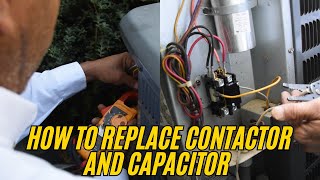
In this instructional video, the technician walks through diagnosing a malfunctioning HVAC condenser unit and performing the necessary repairs. He first inspects the disconnect panel, noting loose wires and a severely clogged condenser coil, which raises discharge temperature and forces the compressor to draw higher amperage, accelerating wear on dual capacitors. He measures the start capacitor’s microfarad value, finding it well below its 45 µF rating (around 36‑38 µF), confirming the need for replacement. He also checks the fan motor current, comparing the measured 0.92 A to the 1.5 A name‑plate rating and finds it acceptable. The technician then examines the contactor, showing heavily pitted, blackened contacts that can cause loss of continuity or a stuck‑on condition, further stressing the system. He explains the impact of these faults on compressor start‑up and overall efficiency. Finally, he demonstrates the step‑by‑step removal and replacement of the faulty capacitor and pitted contactor, emphasizing proper disconnect safety, correct wiring (common, start, fan), and the importance of verifying readings after reassembly. The video underscores that routine maintenance—cleaning the coil and replacing worn components—can restore optimal performance and prevent premature failures.
Chapters
Contacts. When I was talking about pitted, if you look down here between your points right here, you see how black that is? It wouldn't have been long for— well, we know it hadn't had a maintenance in a while. First thing I'm going to do, open up my disconnect. You'll have powered it for a minute. Take a look up in your disconnect very carefully. Give your wires a nice little tug. Make sure they're tight. Go ahead and pull our panel off. If you notice that this coil on this backside is completely clogged. And if you remember me telling you earlier, the discharge is a little warmer than what it needs to be, you know, with the ambient temperature the way it is outside this this morning. And if we look right here in this condenser coil, that thing is completely clogged. And that's— that'll cause high amp draws on our compressor, cause dual capacitors to go out sooner than what they need to be, cause them to work harder in the start and in running. Pressure can't breathe. We got our panel off, so what we're going to do, check our capacitor rating. Let's see where we at. It's a 45F5. I'm going to pull two legs off. I'll pull my fan leg off. Cut my hernia though, or start. Little snuck some time. We should be reading 45 right here, or in that area. 36. So that capacitor needs to be replaced. So 36, we'll check the fan side, 4.5, and it should be 5. But on this capacitor Push or minus 5%. Contacts are pitted. You notice right here, those are pretty old contacts, pitted out. Capacitor, contactor. Let's check this capacitor start amp. Check our amps on our fan. 0.92. On the data plate, it always tells you ratings on your compressor, your condenser fan motor, other operating motors that might be on the unit. That's 1.5. We're good on that motor too. The unit could run a whole lot better though, just by just a maintenance. But we're going to verify the charge on it here in just a minute. Let it run in air conditioner mode for a few more minutes and we'll check the temperatures. Oh, this— we'll change this capacitor. Um, what was it, reading 38 a few minutes ago, should be reading 45. Help the compressor back where it needs to be as far as starting-wise. A few minutes ago we discussed the contactor being pitted, so we'll go ahead and change those as well. Same way, uh, start or herms, the common Common and our fan. Pop it right back in here. Be nice if we put our readings so we can see them, uh, not backwards. You have to actually take the capacitor all the way out just to check the readings on it. I try to make sure as much as possible to turn it out so the tech can see the readings on the thermostat. One shunt contactor, one pole, pole and a half. Flathead screwdriver out of here. And once we get this contact off, I can show you better as far as it being pitted. Contacts, most of them are pitted. If you look down here between your points right here, you see how black that is? It wouldn't have been long for either the contacts wouldn't made any continuity or they'd have just stayed stuck in the whole time causing the condenser to run even though the unit's not calling, causing it to freeze up, stuff like that.