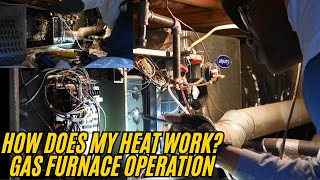
The video provides a detailed walkthrough of a gas furnace’s internal components and their operational sequence. It starts with the control board, which acts as the furnace’s brain, coordinating the blower motor, inducer motor, gas valve, and safety devices based on thermostat signals. The capacitor assists the blower motor, which moves air through a swirl cage. The gas valve controls fuel flow, while the inducer motor creates negative pressure and triggers a vacuum pressure switch to confirm exhaust clearance. A glow igniter then sparks, allowing the gas valve to open and create flame, which is monitored by a flame sensor. If flame is absent, the system shuts down and logs a fault. Once the heat exchanger reaches temperature, a temperature control switch activates the blower to distribute heat. Additional safety devices include a rollout switch that detects heat leaks from a cracked heat exchanger, preventing carbon monoxide release. The video also mentions downstream components such as the evaporator coil, condensate pump for high‑efficiency units, and the low‑voltage transformer that powers control circuitry and safety interlocks, including the door switch that disables the furnace when the access panel is removed.
Chapters
So basically, this is the furnace control board. So the control board, this is the brain of the blower itself. So the control board dictates— once the thermostat sends a signal to tell it what to do, it tells the blower motor to run. It will tell the inducer motor, which is on this side, to operate. It tells the gas valve when to open. It, you know, gets signal from the flame sensor. So this basically is the brain of the blower itself. Next to the control board is called a capacitor. This capacitor is what actually assists the blower motor to run and maintain the speed that it needs to maintain to operate, to move the airflow through the system, basically. Now, the blower motor is in this box, which is called a swirl cage. So the blower motor is connected to a spiral or a swirl case. That's what, when it spins, it propels and moves the air through the system. So it pulls from one end and pushes through the other end. And as you go over, this component is the gas valve. So this is what controls the flow of the fuel as it goes in to create the combustion in the heat exchanger. This is a shutoff, so as the gas gas flows in. This is a safety— this interrupts the flow of the gas whether you want it yes or no. If you got to service the gas valve, you have to be able to isolate the fuel from the system itself. As you move over, this is the inducer motor. What the inducer motor does— whenever you have a furnace and the furnace turns on, calls for heat, the inducer motor is the first component in the line of creating a combustion. The inducer motor kicks on, it creates what is called a negative pressure inside because it's pulling through the airflow from the heat exchange and blowing out the exhaust flute. What that does, it actually tells the system, okay, the exhaust flute is cleared and I'm okay to to start the combustion process. And the way it can tell the control board that that's what's going on, once the inducer motor turns on, it creates a negative pressure and pulls in this device, which is called a vacuum pressure switch. So once it's pulled into a negative pressure, this switch gets closed. And once the switch is closed, now the control board knows that, okay, my fluid pipe is cleared, I'm not blocked, so I'm okay to start the process of creating the combustion, the flame inside. Once it knows, the control board gets the signal that, okay, all is clear, my flute is clear, it sends a signal to what is called this device, which I don't know if you can see in here. This is called a glow igniter. So once the igniter starts glowing or sparking, that's what creates the spark. So the ignition igniter glows Once it glows, it tells the board, okay, I have spark or I'm glowing. And once the board, the control board, realizes, okay, yes, I'm getting the spark or I'm getting the glow, it sends a signal and turns the gas valve on. Once the gas valve turns on, it releases the fuel, which once it gets in contact with the glow or the spark, creates the flame. Once the flame starts and the furnace is burning, we have what is called a flame sensor. That's— it's always located at the last point of the heat exchange, so where the gas comes in, and it makes sure that all the flue points to the heat exchanges have flame burning to all the ports. The flame sensor detects the flame. Once it detects the flame, it tells the control board, okay, yes, I have flame, so you can keep the valve open, you can keep the, the process going, and the process just pretty much continues at that point. Now, if for some reason, um, one of the orifices blocked up or the burners had a crossover that wasn't, um, completely cleared and the flame didn't make it all the way to the end, the flame sensor would not detect a flame, and in that sense, it would activate, I say, the shutdown and tell the control that, okay, something is not right, and the control pretty much would shut the process down. And then you would get a trouble code, and obviously a tech would have to come out and figure out why that was not the case. Once you have full flame, the burners are going, we have what is called a temperature control switch that's attached to the blower motor. And it's attached to the heat exchange. Once the heat exchange heats up to a certain point and it knows, okay, I'm hot enough, it sends a signal for the blower motor to start operating. And the blower motor starts and starts pushing the heat off the heat exchange into the home. And that pretty much completes the process of, you know, the heat cycle. Now there is another few components that plays I would say they operate in the background, but they're there as safety, which is called the rollout switch. The rollout switch is always placed just outside of the burners. Now, should there be a crack or rust or, you know, a break into the heat exchange, once the blow motor is pushing that air across the heat exchange, it will create a pathway for that airflow to go into the heat exchange and push the flame out. And at that point, the rollout switch would detect that, okay, the heat is coming this way. The temperature on the rollout switch would raise, which would trigger the rollout switch, which triggers safety, and in that sense would shut the system down because now you're creating a unsafe situation wherein if there's a crack on the heat exchange, it can release carbon monoxide inside the home, which ultimately is fatal. Um, is there any another safety on this one? I think that's pretty much it as far as, um, safety on the outside. And of course, this is a furnace AC setup, so usually have the evaporator coil downstream from the furnace, which is facing that way going into the home. And the evap coil— beside the evap coil, you have the condensation pump, which in cases where you have like a 90% furnace, it uses a condensation because you have a second layer of heat exchange which condensate. So it produces condensation even in the winter. So it would drain into a condensation pump, which ultimately would, you know, pump the condensate water from out the crawl space. Low voltage. So the high voltage comes in, which is the 240 volts or 115 volts in the case of a furnace, to operate like the thermostats and most other components like the solenoid valve that's inside the gas valve. They use low voltage to operate them, so This is a transformer. It reduces the 240 volts down to 24 volts, which ultimately operates all the lower-volt components inside this. All the safeties, gas valve, pressure switch, low voltage is what passes through all of these. So when one of these gets triggered, it triggers and shuts the system off, which ultimately shuts off the thermostat, because the thermostat operates from low voltage also, not high voltage. So that's what, once you put the door back on, it presses the switch in, which actually starts the furnace itself. So it's designed that should the door fall off or you take the door off, it breaks the power to the system and shuts the system down. So it's there for a reason.