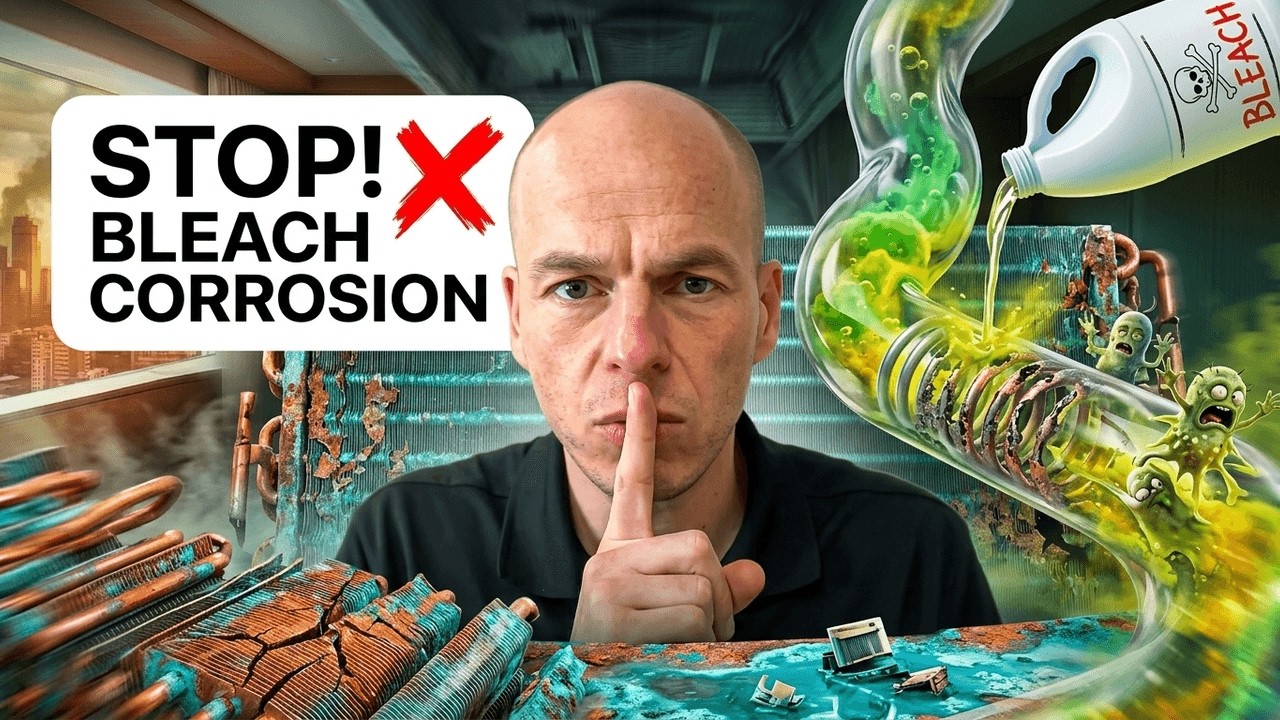
In this video, HVAC professional Derek Cole reacts to a demonstration where a technician (Speaker B) attempts to clean an indoor air‑handler coil by spraying household bleach. Derek explains how an air‑handler coil works—removing heat, causing condensation that drips into a drain pan and then out through a narrow drain line. He stresses that any residue on the coil is simply "growth" until laboratory‑tested, warning that labeling it as "mold" can cause unnecessary alarm. Derek outlines the health and equipment risks of introducing harsh chemicals like bleach into the airstream: aerosolized bleach can be inhaled, may damage components, and requires extensive protective gear, indicating the method is unsafe. He offers safer alternatives, such as EPA‑registered pan treatments and natural cleaning methods, and notes that proper maintenance (filter changes, ensuring clear drain lines) prevents buildup. The video juxtaposes the demonstrator’s bleach‑spray procedure—using a bottle, mask, goggles, turning the fan on while the AC is off, and waiting for the bleach smell to dissipate—with Derek’s clear admonition not to repeat this practice. The overall message is a cautionary guide to HVAC coil cleaning, emphasizing correct terminology, health safety, and recommended non‑toxic cleaning approaches.
Chapters
When it comes to your home, your air, everything, your family is very important. You breathe the air in your home and it's controlled by your HVAC system. So be very careful about what you spray in it and how you treat it because it could be way too harsh. Check this out.
If you ever wake up with a sore throat or the kids are having allergies or you may be having allergies during the summer and you got the air conditioner running a lot, it could have something to do with mold or mildew within your air conditioning system. It's very easy to clean. It doesn't take any time at all. The easiest thing to do is find your return where the air is being sucked in, and this is where, this is where the main part of the bacteria happens, and I'll show you why. Just take this off, and then if you look in there, this is where you're gonna—
He's in what we call an apartment-style situation where The air handler is in the home, uh, through the walls, in the wall. Most split systems in traditional setups are in the attic or crawl space, and the return duct is going to the split unit. So you're not going to see that coil sitting right there like it is right here.
I'm going to change your filter, so you may be familiar with it. Go ahead and pull the filter out. Once you pull the filter out, if you look in here, this is the actual coils, and this is where condensation happens and it gets wet. And there'll be— there's actually a tray inside here, and this is— it gets wet all in here, and it usually has like a little standing water. There's a drain hole at the bottom.
He's right, because you're trying to remove heat. AC is about removing heat, not adding cold air. So that coil is going to be cold, that air is going to be warm. You're going to have condensation, it's going to drip down. So whatever's on that coil, if things are, uh, growth or dirty, that's going to drip down to the drain pan. If those items can't get through the 3/4-inch drain line, it's going to clog it and then it's going to back up the water, which is a problem. We handle it here quite often with a pan treatment. What that does is actually sits in that pan so then when that water hits it, it breaks down with EPA-registered chemical that makes it break down that product so when it gets to the drain line, it can flow better.
Right down here, if that drain hole gets clogged up with lint and debris, It can— the water can even be even more standing water and it'll just stay in there and eventually it'll mildew and it could get mold in there. And all these coils can also get mold.
We don't say mold, we say growth, because until it's tested, the things are tested, you don't know exactly what it is. So saying the buzzword of mold is typically a problem because you You know, scares people, freaks them out, and you don't want to do that because right now it's growth. Now we can send it off to a lab, get it tested, and see what it is and what type of growth it is. But from here on out, we see growth.
In here over time. So the easiest thing to do is go out and get you some bleach, and this is just regular bleach you buy. You could buy it at Walmart or Target. Or any of your stores that you shop at. And then if you have a bottle, I have an old Glass Plus bottle, and just fill it up with the bleach. And then what we're going to do is we're going to spray all this. We're going to spray this down and then we're going to leave. So if you want to, you can, you know, you could wear a mask or eye goggles and some gloves. Normally I just try to hold my breath and—
Okay, we don't want to do do that. Uh, eyegoggles, hold your breath, be careful, gloves— these are things you don't want to be spraying in your house because you're breathing it. If you have to have that much protective gear to spray your coil, that is getting into your airstream. You are going to be breathing it in, so you don't want To do that. Stop introducing harsh chemicals into your home. You can handle this stuff a number of different ways, natural ways, better ways, that's not as toxic as bleach would be.
And spray it in there and try to stay away from it because, yeah, you don't want to get this in your eyes and you don't want to breathe it.
So, yes. I agree, you don't want to breathe it. Point exactly, you don't want to breathe it. What's going to happen when you spray the coils? It is now going to be in the airstream. You're going to breathe it.
Once we get it sprayed down, we'll turn on the fan and then leave and come back and see how it looks. Once you have the coil sprayed down with the bleach, simply turn on the fan. You'll see on your air conditioner controller. It should just have a fan, and you put the fan on, and then you can turn off the air conditioner. See where it says off on— and yours may be different, but you just want to make sure that the air conditioner is off and the fan is on. If you have the air conditioner on, what will happen is the condensation will wash all the bleach away, and it won't have a chance to work. And so, we'll go ahead and leave for the day, and come back, and we should be fresh and clean. All right, uh, just got back from work and the air has been gone.
See what I was saying? That air handler's in, um, in the home there, uh, what we call apartment style, which is right there in the wall in the home.
And it's very clean in there, looks a lot better, smells good, smells fresh and clean in the house. The bleach smell is gone, so we're gonna go ahead and put it back on AC and should be able to sleep and not Well, the bleach smell shouldn't have even been there.
Um, again, do not recommend this. Do not spray bleach on your HVAC system. You do not want to have this stuff on your equipment. You do not want to breathe that stuff. If you have growth, there are a number of ways it can be handled, and you can handle it naturally and not spray harsh chemicals into your own