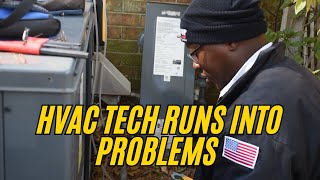
Derek Cole and a technician troubleshoot a furnace that randomly shuts down and needs manual resets. They verify gas pressures, test the blower motor, inducer motor, vacuum switch, and flame sensor, all normal. With no fault codes and every component checking out, they can't pinpoint the problem and plan to return when the furnace actually fails.
Chapters
The gas pressure on the data plate, it tells you it's supposed to be natural gas, should be 3.5.
Right there.
This will be 10 going in, 3.5 going out. This was 3.9. 1.4.
This I'm getting, okay, it's okay. 1.3, so that's not a problem. That's where it's supposed to be.
My blower getting 1.8, maybe 3.9.
That's okay. This is the port, the inlet and outlet port for the gas valve. That's where you used to check the pressure that's coming in and the pressure that's going out to the burners. Spot oil on every maintenance or demand call on a furnace that uses gas, we have to check the, the gas pressure to ensure you got, you know, proper combustion. So the incoming and outgoing, you match it to the data plate to make sure you have the correct pressure going into the system. And going out to the burners. So the issue I'm having with this particular system, it appeared to be an intermittent issue. So the customer explained twice, it just went out, they reset it and it restart, and once they restart, it works. So basically what we can do at this point is cover all the safety components as far as the furnace. So the blower motor, which I check to make sure the blower motor is running, got good amp draw, good airflow. If the blower is not moving enough cold air over the heat exchange, it's going to cause a thermal overload to trip. That can cause it to cut out. So I verify that the blower motor is working fine. Check to make sure I got, I got good amp draw on the inducer motor. The inducer motor is what moves the airflow through the heat exchange to make sure you get good combustion going through the, the burners. Had good amp draw on the inducer motor, no problem there. Where the switch that it activate, the vacuum switch to tell the furnace that my vent is clear, the switch closed, no issues there. Once the burner's lit, I check the incoming pressure, outgoing pressure. No, it was slightly higher, so I adjusted it to the manufacturer's spec. Once I got combustion and flame lit, I got good ignition and the flame sensor picked it up and the flame kept on burning. There was no code on the board to tell me that there was an existing issue or any fault on it. So at this point, I'm kind of like covering all the bases, so we're kind of back to square one. I'm not sure why— what's creating the intermittent issue. Now, there could be a component that's failing. We don't believe in part swapping, so if I cannot narrow down what exactly the issue is, unfortunately we have to just revisit it if whatever is intermittent decide to stay off without, you know, when the customer reset it. That way we can find the issue that's going on. So I'm just going to continue. I just completed checking over the furnace side. I got to make a quick check over the AC side, which they don't need AC now, but once again, once we're here, we always cover all the essential components on the system to make sure that while we're here, it was tested. Pretty much. And this is one of the most frustrating part, you know, in the tech world, is when you go on site and you can't— all the components is doing what they're supposed to do. It's hard to pinpoint where the problems really lies.
I mean, everything checks out fine. Flame lit. Yep, everything here seemed to be in order. Just gotta go inside and see if I got good airflow, see what's going on. But system-wise, can't find any issues out here.