Is Your Heat Pump Broken After the Storm? Ice, Steam, Aux Heat Explained | Deep Dive Ep 678
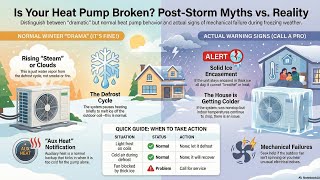
Heat pumps move heat rather than generate it, and after snowstorms they build ice on the outdoor coil, triggering a defrost cycle that produces steam many mistake for smoke. Auxiliary heat works like 4-wheel drive, but emergency heat bypasses the efficient cycle and can spike your electric bill. Watch for thick ice that won't melt, nonstop running, or burning smells as signs you need a service call.
Chapters
Okay, let's just—
Yeah, but you want to take a deep breath?
A collective one.
It is today, Monday, February 2nd, 2026. And if you're listening to this, first of all, congratulations. You survived the storm.
You made it through the snowpocalypse or, you know, whatever the local news was calling it. It's officially behind us.
It's funny how fast that feeling changes, isn't it?
Oh, completely. Yesterday was all survival mode. And today, well, the sun is out. Roads are clearing up.
And we all pretend we didn't just buy 50 loaves of bread.
Exactly.
So you're sitting there, you've got your coffee, you're feeling pretty good about things, looking out the window at all that, you know, sparkling snow. And yeah, then you look into the backyard and you see the monster. You see the monster, specifically that big metal box next to your house, your heat pump. And it is acting weird.
Weird is a very polite way to put it. Post-storm heat pumps can be incredibly dramatic.
They really are.
Yeah.
Maybe it's making a noise that sounds like a, I don't know, a dying robot. Or it looks like an igloo.
Or, and this is the one that really gets me, maybe it looks like it's on fire.
The dreaded smoke signal. Yeah, that'll ruin a peaceful morning real fast.
It does. You go from, I survived the winter to great, now I have to buy a $10,000 HVAC system because mine just exploded.
And that is a panic you do not need on a Monday morning, which is exactly why we're doing this deep dive today.
Right.
Because that panic It's almost always unnecessary.
So to talk us all off the ledge, we are looking at a really timely piece from Derek Cole. There's a blog post titled Why Your Heat Pump Is Steaming, Icing Up, or Running Nonstop After a Snowstorm and When to Worry.
And we should probably clarify who Derek Cole is because there's a lot of, let's say, bad advice on the internet.
Oh yeah. Forums where people tell you to pour boiling water on your electronics.
Yeah, please don't do that. You know?
Yeah.
Derek Cole is the general manager of Simmons One Hour Heating and Air. He's been in the industry for over 2 decades.
He's a Top 40 Under 40 winner. He's been on CBS, FOX, NBC, Bloomberg Business. I mean, the guy is a heavyweight.
He understands the physics of the machine. Yeah. And that's what we need today. We need to distinguish between, you know, scary but normal behavior and actually broken behavior.
Drama versus death.
Exactly.
So let's start with the basics, because I think a lot of the panic comes from just a fundamental misunderstanding. Of what that box outside is even doing.
Right.
Cole makes this huge distinction right at the start between a furnace and a heat pump.
Yeah.
And honestly, even I get them mixed up sometimes.
It's the foundational concept you have to grasp. If you have a furnace, you are a creator of heat.
Okay.
You've got a fuel source, gas, oil, whatever, and you're literally lighting it on fire. It's caveman physics. Fire hot, house warm.
Simple.
A heat pump is completely different. It doesn't create heat, it moves it.
It's a transport system.
It's a heat transport system. Exactly.
Okay. But pause right there because this is where I, and I'm guessing a lot of listeners, get stuck. Mm-hmm. It's what, 20 degrees outside right now?
Mm-hmm.
It's freezing. So if the heat pump's job is to move heat from outside to inside, how is it doing that? There's no heat out there to steal.
See, that is the intuitive trap. Our bodies feel 20 degrees and we think, absence of heat.
Right. Cold.
But in thermodynamics, cold is relative. I mean, unless you are at absolute zero, which is like -460°F, there is thermal energy in the air.
So even in a blizzard, there are little heat molecules just floating around.
Tons of them. Think of the outside air like a giant— a giant wet sponge.
The sponge.
Even if that sponge feels dry to you, if you have a powerful enough machine to really squeeze it, I mean, really crank it down, you can get water out of it.
And the heat pump is the squeezer.
It's the squeezer. And the water in this analogy is heat. The heat pump uses this chemical fluid refrigerant, which has these really unique properties. Okay. It circulates through that coil outside and it's designed to boil, to turn from a liquid to a gas at incredibly low temperatures. So even at 20 degrees, that cold air is warm enough to make the refrigerant boil and absorb that energy.
Okay. So it absorbs the sparse heat. But 20-degree heat isn't going to warm my living room.
No, no. That's where the compressor comes in. That's the pump part of the name. It takes that gas, which has absorbed all that heat energy, and it compresses it. It squeezes it down under super high pressure.
And when you increase the pressure of a gas, the temperature—
It gets incredibly hot. It concentrates the heat. So you take all that scattered low-level heat from the sponge outside, squeeze it into a concentrated hot gas, and then pump that inside to warm your air.
That is actually kind of a miracle.
It really is an engineering marvel.
It's scavenging for heat scraps in the yard. Yeah. Bundling them up and shipping them aside.
Right. But because it's interacting directly with the outside air, it's not tucked away in a basement like a furnace. It has to deal with the weather.
Ah.
And Cole points out that post-storm weather is the trifecta of doom for these machines.
Freezing, wet, and windy.
Exactly. So you've got this metal coil outside that's trying to absorb heat. That means the coil itself has to be colder than the air around it to pick up that energy.
So if it's 20 degrees outside, the coil might be what, 10 degrees?
Or zero. Now add moisture, snow is melting, the air is humid. What happens when moist air hits a zero-degree piece of metal?
Instant ice.
Instant ice. So the first thing Cole wants people to know is that seeing frost on your unit isn't a malfunction. It's actually proof that the machine is working.
It's absorbing heat so aggressively that the moisture around it is just freezing solid.
Exactly. So if you look out and you see that, you know, frosted donut look, just a light white coating on the coils, mm-hmm, you should not call the repair guy.
No, that is business as usual. Put the phone down.
Right.
But there has to be a limit. There's gotta be a difference between a frosted donut and like an iceberg.
Oh, huge difference. Mm-hmm. And we'll definitely get to the bad ice later, but normally the machine knows it's getting icy. It has sensors. And this leads us to the number 1 freakout moment for homeowners.
The smoke.
The smoke.
The smoke signal. I've had this happen. You glance outside and you see these white billows coming out of the top of the unit, and your brain immediately goes to electrical fire.
It's the most alarming visual you can have with an appliance.
I mean, in any other context, smoke coming from a machine means turn it off and run away.
Correct. But Cole is really, really adamant here. That is not smoke.
It's steam.
It is water vapor. And to understand why it's steaming, we have to talk about the defrost cycle. This is basically how the machine cleans itself.
Okay, so unpack the defrost cycle for me.
Right.
What is actually happening inside that box?
So the sensors on the coil detect ice buildup. The computer says, okay, airflow is getting blocked. I need to melt this. So it pauses the heating function for your house.
Mm-hmm.
And then, and this is the part that blows people's minds, It reverses its flow.
Reverses its flow? Like it runs backward?
The refrigerant cycle reverses. For just a few minutes, your heat pump switches modes and becomes, well, an air conditioner.
Wait, it turns into an AC unit? In the middle of winter?
Yes. Think about what an AC does. It moves heat from inside your house to the outside, right?
Right. It takes heat out of the living room and dumps it in the yard.
Exactly. So during the defrost cycle, it grabs some heat, mostly from the compressor, and sends it specifically to that outdoor coil. It turns the outdoor coil into a hot plate to melt the ice.
So it's heating the outside to save itself.
Precisely. Now picture this. You have a metal coil that's suddenly hot, maybe 100 degrees or more. It's covered in ice, and it's sitting in 20-degree air.
You're gonna get a massive cloud of steam.
You get a fog bank. And because it's usually windy after a storm, that steam gets whipped around in swirls, and to the untrained eye, it looks exactly like smoke from a fire.
That is terrifying if you don't know the physics behind it.
It is. And usually the fan on top of the unit shuts off during this process to let the heat build up. So the steam just kind of hangs there.
Is there a way to be sure? Because if I see that, I'm still going to be a little nervous. Is there, like, a smell test?
That's the best litmus test. If you're scared, put on your coat, go outside. If it's a fire, it will smell like fire-burning plastic, that acrid smoke smell. But if it's the defrost cycle, it won't smell like anything. Maybe just wet sidewalk.
Just damp air.
Just damp, warm air. If it smells like nothing, let it ride. It's just taking a hot shower. Okay.
That is a huge relief. But this whole reversing thing— that explains the other complaint Cole mentions. And this one is sneaky because you feel it before you see it.
The cold shoulder.
Yeah. You're inside watching TV, and suddenly you feel a draft. You go check the vent, and the air coming out isn't hot; it's lukewarm. Or sometimes it feels straight-up cold.
And your first thought is, "Great, the furnace died." Exactly.
I'm paying for heat, why are you blowing cold air on me?
And it connects right back to that defrost cycle. Remember I said it switches to AC mode to heat up the outdoor coil?
Right, it's robbing Peter to pay Paul.
That's the perfect analogy. It is temporarily diverting the heat budget to melt the ice outside. So for those, you know, 10 or 15 minutes, it isn't sending that intense heat into your living room.
It might even be pulling a tiny bit of heat from the return air to help.
It can, yeah. So the cool breeze is the price of admission for the system not freezing itself into a solid block of ice.
A short-term sacrifice for a long-term gain.
Correct. It gives you 10 minutes of air to make sure you have 10 hours of hot air.
So if I feel cool air, I shouldn't go bang on the thermostat or crank it up to 80?
No. Step away from the thermostat. Patience is key. Cole says a typical defrost cycle lasts anywhere from 5 to 15 minutes. Once the ice is gone, you'll usually hear a loud whoosh. That's the valve reversing, the fan kicks back on, and the hot air returns.
So just wait it out.
Just wait it out.
Speaking of the thermostat, though, we have to talk about the little light, the one that strikes fear into the heart of every budget-conscious homeowner. Oh, heat.
Ah, yes. The auxiliary heat indicator. Or sometimes it's just a different color light on the thermostat.
When I see that light, I just visualize a cash register sound. Cha-ching! I assume it means my main system has failed and I'm running on some super expensive backup.
It definitely costs more, but it doesn't mean failure. Cole uses this brilliant analogy that really clicked for me. Four-wheel drive.
Okay, I'm listening.
So your heat pump, the main unit outside, is your standard driving mode. It's efficient, smooth, gets good gas mileage. It handles 95% of your driving conditions.
Right.
But then you hit a steep, muddy hill or a huge snowdrift. The standard engine struggles. It can't get enough traction. So what do you do?
You engage 4WD.
You engage 4WD for that extra push. That is O-Heat. When it's 15 degrees outside, your heat pump is working its tail off, but the heat leaking from your house is happening so fast that the pump might not be able to keep the house at 72 degrees on its own.
It's losing the battle against the cold.
It's losing the battle. So the thermostat senses the temperature drop and it clicks on the O-Heat. This usually turns on electric resistance strips inside your air handler. Think of them like the glowing coils inside a giant toaster.
They use a lot of juice.
A lot of energy, but they generate instant hot heat heat, they just bridge the gap. So seeing O-Heat pop on and off during a really cold morning is totally expected. It's just the 4WD kicking in to get you up the hill.
So O-Heat is the system being smart, it's automatic. But then there's the other setting, the one you can manually select— emergency heat.
The E-Heat setting.
I have to admit, when I'm cold and the house feels drafty, I have this strong urge to just switch it to emergency heat. It sounds powerful, like maximum overdrive.
I get it. It feels like you're telling the system, "Stop messing around and get me warm now." Exactly. And that is the wallet trap that Cole warns about. It is the single most expensive mistake you can make during a winter storm.
Why? What is it actually doing?
When you switch to emergency heat, you are overriding the system's brain. You're telling it, "Kill the outdoor unit." You're completely shutting off the heat pump. Completely.
Yeah.
The efficient scavenger outside, the sponge squeezer, it just stops working. And you force the system to run 100% on those electric toaster coils.
The expensive ones.
The very expensive ones. I mean, think about efficiency. A heat pump can give you 3 or 4 units of heat for every 1 unit of electricity it buys. It leverages physics. Resistance heat, the emergency strip, is a 1-to-1 ratio. You are paying top dollar for every single degree of warmth.
It's like trying to heat your entire house with a space heater.
That's a perfect way to put it. You'll be warm, sure, but your electric bill at the end of the month will be absolutely eye-watering.
So when should you actually use it? Is there ever a valid time for emergency heat?
Only in an actual emergency. And CAL defines that very clearly. The outdoor unit is physically broken.
Broken how?
Like a giant tree branch fell and crushed the fan, or it's a solid block of ice that hasn't melted in 2 days. If the outdoor machine physically cannot or should not run, then you switch to emergency heat.
Just to keep the pipes from freezing until the tech can get there.
Exactly. It's a lifeboat. You use it to keep your family safe until help arrives. You don't use it just because you're impatient.
Okay. That's a huge takeaway. If the van outside is spinning, keep your fingers off the emergency switch.
Trust the machine.
So we've covered the scary but normal stuff. Steam, cool air, oh heat, all normal. But Cole also gives us a checklist of red flags. Yeah. Because sometimes things actually are broken.
Right. We don't wanna be so chill that we ignore a real problem and ruin the equipment.
So what's the first thing that warrants a phone call?
It goes back to the ice. We talked about the frosted donut, but if your unit is encased in thick ice, I mean a solid block where you can't even see the fins and it never clears, that's a problem.
That means the defrost cycle isn't triggering.
Exactly. Could be a bad sensor, a bad board, a bad valve. If it stays in igloo all day, it's choking, it can't breathe, and it will eventually burn out the compressor trying.
What about the fan?
If the unit is making noise, you hear that deep electrical hum from the compressor, but the fan blade on top isn't moving, that's a red flag. The fan has to move air across the coil. If it's stuck, pressure builds up to dangerous levels.
Okay. And what about noises? You mentioned the dying robot sound.
Yeah, heat pumps are naturally louder in winter, and that whoosh of the defrost is fine. But we're talking about metal on metal, screeching, grinding, anything that sounds like rocks in a blender.
This seems like common sense.
It does. But people sometimes think, oh, maybe it's just ice hitting the fan. If it's loud and violent, shut it off.
Now, I assume any kind of burning wire smell.
Oh, absolutely. If you smell that electrical hot scent either inside or near the unit, that's an immediate shut it down.
There's one more scenario Cole mentions that I found really interesting. The nonstop runner.
This one is subtle. In extreme cold, a heat pump will run most of the time. But if the system is running 24/7, it literally never pauses. And the temperature in your house keeps dropping.
Wow, it's running a marathon but moving backward?
Exactly. It means it's lost the ability to keep up completely. Could be a refrigerant leak, a bad compressor valve. But if it's running all day and you're shivering, don't just put on another sweater. Call a pro.
And the philosophy here is that prevention is way cheaper than replacement.
Always fixing a bad sensor is a few hundred bucks. Replacing a compressor because you let it run while it was frozen solid, that's thousands or it's a whole new unit.
So let's zoom out. We've gone through the thermodynamics, the steam, the money traps. But I think there's a bigger picture here about how we relate to these machines in our homes.
Definitely.
Before reading this, I looked at my HVAC unit as this, you know, invisible appliance. I just want it to work. I don't want to know how. It's magic.
We want to live in a bubble. We want 72 degrees and sunny inside, regardless of whether it's a blizzard or a heat wave outside.
But the heat pump kind of breaks that illusion because it forces you to acknowledge the weather.
It does. The heat pump is the bridge. It's physically out there in the elements. It's not hiding in the basement. It's wrestling with the wind and the snow and the ice. It's stealing heat from a hostile environment to keep us comfortable.
It's actually kind of heroic when you think about it that way.
It really is. It's this messy, steaming, defrosting struggle happening in your backyard so you can sit inside in your pajamas and drink coffee.
I love that perspective. It makes me respect the machine a lot more.
It's a partnership. And like any partnership, you have to know when to trust it and when to step in and help.
So here's your homework for today, listener. Put on your boots. Go outside, walk around to the side of the house, and just look at your unit.
Put on your expert eyes.
Don't look for smoke, look for the defrost cycle. Don't panic at a little frost, just check if the airflow is moving.
Listen to it. Get to know what normal sounds like so you'll know immediately when it sounds sick.
And if you see that steam rising, don't grab the fire extinguisher. Maybe just give the machine a little salute. It's working hard for you.
And for the love of your bank account, Keep your finger off the emergency heat button unless it is an actual physical emergency.
Your wallet will thank you. Huge thanks to the insights from Derek Cole's article for saving us all a panic attack today. Stay warm, stay calm, and thanks for deep diving with us.
Stay warm, everyone.
More from Derek




How to Prevent Mold and Odor in Your Air Conditioning System with UV Light #shorts





