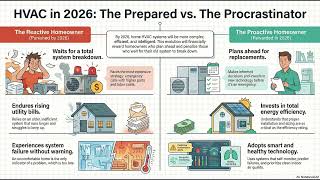
Hosted deep-dive (two presenters) interpreting Derek Cole's 2026 outlook for residential HVAC. Core claims: 2026 will favor homeowners who plan ahead; energy efficiency must be achieved via correct system sizing (load calculations) and quality installation rather than SEER alone; smart, predictive monitoring (beyond Wi‑Fi thermostats) is becoming standard (Cole's company launched a "smart comfort club" in March 2025); indoor air quality — advanced humidity control and high-level filtration — is now a baseline expectation; and proactive preventative maintenance protects both systems and finances. The hosts condense this into four pillars (proper-designed high efficiency; smart predictive monitoring; clean air as standard; and preventative action) and urge homeowners to treat HVAC as a deliberate design project.
Questions this video answers
March 2025
90%
Chapters
Welcome to the deep dive. Today we're. We're jumping into the future of home comfort, specifically what things are going to look like in 2026.
And we're using some really pointed insights from the expert Derek Cole, as our roadmap.
We are, and he is very clear on this. He says 2026 is the year that will, and I'm quoting here, reward the.
Homeowners who plan ahead and punish the homeowners who procrastinate. It's a pretty stark warning.
It is. His whole argument is that things like comfort, efficiency, and, you know, clean air, they don't just happen by accident anymore.
No, they happen by design. And that phrase right there, by design, that signals a massive shift away from the old reactive way of thinking.
Just waiting until your system breaks on the hottest day of the year.
Exactly. Cole argues that whole approach is about to become, well, really expensive, with utility costs going up and the systems themselves getting so much more complex. And that emergency call is just not a viable strategy, which.
That takes us right to the first big shift. He points out Energy efficiency.
Right. It's no longer optional. It's the absolute minimum standard.
Yeah. He makes the point that if you have an older low seer system, it's already running longer, straining more, and you're already being punished for it on your monthly bills.
But here's the crucial distinction he makes. And I think this is so important. Okay. It's not just about the efficiency rating on the box.
You mean the seer number? That's not the whole story.
Not even close. He insists that true efficiency comes down to two other things. The correct sizing of the system for.
Your home, the load calculation.
Precisely that. And the quality of the installation. You can have the most efficient unit in the world, but if it's oversized or installed poorly, it's just going to waste energy.
That attention to the design details, it seems to lead directly into his second major point, the rise of what he calls smart ac.
Yeah, and let's be clear. We are not just talking about a wi fi thermostat you can change from your phone. This is a whole different level.
This is about systems that actually monitor themselves.
They do. They detect subtle problems early, they alert the homeowner, and they can even predict a failure before you ever feel uncomfortable.
And he says this is going from a luxury to just normal.
It is. He points out that his own company launched their smart comfort club way back in March 2025, and that technology is now setting the industry standard. His take is if your system can't Tell you there's a problem before its.
Performance drops, then you're already behind.
You're already behind.
Okay, so from the hardware, he then shifts to the internal environment, the third key element, indoor air quality.
Absolutely. Because comfort is not just about temperature anymore.
No, especially when you hear his statistic that most of us spend 90% of our time indoors.
It's a staggering number. And it means people are, you know, they're intensely focused on controlling humidity, on dealing with allergens, and just making sure the air is clean.
So this goes way beyond just changing out that one inch filter every three months.
Oh, way beyond. We're talking about systems designed from the ground up with advanced humidity control and high level filtration. Clean air, he argues, is now a non negotiable part of what modern home comfort even means.
All of which this high tech, high standard future, it brings us back to the money, to that financial penalty for waiting.
It all connects. He doesn't pull any punches here. He flat out says that waiting for your system to break is the most expensive strategy.
Because these modern systems we've been talking about are so complex.
Exactly. When a unit with a variable speed motor and all these proprietary electronics breaks down, you're not just paying for a.
Simple part, you're paying for a specialized high cost component that needs a trained technician to install it part, probably on an emergency basis.
The costs just compound. So the only way to mitigate that, he says, is through proactive preventative maintenance. It protects the machinery, sure, but it's really about protecting your wallet.
So to wrap this all up for 2026, it sounds like we have four clear pillars from Derek Cole's thinking.
I think so. First is high efficiency, but achieved through proper design.
Second is smart predictive monitoring.
Then you have advanced clean air as a standard feature, not an add on.
And finally, preventative action is the only way to manage the cost.
And planning ahead is the thread that runs through all of it. With systems this complex, being prepared is really the only shield you have against those escalating costs.
It makes sense. So since this whole conversation has been about comfort and efficiency happening by design, we want to leave you with one final thought. Cole's message is to treat H Vac like a proactive design project.
So.
So our question for you is, what existing part of your home maintenance routine could you start treating not as a reactive repair task, but as a deliberate design project starting right now?