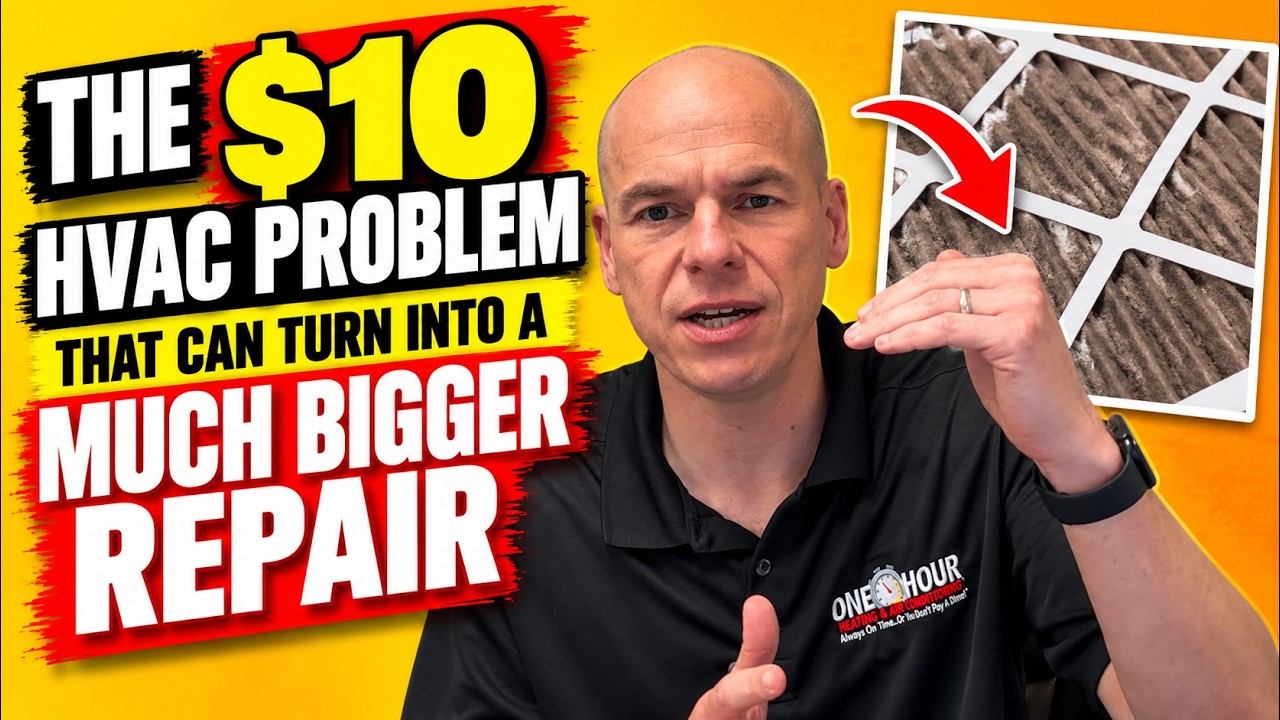
HVAC technician Derek Cole explains why a $10-20 air filter matters: a dirty or overly restrictive one reduces efficiency and causes costly repairs. He recommends MERV 8-10 filters for most homes and checking every 30 days, since a filter that never gets dirty may signal bypass or duct problems.
Chapters
This might be one of the cheapest parts of your entire heating and air conditioning system. $10, $15, $20 maybe, depending on the filters you use. But ignoring it long enough and the conversation can get a whole lot more expensive. Today I want to explain why something this simple matters so much to your HVAC system. Your heating and cooling moves a tremendous amount of air. It pulls air from your home to— through the return, through the filter, across the equipment, and then sends the conditioned air back into your home. The key word is airflow. The filter collects dust, Dirt, pet hair, anything else floating around in your home that causes it to be more restrictive. Now, a little bit of dirt, a little bit of dirt is normal. The filter is there to collect the dirt. But when you get really dirty, your HVAC system may not be able to move the amount of air It's designed to move. Different equipment responds differently to airflow restrictions, but the principles of airflow doesn't change. Now, here's another mistake I see homeowners make. They go to the store and think, well, I'll just buy the most expensive filter they have. That's the best one, right? That's the better one. I need the best. For my home, not necessarily higher efficiency filters, higher MERV ratings. They're rated on a scale called MERV, M-E-R-V, MERV rating. The higher the number, the more restrictive it is, the better at collecting those smaller particles it is. But That could be great for your system, but— and it can be great for your filter setup to collect those particles, but the higher the number you get, the more restrictive it gets on that airflow of some amount, which could be a problem because now you're restricting airflow because it's having a harder time getting through the filter. You have to use the right filter for your system. Now, which one's right for you? Ask a professional. Ask a pro the next time they're at your house. A good rule I like to tell folks is usually when you go to a MERV 8 or 10, that's probably as high as you want to go for the average system. That's a good— that's not a basic filter, And it's not an expensive filter. It's a good, what I call middle-of-the-road filter, where you're still letting airflow in, but you're also collecting particles as well. So it's not so cheap as letting everything fly through, and it's not so expensive as stopping any airflow from getting through. You got the right filter. How often should I change my filter? You've heard Others say, you've heard me say before, check your filter every 30 days. And now that doesn't mean you have to change it every 30 days, but it should be checked every 30 days. How often should I change my filter? It depends on your home. How many people's in the home? How often you go outside in the home? Uh, how many pets do you have in the home? What What are the living conditions in the home? All that plays into how dirty the filter will get. So how often do you need to change it? That's going to depend on your specific situation, but a great rule of thumb is check your filter every 30 days to see if it needs to be changed. You will see it getting dirtier Which is what you want because the filter is there to get dirty. If you check that filter over and over again and it doesn't get dirty, that means the airflow is bypassing the filter and going right to the unit. So do we have a duct problem? Do we have a filter problem? What is the problem? Air should not be bypassing the filter. It should be going through the filter. Because you want that clean conditioned air going back to the unit, going back to your blower motor, going back to your coil. You don't want whatever air— attic, crawl space, outside air— you don't want that air to get to your system because there is no filter. That dirty air is going straight to the blower wheel, to the evaporator coil. That is causing more problems. So how often should you check it? Every 30 days. Change it, see what needs to be done for you. Because, because the way I live, the way I change my filter is not going to be the way you change your filter because it is completely different for every home, every person, every setup because of people, pets. Lifestyles, whatever. It's just the way it is. It needs to be checked yourself every 30 days. Get into a routine, get into a rhythm of when it needs to be changed. Here's the takeaway: check your filter regularly, use the right filter for your equipment, and if you're not sure what's— what filter you should use for your system, Ask your Simmons 1 Hour All-Pro Tech. Taking care of a $10 problem, a filter, really can help avoid the more expensive one down the road. I'm Derek Cole with Simmons 1 Hour Heating and Air.