The A2L Refrigerant Transition: Managing Costs and Homeowner Timing : A Deep Dive
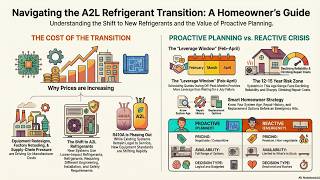
The EPA is phasing out R410A refrigerant for A2L alternatives due to climate regulations. Existing systems stay legal but repair costs are climbing due to R&D expenses, factory retooling, and inventory hedging. Check your unit's age, review leak history, and get quotes during shoulder season (Feb-Mar, Oct-Nov) to avoid peak-season pricing.
Chapters
Welcome back to the Deep Dive. Today we are wading into what I can really only describe as an absolute Alphabet soup of confusion.
Oh, yeah, it's a lot.
It really is. If you've been, you know, anywhere near a home improvement forum lately or maybe just chatting with a neighbor over the fence, you've probably heard these terms thrown around like confetti words like R410A phaseouts, A2L, GWP.
It sounds like the worst chemistry exam you never studied for.
Exactly. And usually when I hear jargon like that, my eyes just kind of glaze over and I completely tune out. Sure. But here's the thing and exactly why we're talking about it today. This specific jargon is colliding directly, and I mean violently, with people's bank accounts.
It really is.
We were talking about the air conditioning units sitting outside your homes right now. There's a massive shift happening in the H VAC industry, and it feels like homeowners are suddenly just, you know, caught in the middle of it without a map.
It's basically a perfect storm. You have strict federal regulations, rapidly changing technology, and some really intense economic. Economic pressures all hitting the manufacturing sector at exactly the same time.
Right.
And the end result of all that, it's landing right on the homeowner's doorstep.
So our mission today is pretty simple. We are not going to bore you with a lecture on thermodynamics, I promise.
My goodness.
Yeah. But we are going to unpack a major federal transition that really kicked into high gear in 2025. We're going to look at why prices are moving the way they are and most importantly, what you need to do about it so you aren't caught off guard.
And to guide us through this, we're looking at a really comprehensive breakdown by industry expert Derek Cole. He has a incredibly grounded perspective on this whole situation.
She really does.
He cuts through the noise to explain the reality behind these new regulations and which is crucial for you listening, why waiting to deal with an aging system might actually be the most expensive decision you make this entire year.
Right. And just to set the stakes here right at the top, if you own a home and your AC unit isn't brand new, this Deep Dive is specifically for you. The goal is to move you from that feeling of hesitation, which Derek Cole points out almost always leads to expensive decisions to a place of clarity. Let's do it. Okay, so let's unpack this A2L thing first, because that really seems to be the scary buzzword everyone is talking about for years. I feel like I finally just got used to hearing about R410 a.
Right. That was the standard.
Yeah. If I go look at my EC unit right now, it probably has, like, a pink sticker on it that says R410A.
That's right. If we look at the lineage here, it kind of helps to see the pattern. Years ago, the standard was R22.
Oh, Freon.
Exactly. People called it freon. If you've been a homeowner for a long time, you definitely remember R22. It was great at cooling, but it was terrible for the ozone layer. So the industry shifted to R410 a. That's what most people have sitting outside their house right now. The quote, unquote, green solution for a long time.
So why kick it to the curb now? I thought R410A was the good guy in this story.
It was the good guy for the ozone, definitely. But as climate science evolved, regulators started
looking at GWP global warming potential.
Exactly. It turns out R410A is a greenhouse gas with a pretty high potential to trap heat if it ever leaks into the atmosphere. So under the A Act, which is the federal legislation driving all of this, the EPA mandated a shift to low GWP refrigerants. And that brings us to the new class we're talking about today, A2L.
And the big question everyone asks is, why does that change everything? Why can't we just, you know, put the new juice in the old machine?
Because the chemistry is fundamentally different. And this is exactly where the fear online comes from. A2L actually stands for something very specific. The A means non toxic. The 2L means mildly flammable.
Whoa. Okay. Mildly flammable. You can totally see why people are freaking out on Facebook about this.
Oh, absolutely.
People are probably thinking, is my air conditioner going to explode?
And that is the absolute number one myth we need to dispel right now. Derek Cole addresses this directly in his breakdown. He just calls it noise. When we say mildly flammable, we are talking about a very specific chemical classification. R410a was an A1, meaning no flame propagation. Propane, on the other hand, is an A3, which is highly explosive. A2L is right in the middle, but it leans heavily, heavily towards safe.
So it's not going to just blow up?
No, it has a very low burning velocity. You essentially need a direct, high energy flame to get it to ignite at all. And even then, it doesn't sustain a fire easily.
So it's not like if I light a barbecue grill 10ft away on my patio. The AC unit goes up in smoke.
Absolutely not. But this is exactly why you can't just put the new stuff in the old machine. The new A2L units are designed with entirely new safety ecosystems built into them.
Like what kind of ecosystems?
They have built in leak sensors. They have automatic shutoff valves. They have specific ventilation requirements. The equipment is engineered from the ground up to make that mild flammability a complete non issue for the homeowner.
Okay, that makes sense. So if I have an R410 a unit, the one I've had for, say, 10 years, am I breaking the law? I've actually seen people asking, is it illegal to own my old unit now?
No, absolutely not. Cole is very emphatic about this point. Your existing system is not illegal.
Okay, good.
The regulations control manufacturing, not possession. As of January 1, 2025, manufacturers just can't build new R410A units for residential use. But if you have one, you can keep it, you can repair it. You can even buy R410 a refrigerant to refill it.
But I'm guessing that supply will get tighter.
Exactly. The supply gets tighter and it gets significantly more expensive over time.
So nobody is coming in the middle of the night to haul away my air conditioner. That's a huge relief.
Correct. Nobody is taking your ac. But. And here's the mess buddy in all of this, while the safety panic is totally unnecessary, the economic reality is very, very real. Just because you can keep your old unit doesn't mean it's going to be cheap to do so.
Which brings us to the part that everyone actually cares about the money. Derek Cole was pretty blunt about this. In the source material, he said prices are increasing, not going down. And it's not just normal inflation.
No, it's structural inflation. He identifies three main drivers for this. And I think it's fascinating because it gives us a real peek behind the curtain of how these massive factories actually operate.
Let's break those down. What's driver number one?
Equipment redesign. We just talked about those leak sensors and shut off valves for the new A2L units. Those aren't free components.
Right.
Manufacturers have had to re engineer the entire chassis of the air conditioner. They've had to change the compressors to handle different pressures. They've had to certify these new designs with UL safety boards. We are talking about billions of dollars in research and development.
And companies definitely don't just eat that cost out of the kindness of their hearts.
Exactly. That cost is amortized into the price of every single new unit sold. When you buy an A2L system today, you are literally paying for the five years of engineering that went into making it compliant.
That makes sense. R and D isn't free. What about driver number two?
This one is more of a logistical nightmare. It's the manufacturing transition itself. Think about a giant Factory floor. For 20 years, they've been perfectly optimized to build R410A units. Robots, assembly lines, supply chains, all set up for one specific thing.
Right. Highly efficient.
Exactly. Now they have to pivot to a 2L. But and this is key, they still have to support the older equipment to some extent with replacement parts.
So they're basically trying to do two things at once. They're splitting your focus.
Yes. And it fractures their efficiency. You simply can't run a factory at peak optimization when you're constantly retooling assembly lines or splitting your workforce between two completely different technologies.
So that inefficiency just adds to the cost.
It increases the cost of goods sold across the board. Cole mentions that factories simply can't handle everything at once. So overall production slows down. And when production slows, costs go up.
And he mentioned something pretty scary about obsolescence here, specifically regarding R22, the really old stuff.
Right. If you are still holding onto an R22 system, meaning pre2010, usually you are in a very precarious spot because factories are pivoting all their resources to the future. They are literally stopping production on parts for the past.
Wow.
Specific coils, compressors, and components from for those old R22 units are becoming permanently obsolete.
So it's not just that the part is expensive, it's that you might call a technician out to your house and they say, I literally cannot buy this part. It doesn't exist anymore.
Precisely. You're holding onto a machine that the world has just moved on from.
And the third driver for the price increases.
Supply and demand, but driven entirely by market psychology. This is the human element of economics.
Ah, the fear factor.
Exactly. When a huge regulation change like this hits the market, distributors, the middlemen between the factory and your local AC guy, they get nervous.
Sure.
They don't want to be stuck holding a warehouse full of R410A units that they can't legally install in a new construction home. So they hedge their inventory. They stop ordering the old stuff way early.
Which creates an artificial shortage.
Yes. And when inventory tightens and everyone in the industry is rushing to make decisions, pricing naturally tightens. Up, too. Cole notes that this is the exact same pattern they've seen every single time the industry shifts. It's predictable, but it's really painful for the consumer who just wants to buy a box that makes cold air.
So we have R and D costs, factory inefficiencies, and distributors hedging their bets. Yeah, all of it points to higher price tags. So if I'm listening to this right now and I'm looking at my thermostat, how do I know if I should be worried? I don't want to spend money if I don't have to.
This is where we get into assessing your current status. Cole breaks homeowners down into a few categories. Let's call it the traffic light system.
I like that. Let's start with a green light, the safe zone.
If your system is newer, say less than 10 years old, and it's running well, his advice is simple. Stay the course, maintain it. Don't panic.
Don't panic. I love that. If it ain't broke, don't fix it.
Exactly. You have R410A, which is still widely available for repairs. You have a system that likely has plenty of life left. Just keep the coils clean, change the filters regularly, and you are fine.
Okay, but what about the yellow light?
This is the danger zone. This is the 12 to 15 year
window, the teenage years of the air conditioner.
That's a fantastic way to put it. And just like teenagers, they can be really expensive, moody, and totally unpredictable. Cole highlights this as the critical period where repair costs start to climb significantly and reliability takes a real nosedive. The components, capacitors, fan motors, compressor valves, they are just mechanically tired.
And this is where the emergency trap comes in. I think this is one of the most powerful points in the source material. We've all been there, or we fear being there. It's July 15, it's 98 degrees outside, and the AC just dies.
That is the red light scenario, and it is the worst case scenario, economically speaking. Cole explains that if your system fails during peak season, you have zero leverage.
You're not shopping around for deals at that point.
You are purely reacting. You aren't choosing the timing, you aren't setting the budget, and you aren't really even choosing the equipment. You are taking whatever is left on the truck because you are desperate for cool air.
That is a terrifying thought. You're literally at the mercy of whatever is available at that exact moment.
And remember the supply chain issues we just discussed? In a transition year like this one, whatever is available might not be the best fit for your home. It might be a unit that's less efficient than you wanted, or it might be a ultra premium unit that's way out of your budget, but it's the only one they can install today. You end up paying a massive premium for the urgency.
So how do we avoid that? If I'm in that 12 to 15 year window right now, what is the smart play? How do I get my leverage back?
You have to utilize the shoulder season.
Shoulder season, define that for us.
It's the industry term for the mild months. February, March, early April, and then again in late October, November. But right now, early in the year is the absolute sweet spot.
Why? Just because the weather's nice?
Because the phone isn't ringing off the hook at the H Vac office. The technicians aren't running ragged from emergency call to emergency call. Things, as Cole puts it, aren't crazy yet.
So this is when you actually have real negotiating power, massive leverage.
You can negotiate timing. You can discuss budget options without the intense pressure of a heat wave bearing down on you. You can actually look at different equipment options, maybe compare a high efficiency a 2L unit against the standard one and wait a week for the to ship. You are firmly in the driver's seat.
It's the difference between buying a car because you want a nice upgrade and buying a car because yours is literally on fire on the side of the highway.
That is the perfect analogy. And in the H Vac world, that car on fire moment is almost always in July. And believe me, the dealer charges a lot more when the car is on fire.
Okay, so let's get tactical. We know the industry is shifting to a 2L. We know prices are definitely up. We know the 12 to 15 year mark is a danger zone. How do you, the listener, combat the confusion and actually prepare for this?
Cole outlines a really straightforward three step preparedness plan. Step one, know your system's age.
It sounds so simple. But how many people actually know that? I honestly couldn't tell you the exact year of mine without going to look.
Most people can't. So go outside. Look at the manufacturing plate on the unit, the big metal box outside. It's usually stamped right there in plain text. If it says 2010 or 2011, do the math. You're in the danger zone. Step two, know your repair history. This is crucial data for making a decision. Have you had to add refrigerant in the last couple of years? Have you had to replace a capacitor or a fan motor?
Why is adding refrigerant Such a big deal. People talk about topping it off all the time like it's windshield washer fluid.
That is a huge misconception in the public. An air conditioner is a completely sealed system. It does not consume refrigerant. It just circulates it. If you have to add refrigerant, you have a leak, period. And on a 14 year old system, a leak is usually a death sentence. It means the internal coils are actually rotting out. If you are paying 300 or $500 to add gas every single summer, you are literally throwing money into a hole.
Okay, that's a great reality check. And what's step three?
This is the proactive one. Get replacement options before you actually need them.
See, I think people are genuinely afraid to do this. They think if they call a guy out for a quote, they're somehow committing to spending 10,000 doll that very day. They don't want to deal with the sales pitch.
That's a huge psychological barrier. But Cole really emphasizes this point. Getting a quote doesn't mean you have to buy today. It's purely about data gathering. It's about getting clarity.
It's putting a price tag on your peace of mind.
Exactly. There is absolutely no harm in having a qualified professional come out in March and say, okay, here's what a replacement would look like for this house. Here are your options. Here is the price. Once you have that piece of paper in your hand, you aren't making an emotional decision later.
Emotional decision. That's a phrase Cole used that really stuck with me. Because when you're hot, you're definitely emotional.
You're under pressure, you're uncomfortable. Maybe your spouse is complaining about the heat. The kids are crying. You just want the problem fixed right away. That is exactly when you overspend, that is when you make bad choices. The immense value of the quote is that it allows you to plan while you are perfectly calm. You can look at financing options, you can save up. You remove the surprise entirely.
So really, the core philosophy he's pushing here is planning versus panic.
That's it. Refrigerant changes are real. The A2L shift is happening right now. Price increases are real. But panic is completely unnecessary. The homeowners who win during these transitions, and frankly, during any big economic shift, are the ones who understand what is coming before it actually hits their living room.
Before it hits their living room. I really like that. And it's about seeing the wave coming and grabbing your surfboard rather than just
getting tumbled by it and realizing that confusion usually only happens when regulations move faster than public understanding. Our goal here today, and Derek Cole's goal in his writing, is to bridge that gap. Once you understand that A2L is just the new standard and that the price hikes are due to manufacturing realities rather than just greed, the mystery goes away. It just becomes a math problem.
And math problems are solvable.
Exactly.
So let's quickly recap what we've learned today. The industry is moving from R410A to A2L. This is a federal mandate. It's not a suggestion.
Right. And because of that mandate, manufacturers are completely retooling, designing new equipment and dealing with split focus on their factory lines. That inefficiency, combined with R and D costs and distributor hedging, is driving prices up across the board.
But crucially, if you have an older system sitting outside, you aren't a criminal.
No, your system is totally safe to keep. But if it's in that 12 to 15 year window, it's a ticking clock.
And waiting for that clock to strike zero, which usually happens in the middle of a miserable heat wave, is the absolute worst way to handle it.
It is hands down the most expensive way to buy. You lose all your leverage.
I think the most surprising thing for me was the idea of the shoulder season. I never really thought about there being a specific time of year to buy an air conditioner, but it makes total sense now. February, March, April, that's your window of opportunity.
It is the only time you really have the upper hand in the negotiation.
So here's where it gets really interesting for me as we wrap up. We talk a lot about saving money on this show. Usually we think of saving money as the act of not spending it. Like, I'm not going to buy that new gadget. I'll just save the cash, Right?
Retention of capital. That's the standard logic we all use.
But this specific situation flips that logic completely on its head.
It really does. And this raises a provocative question for everyone listening to Mullover. We so often view inaction as the safe, cheap choice. But in a massive transition year like this one, with supply chains tightening, parts for old units like R22 becoming literally obsolete and prices steadily climbing, is the cost of inaction actually higher?
That's a heavy thought.
Yeah.
By trying to save money by squeezing just one more year out of an old failing unit, you might actually be setting yourself up for a replacement bill that's 20 or 30% higher when it inevitably fails in July.
Let's just run the numbers quickly. If inflation on H Vac equipment is 10% this year due to the new regs, and your old unit is wasting $300 a year in excess electricity because it's terribly inefficient. Waiting a year essentially costs you $1,300 or more.
Wow.
Plus, you still carry the risk of a major breakdown. Is waiting actually a luxury you can't afford?
It's completely counterintuitive, but the data clearly supports it. If you know the supply is tightening and the prices are rising, buying now, even if you don't strictly need it, this exact second might be the ultimate money saving move.
It's betting on the sure thing versus gambling on a tired old machine.
That is definitely something to chew on. So here is your homework, listeners. As soon as this deep dive ends, I want you to walk outside, go find that metal box sitting next to your house, look for the label, find the manufacturer date.
If it's before 2012, start making some phone calls. You don't have to buy, just get the info.
Don't panic, but get the quote. Be the one who plans, not the one who reacts.
Absolutely.
That's it for this deep dive. We hope this cleared up the Alphabet soup of A2L and R410A for you. Thanks for listening and stay cool out there.
More from Derek




How to Prevent Mold and Odor in Your Air Conditioning System with UV Light #shorts





