The Summer Cooling Mistake That's Costing You Hundreds
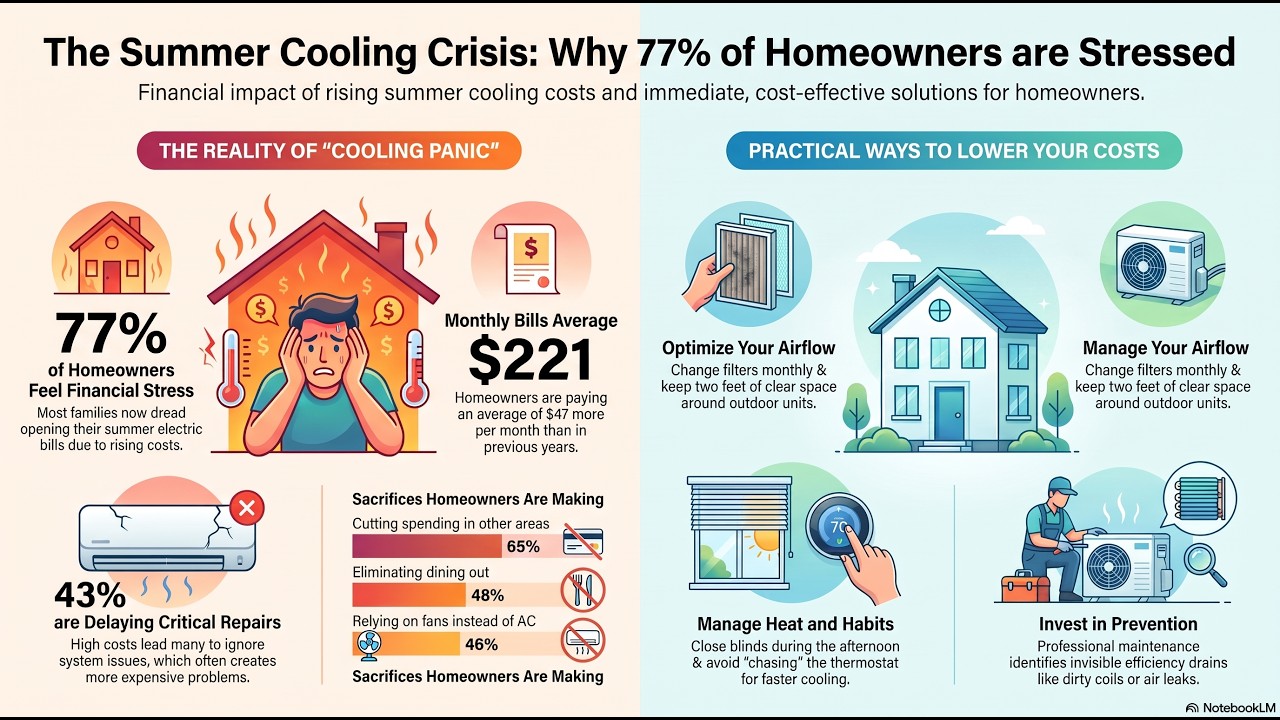
77% of homeowners feel financial stress from summer cooling bills, which average $221 a month. HVAC veteran Derek Cole and the hosts explain why: dirty filters, closed vents, and thermostats set too low force systems to work harder. Simple fixes like filter changes, sealing leaks, and clearing outdoor units can cut costs without expensive repairs.
Chapters
You know that feeling when you walk to the mailbox in the middle of July and you grab that stack of envelopes and there it is?
Oh yeah. The summer electric bill.
Right. You open it up, you stare at that bolded number at the bottom, and your stomach just completely drops.
It's a very specific kind of dread, honestly. It just changes the entire mood of the house in an instant.
It really does. Like, you look at it and think, there is absolutely no way it should be this high. Did I, you know, leave the oven on for a month straight?
Right, because before you open it, your summer is going along just fine. But after—
Yeah.
You're suddenly walking around the house, turning off lights and glaring at the thermostat like it personally offended you.
Like it's your enemy. It is a genuine pit-in-your-stomach panic.
Yeah.
And well, if you felt that way recently, I have to tell you, you are definitely not alone.
Not at all.
Today we are taking a deep dive into the 2026 Summer Cooling Cost Panic Report. It's this fascinating survey of 1,000 US homeowners conducted by Supply House.
Yeah. And we aren't just looking at the raw survey numbers here. We're pairing this data with some incredible analysis from Derek Cole.
Right. He's a 25-year HVAC industry veteran.
Exactly. He's the general manager of Simmons One Hour Heating and Air.
And his perspective is vital for our discussion today because he bridges that gap, right, between the statistics on a spreadsheet and the actual reality of standing in someone's sweltering living room trying to figure out why this system is failing.
Yeah, he sees the day-to-day panic up close.
So our mission for this deep dive is to unpack the financial and the psychological toll that this summer heat is taking on homeowners everywhere.
Because it's taking a massive toll.
It really is. But we're not just gonna sit here and complain about the weather. We want to equip you with practical, actionable knowledge to protect your comfort and, you know, your wallet.
Okay, let's unpack this. Just how widespread is this utility bill panic? Well, the data paints a picture of a homeowner population under severe strain. I mean, according to the report, a staggering 77% of homeowners say that summer cooling costs are causing them actual financial stress.
Wow. 77%. Yeah.
And 70% actively dread opening their summer electric bill.
70%. Getting the mail is literally an anxiety-inducing event for the, vast majority of us now.
It really is. And when you look at the raw numbers they collected, it makes total sense. Homeowners are expecting to spend an average of $221 a month just to cool their homes.
That's huge. And that's an increase, right?
Yeah, that is a $47 monthly increase from what they were paying previously. And keep in mind, that's just the average across the country.
So it could be worse.
Oh, definitely. Right. Depending on your home's square footage, the quality of your insulation, or just where you live geographically, that number could be substantially higher.
Right. If you're in Texas or Arizona, forget about it.
Exactly. Plus, the report highlights this deep pessimism about the future. 75% of the surveyed homeowners expect this summer's bills to be even worse than last year's.
What stands out to me, though, isn't just the math on the paper. It's how those rising costs are actively changing the way families are, you know, living their daily lives.
What's fascinating here is that this is no longer just a conversation about the weather. Or even routine home maintenance.
Right.
We are looking at a major economic shift that's altering household budgets and daily behaviors. I mean, utility costs used to be a somewhat predictable background expense.
Yeah, you just paid it and moved on.
Exactly. But now we're seeing a direct reallocation of resources away from discretionary spending straight into basic utility survival.
And you see that shift right there in the survey responses, like 65% of homeowners are having to cut spending in other areas just to keep the lights on and the AC running.
That's a huge chunk of people.
It is. And nearly half of the respondents, 48% to be exact, say that dining out is the very first thing on the chopping block.
Oh, wow. So it's hitting the fun stuff immediately.
Yeah. So think about what that means in a real household. That utility bill is actively competing with a family's Friday night pizza tradition. The air conditioner is literally eating the pizza budget.
It becomes a zero-sum game for a lot of households. And, you know, when the pizza budget is gone and the bill is still high, people start making even more drastic compromises.
Because they're terrified of these rising costs.
Right. They start resorting to extreme measures to just avoid the AC unit clicking on at all. Like 46% of people are relying on ceiling or portable fans instead of running their AC.
Just sitting in front of a fan sweating.
Pretty much. And another 46% are intentionally keeping their thermostats uncomfortably warm.
Oh, I hate that.
Plus, 39% are delaying turning the AC on for the season altogether. They are basically engaging in a high-stakes game of chicken with the sun.
The human element of these statistics is just profound. People are essentially bargaining with their own basic comfort. They're treating their homes like a hostile environment they just have to, you know, endure.
Yeah. And it's actually impacting their health. The most alarming stats from the report are about sleep.
Oh, the sleep stats are brutal.
27% of homeowners are literally losing sleep because their house is too hot.
That is miserable.
And 15% of people surveyed said they plan to just sleep in uncomfortable temperatures rather than run the AC at night.
That is just wild to me. It's like buying a modern luxury car, but you drive on the highway sweating with the windows down just to save a few pennies on gas.
That is a great analogy.
But I have to ask, is suffering through a sleepless, sweaty night actually saving them money? Or is there a flaw in this logic?
Oh, there's a massive flaw in the logic.
Yeah.
And it comes down to a fundamental misunderstanding of how mechanical systems actually work.
Okay, break that down for us.
The core question Derek Cole asks when reviewing this data is crucial: Is the system actually operating efficiently?
Right.
Because if you have an inefficient, struggling air conditioner, it doesn't matter if you set the thermostat to 78 degrees and suffer through a terrible night's sleep.
Meaning, the system is still working just as hard to hit that higher number.
Exactly! It's the exact opposite of what the homeowner intends. A struggling system running at 78 degrees might have to run for 10 hours a day, drawing excessive amperage the entire time just to maintain that mild temperature.
Oh wow, so it's just chugging along all day.
Yes, whereas a healthy, efficient system might only need to run for 3 hours to keep the house at a crisp 72 degrees.
So by keeping it at 78, you're sacrificing your comfort, you're waking up exhausted, and you're still getting a high bill because your machine is just chomping along, burning energy, without actually delivering results.
Exactly. You're basically paying for comfort that you aren't even getting.
But if a struggling system is the real culprit behind these high costs and the lost sleep, why are people just living with it? Why not fix it?
Well, the answer in the report points straight to the fear of the repairman. 43% of homeowners have delayed an HVAC repair specifically because of the cost.
Honestly, I get it. Repairs are terrifying.
And that statistic gets even more concerning when you look at the broader awareness level. A full 50% of homeowners either know their system has a problem or they strongly suspect it's inefficient.
But they haven't done anything about it.
Nothing. Half of the people out there are just crossing their fingers, hoping the machine keeps breathing through August.
Look, I have to play the voice of the skeptical homeowner here. The report says people avoid repairs because of cost. And can you blame them? It feels like taking your car to the mechanic. You go in for a basic oil change or a weird rattling noise, and you leave with a $2,000 bill.
It's a very real fear.
Right. You call a tech hoping for a simple tune-up, and suddenly you're sitting at your kitchen table getting a high-pressure sales pitch for a $10,000 system replacement. Are people just hiding from their AC units because calling a technician feels like stepping into a financial trap?
This raises an important question, and it is a completely valid fear. Homeowners often feel vulnerable because they just don't understand the machinery.
Exactly. It's just a big loud metal box in the yard.
Right. But we have to look at how much that fear of a temporary repair cost actually drains from a homeowner over the long term.
In daily inefficiency, I mean.
Yes. Because HVAC problems do not fix themselves. They compound. Ignoring a minor issue virtually guarantees you will be facing that $10,000 replacement you were trying to avoid in the first place.
The source material outlines this compounding effect perfectly. They mention things like a weak capacitor, a dirty condenser coil, a failing blower motor, or restricted airflow. If you ignore those, the whole system just works harder.
Let's look at the mechanisms of why that actually happens. Take a weak capacitor, for example.
Okay.
A capacitor provides the initial jolt of electricity required to start your compressor. Think of a weak capacitor like trying to pedal a bicycle in top gear from a dead stop.
Oh, that's impossible. You have to stand up on the pedals just to get moving.
Exactly. You have to exert a massive amount of physical energy just to get the wheels moving. When the capacitor is failing, your compressor struggles to start, drawing a huge surge of electricity.
Which spikes your bill.
Right. And it puts immense physical strain on the compressor itself until it eventually just burns out.
Or take the dirty condenser coil they mentioned. That's the big unit sitting outside in the yard, right?
Yes, that's the one. Your system's entire job is to remove heat from your house and release it outside through the metal fins of that condenser coil.
Okay, so what happens when it gets dirty?
Well, if those fins are clogged with dirt, lawn clippings, dog hair, whatever, it's like trying to run a marathon while breathing through a heavy wool blanket.
Oh, sounds exhausting.
The heat cannot physically escape into the outside air, so the system has to run twice as long and work twice as hard to do the same amount of cooling.
So by avoiding a relatively cheap service call to clean a coil or, you know, replace a tiny electrical part like passenger, you're essentially torturing the most expensive components of your system to death.
Yes, you are.
All while paying a premium on your electric bill every single month for the privilege.
You end up paying for the repair anyway. You pay for it incrementally through your utility company with high bills, and then you pay for it catastrophically when the compressor finally seizes up on a 100-degree afternoon.
Which is always when it breaks.
Always.
Okay, so we've clearly established the high stakes here. Ignoring the problem drains your wallet, it ruins your sleep, and it leads to massive repair bills. But I don't wanna just leave everyone sitting in their hothouses feeling anxious. Let's pivot to empowerment.
I like that.
The report provides 10 specific practical steps you can take today to take control of your home's efficiency.
And what is particularly encouraging about this list is that many of these steps require absolutely zero technical expertise.
Yeah. And they cost nothing.
Just basic habits, right?
Exactly.
They're, purely behavioral adjustments that impact the physics of your home.
Let's start with the absolute basics, the things we can control without calling a technician. Number 1: Change your air filter. Check it monthly in the summer.
This is so important. A dirty filter chokes the airflow. If the blower motor can't pull enough air through the return vent, the motor overheats, draws more amps, and dies early.
Keep it clean, folks. Number 2: Keep sunlight out. Close your blinds and curtains in the afternoon, especially on windows that get direct west-facing sun. I always forget to do this in my own living room, and it literally feels like a greenhouse by 4 PM.
It's simple thermodynamics, you know. Radiant heat from the sun passes through the glass and warms everything it touches inside your house.
Like the couch, the floors.
Right. If you stop the heat at the barrier of your home with blinds, the air conditioner never has to expend energy to remove it.
Number 3: Avoid creating indoor heat. Grill outside, use the microwave instead of the oven, and wait until the evening when it's cooler outside to run the dishwasher or the dryer.
Yeah, running an oven at 400 degrees in July is just forcing your A/C to fight a war it doesn't need to fight.
Seriously. Number 4: Seal air leaks. Use inexpensive weatherstripping and caulking around doors, windows, and attic hatches. We are paying to cool our living rooms, not the neighborhood.
Exactly. And the 5th tip focuses on the outside unit. You need to keep the outdoor condenser clear.
From like bushes and stuff?
Yeah, leaves, weeds, mulch, overgrown shrubs—they all restrict the airflow. You need at least 2 feet of open space around that unit. What happens if you don't? If overgrown bushes are blocking the fan, the unit will actually recirculate its own exhausted hot air. Oh wow. And ends up trying to cool your house using 120-degree air it spit out, which drastically drops its efficiency and cooks the machinery. That's crazy.
Okay, here's where it gets really interesting. The report tackles some major myths that homeowners believe are saving them money but are actively costing them. Myth number 1: chasing the thermostat. Oh, this is a big one. I see people do this all the time. They walk into a hothouse and instead of setting it to 72, they drop it to 60 degrees thinking it will cool the house faster. Yep. Happens constantly. But a thermostat is not a gas pedal on a car. Stomping on it by dropping it to 60 does not make the cold air come out of the vents any faster.
It is a very common misconception. Your air conditioner only has one speed for cooling, and that speed is on. It does not pump colder air when you set the number lower.
It just stays on longer, right? Exactly.
When you drop the temperature drastically, you're simply instructing the system to run for a much longer continuous period until it eventually hits that target. If you leave and forget you set it to 60, the system will just run endlessly.
So just pick a comfortable temperature and let the system cycle normally? Yes, absolutely. Myth number 2: closing vents in unused rooms. Now, I admit I used to do this in my old house. You have a guest room nobody uses, so you close the vents, figuring you're redirecting all that precious cold air to the living room where you actually are.
A lot of people do that.
But the report says this actually reduces airflow and makes the system less efficient. I understand the breathing through a straw idea, but why does this actually damage the system?
Well, seems highly counterintuitive to most people, but your HVAC system, specifically the ductwork, is engineered and balanced for a very specific volume of airflow. Okay. When you close supply vents, the blower motor is still attempting to push the exact same amount of air, but now it's forcing it into a smaller space. This increases the static pressure inside the ductwork.
So the air just gets backed up. But why is that actually dangerous?
Because the air velocity dropping over your indoor evaporator coil creates a physical reaction. That coil relies on a steady flow of warm house air passing over it to exchange the heat, right? The refrigerant inside that coil is extremely cold. If there isn't enough warm air flowing over it to exchange the heat, the natural condensation on the outside of the coil will get too cold, freeze, and turn into a solid block of ice.
Wait, really? A literal block of ice?
Yes. And once the coil freezes, The cooling process completely stops, liquid refrigerant can flow backward into the compressor, and you can destroy the entire unit.
That is incredible. Simply closing a vent in a guest bedroom can literally turn your expensive AC unit into a block of ice. Let that be a lesson. Open your vents. Always keep 'em open. Now, we talked earlier about the fear of the repairman and the anxiety around upselling, but the report strongly advocates for routine professional maintenance. Yes. It really does. This isn't about looking for things to replace. It's about catching the invisible issues. Look, we mentioned the dirty coils, the loose electrical connections, the slow drain lines before they trigger a cascading failure.
It represents a fundamental psychological shift that homeowners need to embrace. We have to move away from a reactionary state where we only call a professional when there is smoke pouring out of a vent or water leaking through the ceiling. Right.
The emergency calls. We need to move toward a preventative state.
Derek Cole mentions their Comfort Club, which focuses on routine system rejuvenations. It's about predictability. You change the oil in your car so the engine doesn't explode on the highway. You should have a technician maintain your AC so the compressor doesn't fail during a heat wave.
Speaking of the compressor failing, the report brings up a piece of technology I wasn't super familiar with, but the concept is fascinating.
An Easy Start. Oh, those are great.
Now, it is important to clarify This is not a magic device that lowers your overall electric bill directly. What it does do is reduce the startup amperage and the mechanical stress on your compressor. How does it actually do that?
Well, the compressor is essentially a very heavy-duty pump. It is the heart of your system. Getting that pump from 0 RPM to full speed in a fraction of a second requires a ridiculous surge of power. Just a massive spike. Exactly. It's the most stressful moment of the machine's life, generating massive mechanical and electrical hurdles. Have you ever noticed your house lights dim for a split second when the AC kicks on?
Yes, all the time. It always made me wonder if the electrical panel was overloaded or something.
That dimming is the inrush current. It is the compressor greedily pulling all available power from your home's electrical grid to conquer that initial physical resistance.
Okay, so where does the EasyStart come in?
An EasyStart device acts like a shock absorber for that demand. It learns the characteristics of your specific compressor and smooths out the electrical surge, feeding it power incrementally. Oh, that's clever. Yeah, it eases the compressor into its cycle, which significantly reduces the mechanical wear and tear on the internal components.
It sounds like it pays for itself just in extending the life of the unit. The report also mentions it's especially valuable if you rely on a storm generator.
Yes, very true.
Because a generator often won't get overwhelmed and trip a breaker from that initial power spike. If you have an EasyStart installed. It's just a prime example of an affordable preventative upgrade that protects a very expensive piece of equipment. Exactly right. So what does this all mean when we look at this entire deep dive from the panic over the utility bills to the sweaty, sleepless nights to the deep-seated fear of repairs? What is the big takeaway here? The data shows us that high bills and a hothouse do not automatically mean you need to drop $10,000 on a brand new air conditioner. Sometimes it really is just a clogged air filter or a blocked return vent or a capacitor that needs replacing during routine maintenance. Yes, the simple things, right? The ultimate goal here isn't just finding the cheapest electricity possible. It's about achieving peace of mind and having predictable bills that don't absolutely terrify you.
If we connect this to the bigger picture, you start to realize that a home is a complex, interconnected ecosystem. I love that way of looking at it. Your air conditioner does not exist in a vacuum. It interacts with your windows, your blinds, your cooking habits, your ductwork, and even the landscaping outside.
Like those bushes choking the unit. Exactly.
Managing that ecosystem well isn't just about preserving machinery; it is about reclaiming your quality of life. Understanding these basic mechanisms gives you back your physical comfort, it gives you back those 8 hours of restful sleep, and frankly, it gives you back your Friday night dining out budget.
It really does all connect, and it brings us right back to where we started standing at the mailbox in July, holding that envelope. We've talked a lot about the technology, the psychology, and the numbers today, but I wanna leave you with a final lingering thought to ponder as you look around your own living space. What's that? If 77% of us are experiencing genuine financial stress and losing sleep because of the very machine that was invented to keep us comfortable, At what point does our home's technology stop serving us and we start serving it?
Wow, that's a great question.
I challenge you to walk around your house today, look at your vents, check your thermostat, go outside and see if there are bushes suffocating the unit sitting in your yard. Ask yourself, who is really in control here? Are you managing your home, or is your home managing you? Take a look at those 10 tips, reclaim a little bit of that control, and maybe get that Friday night pizza back.
More from Derek




How to Prevent Mold and Odor in Your Air Conditioning System with UV Light #shorts





