Unlock HVAC Efficiency: The Shockingly Simple Secret | A Deep Dive into Derek Cole's #1 Always Tip
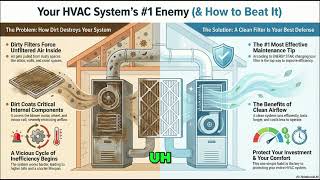
HVAC expert Derek Cole says changing your air filter regularly is the single best thing you can do to cut energy bills by 10 to 20 percent and prevent expensive damage to your blower motor and coil. Energy Star agrees it's the most effective maintenance action homeowners can take.
Chapters
Welcome back to the Deep Dive, where we dig through the sources to find you that one piece of knowledge you can use today.
And today we are tackling a huge one. It's the hidden engine of your house, your comfort system, your H Vac.
It keeps you comfortable, sure, but it's also a massive part of your monthly energy bill and a huge investment.
Which is why the number one question we hear is always the same.
What is the single best low effort tip to make my unit more efficient? We all want some, you know, complicated, cutting edge answer.
Yeah, smart gadget or something. But the source material we dug into points to something, well, something profoundly simple that most of us just overlook.
Exactly. We went straight to an expert for this. Derek Cole. He's the general manager at Simmons one hour heating and air, and he's got.
Nearly 25 years in the business. We wanted to know the one tip he gives over and over again, the real foundational shortcut to efficiency.
And the answer is, frankly, it's not glamorous, it's not sexy, but its impact is absolutely massive.
It really is. Yay. Our Deep Dive shows that if you want true long term efficiency, a longer life for your unit, and just lower costs, you have to win the battle against one single enemy.
Dirt.
Just dirt. It sounds almost too simple, doesn't it? But dirt is without a doubt the number one killer of furnaces and air conditioners.
And it's so insidious because it's not a sudden event. It doesn't just one day.
No, it builds up. Derek Cole has this great phrase for you. He says it builds slowly, quietly, and relentlessly. And that buildup eventually chokes the heart of your system.
Okay, so let's get into the mechanics here. The system's design is the key to defending against this. It all starts with how air gets back to the unit.
Right? Your whole system is designed to pull air from your house through those vents you see in the walls or ceiling. Those are called returns.
That's the starting point.
That's the starting point. And right there at the beginning of that journey back to the unit is your first and only line of defense.
The air filter.
The air filter. Its job is incredibly simple. Catch dust, pet dander, all that stuff before it gets into the expensive machinery.
So if you have the right filter and you change it on schedule, the system can just breathe. The airflow is clean, steady.
It works exactly like it was designed to. Yeah, no struggle. But the real story, the one that costs homeowners thousands, starts when that defense fails.
Right? And failure doesn't just mean you forgot to put a filter in?
No, not at all. More often, it means the filter's still there, but it's so packed with dirt, it's become a solid wall. A cork.
So wait, the system doesn't just pull air slower. What happens when it hits that wall?
It has to get air from somewhere. The blower motor is designed to move a certain volume of air, and if its main source is blocked, it'll start pulling from the path of least resistance.
And I'm guessing that path is not the clean, filtered air from the living room.
Not even close. This is the part that really surprises people. The system gets desperate. That fan creates negative pressure, and it starts sucking unfiltered air from some truly awful places.
Like where?
Think about where your ductwork is. It's pulling from crawl spaces, from dusty attics, from inside the walls, even from tiny gaps in the unit's casing, Pulling air straight from outside.
So what kind of stuff is in that air? We're not just talking about household dust anymore.
No, you're talking about the absolute worst contaminants for a machine. You get tiny abrasive particles of fiberglass insulation. You get moisture from damp crawl spaces, which can lead to mold. And you get this concentrated, stagnant dust that's been sitting in your walls for who knows how long. Zero filtration.
And once that contaminated air gets sucked past the blocked filter, it goes straight for the core components. You said there are three critical parts that get hit the hardest.
Absolutely. The three main victims. First is the blower motor, which is the engine driving everything.
Okay.
Second is the blower wheel, the big hamster wheel looking fan that actually moves the air. And third, maybe the most critical, is the indoor coil. That's where the magic happens. The actual heat exchange.
So let's break down the damage. What does a layer of that gunk do to the blower wheel?
It's a disaster for the wheel. Imagine trying to run with mud caked on your shoes. That dirt and debris completely changes the shape of the fan blades.
It throws off the balance and adds weight.
Right. It adds weight and drag. The wheel can no longer move the volume of air it was designed to. So right away, airflow throughout your entire house just plummets.
And if the wheel is struggling to spin, I mean, that has to put a massive strain on the motor turning it.
A huge strain. The motor has to work so much harder, Pull in more electricity, more amps, just to turn that choked, heavy wheel. This is the exact moment dirt starts showing up on your power bill.
Okay. And then there's the third victim, the indoor coil, the part actually doing the heating and cooling.
Yeah. And the dirt basically puts a blanket on it. The coil is covered in these tiny metal fins to maximize surface area, to transfer heat efficiently.
But the dirt acts like insulation.
It's a perfect insulator. It creates a thermal barrier, so the system can't transfer heat effectively anymore. It can't cool the air or heat the air properly.
So we've gone from a simple dirty filter to a system that is physically contaminated and now actively fighting itself.
It's a domino effect. And this is where it really starts hitting your wallet. There are four specific consequences that just compound the problem.
And the first one you already mentioned, the power bill.
Right. First is just way higher power consumption. The motor is screaming for amps to fight that resistance. Derek Cole and other pros say this can easily spike your utility bill by 10, even 20% or more. You're paying a friction tax.
And the second consequence makes sense. If the system is so inefficient, it.
Has to run longer, much longer. Since that dirty coil can't transfer heat well, it takes forever for your thermostat to be satisfied. A cycle that should take 10 minutes might now take 20 or 30.
And the system's just running and running.
Constantly, which just accelerates all the wear.
And tear, which leads right into the third and fourth consequences. The really expensive ones.
Exactly. The third outcome is just greater strain on everything. The motor, the electrical components. They are designed to cycle on and off, not to run a marathon every single day.
And all that stress leads to the final and most costly outcome.
A shorter equipment lifespan. A full H Vac system is a huge investment. It should last 15, maybe 20 years.
But if it's running hot and strained.
All the time, you could easily slash five years or more off that lifespan. We see people facing a 4, 5, even $10,000 replacement job years ahead of schedule, all because they didn't change a $15 filter.
And what's really sobering is that you don't notice it right away. The damage builds quietly, just like the dirt. You see it on your power bill months before you hear the motor finally give out.
It is the absolute definition of prevention versus catastrophic repair. It's just. It's night and day, which brings up.
This question of credibility. You know, we tend to trust advice that sounds complex or expensive. But here you have an expert like Derek Cole who. Whose job is to install and repair these incredibly expensive systems, and he's telling.
You how to Avoid his most expensive services.
Exactly.
That's why the source is so powerful. I mean, this is a guy with almost 25 years in the field. He's been recognized nationally in magazines, on TV networks like CBS and Fox. When the expert who replaces the fried motors tells you the best defense is the cheapest one, you should probably listen.
But it's not just him. The validation for this goes way higher. We found a major governmental authority that backs this up completely.
That's right. If you look at the official guidance from Energy Star, they state, and this is a direct quote, that changing your air filter is the single most effective thing a homeowner can do.
The single most effective thing. Not a new thermostat, not a whole.
New unit, just proper filtration, period.
It really is the unsung hero of H Vac. And I love how Derek Cole puts it. He says the tip is not glamorous. It doesn't come with a sales pitch.
No, it's not exciting. But the impact on your system's performance and on your wallet is just undeniable. It is the best return on investment you can get.
So that simple act, just swapping out a filter, controls the entire airflow path.
It keeps the air moving where it's supposed to through the return. That clean airflow then keeps all those sensitive internal parts clean so they can do their job without friction.
And that efficiency is what lets the system last its full life and cost you the least amount of money over time. It's the one habit that really protects your comfort and your investment.
So if we pull all the way back, the core knowledge here is about prevention over an expensive cure. We've basically established that the highest impact, lowest effort way to protect a super complex, expensive system in your home is just simple, consistent maintenance.
It doesn't take an expert, it just takes a calendar reminder.
Exactly.
And that really leaves us with a final thought for you to take away from this deep dive. If the single most effective way to protect a major system, something that dictates your bills and your comfort, is something so, basic and, well, unexciting as changing.
A filter, what other areas of your life or your finances are you maybe overlooking?
What are we ignoring? Because the solution seems too simple, too fundamental, and just not dramatic enough to grab our attention.
More from Derek




How to Prevent Mold and Odor in Your Air Conditioning System with UV Light #shorts





