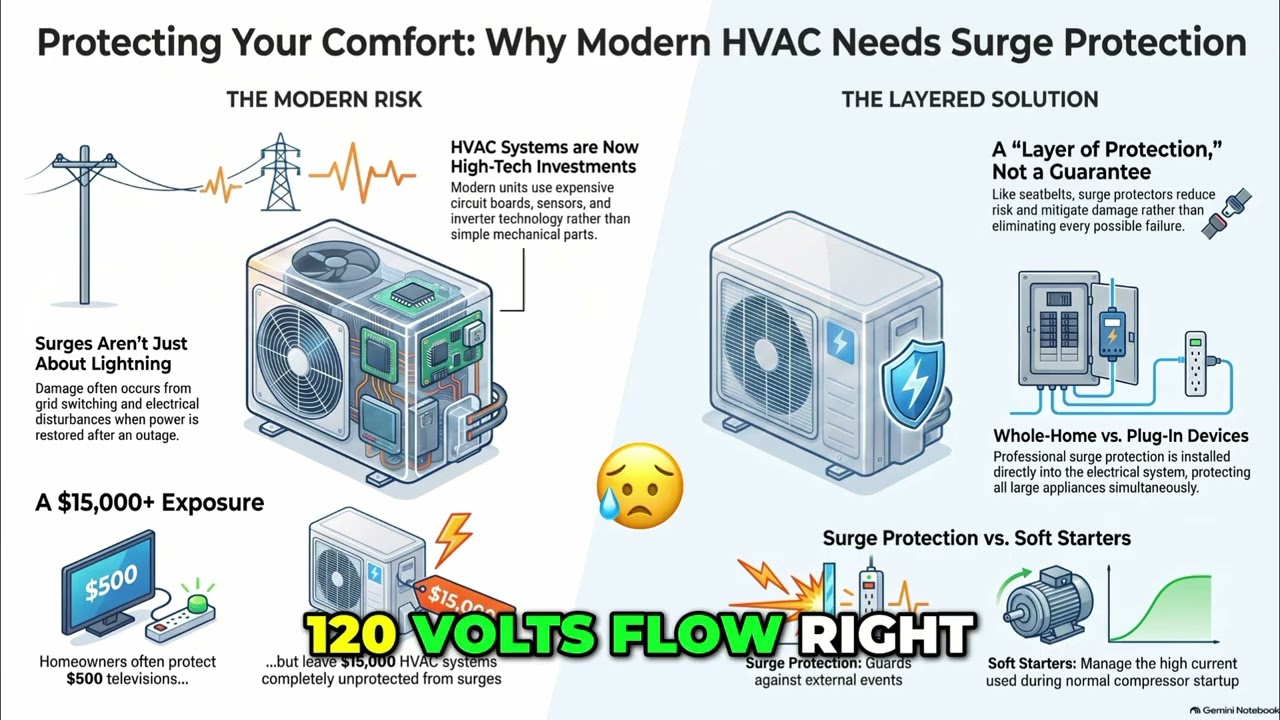
In this segment, the hosts explain that whole‑home surge protectors are not ordinary power strips but commercial‑grade devices installed by a qualified electrician directly into the main electrical panel. They describe the core component—a metal oxide varistor (MOV)—using a pressure‑relief‑valve analogy: under normal voltage the MOV is inert, but when a surge pushes voltage above a safe threshold it instantly drops resistance, shunting excess energy to ground and preventing it from reaching any downstream appliances. The conversation emphasizes that placing this “gatekeeper” at the panel protects every modern, electronics‑laden device in the home—from smart refrigerators and Wi‑Fi‑enabled washers to LED bulbs and laptops—by stopping surges at the front door before they can damage sensitive circuitry.
Chapters
When Derek talks about adding a robust layer of protection, he is absolutely not talking about buying another plastic power strip like the one behind your TV. He is advocating for whole-home surge protection.
Right. And a whole-home surge protector is an entirely different class of device. It is a piece of commercial-grade hardware that a qualified electrician or an HVAC professional installs directly into your home's main electrical panel.
You mean like the main breaker box in the garage or the basement?
The main breaker box, yes. It acts as an absolute gatekeeper for your entire house.
Hmm.
And to really understand the mechanism, we need to look at how it actually handles the physics of a surge. Inside that device is a component called a metal oxide varistor, or MOV for short. Picture it sort of like a pressure relief valve on a high-pressure steam pipe. Under normal, everyday conditions, the MOV just sits there. completely invisible to your home's electricity, just keeping the valve shut.
Just letting the normal 120 volts flow right past it into the house.
Exactly. But the absolute microsecond that voltage spikes above a safe threshold— say, it climbs past 150 volts because the neighborhood grid just came back online— the MOV's electrical resistance instantly drops to near zero.
Oh wow!
Yeah, it throws the pressure valve wide open, it grabs that excess chaotic energy and shunts it directly down your home's grounding wire, safely dissipating it right into the earth before it ever has a chance to travel through your home's internal wiring.
So, it literally stops the surge at the front door. It arrests that chaotic energy at the panel, meaning the spike never even reaches the delicate circuit board of your air conditioner.
And the incredible benefit of putting the Gatekeeper at the front door is that it doesn't just protect the air conditioner.
Right. Because it covers everything down the line.
Yes, this is a true whole-home solution. Think about your house right now, like Derek says, walk around and look at what you own. Everything has a delicate microchip in it today. Your refrigerator has a touchscreen, your washing machine connects to the Wi-Fi, you have smart garage door openers, expensive laptops charging all over the place, and elaborate home entertainment systems.
Even modern LED light bulbs have tiny electronic drivers inside the base. I mean, a single powerful surge event can wipe out thousands of dollars of appliances and smart home tech across your entire house in just a fraction of a second. Installing that MOV pressure valve at the main panel provides a protective umbrella over all of it.