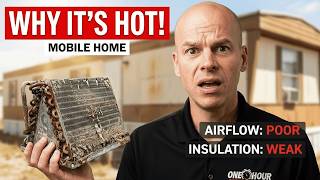
In this throwback episode of the Ask Derek Cole Show, Derek Cole addresses two common homeowner concerns. First, a caller explains that the front of their double‑wide mobile home stays cool while the back becomes unbearably hot. Cole explains that mobile homes have two parallel duct tracks (front and back) connected by a crossover duct. If the crossover is damaged, missing, or has a hole, airflow to the back track is restricted, causing uneven temperatures. He also describes a "4‑point tie‑in" solution where two junction boxes are added to each track, improving airflow without removing existing ducts. Second, a caller asks why replacing a warranty‑covered compressor is so expensive. Cole details the hidden costs beyond labor: refrigerant recovery, proper disposal (EPA‑regulated), replacement of the filter‑dryer, vacuuming the system with a micron gauge, soldering and copper work, and the use of specialized equipment such as nitrogen purging. He emphasizes that quality installations require these steps and tools, and that cutting corners can lead to future failures and additional expense. Throughout, Cole stresses his philosophy of "pay now or pay later," urging homeowners to weigh price against quality and long‑term reliability when choosing HVAC contractors.
Chapters
It's the heart of the system that's failed. So to replace it correctly and spend the time to make sure it's done correctly costs some money. Uh, you have to have all these tools in place. So yes, you can pay for it now. Like I always say, pay for it now or pay for it later, but you're going to pay for it. So if you don't have somebody doing a quality install of that compressor and cutting corners, then you're going to pay for it again sooner than later. Hey, what's going on? Uh, today we are throwing it back to episode 73 of the Ask Derek Cole Show, done years ago. Uh, and you can tell with my voice, MS has, you know, not progressed to where it's at today. So, uh, a little bit clearer, but we're answering questions about a hot mobile home and about a warranty compressor, something very important this time of year. So enjoy the throwback. Hey, on this episode we talk about not getting airflow in your mobile home and why is my warranty compressor costing so much. You ask your comfort and energy questions and they get answered. This is the Ask Derek Cole Show. Hey, this is Derek Cole. Welcome to episode 73 of the Ask Derek Cole Show, answering your home and energy questions. And yes, we're filming this on a Wednesday. Obviously I was out of town yesterday. Something happened in the background, but we're just gonna not pay attention to that. We're actually building on to the back— back— we're building— we're building in the back. It's the warehouse and we're building offices in the warehouse, so it's kind of weird. So if you hear banging noise or If you hear anybody screaming, that's why.
The front part of my mobile home stays cold while the back part gets too hot to sit in. Why is this happening?
So with the mobile homes, we do a lot of mobile homes, mostly double wides. Do a few single wides, but mostly double wides. With the mobile home, you have basically, if you can visualize the top of your mobile home looking down from Google space, You have two tracks of ductwork in a mobile home. You have the front track, you have the back track. Now connecting those two tracks is what we call crossover duct. So we go in to replace a system, oftentimes the crossover needs to be replaced because something has happened to it. So that kind of sounds like what's happened here. You're getting the air on the front, but the crossover duct to go to the second track is not connected or has a hole in it, not getting the air where it needs to go. So that's why you're hotter in that side of the house versus the other side. Also, what we do with a lot of mobile homes is, and I talked to a contractor last week about this because he was not aware you could do it, is we do what we call a 4-point tie-in. So we replace, we leave the tracks in the duct because obviously you can't mess that up, but we put in 2 boxes on each track. So you have 4 points and then we tie it in so you have better airflow. But to answer that question, it's probably a crossover duct problem, which we can handle and look at. And typically when we replace a system, the crossover needs to be replaced. That's why you ladies see that in the notes quite a few times. So when do a double one is because over time it deteriorates, get damaged. Or has a cat or a squirrel, whatever is under there, messing it up.
A what?
Ducked. You said diff? I heard diff.
I said duck. She's a ducked person. I meant to say duck.
I like Oregon Ducks too. Alright.
Why does it cost so much to replace my warranty compressor?
That is a good question. We get that question quite a few times when we have that situation. Um, just because your compressor is under parts warranty, it doesn't mean everything else is covered. Now you get a price, they'll say that's labor, but it's really more than just labor. Um, you actually have to, you know, uninstall the old compressor, install new compressor, solder back in, make the fittings, get our all the refrigerant out of the system, dispose of it, pay somebody to get rid of it after you dispose of it at their house. You then take it back here, or you pump it into a bigger tank, and that tank gets taken away by another company that properly disposes of refrigerant. Because once the compressor is bad or damaged, uh, or has a burnout, that refrigerant is no good for it anymore. So all that has to be done. You have machinery to do that with. Obviously the machinery costs money. All that refrigerant disposal costs money. You have to go back with new refrigerant, clean refrigerant, weigh the refrigerant in. You have to use a micron gauge to actually pull a vacuum on the system to make sure there is no air. Anytime you open a closed system like your HVAC, when you do that, they have a filter dryer. Now the dryer catches any impurities in the system before it gets to the critical components. So anytime you open a system, that has to be replaced as well. So you go through all these steps to make sure it's installed properly, which probably will take you 4 or 5 hours, uh, depending on the location. Um, so I've told customers before You know, why are you this and this company's this and this company's this? Look, there's a lot of corners you can cut in installing a compressor or a coil or something major like this. You can cut corners. You cannot use a micron gauge. You can leave moisture in the system and not take it out. Okay, it's going to work for a little while and then you're going to have another failure. You cannot properly dispose of refrigerant. I mean, a lot of companies, I don't know what they do with the refrigerant, but it's not collected. So they break EPA laws by not collecting. And whatever they did, you know, it's cheaper not to do that. Yes, it's cheaper not to do that. It's cheaper not to have all this equipment to make sure it's done properly. But it goes back to the reason it costs so much is because this at least for us anyway, it's a quality installation and we stand behind it. So yes, the compressor is under warranty, but there's a lot that goes into replacing a compressor. I mean, it's a critical component, it's the heart of the system that's failed. So to replace it correctly and spend the time to make sure it's done correctly costs money. Uh, you have to have all these tools in place. So yes, you can pay for it now. Like I always say, pay for it now or pay for it later, but you're going to pay for it. So if you don't have somebody doing a quality install of that compressor and cutting corners, then you're going to pay for it again sooner than later. So we take the time and do it correctly. Yes, it does cost a lot more money. You have to go through a lot more steps, and you have to use things like— I mean When you— if you're really interested in this, let's see, you're really technical. If you want a U-tube, uh, soldering unit or, or sorting copper, you should have— you should be flowing nitrogen in that line. That way you don't have sitting solder, everything can pass down in the system. We do that. Now, does nitrogen cost money? Yes, it does. So that's another corner you can cut to make the price cheaper. So it goes back to you get what you pay for. I think, uh, that's it. All right, all right. So that's episode 73 of the Ask Derek Cole Show. I kind of got on my horse right there and rode that one out, but the main point being, guys, there's always somebody to do it cheaper. Always somebody that will do it cheaper. But to get cheaper, you have to understand what you're giving up to get cheaper. There's always a trade-off. There's price, quality. What are you giving up to get to that cheaper point? So I'm not saying overpay for anything, but then again, if you got to say, okay, this comes from— this company's at $200, this company's at $500, This company's been around 70 years almost. This company's been around 2 years. What's missing? What's the difference? Why is there a gap? So, see you next time.