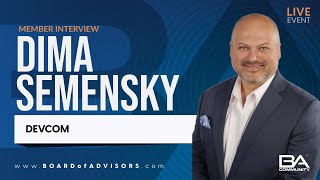
AI Augmentation: The Future of Software | Carrie Charles & Dima Semensky | BA EP 042

A recorded interview between Carrie Charles and Dima Semensky (BA EP 042) about software strategy and AI augmentation. Dima emphasizes process as his company's primary differentiator (a disciplined, metric-driven development cycle), describes a challenging project building commercial real-estate appraisal software (extracting client domain knowledge to generate long, parameterized appraisal reports, described as ~200 pages), and explains how his team translates non-technical founders' ideas into technical specifications. He recounts adopting AI after ChatGPT's release, investing in capabilities, and delivering production AI solutions—preferencing augmentation of existing legacy systems with embedded AI widgets over full rewrites. Practical advice includes: start experimenting with conversational AI (e.g., ChatGPT), keep sensitive data in-house, assign or hire AI-skilled staff, use SaaS as a quick start while tracking gaps, and switch to proprietary software when ROI and feature needs justify it.
Questions this video answers
About 200 pages.
About 40% of his day.
Chapters
So, Dima, what are your differentiators? Because I know there's a lot of people that. A lot of companies that do what you do. What would you say really makes you stand out?
Yeah, yeah. So we've been struggling with this for. For a while. And about, you know, three, four years ago, I finally was able to nail it first. A lot of my team is offshore, so we have a bit of a cost advantage now. There's other companies that are offshore as well. So. Okay, how do we differentiate among those? And I think the biggest thing that we have, it's not technology, it's not cost, but it's process. We put together a bulletproof process of developing software. So it's very meticulously designed and followed by everyone at the company. And so I look at my company as a machine that produces software. It's something that is happening every day, every week, every month, as a cycle. And we have metrics to measure the performance. We understand where we sort of sliding as far as timeline or budget, and we're able to regroup and then sort of all of the team members understand the process and really like it because that gives them confidence. I look at the process not as a constraint, a red flag sort of idea, but more as a confidence booster. Okay. All I need to do is follow the rules and everything's going to be good. Believe in the process, believe in design, and then whatever comes out is most likely going to be a good product.
What is one of the most challenging projects that your team has worked on and how did you get from, let's say, point A to point zone?
Yeah, it's almost like going to gym. Every time you go there, you think it's. It's not gonna. It's never gonna be easier because you lift more weights, and it's still challenging. So I feel like every new project is more challenging than before because we take on more and we want to go faster and we want to go better. So I think current project that, you know, we're involved in or we're building, but I'm sort of more involved in other projects, is a real estate commercial appraisal, property appraisal software. And it's a very complex structure. If you ever seen an appraisal report for real estate, commercial real estate, it's 200 page document that's generated based on variety of parameters. So neither me or my team knew anything about real estate appraisal before project started. Yes. The client is subject matter expert, but we had to pull this out of their heads. We had to document it. We have to consume that, all that information and produce the product. So it is still going on and it's still challenging where, you know, things that they expected were not, you know, really developed and now we need to pivot and, you know, we make compromises. So it's challenging, but it's very exciting. It's very fulfilling versus our enterprise. Clients are very smooth and kind of, I'm not saying boring, but they're more reliable and predictable, but maybe less excitement, less, less experience there.
So when it comes to experience, I know that some of your clients probably have, you know, they're techie, they have a lot of experience in tech and then there's others who don't. Right. And so walk me through the process of I'm an entrepreneur, probably fit within those parameters you mentioned. And I have an idea. Yeah, I mean, I've just got this crazy idea. I thought, wouldn't it be cool if I developed this? I have no idea if it's gonna work. What would you do with me to get that from, let's say just out of my head to a place where we could decide, yes, we're gonna make this happen. Here's the cost and so on and so forth.
Yeah, so that's great. Yeah, we have a lot of clients that have no technical teams except us. But this is even more special case where a non technical founder, we would call him or owner, would come in with ideas. So they come to me. There's only two people that I trust, me and my partner, that we really have these conversations and we try to understand what's going on, what are they trying to build and then basically translate it to the next level to my team that can pick it up in more technical terms. So a lot of what I do is besides running the company is translating sort of non technical ideas and actually help entrepreneurs to form that. Because a lot of times entrepreneurs have this idea but they can't even verbalize it. Many times every time we talk, it's a different thing. And so I'm able to. And hopefully able to create a structure for that and then bring it down to a little bit lower level at a technical and then help you sort of create more technical specifications and run the project. And I love to do that. That's my favorite thing to do. So this is like every time I love it. I just did ba this time, three times already in two days. So kind of. So yeah, that's what it has to happen. If you go directly to technical people, that could be dangerous and that happens.
I did that. Yeah, I did that. And I talked to you about that yesterday where we went straight to a developer, had really a pretty good piece of software design, but now we're thinking we should take this to market. And I remember what did you say to me yesterday? We may have to rewrite it.
Yeah. So there's a difference between building software for yourself versus trying to go to the market with it may have to be rewritten from scratch or at least significant upgrade, which has its own cost as well. And then another thing, we talked about assessing that. So that's what I also help many times is help assess what it would take to get there. And then on the other side, the market opportunity, is there really a market for it and what does it look like over what period of time?
And so for. Actually, let me ask you this because there is no conversation anywhere on earth today without mentioning AI. So what are your capabilities and your team's capabilities when designing a piece of software or a product that has AI capabilities?
Yeah, so we started looking at AI two years ago. The first ChatGPT came out and I looked at it and I immediately got captured by it. I, I can't say I knew where it's going to be even, but I already felt it's a, it's, it's sort of a game changer. And we invested a lot of time and money into acquiring the expertise. And now it's, we, I think we are a little bit ahead of maybe other people. We are building production great software for our clients. Because I started going to my clients and say, hey, let's do something with AI. And some of them said, yep, and some of them said, okay, maybe not. And then the ones that said yes, they were getting ahead of it. And then we started building these prototypes and now real projects. So yeah, we can build basically any type of AI solution at this point that is needed. The key is again understanding where the opportunity and the challenges are. It's what the pain points. And usually there are the manual processing, usually there are where there's a lot of manual work or paperwork or something like that. And that could be automated with AI. And this is still developing. So the main thing is to get in early and start doing something, acquire expertise. And I always say, well, should everyone become an AI developer? And it's like the answer is no, but everyone should understand the capabilities. Just like we all know how to use email. You don't have to build an email system, know how to build your system, but you need to have, you need to know how to use it, you need to. You don't need to build another Google Docs, but you know how to use it, right? Every business person knows how to use business software. Well, every business person needs to know what the capabilities are of AI systems and how to use them in their work. But we can come in and build and augment your software as well as build new systems to help solve business problems. It's all about business problem first. What's the business problem?
So when you said augment your software. So let's say a company already has existing software and they want to add an AI component to that, you can do that as well.
That's actually my main idea. I don't want you to rewrite your software if you want to pull more value out of your software. What it used to be, we used to call it legacy. Oh, it's a legacy system. Let's throw it away and create a new one. And that's a lot of money and time and risk. So what we came up with, and this is what we're doing for one of our clients right now, we're adding these widgets and components that are sort of embedd inside of their existing software that's been around for 15 years, which we've built. And that AI system is connecting to the same data and the same functionality that existing system is, but it does a lot more. And so you don't have to rewrite your legacy system in order to add AI capabilities. Now, that has a limit and eventually maybe it has to be rewritten, but at least I would say for about two to three years, you can actually get away with not rewriting it and pull a lot more value out of your system without spending a lot of money. Just because AI is so powerful in providing features in a very simple way. Right. It's a dialogue. Right? And so that's what we're building right now. And I believe we can build it for any. Like, any company can do this, either themselves or we can help them.
So where do we start? As, you know, as entrepreneurs, as business leaders, if we really don't know how we want to use AI or what we want to build or you know, what we need, where do we start?
Yeah, so this is what I told my team, and I'm going to say the same thing here. You have to start using it yourself. There's time where you hire people and offload it to a specialist. But currently, again, it's just like email. A good example, when email will start coming in, you know, the CEOs started using email. They didn't offload it to the assistants. Right. Everyone had to learn how to use it. So everyone has to learn. So the best thing to start is ChatGPT. Yeah, I know it's boring and it's old, but there's other systems like that. But sign up for ChatGPT, it's free, or you can, you know, buy a little more advanced version for it for $20 a month and start asking questions. Can be from your personal life to your hobbies to your work. And then over time, you will see how you will gain a lot more experience and practice. And you will see, okay, if I ask question this way, I'm getting better result right away. And that will give you first level of understanding. The second thing, if you're a company and you think there's opportunities to use AI, either like you did, as we know, you delegate someone to become an AI expert or you hire a developer on your staff. And it's important to have it in your staff because your data and your content is what matters the most. And you don't want to give your content away. You want to keep it closed until we figure out the legalities of AI and legalities who owns the content. When you use external AI system, talking to your content and what happens with the results, who owns that? Nothing is right now known. It's all in the air. And I've worked with several attorneys that have no idea what's going on. They're trying to put together a framework that as they know it, but they even tell me that that's not even true. They have something, but it's not proven in court, it's not proven in litigation. So the best thing to do is to keep the data to yourself, but also explore all the tools that's out there for various business processes. I use AI today about 40% of my day. If I do something during the day, 40% of it is interacting with AI tools.
So, last question. I know that businesses spend insane amounts of money on their tech stack. And, you know, it just seems like there's a new software product developed just every single day. I get so many messages on LinkedIn. And, you know, many companies have a strong tech stack. So when is it, let's say when would it make sense for a company to look at a product? And this is what we did. We looked at a product that we had and we thought, wait, there's. We want this product to do so much more than it's doing. So we're going to Go develop our own. When would it make sense for a company to do that, to develop their own software versus, let's say, using an outside CRM or an outside, you know, analytics software. The clients that come to you, what are their reasons for doing that?
Yeah, I always, when clients come to me and they tell me what they need and I see that, oh, they can just get away with salesforce.com or another CRM, I always recommend that as a quick start because, yes, there's a quick start and there is a low cost of entry. But as with anything over time, it is not cheap. It is actually cheaper to build a custom system. And what happens is over time, you start lacking the features and then you cannot get them done. Obviously, with a common system, they're not going to customize it for you. And so I think the best strategy is if you can solve it with a cloud system that you can rent, do that, but also have a tracking for what's what, what's, what's, what's not there. And then also the cost projection. And then at some point you will see that it's, it's better to invest in your own proprietary software, which has its own benefits like IP and the multiplier for your evaluation and also your proprietary processes that you can, you know, you can design the software exactly to your business rules and lower the cost of maintenance and lower the cost of software cost overall.
I think you said a key word there is the multiplier. Right. Increase your valuation. And that's a big reason why we do that. Dima, this has been fantastic. I've really enjoyed it. Thank you.
Thank you.
More from Dima
Man vs. Machine: AI, Automation, and the Future of Business | Dima Semensky & Ryan Ogden | BA EP 047