Man vs. Machine: AI, Automation, and the Future of Business | Dima Semensky & Ryan Ogden | BA EP 047
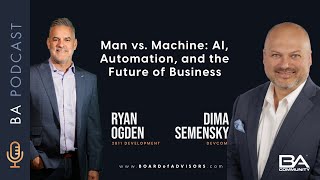
A recorded conversation (Mar 20, 2025) between Ryan Ogden (Momentum) and Dima Semensky (Devcom) about realistic applications and limits of AI/automation in business. They contrast hype vs practical uses, advising businesses to: (1) use generative text widely (drafts, proposals, transcripts), (2) break workflows into small tasks/agents before automating, (3) prioritize automating stable processes (onboarding, pre-qualification, customer support, transaction processing, paperwork/data extraction), and (4) first organize and document data/SOPs. They note current strengths (text generation, research, decisioning via rules/agents) and caveats (need for human domain expertise, risk/guardrail concerns if agents scale).
Chapters
So I'm excited to do an episode here on man versus Machine. And so we. There's a lot of talk about systematizing a business. And I think a lot of people are kind of drawn into this concept that there is an easy button that you can push maybe and you know, that's AI. A lot of times people think. And so I love the idea of let's have a man versus Machine discussion. So I'll start representing the man side of things and kind of the perspective that I'll bring. And then I want to share Dima Szyminski's side of things as well. Let's start with just some quick introductions. So, Dima Szyminski, you're with devcom. And just tell us a little about what you do kind of in this. In this space.
Yeah, I'm in software development. So I build custom software for my clients for the past 25 years. And so that's. And I'm personally myself I have a background in engineering, so I'm still an active CEO and I participate in a lot of projects myself.
Cool. All right. And so in your development, you automate a lot of business processes for people or you Correct.
Yeah. So I'd like to think about what we do is we solving. We help businesses solve business problems. I always try to go down to sort of first principles. What is the problem we're solving with the pain point we're alleviating and which is layering on whatever technology is available, currently available. Again, trying to stay at a cutting edge technology at all times.
Yeah, I love it. And when I've heard you talk about technology, one of the things I love about you is the way you explain it. It's just so simple really. You obviously understand it to an nth degree and really detailed at a really detailed level. But you can just bring it up for everyone to understand. So that's why I'm glad to be doing this with you. So you'll represent the machine side of the perspective and then from my side of the perspective for again, Ryan Ogden with Momentum and Momentum Method is a company that does create, that helps companies systematize their businesses largely through documenting standard operating procedures. It could be other videos and demonstrations, screen shares and things like that, even including workflows and onboarding employees. And we have used some AI tools, which I'll talk about in a minute. But for the most part, I think people have an idea that is kind of one or the other. It's either man or it's machine. And so to set that up, you know, I'd love to talk about. How about. Are there some. Let's start with some of the. Maybe the promise or the myth. I'll put it that way, maybe. What are some ways you might frame that to say I hear people have these kinds of expectations and maybe why those aren't realistic.
Right. So if you listen to a thought leaders around. So we have Elon Musk's and we have son Altman from OpenAI and we have other various thought leaders. Right now they all, they sort of se. They break into different camps. And one camp is AI is just going to help the humanity to sort of evolve and sort of advance human agenda, whatever that is. Another camp is that AI is going to take over and it's going to destroy the humanity and use humanity as fuel. So it's a sort of matrix outcome idea. Some people think about it, it's just like a, it's like a nuclear power idea. So it can be used for good and bad. You have to put safety around it, you have to put government regulations around it and then sort of allow it to evolve within those parameters. So I am in the, I am in a, you know, not in a doomsday camp for sure. I don't think that's going to happen. And the reason I think about it, because AI is nothing else. It's just a piece of software. It's really underneath all the hype, it's just a piece of software just like any other piece of software just called AI versus SaaS platform or CRM. And it's just a tool that we're using. And so I'd like to, you know, I'm trying to understand how to help businesses to utilize it in order to help those businesses, not the other way around.
All right, great, great. And I think I often hear business owners say things like, you know, I just want to take someone else's processes, lift them out of their business and drop in mind. Which fundamentally I think right away is a flawed way of thinking because usually what makes you competitive does not exist in the other business. You know, that's your competitive advantage. And so usually the things that are your competitive advantage are, you know, to some level in their heads. I call that the blob, by the way. They have this blob of information they haven't necessarily, you know, put order to. And so a lot of what we do is we take the blob and then we put order to it. And so you said something that was really profound and just made all of this AI Stuff I think really simple, which is just to set up a little bit more. So we will often interview folks or a few different inputs we'll take, we'll interview or we'll observe what they do or sometimes we'll take any artifacts, any documents they might have, even if they're out of date. And we can kind of infer, okay, if this is how it used to be, this is probably how you do it and get to a version of a draft that can then review. But the, the question of AI. So we've used AI to let's say I in an interview. So I'll interview you and ask you how you do your job. Let's say that's the way that I get information. Now pre AI, I would need to then take that interview and make sense of it manually, listen back through it. Maybe there wasn't a transcription available, it was very tedious. Now with AI I have a generated transcript, you know, automatically available and I can just push a button. Literally. There are plenty of tools out there now where I can just say write the procedures that you can ferret out of the conversation that we just had. And so it makes our job a lot easier. And usually it's still not perfect. We have a few little tweaks to make, but it just makes our job a lot easier. So that's a great experience or a great example of an experience we have where we use AI and embrace it. And you said, and then there are other things that I think people expect AI to do. Switching between systems, handing off tasks between other people and doing lots of more complicated automations like that. And I think you explained it really well of like here around generative AI and here's the, here's the generative AI that exists today that you can really expect to use. There are other kinds of AI that are at least for the non technical users, business owners, they might be out over the horizon. They're probably not quite practical usable yet. So that said, it might have been a long setup, but my question is, would you give us a little perspective on kind of where is AI today? Where it's most practical, what's maybe out into the future?
Yeah. So AI is not just one thing that does everything. It's under, you know, we all have one label. It's easier to operate in general knowledge, general public. But underneath that one term there's various functions just like in a traditional software. There's CRM system, there's accounting system, you can all call it back office, but it means very little because the Back office for one company is very different from the back office for another company. So AI is the same way and it has various components. So the way I like to think about it is what tasks are to be solved and therefore how AI can help with that task. So the first task that AI solves or help solve is generating content. And that could be text, images or video or audio. So we have really four types of content. The fifth one is code, actual programming code as well. That's I would consider also a content. It's a little special because you can run it. And so the first one, generate generative text is right now is probably the best. So if you're not using generative text, you should be using, you should be playing with it. What is generative text? It can generate a draft of a proposal. You can generate a procedure for your employees based on a very small input. And AI takes general knowledge that it was trained on and then enriches your sort of simple limited input and then explodes it into the much more richer content. You can also augment it by providing and feeding it your own special content. So that output is going to be more specific to you, to your specialty. Images are getting there, they're pretty good. They're very good for certain applications, but they're not good for other applications. So that's sort of you can still do this today and if you are in a marketing more and a creative space, that's very good. Videos are even less evolved. But again for small applications that can be used today as well. The second part AI does really well is research and it gets better all the time. Now most of the AI system connected to the Internet and they can google the information so and pull fresh information from the web, from the websites and then basically using its own general knowledge on top of that, provide not just good answers but fresh answers and up to date answers. And that, you know, we can use that in our business day to day. I use it every day. If I have a new client, an industry I've never worked with, which I get a lot before I have a call with them, I'll just do a two minute research with ChatGPT or another similar system in order to get a quick understanding on terminology in a space. And the third one is, which makes a little more unique, is making decisions based on the rule set that is out there. You can train quote unquote AI to make certain decisions based on what and how you build your SOPs or policies and then ask it questions or even do a role playing. Let's say you want to build a new policy and you don't know if it's great or not. You can actually role play with AI where you can run hypothetical scenarios and then let it answer and see what happens and then keep adjusting that policy based on that feedback. So that's kind of the functions that are there right now and that's what you know, in various combinations a business can bring into their process and speed up their processes or make it even better.
I think that's great. So when I put it just in like super practical terms for somebody who's trying to figure out how do I automate systematize my business, how can I best benefit from AI? Certainly generative text should be at the top of the list.
Correct.
So anywhere we're generating text, anywhere we're writing a proposal, submitting, I'm trying to think of other, just a report, anything.
Where we're receiving some proposals or contracts, legal or business. And so generative text is also not just generating text, but it can read the text and you can interrogate your document so you can talk to a data. We say that which could be in a database as well as in your document repository. So that's, that's the most practical use right now and it's the easiest one to start.
Yeah, I think you made me think of when I first started interacting with ChatGPT and doing generative text. I thought of it as a thought partner and so I still think of it that way actually as I'm generating and you mentioned a draft of a document and so that's been my experience too. Very rarely does it just nail exactly what I need, but usually it'll help me with things like, oh, you know, I didn't think of that. I had maybe a five point outline and it gives me a seven point outline. I didn't think of those couple things. You know, it's a great way to just kind of make sure you cover all the bases. You didn't forget anything, gives you new ideas and you can decide, oh, that doesn't apply to my business. And so there are things I have found. There's still usually that last part of a final touch that's needed and then around then this is something I thought was interesting too. If I want to automate tasks, especially handing off between people, going between systems. In the consulting world, we would call that swivel chair kinds of things. I do this here and then over here. So those kinds of things. What I, my experience has been, I love your perspective on this, is that That's a little more difficult for your non technical user to get to achieve with AI because usually you're talking about some programming. Now, unless it's an open API. So unless, and we're getting a little technical here, but some software have open API and so if they're going to integrate with each other through something that's available today, like I'm blanking on the name of the API connectors, but like dot com. Yeah, yeah, that's pretty achievable. Very achievable.
Right. And actually what's happening, because AI right now is rapidly evolving. Every day there is new release, new update of existing product or new product comes out and they all compete with each other. So today you can actually build. So going to tasks. So task is a great way to think about it. The way I recommend to look at it is look at your workflows, what you do in your business, and break it into small independent tasks. A task is something that has an input as some sort of processing inside and then the output. And if you have SOPs like what you do well in creating these SOPs for the business, that can be taken and then actually we can use also AI to analyze and break down those SOPs and specific tasks and connect them in a workflow. And then once we have that connected in a workflow, it could be tasks executed by human or AI agent. So AI agent is something as a piece of software that is able to using, based on your instructions, execute a particular task and there's a handoff between agents or between agent and a human back. And today actually there are systems that you can build those without coding. They're maybe not very detailed at this point or ever going to be. Just like there's a software to build websites without coding that's been around forever, the same things happening in that space.
So with workflows you mean.
Right, with workflows, actual agents. So you can deploy today an army of agents that do certain tasks without writing a line of code with basically interacting with that system like you would interact with ChatGPT.
Okay, so I have a perspective, I want to see if you would agree with this perspective when you automate. And this is really aside from AI, but I'm curious if you agree if it applies to AI also. So when you automate into a workflow, when you automate tasks into a workflow, there's effort to create the workflow and it can be fairly involved. So if you think about the kinds of workflows we're talking about show up often in marketing, you know, so the marketing use case would be when a new customer signs up an email is automatically sent out.
Maybe it's pre qualification running through proposal approval augmentation. Yeah. So it, so I estimate right now the minimal workflow, it takes about six agents to build. And I think if it's, you know, a real life production workflow is probably going to be 15 to 20 agents that are interconnected with each other. So that's kind of my right now, my estimate. And then that's one business process.
Yeah, and I think so I think this makes my point. I think you're going to agree with me then, which is what I would normally advise. A business is trying to figure out what should we automate. You should automate the things, the business processes that are the most established, they really start there. The ones that aren't going to change a lot. The ones because there's effort to go into automating it whether it's through coding or not. Yeah, so it is.
Right. So we call it a stable requirement. So we need to separate stable and unstable requirements. If you're a startup, you may have a stable payables which that's what you automate but your other things are all in the air change every day. You experiment, experimenting, you're researching. Yeah, it's too early. The good thing about agents that as opposed to normal software that you don't have to be very exact anymore, you don't have to be very precise like you would have to be in a normal software because agents have a little bit more freedom of decisions controlled by you within parameters, but a lot more so you can get away with a lot less details and specificity than it used to with a normal software. So that's one big thing. Another thing, if you want to go to a little doomsday scenario, I think what's going to happen and we know that that's just on me but most of the thought leaders think we're going to have 10, 20 billion agents in a few years that going to be running businesses, running informational sort of level of businesses and what's going to happen? I think so if we're going to think the AI is going to take over the world and the AI is going to learn from those agents and it's actually going to build new agents based on what it's learned from what we built and those agents we will not understand. Those agents will not know how they work and then we will possibly lose control. So that could be the doomsday scenario that we should know about it. And so the thought leaders that talk about putting the guard layers, guardrails in there from the beginning, you have to embed that from the beginning. I don't know if you're familiar with sci fi, the three laws of Asimov where robots don't kill humans and so forth. We have to embed those laws inside of agents in order to sort of prevent the worst from happening. And the thing is that the biggest thing is that agents don't have and I think you mentioned that they don't have the will and desires currently. And so that's what controls them. However, there's nothing really stopping from artificial intelligence to achieve and set its own goals. And then when they set their own goals, they're going to try to achieve them like any other intelligent being. And those goals may not be aligned with our goals.
So I think that's a whole topic too of kind of how to garner. We were talking about man versus machine. That's right. How do we make sure we keep control? But I'll put that aside for a minute. I'm glad you brought it up. I think it segues into so what can we do today? I think for most business owners, they think of there's a little bit of fear of what could that happen? And doomsday type of thinking. But at the same time, what should we be doing today? So we talked about that a little bit around anything text generative. I think we just hit on if you wanted to maybe that's kind of the beginner level. And if you wanted to get a little more intermediate, you could look at, well, what are the automation candidates? What would most likely in most businesses, what are the kinds of business functions that can be automated? And then those would be great candidates potentially for the agents and things you're talking about. So I'll just mention a few and see if you want to add two. So like anything that's onboarding, onboarding either new customers or new employees, especially because you're going to do this and you're going to do this and it's going to be a progression.
Especially the pre qualification where you know the ratio of work versus success is low.
Oh, great example.
That way you can. Yeah, this is, this is in every business I think we're going to have that.
Any filtering, vetting of it could be. I had an example of shopping for real estate, property or any. Anything where you're vetting down. Yeah, that's a great example.
Yeah. And the second one on the other side of it is customer support. Customer support currently can be 100 implemented. It's not going to be 100 success, but we see 70% guaranteed success from, from a AI augmented support queue. So you can reduce that. So if you focus on those two things, you can now save those costs, the staffing costs and move that staff, don't fire them, put them on a, on more, you know, human sort of level process. Maybe that's the phone calls, maybe that's extra touch. Maybe it's a concierge service that you can now finally afford, or you could not in the past.
So that's a great example. You have a use case, that's okay in that use case. In that situation we want to jump in and intervene and have the human touch. And now you can actually do that. Yeah, great example. And I thought of one more which was like any kind of transaction processing, you know, just picture the accounting department or you take. I've worked at a dealership helping them map out their processes. And I mean all the deals came across that desk, right? I mean any kind of transaction processing.
Like that, any type of monotonous manual work, it could be also working a lot with a scanned documents, any type of paperwork, which still a lot of it out there that's currently very easy to take into and not even digitizing. That's not, that's. We're past that. We extract the data from the paper, we bring it in. So many, so much data is being ignored right now. And so that's something that I tell to all businesses. What do I do now? Even without touching the AI, the first thing is organize all your content, all your data and understand where it is and don't lose it and actually start saving it if you were deleting it. And second is actually document all your business processes, put them on simple paper. You can use AI to help you with that. Just basically like you said, you can interview yourself with AI transcript that, then send that back to AI processor, ask it to break it down into sops and you'll have first draft, then you review it with someone and you finish it off. So that could be even that. Or you need someone like you to do that. And then once that's done, then you have your content and your processes document and then you can start thinking about building agents and automating everything.
Yeah, and I think I was about to wrap and kind of say so who wins? Man versus machine. But actually I think I'll be the man for a minute and say that at least in our experience. What I find is the example you just gave of the interview. AI again, gets you close and you get a good draft and it accelerates you to the end product. But where we find the human touch is still needed is on things like if I'm going to interview you and you give me a bad answer, a not well thought out answer, or maybe because I have subject matter expertise in what you're telling me.
Correct? Yeah.
For example, I know how to sell and you're letting leads fall through the funnel and you're describing your lead process and I'm like, why would you do it that way? So I can actually offer help also. I'm not saying, hey, I can't do that, I can. But if it's interviewing, it's usually not also looking to give you. Have you thought of this? Or why wouldn't you that or, you know, so that's.
Well, AI is not nuanced because AI knows general knowledge. It's like asking a professor at a university about business advice in your plumbing business. You know, they'll give you a lot of good theory, but they have never worked in the plumbing business and they don't know real, real applications. So someone who actually been around and helped other businesses can really augment that. AI will never be able to do that. Honestly, I think that's one part that, that is going to be extremely difficult because it's a fight between general knowledge and specialized knowledge and it can't do both. Eventually they'll have AI just for biochemistry, just for mathematics, just for physics, but they're not going to have it for each individual thing that we do in our life. So the experience is still going to be important and the practical application is still going to be important. And so that's what we have to take into account.
And the other thing that we end up doing is, although we might have a good draft from AI, we then will interject, hey, right here would be a good sample tool. You just described how you do something and you mentioned a tool and you mentioned a tool that you use. Maybe it's a template or something. Because I know to look for that, I'm going to inject a link. I'm thinking of like if you use Trainual or an SOP system, or even if you're using a Google Doc, you can put a hyperlink to the tool right there. I could say, hey, this would be a great place. That's kind of a difficult topic you just explained. Let's include a little video that we can talk about it in more depth or you can tell the why behind you do that behind why you do that? To help people really learn the content. And so there are little finishing touches like that that we find humans are still doing better, at least for now. But I think on that, unless you had anything else to add, I'd say no.
No.
What a great conversation. Thank you so much. We had man versus machine.
Machine.
I don't know. Do we have a winner? I don't know. I think, yeah.
Well, we'll see. That's to be seen.
I'd say maybe in this case, we both win. Right. Because AI keeps getting better and better and we're getting better and better and faster as we're learning to work together.
We have to watch out for the.
Doomsday stuff you brought up. But, yeah, I see a future where we learn to get. Both of us will get better and better and improve our productivity across all of our businesses and really all the world.
Absolutely. Thank you very much.
Very good, Dima. Thank you. Enjoyed it.
Thank you.
More from Dima
AI Augmentation: The Future of Software | Carrie Charles & Dima Semensky | BA EP 042