10 Ways to Deal with Anger
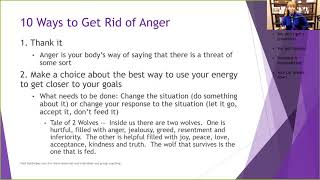
Dr. Dawn-Elise Snipes offers ten practical ways to manage anger, which the average person experiences 15 times a day. Key strategies include acknowledging anger, reappraising situations, physical movement to burn adrenaline, knowing your triggers, preventing vulnerabilities like poor sleep, and building self-esteem.
Questions this video answers
November 17, 2017
15 anger situations per day
Chapters
Welcome to Happiness Isn't Brain Surgery with Doc Snipes. This podcast was created to provide you the information and tools Doc Snipes gives her clients so that you too can start living happier. Our website, Docsnipes.com has even more resources, videos and handouts, and even interactive sessions with Doc Snipes to help you apply what you learn. Go to Docsnipes.com to learn more. I'd like to welcome everybody to Happinesses and Brain Surgery with Doc Snipes, practical tools to improve your mood and quality of life. Today we're going to talk about 10 ways to deal with anger. We're coming up on the holidays, which is supposed to be a time when everybody is happy and footloose and fancy free, but it's actually one of the most stressful times of year for a lot of people. Whether it's because you've got so much going on or be it brings back bad memories or there's a lot of reasons people can get in a funk during the holiday season and anger is one of those funky emotions that may come up. So let's talk about how to deal with it and hopefully help you have a more happy holiday season. So I want you to think about what things trigger your anger. It could be if somebody starts criticizing something about you, your choices that you've made, the way you raise your kids, the way you keep your house, what you look like, whatever it is that tends to get people a little irritable. You may get angry if you don't get a promotion or if you're in a relationship and you get dumped, or if someone is just inconsiderate to you, you may get angry. Other things that can trigger anger include things like your car breaking down. You know, we all have things that trigger our anger and the Average person has 15 anger situations per day. So you know, don't think that you're unusual. But it's important to recognize all of the little things that trigger anger. It can be little anger like irritation and frust, or it can be huge anger like rage, but all of those things add up and kind of drain your system over time. So it's important to be aware of them and try to deal with them as they come up so you don't have suddenly this explosion of anger and hatred and meanness come out. So what's the first thing you can do? And people look at me a little cross eyed when I tell tell them this. But when you get angry, thank your anger. Just kind of say thanks for the heads up that there may be a threat. Because anger is your body's way of saying that it perceives that there might be a threat of some sort. It doesn't say that there is, it says there might be. And anger is part of your fight or flee. So when your body perceives a threat, it says either fight it or, you know, get the hell out of there. Well, we're talking about anger today. So bank your body, say, you know what, thanks for the heads up. And then you can look around and figure out is there actually a threat? Is there something to get upset about or did you misperceive something? So just kind of look around. But if you fight with your anger and, or you stew your anger and you feed your anger and just talk to yourself and oh, that shouldn't have gone that way, and grit your teeth, you're feeding the anger, you're giving it energy, which is going to make it grow. So just thank it, Move on. The second thing you can do is make a choice about the best way to use your energy to get closer to your goals. You only have so much energy. Are you going to use it being angry and irritable about the fact that your car broke down or you woke up late or the power went out last night, or are you going to let those things go? So you've got energy to do the things that are meaningful to you. I mean, how meaningful is it to stay angry about the fact that you woke up late doesn't do any good, or it's dark outside, or even if somebody is unkind to you, how much good does it do? How much does it help you move towards your goals to stay angry at them? You're giving them your energy. You know, just kind of imagine that your energy is dollar bills and you're just handing them money. The longer you stay angry at them, it's taking away from your energy bank. So you figure out what is the best way to use your energy to help you get closer to what is meaningful in your life and what's important to you. And a lot of times you're going to look and you're going to go, well, that person's just not that important to me. Or that situation doesn't mean that much. Sometimes it is something that's consequential, like your car breaking down. So you've got to two choices. And sometimes people say you've got more than that. You can choose to stay miserable, but we're going to talk about the two change choices today. You can choose to change the situation do something about it. Like call a tow truck if your car broke down or change your response to the situation. Let it go, accept it, and don't feed it. So if your car breaks down, you know, you could get all angry about it, or you could just have that anger for a moment because you know, all of a sudden your plans have changed. Say thank you. You're right, this is not really what I intended for today. I got to drop back and punt and then let it go. Don't feed it with anger. Then choose the next logical steps. Calling a tow truck, getting the car fixed, whatever. It is the same thing when people do things to get you angry, whether they say something or do something, figure out a Does this situation even need to be addressed? Is it worth addressing? Is this person worth my energy? Is this situation worth my energy? If it is, okay, then do something about it. Figure out how you're going to address that situation and talk to that person or resolve it if it's not worth your situation, worth your energy. Maybe that person has always kind of been sort of irritable and cranky and negative and nothing you do at this point is going to change how they act. Then you've got to figure out how can you handle it so you can survive. And I'm thinking about those family gatherings and stuff. We all have that one family member who is just a negative Nelly. Well, do you let it get to you and get you angry and get you stressed out? Or do you decide that, you know, that's just the way that person is and that's more their stuff than mine? So I'm not going to give them money from my energy bank. I am going to just let it go and not feed it. It's hard. I'm not saying it's easy. Trust me, I know. But it's a choice. And every time you start to feel that irritation creeping back in, remind yourself that visual. See, I'm frugal. We'll use that word because it's much nicer. I don't like giving people my money. So if I envision myself handing somebody money from my energy bank, it kind of jolts me out of it. And I'm like, oh, that's mine. Anyhow. So there is an old tale, and it circulates on the Internet. But I'm going to kind of briefly tell you here inside us, there are two wolves. One is hurtful, filled with anger, jealousy, greed, resentment, and feelings of inferiority. The other is helpful and. And filled with joy, peace, love, acceptance, kindness, and truth, which Wolf survives. They're constantly battling. And the answer is the one that you feed. So the feeling that is going to survive is the one that you feed. If something bad happens and you get angry, you're feeding that anger. If you take a step back and have compassion and you're just like, oh, bless your heart, then you're going to feed an entirely different animal. And you can remember that little phrase when something happens. You know, sometimes you just got to shake your head and say, bless your heart. And that gives you a chance to kind of get regrounded. Okay, so number three, examine the alternatives. Sometimes people do things and their intentions are good, but they are just going to irritate the crap out of you. So you may need to take a breath and back up and say, let me look at it from this person's point of view. You know, maybe somebody's doing something and they're trying to be helpful and they're just really grating on your nerves. You know, just take a breath and say, okay, let me take look at it from their perspective. Maybe they were trying to be helpful. And again, think about relatives. You always have that one that's in there. Maybe you know that relative who wants to get you married off and she's always trying to set you up with people and just drives you up a wall. Well, okay, you know, you can get irritated, but if you take a breath and you say, all right, let me kind of look at it from her perspective. She's trying to be helpful. Even though she's not hearing me when I say I don't want to be fixed up right now, she's trying to be helpful. So another thing you can do is take a both and perspective. Two seemingly opposing viewpoints can both be right. You know, so when, whenever something bad happens or something happens that you don't like, or somebody has a different opinion, say, okay, can their opinion be true and my opinion also be true. And 99% of the time, yes, you can find some way that they both can be true. So figuring out how to find harmony when two seemingly opposing viewpoints clash. So for example, if somebody is in recovery and people are telling, telling the person, you can't ever use drugs again, they're horrible for you, they almost killed you. And the person is like, well, yeah, you're right. However, it was also the only tool I had that helped me survive until I had other tools. So that can be a both. And you know, if you're in a relationship that maybe your friends don't think you should be In. But for whatever reason, you are not ready to get out of it. You have your reasons for staying in it. They have reasons that you should be out of it. Both of you are probably. Probably have some valid points. So it's a both and perspective. You just kind of have to agree that you are both right. However, you have the choice about what you're going to do. Make lemonade is your next option. When something bad happens, try to make. Find something good in it. You know, maybe your car breaks down. Well, sometimes when that happens to me or something bad happens to my car, I'm running late. I kind of think, well, maybe that was the way the. The universe's way of keeping me from being in a car wreck or something. So, okay, I'll make lemonade. If maybe you took a job that you thought was going to be your dream job and it ended up being horrible and you ended up leaving it, or you're stuck in a bad job, you might look at it and say, okay, this is not what I expected it to be. It's, you know, and I'm frustrated that I feel like I got misled or whatever the case is. However, what are the positives I'm getting out of it? I'm still able to put food on the table. I'm able to do this, that and the other thing. So try to find the benefits. It may not be something, you know, the lemonade may not be strong enough to make you want to stay in that situation forever, but it may help it be more palatable. Kind of like a spoonful of sugar helps medicine go down. Number six, take a walk. When you get angry, that fight or flight reaction kicks up your stress hormones. So your breathing increases, your heart rate increases. All right, well, what is usually going on when that happens and you're involved in some sort of activity? So you've got all this, and we'll call it, for lack of a better term, nervous energy kind of going on inside you right now because your body's prepared to fight. It says there might be a threat. So I'm going to call everybody all hands on deck. Well, if you get out and walk around and use up some of that nervous energy, it can help you get regrounded so you can have a clearer head. Adrenaline usually takes anywhere from 30 to 90 seconds to get out of your system. So if you walk around for about five minutes and get away from it. Now, if you're walking around stewing on it, all you're doing is feeding that wolf. You need to get out, walk around, look at something else. Think about something completely different to give yourself a time to get those stress hormones out of your system so you can think more clearly and be in what we sometimes call the wise mind Number seven. Know your triggers and have a plan. We all have triggers. Things that make us feel, feel angry, things that make us feel threatened. So what are your triggers? Rejection is usually a big one. If you perceive that somebody's rejecting you or rejecting your ideas or rejecting the way you do something, you may get angry or defensive. When you fail at something or you perceive you failed at something, or you perceive an injustice, you may get angry. If there's a loss of control, you know, you get dumped or you don't get a promotion, something happens that you were not able to control, you can get angry. And that can go to everything from, you know, your car breaking down on you to getting a flat tire to the elections, to, you know, what happens at the drive through when you get your lunch, what types of things you know, if you want to look in these three categories, what types of things generally trigger your anger and why. Why do you fear rejection so much? You know, what is it? And when we get down to self esteem, we'll talk about how to address that. Why do you feel fear, failure or why does failure make you so angry? Look at failure as a, wow, I just learned how not to do that again. You know, failure can be perceived as a negative, but you can also look at it as a learning opportunity. I heard somebody say one time, if you've never failed, then you've never stepped outside your comfort zone. So failure can actually be a positive learning opportunity. And recognizing that you don't have control all the time. Now, some of us tend to like more control than others, just temperamentally, but other people have more of a need for control because they felt in the past they've experienced abandonment or trauma or something else. Recognizing that today when something happens and you feel a loss of control, it may trigger some of those feelings of abandonment or whatever. And figuring out how to deal with those is going to be really important. But in the short term, have a plan. If you feel rejection, if you are triggered, if your anger is triggered in some way, have three ideas for things that you can do that can help you not hit that panic button, that can help you de escalate the situation. Walk away, change the subject, take a breath. You know, any of the other things that we're talking about. Have a plan for how to handle it, especially going into the holidays when you've got Family reunions and, you know, Thanksgiving dinner and everybody's around. And if you get set off, what can you do in that situation? If Uncle Bob is drinking too much and he says something unkind to you, what can you do so it doesn't turn into a big hoop dee doo at the Thanksgiving dinner? And yes, it's the responsibility is on Uncle Bob for saying something in inappropriate. That's true. However, you have a choice for how to use your energy and whether you let it kind of turn it into you being the bad guy. So have a plan for how to deal with it. Have a plan going into some of these reunions and meetings and anything if you know somebody's going to be there that tends to push your buttons. Have a plan for either how to avoid that person or how to deal with them so they don't ever even start pushing your buttons. Number eight is prevent vulnerabilities. And during the holidays we can feel like we're pulled at both ends financially time wise, not get enough sleep. When we are sleep deprived, we tend to be more irritable. When we are using stimulants, especially because we're sleep deprived and we're drinking too much coffee, we tend to be more irritable. When your blood sugar gets low, you tend to be more irritable. And when you drink alcohol, you tend to say things, it's a disinhibitor. So you tend to be less inhibited about what you say and what you do. So you can get angry a little bit easier. If somebody says something to you while you're under the influence, you're much more likely to fly off the handle than if you hadn't had that substance in your system. So get enough sleep. Watch your stimulants. I'm not going to say don't use them because, you know, you also don't want to have a migraine in the middle of Thanksgiving dinner. But watch them. You don't want to be pounding back energy drinks right before you go in. Pay attention to your blood sugar. Some people will not eat for 48 hours or 24 hours before Thanksgiving dinner so they can gorgeous themselves. Well, that sets you up for going into Thanksgiving dinner having low blood sugar and while you're waiting around and everybody's gathering, being more edgy and irritable. So think about that. You know, do you need to have a glass of milk or whatever it is that you can do to keep your blood sugar stable and try to avoid the alcohol if you're in a vulnerable situation. Number nine, write it down and talk again later. If you're getting into an argument with somebody, if you're irritable and you decide, this is something I really need to address, but if I say one more thing, I'm going to regret it. Hopefully you're not getting to that point. But if you feel yourself building up, say, you know what, we need to take a break, go somewhere, write down what you're thinking, get everything out. You know, if you're thinking hurtful comments, write down the hurtful comments, get everything out and then shred that piece of paper, get rid of it. So once you get it out of your system, then you can go back and write down more appropriate things to talk about your talking points, so to speak, and censor out the hurtful, hateful, unhelpful stuff so you're not jabbing at the other person. And remember, when you're talking over an issue, when you're angry at somebody, do one thing at a time. Listen to what they say, paraphrase what they said, kind of repeat it back to them to make sure you understood. Then say what you've got to say and don't pull out a list of done me wrongs. You know, just one thing at a time until it's handled and then move on to the next thing. And number 10 is sort of a preventative sort of thing. Work on your self esteem. Because a lot of things that trigger our anger have to do with those fears of rejection. If we fear that if we fail at something, people are going to reject us. We feel that if we're not good enough or we're not pretty enough or we're not this or we're not that, that people are going to reject us. If you work on your self esteem, then you're able to be okay with the fact that, that nobody is gonna like you all the time and not everybody is gonna like you. Just I said it, it's right, not everybody's gonna like you. And even those people who do like you ain't gonna like you all the time. And that's okay because you're not gonna like everybody all the time. So look back over your anger triggers, figure out, you know, whether it's you fear rejection, being judged, failing in some way, not being able to control somebody else's opinion of you. And think about, you know, if I felt good about myself, if I didn't need their approval, if I wasn't afraid that they might leave or reject me, how would my life be different? You know, yes, they could be important to you, no doubt. However, Dr. Seuss says it best. And I've said this one before, those who matter don't mind, and those who mind don't matter. So if you like this podcast, subscribe on your favorite podcast app. Join our facebook group@docsnipes.com facebook or you can join our community and access additional resources, including a group every Thursday evening with Me Live, where you can learn different tips and tools and ask questions about anything that we've talked about or whatever. You can get some coaching advice. Go to docsnipes.com. Thanks for tuning in to Happiness Isn't Brain Surgery with Doc Snipes, our mission is to make practical tools for living the happiest life affordable and accessible to everyone. We record the podcast during a Facebook Live broadcast each week. Join us free@docsnipes.com Facebook or subscribe to the podcast on your favorite podcast player. And remember, Docsnipes.com has even more resources members only videos, handouts and workbooks to help you apply what you learn. If you like this podcast and want to support the work we are doing for as little as $3.99 per month, you can become a supporter@docsnipes.com join again. Thank you for joining us and let us know how we can help you.










