12 Happiness Habits (and Reducing Anxiety and Depression) with Dr. Dawn-Elise Snipes
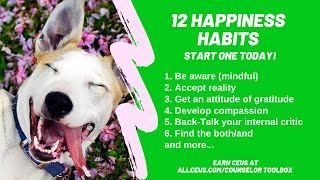
Dr. Dawn-Elise Snipes outlines 12 habits to reduce anxiety and depression, from gratitude and breathing to forgiveness and surrounding yourself with positive people. Happiness lowers HPA activation, improves sleep and immunity, and reduces pain. The webinar includes clinical examples and exercises you can use with clients.
Chapters
This episode was pre recorded as part of a live continuing education webinar on demand. CEUs are still available for this presentation through all CEUs. Register@Allce.com Counselortoolbox you I'd like to welcome everybody to today's presentation on happiness habits. I AM your host, Dr. Donnellice Snipes. In this class, we are going to learn why happiness habits contribute to recovery from addiction and mood issues. And we are going to explore techniques to help clients implement them. And the habits we are going to talk about include awareness and authenticity, acceptance, gratitude, compassion, breathing. Go figure. How breathing can make you happy, purposeful action and long term goals. Back talk. Back talk always makes me happy. Thought conditioning and being sensational. One of the reasons I like to do this topic is because it helps model for clients what life can be like. When I was a very, very young clinician, I was working in a clinic in community behavioral health and most of us were walking around stressed out, freaking out, not looking too happy. And one of my clients came up to me one day and he said, you know, Ms. Dawn is if this is what recovery is like, I don't know that I really want it. None of y' all look very happy. And I mean, addiction has its downsides, but at least there were some happy. And I was like, well, that kind of puts things into perspective. So from there on out, I vowed to model what recovery could be like and to give people the inspiration to want to keep going and keep working toward recovery. Because it is hard regardless of what you are recovering from. And for some others, one of you shared that you worked in the prison system and modeling happiness. Being happy can help other people be happier. It is contagious. So if you are same thing with misery, though. If you are miserable and walking around and grumpy, you're putting off that aura and it's contagious to other people. And they'll be like, ugh, you know, and if you put off happiness, a lot of times people are going to be curious about what's going on and they may also explore it from whatever it is. Explore life through a different lens. If you can just help them take a breath and maybe step, step out of that lens of negativity. So let's go ahead and explore and see where we go with this. What is the impact of happiness? You know, we all know that if we're happy, we feel good, you know, yada yada. But why would I want to work at being happy? Well, before we even get into that, let me give you another Anecdote. If you have a box, you know, just a big old box of stuff. And in that box is all of your unhappiness, all of your problems, all of your troubles, you can go to counseling and you can progressively empty that box, which is awesome. You know, you don't want to be carrying around that weight. But what is left once you remove all of the unpleasant. It is just an empty box. There is no happiness in there. You are not uncovering happiness. A lot of times people are just uncovering emptiness. And that's not what I want. I want them to infuse happiness as one unhappy goes out. It's filled with a happy. And you know, that sounds very Pollyanna ish, and it probably is, but that's how I like to look at it, you know, out with the bad air, in with the good air. Anyhow, the biological impact of happiness reduced risk of diabetes. Interestingly, depending on the study that you look at, people with diabetes have a 41% to 100% greater, or people who are depressed or anxious have a 41% to 100% greater increased risk of developing diabetes. That's pretty big. People who are not happy, and I just focused on depression and anxiety here. I didn't go into a bunch of other stuff, but people who have mood disorders have a greater risk of developing autoimmune issues. Cardiovascular disease. People with depression, for example, have an 80% greater chance of developing cardiovascular disease. So, okay, even if you're not on the happiness bandwagon, let's look at the things that we don't want to get, like diabetes and cardiovascular disease. Maybe that's enough to encourage people to think. All right, well, let me look towards happy. Happiness helps reduce the activation of the HPA axis. You generally cannot be happy and dysphoric at the same time. I mean, you can have a little bit, but most of the time, if you are actually feeling happy, those neurotransmitters and everything are going to predominate. Your serotonin, your gaba, your dopamine are going to predominate, which means your norepinephrine and your glutamate. And some of those other things are going to chill out, which is good. It allows your body time to rest and digest, and it eliminates that neurotoxic environment caused by too many stimulant neurotransmitters in the brain. It leads to improved hormone balance. Well, got to love that. When we're depressed and we're stressed, it alters our hormones, our thyroid hormones, as well as our sex hormones and can lead to things like sexual dysfunction, reduced libido, as well as irritability. Because hormones, even our sex hormones, affect the impact or affect the availability of our neurotransmitters, including serotonin, dopamine, and norepinephrine. When we are looking towards recovery, we need to make sure that everything is in balance. Happiness helps improve sleep. When you try to lay down and go to sleep and you're stressed out, you're depressed, you're anxious, do you sleep well? Generally, no. Generally that HPA axis is activated or you're got hypercortisolism or something's going on and your sleep is going to be disrupted. When people are happy, they tend to have increased levels of their calming neurotransmitters like gaba. They have increased levels of endocannabinoids. You're, you know, basically natural marijuana. They have increased levels of endogenous opioids and increased levels of dopamine. All of those things I'm really, I'm happy to have. And that helps improve sleep. And it also. When we are happy, our serotonin levels or our serotonin system tends to work better in terms of helping us feel calmer. Remember, serotonin is broken down to make melatonin, which helps us fall asleep. So we want to make sure that serotonin is working. We have reduced pain. Low serotonin equates to higher pain or lower pain tolerance, depending on how you want to look at it. When we have low serotonin, which is why some people who have clinical depression also have more pain. Because serotonin is involved in our pain perception, it slows the aging process. When we are happy, when we are not anxious, when we are not depressed, it actually slows things down. If you don't have that HPA axis going, if you're not running on high, running on hot, then you're not basically wearing out the system as quickly. Think about presidents when they start their presidency, and especially the ones that do. Two terms, what they look like when they start and what they look like when they leave office are often very different. And that is one of the best examples of what stress can do to a person. You have more energy when you are happy. Your body is not preparing for fight or flee, and it is not dumping all those chemicals and keeping your muscles tense in order to protect against danger. When you're happy, all that energy is freed up and you can use it for doing other things. When you're happy, you sleep better, which also Means you probably are less fatigued and have more energy and happiness. A good old belly laugh will release endorphins. I encourage people, you know, even if you don't want to do it at work in front of people, that's fine. Not all of us are comfortable being goofy. I am, but I'm probably a little bit of a unicorn that way. A good belly laugh releases endorphins, increases the immune system, and helps people feel happier. Find things to laugh at, preferably not other people that make you happy. I remember when my son was little, we used to listen to a lot of little songs, and we'd watch Sesame street, and I would get songs like Hunker Ducky Dinger Jamboree or. Or Goober Peas stuck in my head. And I'd find myself sort of half skipping down the hallway at work singing Goober Peas. And people are like, are you okay? And, yeah, I was fine. It's a catchy tune. I just had it in my head. And people began to expect that as the norm out of me. And, you know, again, I hope it was contagious and not scary to a lot of people, but endorphins are wonderful things. Figure out how you can get your hit of endorphins. If that means going to Pinterest and looking at funny animal videos or listening to a comedian or whatever it is that works for you. When we are happiness or when we are happy, it is less easy. It's more difficult to be unhappy at the same time. Now you can bounce back and forth, and a lot of people do. And what I say is, you know, we're not going to be happy all the time. We want to increase the proportion of time that we're happy. If you look at somebody over the course of a day, they're probably not going to be happy the entire day. If they are, great. But there may be little hiccups here and there, little irritants. Okay, let it come in and go. And one of the things I encourage clients to do is to spend a week. You know, it's an arduous task to do for more than a week, but to spend a week and identify, you know, keep a log of how much time they spend feeling a particular way, how much time they spend feeling happy, how much time they spend feeling angry. Now they have to do that as they go through the day because it's hard to retrospectively think, well, you know, at lunchtime this happened, and I was angry for about 90 minutes. But encouraging them to practice mindfulness and notice this happened and I stayed upset about it for an hour and a half. How much energy did I use doing that? Emotionally and cognitively, when we are happy, it changes the lens through which we are viewing the world. When we are anxious, when we are depressed, that HPA axis is activated, our threat response system is going off and it has us looking for threats. It has us often interpreting things as threats instead of benign events. When we are looking through a happiness lens, we can sometimes be more objective. You know, when you're giddy happy, you're not going to look at something that's totally dangerous and think, oh, no problem. But when we're happy, it enables us to notice the good things and also to maybe find alternate explanations instead of going straight to the most damning or depressing explanation for why things happen. And when we're happy, it increases our cognitive flexibility. It allows us the opportunity to explore options for why did this happen? Or why do I feel this way and how do I want to improve the next moment? Do I have to stay angry? Do I have to stay sad? No, that's one of those feelings that we feel. It's a natural emotion. However, I also know how I can feel happy. I know what I can do, I know what things make me happy. Which gives me this whole toolbox over here that I can pull from if I decide, all right, I'm angry right now, I don't want to feel angry anymore. I'm going to accept whatever it is happened. It is what it is. Improve the next moment. Let me go to my happiness toolbox and figure out what I want to do do in order to feel better socially. When people are happier, they tend to attract happy people. When you're happy, you know, people who are really depressed or angry are probably going to be a little annoyed by you. Think about that person who comes into work at 8am who is a morning person and just has already had two cups of coffee and as happy as can be. That's usually me and how annoying they are. You know, I usually try to tone it down a little bit when I go into work with around people who are not morning people. But when you are around a happy person, it tends to attract happy people. And if they're not happy when they come into being in your presence, a lot of times, like Lisa said, it's contagious. And eventually they just maybe they start by laughing at you, then they move to laughing with you. That's fine. I used to tell my clients, I don't care if you laugh at me or laugh with me. As long as you're laughing, I've done my job for the day. Happy people have more energy to devote to relationships. If you're happy, if you are not looking for how somebody is doing you wrong, if you are not looking for the threats, if you are not holding on to resentment and anger and grudges and envy and all that other stuff, how much more energy would you have to devote to enhancing and maintaining good relationships? And improved social relationships have a reciprocal effect. As you're happier and you devote more time and have more energy for relationships and are better able to take perspectives, it improves your relationships and those improved relationships provide more social support and and increase happiness. Wow. How cool is that? So let's talk about some habits. How do we make this happiness happen? People need to first start by being aware and authentic. In order to get their wants and needs met, they need to know what they are. We are happy when we feel like we are getting our needs met. You know, there is a big shock there. We want to help people figure out that their needs and their wants are okay. They may not get all of their wants, but it is okay to have whatever wants and needs they have, with a few exceptions, and get those needs met. But they need to be able to articulate them. Encouraging clients to practice mindfulness regularly Checking in and if you've gone through my mindfulness class, you know, I always talk about mealtime mindfulness. Most of us eat at least twice, if not three times a day or more before you start eating. Just doing a body scan, doing a mindfulness scan and saying, all right, what is it right now that I need? Do I need comfort? Do I need sleep? Do I need water? Do I need to go to the bathroom? What is it? What things do I. What are my needs right now emotionally, mentally and physically? And what vulnerabilities do I currently have? You know, it may be noon and you're sitting down for your lunch break and you are just exhausted. The baby had you up all night or the dogs or whatever it was, and you are plumb wore out. And you still have four more hours to go in your day. All right, well, that's a vulnerability. When we're tired, we tend to be more irritable, less able to handle distress. How can I mitigate that? You know, I recognize that I'm tired. So instead of just sloughing through the day and griping and grouching and doing whatever, how can I mitigate that tiredness? Now some people will say, well, caffeine and, yeah, you could but there are other ways to increase energy levels. Deep breathing, increasing oxygenation, going outside and getting some sunlight to remind your body it's time to wake up, not time to go to sleep. Those are things that can help you if you can take a power nap for 10 minutes. Believe it or not, research has shown that a 10 to 20 minute power nap can significantly increase norepinephrine and focus after in the afternoon. So those are different things you can do. You want to evaluate what are your vulnerabilities right now? How can you prevent these vulnerabilities in the future? Sometimes you may not be able to prevent them, but if I recognize every day this week I've been exhausted by the time lunchtimes come around. Let me look back and see what changed and how I can fix it for me. I think I've mentioned to you all that I've got a foster puppy right now. I break all the sleep hygiene rules and I let her sleep with me. Well, yeah, that's not most effective for good quality sleep. So how can I prevent being sleep deprived? Make Lily sleep in her crate, which is not cruel and unusual, but, you know, I like having her there. It's a choice you've got to make for happiness. What is it that's going to make you most happy? And why is it important to prevent vulnerabilities? Well, because when we're vulnerable to distress, we are more likely to have our happiness squished like a bug. You know, you can start out happy, but your threshold, your tolerance for things is probably going to be a lot lower. Vulnerability prevention is definitely something to look at. Living authentically means living in a way that is true to yourself. Encourage clients to take an hour or even 20 minutes and think about what happiness means to them, what makes them happy. You can have them do a collage, you can have them. Sometimes we do a group activity and it seems kind of silly, but, you know, it's better than just sitting there lecturing the whole time. And we will go around the circle and each person has a different letter of the Alphabet and they have to identify something with that letter that makes them happy. Or you can do a balloon toss and whoever catches the balloon has to identify something that makes them happy. It's a little more interactive for group. I encourage clients to make a list that they keep somewhere if it's on their mobile device, if it's in their scrapbook, wherever of things that make them happy. They can even do a collage that they have in a prominent place in their room for Example that they can look at that reminds them of all the things that make them happy. Have them think about how will their thoughts and outlook change when they're happy? And they may shrug, okay, so let's think about a time when you were happy before. What was your self talk like? How was your outlook different when you were happy before? And you know then what it is now? What is the impact of happiness on your health and body? Looking at your energy levels, your sleep, your weight, A lot of us when we're unhappy tend to eat. Some people don't eat at all. But it generally does affect weight, your pain levels and your immune system. Once you start bringing it back to some of the physical things, people are like, okay, yeah, maybe this happiness thing, there's something to it. When you're happy, who do you see in your support system and what will your relationships be like? Encourage them to forecast and if they can't think forecasting, have them look back. When you were happy before, who was in your support system? Who was there, who was helpful? What were those relationships like? How can you make that happen again? What will be different in your day to day life? Hobbies and activities when you're happy? A lot of times people when they are depressed, when they're anxious, when they're stressed, when they're dysphoric, they don't engage in their hobbies, they interest in their hobbies, they're exhausted all the time. So it may just be heck, what's going to be different? I'll be doing them again. And how can you start making these things happen? And I call this the principle of reciprocity. Sometimes you got to, as we say in addictions treatment, fake it till you make it. Sometimes it's important to start being authentic and doing things that you know in the past have made you happy because eventually they'll start making you happy again. As you start feeling happier, you'll want to do them more and that'll make you happier and vice versa. Acceptance is the next habit. So first we're going to be aware, then we're going to be authentic. And when people are not authentic, when they try to be that chameleon, most of the time they are not happy. If they are trying to get approval by being something that they're not, by being inauthentic, then that's going to intensify their fears of abandonment and all that other stuff. Authenticity is so key. Acceptance, fighting against things that are unchangeable or not realistically changeable wastes a ton of energy if you have people, for example, we'll take the incarceration example. Some people are in jail and they are not happy about it. And but staying angry about it isn't going to change the fact that's not going to get you out of jail any sooner. Being happy will more likely prevent you from getting in fights, will give you the energy to do what you need to do to follow directions, get some good time off for good behavior and get out of there. Things that you may or may not be able to change. Feelings, your feelings, now we have them. It's a natural, normal reaction to situations. But you don't have to hold on to those feelings and nurture them and not let them go, which is where a lot of people get stuck. You know, they start feeling angry and they hold on to that anger. They don't know how to accept that anger and unhook from it. So they can choose their next best step. Acceptance and commitment Therapy is awesome for helping people learn to tolerate feelings and develop a more empowered relationship with them. Dialectical behavior therapy is also has, also has some great interventions. Other people, we can't change them. People have to decide if they want to change. If I spend all my time trying to change someone and they don't want to change, I'm just going to get tired and frustrated and angry. It's important that we recognize in relationships what we can and cannot change. If you're in a relationship with somebody and you don't like how they're treating you, what you can change is their awareness of it. You can help them understand what you don't like, why you don't like it, what you would prefer. But it's still up to them whether they're going to change their behavior. Helping clients recognize what parts of situations they can change and certain situations you just can't change, at least not immediately. And you know, anybody who's been paying attention to the news for the past two years or whatever is well aware of, of the fact that some people are not happy with our current president. Well, can we change that right now? Is my personal citizen person getting angry going to single handedly change that? No, it's not. What can I do to change it? How can I influence this situation? I may have to accept that he's in power right now, but if I don't want him to be in power, then what do I need to do to make sure that that changes at a certain point? So encouraging people to recognize the limits of their power, but the fact that they do have a Certain amount of power. The same thing is true if, when people get diagnosed with terminal illnesses, for example, or chronic illnesses, they may not like that. However, it may not be changeable. It may be one of those things. It is what it is. We can't make that go away. We can't unring that bell. How are you going to deal with it? And you can change your approach. You can change your feeling about it. You can do things. If somebody's diagnosed with cancer, for example, they can go to chemo. That's within their power to do. They can't not have. They can't make the cancer spontaneously go away. But there are things that they can do. So acceptance of one's personal power and personal limitations is really important. Encourage people to start practicing accepting situations by just saying to themselves, after something unpleasant happens, okay, what now? Got the diagnosis. Okay, what now? What's the next best step to help me feel happier? Decide whether you will change part of the situation to make it more tolerable or change your reaction to the situation. If you know, let's stick with the chronic illness you get diagnosed with. Crohn's disease, for example. All right, well, I have options. I can continue to eat gluten like it's going out of style and be miserable and doubled over in pain, or I can change my diet, and that will make my pain hopefully go away. So my life is more tolerable. Do I have control of that? Can I suddenly eat gluten anymore? No, I can't change that part. I'm not going to be able to eat gluten anymore. But I can change my diet in order to make my life happier. And you can change your reaction to the situation instead of being angry and resentful and just all tied up about it. Okay, you can't change it. Getting angry about it is not going to improve the situation. A matter of fact, with Crohn's disease, it'll even make it worse. So how can I change my reaction to the situation to one of acceptance? Gratitude is our next habit. We so frequently forget to be grateful. It can be easy to focus on all of the things that we don't have or what's not going right. I've done a few little experiments to see, you know, with the news, making hash marks when I watch the news for an hour, how many unpleasant stories there are or ones that make me unhappy and how many stories there are that make me happy. And you know What? Less than 1% of the stories they show make me happy. Our news even Focuses on just the things that are going wrong instead of the things that are going right. The 150 babies that were born yesterday, and they're healthy and happy and doing all that kind of stuff, we do want to step out periodically and try to identify what's going right. I encourage clients when things go wrong, take a breath, you know, accept, you know, work towards acceptance of what happened. You know, they got into a car accident. Take a breath and, you know, that sucks. The car is going to be in the shop for two weeks or something, may get a ticket, insurance rates may go up. You know, there's some unpleasant things. What went right, you're still breathing. You know, you have the ability to. You have car insurance that will help cover the damage. You. You know, there are positives. So being grateful for the things that you do have or that didn't go wrong. An attitude of gratitude helps people refocus on the positive, appreciate the simple things, and let go of envy and jealousy. There is so much that we could be envious or jealous about. With the influencers on YouTube and, you know, media and everything else. We could be really envious and jealous all the time. But does that do us any good? Does being envious of someone help us feel happier? Does it help us have a rich and meaningful life? No, you know, maybe if it prompts you to set goals and achieve those goals, okay, you know, maybe that little twinge of envy, but holding on to it and nurturing it doesn't do us any good. An attitude of gratitude encourages us to appreciate the simple things, because sometimes you really got to dig to find those things to be grateful for. If it's, you know, you're having a bad day, you may have to sit there and breathe for a second and be like, all right, what am I grateful for? I woke up this morning, I'm grateful for that. What else am I grateful for? And we've all had those moments where it took some digging to figure out five things that we were grateful for. But sometimes that encourages us to look around for the simple things. The birds that were feeding on the bird feeder, the butterflies, whatever it is. Encourage people to remember that even if one area of their life is a mess, it's likely that they have other things in their life to be grateful for. So maybe their marriage is in a shambles. Okay? You know, that is unfortunate and something that needs to be worked on. What things in your life might be, you know, going well? What things in your life are you grateful for? You know, it may be your kids, your House, your job, your health, your, you know, fill in the blank, some funny comedian that always makes you laugh. I don't care. Whatever it is, have people keep a gratitude list and add at least one thing every single day. That went well. You know, I am grateful that yes, it sounds like a elementary exercise, but over time as that list grows, then when you have a bad day, you can go back over and look at it and go, oh yeah, that happened again today. I'm grateful for that. Another one that I don't like as much is to look around and compare yourself to others who are not doing as well or look in your past at the you in your past and, and compare yourself to that and think, okay, you know, I was a mess 2, 5, 10 years ago. Whatever it is, look at me now. I'm not perfect, but I am grateful for the progress that I've made. Compassion is our next goal or habit. Compassion means sympathetic awareness of others distress and desire to alleviate it. But it also means sympathetic awareness of our own distress and desire to alleviate it. A lot of our clients don't have simple self compassion. They are horrible to themselves. They shoulda, coulda, woulda themselves into depression and anxiety. Encouraging people to practice self compassion as well as other compassion. It's a lot easier to be compassionate towards somebody who is unpleasant to you and think wow, I wonder what happened to that person today to put them in that bad of a mood, you know, and then followed by your own gratitude of I'm glad it didn't happen to me. But compassion really helps us reduce how often we get angry. People may have compassion for others, but not for themselves. Encourage people to pay attention to their own self talk. Many of us were raised to think that if we were compassionate with ourselves, it means we're lazy, a weak or a failure and we don't want people to continue to hold on to that mistaken belief. Encourage people to think of three times that they've been compassionate in the past week. To whom were they compassionate, why and how did it impact them? And it doesn't even need to be necessarily a person. My daughter's donkey, we have one foster donkey or rescue donkey and she has no teeth. It just, it drives me crazy. Someday she will not go into the barn and I'm like, it's going to be cold out tonight, Flo. You need to go into the barn. And she won't, no matter how much I plead with her. You know, go figure. So I decided the other day I was going to open the one car garage. You know, she Wouldn't go into the barn, but maybe if she got cold enough, she would go in there. And that helped me sleep better that night. Even though, you know, she probably didn't spend that much time in the barn. I felt like I did something. Even though she was being stubborn and making me angry. Instead of getting angry and saying, fine, be cold, I exercised compassion and that made me feel better. And it was maybe purely a self serving act, but it helped me sleep better that night. And I know she went into the barn, went into the one car garage at one point because I found a half a dozen sweet potatoes slung around the one car garage. But I digress. Encourage people to think about how it impacts others when they're compassionate. If you're working, you're at the grocery store and the checkout person is just in an awful mood and being nasty and short and whatever, you could get angry and be like, that's not the customer service that I'm expecting. Or you could be compassionate again and think, gee, I wonder what's going on with this person right now or you know, in their life that makes them feel that angry. If you react with compassion, how do they react back? I make it a point whenever I go up to tellers or cashiers or whatever to try to be the first one to say hi. Instead of making them say hi because that's what the business tells them they have to do, I say hi. If they've got a name tag on, I use their name and I ask them, how are you doing today? Do I. Am I going to be super invested? Probably not. But I do actually care how they are doing that day. And maybe my taking 10 seconds out of my life to actually ask them that question and share the fact that we are both humans will help them have a better day and feel a little less stressed. That's my hope. Again, those rose colored glasses, I wear them a lot. Encourage people to think about how they're compassionate with themselves and if they're not, how could they be? I tend to be a little bit high strung, so I do have a bad habit of shoulding myself. I should be doing the laundry, I should be mopping, I should be doing the baseboards, whatever. But sometimes I just need to sit down and turn my brain to mush for an hour or so. And it was hard for me to get to the point where I felt okay doing that because I felt guilty that I wasn't doing something else. Have clients look at their issues that surround guilt and compassion. Why do they feel guilty if they're compassionate with themselves. Breathing and Laughter Deep breaths help oxygenate the blood and reduce fatigue. That's a bonus. Slow deep breaths also help lower the heart rate and trigger the relaxation response, which will help trigger the release of serotonin and gaba, both awesome things. On top of that, you know, if you just want to have that uber breath, laughter not only makes you breathe deeper, but it also relieves endorphins. Find comedians. You can go on Sirius XM app, you can go on the Amazon app, you can go on whatever you want and find some comedian or skit or something that will make you laugh. To this day, I can still listen to the who's on first skit and find it amusing. Not nearly as amusing as I did when I was 10, but you get the point. Encourage people to practice deep breathing after each meal. Eating in itself triggers the rest and digest response, but if we practice deep breathing, that helps us relax even more. Encourage people when they're stressed to take a few deep breaths. If they have a fitness tracker, a lot of them now will monitor heart rate variability. And if they identify that somebody is getting too stressed based on their heart rate variability, it will alert them to practice deep breathing for a period of time and schedule in 10 minutes to laugh every day. Whatever it takes for you right now with the puppy in the house, there's plenty of laughter that's going around, but schedule in 10 minutes to laugh every day to release those endorphins. Purposeful Action and Long Term Goals when we are just acting on autopilot and reacting to stuff, a lot of times we'll feel like we're just stuck, we're not making any forward movement. What we want to do is move toward that rich and meaningful life. We want to unstuck ourselves. Basically. When people see that they're moving closer to their long term goals, it inspires hope and it inspires efficacy because they're like, wow, look how far I come. And you know, it doesn't seem so far anymore. Each small step towards a rich and meaningful life can make people feel happier. Purposeful action means choosing to use their energy to do things to achieve their goals. They can be going through the day and something happens and they get upset about it. And then at that point they have a choice. You know, I'm upset, I can go to the bar and have a few drinks and get drunk and forget about it. That's an option. Or I can do whatever this is over here with that same energy that will help me move towards a rich and meaningful Life, as I define it. Encourage people to focus on things they can control. Purposeful action means evaluating a situation and saying, is putting my energy into this going to improve my situation? If not, then I'm not going to do it, but if it is, then I'm purposefully going to use my energy to improve my situation. Have people define what a rich and meaningful life looks like to them. And you can go to the video on psychological flexibility if you want to learn more about acceptance and commitment, therapy and psychological flexibility. But you know, in general it's a pretty front and center concept. What does happiness look like to you? Who is going to be there? What are you going to be doing? If you were happy, what would be different? And have them identify three small changes that they can make today to move closer to that life or even one small change. Encouraging small changes. It's part of that smart goals philosophy. If they make a small change and they're successful, it increases their self esteem, increases their motivation, increases their forward momentum. Back talk Like I said, this is one of my favorites. Your internal critic and ingrained habits can cause you a lot of distress. Choosing happiness habits means quieting the negativity and changing behaviors. Back talk means telling the critic to be quiet and pushing away those negative thoughts. So literally talking back to your own head saying to yourself, no, I don't need to feel guilty for sitting here and watching Netflix or for having a bowl of ice cream or whatever it is that you're doing. I can do that. I deserve that. I'm going to be self compassionate. Back talk also means telling yourself no when you start to engage in unhelpful habits such as stress eating, smoking or engaging in unnecessary conflict. Talking back to yourself and going, no, this is not a helpful use of my energy to move towards happiness. Thought conditioning. Most of us are not in the habit of always seeing the bright side or the silver lining. And even if you are in the habit, sometimes you can fall out of it. Just like conditioner softens your hair. Thought conditioning softens your thoughts by helping you look for the positive, walk the middle path and eliminate cognitive distortions. Thought conditioning and you know, this could be three different groups that you do. You could actually drag this concept out for a couple of days. Looking for the positive in things when something bad happens, what else positive is going on? Maybe not in relation to that. You know, you got into a car wreck and you know, cars in the shop. That that's unfortunate. What's the what positive things are happening? It's sunny out today, you know Whatever it is. Encouraging people to be able to take a breath and embrace the dialectics. There's always good with every bad and there's always a little bit of bad with every good. Which is why you have that symbol for yin and yang. Walk the middle path again expecting that there's going to be good and bad and embracing both and eliminating cognitive distortions. Taking out all of those extreme words like always, never taking out all of those extreme words, you know, there you go. It's hard to eliminate all of them. But paying attention to your verbiage and not only your verbiage to others, but also your self talk helps people figure out and see the happiness in things or see alternate explanations besides the most doom. Saying one and finally being sensational. Your moods are largely impacted by your environment. Think about it. When you go somewhere that is dark and dreary and nasty, how do you feel today? Outside it is gross. There's like 20 mile an hour winds. It is sleeting. It is just not pretty. Outside it doesn't even smell like a pretty winter day or anything. I tried to make it a good thing and it is just cold and bitter outside. How does that make you feel? You know, I feel really bad for the people who have to work in it, but I come inside and you know, I've got warm colors on the walls. I've got Grumpy Cat right here. That makes me happy. I've got pictures of my animals on my desktop. There are things that make me happy that are around. And I guess you guys can't see it the way the camera is, but my husband actually got me one of the is an actual like real pine tree wreath. So it smells like pine trees in here, which is really cool. I haven't had one of those before. But thinking about your senses, because senses trigger memories, we want to trigger happy memories. What smells make you happy? Think about essential oils and memory related smells. You don't even necessarily have to use essential oils. There are certain perfumes that I smell that remind me of my stepmother or my grandmother. What smells make you happy? What sights make you happy? And this could be anything from pictures. Obviously you can have memes and pictures of people and things that are important to you. But you can also have colors. I like being in a room. I like my browns. Drives my daughter crazy. She likes colors and you know, I have varying shades of earth tones and browns but that's calming for me. I like that and I will accent it with colors here and there. But each person has their own preferences and for me, organization is a big one. If I walk into a room and every flat surface is covered in stuff, it gives me a nervous tick. And I know that's my own issue. But if I'm designing an environment that I find pleasing, that makes me happy, I'm not going to have stuff on flat surfaces. There is going to be some element of organization. That's my personal preference. Not everybody's. What sounds make you happy? Birds, music. The sound of running water. And by that I mean babbling brooks or oceans or something. You can get a lot of soundtracks on the white noise machines and DVDs or CDs, and even going on YouTube you can find rainforest sounds or ocean sounds or whatever. And what feelings make you happy? And by feelings, I mean tactile. What touches make you happy? A warm fireplace may make some people happy. A thick angora sweater, cool silk. Some people like wool. You know, go figure. Whatever feelings make you happy. I have one sweater that is just this big fluffy. It's actually polyester blend. It's not anything fancy, but it's this big, fluffy, super warm sweater. And it's one of my favorite sweaters that makes me feel cozy and, you know, happy. I don't know. Have people figure out what works for them and have them figure out how to integrate that into their life. On days that they're not having a great day, they get up on the wrong side of the bed. Encourage them to wear an outfit that makes them feel good, that makes them feel happy. Encourage them to pay attention to the site's sounds, smells, and maybe enhance those a little bit that day to help themselves feel a little bit better at their home, in their car. A lot of us spend a lot of time in our cars going to and from work and in their workspace. You may work in a clinic, for example, where you can't have, you can't wear perfume and all that stuff. For people who have sensitivities to smells, okay, that's fine. What you can do, you can order the little 5ml brown glass bottles usually used for aromatherapy. And you can put essential oils or even spices like garlic or something, if garlic makes you happy in that bottle. And periodically, just take the, take the lid off and take a whiff and it will make you feel a little bit more comfortable. Then you put the lid back on so it doesn't bother anybody else. Peer pressure. Surround yourself with positive people. You know, peer pressure can be positive. Positive people can often help you condition your thoughts, provide support, and are more encouraging. I had a girlfriend when I was in graduate school who was probably the most positive person I have ever met in my life. And she taught me a lot about the power of positivity because nothing was just okay in her life. You know, it was fabulous. And she would whole facial expression and everything. Fabulous or amazing, all of those really excited words. And I mean, she tended to be a little bit animated, but she was so positive and even, you know, she didn't have the perfect life, but she's focused in on those things that were going right for her and that was so inspiring to me. So spending time with her helped me condition my thoughts and learn to look for the fabulous and look for the amazing because, you know, I wanted to grow up to be more like her. Negative people tend to drain energy and enhance a feeling of helplessness and hopelessness. Does that mean we ignore our negative friends? Well, no, because that's not compassionate. However, we need to be able to set good emotional boundaries and recognize that immersing ourselves in negativity day in and day out is not good for our own mental health. If you work in a place where everybody, or nearly everybody you work with is stressed out and miserable and hates their life, well, we got to figure out how we're going to deal with that. At my clinic, after I had that interaction with that client many years ago, we talked about it in our staff meeting and I said, you know, this is not what we really want to be showing to the clients. This is not inspiring, so what can we do? And each one of us, in our own way, did our thing. And one of our clinicians who was career military, he'd been in the military for 20 years and retired and, you know, very squared away, very proper, I won't necessarily say serious, but he was very proper, very organized. You walked into his room, his office, you could probably eat off the floor, it was so clean. But when he would determine in his own way that things were getting too tense or too stressful on the unit, he would don a lab coat, a clown wig, a clown nose, clown shoes, and one of those annoying little horns. And he would walk down to the residential unit and just start squeaking his horn at people. And you couldn't do anything but laugh because it was so out of character for him. But it was one of those things that was endearing when he would do it. Yes, working in a residential facility for people with co occurring disorders, people, a lot of people are going to not be having the best day. That doesn't mean we have to join Them with it, we can show them that there is a little bit of humor, even if just for a second, a squeaky second. So those were things. He also had one of those. He got a. One of the magic wands from Toys R Us or whatever. It was like a Disney fairy wand. And whenever you waved it, it made the magic wand sound. And he would give it to people who were having a bad day, and he would say, you carry this around for the rest of the day, and when you start having a bad moment, wave the wand and see if that helps you feel better. And yes, they felt a little stupid doing it at first sometimes, but it got to be sort of funny and a joke around the facility at a certain point, because it was like, all right, I see what you're getting at. You know, I have the power to change how I feel. Anyhow, those are my Anthony anecdotes for the day. Energy and conversations and relationships is contagious. Think of a person, you know, who's extremely negative. How do you feel when you see that they're calling? It's like, oh, Jane's calling. No, I think I'm just gonna let that go to voicemail. How do you feel after spending time together? You know, if somebody is extremely negative, it can be exhausting. Approach it with compassion. Approach them with compassion. But that doesn't mean you have to immerse yourself in with them all the time. And then think of a person, you know, who's extremely positive. How do you feel when you see their calling? And how do you feel after spending time together with them? And sometimes I blend the two. If I'm interacting with somebody who's extremely negative, I think to myself in my head, what would Stephanie do? And, you know, she was extremely positive. How would she embrace this situation? And, you know, we all have to have our internal Stephanie's, I think. And forgiveness, resentment, regret, and guilt are natural responses to a threat. You know, we want to protect ourselves. Holding on to these feelings drains your energy. Just like trying to walk a dog that doesn't know how to not pull these. The feelings that you're feeling, the regret and guilt and resentment are maybe telling you something bad happened and you need to fit, fix it and. Or protect yourself from it. You're like, okay, this is. This is not working for me. Encourage people to think about something that they're resentful about. Because a lot of us have this closet where we've shoved the resentments. We haven't gotten rid of them. We've just put them in a Closet somewhere. How does holding on to this resentment help protect them? What would happen if they let go of that resentment? They just said, okay, it is what it is, you know, going to let it go. And how can you forgive the person or yourself so it stops draining your energy? And forgiveness, when I talk about it with my clients, is a power play. Forgiveness is me saying, I am choosing not to invest any more energy in you over this issue. That's my choice. I am going to. Doesn't mean I am going to forget, but I am going to let go of the anger that I am holding and, you know, free it up so I can use the energy for something else. Project happiness. Fake it till you make it. Think about, or even try walking hunched over and looking at the ground. They've done studies and they found that when people do that, they feel more depressed. You miss some of the simple pleasures. You know, if you're walking and looking at the ground, you're not seeing the birds flying by or anything else. And you may miss opportunities to positively engage with people. So sit and walk straight. You know, sit up, hold yourself high. Look up from your phone, please, not just periodically, but actually engage with other human beings. Maybe not even have it at the table at lunch or something, unless you're eating by yourself. Make eye contact with people and smile. And I'm bad about doing that one, but I've tried to start doing it more even at the gym. And I find for the most part is very rewarding. People, you know, they're not going to be your bestest friends necessarily, especially at the gym, because they're working out. But when you see the same people there day after day, instead of just walking past them, if you at least acknowledge them, it tends to make them feel like, you know, they're somebody, if you will. You know, they're important, that you're taking time out to acknowledge them. You know, it makes me feel that way when people, you know, just give me a head nod. That's all I'm asking. We don't need to have a deep conversation. Have people think about how else they can project happiness so others can tell that they're happy. You know, there are nonverbals. We can smile, we can look up. What else can can you do? You can laugh. You can sometimes just wear happy colors. I don't know. How can you project happiness? Skipping, that's my favorite. I always default to skipping when I'm in a really good mood. And yes, I'm 50 years old and I still skip. I'm sorry. No, I'm not. I'm not sorry one bit. Happiness doesn't magically happen. By choosing habits habits that promote happiness, we can start feeling happier. People's thoughts, emotions, physical sensations, and environments all contribute to their mood, so encourage them to choose happy. Between writing notes, filing insurance claims, and scheduling with clients, it can be hard to stay organized. That's why I recommend Therapy Notes. Their easy to use platform lets you manage your practice securely and efficiently. Visit therapynotes.com to get two free months of TherapyNotes by just using the promo code CEU when you sign up for a free trial at therapynotes.com. If this podcast helps you help your clients or yourself, please support us by purchasing your ceus@allce.com or getting your agency to sponsor an episode. A direct link to the on demand CEUs for this podcast is@allce.com podcastceus that's allce.com podcastce to sponsor an episode of Counselor Toolbox and reach over 50,000 clinicians per week. Go to allce.com Sponsor thank you.










