12 Things Counselors Need to Learn BEFORE Getting Licensed
Dr. Dawn-Elise Snipes outlines 12 essential skills supervisors should teach counselors before licensure: building rapport, using rubrics for feedback, creating therapeutic alliance, and employing metaphors for insight. She emphasizes structured observation, role-play, and measurable goals to train clinicians and evaluate competence.
Chapters
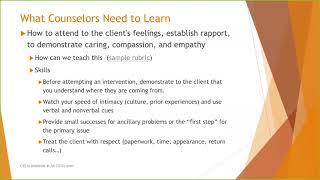
This episode was pre recorded as part of a live continuing education webinar on demand. CEUs are still available for this presentation through all CEUs. Register@Allce.com Counselortoolbox you. I'd like to welcome you to today's presentation. 12 things counselors need to know and how supervisors can facilitate them. So, yes, there's a lot more things than 12 that counselors need to know. But, you know, we've only got an hour today, so we're going to define those 12 things and discuss how we as supervisors can facilitate clinicians learning these particular things. And we'll review supervision goals and individual development plan development. So what counselors need to learn, the first is how to attend to the client's feelings, establish rapport, demonstrate caring, compassion and empathy. And you're thinking to yourself, I thought they already had this. Well, ideally they do, but if you're working with somebody who's doing their first practicum or, you know, they haven't graduated yet, or, you know, every once in a while you'll get somebody who comes along who, you know, has gotten through graduate school but still is working or struggling in certain cases, maybe on ways to attend and establish rapport. So, you know, okay, this is one of those things they have to have because we know that the therapeutic alliance and the relationship is responsible for about 80% of the change that takes place. So we want to make sure this is, you know, squared away and good to go. So the first thing we want to do is teach and make sure our clients can or our supervisees can demonstrate these characteristics. Now this is an example of a rubric and you can look at it more closely when in your class, you don't need to be able to read the 10 point font here, but basically the rubric for creating an environment of respect and rapport, it's four points. Unsatisfactory, basic, proficient, and distinguished is how they anchored it, but you can anchor it any way you want. And the rubric, because we've been talking about rubrics, define what are you looking at at each area? You know, what would. How would you describe an unsatisfactory versus how would you describe a distinguished? So in unsatisfactory, the interactions between the teacher, in this case it would be the counselor and the participants and the interaction among participants. If you're doing group activities, for example, are negative, inappropriate or insensitive to cultural backgrounds and characterized by sarcasm, put down or conflict. So hopefully you'd never get that in somebody that's to the point of needing supervision. But this is one of those things that you would look at now, someone who's distinguished would be interactions among the clinician and the participants is highly respect, respectful, reflecting genuine warmth and caring and sensitivity to cultures and levels of development. The participants themselves ensure high levels of civility among other members in the group. So that would be your highest level. And each one is anchored. So as you're going through and observing a tape or observing a group sess. You can mark off and identify why you marked off the particular level you did. And the rubric goes forward to explain. You know, the rubric is the broad. You know, that would be like your goal statement, critical attributes. These are going to be like your objectives. And these are the things that are present that led you to the description that you had. And then you may have examples. So when I do a rubric or when I have my supervisees do rubrics from their videotapes, for example, I give them the rubric and they have critical attributes they can identify in each area to determine what they've accomplished or what was going on in that session. And then I want them in the examples area to write examples. If they tell me that in this session they were distinguished at creating an environment of respect and rapport. I want them to give me three examples of things they did or things that they saw when they were reviewing their video that led them to believe that. And of course, if I'm filling out the worksheet, that's what I do. But this is something you can have supervisees do when they're reviewing their own videotapes, when they're reviewing their own work. In order to help them become more objectively. I don't like the constructively critical, if you will. They can also do these rubrics even without a videotape. When they walk out of their session, you can have them fill out a rubric. And based on what they remember from what happened in the session, that's time consuming. Most supervisees don't have the time to do that a lot. But it is something that you can consider. So anyway, there's more examples that we'll look at of rubrics. But that was one to give you kind of an idea of different ways you can lay it out. You want to lay out the overall. You know, this is what rapport and an environment of respect looks like. Now, these are the specific characteristics of this, of building rapport, things that you do to build rapport. That way you can mark them off as they're there or they're not there. You can use a Likert scale. You want to make sure to anchor it. And ideally for more reliability, only use four points because when you use five, people generally choose the middle one. They choose three all the time. So use four points of they either didn't do it, they did it some of the time, they did a lot of the time, or they did it all the time. Okay, so skills. In order to help create this environment, clinicians need to demonstrate to the client that they understand where the client is coming from before attempting an intervention. Now I do see this a lot, especially in new clinicians who they get in there and they're so eager and they've got so many tools and they want to share so much. And so the client starts talking and they end up cutting them off or you can see them formulating their response while the client is pouring out their heart. So we do want to ensure that the clinician is listening and understanding exactly where the client is coming from first. Before attempting an intervention. We want them to watch their speed of intimacy. Based on our clients cultures and their prior experiences, they may. The clients may not warm up to the clinician as quickly as the clinician is used to, for example, or if the person is involuntary or they've had bad prior experiences in counseling, they may be a little bit slower to trust. So we don't want the clinician to go in there kind of going gangbusters and with all their enthusiasm and overreach, if you will. So encourage them to use verbal and nonverbal clues. Even if the client says, yes, I'm ready to go here. If their nonverbals are kind of guarded, then being aware that the client may not be ready to go there. Likewise, if the client starts out in sort of a non verbally guarded position and then they open up their nonverbals and start sitting and behaving in a more relaxed manner, then the clinician will have that cue to become a little bit more intimate in the discussion of, you know, the details of whatever they're talking about. Counselors need to learn to provide small successes for ancillary problems or the first step to solving the main problem. Instead of, you know, creating this treatment plan that's going to take 12 weeks or six months or something, and the client sees the resolution way out there, they may start feeling overwhelmed. So counselors need to learn how to provide those small successes. I encourage my supervisees to make sure that their clients have a success in every session. So what did you do? What went well this week? You Know, what improvements did you see this week? And maybe their last week was just a complete disaster. And the client goes, I had no improvements. Well, the success is that you're continuing to try and you came and you're able to reflect upon what went wrong. And we've made plans to make changes so things will get better. So we want to make sure that the clients walk out feeling like they've accomplished something, feeling like they're making progress. And we also want to give clients, whenever possible, tools or something to do to keep their motivation going, keep them engaged in the process every single day between sessions. So if it's doing worksheets, if it's reading books, if it's keeping a journal, if it's practicing mindfulness, whatever it is that we're asking them to do and help them, and this is one of the keys to making it a small success. We don't want them just to do activities for the sake of doing activities, because the clinician said so. The clinician needs to say, if you start practicing mindfulness, it will help you become aware of your feelings, so you're less likely to binge eat, for example. So those are the things that you want to help clinicians kind of develop all the way through, because clinicians have these tools and they're more than happy to hand them out, but a lot of times they forget to explain to clients why, what's the purpose, what's the benefit to using this tool and treat the clients with respect. And these are points, you know, I said that we hoped that clients would have or clinicians would have the ability to establish rapport and demonstrate caring and everything from the get go. And that's true. But these points here, these four points are things that I all too regularly see, not only with supervisees, but with staff that I've worked with. So it's important to make sure that we take it past the very basics of establishing rapport and really create that environment of respect. Which means if you're having clients do paperwork, have the paperwork ready, don't be disorganized, but also don't launch into paperwork the minute the client walks in your room. It drives me crazy when people will take a client into their office to do an assessment. They don't know the client from Adam's house cat. They sit them down and they're like, hey, my name's counselor so and so, and they turn to their computer and they start doing paperwork. No small talk, no get to know you. No very little eye contact. It's just down to business. I know we're pressed for time, and I know there's billables, but it really doesn't take that much time to take five minutes to say, what's your impression? What brings you here today? You know, how is it that you think I can help you or whatever it is and just kind of get a little opening and then explain to the client, I have to do this paperwork, and I'm going to be looking at the computer a lot so we can get it done efficiently. I'm not trying to ignore you. You know, if you have an electronic medical record, you may be looking at the computer. So making sure you acknowledge the fact that the client may feel ignored or disrespected. Because you're all about the paperwork and not really about them. You don't want them to feel like a number. Be respectful of their time. Start on time. Don't run late. Don't be taking calls in the middle of sessions. Appearance, you know, you don't necessarily have to dress to the nines. Maybe in your facility, wearing jeans and a shirt is okay, and that's cool. Just make sure that you are presentably dressed. You don't look like you just rolled out of bed and, you know, staggered into work. And then return calls and keep promises in a timely manner. Do it how you would want to be treated. If you called your doctor and you wanted to reschedule an appointment or you had a question and it took them five days to return your call, how would you feel? So we want clients or supervisees to treat clients the way they want to be treated. We want counselors to learn how to find a collaborative instead of combative metaphor for treatment. All too often, we talk about doing treatment with on counts on clients. Wow, I'm struggling today. Anyhow, using a metaphor in therapy is generally to induce change. In a way, a client is responding to an experience. So if a client is getting frustrated, if they keep doing something and they're not making progress, you can say it really feels like you're hitting a wall here. That's a great metaphor. You know, they may feel like they're walking into a wall and bouncing right off. Talking metaphorically creates some distance that allows the client to talk about difficult things with less pressure. You feel like you're being pulled apart at the seams. So tell me what that's like. Start noticing metaphors that are used by clients, and then write down what questions you could have asked to continue the exploration process in this metaphor. So that's one technique to help supervisees start becoming more comfortable with noticing and using metaphors, because a lot of times it's hard to come up with them right off the top of your head. So if they start noticing the metaphors that those particular clients use, then they'll be able to use those more frequently. Types of metaphors. Sometimes when we talk about counseling, you can talk about it as re parenting. Maybe they didn't have a great childhood and they really want to fix some of those. Some of that stuff that happened back in their childhood. You can talk about it as sort of a family that whoever's involved in their care, their multidisciplinary treatment team, thinking of it as a family, everybody there has a role to do. Everybody there is there to help them succeed. Same thing with the team metaphor. Another metaphor that I've used is a donkey and a rider. Now, donkeys people think of as stubborn and just not wanting to do things. But donkeys are really very smart. One of our donkeys, when we first got them, I knew very little about donkeys, and I learned along the way. But she wouldn't go into the barn. You know, I would take her in because that's where we were supposed to feed them and pick their hoofs and do all that kind of stuff. And I would get her right to the threshold of the door and she would stop and, oh, why aren't you going into the barn? And I got so frustrated. And ultimately I did some reading and I learned that their night vision doesn't kick in very quickly. So if they're out somewhere where it's really bright and they're going in somewhere where the light is significantly lower, they can't see and they're afraid. Oh, well, that made total sense. So I made sure from then on that I had already turned on the lights in the barn before I tried to get her to go in. We didn't have a problem. So helping people view. Helping clinicians view treatment kind of like this donkey and a rider. If the client is not wanting to do what you want them to do, if they're being, quote, resistant, ask yourself, what is the purpose? What is the function of what they're doing? Or why might they not want to be doing what I asked them to do? Because generally there's a reason and it boils down to the alternative. Whatever they're doing is more beneficial than what you want them to do for some reason or they believe it is. So. So sometimes it's a matter of explaining the benefits to the client. Sometimes it's a matter of Changing strategies altogether. But if you look at it as the client is the expert on themselves and they're doing what they can to protect themselves instead of being a stubborn animal digging in, then it's a lot easier to kind of work around. It's just a different mindset. You can help clients look at therapy like a journey. You know, they're here, wherever here is right now, and they want to get to Happiness usa. Now they're going to have to make some stops along the way. So we're going to chart out their plan. Just like back in the day, AAA used to do it, now Google Maps does it, and it will chart your route. Well, that's what a treatment plan is. A treatment plan is going to chart your route, tell you where to turn left, tell you where to turn right, tell you where those rest stops are. And that's important. So if you can view. Have clinicians help clients view counseling as a journey toward recovery or Happiness USA or whatever it is, it's a little bit easier to wrap their heads around. You can have them view it as unraveling a blanket. Sometimes I talk to clients who feel like they're just, you know, they've got this oppressive depression on top of them and they don't feel like they can breathe anymore. That so much is going on. And we talk about recovery is unraveling that blanket that they feel like is weighing on them and suffocating them with a blanket. Anywhere you pull, any string you start to pull is going to start to unravel the blanket. It doesn't. You don't have to start at the end beginning. You don't have to start in the middle. Wherever you start, it's going to start making that blanket lighter. And that's what I like clients to think about. When we start treatment, I'm like, what are you willing to work on? Because any positive change is going to help you make positive changes. So that's another metaphor that clinicians can use. The last one that I like to use and help my supervisees think about is to encourage clients to think about life like writing a novel. They're writing the story of their life. They're writing their autobiography as they go. And when things happen, sometimes it's going to be the end of a chapter. Sometimes a character will, you know, leave the book. Whatever happens, the character leaves and is no longer part of the book. And that's just what happens in that chapter. And that chapter is closed. So what do you do with the next chapter now that that particular antagonist is no Longer part of this story. What does this next chapter start out like? So we talk about life and recovery, sort of like a book. The other nice thing about a book is you can always go back and review those chapters. You know, you're not going to relive them, but you can go back and review them just like clients can go and review memories. So metaphors can be really powerful tools in order to help clients envision the recovery process, envision how they're going to work with the clinician, envision what their goals are in treatment, and kind of envision what happiness looks like to them. Counselors also need to learn how to develop and monitor the therapeutic alliance. So what is it? You know, we talk about the therapeutic alliance all the time, but I don't think we've really defined it very much. Now remember back in the first slide, we had the rubric and we identified that there are components to creating an environment of rapport and respect. Well, there are components to a therapeutic alliance. And some of those components that are identified in the research include partnership. The therapist and the client need to work together as a partnership, each with their own roles and responsibilities, and each being actively involved. It doesn't work really well if the therapist is doing everything or and the client's not going to stick around too long if they think they're doing everything. So both parties need to have an active involvement in what's going on and evaluation and kind of brainstorming. There needs to be an attitude of connectedness, friendliness, and genuine concern on the part of the clinician. And this is one of those things that's kind of hard to objectively put your finger on. But looking at non verbals, you can get a sense of connectedness and genuine concern. Another part of it is communication, being clear and using active listening, which again, we're supposed to do. But too often, especially new counselors are just so eager to get in there and fix the client that they don't take time to hear, listen, and help the client learn how to fix themselves. Empathy and emotional support needs to be there. And individualized treatment with the goal the client sets really being the goal of treatment. Now, you may not have the exact same goal. For example, when I worked in substance abuse, you know, one of my goals was for the client to be abstinent, be clean and sober for, for, you know, the period of treatment. And ideally, henceforth and forevermore. Some of my clients, that wasn't their goal. They had the goal of controlled drinking. They had the goal of just getting off probation well, getting off probation and being clean and sober are not mutually exclusive. In order to get off probation, they had to be clean and sober. And then what they did after they got off probation was their choice. But so our goals kind of work together. But in order to help the client stay motivated, we focused on what's your goal here? Get off probation. Hopefully stay, you know, out of the criminal justice system after that. So how can you do that? Treatment also needs to be holistic and responsive. A lot of clients do better if the wraparound services are identified, if the ancillary needs like housing and, you know, connection with different social services are addressed and influencing factors. This also plays a part in the therapeutic alliance, the client's perception of the supervisees, of the therapist's skill and competence. If the client walks in and thinks that the therapist is a bumbling idiot, then the therapeutic alliance probably isn't going to go too far because are they really going to pour their heart out and take risks with somebody they don't have any confidence in? So skill and competence is important now. It is not the preeminent factor generally. And this is where new therapists, especially those that are in supervision and aren't licensed yet, start getting really hesitant. They're like, well, I'm not licensed yet. I'm an intern. They're not going to have any faith in me. And my response is always, it's about how you present yourself. If you present yourself apologetically, I'm sorry, I'm just an intern. That comes off very differently than, hi, I'm so and so, I'm a registered intern. So part of it is how you present yourself, and part of it is how you interact with the client in the first couple of sessions. If you are organized and present as competent, they're going to forget that you're a registered intern. They're going to perceive you as just as competent as others. And the client also has patient experiences. What's gone on in their life is going to influence the therapeutic alliance. How much they trust you and how much they trust the system, which may affect their willingness to engage. So all of these things come together to form or contribute to the therapeutic alliance. So maybe you've got a client who's had some really bad life experiences and they're involuntary and they're involved in the system and they're just not really willing to engage, and that's okay. That doesn't mean that you can't develop a good therapeutic alliance. That means you may have to go a little bit slower and really enhance These other characteristics here. So you'll talk about this in terms of, in supervision, in terms of what can you do to enhance the therapeutic alliance with this client, to help them become more willing to engage? What do they need and how can you provide it? So enhancing the therapeutic alliance. The therapist's personal attributes such as being flexible, honest, respectful, trustworthy, confident, warm, interested and open have been found to contribute positively to the alliance. So if therapists are having difficulty developing a therapeutic alliance, sometimes we'll just review some of these really basic attributes and I'll say, how can you demonstrate flexibility or respectfulness to your client and are you doing that? And warmth and interest. If they're checking their phone or their watch every five minutes, they're not going to seem interested. If they're looking around all the time, they're not going to seem interested. So paying attention to those non verbals therapist techniques such as exploration, reflection, noting past therapy successes, accurate interpretation, facilitating the expression of affect and attending to the patient's experience were also found to contribute positively to the alliance. So these are other things that especially your new clinicians can really focus on. These are things that are more tangible that they can go, okay, I can focus on noting past therapy successes in session with this client, I can really practice my accurate interpretation, etc. So again, to create a rubric, you can have the attribute here. And when the supervisee is watching their tape, they can put a hash mark in the, in the box that indicates every time they believe that they demonstrated flexibility. And then they can have a narrative over here describing what they did. You know, what those hash marks represented that showed flexibility. And this will give them a really detailed record of what they're doing or what they're not doing. And they might go through and they find out that, you know, they aren't doing anything really to demonstrate honesty. I don't know how you wouldn't demonstrate that one. But, but they might find weaknesses in what they're doing. In developing and nurturing the therapeutic alliance, counselors need to avoid falling into the conventional wisdom that when treatment doesn't meet the desired outcome, it's the client's fault. The client just didn't want to do it. So we need to really focus on not blaming the client. Does the client have a role in it? Most certainly, but so does the clinician. So what was your role in the client's treatment success or lack thereof? You know, maybe you were trying to get them to do something they weren't comfortable with, or you were using a technique that just didn't work for them or it was culturally insensitive or whatever. What impact did the organization have on the client's treatment success? Were they able to get in in a timely fashion? I know, you know, some places I've worked, there's been like a four or six week wait in order to see a clinician. Well, really after four or six weeks, a lot of clients have resolved their own problems or found another therapist. So if the client didn't end up engaging in treatment, your organization may have had something to do with that or their insurance, if their insurance wouldn't pay for treatment. You know, deductibles are so high now. Many clients can't afford to keep coming to coming to services because they have such a high deductible and everything is coming out of their pocket. What did the current field of knowledge contribute to the client's success or lack of success? You know, we are learning more and more every day about schizophrenia and bipolar and depression. So. So maybe there was something. I mean, we tried everything that we knew, but we may not have hit on something that worked for this person. There are still people who have intractable depression and they're struggling to figure out how to help those particular clients. So it might not even be the clinician, the client, or the organization. It may be that we, the field, just don't know how to do best help this particular client. So we want to figure out what's unique about that client so we can tailor our learning towards helping people like that client. And there also may be other people and factors in the client's life if they drop out of treatment. You know, maybe they got fired from their job, or maybe their kid got sick and went into the hospital or they got a promotion and they just don't have time for therapy right now. There are other factors that can contribute to the client's success or maintenance and treatment. So it's not always the client's fault. You know, sometimes the client has other priorities that just trump. I mean, if their kids in the hospital, they're going to be wanting to spend time at the hospital and therapy is going to take a back burner until the child is better, most likely. So these are all things that we want the clinicians to consider instead of blaming the client. But self reflection is definitely due now over self reflection where clinicians feel responsible if the client drops out. Clinicians feel responsible if a client relapses or attempts suicide. You know, we want to make sure that the clinician also recognizes there are other factors at play it's the clinician isn't the master controller of everything that goes on. Because new clinicians can also get overly a sense of over responsibility for their clients, counselors need to learn how to promote the client's sense of personal control and empowerment. We can help clients identify their own goals. You know, help the clinician instead of saying, you're depressed, so this is what we're going to work on. Help the clinician say you're depressed. When you've been depressed before, what has helped you feel better? Or when you've not been depressed before, what has been different and how can we use that in order to figure out how to best help you right now? So we want to help the clinician learn how to elicit the goals from the client. We want to help the clinician remember to ask what has and hasn't worked because there's no sense doing stuff over again that hasn't worked in the past. And if they do want to try something again, they need to explain why it's going to be different this time. We need to help clinicians ask the client's thoughts on what might be an effective next step. So all along the process, we want to be pulling this information from the client and encouraging the clinician to empower the client to take an active role in their treatment. The clinician needs to remember to regularly check in with the client about the effectiveness and utility of treatment. How do you think things are going? What progress are you making on your treatment plan? You know, not asking, how am I doing as a therapist? But asking, do they feel like they're making forward progress? Do we see actual movement acquisition of the goals and objectives in their treatment plan. Clinicians can also empower clients by teaching clients how to set goals. Teaching clients, okay, when you get depressed or if you have a situation that gives you a lot of stress in the future, how do you figure out how to solve it? How do you work through this process and involve them, the clients, in the progress noting process? When clients feel like what's in that chart is a great big mystery and a secret, it's a lot more mystical what we do. When they are taking part in and aware of what's going into the chart, then they're a lot more involved and empowered in the process to be able to say, oh, and don't forget to put in the note that we talked about this. That and the other counselors need to learn how to focus on the future and the client's ability to overcome the past. Many of our clients have really crappy pasts. You know, some of them don't, but many of them do. And if a counselor gets stuck in the past and really just wants to try to dwell there, it keeps the client from envisioning the future as much. So. So metaphors that can be used here, kind of like the forest fire. And obviously you need to be careful how you use this. You wouldn't use it with somebody who had experienced some kind of fire. But the forest fires come, go through forests and clear out the underbrush. Yes, it does, you know, decimate everything for a while, but it makes room for new growth and for the. And it encourages the forest to flourish because it takes out some of the stuff that might be clogging it up. Spring after a long winter is another metaphor that can be used. You know, the winter kills everything off. You know, all your annuals just are killed off. All of your perennials are killed down to the ground. But then they come up again in the spring. During the winter, they're dormant, they're resting. And in the spring is the time for renewal. So, you know, have the clients think about right now. You're coming out of your winter. This has been a really rough time where you feel like you've been, you know, just beaten down. So how are you going to approach renewal? What is your spring going to look like? How can we help clients see themselves as creative survivors? And we need to help therapists figure out how to encourage this. When counselors encourage clients to see themselves as victims, they're not as empowered. When they see themselves as creative survivors, it's more empowering, even something like addiction. Is it a good solution? No, I think we can all agree on that. But was it a creative way to survive until they found a better tool to help them get through? Maybe. So looking at what they're doing, even if it's not, you know, the best choice, it helped them survive. Encourage supervisees to help clients develop an image of the future. And this will help supervisees also envision the future with their client. They can do it through a collage or a narrative or any other myriad of things, but you know, those are the two that I generally fall back on. So focusing on the future and clients ability to renew and spring up and overcome the past. Counselors also need to learn how to engage in brief therapy. And brief therapy is not a minimum of eight sessions. Brief therapy is however much therapy the client needs to achieve their goals. For some clients, it may be three sessions and they discontinue because they got what they needed. Some of them may discontinue for other reasons. But brief therapy is not necessarily a minimum number of sessions. It's however many sessions the client needs to get what they need. But the way insurance is, it's important for a therapist to be able to provide treatment in an efficient, effective manner because you don't know how many additional sessions are going to be authorized. Therapists need to know how to establish the effective qualities essential to counseling before launching into diagnostics. So we talked about this a little bit earlier before launching into, you know, making somebody feel like a guinea pig. Let's help them feel like a human. Let's help them feel like a person that we care about. So talking to the client before launching into paperwork and having them do assessments and getting a full picture of the client and what's going on before labeling something as a mood or personality disorder. And this can mean. And it, you know, makes some clinicians a little bit uneasy that an assessment may take a couple of sessions to really get a full idea of exactly what's going on. Counselors need to know how to adapt a relationship to different clients and their needs. Now, we talk a lot about multicultural sensitivity, so we're not going to hit that one really hard here because that's kind of a done deal. We know that. But there are other issues that come up with clients, like shift workers. If a nurse works from 7pm to 7am you know, when can she get in for counseling? Or if she works 7am to 7pm heaven forbid, five days a week, you know, maybe she's picked up a lot of overtime, when can she get in for treatment? Now, it doesn't mean that you have to see clients seven days a week, but it does mean trying to be flexible and responsive to the populations that you serve. Within reason, parents. How can we adapt the relationship to the needs of parents? You know, during summer break, you know, the kids are out of school. So when we did the IOP program during summer break and spring break, we always had extra staff come in that could facilitate watching the children while the parents were in group. That was one thing that we did. Now, that's not necessarily productive in individual therapy. It's not something you can necessarily do. But working with parents, maybe parents with infants have difficulty getting daycare. So providing tele mental health, you know, counseling through video chat may be more effective. Modifying things. Treatment for persons with cognitive disabilities. And it may not be a huge thing. It may be a mild cognitive disability, but you may have to slow things down a little bit or present Things in a written form in order for them to have time to grasp it. So paying attention to the different needs of the different clients and being creative. We had one client who was trying to write his autobiography and he had the shakes so bad that he couldn't actually hold a pen and write anything that was legible. We didn't have computers in the facility. So anyway, long story short, he recorded his autobiography on cassette tapes and then we listened to them together and then the cassette tapes became committed to the record. But that was one way of meeting his needs and helping him comply with treatment. Counselors need to learn that the earlier change happens in treatment, the more likely will be a positive outcome. So we need to get those early successes. It helps in order to in developing the therapeutic alliance. If a clinician and a client meet and they do that assessment and then maybe the client goes home and keeps a baseline of whatever the target behavior is for a week and comes back and has something to report and feels involved and empowered in the process, they're also probably going to see some improvement just by paying attention to this. So giving clients things to do each week that are going to help them and help them have small successes keeps their motivation going and improves the likelihood of a positive outcome. Other things clinicians can do is use motivational interviewing skills, create small, smart goals, specific, measurable, realistic, time limited and achievable. So set those goals that clients can achieve in a week or even a day. So clients can see that they're able to do some things, they're having some successes, and ensure a success each week and each session. So make sure at the end of session when you're doing your wrap up to point out all of the successes in addition to what you're going to work on next week to help the client see that they're really moving forward. Counselors need to learn how to identify not what the person needs, but what the person already has to work with. And this is a paradigm shift because a lot of times we're taught in graduate school, we need to figure out what the person needs, how to link them up with that and so they can get better. Well, a lot of times people already have a bunch of stuff to work with, they just aren't using it effectively or they don't know that it can help them. So we want to help them figure out how to work with the tools they already have. What has helped you in the past? So encouraging counselors supervisees to use questions like how have you been solving this problem up until now? And what worked, even if just for a little bit, if it helped you cry less, even for an afternoon, what were you doing? You know, maybe you went to a movie or you went out on a hike, and for that three hours that you were out on the hike, you felt better. All right, that's something we can work with. No, the person can't hike 24 hours a day. But that is a tool that we can add into their recovery plan. Encourage the clinician to ask the client, how have they solved similar situations? Or has anybody in their family solved similar situations? And what resources do they have that they're willing to use? Not all clients are willing to use all resources, but you can tap into things like family and friends that can be of assistance. Their spirituality, their coping skills, and even their financial assets. Maybe they need to go on a vacation or hire help to help with the housework or the kids. Encouraging them to brainstorm and figure out as many different areas and tools and resources that the person already has, because that will expedite the recovery process. Help is when the mind is present in the heart, when mind, body, and spirit are integrated, and when an individual is at peace with his mind, body, and spirit, even if one of those elements is experiencing suffering. So I give this quote to my supervisees, and I just encourage them to kind of think about it when they're thinking about the fact that they're in a helping profession. Because, you know, we're working with people who have mind, body and spirit. And while we can't really do a lot with the body, we can refer them out to a medical professional. We can't do a lot with the spirit, but we can refer them to a spiritual leader if that is something that they need. Or we can point them in the right direction, but it's the ability to help people realize that one of those may not be feeling great right now. But we need to integrate them and help the person feel whole. So we as supervisors can offer mystery, compassion, openness, and a simple presence instead of answers or being the expert. You know, I've given you a lot of tools, a lot of things that you can try to help. Supervisees think about asking, but we really want to be as Socratic as possible and ask supervisees, how do you think you can enhance the therapeutic alliance? If they don't know, then they need more education. And you can point them in the direction of some of those articles that I cited and then ask them again after you did all your reading. What do you think you can do to improve the therapeutic alliance we need to learn contemplative listening, which means being receptive to visual, auditory, kinesthetic, and intuitive cues, without an agenda and without a compulsion to help. Sometimes, just like a new counselor wants to jump in and help the client, supervisors want to jump in and help the supervisee because we see that the client is right on the precipice. We want to help them help the client move to their aha moment. But we need to sit there and let the therapist work through their process. One of the most important phrases we can learn are I don't know, and you know what? I could be wrong. I use those a lot with my supervisees because they are the expert on their clients, and the clients are the expert on themselves. And, you know, I know the client as much as I've seen in tapes and as much as the supervisee has let me see. But I don't know everything that goes on in the room in every session. So I hedge always, because I truly don't know everything that they know about the client. So I may give my opinion or what I would do or my perspective, but I could be wrong. So help me, you know, correct me if I'm wrong is one of those phrases I use a lot. We need to create a contract that involves mutually defined goals for both parties that allows for realistic accountability. It establishes a working relationship and lays the groundwork of trust and respect. So creating that individual development plan is important. We need to assess the counselor's clinical knowledge and skills and training using standardized instruments, transcripts, observation with rubrics. So we want to use multiple methods because you don't know how the teachers were grading. You know, you can get an idea. Standardized instruments may be great. You may not have a lot of them available to you, but observation with rubrics can also help a lot because that defines what you're looking at and gets you and the supervisee on the both on the same page. And then you use that information to set learning goals for supervision with an individual development plan. Goals of supervision should be clearly stated, attainable, specific, measurable, and observable in writing and agreed upon by both you and the supervisee. They should contain specific action steps to bring about outcomes, including session reports, review manuals and books. Record and review session. Record and review sessions and use structured role plays. So if a client or supervisee wants to improve their dialectical behavior therapy skills, we're going to have them read about it, learn about it. We're going to review and sessions that were recorded together, we'll rehearse it in structured role plays in order to help them learn, feel more proficient in using those tools. And the IDP should contain specific procedures to evaluate the outcome. So for example, in motivational interviewing, and hopefully the Internet is working well enough to make this come up, in motivational interviewing, you can use the MIA step rubric to identify how effectively someone is implementing motivational interviewing. And this may take a minute. Oh, very good. So then we scroll down and I believe it's on page. Whoops. 90. Maybe, maybe, maybe so anyway, this is like the other rubric where the first part of it, it defines what the term means, what you're looking at, and gives examples of what you're looking for. And then in the scoring rubric, you're marking little hash marks with each time the therapist uses that particular motivational interviewing skill. I'm going to move that over to the side for a second and we'll come back to it in a minute. Individual, individual development plans should include expectations for supervision, including the model of therapy, the number and types of patients to be seen, the number and duration of supervision sessions, and techniques and interventions to be used. Counselor experience and readiness for the position need to be identified, including what is the counselor's current base of knowledge, what are his or her strengths, and what are his or her areas for growth. How are you going to observe the counselor and what procedures are going to be used to determine their reasoning, conceptualization and decision making skills. That way the counselor knows how you're going to evaluate them and they can kind of prepare themselves mentally. So back to our reading guide which finally loaded. So here, rate each clinical behavior and the rating of 1 was it never happened, 2 occurred once, but was not addressed in any depth, etc. And then description of terms so motivational interviewing style or spirit. And it talks about rating guidelines here and really talks about what you're going to be looking for in order to rate this particular dimension. And it does that for every dimension. And then we get down to the score sheet. So the motivational interviewing style or spiritual which was defined on page 105. So then you mark down how many times you see it in a session and then you rate the person's competence on a scale of 1 to 5. And that was all explained in those earlier pages. So that can be really helpful. Now you're not going to do that for every single skill that clinicians are demonstrating, but it can be really helpful for helping people learn a particular method or a particular, particular technique like motivational interviewing or DBT. IDPs also need to include procedures to be used to evaluate the counselor and how often you're going to do it. So are you going to do it weekly, monthly, quarterly, what's going to be happening? And procedures to be used to be to intervene to help the counselor achieve supervision goals. So what are we going to do to facilitate the counselor's growth? And if we see that there's a hiccup, what are we going to do? How are we going to intervene to make sure that the counselor stays on the right path, if you will. In order to assess the learning environment. Now, counselors need to have an environment that's conducive to learning, just like clients need to have an environment that's conducive to growth. So we want to ask if there's sufficient challenge in the learning environment to keep the supervisee motivated. If it's just mundane, run of the mill stuff and they're not motivated, they may not give it their all. So there need to be challenges. Is the theoretical or philosophical dissonance between you and the supervisee manageable? You know, if you're completely on opposite ends, is it manageable or is it not going to be a good learning fit? Does the supervisee have the necessary knowledge and skills to begin the process? You wouldn't take a practicum, one student and throw them into a setting where they were, you know, acting as one of the main counselors on duty and running groups. That's just, that's too much. You know, they're not ready for that yet. So do they have the necessary knowledge and skills but for this setting to begin this process, or do they need to be in a different setting? Does the supervisee have sufficient personal development, self esteem and sense of self worth to progress? We want to make sure that they're not dealing with their own issues when they're working with clients. Does the supervisee possess the basic affective qualities needed for counseling, such as empathy, warmth and genuineness? Now, like I said, sometimes there are issues that need to be tweaked a little bit. But then there's that basic attitude that you get that you get the idea that somebody's there because they really want to help. If you get that idea, you're probably good. And you also want to think about what is the supervisee's investment in the learning process. So when you're creating a learning environment and you're going to have clients going to see the supervisee, you want to make sure that the supervisee is just as invested in working with those clients. As the clients are in getting better, Is the amount of support available to the supervisee sufficient and proportional to the challenge? Are the goals and means of supervision clear and understood by all parties? Are the evaluation criteria realistic, measurable, attainable, accurate, relevant and clearly understood? So obviously you're going to go over that when you're developing the individual development plan. To what extent can the supervisee process feedback? If the supervisee gets defensive or is unable to process constructive feedback, you know that's going to be an issue to think about in the supervision process. Is the supervisory environment conducive to risk taking? If the supervisor supervisee feels like taking a risk might jeopardize his or her job or status or something, then that's going to be a lot more threatening. Or if it's a brand new supervisee in a group with five other clinicians that are almost ready to get their license, that could also be intimidating. To what extent is the supervisor able to help the supervisee integrate new techniques and skills? So if they want to learn, you know, EMDR, and you have absolutely no training in emdr, that's not something you're going to be able to help with. So how are you going to facilitate that? And is there a basis for terminating the supervision at the appropriate time? And generally supervisees are ready to go. Counselors need to learn basic counseling skills. How to use a collaborative instead of combative metaphor for treatment. A process for developing and monitoring the therapeutic alliance. Tools for enhancing success through the use of resources. A method for avoid falling into conventional wisdom. Blaming the client for failures. Strategies to promote the client's sense of personal empowerment. Ways to focus on the future and the client's ability to overcome the past. Brief therapy rationale and techniques. How to establish rapport before launching into analysis and diagnosis. Strategies to adapt the relationship to different clients and their needs. They need to learn the earlier that change happens in the treatment process, the more likely the positive outcome. And how do I identify not what the person needs, but what the person already has to work with? Alrighty, that concludes today's webinar. If you have questions, I am open and willing and I am going to turn the video back on. Hopefully it won't crash on us. For those of you who tuned in a little bit late, our Internet service provider is down in like the entire Southeast, so it's been a little bit jumpy. But so I'm still here if you have questions. Otherwise you are welcome to go take your quiz and be done with me for today and I will see you tomorrow. Same time, same station. Alrighty everybody, have a great day. If you enjoy this podcast, please like and subscribe either in your podcast player or on YouTube. You can attend and participate in our live webinars with Dr. Snipes by subscribing at allceus.com counselortoolbox this episode has been brought to you in part by allce.com providing 24? 7 multimedia continuing education and pre certification training to counselors, therapists and nurses since 2006. Use coupon code counselortoolbox to get a 20% discount off your order this month.










