20 Essential Strategies to Survive Holiday Gatherings and Toxic People
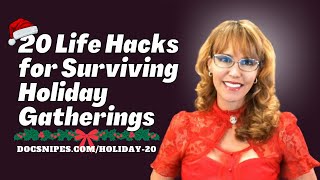
This is a YouTube episode by Dr. Dawn‑Elise Snipes offering 20 practical tips (plus a bonus tip) to manage stress and difficult interactions during holiday family gatherings. Advice emphasizes breathwork, rest, boundary-setting, preparation (planned responses and exit strategies), social supports (battle buddies, safe people), and mindset practices (loving‑kindness meditation, gratitude). The transcript ends with production credits and contact information.
Questions this video answers
Dr. Dawn‑Elise Snipes
November 23, 2021
Mr. Charles Snipes
1633 West Main Street, Suite 902, Lebanon, TN 37087
supportocsnipes.com (as shown in transcript)
Chapters
Hey there everybody, and welcome to this episode on 20 Tips for Surviving the Holiday with Family. I'm your host, Dr. Donnelly Snipes. My first tip is to breathe. And I know that seems sort of obvious, but slow, deep breathing can help trigger your relaxation response. So when you start feeling anxious, you start feeling ticked off. Inhale slowly and you don't have to be all demonstrative about it. You can sit there very nicely and just inhale slowly for a count of six, hold for a count of six and exhale slowly for a count of six. By doing that, you're actually tricking your brain into calming down. So remember, breathing actually can help. Have an emergency text buddy who will remind you to breathe. It can be helpful to have someone who is not there, especially if you don't have a battle buddy with you. And we'll get to that in a minute that you can text when you start feeling overwhelmed or irritated, who can give you a little bit of perspective, give you some encouragement and help you get through the moment. Try to get plenty of rest ahead of time if you're traveling. Traveling wreaks havoc on your circadian rhythms, especially if you're switching time zones. But traveling itself is very stressful. Sleeping in a bed that you're not used to can also keep you from getting as much rest as you probably need. So try to get plenty of rest before you start your travels and make rest a priority during your travel time. It is not the time to be staying out until 2 in the morning when you have to be at your folks house at, you know, 8:00am the next day. So rest can help. When we are sleep deprived, when we are not rested, we tend to be more irritable and tend to be more likely to react to things that normally when we're well rested, we could just kind of let go. Avoid alcohol. Alcohol is what we call a disinhibitor. When you're drinking alcohol, you are more likely to say things that you wouldn't say, say when you're not drinking. Some people say, well, I drink alcohol because it helps me relax. Well, it also relaxes all your filters and that can actually end up causing more problems and making you feel more vulnerable. Proactively associate with safe people. There are probably people in your family with whom you can associate and not risk being triggered in any sort of way. So if you know that Uncle Bob tends to be triggering, he tends to say things that, you know, get under your skin. Try to find somebody else to associate with so you're not just sitting there alone. And Uncle Bob walks up to you. So proactively keep yourself busy. Bring a battle buddy to run interference if needed. This can be really helpful. My husband served as a great battle buddy for me for many, many years, and this is a person who can help switch the topic. If you're having a conversation and it goes to a place that is triggering, sometimes it's helpful to have somebody else who can change the conversation and get you off the hot seat, so to speak. Have an exit strategy or three. You know, you may have a battle buddy who tries to run interference and they're just not that successful at doing it. And it can happen. Make sure you do have some exit strategies so if you start to feel triggered or overwhelmed, you can excuse yourself to go to the bathroom, to go outside, and, you know, watch the kids or help in the kitchen, whatever you need to do to be able to excuse yourself from an uncomfortable situation. Number eight, don't poke the bear, which means avoid controversial topics. There are topics in any family that are controversial, and during the holidays, when people are already edgy, irritable, tired, under the influence, this is not the time to bring those topics up. Number nine, Recognize that many people are exhausted and stressed out from traveling and just life in general, which may cause them to be more irritable and less tactful. If somebody says something that seems rude or invasive in some way, you know, before you respond, take that slow, deep breath, hold it, exhale slowly, and that'll give you a chance to figure out exactly what to say in order to be as kind as possible. Prepare ahead of time your answers to the standard questions most family when you go to visit them, they're going to have standard questions that everybody asks that you're going to say. Repeat the answers five, six times. Every time somebody new arrives, they're going to be like, oh, hey, how's this going? Or what's been going on this year for you? Prepare your answer ahead of time so you're not feeling like you're on the spot. Number 11, don't expect people to change, but be pleasantly surprised if they do. If you have a family member who tends to be hypercritical, who tends to be grumpy, who tends to fill in the blank, expect them to be that way this year, and if they're not, great, be pleasantly surprised. But at least you're prepared. You're braced for it ahead of time. You know, kind of like when hurricane season comes along, you know what to expect. You're not going to live on the coast of Florida and not expect to get a hurricane or two coming through during hurricane season. You brace for it, you're prepared for it. You know what you're going to do. Now, you don't expect other people to change, but you can change how you respond. And that is really important to recognize that if people behave in a certain way and it triggers you, you can choose what you do with that anger or that irritation. When it comes up, you can choose to nurture it, or you can choose to let it go and, and not give them your power, not give them your energy. Recognize that people's behavior is usually about their feelings of inadequacy, insecurity, or just irritability and being overwhelmed most of the time. It probably doesn't have very much to do with you. Instead of getting offended or triggered or angry, try to have pity for them. Think how miserable it must be to live in a body, live in a head that feels the need to criticize and nitpick at everybody else. How insecure must they feel? Tip 13. If you are an introvert, find excuses to go outside, weather permitting, or help in the kitchen. You know, this can help get you out of the hubbub of what's going on. If you can afford to, don't stay with family. That way you have more control over your socializing. My daughter's an introvert and she has a certain amount of time that she's good hanging out with everybody else and socializing and doing that kind of stuff. But at a certain point she needs some downtime. She needs some quiet time. Not because she doesn't like people, but because all of the input from the other people is so overwhelming and exhausting to her, her. So it is important to recognize what you need. And if you stay at an Airbnb or at a hotel, then you don't have to socialize. When you first get up in the morning, you don't have to come down for coffee and breakfast or whatever, and then followed by an entire day of festivities. Not everybody can afford that, so I get that. But if you can consider it, talk to the host ahead of time and let them know that too many people can feel overwhelming and ask them, is there a place that you can take a break if you start to feel overwhelmed or you need some downtime? Is there a place that you can go? A lot of times, you know, in different houses, there's a bedroom or a den or somewhere where you can go to just kind of catch your breath for a minute. Tip number 14 practice the loving kindness meditation before going to the activities. Remember loving kindness meditation. You envision yourself sending positive energies, positive thoughts to these people, recognizing that everybody wants to be safe, happy and loved. So you're sending them thoughts of safety, happiness and love, and hoping that those energies reach them so they're in a better mood. But during the family gathering, remind yourself, everybody just wants to feel safe, happy and loved. So if somebody does something that's triggering to you, remind yourself of these things. That way it is less triggering. And then maybe explore it with curiosity. You know, in what ways is this behavior protecting them? A lot of times, challenging or triggering behaviors from other people are their way of trying to protect themselves because they're feeling insecure or stressed out. Number 15, make a list of distress tolerant thoughts or mantras. For example, it's only three hours. I can do anything for three hours. Say the serenity prayer. Grant me the serenity to accept the things and people I cannot change, the courage to change the things I can, like how I react, and the wisdom to know the difference. Number 16. Maintain and respect boundaries. So maintaining your boundaries means not allowing people to become too invasive, Being able to change the subject or answer a question that stays on a relatively superficial level. This isn't the time where you're probably going to go, you know, deep into all the drama. So don't spill your guts. When people ask questions, provide them an appropriate answer, but not, you know, too much detail. And don't be nosy. This is the time when people are curious. But being too curious can feel invasive to people. You know, you don't want to be asking about their intimate lives or their dating life necessarily, because a lot of people feel very put on the spot when topics like that come up. So do be respectful of people's emotional boundaries and, you know, not being too invasive. Also be respectful and respect your own physical boundaries. If you are not somebody who is super huggy, touchy feely, you know, that's okay. And you know, you may make a concession. I know I grew up in a family that wasn't super huggy, but my husband's family is. So when we go to family gatherings at their house, you know, there's a greeting hug and a parting hug. But, you know, we're not expected to be, you know, huggy, touchy feely the rest of the time. And that's important that you recognize whether you're willing to make that concession. Do you feel comfortable with permitting that or do you need to offer a handshake instead? You know that it really depends on you and what Makes you feel the most comfortable. Number 17. And this is. Some of you will not like this one, but this is one that can make it a little bit more tolerable, and that's to make a private game of it. And I say private because this is not something that you want to make into a big thing with other people. But in your own head, you can make a game of it for, you know, saying, you know, how long will it take before Uncle Bob says something that's offensive? Or how many times will Aunt Sally do this, that or the other? So those things that annoy you, instead of letting them annoy you, you know, kind of make it a game in your own head. You know, it's just a different way of viewing what's going on. Number 18. Kill them with kindness. A lot of times, because people are stressed out, because they're exhausted, because they probably have a lot of the same frustrations and apprehensions about family gatherings that you do. They may be kind of on edge when they arrive at family gatherings. Try to find something nice to say about everybody. When you do, it starts to diffuse that stress, that tension. If you start out with something nice, it's hard for them to respond with something nasty. So kill them with kindness. Number 19. Bring an emergency kit. For some people who get overstimulated easily, especially people who are on the spectrum or who have ADD ADHD headphones, noise canceling headphones might be helpful. Bring fidget items like crochet or even a worry stone. I meant to have one to show you guys, but they're just little stones that you can hold, that you can rub. They actually have fidget rings now. It's a ring, but then it's got a central part on it that you can spin around. So you're not spinning the ring, you're actually spinning a washer, if you will, on the ring. So those are really cool movies. Sometimes it can be helpful to bring movies with you because you can distract people's attention to a good movie. Then there's less. Less socializing for a minute and you have a chance to get your breath. Or even a playlist of funny videos. You know, people may want to talk about it or whatever, but you're distracting. Instead of talking about your social life or how work's going or something that may be more sensitive, you're talking about the funny cat video or rabbit video or otter video. Obviously you can tell what kind of videos I've got in number 20. Embrace the dialectics or develop an attitude of gratitude. Having a family that drives you crazy sometimes means that you have a family and that's a beautiful thing. And recognizing the good with the bad, you know, yes, you have some family members that may drive you completely bonkers, but. But they love you and they are there because they love you. And bonus tip. So this is 21 think before you speak. And I've presented this mnemonic multiple times in different videos. But it is so, so important, especially during the holidays when people are already on edge. Is what you're getting ready to say, is it truthful? Is it helpful? Are you saying it in a way that's inspiring or in a way that's condescending or critical? Is it necessary to even say it? And is it kind? So, for example, if you have a. You're visiting a family member and you don't like the way they cook the turkey, you think it's dry, well, that may be truthful. And maybe you have some tips for making a better turkey that would be very helpful. But is it necessary? Especially at this point in time today, during this holiday gathering, is it necessary to even bring this up? And if for some reason you feel it is, then how can you say it in the kindest, most inspirational way possible? Thinking before you speak can head off a lot of hurt feelings and drama and anger and passive aggressiveness and everything else focus on. You know, a lot of times when you have the urge to speak, you can even just pare this down and ask yourself, is this necessary? Is it necessary that I say this? And many times you'll find the answer is no. We often talk way too much. And there used to be a song about that. I don't remember the name of it, but it went, you talk too much, you worry me to death. You talk too much, you even worry my pets. You talk, talk, talk, talk too much. Anyway, obviously I'm not going to sing it for you, but you can probably Google it and find the song and maybe you can even listen to that song in your head when you're at those family gatherings and people are, you know, saying things that they probably shouldn't and kind of get a little giggle from it. Holidays can be stressful for a lot of reasons. Hollywood often sets people up to feel bad. Most people's holidays are a whole lot more like National Lampoon's Christmas vacation than some of those Hallmark movies that you see. The Hallmark movies are the idyllic Christmas and Christmas vacation is more realistic if you would choose. If you choose to attend a family gathering, remember that people are going to be themselves and then some. They probably are stressed out, so their filters are kind of off duty and they may be more intense than they normally are. However, it's likely that they all chose to attend this family gathering just like you did, because they actually love each other, even if they have difficulty showing it. Stepping back and examining people's behaviors, their actions, what they say, from the perspective of what are they trying to communicate or in what way is this communicating that they don't feel safe or they don't feel happy? And responding from a place of empathy instead of one of frustration or aggression can really be helpful to get you through the holiday season. Happy Holidays. Learn more@docsnipes.com YouTube this episode was produced by Mr. Charles Snipes and presented by Dr. Donald E. Snipes. They can be reached at 1633 West Main Street, Suite 902, Lebanon, TN 37087 or by email@supportocsnipes.com.










