259 Addressing the Unique Mental Health Needs of College Students
Dr. Dawn-Elise Snipes covers mental health in college students, including why 37% report depression-related functional impairment. She connects mental health to substance use, addresses specific groups like veterans and LGBTQI2 students, and outlines practical strategies for campus prevention and crisis response.
Chapters
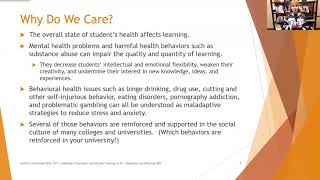
This episode was pre recorded as part of a live continuing education webinar on demand. CEUs are still available for this presentation through all CEUs. Register@Allce.com Counselortoolbox you so I'd like to welcome everybody to today's presentation addressing the unique mental health needs of college students. Now, if you've looked at our schedule, you know, in the upcoming weeks, we have a couple more similar presentations that are going to occur. One of them will be assisting high schoolers in making the transition to to college and dealing with some of the issues that come up, especially for freshmen, and helping them make that transition. But today, we're just going to talk in general about mental health needs of college students. We're going to identify the scope of mental health problems in college students, the impact of mental health issues on learning, and student retention. You know, think about it. If somebody is clinically depressed or just overwhelmed with anxiety, they're probably not going to learn too well. And you know, we want to look at helping them do that because universities benefit when they have people successfully complete. Students benefit when they successfully complete. So let's help them successfully complete. We'll learn about the connection between mental health issues and substance use. You know, we'll go over that briefly, explore the unique issues faced by college students and identify the components of a good campus mental health program and other strategies to reduce stressors. Now, depending on the university that you work at, there's a university locally here, it's a really small University, has about 1500 students, but, you know, or you have things like University of Florida, where I went, and I believe they're upwards of 80,000 students now. So different universities are going to have different amounts of funding to do different programs. So we're going to kind of brainstorm and I'm going to encourage you to share your suggestions for ways we might be able to make these services more available to students in the communities. So According to a 2016American College Health association survey, 37% of students reported feeling so depressed within the last 12 months, it was difficult for them to function. Okay, just let that sink in for a second. Going around a college campus, 37% of students, that's more than one in three, reported feeling so depressed within the last 12 months it was difficult to function. Wow. You know, that's kind of staggering. And it's not just because of school. You know, it could be because of life circumstances. There's a lot of things. But that means more than one in three students, almost half of students, when they're Going through a year at school, get to a point where they are clinically depressed and it's difficult to function. Wow. 21% felt overwhelming anxiety. Now these can be overlapping. Some of the students had depression and anxiety, but some of the anxiety cases were unique. So we're looking at roughly 50% of the student body in a 12 month program or 12 month period feeling like they can't function because their mental health issues are so strong. A survey of students seen from mental health services at 66 college counseling centers found that prior to college, 10% of these students had used psychiatric medications, 5% had been hospitalized for psychiatric reasons, 11% had seriously considered suicide, and 5% had had attempted suicide. That's just kind of giving you a picture. I mean, we tend to think of students that are coming into college as being happy and energetic and enthusiastic and all that kind of stuff. But we also have students who, you know, have had a rough life or have been struggling with mental health issues. 10% of the students had used psychiatric medications. So that's 1 in 10. That tells us that there is a need for mental health services on college campuses. That tells us, these stats tell us that even if the person, when they're coming to college is feeling great, that they are at risk potentially for relapse. Think about when you went to college. I know my first semester I didn't sleep the way I should, I didn't eat the way I should. I did a lot of things. I was in a new environment, I was away from my friends, I was away from my parents. There are all kinds of stressors and a lot of times when those things kind of all lump together, it can trigger depressive episodes or anxiety issues that were dormant until then. So we need to help students ideally prevent problems, but also provide outlets for early intervention. The 2015 National Survey of Drug Use and Health shows that adults 18 and older with past year mental health issues were more likely than other adults in that age group to have used illicit drugs in the same period. 32% versus 14.8%. So we know that people who have mental health issues are at a greater risk for using substances. It doesn't mean they're going to, but we do want to recognize that there's a risk factor there. The risk of co occurring disorders is pronounced among college students as they transition from adolescence to adulthood, an age when mental health issues often surface for the first time and in a new environment where substance use is common. Now, a lot of students have gone through puberty. But think about the Erikson Ericksonian developmental stages. They are trying to figure out who they are, what they want to be when they grow up. They're transitioning from being a youth to being a young adult. And they're having to, you know, pay their own bills and get to class and be responsible and do all that adulting stuff. There is a lot of stress there. And so there's. There are a lot of issues, not only, you know, practical issues, but also more cognitive issues and self esteem issues that, you know, all adolescents go through. Couple that with wanting to be accepted, wanting to be parts of certain groups. And just the sheer availability of substances can make it increasingly problematic or likely that someone may experiment, at least with substances. Increased academic distress is associated with increased mental health issues, including suicidal ideation. So as students start to struggle, they can become more anxious, more depressed, more helpless and hopeless. As clinicians or as professors, I've been both. We need to be aware of that. If we see students starting to struggle, we need to step in and go, all right, what needs to happen? What resources do you need? I'm not saying we're going to just say, oh, well, don't worry about the final. It's not a big deal. No, they need to be held accountable. But we can also help them reach out to resources. The student mental health center or an off campus resource or their family or somebody if they need additional help. Maybe they need tutoring because it's difficult. I know one of the community colleges up here is awesome because they have classes, but they have a huge tutoring program where students who've gone through the program before will volunteer to other students and help them get through the class. So there's a lot of emphasis on helping one another so we can help people reduce academic distress. The misuse of drugs and alcohol is correlated with the need to cope with the pressures of college life. And that's evidenced by a bunch of things, but also 6.4% of college students. So, you know, that's quite a few. Six out of every hundred college students report non medicinal use of ADHD type medications. So Adderall, you know, any of those ADHD medications to help them focus and stay awake and get the job done. Which tells me that there's a significant portion of students who are going to college who haven't learned good study and time management skills skills because then they get to college and they feel like this work burden is overwhelming. I see what my son's friends do right now in terms of homework and everything, and they have a ton of homework. So you Know, figuring out why Johnny is having difficulty managing his time and handling the workload when he gets to college is really important to help people, students learn to prioritize again because once we get out on our own for the first time, at least it was for me, it was really hard, especially that first semester, to be as responsible as I probably should be. I know I had intro to English at 7:30 in the morning all the way on the other side of campus, which was, you know, three quarters of a mile away from my dorm. And I just dreaded going to that class. So it was, I missed it more than I really should have. And that didn't help, you know, with my, with my academic success that particular semester. So it's important to be aware of what might be contributing to these pressures of college life and how can we help students intervene. It's not just time management, it's friends, it's students, it's, you know, sports, sororities, whatever. And the campus culture of alcohol use. If the campus culture embraces alcohol use, if it's not a dry campus, then there's going to be more likelihood for people to misuse drugs and alcohol. If it's there, they're probably more likely to experiment even if they're not of age yet. So why do we care? Well, the overall state of the students health affects learning. So we need to be able to advocate for students and advocate for services within the communities. When students come to a community like Gainesville, I'll just, you know, a significant portion of our population in that county was from students. So a significant amount of money that was spent in that county was from students. So the community benefited from students being there. So it was in everybody's best interest to make sure the students were happy and healthy and had access to resources. So we want to make sure that students are able to learn and they're able to successfully complete college. We want people continuing to go to that college going. That's a great university. Mental health problems and harmful health behaviors such as substance abuse can impair quality and quantity of learning. They decrease students intellectual and emotional flexibility, weaken their creativity, undermine their interest in new knowledge, ideas and experiences. That's not a surprise when we think about how you feel when you are stressed out, depressed, lonely, feeling isolated, homesick, whatever word you want to put on it. You're probably not focusing as well, you're probably not sleeping as well, you're probably not able to be as flexible in your thinking. Most of us when we get stressed, aren't as flexible in thinking I know I can get, when I get stressed, I can get a little bit rigid, and that's my normal temperament. So I tend to be more like that. And I have to back up and go, okay, now how can I be flexible here? So we need to help students recognize why it is important, why it is vital to take care of their mental health as well as their physical health. Do I expect them to never drink? No. You know, I'm realistic. But they need to be aware of the effect of alcohol on their ability to learn and retain information. You know, so they don't think that they can be drinking and studying at the same time and get the same benefit. And they also need to be aware of the transition from recreational use to substance abuse. Behavioral health issues such as binge drinking, drug use, cutting, and other self injurious behavior, including eating disorders, pornography addiction, and problem gambling, can all be understood as maladaptive strategies to reduce anxiety and stress. So if you go through each one of them, you can kind of understand binge drinking. You know, alcohol is supposed to calm you down. It can numb things out for a while. Same thing with drug use, cutting and other self injurious behaviors is often geared to helping the person, number one, feel like they are finally in control of their own pain. But also it gives them something else to focus on. But besides their internal angst, they're focusing on the fact that that really hurts. Eating disorders may be a way of adjusting or trying to adjust body weight in order to get approval. So you can see where these things either allow an outlet or help the person escape or numb. Or they may be designed to help the person feel like they fit in with this new group. A lot of students, when they go to high school, they went to high school with those same people for four years. They may have even gone to middle school and elementary school with them. So they've had these same friends. And a lot of times you're taking somebody and you're plucking them out of their area of origin and you're plopping them down. In this new community, which is often hundreds of miles away from home, they know nobody. I mean, that's huge culture shock on so many different levels. Many of the behaviors that I just listed that students use to reduce stress and anxiety are often reinforced and supported in the social culture of many colleges and universities. Drinking at parties, drinking at football games. Eating disorders are often supported culturally in certain circles. Problematic gambling. There's a lot of gambling, betting on sports, things that go on. It's not Uncommon. And part of it. Part of these things may be to help people feel like they fit into a group. Part of it may be to escape. So regardless, we need to help people figure out why they're doing what they're doing and what alternatives there are that might be healthier. Students can self medicate by turning to substance use. And substance use is frequently associated with negative personal, social, and community consequences, from regretted actions while intoxicated to. To hooking up. Just kind of thinking about your generic college student that goes out and gets completely wasted at a party. And this happens in high school too. I'm not saying it doesn't happen in high schools. So what happens to that student? They may do something they regret. They may end up, you know, streaking across campus or going skinny dipping or whatever it is, or they may hook up with somebody that. And they feel guilty after words that they may be exposed to a situation in which somebody else takes advantage of them. So they're victims of date rape. There's a lot of things that can happen. We need to make sure that students have access to care to cope with these events, to prevent ptsd, depression, and suicidal ideation. Sometimes people will go, oh, my gosh, I can't believe I did that. I, I can't live with people knowing what I did or feeling anxious about what happened or feeling bad, guilty about themselves. What if my parents find out? They will disown me. Yada, yada. We want to make sure there's a set of services out there where students can openly go and talk. And they don't feel like they're being blamed for what happened. They don't feel, feel like somebody's going, well, if you wouldn't have been drinking, okay, they were, they did, it happened. How can we move on from here? And helping them figure out how to move on, cope with any feelings they have and take any necessary legal steps, if necessary issues students face stressors, new freedoms and independence. There is nobody telling you when curfew is. There is nobody telling you what to eat, when to eat, whether you have to go to class, who you can be friends with. All those things that were at least in part regulated when youth were in high school. For a lot of youth, that's gone now. And students often have a hard time reining it in and going, okay, I still need to do all this, even though I don't have somebody standing over me saying, you got to go to class, you got to do this, you got to do that. There's new surroundings and experiences. Oftentimes people are meeting entirely new people from different places. And it can be really exciting, but it can also be really stressful. I've shared with you guys that I can't find my way out of a paper bag. And I admit it, I have never had a good sense of direction. So when I went to uf, that campus is huge and sprawling. It was a little intimidating to me because I had to figure out how to get to my classes and do all these things. And this was long before GPS and cell phones. So, you know, I had to use a map. Oh, my gosh, a paper one. But the experiences, while exhilarating, can also be stressful. You're wondering, are people going to accept me? Am I going to like my roommate? How is this going to work? How do I handle this? There's going to be new social networks, so you're getting to know different people. But anytime there's social networks, you know, you'd like to think that everybody's going to like you, but it ain't the case. So helping students accept the fact that there is going to be some rejection and help them deal with the fact that they don't may not fit in exactly with any particular area. Development of social networks, if they're pledging one of the fraternities or sororities is huge. I remember pledge week. The students would get so stressed out. Oh my gosh, they would get so stressed out before they even started pledge week. And it was exciting. But then every time they went, they were rated, they were judged, and they were cut from lists. And if they didn't get into the sorority or fraternity that they wanted, it was devastating to a lot of them. And I mean, it was. It was awful. This can be really challenging. We can also see the same thing happening as they go through their pledge period, which is usually the first year. And there are additional stressors that are put upon them. Whether or not it's hazing, there's still additional stressors. So even in the best run organization, they're going to be asking the new members to learn about the group, the club, the rules. There's going to be certain activities that are expected that students have to juggle. On top of everything else, there's separation from family and established friendships. There's a grieving process that needs to happen. You're not there anymore. You are not able to go home and have mom do your laundry and cook for you necessarily. So you may miss your friend, friendships, the things that you used to do. There's also this transition where youth Start recognizing that they're not kids anymore. They're moving into adulthood, which is, again, exciting. But there's also a little part of a lot of us where we grieved losing that lack of responsibility, or whatever you wanted to call it of childhood. Now we've got to adult, and, you know, those days are gone and behind us. So there's a lot of transitions going on, and the academic demands hopefully aren't all that much harder once you get to college. But there's a lot more freedom in the academic classes you're not going in. For most classes, you're not going in every week and turning in homework assignments that get graded. You. You're not sitting in class and having quizzes every other week. There's usually like three tests and a paper or something. So it can be really overwhelming for students, not just that first year, but all the way through when their entire grade rests upon, like, four different things. You know, each one is 25% of their grade. And if they bomb one, they know they're not getting an A in the class, which can be devastating to students. A lot of students, they go to college because of the high competition and all that stuff. They were always tops in their class, so they're not used to getting B's and C's. And it can be really startling and disheartening for some students, so that's important. Some students may be afraid to seek certain types of help or request accommodations for a mental health issue for fear of being viewed as incapable or being expelled. However, without these accommodations, their performance is likely going to be negatively affected. I had a good friend of mine who was in my graduate program who had adhd and, you know, she needed special accommodations during testing time. I had another friend who had dyslexia who needed special accommodations. And it's important for students to recognize and feel comfortable asking for help. And the college, the professors, as well as the clinicians, and, you know, as a student mental health center, we need to advocate for students and say everybody is valuable and everybody is intelligent. If you need some accommodations, that's fine. You know, that's like somebody whose vision is starting to go, who needs to wear glasses. It's not a big deal. We just. We need to know in order to facilitate your learning experience. So as clinicians, we can do a lot to advocate with professors and help them understand what reasonable accommodations are available and required for their students. And we can help students recognize that there are a lot of people who are struggling with ADHD or dyslexia. Or depression or anxiety or whatever it is. So one of the things we can do preventatively is help youth college students develop resilience. A key component of well being is resilience, which is the ability to recognize, face, and manage or overcome problems and challenges and to be strengthened rather than defeated in the process. And I always make the analogy, and I think I'm gonna have to change it pretty soon, because most of y' all may not even know what a Weeble wobble is. But there were these little toys we played with when I was growing up, and they were shaped kind of like a buoy, and you could push them down and they would pop right back up, and then they would wobble around. But resilience is like being a Weeble wobble. You know, sometimes you're going to get knocked down, but you pop right back up, and you're all the better for it, and so you're not defeated. Resilient graduates better navigate today's uncertain and volatile economic, employment, and career environments. So we want to help students become resilient. So when they go out into the field and they recognize that, okay, job prospects are, are low right now, or they're working somewhere and that particular sector starts to downsize, they know how to deal with it. They know that if layoffs are imminent, okay, what do I do? How do I look for a new job, or how do I evaluate my skills to see how to go back to school or whatever. We want to make sure that when a problem comes their way, they're not standing there like deer in headlights going, I don't know what to do. They need to have good problem solving abilities. Challenges to health and well being undermine resilience by making it more difficult for the student to deal with life on life's terms. Again, we're not just talking mental health, we're also talking physical health and substance abuse. All those things combined can prevent or independently can make it difficult to deal with life on life's terms. Think about when you're sick or when you're in a lot of pain. Maybe you have a toothache and, you know, you can't get into the dentist for three days. A lot of times that makes it a lot harder to concentrate, to think clearly, and to deal with any more stressors. You know, you're feeling bad, you've got a toothache, and somebody comes in and says, you know, John just called in sick, you're going to have to cover for him. And if you were feeling better, you might not be happy about it, but you could do it, but since you're sick and in pain, you're just like, no, no, that's not happening. And students can be the same way. When they start feeling run down and exhausted and fatigued, they have more difficulty learning and they have more difficulty dealing with the stressors that come their way because all of their resources are depleted. Less resilient students take fewer intellectual and creative risks and tend to be poorer partners in group learning situations. So it benefits the whole university, not just the student, not just the university, but all the students in the university. If everyone is healthy and resilient. That way you have people that are in groups, you know, because we do a lot of group work, people that are in groups that are functioning well together, and there's not one person that's kind of a drain on the whole group. Another key component of resilience is hardiness. And y' all know, I love hardiness. Commitment, control and challenge. It's a strategy that promotes resilience. The hardy personality allows people to have confidence in their ability to handle change. It increases their belief in their general competence, and it helps derive personal meaning from their activities so they can see what they're doing is important. You know, it's something that they have control over to a certain extent, and it's a challenge. You know, it's something that they look forward to doing. It's not too easy, not too hard. The commitment part, and that's the first part of hardiness, is helping youth recognize or helping people recognize that sometimes life's going to hand them lemons. Things are not going to be perfect all the time. Most of the time, there's going to be something that's a little wonky in one aspect of your life. Ok, you're going to work on fixing that. But let's look at the other 78 areas of your life and how well they're going and how you can be committed to spending your energy there. So if Sally, for example, has six courses, well, three courses, we'll say three courses, and she's doing well in two of them, but one of them, she's really struggling. You know, we want to encourage her commitment to the college process and what she's doing. Help her focus on making sure she keeps her grades up in those other two courses, but then also help her see, okay, what kind of resources can we help you access for this third course, what may need to happen so you can be successful there? But we want to encourage students not to view failure, you know, or struggling in a class or In a group or whatever the situation as something that goes against them, it's an opportunity to learn how to better deal with it and to remember that there are other things in their life that are really important, that are going well that they do have control over. So all of this is how we want people to approach everything. And they actually started doing hardiness evaluations or testing on people who are recovering from open heart surgery. And they found that people who had had open heart surgery, you know, yeah, okay, their health is not great right now because they just had open heart surgery. But they were committed to their family, they were committed to their job, they were committed to their church, whatever it was they were committed to. And it gave them the drive to push through and fix whatever this was over here, which whatever was causing the problems that led to their open heart surgery. Learning experience of all kinds, from academic courses to student employment, can help students develop the ability to be resilient. So I'm going to ask you to think about what types of experiences can we facilitate to help students? Said another way, what problems can we present students and in what way can we present those with what expected outcome? What are we doing? So a couple examples I can think of. While you're thinking of ways we can help students develop resilience. If a student earns a poor grade, okay, it happens. So what can we do to help them deal with that? You know, they can, like we talked about, maybe they need to go to tutoring or, you know, maybe it's just not their thing and they need to look at what's important in their life, what's going to make them happy. And if this particular course of study is really where they want to be. If students are not invited to join a club or they don't make a sports team, it can be devastating for them. So helping them look at all right, you know, you tried out as a walk on for the football team and you didn't make it. And that was devastating. You're doing well in school right now. You got a house over your head, a roof over your head, yada yada. What can you do? If this is important, what can you do to improve your skills? So next time, next year when you try out, you might make the team. So helping them figure out what parts of that failure or struggle they have control over and also reflect on all of the other things that are important in their life that they still have definitely help them look towards the long run. You know, right now, this really is unpleasant. But in order to improve the next moment and keep you working toward a rich and meaningful life. What has to be in there? We can provide culturally competent trauma informed services and active outreach to specific populations. There are on any college campus, there are students over traditional age, there are veterans, There are people who are here from a different country that are here just to go to school. So we need to make sure that we reach out to everyone in a culturally sensitive and responsive way. A lot of cultures are not okay talking about mental health problems. So how can we reach those cultures? How can we reach those students and let them know what resources they have to access? One of the ways, and we'll probably get to that in a few minutes, is considering offering services or providing information in student centers. So if you have a student center for the Hispanic students, we used to have one at uf. If you have a place like for the military people to go that serves veterans and people who are in ROTC where you can provide information about services so they don't have to feel like nobody understands them and they don't have to feel like they're putting themselves out there by walking into the student center and going the student mental health center and going, I need help. Eventually they may end up having to get to that point. But hopefully we can provide preventative information and outreach early so they don't have to get to that point. So how can outreach be done in residence halls? Resident advisors are responsible in most schools for providing outreach activities. I know we had to do one a month for our group and we also had to have bulletin informational bulletin boards. But we had to do at least one informational board presentation a month about a health and wellness topic of some sort. So that's one way outreach can be done now, getting students to go to those we found. And it's probably no surprise the best way to get students to actually attend those is to offer food. You can't. At least at our university you couldn't make them mandatory. So we wanted people to go. We offered pizza. Pizza brought in everybody. Sports teams. We can go to the team practices and do a little dog and pony show for 10, 15 minutes or during spring training or whenever their initial training period is going there and having an hour to talk to the. To the sports teams. Panhellenic Council we can reach out through. Most universities have a centralized committee that oversees Greek life and we can disseminate information through them. Student unions are great places to put information. And residence halls, we have those outreach things. We have the bulletin boards. Please don't ever forget the back of bathroom stalls, because people read those things. You're just sitting there doing your business. A lot of times you're going to read what's on the back of the bathroom stall. And if it has, you know, information that's pertinent, maybe a phone number or a resource that somebody may want to tear off, it's. If you're in the bathroom, you know, nobody can see you doing it. So if somebody's concerned about their anonymity, you know, that can be helpful. Same thing with student union. Back of bathroom stalls in addition to out in the aisles, in the hallways, you know, places where it can be seen. Because we don't want people to think that they need to hide in the bathroom if they've got a mental health issue, we want them to understand that mental health issues are common. A lot of people have them. They can be dealt with. Email. You can send out mass emails to the students. Undergraduate courses at uf, the athletes used to have to take Alcohol and drug awareness, which was a class that I taught, among others, and they were required to take that as part of their curriculum in order to be aware. I don't know if it's an NCAA requirement or it was just a UF requirement, but we can potentially encourage people to take certain courses to help them get the education they need. We also had a course that was called Stress and Wellness that a lot of people took. Where else and how else can we do outreach? How can we reach students? How can we reach the. Not only the freshmen, but even the seniors? Because, oh, wow, it gets really stressful. That senior year, you got senioritis, hard to study, and you're realizing, oh, crap, I actually have to go. Once I get my degree, I've got to go get a job. And, you know, that can be kind of scary. And if you've lived in the residence halls your whole college career, then you're going to be moving out into, you know, regular housing and having to figure out how to do that. It's not just dropped there for you to go to. Cultural factors may also inhibit help seeking. Racial or ethnic beliefs about mental illness and help seeking, like I said earlier, can prevent people from reaching out for help, especially if they think that their parents might find out or their friends might find out. Anonymous hotlines have been used on some colleges to and have had a great amount of success. Having services, like I said, in student centers that are specifically targeted and culturally appropriate can be helpful. LGBTQI2 persons may feel like they're going to be discriminated against or misunderstood Gender Males tend to seek help less often than females do. We want to make sure we provide inviting activities and services for males as well. We don't want them to feel like, you know, it's going to be something that is off putting group membership. Certain groups may not want to go and reach out for services. Many veterans face the challenges of having physical injuries, PTSD and traumatic brain injury. So they may need additional accommodations and or additional support services. Adjustment from a military environment to the less formal campus culture can also be quite difficult because there's. Well, you can imagine going from a military organization to one that is warm and touchy feely and everybody gets to talk and it can be very difficult. The veterans tend to like things regimented. This is how it is, this is when it's due, yada yada. This is the rubric for grading. There's not a whole lot of wishy washy stuff. Providing mental and behavioral health services within a veterans center or focused programming for a military learner can improve their functioning and learning. We need to ask though, if you're not former military, you may not understand all the unique needs. So we need to create committees that incorporate representatives from the different cultures and factions on our college campus to figure out what kind of services are needed and how can we best provide them. Students with autism spectrum disorders, including Asperger's syndrome, also have important needs. Remembering students with autism spectrum disorders aren't generally intellectually challenged in any way. So, you know, and some of them are quite smart. You know, a lot of times autism doesn't do anything to cognitive ability, early identification treatment and effective accommodations before matriculation. So before going to college can prepare these students for the academic rigors of higher education. If they've been in, you know, regular public school and they've had a individualized education plan, they may be used to things being a certain way. And especially for persons with autism, change and transition can be extraordinarily stressful. So it's important to help them ease that transition. Sometimes students with autism spectrum disorders may start college in the summer instead of waiting to the fall when there's the rush of people so they start getting the feel for what it's going to be like and it eases the transition. Social skills deficits are often problematic for students. Participating in the classroom, learning in groups, engaging in student organizations and activities, and living in residence halls. So we need to be able to provide support to those youth and we need to educate as much as we can. Ethically, obviously we can't violate HIPAA but we do want to help people understand. How do you deal with somebody who has difficulty processing stimulus? How do you deal with someone with an autism spectrum disorder? Making sure that resonance assistants, residence life directors, professors all understand what autism is and how to best help in general, the student with autism. Obviously, you've got to hopefully have an office of disability resources that can provide specific interventions, but, you know, they need to have a general idea so they can, you know, identify some behaviors and go, oh, well, this student may have autism. And it's important, if possible, to communicate with professors and encourage students to advocate for themselves and let professors know, I've got Asperger's syndrome or whatever. So the professor can best assist the student. Collaboration among several campus offices is necessary to respond to the needs of these students and promote their learning and retention. So we need to have the office of disability resources, we need to have the academics, the professors in there, and we need to have. Campus counselors involved. And if the youth is in any sort of club, or if the youth is in any residence hall, we may also need to bring in the director of residence life. So quality programs have strategies to strengthen learning outcomes for students at any age and in any context. It improves the quality of the learning environment, provides education and outreach and prevention services to help students manage unique stressors. And some stressors are unique just to being in college, but then there are other stressors that are unique, right? Then if there is a student that commits suicide, if there is a rash of crime on campus, those things are unique to that particular time and place, and we need to reach out and help students deal with it. Providing culturally responsive, trauma informed services to treat mental health and addiction issues is also really important. We need to make sure, again that we know what types of services certain cultures will accept, who are the decision makers, and how we can best offer those services in a way that will encourage people to use them. We also need to ensure faculty, staff and administration and health personnel are aware of strategies to help students deal with stressors. A lot of times students will present at the health clinic when they're feeling run down, stressed out, and depressed. So we need to make sure that whoever's staffing that student health clinic is aware of mental health issues and able to do brief screenings and make appropriate referrals. The best way for colleges and universities to nurture resilience among students is to promote health and well being, especially mental and behavioral health at the individual, organizational and community levels. I mean, these youth are living in the community, and I keep saying youth and That I shouldn't because there are students over traditional age. These students live in the community. You know, some live in residence halls, but a lot will live in apartments. They will need to find housing. They many will often need part time or full time employment. They can be engaged in activities in the community that can help them bolster their self esteem and sense of personal agency. They don't have to be involved only with activities on the campus. In fact, I encourage students to reach out to local organizations to do volunteerism because it helps bridge that transition when they eventually do graduate and leave college so they know what's in the community, they've already started kind of dabbling around there. We can have a publicity campaign to reduce the negativity associated with seeking help for mental health issues. Educate the campus community, and that includes students, residence hall staff, instructors about the warning signs of mental health issues. Sometimes it's Jane who notices her roommate is starting to get withdrawn. Who is the first person who could step up. So we want to make sure students during orientation get a glimpse of psychological first aid or psychological triage. And they all also need to have information about stress management and wellness strategies. We need to demonstrate an understanding of different ethnic, racial and social norms and needs and raise awareness of the resources both on campus and in the surrounding community. Because sometimes students will need to access resources that are community based. What the college campus has just can't support their needs. So we need to help them realize this is out here. This is how you access this particular setting. Ideally, screen students during orientation when they're coming in and signing up for classes and doing whatever. There should be a time to screen students. Provide web based screening that connects with the counseling center. So if students, you know, halfway into the year start thinking they might be depressed, they can go online, take a web based screening on a secure website that connects. The answers are fed into the counseling center and they're able to schedule an appointment if the screening determines that they're presenting with depression. Improve campus culture, focusing on discrimination, trust, respect, dignity, sensitivity and cultural competency. Make it a welcoming place. Improve access to information, focusing on and information needed and communication and dissemination practices. So we need to figure out what's needed, how do we communicate it, you know, and how do we disseminate it? You know, what's the best way to say it? Communicate it so it gets understood, heard and people don't think, oh my gosh, lecturing at me again. But then the third way is how do we disseminate it? How do we take this wonderful brochure that we've put together and get it to people and get them to read it. Make services available on campus, even if that's a clinician from the community. So smaller campuses may not be able to afford to have a student mental health center. Okay, that's okay. We can work with a community mental health agency and have them co locate a clinician on campus. Manage expectations of campus mental health systems and changes to promote mental health and recovery on campus. The mental health center can only do so much. You know, no matter how big the university and how much funding it has, there are going to be limits at some point. So we need to help students focus on their control, how much control they have and what their choices are. Maybe they want to go to the student mental health center, but there's a six week wait to get an appointment. What other options do they have if they don't want to wait on that? You know, maybe there's some community resources. What are their expectations about mental health care? Do they want group, do they want individual yada yada and you know, what can we provide? We may only be able to provide group counseling or we may only have a clinician on campus twice a week. So what are your expectations and how can we facilitate that? What are the administrative expectations of the mental health center? You know, they can again, they can only do so much. Most student mental health centers are not going to have the ability to bill insurance. So if somebody needs to have insurance billed, they may have to submit it on their own. What accommodations are available and what community approaches exist in order to support students and support student wellness. Other services, access to mental health and behavioral expertise. For faculty, staff, families and peers who are concerned about a student, this is another great place for a hotline where they can call up and go, okay, I've got this student in my class or I've got my roommate who started acting this way and just get a consultative feedback about what can I do or what needs to be done. Encourage the ability for self referral. If there's a big process to get student mental health services or to get mental health services, people are less likely to engage. So we want to make sure that they can self refer and be seen by a clinician instead of having to go through six other people off campus. Referrals need to be available. Emergency services need to be available. Most communities have a crisis center or an emergency services team. The campus and as clinicians, as professors, we need to know how to access that. If we have a student start to decompensate during class or between classes. How do we handle it? We need to offer aftercare programs and these are generally group based programs to help people who've been struggling with depression but they're in a remission right now. We want to help them be able to maintain that. So providing aftercare program programmatic opportunities, medical leave policies for students as well as for faculty. But right now we're talking about students. If they get to the point where they are so clinically depressed that they cannot function, they don't feel like they can do finish their finals or whatever, what are the medical leave policies and how do they partake in those if they need to take a break from college for a semester? And what are the non clinical student support networks? I mean ideally there are student support networks out there in the residence halls, in the student union where students can get assistance with, you know, day to day stressors and activities and things on site. Counseling centers with an interdisciplinary team that includes the primary health care providers, licensed social workers or counselors, life skills support staff, registered dietitians and peer support specialists are ideal. Now most universities can't afford that, but if you can is great. If you can't reach out to the community and figure out if there's a way you can get some people, practitioners from the community to either volunteer their time or if there's a way that they can come and then bill for services provided to the students. Most of the time if you don't have a student mental health, student health center, then students are going to have private insurance that's going to cover them. So practitioners still can bill for services. Administration just has to work out the nitty gritty of that on site. Medical services and assistance with prescriptions is very, very helpful. And it doesn't necessarily mean money. It means making sure that students know how to access patient assistance programs and if they need to get prescriptions filled and they can't afford them. Student and administration leadership to promote mental health and suicide prevention among athletes, the panhellenic organizations, students over traditional age minorities as well as unaffiliated students. You know, just those students that are there to learn. We want to make sure that we're reaching out to all the groups, life skills development programs, how do you fill out a resume, how do you interview for a job, how do you rent your first apartment, how do you manage your budget, all those things exceptionally helpful to reducing student stress. Social network promotion, making sure that there are activities out there. We used to have movies on the lawn when it was nice outside and everybody would go to the student union and bring a blanket and they would have movies and play. That was one way to encourage social networking among unaffiliated students, so to speak. Other helping strategies Tutoring programs. I mentioned before that one of the community colleges here has a really strong tutoring program and that helps a lot of students. If there's one that's there and easily available with people that can help them try to figure out and navigate, that's excellent. Tutors can be really expensive. So if the university offers one that's definitely helpful for the students, mentoring programs are helpful. If new incoming students can be paired up with an older student, that is beneficial in many, many cases. I know at our university, going through drop add at the beginning of every semester was this huge kind of confusing process. So it would have been helpful had I, you know, had an older student mentor that could have said, okay, brace yourself. It gets kind of crazy, but this is what you got to do. Ensure sufficient parking and transportation. Students can get really frustrated, you know, trying to find parking, and it can be overwhelming, you know, if they're already stressed out, to dread going to campus and thinking you're gonna have to drive around for an hour to find a parking space and hope you're not going to be late for your exam. So if you don't have sufficient parking, you know, some campuses don't. Ensuring that there is some form of transportation to help students get there, whether it's the bus system or whatever. Hold all student groups on campus strictly accountable for underage alcohol use at their facilities and during any functions that they sponsor on campus or off campus. Eliminate alcohol advertising in college publications and educate parents, instructors, and administrators about the secondhand effects of substance use that range from interference with studying to being the victim of assault or date rape. We want to encourage parents to know about it too, because sometimes students that are in college are still, you know, willing to start listening to their parents. You know, I hear that once my kids get a little bit older, they'll start thinking, I know something again and, you know, they may listen. Enlist administrative, community and student assistance in changing any culture that supports alcohol use by underage students or substance misuse. Expand opportunities for students to make spontaneous social choices that don't include alcohol by providing frequent alcohol free events, late night events, extending the hours of student centers and athletic facilities, and increasing public service opportunities. There are lots of things that students can be called upon to do, and most of the time students are really eager to go out and do stuff, but we need to provide those things for them to do. Whether it's movies on the lawn or volunteering for Habitat for Humanity or you know, having an all night bowling extravaganza at the student union, whatever it is, if there are things to do, generally students will come if they're happy things, if they're lectures and workshops and stuff that's less. You need to offer food to bring. Those emergency mental health related situations that should be addressed in a campus wide emergency plan should include managing suicidal or homicidal ideation, managing victims of sexual assault with clarification regarding exemption from mandated reporting in this context. So who has to report? Who doesn't have to report in this context? Remembering that in college, you know, I started college when I was 17, there are often people who are underage. So it's important to remember that you may be dealing with a juvenile. Managing highly agitated or threatening behavior, including acute psychosis or paranoia. Now this can be because of mental health issues or more often than not because of substance use, including some of the synthetic marijuana like spice, managing acute delirium and confusional state and managing acute intoxication or drug overdose. The staff and students need to be aware of signs of intoxication so they know what to look for and drug overdose. Hopefully the university has naloxone available for opiate overdoses, but having a procedure there, just like fire alarms, having a procedure handy that everybody knows what to do to reduce deaths from overdose. Written procedures should at minimum identify situations in which EMs should be immediately contacted. Identify situations in which the individual responding should contact a trained on call counselor or the sexual assault center. So if a student starts to decompensate in the middle of class, how do we handle it? Identify trained on call counselors who will be able to direct and be consultative in crisis intervention to help stabilize the situation and recommend the next steps for action. So great, we're going to call the on call counselor. Who is that? Need to have somebody identified as your point person. Designate expectations for each stakeholder during a crisis. What is the professor supposed to do? What is the RA supposed to do? What is the counselor supposed to do? That way everybody knows their role. It identifies specific steps that need to be taken by each stakeholder after an emergency situation has resolved to provide appropriate resources and follow up care to the student. So if a professor calls the crisis center and the student is, you know, stabilized and taken over to student mental health services, when that student comes back to class, what is the professor's responsibility? Before that student comes back to class, what is the professor's responsibility? We want the student to feel like they're welcome back. We want them to not feel ashamed to go back to class. And we want them to feel like they're not going to be penalized for having to leave because of a mental health issue. And specify a procedure for reviewing preventative and emergency procedures after the resolution of the emergency situation. So you want to go back and do a post hoc analysis. How did this go? What could have gone better? Is there anything we need to change? Special issues for student athletes Coaches should learn about the importance of being attentive and empathic in their interactions with student athletes who are facing mental health challenges, while understanding that their role is not to manage the situation themselves. They're there to be empathic, to be listening. But if the student starts having a mental health issue, there's somebody else they can call. They don't have to manage everybody on their team like that. Coaches can sometimes be super empathic or sometimes be more of the suck it up and go in there and, you know, get over it sort of approach. And a lot of that is how they were coached and how they were raised. Clearly delineate a transition of care plan for student athletes who are leaving the college sport environment in the interest of continuing medical care and student athlete welfare. So if they leave the college environment because maybe they got hurt or they got sick and they actually have to drop out of college for a semester or more in order to take care of their stuff, what is the transition of care plan? To make sure that we don't just go, well, good luck taking care of that. Let us know when you're done. We want to have a nice handoff. Identify who's responsible for initiating the transition of care and for facilitating the academic waiver process, should a waiver be needed and that waiver comes in when somebody has to take a semester off, for example. And develop a plan for helping student athletes who've been away from campus while seeking care for mental health issues. A process to transition back to campus and to support participation. Understand the institutional policies related to athletics, financial awards and team engagement for student athletes who are unable to continue sport participation either temporarily or permanently due to mental health considerations. So if somebody is unable to continue on their scholarship, what's going to happen? Are they going to have to drop out of college? What kind of funding is available? What happens to their housing they may have been staying in student athlete housing. What's the process? Encourage coaches and student athletes to be aware of strategies for financial support in need of extended for athletes in need of extended outpatient treatment or inpatient care. So if you have a student athlete who becomes addicted to drugs, for example, and they need to be in residential for 60 days, what sorts of funding options are there to help that student athlete deal with the issue? Consult campus disability services offices on how to increase inclusive practices that may increase engagement of student athletes. So ideally, coaches are consulting the office of student Disability resources and saying, all right, now if I have somebody on my team, which they probably do, who has depression or anxiety, you know, what types of things can I do to help them to help prevent future issues and increase engagement? So to thrive, students need access to services and programs of outreach, education and prevention that eliminate fragmentation and improve access to biopsychosocial services. So, you know, you don't want mental health over here and financial services over here and disability resources two blocks away, ideally, even if they are physically separated. We want to have all of the partners, all of the players, able to effectively and seamlessly communicate, recognize patterns in campus life that suggest the presence of mental and behavioral health concerns among individual students, groups of students, or the campus environment itself. So you want to look for signs of depression, you want to look for evidence of eating disorders, you want to look for evidence of potential substance abuse. Provide outreach and consultation to prepare all members of the campus community to recognize and respond to students with mental or behavioral health concerns and emphasize case finding, using surveys, presentations, self assessments, activities, and special events to identify students whose lack of psychological well being is interfering with their development, learning, and achievement. So we want to provide a lot of different ways for students to kind of tap into these resources, nurture a supportive tone and attitude about mental health in campus culture in order to challenge stereotypes about mental health problems, undermine prejudices about stigma and counseling, and provide encouragement to students to reflect on their need on their own mental health and services needs. So these are all components that we can incorporate in order to help build a healthier, more productive, more successful campus community. Are there any questions? Okey dokey. Well, everybody have an amazing weekend. And I don't remember what I'm teaching on Tuesday, but I'm sure it'll be something fun. So I will see you all on Tuesday. If you enjoy this podcast, please like and subscribe either in your podcast player or on YouTube. You can attend and participate in our live webinars with Dr. Snipes by subscribing at allceus.com counselortoolbox this episode has been brought to you in part by allce.com, providing 24. 7 multimedia continuing education and pre certification training to counselors, therapists and nurses since 2006. Use coupon code counselortoolbox to get a 20% discount off your order this month.










