331 Developing Interpersonal Effectiveness Self Esteem
Transcript of a continuing-education webinar by Dr. Dawn-Elise Snipes on improving self-esteem through psychoeducational group activities. Covers definitions (who you are vs what you do), sources of self-esteem (positive regard types), identifying and disarming the inner critic, cognitive distortions, self-compassion, handling mistakes and criticism, goal-setting, boundaries, and core beliefs, with multiple interactive group exercises and homework suggestions.
Chapters
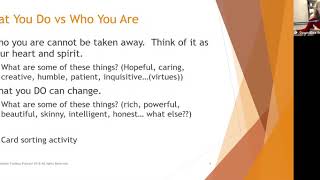
This episode was pre recorded as part of a live continuing education webinar on demand. CEUs are still available for this presentation through all CEUs register@allceus.com counselortoolbox I'd like to welcome everybody today's presentation on self esteem group activities. As you already know, I am Dr. Donnelly Snipes and this is a live interactive webinar. So today we're going to be talking about the nature of self esteem and identifying and disarming the critic, creating accurate self assessment, identifying cognitive distortions, shaking the shoulds, developing compassion, handling mistakes, responding to criticism, and addressing core beliefs. So we got a lot to cover. So one of the things clients really need to understand is what self esteem is. I mean, that's just such a garbage term. I mean, self esteem is how you feel about yourself, but you know, you feel about yourself differently on different days sometimes. So we start with the definition and trying to define what self esteem is. And I want people to come to the understanding that it's how you feel about yourself in contrast to who you think you should be. So on those days, we're not feeling so great about ourselves. A lot of times we have some of those shoulds going on in the back of our head, saying, you should be doing this more, you should be going to the gym, you should be doing this stuff. And people may start to feel badly about themselves. The more rejecting we are of ourselves, the more distress we experience and the more we seek external validation. If we start beating ourselves up, we're going to look for help, and elsewhere we're going to look for somebody to tell us we're okay. In order to develop healthy relationships, people need to feel good about themselves. A healthy relationship is not one where I'm grabbing onto you as a lifeline and going, please validate me. A healthy relationship is one where I'm going, I'm pretty awesome. And you're pretty awesome too. We would be really awesome together. Another analogy I make if we're struggling with this is that self esteem can be thought of like good soil. When I have good soil in my garden, the plant, the seeds take root, they grow, the plants get their nutrients from that soil. So if you can get your self esteem and self worth from within, you're going to be able to stand up straighter on your own. A seed that's planted in poor soil relies on other people to bring in nutrients, they rely on you to bring in fertilizer, they rely on you to bring in water, they rely on you to do all that. So they can survive. But we really want people to develop their own good nourishing soil, if you will. Benefits of strong self esteem, you know, so why are we doing this? When people feel good about themselves and we can ask clients what they think or, or we can just go through this and get to the fun activities. When people have strong self esteem, they tend to have more stable moods. They tend to be more able to set healthy boundaries. When your self esteem is low and you're looking for that external validation, a lot of times you're fearing abandonment and you're afraid to say no and you're afraid to set boundaries and you're afraid to have your own opinions because you don't want to lose that other person's validation. When you have a strong self esteem, you can say, these are my boundaries. This is how I feel. These are my thoughts on this situation. You don't have to agree with me, but it's important that you respect that they're mine. People with strong self esteem tend to have stronger sense of self confidence and improved relationships. I mean, it makes sense if you're in a relationship with somebody who's constantly needing validation. It can get exhausting if you're in a relationship where both of you feels good about yourselves. Not sure if that was the correct conjugation of those verbs, but whatever. If you both feel good, then you're less likely to be jealous, you're less likely to be clingy, you're less likely to try to be enmeshed, you're less likely to have all kinds of other problems. And people with strong self esteem often have less stress because they feel pretty good and they're not wondering, am I okay? And less feelings of emptiness because they look inside their heart and they go, wow, I'm really awesome. When we get there, you'll see the difference between who you are and what you do. When we look at who we are, those are qualities that are within our heart that fill our core. So when you have those qualities and you recognize those qualities and you embrace those qualities, then you don't feel empty, you feel filled up. So where does self esteem come from? Well, positive regard. And here we go with the activities and the flip charts or the breakout groups again. Now you remember in my groups I do flip charts where you can put the flip chart papers around the room and people can go around in small groups and fill them out, or you can break your group up. If you've got enough people in your group that you can break them into two or four groups, then you can do that and let them talk for five minutes or so and then report back to the group. So we talk about positive regard. What is it, and what is direct positive regard? And I separate direct and indirect positive regard because direct positive regard is when I'm talking to you, saying you are lovable. Because indirect positive regard is in general, when I'm saying in general, people who are lovable have these qualities. So direct positive regard directly addresses you, the person. Indirect are those messages we get from the media, for example, that say, in general, a person should be hear that should word again. Conditional positive regard says, you're only okay if you're only okay if you drive a Maserati. You're only okay if you do this. You're only okay if you look this way. Conditional positive regard. So when we get conditional positive regard, I.e. providing validation for something we've done, not necessarily who we are. Unconditional positive regard just says you're okay. There's no if after it. It says you are okay. You are lovable for who you are, the way you are right now. Yes, you're probably imperfect. We're all imperfect, but you are lovable. We've talked in other classes about the semantic difference between you're a good boy and you're a bad boy versus you did a good thing versus you made a poor choice, but you're still a good boy. So we want to separate the semantics from what people do from who they are. So in this group brainstorming session, I have people either go around to the flip charts or think about or talk about what makes people lovable. And I usually give people 10 minutes to come up with some characteristics here because I want a pretty extensive list of what does somebody need to have about them in order to make them lovable. Then we move into what you do versus who you are. And who you are cannot be taken away. Think of it as your heart and spirit. So some of the characteristics of who you are include somebody who's hopeful that can't be taken away. Caring, creative, humble, patient. A lot of these things kind of fall in the virtue category. What you do, those things can change. So you can do things. You can earn a lot of money. You can have a job that makes you powerful. You can have physical looks. You can be intelligent, you can be honest. You know, there are a lot of other things that you can do that can change. So we spent a lot of time talking about these, because some of these, like honesty. Which category does that go in? Is that who you are or Is that what you do? Do you have to be honest to be lovable? You have to be honest to be trustworthy. But do you have to be honest to be lovable? So another one way we do this is take the list from the prior activity and have them divide out those characteristics between who you are and what you do. The other way to do it, which sometimes is easier, is a card sorting activity. And I put these different characteristics on index cards. And we have one pile for who you are and one pile for what you do. And have a board in the group room that has the. I can use Velcro and stick these cards so you can see it. You know, think about like a first grade classroom. But still it gives us something that we can look at as we stick those things up there. But I have clients stick them up there. So, like honesty. We'll take that one for right now. They put it in whatever category they think it belongs in. And then I want to discuss why does that belong there? Why is it something, if they put it in who you are, why is it something that characterizes your core being versus something that you do? And if they put it in the other category, I'm going to ask them the same question. I want them to defend their answer, or articulate, maybe defend is the wrong word. Articulate their answer. And that gets a lot of people talking. And we start eliminating things from the who you are category that they may have put there because there are more things you can that. That people do. So they start really honing in on those characteristics that make somebody awesome and lovable. And you know, honestly, there's not a lot of things that usually end up in that category because most people are lovable for who they are. And that's what I want to get at with this activity. Another fun activity you can do is to have people identify five people that they admire and ask them, what qualities do you admire about them? And then for each quality, explain why it's admirable. So maybe you put up a picture of Oprah or Colin Powell or whomever happens to be popular at the moment, and you ask, what do you admire about them and why is that admirable? What do you wish was different about them? And you know, they don't see all these questions at once because the third question is kind of a gotcha. What do you wish was different about them? What do you think they should do differently? And most people will have something out there that they wish that the person would do differently. Okay, so they're not perfect in your eyes. All right, that's okay. Are they lovable? Oh, that's the gotcha question. Because generally it comes down to, yeah, of course they're lovable. They're good people. I just wish some of these things might be a little bit different. Ah, okay. So let's apply that to you another way of doing this. Instead of having people think, who do I admire? Because sometimes you can get stuck on that one. I know I always do have pictures of five people who are currently admired in popular culture and post those up and then talk about each one of those people. And it can be Kim Kardashian or whomever happens to be all the rage. And think, what? Why do I admire that person? And then we also start talking about, is it the person you admire or is it something else, like the attention that they have or the money that they have, or is it the person themselves? So we want to start separating what they do, what they have from who they are. And, you know, when it comes down to it, a lot of times we don't know a lot about people that are in the spotlight all the time as human beings. We know, you know, their net worth, we know what movies they've been in, etc. But we may not know a lot about them. So we start separating it out and going, okay, so when we're talking about self esteem, I want to separate what you do and what you have from, again, who you are. So the internal critic is your biggest bully. And unfortunately, the internal critic lives in your head, and you can't just step away from him. You can't escape the internal bully. So when people have internal bullies, which most of us do have, that internal critic, our own head is not a safe place to be. Well, that's unfortunate. So I generally ask clients, what are some ways that your internal critic bullies you? What are some things that your internal critic has said to you this week? And we'll write those up on the board just so we have them out there. And then what would you do after you get all that, all the list of different things that the internal critic has said to people in your group over the weekend? What would you do if somebody else, outside of your internal critic, if somebody else came up to you on the street and said that, or if your significant other said that to you, what would you do? And generally they're like, oh, I wouldn't tolerate that. Okay, so why do you tolerate it from inside your own head? Let's think about that. My goal in this activity is to Encourage people to start kind of getting angry at that internal critic and go, you know what? I don't deserve this. I don't deserve to talk to myself this way. I don't deserve to treat myself this way. Then the third question I ask them is, what would you tell a child who is experiencing something like this at school? If somebody said something like that to your child at school, what would you tell them to do? Okay, so now we're starting to think about what would you do to an in an outside environment if this happened? All right, now let's start thinking about what we can do in our own head. So this inner bully is the one that's filled with the arsenal of shoulds. You should have been better at that. You should have gotten that job. You should have gone to the gym today, whatever that should is. And there's a lot, if you pay attention, and sometimes, especially with individual counseling, I may give somebody an assignment to, to keep a list of all the shoulds they tell themselves over the week. How many times did they should themselves and encourage them to look at that. And every should that is on that list. Ask themselves, read the should. I should have gone to the gym. Okay, but you didn't. Does that make you less lovable? No, Cross that one off. Stop shoulding yourself, because those are the conditions of worth. Those are the ones that are saying, you're lovable, you're successful doing the right thing. Only if. So we want to start catching that critic. And then when we start catching that critic, when people start becoming more aware of that critic talking back to them and going, who says? Who says I should have gone to the gym today? Or if you didn't go to the gym because you weren't feeling well, you didn't sleep well, respond back with, I made a better choice by not going to the gym and getting excessively run down, whatever the case may be. But encourage the person to respond to that critic instead of just taking it all the time. Another thing we want people to do is start figuring out who they are. We've already talked about who you are versus what you do, but we've talked about that in general terms. We haven't talked about each individual person. So this is one of my favorite activities for ending self esteem group. I have people start listing their strengths and weaknesses. They do this on individual little strips of paper, and they put those strips of paper in an envelope, okay? So you give them five minutes to write down what they think their strengths are. Then they take that envelope. So you have eight people In a room. They take that envelope and they pass their envelope down to the next person and whoever the next person is writes a strength about that person. Okay, let me use names. So Sally has her envelope and she's put her five strengths that she thinks she has in it. She passes it down to June. June writes on a strip of paper a strength that she thinks Sally has and puts it in Sally's envelope and then passes it down to Kendra. And Kendra writes down on a strip of paper a strength that Sally has and puts it in Sally's envelope. And all the envelopes go to every person. So when people get their envelope back, they have not only the strengths that they put in there, but the strengths that their group mates have seen in them in there. So it reinforces their self concept and it generally leaves people feeling acknowledged and supported when they walk out of group with all of these strengths. I tell them, when you get home tonight, look in your envelope and go through all of your strengths and start developing a new description celebrating your strengths. What is your new self description? I am courageous. I am intelligent, I am whatever. And encourage them to write out a narrative that describes themselves with all of those strengths that they were given and read that every morning based on your revised ideal self. So when they come back to group, I asked them if you woke up tomorrow with a strong self esteem. You woke up tomorrow and you felt great about yourself because all of those characteristics that you found that you have, those strengths that you have, you're all of those things and you're lovable and you're awesome, just who you are. If you woke up that in the morning and you felt that way, what would it be like? What would be different? What would be the same? What would it feel like to not be going, you know, I'm not good enough or you know, if I would have only if you could just put yourself out there and go, you know what, I'm pretty awesome. I'm going to make mistakes, but I'm pretty awesome. So how would your relationships be different? And relationships is kind of broad, so a lot of times I'll break it down and go, how would your relationship with your significant other be different? If you had a really strong self esteem and you felt good about yourself, how would the relationship itself, you know, would you feel more confident in your relationship? These are things I want them to start looking at. How would your relationship with your kids be different if you had a strong self esteem? If you weren't second guessing yourself or trying to be their best friend because you needed that validation. What would your relationship be like with your friend? Friends? If you had a strong self esteem, if you had a strong self esteem, how would it change how you handle stressful situations? A lot of times when people have low self esteem, they automatically have that, I can't do this. Those distress intolerant thoughts. People with strong self esteem tend to have a sense of self efficacy and they also have a sense that they're supported by others and they have resources so they can reach out to other people. If your self esteem were strong, you felt good about yourself, you walked out that door in the morning and you said, I'm going to conquer the world today. How would that affect your mood versus if you have a low self esteem and how would it affect you in your job? So those are four major areas of people's life. And if they have difficulty identifying how it might affect them, then we start at the beginning. And I say, okay, if your self esteem's low right now, how do you think? How is that affecting your relationships? And then we go through how low self esteem affects these things. Then I go, okay, now you see how it's affecting. Low self esteem is negatively affecting these things. So how would high self esteem help you in those areas? Cognitive distortions. And I know we've gone over these before, but we're going to go over them real quick. Magnification and exaggeration. And I explained to clients that cognitive distortions are unhelpful thoughts. I usually don't even use the word cognitive distortions because that sounds too flowery. They're unhelpful thoughts. Unhelpful ways of thinking about things, thinking errors, however you want to phrase it. Magnification and exaggeration. And I ask people to think as we go through these, about times when they've done this. And I have them share in group when they've done it. You can also. This is one of my favorite bouncy ball activities. You can put it on a beach ball, all the different cognitive distortions and pass the beach ball around. And each time a person gets the beach ball, they look down or whatever cognitive distortion is there. They've got to give an example of how they've used that in the past. So that gets people thinking and realizing and recognizing that sometimes their thoughts are unhelpful. Magnification and exaggeration. That's when you take something and you just kind of make a mountain out of a molehill. This is the worst thing ever when you know it's a hiccup. So what are the facts for and against your assertion that this is the worst thing ever? And what is the probability that this catastrophic event is going to happen now? Because whatever is going on, so when people start to magnify and exaggerate, we want to help bring them back down and look at that middle path. Yes, there's probably something to it, but is it that bad? Minimization of the good. And this is one we don't talk about a lot, but people do it. They'll say, anybody would have done that, or they only focus on the bad things they did or the mistakes they made instead of highlighting the nice things they did, the good things they did. So we want to encourage people to own it. When you do something good, own it. You don't have to go and tell everybody you did it, but own it and feel good about it. If you were honest, if you were helpful, if you were compassionate, whatever it was, own it. Encourage people to keep a list of random acts of kindness or whatever you want to call it for this, to combat the minimization of the good so they can look back and recognize things they did. And I encourage people to write down one or two things at the end of the day, one or two things they did that day that was. That was good. And they can define good however they want it, they succeeded at something, or they did something nice, whatever it was. But I want them to start focusing on the good. All or nothing. It can be, you always do this, or you never do this, or every time I go for a job interview, I don't get it, or, or I never get what I want. All or nothing, all or never. Always find exceptions because most things don't happen all the time. Most things there are exceptions to the rule. So encouraging people to find the exceptions so they see that this doesn't happen all the time, when they find those exceptions, they can say, what's different when this isn't happening, if I don't want it to be happening, what's different when it isn't happening? And how can I make that happen more often? The availability phenomenon. This is when you expect something to happen because it happened recently. Availability phenomenon affects us a lot. If you're a supervisor, when you're doing evaluations, because a lot of times you remember what happened in the last three months and forget what happened at the beginning of the fiscal year. So a lot of your evaluation is based on that last three months. Another time availability phenomenon gets us is plane crashes. This is a huge one that most people can relate to. We see those because they are all over the news and it makes us think that, oh my gosh, being on a plane must be dangerous because we hear about this plane crash and I heard about a plane crash a couple months ago and before that. Well, yeah, but what's not available to us is the data that says every single day 20,000 airplanes fly and don't crash. So one, one plane crash out of every, you know, 300,000 flights or something. It's probably even more than that. I don't do math well in my head that one crashes. So it's important to look at that. What are the facts for how dangerous this is? What are the facts in that particular crash? Maybe it was from a second rate airliner and the airplane hadn't been maintained as well as it should be. You know, there, there are issues that can happen. So what are the facts that support your notion that whatever this is is dangerous or fearsome or awful? And what is the probability that whatever you're expecting to happen is going to happen once you know the facts? What is the probability that when you go on a hike and you're sleeping in a sleeping bag, you're going to wake up and you're going to have a poisonous snake in your sleeping bag? Could it happen? Yeah. What's the probability? Pretty slim. You may have a snake, but it's probably not going to be a poisonous one because there aren't that many poisonous snakes. Emotional reasoning, again, going back to the facts, combating these things is pretty cut and dry. We're either looking at the facts or finding exceptions. Most of the time, emotional reasoning is when people believe something is awful or scary because they're afraid. Instead of looking at the facts about is this really dangerous, awful or scary? Overgeneralization. We overgeneralize when we say, you know, all relationships are going to end badly or every person in this situation is going to do the same thing. So I want to encourage people to look at overgeneralization and see if there are exceptions. For example, if somebody says every relationship I've been in has ended badly, okay, well let's look at that and see if there were any relationships that they had been in that didn't end badly or as badly. So we find the exceptions and we look at the differences. When that one ended, what happened? Mental filter. And this is sometimes you can have a good mental filter and you only see the good in things. Those are the people that have those rose colored glasses that some of us just desperately want a pair of. But the mental Filter that lets you only see the bad things. These are the people who tend to be conspiracy minded, negative, pessimistic most of the time. Encourage them to look for the good in situations. Yes, this happened. However, what else is going on? And personalization and blaming. We can take everything personally. You can, you're going to be miserable. So encouraging people when they start taking something personally instead of saying, I'm a bad person because what parts were out of your control and what parts were in your control, what did you do to contribute to this situation? And you know, maybe the person did do some things to contribute to it and they can learn from it and move on. It's important for them to recognize though that there were probably lots of things that were out of their control in that situation. Cognitive distortions often keep people stuck, feeling badly about themselves, feeling unlovable, feeling like they're going to be abandoned. So we do want to look at cognitive distortions in terms of relationships and in terms of the person's inherent goodness and lovability. We want to encourage people to develop compassion for themselves, but that's hard. Most people don't want to do that or they don't feel like they deserve compassion. So I usually start out with, let's develop compassion for other people first. That's easier for most people. That's easier to be compassionate for other people to other people. So I ask the group, how can you show compassion for other people? And you know, they may give you some ideas or they may not have any. So it's always good to come armed with scenarios. How can you show compassion for the person running the register at the grocery store when it's really busy? How can you show compassion for someone who's homeless? How can you show compassion for your kids? How can you show compassion for somebody at your church who just had a heart attack? Encourage them to think about different ways to show compassion. Sometimes it's appropriate at this point to bring up the five love languages and encourage people to think about ways they can demonstrate compassion. Another thing we talk about is what is compassion? And sometimes you do that before showing compassion. But compassion is that willingness to love people and help people out even when they're not perfect, even when they're struggling. So how can you develop compassion for people? How can you be there for them even when they're not perfect? You're compassionate with your child. When your child goes out and tries out for varsity football and doesn't make the team, they come home and they're devastated. Well, you could be hard on Them and critical and say, well, you should have done this, that and that here, that should again. Or they come in and you can say, I hear this really hurts right now. And you're devastated and disappointed you didn't make the team. And I feel for you. What is it that I can do to help? That's compassion. That's not criticism, that's not being negative. That's going being empathetic and being compassionate, understanding that they're off their game right now. When my kids take tests, for example, they'll go and they'll, you know, give their all for taking a test and then they'll come home and they'll be exhausted. I generally tell them, you know what, take the rest of the day off. You don't have to do the rest of your lessons for today because you really exerted a lot of energy showing compassion for them. Because I know that they're exhausted. Okay? So once you start talking about how to show compassion for other people and how to help other people out, then we step back to self compassion. And that requires being mindful of what you need, then being willing to do it. If you need to take the day off because you're just emotionally done for that week, that can be considered self compassion sometimes, not all the time, but sometimes sitting on the couch and binge watching a TV show for a while just because your brain, it's been a hard week, that's compassionate. Instead of being critical going, I should be doing the laundry, I should be playing with the kids, I should. No, sometimes you just need to say, you know what, you deserve to just relax, you deserve to rest and recharge. Encourage people to identify ways that they are not compassionate with themselves and how they can develop self compassion in order to minimize vulnerabilities. And then we take all that and put it together and talk about modeling and social learning and how if we're compassionate with ourselves, if we show and demonstrate how to take care of ourselves and be kind to ourselves, our kids see that, other people see that and they learn from watching us that, hey, it's okay to cut myself some slack to take a little break here. So they start developing compassion for themselves and they can start developing compassion for other people. Another activity I have my kids do a lot or I did when they were younger. If they would start getting frustrated about something or they would get angry at someone for something, I'd say, tell me three other explanations for why that might be happening other than something that irritates you. Maybe the cashier was really slow today. And the line was really long and the cashier was slow because they don't feel well or something bad happened at home, or maybe that's just as fast as they can go and they're doing their very best. That's compassion. Compassion is the opposite of criticism. So more with the shoulds, because the shoulds just keep us down. Recognizing how the shoulds affect people's self esteem and encouraging people. Remember I said a lot of times I'll have them keep a journal or a log of all the times that their inner critic told them they should do something for a week. And then we go back over that log and change the wording. I can do this, I will do this, I cannot do this, or I choose not to. You know, you should go to the gym. I choose not to go to the gym, or I can go to the gym and I will later this afternoon. So encouraging people to get rid of the coulda, shoulda, woulda's, and I can, I will or I won't. Sometimes shoulds point people in the direction of atonement and guilt. Though sometimes shoulds can be helpful. I know I just said they're awful things. Most of the time they are. But we need to pay attention when we hear shoulds. Because sometimes they say, you should have remembered to call your dad on his birthday. Ooh, golly, feel bad about that so you atone for what you did. You know, that should can make you feel guilty, but it motivates you to do something differently. Not to hold on to the guilt and feel awful about yourself. But, but to go, oh, I made a mistake. Learn from it. Move on. Handling mistakes is another thing that people with low self esteem don't do well because they see that mistake is like this glaring sign across them. So help people reframe mistakes. And sometimes I'll have people go online and look for quotes about failure and what famous people have said about failure. For example, when you fail, you've learned one way not to do something. When you fail, it's a learning experience. When you fail, it shows you tried to move beyond your comfort zone. Finding those kinds of quotes to help people reframe mistakes as learning opportunities, encourage them to be aware of the entire context. Because sometimes we make a mistake and we fail to take into account that we may not have had all of the information. When you go into the emergency room, if you're unconscious, the doctor may start, you know, working on you, not realizing because you didn't wear your little bracelet thingy, not realizing that you're allergic to penicillin and he gives you penicillin and that ends up in anaphylactic shock or something. Really bad stuff. That was a mistake. But limited awareness, the doctor had no way of knowing that you were allergic to penicillin. When people are in relationships, you generally don't know every single person about every single thing about the other person. So this limited awareness, you can say something that may hurt their feelings, you totally didn't intend to. The mistake was caused because you had limited awareness. You didn't have the information that said, ooh, that would be an insensitive thing to say. Okay, now you know, so now you can learn from it and go, okay, I know that is a sore spot for that person, so I'm not gonna say that again. What mistakes are learning opportunities and encouraging people to remember their mistake to success ratio. My daughter is in martial arts and some days she'll go in and she will make a mistake. She will say something that later on she's like, oh my gosh, I can't believe I said that. Or, you know, she'll be doing a kick and accidentally pass gas or something and she's mortified. And I mean, she brings it home and she thinks about it all night long. And I encourage her to look at her mistake to success ratio. Okay, you did whatever it is, you did it. Now, in comparison, how many other times did you talk to people that it went just fine and you didn't have an oh my gosh moment? How many other times did you go to class and not, you know, let one rip? And I also encourage her again, to look at the context. Martial arts. How many people in your class haven't done that at least once? And she's like, yeah, I know, but still. Okay, but encourage people to look at their mistake to success ratio so they recognize that while the mistake, because it was embarrassing, really sticks out like a sore thumb in their mind when you compare it to all of their successes in that area, that's probably, you know, not huge. Responding to criticism. When you have low self esteem, you're seeking validation from other people. So when they provide criticism, even if it's constructive, it can really cut to their core. Encourage people to remember that reality is ever changing and no two people share the same exact reality. So maybe they went in and did a presentation for their boss and he said, you should have done done it this way, that way, and the other way, whatever, he didn't like it. Does that mean it was a bad presentation? Not necessarily. It means it didn't fit with his style, it wasn't a good presentation in his reality. But you could present the same thing to somebody else and they may absolutely love it. So reality is very subjective. When people provide criticism because their reality is different, you need to get into their shoes a little bit and understand where they're coming from may not be where you're coming from. And that's okay. You get to step back into your shoes later. What does the criticism mean about you as a person? And the first thing I'm hoping people are going to respond when I ask this question is it doesn't mean anything, anything at all about me as a person. It means they didn't like what I did. Awesome. That's what we're getting at. What does the criticism mean about the situation? You know, if they don't like something, if you get some criticism from your significant other about your relationship, how things are going, you know, you always have that, we need to talk and you're like, oh my gosh, what does the criticism mean about the situation? Does it mean everything is falling apart? Does it mean it's all your fault? People with low self esteem tend to personalize it and magnify the problem. So we want to look at those cognitive distortions and what does it mean about the other person? It may just mean they have different experiences and different expectations, but sometimes people are critical. People can be critical because they feel insecure, so they criticize others. So it's important to look at the source of the criticism and then the utility of the criticism. Even some of the most unhelpful stuff and seemingly useless stuff you can usually find nuggets of help in. So, so taking that criticism, whatever you hear, and thinking, okay, what in that mishmash of stuff might be useful? How might any of this help me? And if there's a nugget in there, pull that nugget out and then leave the rest. Because again, we all have different realities. So it's important to encourage people to hear other people's point of view, to take what's useful and leave the rest. Asking for what you want. People with low self esteem, typically, because they don't want to offend anybody, they don't say no when they really need to say no. They say yes to everything and then they feel overwhelmed or overburdened or resentful. And a lot of times they tend to not ask for what they want, either because they feel they don't deserve it or because they're afraid that they may get rejected. So the first thing is to figure out what do you need and what do you want? Needs are those things that, go figure, we need to have, we need air, we need a roof over our head, we need food. Those are things we need. And theoretically, ideally, we need love. Want is something a little bit different. I can want to have, you know, a mansion. I can want to have 50 friends. I can want to have these things, but what do I need? So encouraging people to separate their needs from their wants and then create a win win situation to start getting those things met, Starting with the needs, because we're not going very far if we don't have those needs met. Encouraging people to learn what a win win situation is. And I will propose scenarios in group. If two people are getting ready to go out and one person wants to go for Italian for dinner and the other person wants to go for Mexican for dinner, how do you create a win win? If two people are getting ready to go out and they're going to movies and one person wants to go to a horror film and the other person wants to go to a romantic comedy, how do you create a win win? And a lot of those scenarios come up pretty often in people's lives. So encouraging them to think, how can I make this work for both of us? Even changing the semantics, instead of saying create a win win, say how can you make the situation work for both of you? Last weekend we had a horror movie marathon. My son's not real into horror movies, but his friends and Haley's friends came over and he didn't want to watch the horror movies and some of their friends wanted to watch the horror movies. So how could we create a win win? Well, he went upstairs and played video games and then we took an intermission between movies. So everybody went up and played video games and then came back down and watched watch the other movie. So that was a compromise to create a win win. So he got his social time and we got our movie marathon. Goal setting and planning. People with low self esteem need to feel like they deserve what they deserve to get what they need. So have people identify what they want, you know, that goes back to that wants and needs. Prioritize those goals. Of the things that you want in life, of the things that you want to do, of the things that you want to change about yourself. What do you want? Prioritize those goals and then make smart goals specific, measurable, achievable, realistic and time limited. Make a commitment to those goals and then identify blocks to achieving those goals and how to unblock them. What obstacles Might keep you from achieving your goal and how can you get around that obstacle? So typical goal setting. When people start to set goals and start to achieve goals, guess what? Their self esteem goes up. They start feeling like, I can do this, I've got this. Core beliefs. And this goes along. It's another permutation of self esteem. But core beliefs are those few statements that we have that we hold true about ourselves. And some of us may have dysfunctional core beliefs. I am useless. I am the black sheep of the family. I am whatever. And I want to encourage people to look at those core beliefs, then identify what core beliefs they would want their children to have. I know you're going, how do we get to the children? Well, people have difficulty identifying core beliefs for themselves. So what core beliefs do you think every child out there should have about themselves? Whether it's your child or the child next door? What core beliefs do we hope that children grow up with? Okay, that's usually pretty easy to come up with in group. Then I say, okay, now how can you create that core belief in yourself? Because we want children to believe that they're good enough. We want children to believe that they are strong and courageous. We want children to believe these things. So what can. How can they operationalize that in themselves? Encourage them to develop those new core beliefs about themselves and again, review those every single morning. Just like the old Stuart Smalley, I'm good enough, I'm smart enough, and gosh darn it, people like me. Encourage them to review their core beliefs every morning to remind themselves who they are. To improve self esteem, you must change the way you feel about yourself. Change your feelings about your self evaluation. Some of these things we can't change. Some of them we can. So identify the ones you can change. Make a plan to change them. Of the things you can't change, figure out what you're going to do about it. You may think that in order to be lovable you have to have an IQ of 147. I don't know, I'm just spitting in the wind here. Well, you can't really change your iq, so that's not what you have. You have to change how you feel about that. Okay, you may not have an IQ of 147 or be good at calculus or whatever it is. Does that mean you're any less lovable? Aim for effort, not perfection. Even those things that you can change, you're probably not going to be perfect at, because none of us that I know of is perfect. So encourage people again to Keep a tally of those mistakes versus successes and aim for effort. Aim for progress, not perfection. And look at some of the characteristics that you're holding yourself to that you think you need to have and identify if they're important to you not or if it's something society says, something that your family says. Is this something that's important to you? Make a list of positive affirmations and add one new one each day and you can go online. You know you can go online and find anything. You can go online and find a list of positive affirmations and encourage people to pick one from that every single day and add it to their list of positive affirmations. My guess is there's probably even an app that will send you a positive affirmation every day. I haven't looked for one, but my guess is there is one. If not, one needs to be created. When you find fault in yourself, remind yourself of three positive qualities about who you are. For example, patience is not my virtue. I am not the most patient person in the world, but I am loving and I am compassionate. So encourage people to recognize that even though they may not be perfect, they do have a lot of positive qualities. Remind people not to minimize their accomplishments. Pick credit where credit is due. Own it. You do something good, own it. Surround yourself with people who are positive and encouraging. You don't need to surround yourself with people that will validate you for your self esteem. But if you surround yourself with people who are generally positive, who generally have high self esteem, guess what? That stuff's gonna rub off. Instead of complaining about faults, take positive action. If there's something you feel bad about that's impossible to change, add a new positive quality. Some things are impossible to change. For example, I have brown eyes. I would love to have blue eyes like my daughter, but I don't. I have brown eyes. You know, if I felt bad about that, there's nothing I can do about it. However, I can add a new positive quality. Do a good deed every day. Random acts of kindness go a long way to improving our self esteem and help us feel good about ourselves. Make changeable specific attributions for negative event. And we're going to talk about this a lot on Thursday. When things happen, don't assume they're always going to happen forever. Don't assume that they happen always, all the time, in every situation. So if you made a mistake at a speech that you were giving, okay, you made a mistake, you can fix that. You can have a better performance next time. Specific attributions Is it because you suck at giving speeches or is it because you had too much caffeine before you went up on stage looking for specific reasons why that might be happening as opposed to something global about yourself. Encourage people to have patience because changes don't happen overnight and they need to accept their fears and work with and through them. Because nobody's perfect. Change is scary. Setting boundaries is scary. Feeling good about yourself in some, some instances is scary because if somebody grew up in a household where they were taught to don't talk, don't trust, don't feel, then if they're starting to try to feel good about themselves, they may hear somebody in the back of their head going, who are you to start thinking that you're all high and mighty. So we do need to address those internal critics, those internal tapes from the past, and encourage people to embrace their fears. Their fear that maybe they'll be rejected if they start feeling good about themselves and work through it. Evaluate whether you hold yourself to a higher standard than you hold everyone else to. And I make the analogy of a pole vaulter. If someone's a good pole vaulter and they can vault over a four foot pole, for example, and you think that's, that's great, that's awesome that you vaulted over a four foot pole. But then when it's your turn to pole vault, unless you can clear a 10 foot pole, you think that you're a failure. How does that work? 4 foot, 10 foot. Encourage people to look at how realistic they are of the standards that they hold themselves to. Because if you're holding yourself up to this higher standard, you're setting yourself up for failure, which is going to ding your self esteem. If you hold yourself up to the same standards and you achieve that goal, then you can say, you know what, I did it. Manage your inner, inner critic. Focus on what goes well. Remembering that caring about what people think about you, that's good. You know, it's, you know, one of those things that we need to do in order to function in this society. But worrying about what they think is pointless. So I can care what people think. If I decide to go to the Walmart in my pajamas with no makeup on, yes, I could care. Because that's probably going to shape my behavior. If I worry about what they think, if I start getting upset wondering, oh, are they judging me? That's pointless. They're going to judge me whether I am dressed up with makeup or you know, in my pajamas and flip flops. So there's a semantic difference. There Aim for effort rather than perfection. View mistakes as learning opportunities. Encourage clients to remind themselves that everyone excels at different things and stop comparing their strengths to your weaknesses. So, for example, my husband is really good at math, really good at logical things. I am not. But I am really good at writing. And he is not. So does that mean that he's better than I am or I'm better than he is? No, it means we are better at certain things, but it doesn't mean we're better people. We we are both good people. Recognize what you can't change and what you can, and take pride in your opinions and ideas so self esteem begins in childhood. It's imperative to help people separate strengths and weaknesses in what they do from who they are. Self loathing and rejection contributes to all those dysphoric emotions Anger, jealousy, envy, anxiety, depression. Part of self esteem development includes identifying your values, what's truly important to you, understanding your wants and needs, and addressing the cognitive distortions that keep you stuck and keep you looking at the unhelpful side. Self esteem by McKay and Fanning is a really good book. There are some activities that we talked about today that are in that book and a bunch of other activities, so if you want to take a look at that, it's available on New Harbinger. Are there any questions? Alrighty everybody. Thank you for being here. And like I said, I will upload the updated version of the PowerPoint in just a moment. If this podcast helps you help your clients or yourself, please support us by purchasing your ceus@allce.com or or getting your agency to sponsor an episode. A direct link to the on demand CEUs for this podcast is@allceus.com podcastceus that's allce.com podcastceus to sponsor an episode of Counselor Toolbox and reach over 50,000 clinicians per week. Go to allce.com Sponsor thank you.










