A Revealing Look at Thinking Errors and Cognitive Distortions
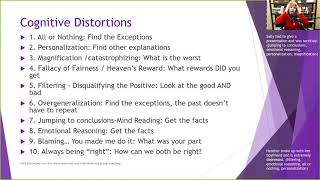
Dr. Dawn-Elise Snipes breaks down 10 cognitive distortions like catastrophizing and all-or-nothing thinking that fuel anger, fear, and depression. She walks through how John, Sally, and Heather each fell into these traps, then shows how to reframe them by checking facts, finding exceptions, and weighing evidence.
Questions this video answers
10
John (angry about wife calling his friend), Sally (fearful about giving a presentation), Heather (devastated after a breakup)
Chapters
Welcome to Happiness Isn't Brain Surgery with Doc Snipes. This podcast was created to provide you the information and tools Doc Snipes gives her clients so that you too can start living happier. Our website, Docsnipes.com has even more resources, videos and handouts, and even interactive sessions with Doc Snipes to help you apply what you learn. Go to Docsnipes.com to learn more. Hi everybody, and welcome to Happiness Isn't Brain Surgery with Doc Snipes practical tools to improve your mood and quality of life. Today we're going to talk about cognitive distortions, and there are a bunch of them, but we're going to focus on the 10 most common ones and how they can make you miserable and likewise, what you can do to combat them. So let's start with what is misery? Well, misery typically we think of as anger, fear, and depression. Those three big unpleasant emotions. Well, anger and fear are responses to a threat. It's your body saying you either need to fight or flee. Depression is a response to a loss or a sense of hopelessness and helplessness. Depression tells us that, oh, we're really sad that that's not there anymore, that we don't have it. If you never got depressed about anything, not saying we want to be depressed all the time, but when we're depressed or sad for a moment, it shows that something was meaningful to us. It doesn't need to be considered something that's bad. Depression tells us, oh, that was important and I'm sad that it's not there anymore or that things have changed. When we have one of these feelings, anger, fear, or depression, it's our brain's way of telling us that there might be be a problem. Now there's an emphasis on might. It doesn't mean that there is based on prior learning experiences. For example, if you know, you saw me and I was across the room because I tend to talk with my hands a lot and I tend to be very animated. If you had a history of coming from somewhere where there was a lot of domestic violence, you may think that I was angry and I was being aggressive, which may trigger a fear response in you based on your prior learning. But the key is to check it and say, is this actually a threat right now? Is my brain interpreting what's going on correctly? When we accept these unpleasant feelings, without question, we often feel unpleasantness unnecessarily. A lot of times our brain is wrong. It says there might be a problem, but there really isn't. So for example, when I'm Home alone at night and I hear a noise outside. You know, my heart starts beating a little bit faster if the dogs start to bark like crazy. You know, I start thinking, is there somebody outside? Well, I got to check that. You know, I could sit there and be scared and be worried and nervous all night long, or I could get up and check it and go, oh, you know what? It was just the wind and go on with my day and it wouldn't be a big thing. So it's important to check yourself. So we're going to talk about three examples in this presentation, just because they're common things that come up, but we're also going to talk about the distortions and how you can apply them to your own thinking. So the three examples we're going to talk about today. John saw that his wife had been frequently calling his best friend and became enraged. Sally had to give a presentation and was just terrified. And Heather broke up with her boyfriend and was devastated. So we've got anger, fear, and depression here that we're going to talk about. And like I said, these are not going to cover all the situations, But I want you to see how situations when they're not checked can lead you to unnecessary misery. So what are these cognitive distortions? Well, cognitive means thoughts and distortions means kind of out of whack. We think of things or think in ways that aren't exactly accurate. We distort the truth, so to speak. They often say that truth or reality is 90% how we perceive what's going on and 10% what actually happened. So 90% is a lot. So our perceptions mean a lot. Our past learning experiences mean a lot. You know, children, when they're young and they're learning, they may not understand things because they don't have those prior learning experiences. So they may not realize something is dangerous and they may not get afraid when they should. As adults, we tend to get afraid when we don't need to. So it's important to be able to be mindful of how we're feeling and our environment to go, are we safe? So the first cognitive distortion is all or nothing thinking. And most of us engage in this periodically when we use words like always, never every single time. Those kinds of phrases may emphasize what's going on, and it may seem like something happens a lot, but that's not every single time. Rarely does something happen every single time or never. So you want to go and look for the exceptions. So if you never take my feelings into account when something is happening, well, is that true? Does that person never take your feelings into account, or is it something they frequently don't do? But sometimes they take your feelings into account, and we want to really look at how frequent these things happen. Sometimes we overlook the positive, and we're going to talk about that in a little while. But sometimes, you know, somebody may take your feelings into account a lot of the time on a daily basis. But then there are a couple big, glaring episodes, big, glaring incidents where they didn't take your feelings into account and you're remembering those and forgetting all the good all the other times that the person did take your feelings into account. So try to eliminate extreme words from your vocabulary instead of always or never use the word sometimes. Personalization means you're taking things and saying, well, you made this happen. You made me feel bad, you're angry at me. So if you're walking down the hallway at work and maybe your co worker gives you a dirty look, and you may automatically take that personally and you may say, oh, my gosh, what did I do? Why did I make her angry? Or on the other hand, you may say, what is that person's problem? How dare they give me this nasty look? I was trying to be nice. Either way, whether it's anger or apprehension, that's an unpleasant emotion that you may not need to be feeling. The person may have been thinking about something, and often La La land is what I like to call it while they're walking down the hall. And that facial expression may have had to do with what they were thinking about and they didn't even see you there. Think about it. Have you ever walked down the hall and just kind of not noticed what was going on because you were stuck in your own mind? Imagine what kind of facial expressions you make. My daughter catches me with that. Occasionally. I'll be checking my email or something and I'll look up and I'll have a look like I just swallowed a sour lemon. And, you know, she's like, why were you making that ugly look at so and so. I'm like, huh, I didn't know I made an ugly look at anybody. And so you need to kind of pay attention not only to what other people are doing. And if they do something that makes you angry or feels hurtful or, you know, makes you scared that you offended them or something, check it and go, you know, is it about me? When you go through a cashier's lane, you know, if the cashier is exceptionally rude, it happens, you know, I try to step back and go, what are three reasons Besides the fact that the person just didn't like me for some reason, what are three reasons this person may have been rude to me? Maybe they'd been having a really bad day and they just were in that kind of a mood, had nothing to do with me. Maybe their boss had just gotten onto them and they were kind of in a funk and they were angry at their boss and it was just still bleeding over. Or maybe that's just the way they are. I mean, in their head they live in a very dark, unhappy place and they're not nice to anybody. You know, I try to look at what are the possible other explanations. And y' all know I like the number three. So I look for three explanations, magnification and catastrophizing. So something happens and you're like, oh my gosh, I lost my job or I got laid off. Now I'm going to lose my health insurance, I'm going to lose my house, I'm going to be homeless, living in my car. You know, you just go from 0 to 120 in no time flat. Well, that just makes you miserable. How likely is it that all those things are going to happen? Could they happen? Well, yeah, possibly. And you could get struck by lightning during the next thunderstorm. How likely is that to happen? Pretty darn unlikely. So when you start feeling yourself getting revved up like the sky is going to fall, stop yourself and go, okay, let's look at the evidence. Not how I'm feeling about what's going on, but let's look at the factual evidence for and against my thought that this thing is going to end up being the worst thing in the world. What is the evidence for it, for and against it. So I can weigh it and decide how likely is this to happen? You know, when I look at the objective evidence, number four is your fallacy of fairness or heaven's reward. And they're kind of different, but they're kind of the same. The fallacy of fairness is when you believe that things should happen because everything in the world is fair. Well, hang it up, it ain't. Everything in the world is not fair. Or, you know, we'd all be 5 foot 11, blonde hair, blue eyed, supermodels, you know, and the playing field would be level. That's just not how it is. It's not fair sometimes. So you need to think about it in terms of what do you have and an attitude of gratitude. Heaven's Reward is a little bit different and it says that if you do something good, good should come Back to you. It's karma, heaven's reward. You know, it's not fair if you do good things and you don't get good things back. Either way, however you want to look at it, accept what you did get. You know, if you do something and you know, you get a smile back, maybe you were hoping for more, but you got a smile. That's great. But what else did you get? Did you get a warm feeling inside? Did it make you feel better about yourself? When you look at whether things are fair or unfair, take a look at other people. You know, look around you, you'll probably find that you're better off than a lot of other people. So, you know, in the big scheme of things, you know, you've got a lot to be grateful for. Maybe some things aren't fair and they aren't. However, you can focus on that which is going to make you miserable because you can't change it. You can't make life fair. Or you can choose to focus on the good things in your life and what you do have control over. Number five is filtering. And a lot of us, especially if you're depressed or you're anxious or you're angry, or you just tend to be more on the negative side, tend to disqualify the positive. So when something good happens, it's like, well, of course that was going to happen. And when something bad happens, it's like, oh, my gosh. Disqualifying the positive also means disqualifying your good trait. So you focus on all the things you do wrong, but not on all the things you do right. It's important to look at both of them. And next week, when we talk about dialectics, we're going to talk about always looking at both sides, always looking at the good and the bad. Because things can be going really well in some areas of your life and really crappy in a couple others. So are you going to get all upset and say, my life is just over. It's miserable because a couple things are going bad even though five other things are going pretty well, or are you going to look at those things that are going well? Going well? I've got all this stuff going for me. All right, we need to focus on these other couple of things and figure out how to fix them. So you don't want to disqualify the positive, whether it's the positive things about you, the positive things that you do. And the same thing is true if you are parent or a supervisor or even a friend when you're Talking to people, a lot of times we forget to give them kudos for things they do well, and we only focus on the things they do wrong. You didn't get your paperwork in on time or your room wasn't clean, or this or that. Instead of going, awesome job, ideally, you want to have three to five awesome jobs in there for every critique. So, you know, try to start doing that each week with the people that are important to you. When you see them, you know, congratulate them on things, thank them for things, make sure to give them kudos for the good things, and do the same thing to yourself. At the end of each day, look back over the day and go, what did I do that was nice? What did I do that was good? What did I do that helped me move toward my goals? And yeah, you may have done some other things that didn't help, but focus on the things that did. So you. Because you're naturally going to remember the things that you forgot to do or didn't do well. That helps you get more balance. And when you have more balance, it doesn't seem like life is so out of control and so negative. Number six is overgeneralization, which is kind of like all or nothing. But overgeneralization is when you take one thing and assume that every other incident is going to be that way. So, for example, if when you were in high school, you had to give a speech and you really flubbed the speech and it was just an awful, embarrassing experience, and you assume that every time you've got to get up in front of people, henceforth and forevermore, it's going to go just as poorly. That's over generalization. That's taking at one instance and assuming that it's going to apply to everything. If somebody is unpleasant to you again, you've got to think to yourself, maybe it's a co worker and oh, that person is just the meanest, most nasty person ever. Okay? Or was that a specific day and a specific episode? Maybe that person got up late, had a flat tire, you know, got to work, got in trouble, something else happened, and they were just in a funk that day. So do you want to assume that they're like that always in every situation? Or do you want to say, well, maybe that was just a bad day. Let's see what they're like tomorrow. So try not to over generalize, over generalize. The past does not have to repeat itself. If you get into relationships, you know, you can say, every time I get into a relationship, it ends up in Disaster. Well, that's all or nothing. Thinking every time is one of those extreme words. So you want to look for the exceptions, but you also don't want to overgeneralize and assume that every relationship you get into is going to be a failure. You want to look at each relationship that you've had and find the things that went well because you want to do those more and find the things that didn't go so well so you can work on them or avoid them in the future. Number seven is jumping to conclusions or mind reading. Assuming you know what somebody's going to say, assuming you know what somebody wants, assuming you know what their intent was, can make you miserable. Especially if you assume that their intent is not good, is malevolent. So you want to get the facts. What exactly was going on? Emotional reasoning is your eighth cognitive distortion, and we use that a lot. People use that when they're getting ready to get on an airplane, for example, they're afraid of getting on an airplane, so they assume that it's dangerous. You know, they don't. They haven't looked at the facts to see, you know, how much safer or more dangerous it is than driving, which they do every day. They haven't looked at the facts to see, you know, how common is it for an airplane to actually have problems. But they feel fearful because they've paid attention to the occasional plane crash that makes the news. Well, the 20, 30,000 flights a day that don't make the news aren't even registering in their mind. So it's important to recognize whether you're using emotional reasoning. You feel scared, therefore this must be dangerous, or you feel angry, so therefore there must be a threat, versus what are the facts. So step back and go, I'm feeling scared. I'm feeling nervous that this is a dangerous situation. What are the facts? Do your research. Look online. With the advent of the Internet, you can do a whole lot more research and educate yourself now more than before. Now be careful. Make sure you use good websites. And please, if you're worried about a health condition, stay off places like WebMD. Call your doctor because you will freak yourself out unnecessarily most of the time. But get the facts, because most of the time when we are scared about something, it's not as scary as we're making it out to be in our head. Number nine is blaming. You made me do it. Well, you know, somebody does something and you get angry or you get sad or you get however. Well, that's true, they did something. But what was Your part in it, did you tell them that that bothered you? Did. When they did it, did you react to that in a helpful way? Did you overreact to that? Sometimes, especially if we're in relationships, whether it's a friendship or a close relationship, we'll just stuff things. People do things that annoy us, and we kind of stuff it. It's like, okay, whatever, whatever, and we get a bunch of whatevers. Well, all those whatevers end up lining up on a list of done me wrongs that eventually come out. Somebody, the person does something, and it's like the straw that broke the camel's back. And all of a sudden you're hitting them with this litany of done me wrongs that they've been doing for the past six months that you haven't addressed. You did this, you did this, you did this, and you keep doing this. Well, if you didn't tell them it bothered you and why or how to address it, then they may not even know. So you can't hold them accountable if they do the same thing, like leave the toilet seat up 12 times. You can't hold them responsible for all of that because they may not realize that it bugs you or even realize that they're doing it. So you need to look at what was your part in it. Yes, people. Other people do things that can trigger feelings in you. Feelings are designed to get you to do something. Not to sit on it, not to stew in it, but to do something, to fight, to flee, or to reflect. So when you feel a feeling, then it's your choice what to do in the next moment. You can improve the next moment and decide what to do so that feeling goes away, or you can stew and stay stuck in it. You know, that's your part. You choose how you continue to feel. Your immediate reaction. That's a biological thing that comes from learning and all kinds of stuff. You can't control that. So don't try to control that, but say, okay, I feel this way. How can I improve the next moment? If somebody is doing something that makes you unhappy or causes you problems, you need to make sure to address it ahead of time. If, for example, you know, we're coming up on the holiday season and maybe you're anticipating that your spouse is going to get the kids Christmas presents, and then it comes to Christmas Eve and there are no Christmas presents, and you're like, you were supposed to do that. That was your responsibility. Did you communicate that to them? Did you check up and make sure things were going. I mean, the Day before Christmas or the week before, you probably should have been going, have you gotten a Christmas presents yet? Or, you know, I don't see anything coming in. For something that's important like that you need to be aware and kind of on top of things. Not saying that we should have to micromanage other people, but if there's something that's really important to you, then you probably need to stay on top of it. And number 10 is always being right. If you have difficulty, you get angry. When people don't accept your point of view, when people don't accept your rationale or your way of doing things, it can cause a lot of unnecessary misery and strife between you and other people. So you want to ask, how can we both be right? You know, politics is one example. You know, you may have one opinion and your best friend or your parent or somebody else has another opinion. All right, Is it possible that both of you could be right from a certain point of view and you can agree to disagree? It doesn't mean the other person's necessarily wrong. It just means you don't hold the same opinions and rightness, if you want to stick with that term, is very subjective when it comes to opinions and ways of doing things. There are, you know, my daughter's working on algebra now, and she solves problems differently than I do. Now, does it mean that her way's wrong? No, she gets the same answer. So we're both right. We just go about it in a different way. And far be it from me to tell her she's wrong because it's working for her. So you want to be able to step back and go, is there some validity to their point? You know, examine it. And even though you may disagree, it's their opinion or it's their way of doing things. Is it getting you to the same place? Okay, so let's go with those examples we talked about in the beginning. John saw that his wife had frequently been calling his best friend and became enraged. So what other explanations might be going on? So the first thing is he jumped to conclusions. He probably assumed that she was sneaking around behind him or, you know, whatever the case may be. Well, maybe she was sneaking around behind him to plan a surprise birthday party for his 45th birthday. Oh, well, that's a whole different thing. He used emotional reasoning. He felt angry, therefore she must be doing something wrong. Instead of going, I feel angry, so let's see if it's me or if it's somebody else is doing something wrong. And he used overgeneralization he assumed that because she was calling him, and when people call other people, it must mean that they're in some sort of a relationship. So there were several cognitive distortions there, when in reality she was just planning a surprise party. Sally had to give a presentation and was terrified. A lot of people are terrified about public speaking, even if it's just giving a presentation in front of their team. So the first one was jumping to conclusions. She assumed people were going to be judging her. She assumed that it was going to be a disaster. She foresaw all these things that were going to happen before they even happened. She used emotional reasoning. She was afraid that things were going to go poorly. So she said, this is a really terrifying thing to do. She personalized it. She may have thought that they're going to think, I am the most stupid person in the entire world when I get up and do this presentation, or they are going to, you know, really hate me. It's going to be about me, not necessarily about the material. I used to sit in these long meetings where we had to get up in front of all the other directors and present our monthly report. And it was a little intimidating. The ce, all the C level executives, the CEO, the cfo, the C this, the C that were in there, as well as all the directors. So they were my peers and my superiors. However, you know, they didn't dislike my presentation or dislike me, for example. But the material I was presenting was boring, boring as sin. And we had to hear the same basic thing from 30 different departments. So, yeah, it got redundant and people would start getting antsy and irritable. Had nothing to do with me. Had to do with the fact that we'd been sitting there for six and a half hours. So personalization, you don't want to personalize, so you want to check it and go, is this about me or is this about the situation? And magnification. She was assuming that this was just going to blow up in her face and people would notice every single mistake she made, like she was under a magnifying glass. In reality, most people, they're sitting in there and they won't know if you make a mistake. And even if you do, you know what, everybody makes mistakes. So they're gonna. They may feel for you a little bit. So those were some of the cognitive distortions that she used. So before getting up to do that presentation, she could have looked at the facts, looked at, you know, everybody has to do this. I wonder what it's like for everybody else. And looked around and seen that other people, when other people were doing their presentations, the audience was not engaged. So when she did her presentation, if they weren't engaged, it wasn't about her. It was about them having other stuff to do. So get the facts. Look at it objectively, like a fly on the wall. Take yourself out of the situation and see whether it is as scary and as awful as you're expecting it to be. And finally, Heather broke up with her boyfriend and was devastated. Okay, well, it happens when you break up with somebody. When a relationship ends, whether it's a boyfriend or a best friend, it can be devastating. In this case, she may have been using filtering, disqualifying the positive aspects of not being in that relationship anymore, or only looking at the good parts of the relationship and forgetting all the reasons that they broke up, which the negatives that were there. She used emotional reasoning. She felt sad. Therefore, this may be. Must be devastating. This must be the end of the world, because I feel like I just got my heart ripped out, stepping back and going, okay, I feel really bad right now, but is my world really ending? Will I never find someone else? Chances of that happening are slim. Likely you're going to find somebody else and, you know, repeat the process. All or nothing thinking she's using that. I will never, ever find anybody else. If I can't have this relationship, I'm not going to find anybody else. Or I'm a total failure in relationships. That's all or nothing. Thinking total failure. Well, let's look at what the other person's part was in the relationship. Let's look at the relationship itself. What other factors contributed, contributed to it failing. And, you know, that takes us to personalization. What part did you have in it? Did the relationship break up? Was it all your fault? Was it all about you? Are you unlovable? Probably not. The relationship probably broke up because it was a bad fit, because of stuff on the other person's part. Because of stuff, you know, maybe her significant other was going off to college or getting deployed or something, and they decided to end the relationship. So it may have had to do with a lot of factors that had nothing to do with her. So when you feel devastated again, you want to check yourself for some of these cognitive distortions and see if your impressions, see if the things that you're seizing on, that you're focusing on are valid and whether they include the big picture. Too often we just filter out and focus on one little narrow aspect instead of looking at all the other things that could have contributed a good thing. To do is write down each one of these cognitive distortions on a piece of notebook paper. You know, one on each, one distortion on each piece or however you want to do it, and review it throughout the day when you start feeling kind of antsy or angry or whatever, and see if you are using any of these distortions. See if you are telling yourself things using any of these distortions. Because our self talk is what often keeps us stuck in misery. If you like this podcast, please subscribe on your favorite podcast. Appreciate Join our facebook group@docsnipes.com Facebook or join our community and access additional resources, including live coaching Once a week with me, doc snipes@docsnipes.com. Thanks for tuning in to Happiness Isn't Brain Surgery with Doc Snipes. Our mission is to make practical tools for living the happiest life affordable and accessible to everyone. We record the podcast during a Facebook Live broadcast each week. Join us free@docsnipes.com Facebook or subscribe to the podcast on your favorite podcast player. And remember, Docsnipes.com has even more resources members only videos, handouts and workbooks to help you apply what you learn. If you like this podcast and want to support the work we are doing for as little as $3.99 per month, you can become a supporter@docsnipes.com join again. Thank you for joining us and let us know how we can help you.










