Addressing Transition Issues Among High School and College Students
This content was created by Dr. Dawn-Elise Snipes. This content was uploaded by Dr. Dawn-Elise Snipes. This is a YouTube video titled "Addressing Transition Issues Among High School and College Students" created on April 26, 2018, discussing the challenges faced by students transitioning from high school to college.
Chapters
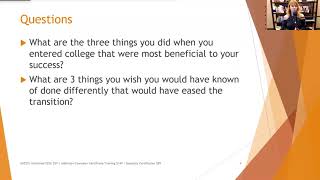
This episode was pre recorded as part of a live continuing education webinar on demand. CEUs are still available for this presentation through all CEUs. Register@Allce.com Counselortoolbox you. So I'd like to thank everybody for being here today. We're going to be talking about addressing transition issues among high school and college students. Now I have a child that is getting ready to go off to college in August. Oh my gosh. So, you know, this was kind of a timely presentation for me to put together. We're going to review 15 common issues students face when transitioning to college and interventions that counselors can consider. And you know, now again, even if you are not on a college campus as a counselor, as a therapist, you may be in the community and you may still be working with youth who are in college either because they don't want to seek services on campus or because services don't exist on campus, or you might be seeing a high school senior who is getting ready to transition and wants to proactively try to prevent problems. And we're finally going to discuss ways colleges and campus counselors can engage students. That's one of the hardest things. And yeah, pizza helps, but there are a lot of different groups of students that we need to figure out how to engage. It's much, much, much easier to engage the students that live in the residence halls and to engage the students who are in sororities, fraternities, and athletic teams because they are sort of captive audiences. But for those students who are over traditional age, those students who live off campus, it can be more difficult to engage those students and really assist them in knowing what services are available and encouraging them to access those services. So the first question what are three things you did when you entered college that were most beneficial to your success? And you know, I will share while you're thinking residence halls, I stayed on campus. I actually stayed on campus through my entire career. The first semester I was just a regular old resident. And then I became a resident assistant and I was a resident assistant or some other position within housing, living in the dorms for the entire four years that I was in college. So residence halls were awesome for me. They helped me develop friendships and really get integrated into college community life. Time scheduling. I'm typically kind of rigid anyway when it comes to scheduling, but I found out that it was even more important and I had to do when I was in high school, you know, I was the one who would be doing fourth period homework and third period. And when I got to college you know, you couldn't do that. So making sure that I scheduled my time appropriately. And then at the university that I was at, the residence halls actually had their own student council. And in our residence hall, we had five different residence halls. Each residence hall had representatives and, you know, we got together or they got together and decided on activities that would be for the entire residence hall area, not just for, you know, one floor, so to speak. And we had some great things. One thing we had was called Mudfest. Every year, every October, we would have. We would dig a pit in the middle of all of the different residence halls and fill it with mud, hence the name Mudfest. And we would have all kinds of activities and festivals and competitions to see which floor in which building would be the champion. And we played tug of war and, you know, stupid games. But it created an immense amount of camaraderie among the different teams that we would have in the main sitting area on each floor. I can't think of what it's called right now. There was a picture window on every single floor and every floor decorated that for their team. So there was a lot of team spirit that was going on. And it was a really fun thing that became an annual tradition in that set of residence halls. So that was one thing that was really cool about being in the residence halls. Exploring the campus on your own. Andrew suggested that, and that's really important too, because it helps you feel more comfortable knowing where your different classes are and knowing how to get to your different classes. But it also, when you explore the campus, you find resources that you didn't even know were there. I mean, there are all kinds of wonderful little hidden out of the way things on a lot of campuses. The UF campus is sprawling and we have Lake Alice and different jogging tracks and the fitness center. And, you know, we had a lot of different opportunities and different things that weren't necessarily front and center, like the stadium, for example. So going and exploring, you find a lot of nice places. And you can also find really cool places where you can go study, where it's quiet, let's see. And engaging in school sponsored social activities definitely is beneficial to meeting other people, even if you're not in the residence halls. If the university offers things at the student recreation center or whatever they call it, where you went, that's nice. We had a restaurant at the student recreation center. It was called the Orange and Blue. And they had open mic night, they had karaoke night. They had a lot of different things. And it was kind of like a small Sports bar, but not. So that was a really fun place to go. We also had bowling lanes and pool tables and other different things where you could just go and hang out even if you weren't in a residence hall. If you were living off campus, you could come to campus and hang out with people that were your own age that had, you know, potentially similar ideals. For some people, one of the best things they can do is get their own apartment. And that's true because you need the space, you need the quiet in order to do studying, and, you know what your goals are. And, you know, especially for people who tend to be more introverted, being around a lot of people isn't necessarily ideal or even wanted. You know, I'm an extrovert, so I like to be around a lot of people. I like a lot of energy and a lot of activity going on around me. But there are a lot of people that I know that, you know, they have two or three study buddies or they hang out with their roommates, but that's their social group. They don't want to be bombarded with 50 people in the university bowling alley, for example. And that's cool. So definitely knowing where the best place for you is to have your downtime. But then that also leaves you the ability to go on campus and do things when you feel like it and making sure that you get yourself out to do those sorts of things. One of the things that I suggest to a lot of high school students that are transitioning if they want to live in an apartment not on campus, is to consider getting an apartment with one or two friends, one or two roommates. And that can be, you know, you got to find the right people to room with. But if you are in an apartment with a couple of roommates, generally you're going to have somebody that occasionally says, come on, let's get out of. Get out of the house for a little while. Let's go to the beach, or whatever. What are three things you wish you would have known or done differently that would have eased the transition? And again, for me, homesickness, you know, I got really homesick. My boyfriend was still back in Fort Lauderdale when I came up to college, so it was, you know, difficult and figuring out how to deal with that. And, you know, I miss being around my dad and my stepmom. I missed the routines. I missed where I used to work because I had a job all through my senior year, and I really missed all of that stuff. So that transition was a little bit bumpier. And I wish I Would have been a little bit more prepared. Conflict resolution skills would have been great. My first roommate and I did not get along very well and it was a challenge then. Class scheduling was another thing. I remember my first couple of semesters having a class across campus which was like a 20 minute walk every morning at 7:30. Now my attendance at those classes was not good. So I needed to learn, you know, not only scheduling and trying to avoid the 7:30am slot, but also, you know, how to schedule my time. So if I had to take a 7:30 class, you know what I could do to be prepared ahead of time. So all I had to do was kind of roll out of bed and grab my book bag. At a lot of universities there's a test out option for low level classes that many students don't know about. So it's important to talk with your admissions counselor and ask about the ability to test out of certain things so you don't have to take intro English or composition or whatever when you first, when you start college. Okay, so prevention tasks that we can engage in as, you know, clinicians, parents, what if, whatever you want to, whatever role you want to don. In this particular class, we can help students develop a sense of belonging on and off campus. It's really important that students feel like they've got a place to go. They don't feel like that's the campus and it's a scary place. It should be home away from home. So campus wide activities and festivals help reduce isolation and encourage developing social support. We had a center place among a bunch of buildings next to the student union where they would have movies on the lawn whenever the weather was nice, every single weekend. And that was a great activity where you could just come and bring a blanket and sit out and watch some movie for free. Because a lot of times college students don't have a lot of money and people were able to just kind of hang out, play Frisbee, you know how it goes when you have a lawn type festival, residence hall, team building activities, like I mentioned the mudfest that we used to have now, you know, I saw some other things go on on certain floors where the youth really bonded. But it wasn't necessarily the best choice. The male floor that was right above ours decided to construct for themselves a hot tub in their lounge. And you know, you can think about the structure and having a hot tub in their lounge. And then when they were done, they drained it out the window, out the fifth floor window onto whoever walked by because that was fun. There was also an Incident, which I will admit that I took part in. We had tile floors in the hallway in our residence hall. So we kind of got it a little bit damp and we put a little bit of laundry soap on it and we created a ginormous slip and slide. Now that probably wasn't the best idea, but it was a lot of fun. So not that I'm advocating for those things, but there are different activities that if it sounds fun, people will likely get involved in. We can help students develop connections to faculty and staff who will advise, register and help students apply for aid. Now a lot of universities have a financial aid office that will help with a lot of this stuff, but also connecting with faculty. At my university, there were a lot of times it was really hard to get into certain classes and you would have to go through drop ed. And there was just this whole process, process the first week and a half of class every semester that was a little overwhelming the first time you did it. So if students have connections to faculty and faculty can say, okay, I know you need this class, let me tell you what you need to do to try to get into it. That can help. If they have faculty who can help advise them on the sequence of classes to take or, you know, what they probably should look at for extracurriculars when they're or not extracurriculars, but electives when they are in their under lower division classes so they can prepare best for whatever upper division college they want to apply for. So there's a lot of different things that faculty can actually help with as well as staff. We want to provide opportunities for students to learn life skills like money management, time management, study skills and conflict resolution. And how we reach out and engage students and teach. This is going to really vary. We can, you know, obviously hold workshops, we can hold seminars, we can have videos online. We can, you know, fill in the blank on different things you can do. If you've got a student radio station, maybe there's a minute, you know, you have a minute break every hour or something where they provide a useful tool. There's a lot of different ways to do this and we're going to talk about some more later. And we need to ensure that students are aware of all the resources available to help them with housing, finances, extracurriculars, disability, accommodations, transportation, counseling and health. Not all of that is going to fall under the auspices of the university, especially if they live off campus. Transportation may be an issue. They may need to learn to ride the bus to campus. And for a lot of us, we've never ridden the public bus system before, so that can be kind of overwhelming. They may, you know, you may not have a lot of counseling and health resources on campus. So what are the resources in the community? So we need to think broader than just what does the university offer? We need to think what services might a student need and where can they find them in our community, which includes the university, but, but also includes a lot of other stuff. Develop a week long summer bridge program or mandatory orientation where students will complete a variety of assessments to diagnose learning strengths and weaknesses. So we're not just diagnosing disabilities here, we're helping students figure out, you know, what, do you even know how you learn best? Do you know the best way to study for you? So this week long program can, you know, it can be all day or it can be four hours a day for that first week. You know, think about, you know, when you went to college, the, the first two weeks. Usually the dormitories open two weeks ahead of time so you have time for panhellenic rush and all those other things. Okay, well, a lot of students could probably squeeze this in in the morning and rush can take the afternoon and this can take the morning. Where students are required to come and get checked off in these things, they begin to develop the skills and strategies necessary to succeed in their courses, including time management, stress management and wellness. So they're coming in, they're going through these classes and in order to register for classes, they have to have a certificate of completion or whatever in the system in order to register for classes. Can be one way to enforce the mandatory part of the orientation. Students meet in daily workshops that build skills around team building, group support, interpersonal skills, and again, conflict management. That one's going to keep coming up. But a lot of students haven't had to really reach out and work on developing in depth groups and things. You know, when they were in high school, there was this occasional group project here and there. At least where I went to college we did group projects a lot. So knowing how to work within a team and knowing how to reach out to friends for support, etc. Is going to be important. And for a lot of students, not all. They went to school with the Same people for four, eight, 12 years and they're coming to college now and they may not know anybody there. They haven't had to make a whole new cohort of friends since they were knee high to a grasshopper. So thinking, you know, well, Sally was so popular in high school, yada yada, yada, she'll have no problem transitioning. Well, if you pluck Sally out of her hometown school where she knows everybody since they were in diapers, and plop her into a university setting where she knows nobody, it can still be a huge shock. So we want to help students develop that. Questions we want to ask students, what are your short and long term goals both academically and personally when you get to college? So, you know, this means more than getting good grades. What are you wanting to do with your life? What are you wanting your social life to look like? You know, what are, what are these goals? What are your health goals? You know, let's really think about, as I've said in other presentations, what does a rich and meaningful life look like to you? So it's going to college is not just about studying and it's also not just about partying. It's about discovering who you are. It's about, you know, starting on your career and certainly academics. But there's so much more to that. We want students to start thinking about that because when they're working on time management, if they say, okay, I'm going to manage my time and this academics is my focus, they may take a 15, 18 hour load and then not have time for anything else. And then they get out of college and they're exhausted. They get out quickly, but they're exhausted and they look back and go, you know what, that wasn't very much fun and I missed out on a lot. So I want to make sure when they're managing their time, they're integrating all of their aspects of self. We want to ask students, how do you think your relationships with your family will change when you go to college? And it can change with siblings, it will change with parents. The person is fledging, they're leaving the nest. Now they're starting to have to pay their own electric bills and you know, get ready to get a job and be more responsible and all that stuff. So there are going to be changes. And do you expect your college grades to be similar to those you got in high school? If so, how will you feel if they're not? And how will you deal with those feelings and improve? A lot of students, there's a huge gap between what's expected in high school and what's expected in college. And a lot of students who may have made straight A's in high school go to college and it's like, oh my gosh, this is so much harder or so much more work. I remember the first time I taught At a community college. You know, I had been at a four year university for so long and gotten my master's degree and I wasn't, you know, I just remembered what I experienced. So I went into the community college and was teaching this class and I told them, okay, you know, you're going to have a paper that you have to do, it's 10 pages and I expect an outline by midterm. And their eyes got like this big. They had never written a paper over two pages before and a lot of them had never even done an outline. They had no clue what an outline was. So I needed to backpedal a little bit and go, okay, let's start with the basics. So we want to make sure that students understand what's going on, but we want to help them realize that they're not necessarily going to get straight A's right away. Where will you find help to do well in your classes? And this is where I want students to start thinking about, where are you going to reach out? You can reach out to your parents, you can reach out to your people who are in your class, you can reach out to tutors. There are a lot of different options, but I want students to start brainstorming because there are going to be classes where they may need assistance making sure that they do well. How will you discipline yourself to keep academic commitments such as going to class and being prepared and what will you need to manage your learning and your time? Encouraging students to just start thinking ahead about, alright, how am I going to make sure that I get this stuff done? I always took the syllabus. I loved getting my syllabus the first day of class because then I could plan out my entire semester when I was going to have what papers done and make sure that I didn't have, you know, three papers due on the same Friday and expect to do all three papers that week. So I was able to organize my time for academics and then I would plop in my social and recreational stuff around that. And finally, when you feel stressed out at college, because you will identify five ways to deal with it. So this is sort of that strengths based question or solution focused question that says what do you do with the. To deal with stress right now? Because they've had stressful things happen in high school. So let's figure out how they deal with their stress. And another question that Pat brings up is we may want to ask students, why are you going to college? They recently passed a law, I guess it would be in the state of Tennessee where students who get a certain amount on their actual, which is like 18 or something, can get two years of college for free. The governor's mission was to make sure that everybody could at least get a two year degree. So there are a lot of students who wouldn't necessarily have ever even thought about going to college who are now enrolling in at least two year programs. So they come, and a lot of times they are relatively ill prepared, but they're like, well, why let the money just go? So I might as well do something with it. So we want to know why are you here? You know, what is it that you hope to gain out of being in college and how can I help you achieve those goals? Some students, you know, may not have had a lot of guidance. They may be going to a school because they're a legacy and they were expected to go to such and such. You know, I was a legacy at uf. My, my parents went there, my grandparents, so I was expected to go to the University of Florida. And you know, I loved it, but I really didn't think for undergrad about any other colleges. Some students may feel that way and if they are not book learning inclined, maybe they tend to do better with manual things like tech programs. Then they may feel pressured into going into a field or maybe they don't want to be an engineer, but they're expected to be an engineer because their dad was, their grandfather was, and their great great grandfather was. So we need to start encouraging them to think about what is it that you want to get out of this experience. So question for you guys, what issues caused you the most angst when you were a freshman? I mean, obviously there were issues or I had issues interpersonally with my first roommate and that caused a little bit of angst there. Otherwise my residence hall experiences were really pretty good. Another thing we had was the bell curve. And in certain weed out classes, the person at the end of the semester who ended up getting an A actually only ended up having like a 45% because the tests were so hard and they were trying to get people to drop out, which I could never make it to the end because I couldn't look at my grade and go, well, as long as somebody doesn't skew the curve and get an 80 on that final exam, I can pass. So helping students get through that and, you know, I think it's an unfortunate practice, but it was what it was and you know, letting them know that, you know, everybody pretty much got a 45 on this test and that just kind of Moves the curve down. So that was. That was a huge thing for me because I was used to, you know, that bell curve where people actually did get good grades. Proofing each other's papers can be a little bit frustrating when you. When you're in college because you're reading it and you're seeing all these mistakes. And there's a desire to not want to hurt somebody's feelings, but there's also the desire to want it to be right. So that can put you in awkward positions, too. Another thing that causes a lot of people angst is finding their niche, whether that be pledging a sorority or a fraternity or being on a sports team or an intramural team. And if they find a niche that they want to belong to and they don't get accepted, it can be devastating for a lot of youth. So one of the first things that students experience is feeling overwhelmed. You know, they get to college, and they didn't know what they didn't know. They didn't know what questions to ask because they didn't have any idea to ask the questions. So that's the first thing to help students really walk through the process. Do a dry run. If there's a bridge program, that's awesome. For our drop ad, for example, at the University of Florida, I had no idea how to do that that first semester, and I didn't know that there was such a thing as drop ad, so I didn't know that. Ask about it. So we want to make sure students are prepared and they've got, ideally, a mentor or somebody who can help them along the way. There's a gap, as I mentioned before, between the level of learning required for college versus high school. So students can start to feel overwhelmed really quickly. Normalizing that is really important. Environmental changes. With no curfew, it's easy to stay up really late and stay out really late. If there's nobody saying you need to be home by 11, there can be culture shock. If somebody's coming from a little rural community and going to a school in the big city, or, you know, they've been an only child and now they are living in a dormitory and have three roommates. They, you know, there's a whole lot of different scenarios where somebody has their culture of origin, you know, their home, their what they're used to, and they come to college. And for most of us, it's a bright new world. And there. There's a lot of adjustment. There's a lot of getting used to being around different types of people and just Moving out of the parents home. I know a lot of youth who moved out of, you know, moved out, went to college and they would go home every weekend to have mom do the laundry because they still didn't know how to do their laundry. So there are little things that people need to figure out how to do and to keep them from feeling overwhelmed. We want to make sure that they feel efficacious at, you know, kind of grabbing life by the, by the coattails. And it's easy to get disorganized when you have that many classes plus managing other things. If you, if, if the student lives off campus, then they probably also have bills to pay. If they live on campus, then everything is kind of covered under the residence hall bills. But if they're off campus, they've got to pay their electric, pay their water, pay their cable, yada yada. And it can get really overwhelming really quickly. For some people, identity development is the next thing because this is the time. I mean, think about Erickson's stages where when youth are figuring out who they are, what their values are, what they stand for, where do they fit in, you know, all that kind of stuff. They choose a major, they figure out what they're going to do. And it's really hard for a lot of students because they choose a major and a lot of times they will change their major two or three times before they get into upper division. And for some students, they feel very nervous about that because they're like, well, I committed to doing this. I entered as pre med, so I've got to stay pre med. No, you entered as pre med. Now you've experienced college, you've experienced some harder classes, and you've started to figure out what you might be interested in. So is this the direction you still want to stay? That's what the first two years is about, is figuring out the direction you want to go. Wanting to belong or find that niche, as I mentioned on the last slide, can also be really challenging for a lot of people if they don't get accepted. And if you're familiar, and I think all of us are familiar to more or less extent about fraternity and sorority rush. But you rush and you are invited back to a subset of houses and then you identify the houses that you want to belong to, and then they look at the lists and they figure out who that wants to belong to them they're going to accept. And it's just this negotiation, so to speak. And when people don't get accepted to the sorority or fraternity that they want to be accepted to. Even if they get accepted to a different one, it can still be devastating. And we want to help people really work on their coping skills and their self esteem during this period. They may have difficulty balancing multiple roles. Sororities, for example, take a lot of time. You know, there's, especially during the pledge period, there is a lot of stuff that you're expected to do. Working. If the person also works part time, that's going to take time, plus going to classes, plus doing studying, plus doing the grocery shopping and the laundry and all that stuff. So people need to know how to balance those different roles in order to make it all work. And social anxiety can also be huge. Like I said, a lot of these students have known the people they've been going to school with forever in a day. And now they're in a sea of thousands of new people. And it can be a little bit overwhelming. And if somebody has social anxiety, it may come out, it may not come out until college, and it may start coming out then because all of a sudden they're having to meet new people and they're not, you know, already known in their hometown. They were a known entity. Exploring new aspects of self and others is also a stressful time for a lot of youth. They're figuring out what their values are, what's important, what causes are you going to take up. They're learning more about their culture, they're exploring more their sexual identity and their interests and talents. And all of this can be very tumultuous for a lot of youth, especially if they are exploring aspects of themselves that they don't think are going to be accepted by their parents or by their friends. And it's a time they need to be able to have, like, others to reach out to. So there need to be houses or places where people can go that are, you know, like the. We had a Hispanic student center, we had a LGBT student center. We had student centers for different groups of people where they could go and feel like they belonged. They could walk in there and know that they belonged. Social pressures and expectations, yeah, they existed in high school, but they can be even worse in college because parents aren't there. Drinking, partying, staying out late, attending social events all the time. I remember living in the, in the dorms. I had friends who went out every single night. And you know, a lot of times they went to the student union or went to somebody else's dorm or whatever, but they were going out. They weren't staying home and studying and they were staying out till 11:12. 1 I'm a pumpkin. Even in college I was usually in bed by 10. And the pressure to go home or not. Students have the pressure to stay, to party, to do things on the weekends with their new friends. But they also likely have pressures from their friends at home to go back, from their significant others at home to go back, from their parents who are experiencing a little bit of emptiness thing going on to go back. So they're having pressure from both sides and they need to figure out how they're going to manage the pressures from all those different people and be authentic with themselves. What is it that they want and need? Time management. Encouraging students to know their limits, schedule time for fun and take breaks to keep their mind fresh and clear. It's important to have balance. Yes, it sounds great to take 15, 18 hours a semester and be out in, and go three semesters a year and be out in three years or whatever, that sounds great, but in reality it's not much fun and it's exhausting and you lose large parts of yourself when you've got that much schoolwork to do. So encouraging students to find balance so they can rest and recharge at home. Parents, teachers and coaches provided structure schedules and timelines for completing homework assignments. College professors, they give you a syllabus and a lot of times it's like four tests and a paper and other than that you're expected to be studying and getting the stuff done. So it's important that students figure out how to create for themselves their own timeline. When students get behind, they may not know how to get caught up. You know, they get halfway through the semester, they haven't cracked the book yet, and then they're like, oh my gosh, midterm is coming up. I have no idea how to get ready. Well, it's probably going to be difficult, but they need to have, they may need to have some assistance in figuring out what are the bare necessities I need to do in order to prepare. And some students may feel overwhelmed just looking at the syllabus. I know one university in Lebanon, the psychology program. The freshmen are told that to graduate they have to do a senior thesis, which is going to be a minimum of 30 pages. And that weeds out like a third of them right there because they're like, I can't even think of writing a 30 page paper. Life skills are another stressor for high school students when they transition. Some students get anxious or overwhelmed because they've never had to develop these independent living skills. They've never had to Go to the store. There's one comedian that I love that talks about going to the store, and he's like, I walked through the aisles and all I saw were things to make food, but there was no food. And his point being that there were all the ingredients, but he had no idea how to put them together. He had no idea how to create a shopping list in order to prepare the meals that he wanted to prepare. There are a lot of adulting skills that we take for granted that we need to make sure that students learn. And one of the best ways for them to learn and, you know, I would love to say mentorship with their parents, and we can hold their hands, and that would be great, but we ain't got that kind of time. YouTube videos on adulting are out there. Encourage them to, you know, consult resources and learn how to find decent resources online to help them with some of their adulting skills. Online videos and residence hall workshops can educate students about how to do laundry, money management and paying bills, study skills, and self advocacy. And what I mean by that is how to stand up for themselves. If they want to return something and, you know, the customer service person won't take it back, how do they advocate for themselves and talk to a manager? You know, kind of goes with conflict resolution. But if they definitely desperately need a class in order to get into upper division and they've tried for four semesters and they still haven't gotten in, how can they advocate for themselves? Money management comes up partly because a lot of youth haven't ever had experience with managing money and paying bills and doing that kind of stuff. But also, sometimes people spend more than they should because they have anxiety about not fitting in. If they can't afford to go on the trip with their friends, if they can't afford to go shopping, if they can't afford to buy, you know, all of the letters, the bags and shirts and everything with their sorority or fraternity letters. So they may spend a ton of money and they just. They can't afford it. They may run out of money before their bills are paid. So it's important to help students learn how to, you know, prioritize, know what their resources are and develop an appropriate spending plan. Seek the advice of a financial planner or counselor. A lot of times, there are people within the financial aid department who can help them consider student loans if they don't have any. The subsidized student loans typically don't start charging interest until like six or 18 months after you've graduated. The unsubsidized student loans often start accruing interest right away or as soon as you graduate. So have them look at subsidized student loans to at least take a little bit of the pressure off. Encourage them to be careful about being drawn into credit card opportunities that are offered to college students. I remember that there were all of these opportunities all over the bookstore when you would go in to buy your textbooks, which were really expensive and they are just getting more expensive. So it was really tempting to apply for a credit card, but a lot of students have difficulty understanding and managing credit cards and paying off balances. Encourage them to look for a job. A lot of universities have a board or website now where they have student work opportunities on the university and places in the community can also post job opportunities. Encourage them to not spend money unnecessarily and take advantage of discounts that are offered at various businesses. Remembering to be creative. One of the things you can do if you're doing a group with incoming freshmen or if you're doing a group with high school students who are getting ready to go to college, is have them identify 15 creative things they can do that don't cost any money or cost less than $5, because sometimes you got to drive there and that's the gas does cost money. Making new friends. You know, we've talked about the niche, but also just making new friends. Some people go from being, you know, the prom queen, the football hero, the this, the that, to just a number. You know, there is a quarterback or football hero for the university, and that's not you. And it can be really difficult for people to go from being preeminent to just being themselves. They may have feelings of isolation, especially if their friends go to a different university. Making sure to help people make connections. We used to, as residents, advisors, we used to try to create a list the first week of the interests of the different people on our floor. And we had a bulletin board and we would connect people by their interests with little strings so they could see who may share a similar interest. Another thing we don't talk about a lot, but it occurs quite frequently, is people experiencing jealousy when their old friends start to make new friends. So maybe this cohort of five students from one high school went to the university and then, you know, they're all best friends, but then they start making new friends. Well, some of the people in that cohort may feel left out or jealous or wondering if they're going to be abandoned by their friends. So we want to make sure that we work on those interpersonal communication skills and any attachment issues that may be there. Failing to network can also be a problem. When students don't get to know and spend time with classmates, professors, and other academic advisors, they lack support and a place to go for ideas and answers when a problem does arise. I can tell you, after many semesters of teaching, with the exception of the one semester that I made it mandatory that everybody come see me at least once during office hours, I saw students maybe six times, not a year, six times in the five years that I was teaching. So, you know, we really want to encourage people to get in there and network and at least talk to the professor and get some ideas about what they might be able to do to succeed in the class or whatever. Practical experience and internship opportunities should always be available to provide maximum networking opportunities for students. So if we can encourage them to participate in any sort of internship opportunities or practical experiences that's less formal than the classroom, they have more opportunity to talk to one another when they go to class. And, you know, they can find out about study groups that are being formed within the class. They can find out about special study groups that the professor may be holding that they wouldn't find out about unless they went to class or went to the professor's office. Office hours and very true. Remind students. Pat points out that their tuition pays for them to have one on one time during office hours with their professors. So they're paying for it. They might as well use it. Homesickness can bring on feelings of grief and longing. They may miss somebody checking up on them. You know, you go home, you make your dinner, you go to bed, and nobody says, you know, how was your day today? So especially for students who choose to live off campus by themselves, this can be troublesome. They may miss their pets. You generally can't have pets in dorms. And a lot of students choose not to have pets, even if they live off campus. You may miss the comfort of home turf. You know, when I went to college, I had to learn my way around the city. I had to learn where to shop, I had to find a new hairdresser, I had to find, you know, a new doctor, a new dentist, all that kind of stuff. I missed the comfort of knowing where everything was and how long it took to get there. Missing the things they used to do and routines they had. Yeah, you know, it's different. It's a move, you know, just like when we get job transfers or whatever. Encourage students to remain on campus during the week and on and on weekends to get to Know the campus and become more involved in athletic and social events. There's definitely networking that can happen there. Have them force themselves to become part of the culture within their new academic world. That means forcing themselves to partake in some kind of activity where other students will be around, even if that means just hanging out at the library. You know, lots of people hang out at the library. Stay in touch with friends back home through email and phone, and ask friends and family to email, call, and send care packages. Students used to just. Their eyes would light up when they would come down to the front desk at the dorm and they would have a package waiting for them. So that's definitely something that can help ease homesickness and encourage them to plan a visit home once every month or two. You know, if they're going home every single weekend, it's probably going to make it harder for them to ever detach from the old and embrace the new. Depression. Every problem that happens can raise a student's stress level and contribute to hopelessness and helplessness. So we want to empower students with options. Let them know what resources are out there. Let them try to help them figure out how to solve their problems. Encourage staff, faculty, staff, residence hall staff, etc. And other students, because, I mean, if you're living with three other people in a dorm room or in an apartment, they're going to be in tune to some of your mood changes. So encourage staff and other students to stay alert to students starting to fail by skipping class, failing grades, withdrawing moodiness, anything that might indicate that they are starting to flounder so they can be connected with some sort of resources. Some students find temporary relief in partying, which may contribute to poor grades and depression, because you know that partying leads to exhaustion and a disruption of neurotransmitters, which can compound the depression. You know how hard it is to go to class when you're hungover. Students need to grieve. They need to grieve the ending of their childhood and embrace young adulthood. Yep, at a certain point, you got to start adulting. The loss of routine with their friends. The loss of friends. As you know, as we go through college, whether it's the first year or through college, people get paired up, get married off, start having kids, get jobs, move away. It doesn't mean that they're totally gone. You can still email and communicate, but it's not the same. And they need to grieve the changing relationship with mom and dad, where mom and dad aren't necessarily doting over them as much anymore. They may miss that, so they may need to go through a grieving process. Unresolved relationship issues commonly cause bitterness, resentment, and anger. They may break up with a high school sweetheart before they go to college or during their first semester, and that can be very traumatic. There's pressure to choose the right major and get good grades, especially if they're the first person from their family to attend college or they're expected to follow in a parent's footsteps. That can cause a lot of relationship tension. If Sally was expected to go to med school and she decides, you know what? No, I want to be a mathematician or a computer engineer or whatever it is, and she tells her parents that, the parents may take that as a slap in the face, so to speak. So we need to help students figure out how to identify who they are and what they want and negotiate. These conversations with their parents can also get even more tense. If parents are paying for their college, they're not on scholarship because parents can say, well, I'm paying for your education, so you are going to go to medical school or you are going to go do this. And encouraging students to look at what other options are out there. If you truly just are not happy doing this, how could you continue to fund your education if your parents decide to withdraw their support? Lack of acceptance from parents of the new identity or new friends. Sometimes the first time you go home and you bring all your new friends and your parents are like, wow, that's different. Or parents may not be liking the new identity. Maybe somebody was very quiet and demure before and they're kind of coming out of their shell in college, whatever it is. Sometimes people who are LGBT don't acknowledge their identity until they get to college. So that may be another thing that they start to embrace in college that makes the relationship with parents difficult. And as I've mentioned multiple times, lack of acceptance into a group or discharge for failure to comply can cause bitterness, resentment, and anger. People who don't get accepted into the sorority or fraternity that they want to, and they, they may be very resentful of that sorority or fraternity guilt for leaving a chaotic home environment. Some students come from not the best home environment, and they have been the one that's been taking care of their younger siblings, and so they have guilt for leaving them behind because somebody else has to pick up the slack since mom and dad are not capable of doing that. Any of these feelings can cause students to lose focus of the goals that they're attempting to achieve in college. So we need to help Them figure out how to navigate that. Roommates. Students may never have had to share such a small space with someone before, let alone a perfect stranger. So this is an adjustment. Conflicts will arise and conflict management skills will be tested, which can lead to high distress. You know, when people are angry and bickering, it can put everybody in the room on edge. And avoidance of one another, eating disturbances, sleeping disturbances. If you're in a tense environment, it's harder to relax and get your work done. So we need to help students figure out how to negotiate these roommate conflicts and interpersonal issues. Encourage them to set rules for the room or suite that everybody can agree on. This usually revolves around, you know, what time is, lights out, what do we do if we're going to be late, yada yada. Learn that roommates don't have to be best friends. The important thing to remember is to respect one another and help students recognize and learn that they're not going to be liked by everybody all the time. Some students have difficulty accepting if they are not best friends with their roommates. They just, they can't handle that. They can't stand living with somebody who doesn't just adore them. Educate students about cultural differences because a lot of times you have people that are smushed together in the same 300 square foot room from very, very different backgrounds and encourage them to learn how to live with the fact that you aren't going to be liked by anybody all the time. You know, failure. Don't be afraid to fail. It's going to happen. That means you're getting outside your comfort zone. The reality is if that students actually do their work, they're probably not going to fail. But a lot of students tend to get really worried when out of nowhere they get a B in a class, which can seem like a failure to them. They've not gotten B's before or they've not worked that hard and gotten a B before. Helping them adjust to the realities is important for us in helping them make a transition and not start to get consumed by anxiety or feelings of helplessness. And sometimes people switch majors or even universities. A lot of students may look at that as a failure. They started out, they had a plan and now they're having to adjust their plan or even maybe switch to a smaller university. And that doesn't mean they're a failure. That means this is not the right fit for them. So helping them embrace that change of that paradigm shift is going to be important. Poor grades freedom coupled with a lack of accountability makes it really Easy to fall short of completing the necessary studying to succeed. Failure to dedicate the appropriate time to studying and reading is likely to have negative impacts on grades. Some people can skate by, but they're the few. Have students try to be accountable to others for their academic performance. So have a study buddy know each course, the syllabi, the requirements, and the professor's expectations for papers, for essays, for anything that is somewhat subjective. Encourage students to ask the professor for a grading rubric so they can identify if they're covering all of the main topics. When students are not in class, they're not receiving the benefit of the instruction or the information given regarding grading, future assignments or opportunities like study groups. When I taught, I always resented being in a class where the priority professor, just read to the book. Read to us from the book. I'm like, I already read the book. What am I here for? So when I taught, I told my students, you're expected to read the assignments that I've given you. We're not covering those in class. I mean, we will touch on them, we're going to integrate them, but in class we're going to talk about how do we put this into practice. Set aside a certain time each day devoted to studying. Encourage students to study with other classmates. That way, you know, because what Sally writes in her notes is probably going to be different than what Jane writes in her notes, and you're going to have a more complete picture of the notes when you put the two of them together. Encourage students to set realistic goals and reward themselves for accomplishments. So setting the goal of getting your homework done each day, each day there should be some sort of little reward. It sounds silly, but it's true, especially for those classes you don't like a lot. Encourage them to avoid pulling all nighters, which can interfere with work quality as well as mood and attentiveness in other classes, as well as reduce immunity. You see a spike in illnesses right after midterms and final exams because students just didn't sleep while they were preparing. Have them get their study habits evaluated. A lot of universities have options for this. And if they're having difficulty and they're struggling to get good grades, have them get evaluated for learning disabilities or ADHD if it seems appropriate. Wellness and nutrition. Good nutrition helps. It helps them increase focus and concentration and improve mood. Why do you think that we have all of these free breakfast programs for elementary, middle school, and high school students? Because you need to have food in your system to feed your brain so it can learn. Alcohol is a depressant and can impair sleep and it also creates situations students regret and it can impair learning. So there's a lot of reasons why alcohol needs to be used only with moderation if it's going to be used at all. So don't drink while you're studying because it's going to impair your memory formation. Eating lots of junk food and drinking too much alcohol as well as sugary beverages can cause students to pack on the pounds, which can take a hit on their self esteem. And in addition to good nutrition, encourage students to exercise. It improves mood, sleep quality and self esteem, especially if they, you know, do something they enjoy. It doesn't have to be a group activity. They can go to the student recreation center, but it gets them out and it gets them feeling more positive. And exercise, we know, increases serotonin. Sleep is also vital. Exhaustion impairs concentration and learning, makes it take longer to get things done, leaves less time for pleasurable activities because it's taking longer to get things done and it reduces immunity. So why do you want to be exhausted? You know, it's just not worth it. Encourage students to cut down on the caffeinated beverages and the sports drinks. Get at least eight to nine hours of sleep each night. You're laughing right now, probably. I tell them this is an ideal. You know, they're probably not going to get eight to nine hours most nights, but they can try. Avoid alcohol and antihistamines before bed, which impairs sleep quality. Have them develop a sleep routine to help them get to sleep quickly, and encourage them to invest in earplugs and a sleep mask as needed. If they've got noisy roommates, it may be important, especially if they've got a roommate who snores like a Mack truck. Other tips Students need to do what they like, not just what boosts their resume. Encourage them to do some fun things every single week. They also need to learn to take time for themselves. Sorry. They need to take a step back from everything and de stress. In college, so much can be going on that you need to step back and breathe and get some perspective. You know, if you've got finals coming up, it can feel like the walls are closing in. Taking a step back and taking, you know, two or three hours off to just walk at the park can help people clear their heads and figure out, okay, what do I need to do? So what resources did your university offer that were helpful? And what resources do you wish would have been available? The transition from high school to college is not an easy one to ensure student success. Colleges, including professors, administration and wellness providers, all need to be aware of common challenges that students face, especially in that first year transitioning from high school. There are many ways to provide resources and education to students to ensure their success. If you enjoy this podcast, please like and subscribe either in your podcast player or on YouTube. You can attend and participate in our live webinars with Dr. Snipes by subscribing at allceus.com counselortoolbox this episode has been brought to you in part by allce.com providing 24.7 multimedia continuing education and pre certification training counselors, therapists and nurses since 2006. Use coupon code counselortoolbox to get a 20% discount off your order this month.










