AllCEUs Live Webinar
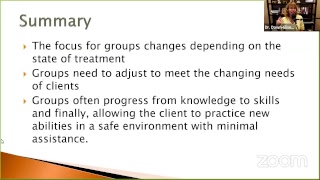
Dr. Dawn-Elise Snipes covers SAMHSA guidelines on group therapy: matching clients to groups based on stage of change and cultural factors, preparing groups with pre-interviews and agreements, and running groups through three phases of development. She walks through stage-specific strategies from early treatment (skills and safety) through late treatment (relapse prevention), plus practical tools like talking sticks and behavioral contracts.
Chapters
I'd like to welcome everybody to group therapy. This is based on tip 41 from SAMHSA. Today we're going to be going over chapters three through five out of tip 41, the stages of treatment and process issues. So we're going to start out by trying to talk about how to match clients with treatment groups. Because you know, you don't want every single client in every single group. There's sometimes a good fit, sometimes a bad fit. We'll talk about assessing clients readiness to participate in group therapy and determine the client's needs for specialized groups. Now, if you've been in a treatment situation where people were mandated to groups, if they came into your treatment program, you know how disruptive it can be if you've got someone who's in the treatment group who is in pre contemplation or not even there yet and is being disruptive, et cetera. So we'll talk a little bit about some of that. When you match clients with groups, you really want to look at the client's characteristics, needs, preferences and stage of recovery. So blah. If they're in pre contemplation. People who are in pre contemplation are not really ready to work on deep issues, nor are they probably in the mindset that they need to work on those issues yet. So you're probably going to put people who are in pre contemplation more in psychoeducational or skills groups. And depending on their needs, some people are going to need a smaller group because they've got some cognitive disabilities or something else going on and paying attention to that. What are their preferences? Not everybody is going to want to be in a big group. Not everybody's going to want to be in a therapy group. Some people will be great with skills groups, but not want to go into process groups. And that's cool. We just want to know what the person wants and if they have to be in one of those kinds of groups. Because I'm realistic, I've worked in multiple different scenarios where people had to be in group and it wasn't an option. So how can we make the group as accommodating to them as possible? You also have to consider the program's resources. Yes, it would be great if we could sequester people by readiness for change or by diagnosis or by gender or all of the above in some circumstances, but that's not always possible. One of the places I used to work, we always lamented that we wish we could take some of our clients who were involuntary and pre Contemplative and them in a separate group as opposed to putting them in with the clients who were in action, the action phase of change and in residential and had been there for three weeks out of 30 days already. But that just wasn't the way our program was structured and we didn't have the resources to break it out. So we had to be creative when we went about handling client issues and when we went about handling planning for group because we had to be prepared for all levels of readiness for change and a variety of different issues from the clients that were in there and paying attention to clients, ethnic and cultural experiences, some clients, and you know, even. Even based on age. My grandmother is 87 now and she was raised in a generation where you didn't air your dirty laundry in front of everybody. She wasn't ever going to go. And she probably to this day would never go into a group and just start telling people all the things that are bothering her. She was the kind of woman who was raised to sort of suck it up, have a stiff upper lip and go about it. If she would have ever been convinced to go to counseling, I could see her thriving in one on one. But I can see her kind of becoming a wallflower in group and that's okay. Being culturally respective of her age, you know, I'm not going to force someone who is not comfortable speaking in group or that's not how they were brought up to actively participate in a group situation, in a group activity necessarily. I want them to stay conscious, I want them to stay alert and engaged. But if they don't want to share some of their stuff, you know, that that's okay. And I want people to be there where they're comfortable. At some point they're probably going to have to share their stuff with someone. And those clients I might call, you know, during break time, call them aside right before they go out for break, ask them if they have any questions, talk about whether this is hitting the mark, making sure that they're still with me, but validating the fact that they may not be comfortable yet or ever to speak in that particular group. So who's inappropriate? There are some clients that are just not going to be appropriate for group. And if you can not have them in group, that is ideal because it can be disruptive. Clients who refuse to participate obviously aren't going to get much out of group if they're just like, I don't need to be here, I don't want to be here. But if you've ever run a group for clients who are involuntary for one reason or another, they may have to be there. So one way you can deal with this is kind of like trying to get a student in a classroom who is not engaged to engage and give them things that they can do to help. Ask them specific questions. If they are refusing to answer, refusing to participate for the benefit of the group, it may be beneficial to discuss, you know, how people are allowed to set personal boundaries and let that person sort of fade into being a wallflower a little bit. Now, therapeutically, obviously that person is not going to get as much out of group. However, at a certain point, if that, if you have to have someone in group who is not appropriate and for whatever reason, you cannot discharge them from the program and refer them to something that would more meet their needs, you got to be a little bit creative. Clients who cannot honor group agreements. Now this is a big one because if you have people who are not honoring confidentiality, if you have clients who are not honoring respect for one another, then that does begin all of these. But this one in particular will begin to erode the viability of your group, let alone the benefit to anyone who is there and wanting to participate. So in my experience, one of the things we've done to work with these is put people on behavioral contracts. If they can't adhere to those, then sometimes they've had to be discharged from that particular program. Like I said, the programs that I've been in have been group based. So if you can't and refuse to honor group agreements, then, you know, we need to find a different placement that's more to your needs. So we don't harm the other 12 or 13 people that are in group. Clients who are in the throes of a life crisis. Now, some clients may be great. They're going along just swimmingly. Three, four, five weeks into treatment, all of a sudden the bottom falls out. They're not able to focus, they're not able to concentrate. They are in a constant state of crisis. And you know, I get it. So they may need to take a break from group or when they're in group, they may need to be able to withdraw some because they are just barely holding it together. Depending on your setting, obviously I'll not say that so much anymore. I think you get the point. You've got to adapt and do what you can for this client. What's in the best interest, not only of the client. And when you, when you're doing group, that's kind of one of the interesting things that you've got to balance is the need of the individual client versus the need of the group and the group as an entity, but also the group in terms of 12 other individual clients. So we've got to figure out what the best thing is in order to meet the need of the Most people do no harm. Clients who can't control impulses Now, I've worked with clients in recovery who've had adult add, adhd, actually juvenile ADD and ADHD too. And sometimes they have difficulty with impulse control. They have difficulty waiting their turn to say something. They have difficulty knowing. I've also worked with clients who have fetal alcohol spectrum issues who, who don't interpret nonverbals quite as well. So there are things you can do like using a talking stick. So whoever holds the talking stick or the talking emblem, whatever it is, is the one who gets to talk. And it helps prevent some interrupting. Working with the client outside of group to help them work on developing skills to handle their impulses, because this is something they're going to have to learn how to control in the great existence, not only in the microcosm of group, but in life in general. If they cannot control their impulses and they're completely disruptive, then obviously this may not be an appropriate placement. But most of the time, for most types of impulse issues, it's a matter of helping clients develop distress tolerance skills and be able to sort of ride that wave of the impulse until they can have their turn to speak or until they can have their have their moment in the limelight. Clients whose defenses would clash with the dynamics of the group in psychoed classes. This isn't. Or groups, this is not nearly as much of an issue if you've got somebody who is very cranky, very sarcastic, very down, hopeless, irritable, all that stuff. And we run into people like this periodically who they've experienced recovery or maybe they haven't, and they've kind of given up and they're there because they have to be there, or maybe there's a little glimmer of hope somewhere, but it doesn't come out very often. And their protective mechanism is to push everybody away when that happens in the group, the group can feel alienated from this particular person and that particular person won't feel the vibe that they're supposed to get in a group. I always feel like I'm making bread when I start talking about group work because I'm always needing something. But I digress. It's important to look at those defenses, but also to help the client understand Become aware of their defenses and the impact of their defenses on other people. And it's a process. If those defenses are harmful or hurtful, obviously we're going to have to look for a different placement and clients who experience severe internal discomfort in groups. I had one client who had a tic disorder and when he would get stressed, his tics would get worse. And they were pretty darn severe. They were so severe he couldn't eat in the cafeteria because he couldn't control his body enough to get his hand, get his spoon to his mouth. So this person has significant social anxiety that was compounded by the tics and vice versa. So obviously having him in group was not good for him and the clients didn't really know how to respond. So we worked with him on becoming more confident and dealing with his social anxiety until he got to the point he could be in group. And then we knew we weren't going to call on him. He was able to just be in group without having to say anything, get used to being there and being comfortable in that group. And then he had the empowerment, if you will, to speak up when he was ready. He was with us for, I think he was with us for almost four months. And it took the lion's share of that four months to get him to the point where he was eating in the cafeteria and able to participate in group to a small extent. And these were psychoed groups. These were not stressful therapy groups. If you will, some other placement considerations. Sometimes women want to be in, and I wouldn't necessarily just sequester it to women. I think there's a great benefit in having gender specific groups for them to speak about gender specific issues. In most cases you're not going to put adolescents with adults. I can't think of any where you would. But there probably are exceptions. The level of interpersonal functioning. If the person is not able to interpret nonverbals, if they have any of those issues that we talked about in clients who may be inappropriate for group, then we need to think about whether group is the best placement for them and if so, what kind of group is going to be best for this person? Do they have motivation to abstain? If it is an addiction group, now, if it is a mental health group, ideally you don't want people coming to a depression group or an anxiety group or any kind of group under the influence of mind and mood altering substances that are not taken as prescribed. I mean, occasionally you're going to have somebody on Suboxone or methadone or something Else that will impact them somewhat, but they're taking it as prescribed. So how do you handle that? How do you handle that in an, in an addiction group and how do you handle that in a mental health group? It's going to be a policy consideration, I know, for working in dual diagnosis. When we had people who were coming to our groups where everybody in there was recovering from an addiction in addition to mental health issues. If someone was having issues with their level of medication and they were nodding off because they had too much, or they hadn't adjusted to the dose of the opiates they were on, or even any other medication like Seroquel, we've talked about that before, where it can be very sedating. The tendency for somebody to nod off in group would trigger a lot of other people in group who were dealing with recovery issues. So being aware of how each client's non verbals and particular issues are going to affect everybody else in the group, whether it be triggering their depression, their anxiety, if there are transference issues, and we'll get down to those in a few minutes, the stage of recovery. You're not going to put somebody who's pre contemplative, probably, hopefully in an intense therapy group because they're probably not there yet. Putting them in psychoeducational or skills groups is going to be a better placement. And what is their expectation of success? If they don't think groups are going to help, if they don't want to be there, how's that going to impact the rest of your group? And again, that kind of attitude may or may not be a big deal in a psychoeducational group. That kind of attitude may be a lot more impactful in a therapy group in terms of addressing drug screens with a group. Ideally when people come into your facility, they are given whatever your agency's policy is. I mean, if you're a straight up mental health agency, you may or may not do drug testing, you may not have CLIA waivers and all that kind of stuff to do on site drug testing. But ideally they will know ahead of time what the policies and procedures are. If it's a mental health agency and you don't have testing available or you don't routinely test, making it clear to the clients what your policy is about. Being on being under the influence of any substances is going to be really important. Because if you suspect someone is drunk, high, etc. And you call them aside and ask them about it, or determine that there's a pretty good chance that they are, how is Your agency going to handle it and what are the next steps? So there needs to be some sort of a plan and generally I would say 80% of the time and I'm just kind of spitballing there. Clients will deny that they're under the influence. So having urine screens available are definitely beneficial. Whether you need to send out for them and tell somebody they need to go get screened within 24 hours at ex and so facility and bring back their drug screen results before they can return to group. However, your facility wants to handle that. But if you start the group, if you start the orientation process, letting people know that they can't be under the influence of substances, then it's easier. If you have a substance abuse group and you think someone's under the influence, ideally in that program, whatever that program is, there is random drug test. But you also in orientation give yourself and or the agency the ability to drug test at will. So if you suspect someone is under the influence, you can pull them aside and do an on site UA or a breathalyzer. It goes with that whole informed consent for treatment. Want to make sure that clients know about it ahead of time. Preparing the group for new members. And we don't often do a good job of this. Some people do so, you know, take it for what it is. I know initially I didn't. I try to be a lot more careful about it now because where I. The groups that I've always run have been rolling admission groups. I've never had a closed group. So I just expected new people every day and I expected people to go away every day. And that's kind of the way it was. But in an ideal situation, you want to integrate new clients into the group slowly letting them set their own pace. It's kind of like introducing somebody you know. If you bring a significant other home to meet your family, you know, you want to prepare your family for it and you want to prepare the significant other for it. Because a group ideally is going to create a community or a family type microcosm. So when you bring someone in, the whole dynamic is going to shift a little bit because they got to make room for that person at the table, if you will. When somebody comes into group, be aware of signs of transference and countertransference between the clinician and the client. Obviously if you're having transference or countertransference issues and between the client and other clients. So you know, the client may see Jim Bob who's sitting over in the corner and it reminds him of his Uncle Sam. And he just adored his Uncle Sam. So he links on to this guy sitting over in the corner. That can be okay. But we also don't want the two of them to form a bond based on some transference issues. We want them to be able to be honest with each other and recognize that the influence of transference and countertransference, obviously this is more detrimental if it's a negative influence and somebody comes in and maybe. I had a client one time and this was in a real rural county, and I was asking him during the assessment if he had gone to any AA meetings that were local. And I didn't have a lot of experience in this county. You know, I traveled there. And he said, no, ma', am, I don't go to those meetings. And I said, okay, why? And he said, I would be the only black man there and it's not safe for me to go to those meetings. And I said, oh, duly noted. And that hadn't even crossed my mind at that point in time that there would be such a thing in this day and age where it would be sort of an all white meeting that wasn't accepting of people from other ethnicities. So being aware of that even in your own group, you know, obviously that was an AA meeting, but being aware of those sorts of transference issues, biases, prejudices that may come out as clients start to welcome the new person and the new person starts to feel a little bit more comfortable again, thinking about, think about bringing somebody to Thanksgiving dinner for the first time with your family. And that can be overwhelming for everybody involved. But you'll see the person start to loosen up, start to talk to other people, and then you can start bringing them in to the group discussion a little bit more and putting a little more pressure on them to participate at the same level as everybody else does. But don't expect them to hit the ground running when they first walk into a group for the first day or even second. In chapter four, it goes over distinguishing the differences between fixed and revolving group memberships, preparing clients for groups, and describing the tasks for each of the three phases of group development. In the next section, we're going to talk about the types of groups that are appropriate for each phase of treatment. So I want to be real specific. We're talking about group development here. Still fixed membership groups. Oh, I would love to have one of these, but you know, I haven't ever been lucky enough to. Members are prepared to stay together for a long time, the membership is stable. So say it's a depression group and it's going to be a 16 week group which obviously is time limited. The members all start at the same time, go through the same stuff together and they will all sort of forming, norming and storming all at the same time. If you go back to Group Therapy 101 they will get used to each other and there will be a period where they're kind of struggling to see for power struggles, pecking order and struggling with the, the group leader to a certain extent to see what the boundaries are and what the limits are until the norms are set. So understanding in time limited groups one of the benefits is everybody starts at the same time so you don't have a new person coming in and trying to test boundaries. Everybody knows and they're all on the same page. Ongoing groups New members may fill vacancies in a group that continues over a long period, but it's not a constant revolving door. So you have somebody who is in group and is an ongoing depression group of 16. And when one person graduates or reaches maximal gains at that level of care as we say and moves on, then we have an open slot so somebody else comes in. And that's much less chaotic in some ways for a lot of people. And there are a lot of benefits to the closed groups because or fixed membership groups because people are able to really establish connections with one another and have disagreements and arguments and learn how to work through that, learn how to form healthy relationships, set boundaries and terminate in a relatively healthy fashion. Revolving membership groups New members enter a group when they become ready for its services. Which if you're in residential or iop, a lot of times your groups are revolving membership. So as soon as somebody signs up if they're ready for a group, they enter. So you may have a group census of 8 for a while and then 15 for a while and then back down to 12 and it's just kind of all over the place. The groups must adjust to frequent unpredictable changes. For some people they prefer these types of groups because they don't ever feel like they have to bond with anyone. The downside is they don't ever feel like they have to bond with anyone. So they miss out on the opportunity to learn how to develop healthy relationships. These revolving membership groups are also either time limited or ongoing. In the ongoing groups, the member, each member participant remains until he or she has accomplished his or her specified goals. In time limited groups there's a curriculum and you go through it. When I was in residential, a lot of our psychoed groups were time limited revolving groups. There were 16 sessions. You had to attend each of the 16 sessions. Now you may start at session eight and then you would have to stay through when we picked up and got back to session eight again. But you got every single module that was being taught in that particular skills group or psychoeducational group. So how do we figure out how to place all these people and where people are at? Well the pre group interview begin as early as the initial contact between the client and the program in order to try to form a therapeutic alliance between the leader and the client. So you want to meet with the client, go hey you know I'm, my name's so and so and I'll be leading the self esteem group or I'll be leading the depression therapy group. Do you have concerns? How do you think this group can help you? Give them some open ended questions that they can start talking with you about even if they're not starting the group right away. It'll also be a time that you can reach consensus on what's to be accomplished in therapy in that particular group and educate the client about kind of how things go. Allay any anxiety related to joining the group and explain the group agreements. Now if you work in again iop, PHP or residential, you may have clients attending multiple groups and that's cool, you don't have to do pre group interviews for every single group. You'll want to do a pre group interview for different types of groups. So if you have psycho educational groups where the group agreement is one thing and you know obviously the structure is far different than a therapy interpersonal group, then you may you'll want to have two different kind of group interviews or introductions so they know what to expect in those groups. Otherwise they may go from a psychoed group into a therapy group, expect it to run the same way and become disruptive or feel like they make mistakes or don't know what they're supposed to do. So make sure your clients are oriented to every type of group. But in general if they're going to multiple groups, lay the foundation for what's expected and what is supposed to be accomplished in each group. Remembering that when you do do groups for each group, every time you do a group, start the group out by saying these are the objectives for today, this is kind of what we're going to go through and give them sort of a big picture so your global learners can get an idea about what to expect. Explain how group interactions compare with those in self help groups. A lot of our clients have tried self Help groups, whether they're depression anxiety 12 step. So we want to talk about the difference between how things go in those groups. A psycho educational counseling group is far different than an AA meeting or a depression therapy group. So again, let them know what it's going to look like, maybe role play a few things. Emphasize that each person may be at a slightly different place in recovery. So not everybody is going to have the same skills. Even if they're at the same place, not everybody's going to have the same skills. But if somebody says they can't imagine doing something or I can't, I don't know how I can cope with it and somebody else comes up with, well, I've done that in six times worse. So what are you bellyaching about? Not helpful. We want people to understand that some people are just learning new skills and trying to figure out how to implement them, whereas other people in the group may already have a lot of those skills and be adept at using them. So maybe they can mentor, maybe they can suggest, you know, when I've experienced something similar, this is what I did. Encourage using I language and not giving advice, just sharing experiences. Let members know, new and old, that they may be tempted to leave the group at times. And because the going gets tough, sometimes somebody will say something that irks them that's not okay. This is a time where people need to take a breath, learn distress tolerance skills and figure out how to work through the disagreement and give them skills to do that before they start group so they don't hit one of those walls and like feel like they're going to lose their stuffing. Recognize and address clients therapeutic hopes. And not necessarily in group, but if you can do it in group, that's awesome. But periodically pull the clients aside and go, hey, John, I noticed that you seem to be a lot more comfortable talking in group today. Or you seem a lot more hopeful about the progress that you're making on X. And so task making sure that clients feel like they're more than just a number, they're more than just a button, a seat. They're actually John Smith or Sally Sue. Group agreements establish the expectations that group members have for one another, the leader and the group. So it's not just me saying this is the way it's going to be. It's a group agreement with everybody saying this is how we're going to behave and act and react toward one another. It requires group members entering a long term fixed membership group to commit to the group. So if it's a revolving Membership group, then there's a set of rules. If it's a fixed membership group, there may be some discussion about how to handle certain things. For example, the use of methadone. You know, if somebody is on methadone and they come to group, if they're on it as prescribed, not taking it illegally, how is that handled? Is that acceptable in that group? And with the agency resources, you may not be able to make that decision, but sometimes groups can. So knowing what trigger points are, knowing what those clients need to feel safe is really what I get at. When I talk about a group agreement and I ask clients, what is it that you need to feel safe and as untriggered as possible. There are going to be times where you may feel triggered. We want to inspire clients to accept the basic rules and increase their determination and ability to succeed. So part of this group agreement is getting buy in from them, making them feel, making them understand, not just feel like, but understand that they do have a voice in a group. They're not, it's not a classroom where they're just sitting there and they're a butt in a seat, despite what your supervisor might tell you. Elements in group agreements communicating the grounds for exclusion. So who gets kicked out or who can't join this type of group, you know, what kinds of things would create a situation where you would be discharged from group? How do we handle confidentiality? How do we handle physical contact in mental health groups? People will get upset, people will cry, people will get frustrated, and some other people may want to reach out and physically comfort. Is that okay? How do you handle that? What is okay, what is not okay? In addiction recovery groups, they tend to be kind of a huggy bunch, which took me a long time to get used to. And they do a lot of hand holding when they say the serenity prayer and things like that. And it took me about two years to kind of get okay with that kind of physical contact. But that's just the way I was raised. I'm not a huggy, touchy feely person. So understanding what the group members want, what's okay, and setting those boundaries and enforcing those boundaries. What is the impact of mood altering substances? If you attend and you're under the influence of what are the consequences, what's going to happen? What is the policy for contact outside of the group? Now there's outside of the group in other support group meetings and there's outside of the group socially. What is the stance of the group, the leader and the agency on all of those things. And how do you come to an agreement? What kind of participation is expected? I always told my people, well, that's not true. Depending on the group I had when I worked with people in felony probation who were all involuntary, I expected them to be there, be awake, and at least take notes on what was going on. If they didn't want to share, that was not a big deal. But they got reward for. Rewarded for participation. So I kind of incentivized them to participate. But what is required? Are you required to share at every group? What are the financial responsibilities and how do we handle termination? So if some. When somebody graduates, if you will, how is that handled? Do they just quit coming or is there a termination ceremony? What happens in the beginning phase of treatment? We want to prepare the group to begin by having everybody introduce themselves, review the group agreement, provide a safe, cohesive environment, establish the norms for how things are going to run, and. And then you initiate group work. So this is, you know, depending on how long your group is, this could be the first session to the first couple of weeks of kind of getting used to each other and figuring out the ebb and flow of conversation. During the middle phase of group, both process and content are important. So not only what you say, but how you say it, not only what you do, but how you do it. We're going to focus on, in terms of using skills and interacting with other people and developing all those ancillary things that we want to see develop in group work, not just the skill being taught or the issue being discussed. In middle phase of treatment, clients receive feedback that helps them rethink their behaviors and move toward productive changes. So this is when other group members can say, you know what, John, what I've seen over the past week is blah. And encourage clients to provide feedback in objective, nonjudgmental terms and using I statements. What I perceive to have seen is this is what's going on. It gives clients the ability to hear what other people are seeing and how they impact other people and make decisions on how to act. And it's also a time where group members can sort of alert clients, alert other clients to their blind spots. Leaders allocate time to address issues, pay attention to relations among group members, and model helpful interactions that combine honesty with compassion. Encourage open communication, but helping them develop interpersonal effectiveness skills so they can be mindful of what they're saying, what they need, and. And setting effective and healthy boundaries. End phase of group is reaching closure, putting closure on the experience and helping each client examine the impact that group has had on them. Acknowledge the feelings triggered by departure. You know, a lot of our clients have abandonment issues, have had bad relationships. So we want to talk about that leading up to the closing of a group or if someone terminates against medical advice. It's important for people to be able to get closure when a group member leaves. Giving and receiving feedback about the group experience and each member's role in it. So everybody's allowed to share what they got and what they got from one another. It's also a time to complete any unfinished business and explore ways for group members to continue learning about topics discussed in groups. So if it's a depression management group, you can only go through so much in 16 weeks. Where can they continue to get support? Where can they continue to get information? Where can they continue to get help? Once you have a feel for kind of how group develops, then we need to start thinking about the stages of treatment. In the early stage of treatment strategies, focus on immediate concerns. Think of Maslow's hierarchy. You want to make sure they've got their meds, they're stable on any meds they need to be on. They've got adequate nutrition, a safe house, transportation to get to and from group, and they're able to deal with any vulnerabilities, Start preventing vulnerabilities, and start developing distress tolerance skills. When we get into group, we're going to start triggering some hot buttons, and we want to make sure they have the skills and the foundation to be able to handle that. In the middle stages of treatment, clients recognize their problem causes many problems, and those problems block them from getting the things they want. So in the middle phase of treatment, clients are really in the action phase and ready to start making some changes. So this is the time we're going to be moving them into skills groups and potentially some process groups so they can start looking at their stuff and not just talking about these skills, distress tolerance skills, and those sorts of things that are more academic and abstract. In the last stage of treatment, clients identify treatment gains to be maintained and risks that remain. So basically, relapse prevention, what did you get? How far have you come? What new tools do you have? What are your relapse warning signs? So you know when you're headed down that slippery slope towards a depressive episode, and how can you prevent that? In the last stage of treatment, you're going to take everything they've learned and all the skills they've developed and tie it up in a neat little bow so they have something to walk out with. In early stages, of treatment. Some clients enter because of health problems, others because they're court ordered or referred by children and family services. So a lot of times group members are in emotional turmoil and at best in co occurring groups, they may be just coming out of detox. So in the early stage, again, we're focusing on skills. Dress up, show up and try to get something out of group. But I'm not looking for light bulbs. I'm not looking for life changing experiences in the early stage. I'm looking for them to get ready to start doing those things. I'm looking for them to start getting comfortable with the process so they're ready to start taking care of those wounds. Therapeutic factors in the early stage, we want to instill hope, help them realize they're not alone. Universality. We want to give them information about what is available, what could be causing their symptoms, what treatments they could potentially start looking at, and skills that they might start trying. We want to start looking at the primary family group and it may not be possible to correctively recapitulate. As Samhsa says, it may not be able to fix the primary family. They may have washed their hands of it, or it may be a family where there is an identified patient and they are unwilling to see any of their behaviors. But we do want our clients to start developing a healthy support system outside of group with someone and developing their own family network, if you will. We want to help them develop socializing techniques and interpersonal learning, watching how one person interacts, developing skills, developing group cohesiveness, and looking at other factors that may be affecting people's comfort in group. So when we get into that middle stage of group, everybody feels safe. In the early stage, as leaders, we want to stress that clients have a lot of things in common. We want to be somewhat spontaneous and engaging, not too much by the book. You know, you can be too regimented even in psychoeducational groups. Make it fun. I find that clients engage and remember a lot more if you make them laugh. I remember one time we were talking about the fact that in substance abuse recovery they say you shouldn't get into serious relationships for a year after you begin recovery. Because it's just, you're not your headspace, you're not in the right headspace. And one of my clients started shaking his head and he's like, I can't, I can't imagine that. And I said, really, what you're not looking for is Ms. Right. All you're looking for right now is Ms. Right Now. And his eyes Got all big and I was just like, what? I'm realistic. Yes, you're probably going to go out with people, but don't be looking for someone to settle down with. And so occasionally make jokes, make off the cuff remarks, encourage them to laugh. I mean, how much more do you get from a group or from a class? If the instructor occasionally tells a funny story that kind of hits home. Focus on helping clients achieve abstinence. If it's a substance abuse group, prevent relapse from any issue that they're facing right now. And learn ways to manage cravings, if they're dealing with substances, if they're dealing with emotional eating, if they're dealing with anything like that. But also learn ways to manage urges. Because we've got a lot of clients who come into anxiety and depression groups who do self injure or have other unhelpful coping urges. In the middle stages, your clients are becoming more stable. Self, knowledge and altruism can be emphasized. Help them share their experience with other people. In order to help other people, emotions of anger, sadness, terror and grief may be expressed more appropriately. So you're going to start seeing a little bit more up and down, a little bit more emotionality, and that's okay. You know, they're starting to feel safe enough to open that Pandora's box a little bit and experience feelings. And they're starting to develop the skills to be able to get those feelings under control so they're not overwhelmed by them. So we want to encourage clients to continue in the middle phase to use the group to explore their emotional and interpersonal world. How does this feel to you? Does it feel overwhelming? What skills can you use? In the middle stages, cognitive behavioral interventions provide tools to modulate feelings and express and explore them so clients don't feel overwhelmed by that rush of emotion. And this is a time where interpersonal groups may be helpful. So they start learning from one another and exploring sort of how their past is impacting them in the present. In the middle stage, leaders help members see how continued substance use, if they're using it, interferes with what they want out of life. In mental health groups, we also help members see how continuing to do things that enhance or cause trigger their depression or anxiety is also interfering with what they want out of life. So what can you do differently? And this is, you know, with depression and anxiety, this is one of those times where we're often talking about changing your thinking patterns. If you keep thinking this way, you're going to keep having this depression, anxiety, anger reaction. How can we alter that so you can get what you want out of life, which is ostensibly being happier. However they define happiness, we want to help clients join the culture of recovery. Preventing vulnerabilities, being mindful, using distress tolerance skills, using interpersonal effectiveness. It doesn't matter what your issue is. Recovery incorporates all four of those things for most everybody. We want to support the process of change by drawing attention to positive developments. You know, really highlight the positive. If somebody stays clean for a month, if somebody stays clean for three months, if somebody had something bad happen but they came to group anyway, commend them and their courage. And we assess the degree of structure and connection clients need as recovery progresses. A lot of times they will need less structure as the group progresses because they're going to start self moderating a lot more. In the late stages, clients work to sustain the achievements of previous stages. They may discover and acknowledge that some goals are unrealistic. They're not going to be happy. 24, 7, 365. Who knew? Certain strategies are ineffective and environments deemed safe are not conducive to recovery. This is when they really start looking at their relationships and how they're living their life outside of group. And are these actions, behaviors and environments helping them get closer to their goals and being the person they want to be or not? Significant underlying issues often emerge such as poor self image, relationship problems, shame, and past trauma. At this point, when they start looking at all these things that might not be conducive to recovery and they start thinking about changing them, then the terror might hit because they're afraid of not having the validation from someone else, or they're afraid of being rejected or there's a lot of stuff, stuff that comes up with those underlying issues and this is the time we want to start dealing with those and figuring out how to overcome those obstacles. In a late stage, process oriented groups may become appropriate for some clients who confront painful realities so they can work through the trauma, the abandonment issues, the cognitive distortions that were indoctrinated in them, whatever the case may be. And the group can be used to settle difficult and painful old business. They're learning how to form relationships, they're learning how to be accepted for who they are. They're learning all those things that we hope kids are learning when they're knee high to a grasshopper. But this is a time people can start dealing with those issues and start feeling more whole and less broken. In the late stage, the leader shifts towards interventions that call on clients to take a clear headed look at Their inner world and system of defenses. So we're less telling and more saying, okay, John, in this situation, what has worked and what do you think is going to be the best choice for you at this point? We don't want to rush to rescue them. We want to basically take the training wheels off and let them start riding and see how they go. We're still there to kind of catch it if they start to fall, but we want to let them start trying to ride on their own. Late stage interventions permit more intense exchanges because clients can handle those emotions now. They have the skills to be able to feel anger without being overwhelmed, so they can express anger. And we want to help them learn how to do that effectively and appropriately. The leader allows clients to experience enough anxiety and frustration to identify destructive and maladaptive patterns. Not to the point where they're putting their fist through the wall, but we want to help them figure out how do you respond when it feels like your needs are not being met? What are your undealt with destructive and maladaptive patterns we still have to address. So the focus for group changes depending on the stage of treatment. In early treatment, people really need more skills. They need time to get kind of comfortable with things and really kind of get their land legs as far as, okay, I'm really getting ready to do this. Groups need to adjust to meet the changing needs of clients. So once they move into middle phases of treatment, we may need to add process groups. And you're not going to change a psychoed group into a process group. You're probably going to have to add a group or refer out to a group. But we do need to make sure that we have resources available for clients. Groups still often progress from knowledge to skills and finally allowing the clients to practice their new abilities in a safe environment with minimal assistance. So in the early stage they may come in and major, major anxiety, major anger management problems. So when they start to get upset, we start helping them learn how to calm themselves down, how to relax. Basically, groups can allow for a long drawn out process of desensitization. Clients will get used to feeling a little bit of anxiety, maybe feeling up to a five or a six, but then they will know that they can de escalate themselves. And by the end we want them to be able to feel that even if their distress level gets up to a 9 or hopefully never a 10. But if it gets way up there, they still have two or three drop back and punt coping skills or resources that they can use and fall back on so they don't engage in self destructive behaviors. We want to make sure they've got something at every step of the process. Are there any questions? Now that question on drug screens not knowing your background whether your mental health or substance abuse are co occurring. If I didn't answer that satisfactorily please re ask the question and I will see what I can do to clarify the answer. Alrighty y'. All. Well I appreciate you coming today. If you have any questions or issues you can always email me and I will handle any, any of the technical like clinical questions. If you have technical issues you can email me. I can't guarantee I'll necessarily be able to help. I'll try. But technical, technical issues like computer related issues or account issues. You can submit a Support Ticket to supportlce.com Alrighty, have a wonderful weekend and I will see you on Tuesday. I think all of us have a grandma in there who was raised in that generation that you did what you did and you kept all your hurts to yourself. It.










