Assisting Families Through Life Transitions | Comprehensive Case Management Certification
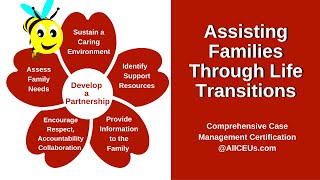
A recorded continuing education webinar by Dr. Dawn-Elise Snipes introducing the Registered Nurses Association of Ontario’s "Flower Empowerment" model for assisting families through life transitions. The talk explains the model’s components — clinician-family partnership (core), advocacy (stem), values/vision/principles (leaves), roots (responsibility/accountability), and results monitoring — and provides practical assessment questions, examples, and implementation/advocacy guidance for clinicians, case managers, and organizations.
Chapters
This episode was pre recorded as part of a live continuing education webinar on demand. CEUs are still available for this presentation through all CEUs register@allceus.com counselortoolbox you hi everybody and I'd like to welcome you to Assisting Families through Life Transitions. I AM your host, Dr. Donnellice Snipes. When we're working with families and helping them through transitions, there's a lot of different things that need to take place. And the Registered Nurses association of Ontario came up with this great model called flower empowerment. It's a comprehensive approach which obviously is great for case management as well as nursing and social work. When you look at it, the core of the flower, like where the petals and everything are, is the clinician family partnership. And in this partnership we assess need. We work to sustain a caring environment. We educate the family and the family educates us. It's not just one directional. And we identify sources, that or resources that the family may need and help them get linked with those resources. The stem of the flower symbolizes advocacy activities. Sometimes as clinicians, we will be out there and we will recognize that something needs to change. There's a need, for example, for Medicaid services or Medicaid availability to certain people who currently don't have it. For example, single males. There are a lot of single men who, you know, they don't have children, but they also don't have insurance. And that would be an advocacy place or a policy place. Other policies might be the types of services that clients are eligible for at your facility or at other facilities. It may be important to advocate for them and within those organizations. For example, I used to work in substance abuse treatment, residential substance abuse treatment. And the workforce development board in my area was not willing to work with people who were out of residential treatment until they had been clean for at least three to six months. I don't remember which one it was. Well, let's think about this. If somebody gets out of treatment and, you know, they've done 30, 60, 90 days in treatment and then they can't get a job for three to six months, how are they supposed to put a roof over their head? How are they supposed to comply with probation if they've got that going on? How are they supposed to feed themselves, get their medication, get transportation to and from treatment? You know, it didn't really make a lot of sense. So advocacy was something that I needed to do in that situation. The leaves of the flower symbolize vision, values and principles. And those are the things that we as clinicians case managers hold dear our vision for what our community can look like, our vision for what life can be like for people with, you know, fill in the blank for people with autism, people with fibromyalgia. Whatever your particular client caseload is the values that we hold. What is it that we're responsible for? What is it that we think is important to happen in this partnership with the family and the principles? And sometimes you're using this model when someone is transitioning. Maybe you are a dialysis case manager, or you are a case manager for someone with severe and persistent mental illness, or you are a case manager for patients who've had strokes. There are a lot of different things that, you know, families may be going through transitions because their loved one all of a sudden has something different about them. You know, they're developing Alzheimer's, dementia, they had a stroke, they had a heart attack, they have been diagnosed with diabetes. Anything that creates a transition or a change that the family may have to adapt to and the person may have to adapt to, is where this flower and power model comes in. The roots that feed the flower, that feed the partnership include responsibility and accountability on both parts. Not just the clinician, not just the family, but both parts. Participants in this relationship, just like in any relationship, it's a two way street. Both participants in this relationship need to be responsible and accountable for doing what they need to do and doing what they say they're going to do. And if they need more information from the other party asking the questions, getting that information. Both the client and the clinician need to recognize the value of the partnership. A lot more is going to get done if we work together. Instead of me doing it for someone, which doesn't empower them at all, it doesn't teach them the skills they need. They're going to continue to potentially need me because they haven't learned those skills, or for me throwing it all on them and going, well, good luck, you can figure it out. Just make a few phone calls. That's going to cause them to be frustrated and it's going to take a lot longer for them to access the resources they need, if they ever access them at all. The value of the partnership is we bring our strengths. The family knows what strengths they have, what knowledge they have, what resources they have, and what works for them. We know about other resources that they may not even know about. We know more theoretically about whatever this condition is that the person has. And we can educate the family about what's going on, what to expect, what they might Need. We also may know more about, you know, making some of those linkages so when we work together we can synergize. We do want to respect the uniqueness of each family. If we try to put every person in this cookie cutter little plan, it ain't going to work very well if you've got a family. And I'll just use my own family since there's no HIPAA issues with that. When my grandmother was getting older, much older, she was almost 90 and she started to develop some dementia. Not Alzheimer's, just regular old dementia. But she got to the point where she was unsafe living in her own home and making that transition. Making that decision about when it was necessary for him for her to transfer to assisted living was a very unique decision for the entire family. Some families can keep their parents with them until their parents pass on. Other families because of, you know, various situations, they live far away, they've got children that they need to devote extra time to. They've got a job that keeps them from being able to provide the 24 hour supervision. There are a lot of reasons why some people may be able to accommodate a parent with dementia and other families may not be able to. We want to identify resources for emerging needs as well. We don't want to wait and be reactive all the time. When somebody is discharging from the hospital, for example, after a stroke, if we know that there are certain things that they're going to need when they get to the house, we want to have those in place already. We want to have already made the call to get the grab bars installed next to the toilet or whatever it is that they may need for stability, if that's one of their issues, or to get a whiteboard if they're nonverbal at this point. And they need to be able to write or a keyboard so they can type. Thinking about the basic needs. If they need to be able to communicate how they're going to get their to the bed, you know, are they able to motivate on their own or, you know, move on their own? Are they able to feed themselves? Are they able to shop for themselves? If not, we got to make sure that happens. Are they able to bathe themselves? Are they able to remember what medications to take and safely take their medications? All of those things that we do on a day to day basis we need to go through in our mind. And each individual person who has a stroke is going to be slightly different in what their needs are. Each person, for example, when my mother was put into hospice Care, and my father was put into hospice care. The types of care that they got and the types of care that they needed were very different based on family needs at that particular point in time. And it's important to recognize what their uniquenesses are, but also, again, plan for those emerging needs. When mom was first discharged from the hospital, she was not able to stand up for long periods of time, so they had to have a seat in her shower. That was something that was emerging need. It wasn't something she needed the minute she got home from the hospital, but it was something she did need. And then as her disease progressed, the caseworkers at hospice were awesome with staying on top of, okay, this is the next phase we're getting ready to go into, and these are the things that she'll probably need. We weren't reactive. We weren't calling them, going, she's in agony. Can't you do anything? They had already put in the morphine pump, and we were working proactively to make sure that she stayed comfortable. The final R is results monitoring. Just like when you feed a flower or when you feed plants, you don't give them the same thing all the time without looking at them. And if they start turning yellow or wilting or doing something that's clearly unhealthy, you're not going to continue feeding them the same thing. And results monitoring is the same thing in a relationship. If you're doing something and it's working well and this partnership is thriving, and you know the clients are happy, you're happy, everybody's happy, then great. But as you monitor the results, you are also looking for areas where things may be breaking down so you can mitigate them early. The clinician family partnership recognizes that the family assessment of the situation is essential. My assessment of the situation as the clinician is only part of the equation. The family's assessment may be the same as mine, or it may be very different. I may think they need all these resources. They may say, no, we don't, or vice versa. I may see this condition, whatever it is, as something that is manageable. They may see it in a completely different way. It's important that we get the family's assessment of what this situation is and what it means to them. If they're taking in a parent, for example, who has dementia, what does that mean to them, and what are their thoughts and feelings surround it, surrounding it? If they have a child with autism, what does that mean to them and what are they anticipating? Sometimes they may be anticipating things that are Highly unlikely. And we can dispel some of those fears and myths. Sometimes they may be anticipating things that are highly unlikely and they're, you know, optimistically. And we can support their optimism, but also help educate them about what to expect realistically. We do want to respect the important role of family in the person's life and recovery. And I use the term family as. To refer to the family as the person defines it. It may be blood relatives. It may not be whoever they define as the important people in their life that they consider family is what we're talking about here. We want to determine the desired degree of family involvement. How much does the patient or the person want their family involved in this stuff, and how much does the family want to be involved? And then we've got to kind of negotiate that. The person may want a lot of family involvement. And the family says, you know what? I just. We would love to, but we can't. We live 400 miles away. We can't just move and be there for you. We will try to hire caregivers to come in and so you can stay in your home as long as you can. You know, there are other ways around it, but it's important to figure out what they want. The other opposite side is the patient may not want family involved. They may say, you know what? I don't. I don't want them stressed with this. I want to handle it on my own. Okay, if those are their wishes, then we need to help the client at that point. If their family is involved at all and they have different ideas, they may have their feelings hurt. So we may have to help them negotiate that a little bit, too. We want to negotiate the role of the clinician and family within the partnership. What is it that we, the clinician case managers, are going to do? What is it that the family has to do? And make sure that those roles are very clear. When you've got John Smith, who's at home, and he has seven different medications he's taking and they're about to run out, whose job is it to call in and get those medications refilled, Is the case manager going to do it in the weekly visit, or is it the family's job? Who's going to make the doctor's appointment for the physical therapist for Mr. Smith after his stroke? Is the case manager going to make the appointments and just tell the family when to show up, or is the family supposed to call and make those appointments? The clinician needs to listen in a family partnership, and ideally, the family listens too. But in these transition periods, the family is often in a period of crisis. Or remember that when we're in crisis, we are not remembering things quite as clearly. Our memory is not so good. We need to listen. What is it that they're telling us verbally, but also what are their behaviors telling us? And we need to pay attention to that. We also, since they may have difficulty listening, comprehending and remembering, especially initially, if they're in a sort of a state of crisis, write it down. Down. Give them handouts. Give them things to read so they can remember. If you're trying to decide, for example, these 17 things need to be done this week and you divvy them up. The clinician, me, I'll do these things. And then you need to do these things. Write it down and hand it to the person so they can. They have a checklist. It's not condescending at all. It's just helping them keep track because they've got so much going on. You want to engage in a participatory dialogue, which means a dialogue. Don't talk at them. Don't tell them what to do. Ask them, what is it? How is it that I can be most helpful to you? What are your needs at this point? Give me something to work with. If I make suggestions, I'm going to follow it up with, what do you think about that? Or would something else work better? Get their feedback. Get their engagement. They're going to be more likely to follow through if they're engaged and participating. Recognize patterns in the partnership. There are going to be some people who just, they just really want to help and they are going to say yes to everything. I'll do that, I'll do this, I'll do that, and I'll do the other thing. And they are just gung ho. But then they take on too much, they get overwhelmed and nothing or very little gets done done. We want to recognize those patterns so we can help and intervene with those. And it's important to highlight family strengths in every single meeting, not just the first meeting. You know, every time you get there. If you sit down at this first meeting and four of the family members are there. Wow. You know, it is really heartening to see how much support you have, Mr. Smith, and how available your family is and desiring to help you out. Let's, you know, work with that. If family members are good problem solvers. If family members are, you know, maybe one family member is really good at helping Mr. Smith, who has Alzheimer's, and when he gets Agitated, maybe. Jane is really good at helping calm Mr. Smith down when he gets agitated or de escalate him. We want to highlight that strength. We want to highlight the amount of love and support that's there. Even again, if it's not a blood relative, it doesn't matter. These are the people that are important to Mr. Smith and Mr. Smith is important to them. The assessment needs to take place within the context of the family, as the client defines it. Get as many people there as possible. It's going to make your planning a whole lot easier if you can just get everybody together, at least for this first meeting. If you can't get everybody in the same physical location, use the telephone, video chat, video conference, people in. It's not that difficult with things like Zoom meeting. You can video conference in 4, 5, 10 people at a time so they can be there and participate in this family meeting. And that in these days, tends to work a little bit better. People are less put off by having to, you know, call into a video meeting. So that increases compliance. Anyway. Identify if assistance is required to strengthen the family. If you get there and Mr. Smith, you're in the hospital, Mr. Smith had a stroke, he's getting ready to discharge and his elderly wife is there and she's, you know, just completely for glumped with everything that's going on. And the kids are there and they're bickering about who Mr. Smith favors the most and they're already trying to plan his will or whatever. And you see a lot of dysfunction when, when you're there, even if everybody's present, if it's dysfunctional, we may need to identify ways to strengthen that family situation, which is often referring to a social worker or family therapist. Information we need to get during the assessment. The family structure and composition. Who's in your family? Who is the, you know, who makes the main decisions? Who's the one that's responsible for paying the bills and doing the shopping and the basics. You know, let's understand how this family operates. Think of the family like a business or like a machine. We need to know how all the parts fit together. What is their culture and what does that culture or how does that culture influence Mr. Smith's treatment? As well as the integration of the family. In many cultures that are family centric, it is essential to incorporate multiple family members in the recovery process. We want to know about power and role structures. Again, who does what? Who makes the decisions? We want to assess their communication skills and styles. Are they able to effectively communicate with one another? Reminding them and educating them that in this transition period, even if it's not a total crisis, people are not completely emotionally overwhelmed. A change causes disruption. And during periods of disruption, we have more difficulty remembering things. It's more important to write things down. When my daughter's dog got diagnosed with congestive heart failure, she's on three different medications now. Initially, it was a lot to remember which medication she got when and how much, and yada yada. So we got a whiteboard and we put it on the refrigerator and we had a list of which medications she got when. And there was a little checkoff block and we did a grid for the entire week. And we could check off after we gave her her medication to make sure that we remembered to do it. She's been on those meds now for almost two years. We don't have to do the check off block anymore. But it helped us segue in and learn that new behavior. It helped us communicate. I could look at the refrigerator and know that Raina got her medication. Haley could look at the refrigerator and know that, hey, yep, I did give her her medication this morning. Those are the things that are important. Communication is essential. We need to factor how they communicate with one another, enhance that communication since they're under stress. What needs to be written down? How can we communicate what's going on? If somebody has 24 hour care, for example, family care, how are they going to communicate what's been going on with dad? When I worked in a residential treatment facility, we had a logbook. And at the beginning of every shift, the person read what was in the logbook. And at the end of their shift, they wrote a summary of what happened during their shift. And then the next shift came on. If you've got a family that's working in shifts like that, keeping a logbook can be helpful. It doesn't have to be super detailed. But that enhances communication among everybody. Because then Susan, who is the night shift person this week, can look back at what happened in the previous eight hours. But if she has some questions, maybe it seems like Mr. Smith might be getting a urinary tract infection or something. She may be able to look back over multiple days, look back in that log to see what's been going on with him. That's why it's much better to have an actual log. And it can be online or it can be on paper instead of texting somebody. If I texted the person that was taking the next shift, they would have that text, but maybe not the person after that. You can do group texts and stuff, but it is probably better to have a durable log. Another benefit of the durable log is it improves family communication with the providers. They can bring the log in and give it to the physician or give it to the clinician and say, this is what's going on. If Mr. Smith has Alzheimer's and he's becoming progressively agitated, then when the social worker comes, they can give the social worker the log and it will show evidence of increased agitation. But it also might indicate some triggers for that agitation that the social worker would pick up on. We want to assess access to resources. Do they have insurance? What can they get access to? Can they borrow things from friends if they need a particular type of chair? Or maybe they have a friend who already has a walker or a wheelchair that they can borrow for a little while. If not, where can they get it? How can we make this accessible to them? We need to look at the environmental characteristics, assuming it's safe. You know, that's the first thing that we want to look at. But if we're working with someone who has some mobility issues or some safety issues, then we're going to need to consider that. If somebody has Alzheimer's or dementia, they may forget to turn off the oven. They may, you know, create situations that could be dangerous. If we are working with someone who has, I don't know, some other condition where they might not understand what is okay to eat and what is not okay to eat. You may need to lock, you know, like little kids. You may need to lock up cleaners and medications. We just want to look around. If you're working with someone who's discharging from residential treatment for substance abuse, definitely want to look at that environment. What things in the environment could that person use to get drunk or high? And anything from hand sanitizer to, to pills in the medicine cabinet need to be controlled for. We want to assess family strengths and family supports and the family perception of events. We already kind of talked about those and the degree of involvement, again, desired by the family. Initially, they may think, I'm gung ho, I want to be all involved. And then, you know, three, four, six months into it, they may start going, I tired, I'm exhausted. Another thing that we need to consider, and that's that proactive consideration of resources that might be needed is respite care. Most families, unless they have a ton of people in their family, are going to need a little bit of assistance with respite care. If they have a family member who needs 24 hour awake supervision, it just, it can get exhausting and we need to proactively plan for that. Sample questions that a person might ask in an assessment. Who would you like us to share information with and who Not a lot of times we ask the first one but not the second one. And with hipaa it gets a little bit clearer, I guess, because they sign the releases for who they want us to share information with. But it's always good to ask, how can we be most helpful to you and your family during this transition? This helps clarify expectations and it starts to open that door to increase collaboration. How can we help you? If somebody has just had open heart surgery or a stroke, or, you know, been in an accident and is now in a wheelchair, they may not have any clue what they are going to need or how you could be most helpful and that's okay. But you open the door, you ask that question and then you can follow up later with more specific questions because ostensibly you've worked with that condition or diagnosis before. So you have an idea about some things they may need and then you can. I like to do a checklist and run down the checklist of do you need this? Do you need this? Do you need that? And they can say yes, no or maybe. And. And for the yeses, we can jump all over that. For the nos. Alrighty, I'll table that. Just in case. I'm not going to say the ship has sailed. Put that on the back burner because you don't think you need it right now. No problem. And for the maybes, we just, we wait it out. And if that maybe turns into a yes, then it's incumbent upon the family or the client to call and say, I really do need that. Now we want to ask what has been the most or least helpful to you in past times of crisis? This is a crisis. Whatever this transition is, it's a change. And change is a form of crisis. This helps the person identify past strengths, problems to avoid and successes to repeat. What was helpful? Maybe they will say, you know, in the past, when I've, you know, had problems, I haven't reached out. My grandmother used to do that, God bless her. She would get sick. And this was after my grandfather passed and she was living alone and she would get all clogged up. So she literally was deaf. She could not hear a gosh darn thing and she couldn't drive and she had no way of hearing the phone. Now could she have gone next door and had the neighbor call my uncle? Certainly, but she didn't do It. So that was probably a problem. She let the illness get to a point where she was in many ways incapacitated and she was not willing to ask for help. So things got progressively worse. Helping them identify, how have they coped? And it doesn't have to be a health crisis. It could be, you know, they lost their job or they got divorced or whatever. We've all had crises in our lives. What things have we done that helped us cope with the distress? And what things have we done that weren't so helpful? What's the greatest challenge facing your family right now? This indicates actual or potential suffering and helps us identify roles and beliefs. They may start. The patient may start talking about guilt, about being a burden on other people. If you're talking to the whole family, which hopefully you are, the family might start identifying different things that they see as the greatest challenge to accommodating this transition. All right, let's just start making a list of it, of those things, and then we can figure out how to help the family resolve these challenges. What do you need to best prepare you and your family member for dealing with this issue? And this assists in discharge planning, especially sometimes. You're not doing this assessment until after discharge. Hopefully it's soon after discharge, ideally before discharge, Whether it's from a crisis stabilization unit, from detox, from the hospital, wherever. We want to know what they need in order to feel comfortable and confident going home. When my son was discharged from the hospital, he was premature. Very, very premature. And I was scared to death his heart was going to stop again because it kept. That was the criteria for him getting out of the hospital. He had to go an entire week without his heart stopping. And I'm like. Without stopping breathing and his heart slowing down to, like, you know, whatever they call it bradycardia. I'm like, really? You're sending him home and he's only gone a week without doing that? I was terrified. If somebody would have asked me at that point, what do you need to best prepare you and your family member for dealing with this issue? I would have said a heart monitor. Because I can tell you I did not see much that first four or six weeks until I was certain he was not going to stop breathing, which is, again, why it's important to ask, why do you believe. Who do you believe, I'm sorry, is suffering the most in your family at this time? This can help identify which family member requires the greatest support and intervention. When my mom was diagnosed or entered into hospice care, and that was way after she was diagnosed you know, who needed the greatest support and intervention at that point in time? I really think her husband did. He was really, really struggling. Mother had gotten to the point where she was pretty resigned and had reached a point of acceptance with what was going on. But her husband was struggling greatly. When my grandmother was. Was put into a assisted living facility, very much against her will, she was very angry about it. Who was suffering the most at that point in time? Well, it was probably Grandma. Now, thankfully, she adapted very, very well. But, you know, it was a struggle. What is the one question you would most like to have answered right now? And this can explore the most pressing issue or concern. The person may say, what is the chance that they're leaving drug treatment? What is the chance I'm going to relapse? If they're leaving the crisis stabilization unit, the family may say, what is the chance that this person's going to try to kill themselves again in the next week if they've got cancer? What should we expect over the next week, month, six months, whatever those may be the most pressing issues or concerns. Or it could be something like, where do I get the prescriptions that I need to have filled? And you know, it could be something much more practical like that. Finally, wrap it up with a question similar to. And you got to figure out your own way to ask this question. How have I been most helpful to you and how could I improve? I don't like wording it exactly that way. And depending on the family, a lot of times I'll say, what has been most helpful to you today? Because I don't want them feeling like I am soliciting positive reinforcement. How have I been awesome for you today? You know, they don't really need that at that point in time. And I often say, how could we improve our services or what could we do to better meet your needs? Using we in terms of the organization. And a lot of times that, in my impression, my experiences, it seems to make them feel more comfortable about talking about what they might need because they're not feeling like they're criticizing you, but they're feeling like they're saying, okay, your organization could do this for us or be more helpful this way. And that feels less threatening to them than saying, yeah, you could be on time next time or you could. Whatever sources of resources and support we need to take a look at with families, intra familial sources, what sort of resources are within the family? Their coping skills, their strengths, their spirituality, their sheer number, whatever it is, extra familial outside of the family. What kinds of resources exist? And this could be community services, training programs, volunteer programs, meals on wheels, for example, Anything outside of the family that might be a good resource to support this transition. An interfamilial is between families and this can be support groups. Anything where you're interacting or where the family is interacting with other families who are going through the same thing. Survivors of suicide, Alzheimer's support groups, cancer support groups, anything like that can be really, really helpful. The values and principles that we hold dear. Remember the leaves on the flower. We need to first recognize our personal assumptions and values about families and cultural beliefs and adjust families care to meet their cultural needs, not ours. We need to be very culturally aware. Families are unique, diverse and change over time. We what you have initially may change over the first three, six months or maybe if this is a longer term thing, you're obviously going to potentially have a lot of changes. Families in transition can make informed decisions. They are not incapacitated. They are able to make informed decisions. But we need to give them the information and in a clear, concise way and give them the time and the space to think about it. Encourage them not to make rushed decisions. And here's the information. Think about it. Maybe it's go get a cup of coffee and think about it, or think about it and we'll talk about it next week, kind of think about it. But they can make informed decisions. Families have expert knowledge and skills that help them determine their their own needs and respond to expected and unexpected life events. As families, as people, we adapt to life on a daily basis. We know in general what works, what doesn't, what helps us bounce back. Now, some families are more resilient than others, but families are aware at some level of what they may need. And we need to help them elicit that knowledge if it's not just right there for on the tip of their tongue. We want to help them use a solution focused approach to looking back over challenges in the past and what they've needed and what's helped them survive and thrive during those situations. Partnerships with families are built upon mutual trust, honesty and collaboration and support and strengthen families. We don't want to go in there and get caught up in gossip or splitting or anything like that. And we need to be aware that in some unhealthy families that might happen. Where you've got one faction that has one idea about what they want to have happen. Maybe they want Mr. Smith to go into an assisted living facility and another faction that doesn't and you don't want to get in the middle of that and feel like that you are breaking the family apart. It's important to have them come together and come to some cohesive plan for cohesive direction for where they're going to go. Families should be supported in their choices. And it's important to remember that family members and the client may have different and conflicting needs. Families may need emotional support. The client may need practical support. Families may need education. The client may have already read about everything already, or vice versa. And we don't want to assume that because the client knows something, the family also knows it, or vice versa. We want to figure out who knows what, who needs what, and what do we need to do. Creating a healthy family environment to support the transition will greatly improve the likelihood of successful recovery and the highest quality of life for the patient and the family. Outreach it's important that we do do outreach and advocacy. We want to reach out to social workers, mental health clinicians, doctors, families, policymakers and the public and let them know about the skills and tools and resources that are needed to recover or to make this life transition and to to encourage and put out the idea that a high quality of life is really possible. Even if you do have whatever this condition is, you can live a rich and meaningful life. We want to increase hope. We want to increase senses of efficacy. We want to make sure that the community is supportive of developing the resources necessary to make sure that everyone in the community is able to get what they need to live their highest quality of life. We can provide also preemptive information to assist families in managing expected or unexpected life events. We don't have to wait until there's a transition. We can give information when they are at their primary care doctor. You know, primary care physicians can hand give handouts to families or have things on their website that educate. When I got pregnant with my first child, they gave me the book that was yay big by the American association of Pediatrics or whatever that went over everything to expect with a new child. And of course people recommended what to expect when you're expecting. And there were other resources that was preemptive. I didn't even have a kid yet, but I was learning, so I knew what to expect when it happened. We can provide that information, but it doesn't even have to be around a particular event. We can provide information to families, to communities, through public service announcements and other things about ways to manage stress when it happens, when this happens, you know, how do you make a plan for disaster? We should all have some Sort of a disaster plan. How do you manage disaster when it happens? Who are your resources? What do you do? How can you manage these things so you can experience as little disruption as possible in the workplace environment? You know, we all work somewhere and a lot of times when we're doing case management and social work activities, we are in the client's home or in the hospital. However, in the workplace, sometimes it happens and then sometimes we're just there doing paperwork or whatever. We do want to ensure that staff is oriented to family centered care. We want to make sure that staff is embracing. If Mr. Smith's sister shows up and wants to talk to his caseworker. You know, obviously there's all the HIPAA stuff, but once we make sure that, you know, we're clear on hipaa fronts that Mr. Smith is Mr. Smith's clinician is connected with his. We want to ensure that clinicians and case managers can effectively access resources. If we have a client who needs transportation, for example, and we can, there's no way to arrange for transportation. That's a problem. We need to figure out how to make that happen. In the facility that I worked at, there were some issues with transportation. We ended up as a facility purchasing bus tokens and when we couldn't get other forms of transportation for clients, they were able to use bus tokens to get to where they needed to get in the workplace. We also need to provide ongoing opportunities for professional development. As research happens, different things will come to the forefront as being good resources for helping people with fill in the blank, whatever the condition is. And professional development activities can educate the case managers who then have that knowledge that they can use to educate the clients and families about the options. Implementation. We want to ensure appropriate staffing levels and placement. If you have one case manager with 80 clients, that's probably not a good staffing level. There's no way you can see 80 clients a week, especially if you're doing home visits. That's just not going to work. And it's important to figure out how to make how to be responsible and accountable for what you as the case manager is supposed to do. As an organization, we need to implement family centered practices and policies where we do try to bring in the family. If Mr. Smith's wife or daughter starts struggling with depression or anxiety, we don't say, well, you're not our client. Mr. Smith is our client. We recognize that that person is part of Mr. Smith's support system and it's important for us to link that person to resources so they can Be healthy and responsive. In Mr. Smith's support system. We want to create a work environment conducive to promoting family involvement. You know, that's family involvement for the clients and their families. Develop employee assistance programs that promote family health. Now this is for the employees. We are not great with our clients and 100% with our clients if we have a bunch of dysfunction going on in our own house and in our own family. Employee assistance programs can be great at helping maintain a healthy, focused workforce which goes along with ensuring that we have policies that promote work life balance. I have been privy to colleagues of mine who've been in case management positions before and they, in order to make billable hours, they would go from house to house to house to house all day long, every single day. And they would bust hump. And then, you know, in order to make their billables, that was their day. And then they had to come home and do notes basically on their own time in order to make sure that everything was documented and that wasn't good for work life balance at all. We want to make sure that we are advocating for our staff to have reasonable workloads and there are a lot of ways to work smarter, not harder. Within advocacy there is lobbying. We want to lobby for family caregiving. Resources for Medicaid, for example in some states will pay for a family member to be a full time caregiver instead of having to hire someone from an agency. We want to lobby for public education about the legitimacy of family caregivers, lobby for consistency in funding for respite care and research, and lobby for mechanisms within organizations which for families to receive family oriented treatment. Instead of having to have an identified patient, we have the family as our client. Questions to ponder. Think of your collective experiences from supporting families during life transitions. You know, we've probably supported many families. If you could change one aspect of the care and support they received, what would it be and what would you do to make it different for them? That's just one of those things that can kind of put you in the driver's seat to enhance and improve quality of care within your organization. With regard to implementation, we need to assess organizational readiness. If we're going to do a better job of supporting families through life transitions, we need to figure out if our organization is on board with it. We need to involve direct and indirect members. So we're involving the clinicians, we're involving client representatives, we are involving senior management, we are involving stakeholders within the community. We need to be dedicated to making this change and provide ongoing opportunities for collaboration both within the organization and and with other organizations that we are linking to. And everybody needs to have opportunities. Clients, staff. The organization as a whole needs to have opportunities for reflection about what are we doing, how well is it working, what could we do better, and what are we just hitting out of the ballpark right now? The Flower and Power model provides a simple but comprehensive framework for developing a working partnership with families that are undergoing life transitions. Between writing notes, filing insurance claims, and scheduling with clients, it can be hard to stay organized. That's why I recommend TherapyNotes. Their easy to use platform lets you manage your practice securely and efficiently. Visit therapynotes.com to get two free months of therapy notes by just using the promo code CEU when you sign up for a free trial at therapynotes.com. If this podcast helps you help your clients or yourself, please support us by purchasing your CEUs at allce.com, or getting your agency to sponsor an episode. A direct link to the on demand CEUs for this podcast is@allce.com all podcastce. That's allce.com podcastce. To sponsor an episode of Counselor Toolbox and reach over 50,000 clinicians per week, go to Allce. Com sponsor. Thank you.










