co occurringimpact3 1
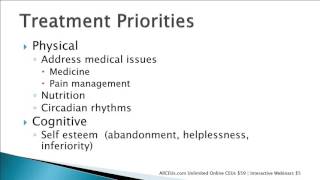
Dr. Dawn-Elise Snipes walks through treating a 40-year-old with alcohol and opioid dependence, depression, and anxiety. Early priorities: manage pain and sleep, fix nutrition, then layer in cognitive work like identifying distortions and building self-esteem. Addiction and mood disorders need simultaneous treatment, not one after the other.
Chapters
Welcome back to Co Occurring disorders and their impact on Treatment part three. So for the rest of this presentation we're really going to talk about treatment implementation. So we're going to start out with a case study which should sound familiar if you've worked in a residential or a detox facility. Our client, we're going to call him Jim Bob, comes in, he has a blood alcohol content of 0.23. And you know, if you haven't worked in a substance abuse or detox facility, you might be thinking, wow, that's pretty high. But that's actually not that high for a lot of people who present in detox. So he's 40 year old male with a blood alcohol content of 0.23. Polysubstance dependence of alcohol and opiates, which we know both of those are depressants and you combine them and it's one plus one equals like seven. So it's really dangerous to combine alcohol and opiates anyway. But so he's abusing both of these right now. He's also got persistent depressive disorder, which used to be called dysia, generalized anxiety and chronic back pain. He started using the opiates to deal with his chronic back pain, found out that, you know, he felt pretty good when he was taking them, which probably because it helps some with his generalized anxiety, and the alcohol is probably being used to mask his persistent depressive disorder. But we'll look about, look at that as we get more into the treatment aspects. He was referred to residential after a three day detoxification. So he shows up in residential, he's only had three days to detox from a blood alcohol of 0.23. Now the first thing that that tells me is Jim Bob's probably been drinking for a while, so it's going to take him a while to get out of the fog. You know, he may not have alcohol in his system anymore, but all of those brain chemicals are wonky and it's going to take him a while to rest and recuperate. So we know that Jim Bob is going to have probably difficulty concentrating and he's going to be in a fog for the next two to three weeks at best. You know, we might be looking at longer depending on how long he's been drinking. His current medications on top of the opiates and alcohol are sertraline for depression and anxiety and ibuprofen for pain. So the doc decided to keep him on the sertraline and switched him from opiates and ibuprofen to just ibuprofen alone. So that's also probably going to impact his early recovery because when one is taking opiates, the body quits producing the endogenous opioids, your natural painkillers. So what normally would his body would normally take care of and go, we got this. You know, we're going to numb the pain. The body's not making those anymore. So it's going to hurt and he's going to be achier and things are going to seem worse right now, which is going to make sleeping harder, concentrating harder, and probably have a negative impact on his mood. So he's not concentrating, he's in a fog and he's got all this working against him. And you know, some of you are going, wow, you know, wouldn't want to be him. Well, I wouldn't either. But we want to put ourselves in his position and go, okay, what does Jim Bob need to make it through not the next three weeks, but to make it through until tomorrow? What can we do to help him develop some sense of control and hope? Because we want to start dealing with the hopelessness and helplessness. And we haven't even talked about what causes his persistent depressive disorder or his generalized anxiety yet. We haven't dealt with those cognitive issues. We're just looking at physical issues right now that are probably going to make treatment and recovery a challenge in the first couple of weeks. So our treatment priorities first address medical issues. Like I said in one of the other slides, sometimes it is easy peasy. You can send somebody to the doctor and they find out that they've got a thyroid imbalance. They can get on medication for that. They can get go to a pain management physician, maybe get some nerve blocks or something that is non opioid based. There are a lot of different techniques and interventions that can be used to help people deal with some of the physical causes or things that would exacerbate physical depression or not that would exacerbate depression. The other thing we want to look at is making sure that Jim Bob is getting enough sleep, which is going to go partly with the pain management, but partly with dealing with the anxiety. So the doc may start him on a short course of psychotropics. The sertraline is what he's been been on and he is going to stay on for a little while. Hopefully that will do enough to help him out through this early detox period. Other things that we want to look at is nutrition and I'm not talking switch his diet up completely. All I'm talking About is making sure that he's getting enough protein, enough carbs, enough fats, and drinking enough water. He needs to start flushing some of those toxins out of his system and giving his body the building blocks to make the neurotransmitters that he's going to need for recovery. We don't want to switch somebody to a super healthy diet if they've been eating crap because we know that they're not going to stick with it. Probably. We don't want changing their nutritional habits to be painful or seen as unpleasant. So you know where I used to work, the ladies that cooked in the kitchen, they were wonderful cooks, but they cooked southern. Let me tell you what, just about everybody who worked there put on £15 within the first year because they used a lot of seasoning, but the food was relatively nutritious. We had a registered dietitian overseeing everything. There was always a protein, there was always a vegetable. Now it was drenched in butter, but there was always vegetable. So we want to do what we can to get the healthy food in their system without making them sort of balk at it. So nutrition helping, make sure they're eating consistently throughout the day. Which partly goes to circadian rhythms. Your circadian rhythms do more than just make you sleep. They also tell your body when it's time to eat and when it's time to be awake and all that other kind of stuff. So what can we do for circadian rhythms? Well, the first thing is just like we used to do, if you've, if you're a parent and you've had a child, there needs to be some sort of a wind down routine because that tells the body to secrete melatonin, which will help you get sleepy. Yep. Believe it or not, you actually make melatonin. So how do we do that in residential, we had a wind down routine. They would come back from a meeting, they would do chores, they would have snack time, watch TV and then it would be lights out at 10 o'. Clock. After a while, the body starts to expect that. Just like with small children, they come home from school, they eat dinner, they read a book or take a bath, then read a book and wind down for a few more minutes and then go to sleep. Is cueing the body in that, okay, this is the routine that means sleep is on the way. Does it mean you have to go to bed at the same time every night? No. I mean, ideally, yes, you would want to in order to give yourself the best chance of rapidly resetting these, these cycles. But the nice Thing about the visual cues and the activity cues is if you're off by a little bit, you know, one night you, you're really, you come home from work and you're really sleepy. It's like six o' clock and you go through your wind down routine and it's 8:30 and you go to sleep the next night you're doing pretty good, didn't have such a hard day and you don't end up starting your wind down routine until 8 or 8:30 and you don't go to sleep till 10. As long as you're within a reasonable window. I mean you don't want to stay up till three in the morning. But hopefully in early recovery they're not doing that. The circadian rhythms also need to have the wake up cue. So when people get up out of bed, sitting around in the dark, you know, doing whatever is not and kind of slowly edging out into the morning is not going to reset that circadian rhythm. They need to get up, they need to get dressed and they need to turn on the lights. Now you know, that doesn't mean they have to start doing chores or going out and doing groups or whatever the case may be. Not everybody likes to hit the ground running when they wake up in the morning. But there needs to be light and there needs to be movement of some sort and getting out of the PJs, that's another cue when you put on your street clothes that it's time to be awake. These are all really basic life skills that people can undertake and will help them start feeling better as they start having more quality sleep. Now I'm not expecting Jim Bob to sleep through the night for at least a week or so with his anxiety and his pain and everything else. But if when he's asleep, he can sleep pretty well and we start training him his body to sleep at night and be awake during the day, in a week or three he'll probably start getting some more satisfying, restful sleep, which will help a lot of things. All right, so once we hit the basic physical things and you notice I didn't mention exercise in here, Jim Bob is not ready to exercise. Most people in early early recovery are not ready to exercise. If they are light walking, whatever the doctor approves of is great. But most people aren't wanting to go out and start running 5Ks. And exercise isn't something that a lot of people like to do. I usually leave that up to the client whether they want to start exercising early on in their recovery or whether that's something I suggest they try a little bit later. And we usually work it in with animal assisted therapy because that's a whole lot more fun to go out and play ball with the dog than it is to go out and go on a power walk for 30 minutes or something. So anyway, cognitive. Now a lot of the thinking errors, cognitive distortions, thinking thinking, negative attributions, all that stuff we talked about in the mood disorders, personality disorders and even addictive behaviors come back to a couple of things. Number one, cognitive mistakes, irrational thoughts, cognitive distortions, and number two, low self esteem. You will find. I, I have never found, let me, let me put it that way. In the almost 20 years that I've been working in co occurring disorders, I have never met a patient who walks in and would have what I would call a high self esteem. They have some stuff, they have some issues. And whether that predated the, the addiction or it's a result of everything they did in their addiction doesn't really matter right now. Their self esteem is low at best and usually in the crapper. So we need to start helping people realize that they are worthy for who they are, not what they can do for people. And they don't need someone else to tell them you're okay, they can do that. I always make the joke and it's getting to the point now that most people don't get it because, you know, I'm that old. But Saturday Night Live used to have somebody called Stuart Smalley and he would look in the mirror and he would say, I'm good enough, I'm smart enough. And gosh darn it, people like me. And most of my clients look at me and if they remember the skit, they're like, yeah, I'm not going to do that. And if they don't remember the skit, they just look at me like I'm crazy. But it's all good. We want people to start figuring out what's good about them. So there are a lot of self esteem exercises you can do. We're not going to go into that in this class, but that is something that people can start working on early in recovery, writing down one or two nice things that they do each day or making a gratitude list, focusing on things that are good about them. There are a lot of different ways people can improve their self esteem. One of the things that we do at the end of the day is a daily summary. And I make people and make is actually the word I want to use. I make people identify three accomplishments or successes for the day that helps people see that they are good and they are able to accomplish things and there is something to this whole recovery thing and they can do it. And even on the bad days, people struggle, but they can find three accomplishments, even if it's just getting up, sticking with it, and staying sober. All right. A little bit more difficult than the self esteem is helping people address irrational beliefs. And this can be a bit of a challenge for people when they first start doing it, because we talk about those automatic beliefs and it's sort of is not tangible. But I encourage you to give your clients a list of cognitive distortions and irrational thoughts and have them keep it with them so when they start having a bad moment, they can go down that list and go, are any of these thoughts cognitive distortions or irrational? The next exercise we're going to talk about is cognitive processing therapy, which is a little bit easier for people to grasp onto, but. But the ABCs, the cognitive behavioral therapy is really the yardstick by which everything else has been measured and built. So A is the activating event. What was it that happened? B comes right after A and you almost don't even realize it. Then comes C, the consequences. So the activating event, somebody cuts you off in traffic. The consequence, you get upset. In between somebody cutting you off in traffic and you getting upset, you had a whole litany of beliefs that you didn't even realize it happens in like a milli. Millisecond. They were rude, they are not paying attention, they could have killed you. Whatever the case may be, you have all these beliefs. So the next step, something happens, you get upset. Before you start acting on it, determine which beliefs are factual and accurate. Was the person really being a jackass or were they? Maybe you were in their blind spot. Maybe they weren't paying attention. We all make mistakes. We're not perfect. Once you determine and eliminate any beliefs that are not factual and accurate, then evaluate your options for your energy. When we're talking about getting cut off in traffic, is getting all upset and screaming at them through your car with the windows rolled up, Is that going to do any good? And I challenge anybody to say yes. So you're just using a whole lot of your energy for no benefit. What are your other options? Let it go. Take a different route. If you don't like traffic, how else can you use that energy that would be more productive to you? Another way to look at it is, do you really want to give that person power to make you upset? And generally, when you put it that way, to Somebody who has an addiction, they'll say, oh no, nobody takes my power. That's how you can look at it. The short, short, short version of this is, something happens, you get upset. Ask yourself, is this worth my energy? And if the answer is no, then move on. Figure out how you're going to move on, but you don't have to act on every feeling. Cognitive processing Therapy Sometimes we have irrational beliefs. Something happens, we get upset, we think, you know the sky is going to fall. So you ask yourself, what is the evidence for this belief? What is the evidence against this belief? And we're talking about evidence, not feelings. We're talking about evidence. Is the source of the evidence reliable? If it's your three year old, probably not. If it is some scientist with three PhDs, well, okay, maybe they might know if the sky is falling. Is the belief based on fact, feeling or habit? This is one that gets tricky. Is it fact? If it is, okay, great. Are you making, is this belief based on a feeling? You just have this gut feeling. Sometimes we have this feeling that something bad is going to happen. So what's the evidence for this belief? I have none. What is the evidence against this belief? Well, I still have none. I just feel like something bad is going to happen. Is the source of the evidence reliable? Well, if generally when you get a sick feeling in the pit of your stomach, something bad happens, you might go, yeah, you know, 70% of the time. Spot on. You go back down to is the belief based on fact? No, it's just a feeling I have in the pit of my stomach. Okay, so feelings aren't all that reliable. So we want to just pay attention to that or habit. Sometimes we have thoughts or beliefs just out of habit. We expect someone to act a certain way or we expect something to turn out a certain way. So if it's an expectation based on prior experiences, you might call that a habit. So then you've got to ask yourself, okay, do I want to go into this and get all riled up expecting the worst? Because that means I'll probably create it. Create the self fulfilling prophecy. All right, so we've looked to see if there is evidence, the source of the evidence is reliable and identified whether our beliefs are based on fact, feeling or habit. Then we say, are we thinking in all or none? Terms of if you're thinking, you know, we'll go back with that sick feeling in the pit of your stomach that means something horrible is going to happen. Well, you know, that's kind of an extreme reaction. Little bad things happen all the time, you know, so if you're expecting that, then you're probably gonna blow things out of proportion. Are you focusing on the entire event or just one bad aspect? So if maybe you go out on a vacation and during your vacation you lose your passport and you come back and you say, that was the worst vacation ever. I lost my passport. You're focusing on that one aspect. You were gone for two weeks. You did other stuff, but this passport is the only thing you're remembering. And then you ask yourself, is the distress from this belief worth my energy? Is it worth dwelling on what could happen? Or the fact that I've got a sick feeling in the pit of my stomach? Or the fact that it was I lost my passport? Only the individual can decide this for themselves. But I encourage you to encourage them to write all seven of these down on an index card or in their phone and keep it with them at all times. So when they start kind of spiraling out of control into the what ifs and catastrophizing, they can check themselves. Most of our clients will find that once they start becoming aware of these irrational beliefs, they naturally start stopping them. For example, once I started using the verbiage that or stopped using the verbiage that, so and so or such and such made me angry. There was a difference in my approach to life because I realized that nothing can make me angry. Something can trigger an anger reaction. But then I choose what to do with it. I can let it go, in which case, you know, I hardly notice the blip. I'm just like, ugh, I'm not going to deal with it. Or I can nurture it and blow it out of proportion. But I am responsible for my own feelings. Once clients wrap their head around this, they will find that life is a lot easier. The other concept they need to wrap their heads around, which is a little bit harder, is understanding that when something happens with someone or when they don't get along with someone, it's often more about that someone and that someone's feeling about themselves than it is about them. So if somebody gets upset with you, yeah, look at what your pardon it was. But there was probably some of their stuff in there, too. So not to take everything personally, because it's not all about you. The next thing, which again is another easy one, is to find exceptions and connections. Exceptions are when the behavior doesn't occur. So remember, we talked about at length so far about how all these things are interconnected. So if you say, all right, Jim Bob, on those days that you are not as depressed, you know, because the persistent depressive disorder is kind of like Eeyore. It's kind of always there. But when you are not as depressed, what is different? And Jim Bob might say, well, generally I've slept more and I'm not in as much pain. Okay, so what do we need to do to help you sleep more and deal with your pain? Those are things that are easier to deal with than the fact that you're still upset because you didn't have the childhood you wanted, which is a whole nother existential issue we need to focus on later. Find exceptions when you are not using, when you are not drinking, when you are not using pills, what are you doing instead? Because those we want to do that more. So if you don't drink when you are at the gym, if you don't drink when you are with your kids, if you don't drink when you're at church, whatever those exceptions are, this is what we want you to start focus on focusing on doing more. For right now, once you develop stronger coping skills, you'll have a wider repertoire of things that you can do when you start to get upset. But for right now, let's just focus on doing things that conflict with using, where you can't do one and the other at the same time. This will help patients start finding hope and strength. They will start seeing that there have been times in the past when they haven't used. It may have only been for two hours or a day or maybe even a week, but they did it. And all I'm asking them to do is go for two hours or a day or maybe a week. Now I'm not asking them to go for forever. I'm asking them to do what they need to do hour to hour, minute to minute, until they start feeling a little bit better and the pain starts to subside. Which takes us to finding motivation. In motivational interviewing, there are activities called decisional balance exercises, which are wonderful, but you've got to remember that motivation is activity specific. I may say, I want to be happier. Well, I'm really motivated to be happier, but I may not be motivated to do everything it takes to be happy. When people come into recovery, they say, I want to be sober. And I say, okay, that's great. So what are you willing to do to be sober? I had a client come in one time. It was in a drug court program. And she comes in. She doesn't know me from Adam's house cat. And she sits down and I introduce myself, and she Says hi, doesn't introduce herself, and she says, I'm not going to those meetings. I said, okay. And she repeated herself. She said, I don't care what you say, I am not going to those meetings. They don't work. And she went off on this diatribe for probably 30 seconds or a minute about her impressions or feelings about 12 step meetings. And I sat there and I listened to, and when she was finished, I said, okay, meetings aren't going to work for you. So what are you going to do instead? Because I don't care about what you're not going to do. What I need to know is what you're going to do instead. And she just had this dumbfounded look on her face for a minute because nobody had ever listened to her or listened to her preferences. They'd always tried to shove her into this pre formatted treatment, and that wasn't going to work. She made it abundantly clear to me that was not going to work. So I asked her what was going to work. And that was a whole new concept that she might actually know what works best for her. Nobody had ever treated her like that. So we want to help our patients find motivation, but we have to help them understand that motivation is activity specific. Getting healthier, getting in shape means going to the gym. It means eating a healthier diet, two things at least, and maybe getting better sleep. So we'll say three things. Most people are not going to be motivated to do all three at once. So you say, which one are you motivated to do? They go into great detail on how to do these decisional balance exercises in tips 35. But we're going to go over a couple examples of them just so you can see how to break it down with your clients so they can understand and increase their own motivation. I want clients to learn how to set their own goals, to learn how to identify their own exceptions, and to learn how to maintain their own motivation. They don't need me, you know, I'm going to teach them some skills right now. But six months or a year from now, I'm hoping that they have these skills and they don't need to have someone else kind of prompting them to do the next right thing. So motivation is a key to change. We don't do something if we're not motivated. You don't get off the couch to go to the kitchen to get something to eat unless you're motivated to get something to eat. As simple as that. You don't get up and go to work unless you're Motivated to go to work. Now, some days we don't want to go to work, but we know that in the big scheme of things, what we want for our life means that we have to go to work. So that's the motivation. Motivation is multi dimensional. There's physical motivation, pain versus pleasure. You know, I'm not going to do things that hurt. I'm going to go for things that, you know, make life better, make me feel better. I'm going to go for things that help me get energy. They don't drain my energy and that increase my comfort, not cause me discomfort. Emotional motivation, happy and sad. If I'm going to do things that make me happy, not things that make me sad. Cognitive motivation is looking at the right and wrong or confusion and clarity. So when you do something, doing it because it's the right thing to do is one motivation. Another cognitive motivation is doing something because it'll help you kind of get focus on what's going on. You know, we talked about our clients at this particular period are probably having difficulty focusing and concentrating. So they may be motivated to make lists, they may be motivated to write things down. They may be motivated to do something a little bit different because their life right now is very chaotic and they figured out that doesn't work. They want something a little bit more clear, a little bit more focused. Then we have social motivation. Are you going to get acceptance from your peer group for this behavior? Do we always do things to get acceptance from our peer group? No, most of the time we do, but sometimes the right or wrong may win out. But. So we want to look at social acceptance. We want to encourage people to be around peers that are going to support their decision to be clean and sober, take their medication, live a healthier lifestyle, whatever the case may be. And social media motivation can also be in terms of reinforcement and punishment. Your peer group is going to be more supportive of the things that they want you to do versus the things they don't want you to do. And then there's environmental or situational. And there are a lot of things here. Financial motivations, housing motivations. Sometimes people do things just so they won't be kicked out of their house. Employment motivations. Sometimes they do things just so they can not lose their job because they don't want to be kicked out of their house because they're broke. So you see how all this kind of. There are a lot of different types of motivation that we can look at and we can harness to help people remember why the pain is worth it. Because because sometimes recovery sucks. I mean, there's just no way to say it nicely. The best thing about recovery is you start to feel feelings. And the worst thing about recovery is you start to feel feelings. But helping them maintain their motivation to push on through is something that we can do. Motivation is dynamic and fluctuating. When the going gets tough, people want to get going. When it starts to become uncomfortable, people start going, oh, do I really want to do this? So we need to make sure that they've got the motivation to say yes. I, not only do I want to do this, I can do this. Motivation can be modified. We can make people more motivated, or people can make themselves more motivated by really taking a look at the reasons why they want to do things. And we can increase the rewards too, in terms of offering certain token economies or certain rewards for periods of sobriety or periods of medication compliance. And motivation is behavior specific. If you're using motivation to encourage somebody to do something that is a complex task, it's probably not going to be nearly as effective as if you use motivation or you focus the motivation on a specific task. For example, when I was program director, I loved being program director. That was great. I loved working with the clients. I loved creating organizational plans. I even really enjoyed writing manuals and going through audits. What I didn't like doing was performance evaluations. Not because I had conflicts with my, with my staff. I had a great staff. I just didn't like doing them and I have no idea why, but I didn't. So I had to work to increase my motivation on that specific task. Because I would get up and I would go to work and I'd work a 10 or 12 hour day and not blink an eye. But I would manage to avoid doing those silly performance evaluations. So motivation is behavior specific. And if there is a particular behavior, you need to hone in on that. So let's talk about physical health first. Your decisional balance exercises are broken down like this. You want to look at the benefits and the drawbacks of the new behavior versus the old behavior. And sometimes it's a little clearer and sometimes it's a little bit muddy. But I find it's easiest for most clients to break it down in terms of the different dimensions of motivation. So, for example, the benefits of improving nutrition, the physical benefits, and this is, you want to have your clients fill this in. You don't want to fill this in for them because it needs to come from them. What do they see as the benefits, the physical benefits to improving nutrition, weight Loss, lower cholesterol, reduced need to take blood pressure medication, more energy, whatever they find. Emotional benefits of improved nutrition. They may find that their mood improves because they're providing their body the building blocks it needs to make the neurotransmitters to feel good. Cognitive benefits of improved nutrition? Yeah, there may not be any. It may help them think a little bit clearer. I know when my blood sugar gets low, I get kind of foggy. They may or may not come up with that. That's okay. You're not going to have motivations in every single area. Social benefits of improved nutrition. Maybe some of their friends are trying to eat more healthfully. Maybe it's something that they want to teach their children. They want to teach their children good eating habits. Encourage them to think about what are the social benefits for them and their family, for them and their friends and for them and just society in general. How does improved nutrition affect how they interact with society and environmental? You know, we talked about improved nutrition is not going to affect housing at all. Will it affect how you do your job at work? Maybe, maybe not. There's been a lot of research that's shown that kids focus a lot better and do better in school if they have a good breakfast. So possibly it may improve your work product. But that might be a stretch for some of our clients to believe and endorse. But we can look at the financial aspect of improved nutrition, especially if they're not having to take as much medication. You know, then we want to go over to the drawbacks. And yeah, we talk about those. Why? Because we need to remove the barriers and the drawbacks to this behavior change, all of these are barriers. So we need to figure out how to deal with them. Physical drawbacks of improving nutrition. You're going to have cravings. There's just no two ways around it. If you've been binging on chocolate, refined sugar and caffeine, those are my three. You're going to have cravings. Emotional drawbacks. Some people get really cranky when they can't have their chocolate, refined sugar and caffeine. You may also get headaches. So how do you deal with those? One way could be to gradually train your nutrition so you're not quitting cold turkey. There are a lot of ways, but you want to encourage your clients to figure out how to eliminate these barriers. Cognitive barriers to improve nutrition. Now, one of them may be they don't know what good nutrition is because they've never been taught how to eat healthfully. A good friend of mine who's A registered dietitian said, you know, don't worry so much about serving sizes and how many servings and the food pyramid and this and that. Instead of using a big plate, use a salad plate and make sure you have a minimum of three colors on your plate at every meal. If you do that, you're probably going to be just fine. And I find that works really well with clients because it takes away the anxiety of worrying about, you know, how much is a serving and Okay, I need six to 11 servings of which food group? There's too much to remember. Anybody can say small plate, three colors. Social drawbacks to improved nutrition. Well, you know, it's going to make having pizza every night kind of not the thing to do. And we can also go with financial. A lot of the less healthy foods are cheaper, which is unfortunate. So you've got to think about financially, you may have to plan for eating a little bit healthier. Thankfully, most of this is covered on food stamps or WIC or what have you. So it doesn't matter that much to most people whether they're eating, you know, peanut butter or potato chips. Okay, so the benefits to your change, we want to increase those. The drawbacks to your change, we want to get rid of those. Now we go and look at the benefits to staying the same. Why? Because you don't do things unless there's a benefit. And if we don't address that issue, then we are going to set our clients up to have a motivation lapse. So let's look at what are the benefits for the current eating habits. Physically, it tastes good, it's easy. You know, sometimes maybe they're eating fast food every night, which means they don't have to spend a lot of time preparing food. It's easy, it's quickly accessible, it tastes good. Emotionally, it may be more of a comfort food, but by the same token, it also may be a stress reliever because they're not having to prepare a whole meal. So these are things that we also need to work on sort of eliminating. What are the, the benefits to eating poorly. How can you get around those? For example, instead of going and buying, you know, a family meal at a fried chicken, maybe you can get a frozen dinners for everybody. A little more healthy. Probably doesn't cost anymore. You can just pop them in the oven. You don't have to worry about making multiple things. You can also cook ahead. So, you know, prepare pasta and you can make multiple different things off of it over the course of a couple of days. Cognitively, yeah. Probably not a whole lot of things we need to address that we haven't. Social benefits of current eating habits. The kids like it. You know, the kids. Kids like to eat hot dogs, grilled cheese, and pizza for every meal if they could probably. Oh, and chicken nuggets. That's. That's another big one. But when you think about that, you're not getting a whole lot of different colors there. So we want to go back to those colors. Does that mean they can never have hot dogs, grilled cheese, chicken nuggets, and pizza? No, they can have it. We just need to encourage them to have it in moderation and, you know, maybe as part of the three colors. Environmental. Probably not going to be a lot of benefits in the current eating habits. Except for maybe you don't have to do dishes if you're eating fast food. You just throw the dish, throw the stuff in the trash. Yes, you're going to have to do dishes. It's just one of those things you can't get around. Drawbacks to maintaining current eating habits. This is a motivator. So we want to focus on why would you want to do this? You see how we're going physically. Drawbacks to the current eating habits. You're putting on weight. You're needing more blood pressure medication. It's not as healthy. Kids are learning poor eating habits. A lot of people find when they start eating healthier and drinking more water, they can think more clearly. There's a hypothesis that it's because not only does the body have more building blocks to make what's necessary and vitamin B12 and all that kind of stuff, but you're also flushing more of the toxins out of the body. Whatever kind of gets you through the day. Drawbacks to current eating habits. Social drawbacks. There may not be any unless your friends are all health nuts and you're the one that's out there eating fast food all the time. And environmental drawbacks. Well, you can think about all the waste from the fast food that you're eating that is going into the trash. You can think about the amount of money you're spending on fast food if that happens to be what you're eating. It really depends on the client and the client's situation. This is a great activity to do in group because one client will think of probably 20% of the things to go on here. So if you have five clients, you're going to come up with a whole lot more and, you know, maybe 100%, but you get my thought process that multiple heads are Going to have multiple ideas about what the benefits and drawbacks are and they can share with one another. So let's talk about mental health. Same thing. Changing thinking patterns. Benefits to changing thinking patterns. Physically, you're going to be less stressed. Emotionally, you're going to be less depressed. Cognitively, you'll be able to concentrate and focus a little bit more if you're less stressed and less depressed. Socially, if you change your thinking patterns and you don't see the world as so negative, if you're not depressed all the time, it's going to be a lot more fun to be around people and people are going to want to be around you more. And environmentally, things go a lot easier. Work will probably seem easier if you are not constantly waiting for the sky to fall. Worried about everything, depressed all the time. Whatever the thinking patterns may be, the drawbacks to changing thinking patterns, it's hard. There really are no physical drawbacks I can think of. Emotional drawbacks is it's hard, it's frustrating because these thinking patterns are ingrained. So it takes time to change. That goes with cognitive as well. One of the things to encourage your clients to do is to be kind to themselves. You know, you're not going to get it every time, you're not going to change it every time. If you can change it 20% of the time the first week, that's phenomenal. Socially changing thinking patterns, are there any drawbacks? Well, if you start expecting or stop expecting people to let you down, then you may actually trust in somebody, which may make you more vulnerable to getting hurt. Yeah, that's true. But how can you deal with that? And one of the things that we want to encourage our clients to do is start developing healthy boundaries. Whole nother class Environmental drawbacks to changing thinking patterns. There's not a lot that I can think of now. Remember, I'm the one person in the group, so I'm probably coming up with 20% of the reasons here. So we look at the benefits of maintaining current negative, sort of paranoid, depressive, worried, stressed out thinking patterns. Physical benefits. None I can think of emotional benefits. It's what you know. It's easier because it's what you know. Is it what you want to continue to do? Probably not. So how do you deal with that? Because it's, it is a change cognitively. Again, it's what you know. So this, your current thinking patterns are going to be your automatic reaction. It's going to take some time to change that automatic reaction. It's going to take some practice. The good News is with time and practice, you can change your thinking patterns. So it's not a process. It's pretty much automatic. Social benefits to maintaining current thinking patterns. Your current social circle probably supports those thinking patterns, which means you have to look at your current social circle and go, is this the best recovery environment for me? Which takes us to environmental current thinking patterns that are negative, stressed, depressed, high strung, worried all the time. People who feel like that generally don't have a lot of energy to clean house, to do other things because they're so spending so much energy internally that their external environment tends to kind of become chaotic. And then we go over to the fourth quadrant. The drawbacks of maintaining current thinking patterns. Physically, when you're negative and depressed and stressed all the time, you store stress and it hurts. You can give yourself headaches, migraines, backaches, poor sleep, you know, the list goes on. We know that when people are stressed over a period of time, that their immune system also goes down, which means they get sick more often. And I don't know about you, but I'd rather be just about anything than sick. Emotional drawbacks to current thinking patterns. Well, they're keeping you stressed and depressed. Cognitive, same thing. Social drawbacks to current thinking patterns. They're keeping away people who are positive and optimistic and may be able to help you feel happier. And environmentally, the drawbacks to current thinking patterns is that your environment's probably in as much chaos as your thoughts are in your own head. Another mental health issue that we want people to work on early in recovery is developing social supports. So we want them to look at the benefits and drawbacks in addiction recovery from jump. We start talking about changing people, places and things, which is true, it needs to happen. But that is scary as all get out for most of our clients, because they don't feel worthy, they don't even like themselves. So they can't expect other people to like them. Which is why we start with self esteem work so early in the process. So figuring out how to make friends and not only make friends, but make friends when you're not drunk or high is scary. It's. It's terrifying. So we want to start with the benefits. And sometimes when we talk about making a change or doing something that's really hard or really scary, we still go through it the same way. But then we will revisit the benefits of the change at the end. So developing positive social supports, physical benefits, there may not be any. You may experience some less stress, which means less neck, head pain, that sort of Stuff that's sort of far removed. Emotional benefits, definitely stress reduction and a feeling of not being isolated and all alone. Cognitively, positive social supports can generally help you by acting as a good sounding board and giving you suggestions and sort of being a second head. You know how they say two heads are better than one? Socially, positive social supports are great because you're surrounding yourself with people who are positive. Positive begets positive. You know, it's not like a magnet. You know, positive doesn't attract negative. When we're talking about relationships, positive attracts positive. So environmentally, you may have more energy to keep your environment in a little bit more of a, you know, clean. And you may also have things in your environment that start to be happy. You might start noticing things in your environment. For me, my kids have been laughing at me lately. I saw this meme on Facebook, and it was a hamster, a sweater. And it's just like the cutest thing I've seen in my entire life. So now it's my lock screen on my phone, and whenever I start having a moment, I look at my screen and it makes me smile because it's a hamster in a sweater. And you're probably rolling your eyes right now thinking, I've lost my mind, but it's okay. Laugh with me, Laugh at me. As long as you're laughing, I'm happy. And that's part of having good, sober, healthy social supports. People realize that it's okay to be different. It's okay to be happy, even if other people, you know, aren't. I mean, I'm not going to be yucking it up at a funeral or something, but just because my roommates had a bad day doesn't mean I have to get all grumpy, too. All right, so let's move over to the drawbacks of new friends. Physically, again, not a whole lot. Emotionally, it's scary to put yourself out there and introduce yourself to new people, put yourself in new situations. So this is something that you can work on in therapy with rehearsals. You can work on practicing introducing yourself. You can go in groups to new situations. So it's. You're not going in there by yourself. I hate going into new situations all by myself. I'm kind of a chicken that way. So I make somebody else go with me, and it makes it a whole lot easier. Socially. The drawbacks to developing new friends is that the current negative, unhappy, dysfunctional friends might not want to hang around with y'. All. You've got to decide whether you're okay with that and how you're going to deal with your current friends as you start making healthier, sober social supports. All right, what are the benefits to maintaining your current friends? Well, you know them and you can anticipate them. Even if they are mean, nasty, negative, whatever the case may be, you know what to plan for, and you can kind of deal with it. They may not be building you up, but you figured out how to keep them from tearing you down. Cognitively, it's less to think about because you know what to expect. We like to keep our current friends. It hurts to have to end a relationship or to put distance between yourself and someone, but at the end of the day, you have to ask yourself, physically, emotionally, cognitively, is the energy that I'm putting into this friendship or surviving in this friendship worth it, or is it just dragging me down? Which takes us to the drawbacks of maintaining. Maintaining your current social relationships. And then finally, of course, we had to look at sobriety. Now, sobriety is a bunch of different things. Not just not using. And I'll say that again, sobriety is not just not using. It's a whole different way of thinking, a different way of approaching life. It's characterized by honesty, courage, discipline, integrity, you know, all kinds of stuff that are not prevalent in an addictive lifestyle. So right now we're just looking at stopping using. But we need to encourage people to recognize that that's just being clean, that's not being sober. So what are the benefits to not drinking? Well, physically, it's better for your health. You're not going to put yourself in situations where you're getting into bar brawls. Legally, you may not be getting as many DUIs. Socially, it might be kind of scary. So we're going to save that for right now. Cognitively, benefits to not using is you'll actually remember what you did the night before. Drawbacks to stopping. Physically, you're going to have cravings. And physically, the detox from alcohol is not the most pleasant in the world because after that depressant effect wears off, there's an anxiety effect where people feel their anxiety going up, which is often why they have another drink. But if you're detoxing, you can't. So the physical drawbacks from alcohol are unpleasant and they can be life threatening. So if you're detoxing, please, from alcohol, please make sure to have your clients detox under medical supervision. Emotional drawbacks to stopping, you're going to have to feel feelings. Oh, crap. That can be a benefit or a drawback, kind of depending on the day. But we need to encourage clients to be aware that you're going to start feeling some stuff and it's not going to be pretty, but you can do it. Cognitive drawbacks. You're going to start remembering all the stuff you did when you were drunk and having to make amends. Dealing with the guilt, you know, all the stuff that people experience in early recovery. The good news is thousands of people have done it and made it through and dealt with the stuff, so your client can too. And having faith in in your client that they can do it will help them have faith in themselves. Benefits to continued use. No cravings. Emotionally, you'll be numb. Cognitively, you're not going to remember what you do. So you don't. You're not going to feel as guilty unless you start to sober up. Socially, you get to keep all the same dysfunctional friends. And environmentally, you may not be able to stay at your house anymore. You may be living out of your car, but you don't have as many responsibilities. Now, I say that kind of ingest, but we want to encourage clients to really get honest about the reasons they use alcohol. The main benefit is generally dealing with emotions. So we need to make sure right here, we help them figure out when they start feeling feelings, how do they deal with it, and then the drawbacks to continued use. This is usually the easiest one for them to fill out because they're in that early recovery stage and they're like, oh, I'm not going to do that again. And these are all the reasons why. Encourage your clients to not just talk about this in group, but to write. Give them worksheets that look like this and encourage them to fill them out so when they start having a weak moment going, why am I here? They can look back at their decisional balance exercise and go, okay, that's right. I really do want to start living a happier, healthier life. This just sucks right now. So treatment priorities. Cognitively, when people start feeling those feelings, they need to work on developing mindfulness. What does that mean? Well, the first thing is understanding the function of the feeling. Just like our reactions and all of our quote symptoms are functional and self preserv geared towards self preservation. Our feelings function to protect us. We have the fight orf flight reaction. When we are faced with a threat, we size up the threat and we decide, I can take it, I'm going to fight or oh crap, I can't, I'm going to flee. Now you break that down. You've got anger versus anxiety or stress. Understand the function of the feeling when they start to feel a dysphoric feeling, is it anger, is it anxiety? And then depression is out here. Where is the body saying, I've got no more. I've got no more gas. I just can't do it anymore. And if they're starting to feel depressed, that means they need to figure out how to reduce some of that stress. So what is the function of this feeling? Why is it making them feel angry, anxious, or helpless and hopeless? Break it down to those four very rudimentary feelings. And then distract, don't react. Just because they're feeling it doesn't mean they have to act on it. Just because they're depressed doesn't mean they have to cut, doesn't mean they have to drink, doesn't mean they have to cry, doesn't mean they have to put a fist through a wall, Whatever they typically do, they're feeling a feeling because it's their body's way of saying, dude, you got to do something. What are they going to do? They need to take this time to say, all right, I need to distract for a second. Because when you have this fight or flight reaction, or fight, flight or forget it. And I'm paraphrasing there, but when you have that reaction, that's basically an adrenaline reaction, a primitive reaction, and we want to let that go by. We want to let that adrenaline get out of our system so we can think clearly and make a decision in our rational mind. Make one that is based on higher order thinking that humans are capable of. So distract, don't react. How can they distract themselves when they start feeling? Fill in the blank again. Have them keep it on index cards. Three things. I always say three options. When I am angry, I can. When I am anxious, I can. And when I am depressed, I can. So that's nine things altogether. Those are things they can do to distract themselves until they can figure out what they're actually going to do about the situation. And then finally, mindfulness. And this is an overarching activity, the mapping activity. I love doing this activity. I give people a map, which is why it's called the mapping activity. Hey, go figure. On one end of the map I put a star. That's their destination. And they can call it whatever they want. Recovery, happiness, Eden, I don't care. And on the other end of the map we're going to put you are here now, just like back in the olden days before we had Google Maps, we had. You would get maps from AAA and they would tell you where all the Road construction was and all the potential barriers to your travel and tell you different alternate routes. Google now will tell you what three routes you have, which one's the fastest, and whether it's clear. When you get to a barrier, you know, a traffic jam, something like that, it will either tell you this is still the fastest route, you just have to sit through it, or would you like to detour now? Good, orderly direction is a term we use in any recovery, talking about in the big scheme of things, because people with addictions, depression, anxiety, want this pain to stop now. So good, orderly direction says, okay, this may not be my favorite thing to do right now, but a month from now, is this getting me closer to where I want to be a month from now, six months from now, five years from now? So they need to identify their potential barriers to reaching whatever their destination is. Where are the traffic jams? Where are the roadblocks? They need to figure out what alternate routes to take if there is a roadblock and how to do it safely. You know, you don't want to just without a gps, go drive and take an exit off the interstate and randomly go driving around until you find your way back to your path. You want to have an alternate route mapped out for yourself ahead of time or develop a method for tolerating the roadblock. My partner cannot stand to sit in traffic. Drives him absolutely bonkers. But sometimes that is still the fastest route. So how do you tolerate sitting in traffic? How do you tolerate this roadblock? It's unpleasant. How do you get through it instead of trying to make it go away and probably making things worse? The mapping activity gives a visual perspective for the recovery process. And you want to have them identify pit stops along the way. You know, if you were doing, if you're actually driving the route, you would stop to pee, stop to eat. So what pit stops are they going to take along the way, where they give themselves an atta girl or an atta boy? And what does that look like? A relapse in any of the disorders can trigger a relapse in any of the others. So if you have a relapse in your pain, it may make you start feeling depressed again because you're like, oh, crap, here we go again with this, which may make you want to use again. And, you know, any permutation of that. It's important to identify the most salient factors to address first. For example, pain contributes to sleep problems, depression, and addiction. So we know that pain is one of these common threads that if we improve that, we're going to have an improvement in mood and sleep, which will also probably help kickstart the body's building of endogenous opioids and the pain management system and all that kind of stuff. Another example is anxiety contributes to pain because you store stress and exhaustion, depression, and again, addiction because people, when they get stressed out, want to have a drink or something to help them relax. So if we help people deal with their anxiety, we also are going to be impacting the physical and the addiction aspect of their recovery. One way to get at what the common thread is for some of your patients, if there's not one that's really obvious, is to say what is one thing you need right now to start getting better. And they may just say something like I need a break. And you're like, okay, so I hear you're overwhelmed. That tells me anxiety. So how can we help you get a break? Make a practical plan for time management, delegating and handling some of those other issues. Practical counseling is not magic. It's practical solutions to real life problems. Nutritional and medicinal interventions will take one to six weeks to take effect. Make sure your patients know this. That way they don't start getting frustrated when after two days they're not feeling better. Quite honestly, with most of your medications, the first two days you're going to feel worse because your body's adjusting to it. So you may have some flu like symptoms. They need to know that too. Otherwise you may have some high rates of medication non compliance. Please do not treat the addiction and expect the mood disorder to spontaneously remit. If we treat this addiction, then the depression is going to go away. It's not that simple. You know, the body is going to be able to more effectively make serotonin and the dopamine pathways will and the motivation pathways may start to recover. But there's a lot of cognitive errors and a lot of stuff that people have to deal with. So we need to treat both of them. Likewise, you can't treat a mood disorder and expect the addiction to spontaneously remit. Well, if I treat your depression, then you won't need the alcohol or the binge eating anymore. Well, that may be true, but if the person is still drinking while you're treating the depression, then they're still keeping their neurotransmitters wonky. So we need to treat both of them. It's not nearly as true anymore, thank goodness. But when I first started working in the field, I worked with several psychiatrists in a substance abuse treatment facility who said no. A person has to have six months of clean time before I will even consider prescribing an antidepressant. So basically you ended up with somebody who was really depressed and clean, and they don't stay clean for very long if they're in that much emotional pain. So not that we can make doctors prescribe anything, but it is important to educate the clients and the physicians, if necessary, that we have to address both things simultaneously. And just as as one gets worse, the others will too. As one gets better, the others will too, which is awesome because we can focus on what clients are willing to change and gradually other things will start to improve. If a client is not willing to stop using, but they want to improve their depression and work on their marriage, okay, we'll work on those things. And in the back of my head, I know that part of improving their depression and working on their marriage is stopping using. But I'm not going to say that right now because they need to come to that realization for themselves that things are not going to get better as long as one of those pieces is still wonky. So addictions impact the person physically, socially, emotionally and cognitively. Physical health problems can contribute to anxiety and or depression. Anxiety and or depression can trigger an addiction relapse. Physical pain can also increase depression, irritability and disrupt sleep, creating relapse triggers for both mood disorders. Addiction, A biopsychosocial approach helps people deal not only with the addiction, which is a means of escaping the pain, but also with the causes of the pain itself, whether that pain is emotional or physical. Remind patients that their motivation will differ between presenting issues and over time. So it's important for them to stay aware, mindful of their level of motivation for the change behaviors that they're undertaking. When one disorder gets worse, it may need more attention. So maybe if the pain, whatever's causing the pain, starts to get worse, it may require more time and attention. But that doesn't mean to forget about everything else. If you start forgetting about everything else, then those cognitive habits and other habits may creep back in. So you may need to give it more attention. But don't forget about the other two areas. If you've watched and participated in this program for CEUs, log into the classroom@allce.com and take the quiz. If you've watched and participated in this presentation and want CEUS but have not yet registered, you can purchase access to the quiz and certificate on our website@allce.com. This presentation was recorded as part of a live interactive webinar. If you are watching it on replay. Please remember you can always contact Dr. Snipes on her personal chat page at Purechat me qtvx it.










