Conquer Social Anxiety with These 10 Expert Tips
Dr. Dawn-Elise Snipes walks through ten behavioral strategies for social anxiety, from cutting caffeine and building exposure hierarchies to breathing techniques and the THINK mnemonic for catching catastrophic thoughts. She mixes clinical guidance with actionable micro-skills you can use right now.
Chapters
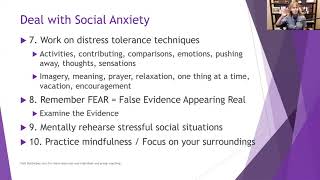
Welcome to Happiness Isn't Brain Surgery with Doc Snipes. This podcast was created to provide you the information and tools Doc Snipes gives her clients so that you too can start living happier. Our website, Docsnipes.com has even more resources, videos and handouts, and even interactive sessions with Doc Snipes to help you apply what you learn. Go to Docsnipes.com to learn more. Hey there everybody, and welcome to Happiness Isn't Brain Surgery with Doc Snipes. Practical tools to improve your mood and quality of life. Tonight we're talking about 10 ways to deal with social anxiety. A lot of people have social anxiety and that's basically how having unreasonable fears that you know are kind of excessive when it comes to being in any kind of social situation. Some people have only social anxiety when they've got to do things like perform or public speaking or something like that. Other people have social anxiety when they have to go to work, when they have to be in crowds. They don't like going to the shopping center or the mall where there's a lot of people around. So depending on your level of social anxiety, some of these things may be helpful to help you work through and deal with your social anxiety. The first is to minimize stimulants. Stimulants rev you up. Anxiety revs you up. When you take stimulants, if you drink too much coffee, you may feel anxious. So if you're drinking stimulants before you go into an anxiety provoking situation, you may misattribute your anxiety to the social situation when in actuality it was the caffeine or the nicotine. The other thing that you want to do is pay attention when you're at some of these events that you're minimizing your stimulants. The other thing, and I'll you know, this is not a stimulant. Alcohol is technically a depressant. But when alcohol starts to wear off about 30 minutes after you drink your drink, it starts to wear off and there's an anxiety rebound with alcohol. So if you have high anxiety, if you have social anxiety, drinking to quell that anxiety is probably not your best bet because in the end it's going to kind of backfire and bite you in the ass. Know your temperament. Not everybody likes being around big groups of people. I personally draw energy from being around people, so I love being around groups. But my daughter, on the other hand, is much more of an introvert and she would prefer to be around two or three people at a Time she gets really exhausted when she has to be in big groups of people. It doesn't mean she's got social anxiety. So know what your preference is for being around people. So when you're developing your self confidence, when you're developing your skills, when you're working through this social anxiety, you're not putting yourself in situations that would stress you out anyway. So know your temperament. If you're an introvert, when you're making your exposure hierarchy, which we're going to talk about in a minute, you're going to start with something like going out for coffee with a friend to Starbucks, or maybe even having a friend over for coffee in your house, depending on how bad your social anxiety is, and then you're going to work up from there. But if you are an introvert, you're never going to be totally relaxed and in a group of a large group of people. So just understanding the difference between being anxious and like feeling like you're going to crawl out of your skin and being uncomfortable or having it be very draining to be in a large group of people, understanding your temperament, that's part of it. So you can say, you know, this is normal. I am not the type of person who likes to be in a large group of people. So it's going to take some preparation and it's going to take a lot of energy, but I can do it. Know your triggers. Different things trigger anxiety for different people. Some people have anxiety when they feel like they're going to be evaluated. So if they're doing a presentation for their colleagues or their peers, they're more likely to be anxious than if they're say, hanging out with five other parents at a kid's play date or something. Some people have one of their triggers is authority figures. I know whenever I had to present in front of the CEO or in front of my department chair or whomever that gave me more anxiety than presenting even in front of a class of 150 students. So it's kind of all about what your particular triggers are. If the other trigger you might want to consider is the situation. You know, if you feel like you are on stage, if you feel like you are the center and everybody's looking at you, that's probably going to be a lot more anxiety provoking than if you are mixing and mingling with other people at a party. So know what triggers your anxiety. So thinking about how your social anxiety impacts your life, what kinds of things can you not do or what kinds of things things do you find are just terrifying? To do. Keep a list of all of those things, starting with the things that only make you a little bit nervous, to things that you would rather, you know, pull your eyebrows out than do. And start at the beginning. Start with the things that only cause you a little bit of anxiety. Imagine doing them. Rehearse doing them in your mind. See yourself going through them successfully, for example, a job interview or a first date. Imagine what it's going to be like, what the other person's gonna say, how you're gonna respond, and how it's all going to go well. Just keep imagining that until you can imagine it or think about it and you don't feel stressed. Then when you go in to do it, it's going to be a lot easier. Once you get past that first thing, move on to the next thing that causes a little bit more anxiety. All right, Start at the beginning again. Imagine doing it. See yourself going all the way through. Maybe it's doing a public speech. See yourself getting dressed for it, getting ready for it, walking out on stage and delivering the speech. And see it go, well, you're not going to see yourself tripping and falling. You're not going to see yourself stuttering and stammering or dropping all your note cards or anything. Those are the things, the catastrophic thoughts that you have that are likely not going to happen. I want you to imagine it going perfectly. Rehearse it in your mind until you can do it literally with your eyes closed. Then when you go out to do it, it's going to be that much easier because you've already done it 20 times in your own head and been successful at it. So just do it like you practiced. Keep a rational outlook. A lot of times, social anxiety is caused by catastrophic self statements, things that you tell yourself, people are judging me, they're laughing at me. People are going to think I'm an idiot, whatever your thoughts are. So keep a list of what those thoughts are and write counter thoughts to them. People are judging me. Well, they may be, but do you care? So if people are judging me, that's on them. If people are laughing at me, well, at least they're laughing. But in reality, what other reasons could the people have had to be laughing? What are three other explanations for why they might be laughing besides laughing at you? So look at your catastrophic self statements, statements like I told you before, imagining that you're going to go out on stage and you're going to walk out there, you're going to trip over your own two feet and you're going to wipe out on the way to do this presentation and humiliate yourself, well, that's pretty darn catastrophic. So think about exactly what is going to happen, what are you going to do and how rational, how realistic, how likely is it that all these things are going to happen. And you know, if that is one of your fears, watch the movie Miss Congeniality. Because she is going at as Miss America, I think is who she's trying to portray. And she falls flat on her face and she just picks herself right back up and walks on. And nobody thinks anything of it after that. It's not like a week later or 20 minutes later in the movie. People are still talking about her falling down. She did, she got over it and, you know, moved past it. When you make a big deal out of it is when people start to think about it a little bit more. Practice breathing. When we get stressed, we tend to breathe more shallowly and more rapidly. When you breathe slowly and deeply, you're triggering the relaxation response in your body. It doesn't mean you have to take those big giant deep breaths like you do at the doctor's office or anything that's overly demonstrative. But focus on your breathing. If you start feeling yourself getting anxious, breathe in for a count of three, hold for a count of three, and breathe out for a count of three. And you know, again, it doesn't have to be noticeable that you're doing it. You can do it in a meeting and nobody will even know. But if you can slow your breathing, you'll slow your heart rate and you'll trigger the relaxation response to help you deal with your anxiety. Sometimes we've just got to suck it up and go through things that create a lot of anxiety for us. I remember one place I worked, once a month, we would have to get up in front of all of our colleagues and all of the executives and give a report on how our department was doing. I hated doing that. I hated being up there giving this report. Not because of the content of the report. I just hated being up there in front of everybody. And it was really no big deal. But it would cause me a little bit of anxiety. I had to do it. So distress tolerance techniques were always useful because it was an eight hour meeting. So it might be four hours of me sitting there anticipating going up and having to give my speech. So what would I do during the four hours while I was waiting? I would do activities. I would listen to what other people were saying. I would make notes. I would sometimes go through clinical charts and Sign off on documentation and not pay attention. But, you know, I digress. Contributing. So if you're at a party, you can't really do it in a meeting. But if you're at a party, for example, and you start feeling anxious, get up, maybe help the hostess out or the host out in the kitchen, go around, pick up glasses, pick up trash, throw things away, do something to be helpful, to contribute so you're not feeling like you're having to sit there and be on the spot. Comparisons can help too. You can just kind of blend back into the wall a little bit and compare how you're doing to how other people are doing or how you're doing to how you've done in the past because you're probably doing better now than you did. Then trigger opposite emotions is another way of dealing with the stress. If you're feeling anxious, you, you know, bring out the opposite. Tell a joke, find something funny, Find a video or something that makes you laugh and share it with other people because that'll make you start laughing and feel more relaxed and release endorphins. You can also just push away some of those thoughts that keep coming into your head. I'm going to make a mistake. I'm going to say something stupid. They're judging me. It's going to be awful. Just push those thoughts away and go, you know what? No, I can do this and I'm going to push through. The final thing you can do in this particular set of distress tolerance techniques is sensations. Focus on sensations. Some people will have a rubber band that they snap on their wrists to kind of help them focus on something else. Some people wring their hands. I don't recommend that because you know, that just kind of shows you're anxious and keeps your anxiety going. Listening to loud music, you can go into the bathroom and splash cold water on your face. Unless it'll make your mascara run. There are a variety of things you can do. You can also find. Go and find some coffee because coffee is hot and that focus on how the coffee feels in your hands when you're holding the cup. Focus on the taste of the coffee. That hot sensation will kind of distract you from other things that are going on. So focus and we're going to talk about one thing at a time in a minute. Another set of distress tolerance techniques that can help are imagery. And we've talked about rehearsing it before you go to the party. Imagine what you're going to do before you go to the mixer or to your in laws or wherever it Is you're going, that's potentially going to cause you anxiety. Imagine going through it and doing it successfully. Find meaning in. In what you're doing. So sometimes, you know, maybe you're going to your spouse's holiday Christmas party and it's like the last thing you want to do because you don't like big crowds like that. You don't know anybody, but find meaning in it. Why are you doing this? Because it's helpful to your spouse. You're providing support and, you know, maybe you can find somebody that has similar hobbies or something before you go. If you're going to your spouse's Christmas party, for example, try to find out who might be at the party that shares similar hobbies and stuff. I know my husband works with people who do organic gardening and who are kind of health conscious. I won't say fanatical, but health conscious like I am. And we like to use a lot of lentils and beans and cook in healthy ways. So identifying those people, I can't talk about what they do at work because that's just way out of my wheelhouse and over my head. But I can talk with them about these other things. So I'm not just standing there looking around, feeling like I'm out of place. So find meaning in what you're doing and try to find connections and commonalities with other people before you go. And then, you know, I can have. Would have my spouse introduce me to one of the people that does organic gardening, for example, and then we could start talking. Once you get more comfortable, then you're going to feel more at ease walking up to people and going, hey, you know, and striking up a conversation and finding out commonalities. If you've got children, a lot of other people have children, so you can talk about your kids. Or if you've got pets, you can talk about your pets, your dogs. People love their dogs. Prayer. Prayer can help. Sometimes you just got to take a breath and say a prayer before you walk into that situation to kind of get you through and get you going. Practice relaxation. If you're feeling really stressed, just again, you don't have to get out of your chair. You don't have to go anywhere. But practice tensing and releasing your muscles. Clench your fists and release your hands and feel the difference between tense and released, and then tense kind of your whole upper body. And you don't have to do it like this because that's obvious, but you can kind of tense up a little bit and relax and feel the difference between Stressed and relaxed. And then when you do it one more time, you tense. And when you relax, you feel all the stress just draining out of your body, out of your fingertips. So that's kind of a guided relaxation to help you when you're kind of on the spot. One thing at a time. When you're in a social situation, there is a lot of input. There is a lot of stimulus going around. A lot of people focus on one thing at a time. If you start getting overwhelmed, if you're at a party, maybe you can go over and get something to eat. Focus on talking to one person at a time, or focus on what you're eating or, you know, find something that you can focus on so you're not trying to keep up with everything that's going on. Take a mental vacation or a physical vacation. Sometimes you just got to excuse yourself and go to the bathroom and hide out for five minutes, and that's okay. You know, sometimes you need to go somewhere where, you know nobody's watching, and you can take those good, deep breaths and go, you know, I got this. It's going to be okay. I'm doing fine. Give yourself a pep talk. Look realistically over how the night's gone and the majority of it. Has it gone okay? Yeah, there are probably going to be some hiccups and faux pas here and there, and if there are, that's okay. It happens to everybody. Nobody is perfect at their social interactions all the time, and that's okay. But look over it realistically to realize that tonight is going okay. It may not be going the way you had hoped it would, but it's going okay. There's nothing catastrophically wrong. And remember that we are a lot more important in our own minds than we are in anybody else's mind. So when we make a mistake, we will remember it for six months, but other people probably forget it about 60 minutes later. It's just, you know, even if it's something like you walked out of the bathroom and you had your dress tucked in the back of your panties. Done that before. Trust me. Not something I want to repeat. But I would bet if I ask any of my staff now, yes, I did it at work, about that incident, they'd look at me and go, no, I don't remember that. I remember it because it was mortifying, but nobody else really cared. They were past it by the next day. Nobody really thought anything about it. So remember that a lot of stuff that seems huge and glaring to you is only because it happened to you and other people. Are so involved in their own life, they probably didn't notice or won't remember. Remember that fear is an acronym standing for false evidence appearing real. So always examine the evidence. If something happens and you think it is the absolute worst thing in the world and you're just gonna die, how likely is it that that's true? Is it the worst thing in the world? Are people judging you? So look at the evidence. How do you know this is going on for certain? And what are other explanations for what might be going on? Mentally rehearse those stressful social situations. Get ready for it. The job interview, the first date. And for some people, even going to the doctor can be a stressful social situation because they get kind of a white coat syndrome where they don't. They're afraid to speak up to their doctor. I found that if there is a certain set of things that you need to say, like if you're going in to talk to your boss or you're going in to talk to your doctor, sometimes it's helpful to write down a list of the points that you want to cover with them or the symptoms that you're having so you can go over it and make sure you get everything said and you don't end up kind of getting shut down. When I used to go have supervision with my boss, you know, I only got supervision for one hour once a week, and that was if I was lucky. So. So I would go in with a whole laundry list of things, and it could be the stuff that I was upset about or having difficulty with, and I could have a laundry list and just go through it and mark it off. So I would make sure that I got everything said and I covered, and we were on the same page by the end of the meeting. Finally, practice mindfulness and focus on your surroundings. Know how you feel. If you start feeling anxious, step back and ask yourself, why am I anxious? What do I need right now in order to feel calmer? Try to do this periodically so you don't wait until your anxiety is, like, off, off the charts. Focus on your surroundings. Look around. Find places and little niches that you might feel comfortable. Maybe there's somebody else sitting over in the corner. You can go sit down with them and chat. Maybe there's an empty seat somewhere that you can just go sit down and take a breath or go out on. If it's a patio or a party, maybe you can go out on the patio for a few minutes. Oftentimes there's somebody sitting out on the patio trying to get a Little peace and quiet themselves so you can find a situation that's less anxiety provoking. Two little bonus things I'm going to tell you with social anxiety, a lot of times people are afraid that they're going to offend someone. And these days it is so easy to offend people. So what I tell my clients and my kids and what I try to remember myself is before I speak or when I'm talking to people, if what I'm saying is true, helpful, important, necessary and kind, then you know, there's probably a good chance I won't offend them. Look on your social media, look at the comments people leave on other people's posts and stuff and see if they meet these criteria. True, helpful, important, necessary and kind. 90% of the time the answer is no. Well, I won't say that much. About 50% of the time the answer is no. There's a lot of times people will just say nasty stuff that really didn't need to be said, and that can be offensive. But if you practice and really focus on making sure what you say is true, helpful, important, necessary and kind, and if you're following me, that spells out think, then the chances that you're going to offend somebody greatly reduced. If the person still gets offended, it's probably more about them because you weren't trying to offend them, you weren't trying to be hurtful, you were trying to be helpful and kind. Therefore, it may be more about their stuff. Whether they have an issue with you or they have an issue with something else that's going on and you just happen to be kind of in the way, it's more about them. You can't control how they react to things. It's their responsibility. If you're being nice and they take it the wrong way and they get offended, that's their perception and they need to work on that. The other bonus that I'll tell you to take away is something I got from Dr. Seuss and I love it, something he says about judgment. Those who mind don't matter and those who matter don't mind. So the people that matter in your life, there are going to be people judging you all the time. That's just the way humans are. But those who mind what you do, those who get offended, those who judge you all the time, they don't matter. The people who matter to you don't mind if you make a mistake, don't mind if you're not perfect. They actually probably embrace all of your imperfections. So before you approach a social situation. Remember, not everybody's going to like you. That's just it's not possible to have everybody like you. So remember the wise words of Dr. Seuss, those who mind don't matter and those who matter don't mind. If you like this podcast, subscribe on your favorite podcast, your favorite podcast app. Join our facebook group@docsnipes.com Facebook or join our community and access additional resources@docsnipes.com. Thanks for tuning in to Happiness Isn't Brain Surgery with Doc Snipes, our mission is to make practical tools for living the happiest life affordable and accessible to everyone. We record the podcast during a Facebook Live broadcast each week. Join us free@docsnipes.com Facebook or subscribe to the podcast on your favorite podcast player. And remember, Docsnipes.com has even more resources Members only videos, handouts and workbooks to help you apply what you learn. If you like this podcast and want to support the work we are doing for as little as $3.99 per month, you can become a supporter@docsnipes.com join again. Thank you for joining us and let us know how we can help you.










