Creative Ways to Enhance Treatment with Patient Placement Criteria
A webinar-style presentation by Dr. Dawn‑Elise Snipes explaining how patient placement criteria (ASAM, LOCUS) and the Functional Assessment Rating Scale (FARS) guide level-of-care decisions and treatment planning. Covers differences between patient placement instruments and insurer level-of-care guidelines, scoring dimensions (six ASAM dimensions), practical uses (authorizations, treatment planning, relapse prevention), and clinician workflow tips (motivate, manage medication, meetings, monitor).
Chapters
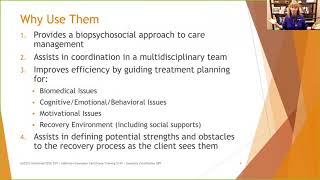
This episode was pre recorded as part of a live continuing education webinar on demand. CEUs are still available for this presentation through all CEUs. Register@Allce.com Counselortoolbox you. I'd like to welcome everybody to Today's presentation on 10 Ways to Use patient placement criteria. You'll notice over the next few presentations, I'm trying something a little bit different, partly to rein myself in and partly to give you something that you can sort of count down on and focus on what you're getting out of the presentation. So. So we're doing things that are more list oriented, if you will, so that'll give you a little bit more to go on. Okay. Today we're going to differentiate between level of care guidelines and patient placement criteria. Learn about the Functional Assessment Rating Scale, which is required in some states. I happen to love it myself, but some people, you know, you either love it or you hate it. I think, I don't think there's any middle ground. We'll learn about the asam, which is required by most insurers and actually required by people who receive. By organizations who receive state funding in 66% of the states. We'll learn about the locus, which is often an alternate to the ASAM, and discuss why these tools are used and how they can benefit the clinician and the client. It's not just another piece of paperwork. If you use it right, it actually can make your life a whole lot easier. And that's one of the things that I used to have my interns and beginning counselors especially focus on was how is it that this new piece of paper work that we've got to do can be useful in helping us in our, in our treatment. And that's kind of what we're going to talk about. So we'll start here. Patient placement criteria suggests a treatment intensity level that meets the needs of the client. And the ASAM and the LOCUS are both patient placement instruments. The LOCUS is a little bit more in depth and kind of drawn out, takes a little longer to do. The ASAM is, you know, fast and dirty, if you will. The ASAM criteria is required in 66 states that receive state funding. That's not important for the test. I just want you to realize how prominent the ASAM is and you can use it with mental health issues, mental health diagnoses. So for example, here. And you don't need to be able to read all the text on it. We're going to talk about this in depth, but it does show you like for readiness to change a person who is willing and engaged in treatment for substance abuse and willingly engaged in treatment as a proactive, responsible participant willing to change mental functioning and behavior. That's how it applies to mental health. So they have modified these to fit a co occurring facility, but you can also use it just on the mental health dimension. But each one is going to have its own issues and I'm getting ahead of myself with that. But the ASAM is really cool because then you go all the way down here. You notice that everything scored either a 0, 1, 2, 3 or 4. And these are the six dimensions you score people on. And then you look at what people scored at for each dimension and you can basically add up and score out where they should be placed in an ideal situation. Now not all patients are going to go, yeah, you know, that's the recommendation, let's go for it sometimes. And very many times if it scores out for residential, patients will say, you know, I can't do that right now. I've got kids, I've got a job, I've got this, I've got that. So then we're looking at intensive outpatient or maybe partial hospitalization. Level of care guidelines are defined by insurance providers and in some states like Florida, state law. So these guidelines tell you exactly what you're supposed to do at a certain level of care. So patient placement criteria says what level of care to put people at. Level of care guidelines say what are you going to do when the person gets there? What is it that intensive outpatient services are supposed to provide? And we are going to take a look at that really quick because until I started working in private companies, I had never seen a level of care guidelines. So I had no idea. But basically every insurance company, every insurer has these and you can Google like CIGNA level of care guideline, residential treatment or just level of care guidelines. And you will come up with the documents for each insurance company. The key to this and the reason it's important, especially for private companies that take insurance, is because if you don't meet these guidelines, then the insurance company can audit your records, say you didn't meet the level of care guidelines for intensive outpatient. So we want to pay back and they can disallow the entire episode of treatment or they can reimburse you if they choose to be generous at a lower level of treatment, such as for outpatient, which would only qualify, for example, one hour a week. Okay, so what are we looking at? The first part, the description basically is a rehash of the Patient placement criteria. This is the kind of person or the person that has the kind of symptoms that would be in this kind of treatment. So you want to look over those, because that's what you're going to get your authorization based on. But what is required, and we're not going to go through this in depth, but I'm going to hit the highlights. It tells you within 72 hours prior to admission, there has to be a face to face individual assessment. So you can't have an assessment in Monday of one week and admission Monday the next week. That doesn't meet guideline criteria. It has to include clinically based recommendations. The admissions process should include a documented current diagnosis evaluation by a licensed behavioral health clinician with training and experience consistent with the age and problems of the individual within 48 hours of admission. So if somebody is brought into your program and they've been screened by somebody who is not a licensed behavioral healthcare provider, then to prevent paybacks, it's important that you get somebody who's licensed to review it. So that's one thing that you just kind of want to be aware of. The individuals at this level of care are in structured treatment three to four hours a day, three to five days a week. So this is where it's starting to say how often. You know, it can't be two hours a day, five days a week to make your nine hours. It has to be three to four hours a day, three to five days a week. So that's important for the structure of the program as well as helping patients understand what they're committing to or what they're going to be able to get out of treatment. It says an individualized treatment plan must be completed within 24 hours of admission. This isn't a general one. This, this isn't the. You're going to come in and go to a group this many times. This is an individualized plan within 24 hours of admission. So if they get admitted on a Friday morning, you're going to have to be bust and hump. In order to meet this criteria. Family involvement is required. And discharge planning will start at the time of admission. And there has to be evidence of that in the clinical record. So you have to show that you started with discharge planning at the time of admission, just in case the person doesn't come back, but also to make sure that you have all your proverbial ducks in a row when the person does discharge. So CIGNA calls this medical necessity criteria. But it's also, you can find it, like I said, by Googling level of care guidelines. So when you're doing your patient patient placement criteria, if you've reviewed the level of care guidelines, you know what kind of services are available at each level of care. And if you're thinking to yourself, you know, this person really needs more than three hours, three days a week, then you're going to be looking probably for partial hospitalization or residential treatment. So you know what's offered at that level of care. So why do we use them? We're going to get this part out of the way at the beginning. It provides a biopsychosocial approach to care and management. If we go back to, well, we'll get to it in a second. It assists in the coordination of a multidisciplinary team. The doctor, even if it's not a person in your facility, if they know what an ASAM 2.1 level is, which is intensive outpatient, then they are going to know what kind of services that client is getting and what kind of services that client has access to. So it sort of like diagnosis in the dsm, it facilitates sort of a shorthand between clinicians and it also helps the doctor know or the rest of the team know what sort of issues and what level of readiness for change and ability for change and all that kind of stuff the person was presenting with when they came for admission. Now, there is some variability, but if somebody is admitting to a program that's intensive outpatient versus once a week outpatient, we know that their problems are probably more severe and require a lot more structure in order to see any sort of appreciable returns. Patient placement criteria improve efficiency by guiding treatment planning for biomedical issues, cognitive, emotional and behavioral issues, motivational issues, and recovery environment, including social supports. A lot of times, and we talked about this with the framing bias a little bit a few classes ago, we tend to not look at the bigger picture. And you know, if you've been in enough of my webinars, you probably can't avoid looking at the bigger picture now. But a lot of times when we're trained in, I know when I was trained in graduate school, we, we really didn't assess for a lot of biomedical issues or look at differential diagnosis that way. We were differentially diagnosing between mood disorders and personality disorders. But some of the other stuff, the general medical conditions, those kind of went by the wayside, and that's not good and it's unfortunate. The patient placement criteria really forces us to look at that and figure out what referrals need to be made if we say, this person has biomedical issues that are hindering their ability to reach maximal gains in treatment, then it's going to be incumbent upon us to have something in the treatment plan as far as a referral or something to address those issues. So if you identify it in the patient placement criteria, when you're doing your assessment, then it needs to be addressed as a problem. Then it needs to be addressed in the treatment plan. So where are we going? We can use this, a template to identify our main problems or goals or whatever you want to call it for our treatment plan. So that's really awesome. And as an auditor, when I go through charts, if I see things identified in the patient placement criteria that supported their admission to whatever level of care, and I don't see those issues addressed in the treatment plan, I kind of freak the freak out. So just being aware that this can improve efficiency, you don't have to think, well, what kind of issues do we need to address? It's all right there. For new clinicians, it helps get them started by saying, this is where we start. These are the issues we're looking at. It also assists in defining potential strengths and obstacles to the recovery process as the client sees them. For example, when we're talking about the recovery environment, we might talk about the environment that the person lives in. We might talk about where they work, if they have a job, what their financial situation is, and start identifying, do they have good social supports, do they not? What's going to benefit them in the recovery process? Because one of the big factors in a lot of cases, when we're deciding whether to refer maybe to intensive outpatient, partial hospitalization, or clubhouse type things, if we're talking like mental health settings or residential, is what does their recovery environment look like when they're not in treatment, when they're not actively engaged with us, Are they in a safe, supportive environment? And if not, again, that becomes a treatment issue because we want to make sure that when they discharge, since discharge planning begins at admission, that we start addressing that. We start figuring out how can we help you create a safer, more supportive environment in which you live and work? And this also, it starts getting the client involved. So they start seeing the connections between, oh, yeah, well, I'm living in a. In a house right now where there's a lot of chaos and domestic violence, and I don't have a job right now, and I'm stressed out about how I'm gonna, you know, pay the bills and feed my kids. And, oh, yeah, I can see that. How that might be contributing to a lot of other stuff that's going on. So we start helping them categorize some of the stressors and see how everything might be feeding in, if you will. It assists in providing specific measurable issues such as looking at the recovery environment, identifying financial stressors, well, that's something that's more specific, measurable. We want to look at how can you make your basic bills and it can be used in the development of the treatment plan to create achievable, realistic time limited goals. So we're identifying things right now because the client comes in and a lot of times they're like, I just don't even know where to begin. We're helping them narrow it down. We've got six domains that we're going to be looking at. We're going to narrow it down, we're going to identify some things and we're going to start making actionable plans for the person to start working on. And for a lot of clients, as soon as they start seeing things start to come together, as soon as they start seeing a plan, they start getting more hope. And hope translates to motivation and motivation translates to improvement. Level of care guidelines can help us explain why we're making recommendations for XYZ level of care. If somebody comes in for an assessment and we identify that they need to be in intensive outpatient versus once a week, we can show them, you know, sort of objectively, subjectively, objectively, with a semi standardized measure, exactly why we're making the recommendations, why we think once a week for one hour a week is not going to cut it for them. And with clients, I always tell them, you know, you're the expert on you and I can make recommendations until doomsday. But ultimately you know what's going to work for you and you know what you need. If you are not ready or able or you don't agree with that recommendation, then by all means we'll start out wherever you're willing to start and prove me wrong. You know, with many clients with when I made a recommendation for residential and they were like, no, can't do that. Okay, you know, I'm not going to fight with you on this because I see that there are reasons you don't feel you can commit to residential. So how can we make intensive outpatient work for you? Level of care guidelines help demonstrate the interactive nature of medical, environmental, cognitive, emotional and motivational issues. I will show them the asam, which is what I use. We didn't use the locust where I was from and I will show them the six dimensions and we'll talk about why do we assess each one of them, why it's important for us to make sure that they make progress, or they've got a supportive situation in each one of those dimensions. I don't want it to be a mystery. I want them to see how the pieces all fit together. Because maybe they're not ready to start working on their social support and relationship issues yet. That's just too much. They've got cognitive issues, they're depressed, whatever, but they can start seeing how they. Any changes that they make might affect other changes. It can help demonstrate the interactive nature of the issues. It's a standardized method for demonstrating a need for continued services or discharge. So you can also say, well, now that you don't meet these criteria, we can step you down. Or if somebody needs more services, then when we call up the client coordinator at the insurance company, we can get an authorization by saying, you know, the client meets these criteria. And this is why we need more sessions for intensive outpatient, or maybe they're in outpatient and they need to be seen twice a week for a little while because something came up. It helps us justify our decisions and document it. Speaking of documentation, it provides documentation and defense that reasonable recommendations were made. Because if you ever get slapped with a liability lawsuit, one of the things you've got to prove is that you did what any other reasonable professional would have done. So bada bing right there. And it improves motivation by identifying those benchmarks for step down, which I kind of already hit on, but they can see that, alright, in order to step down to once a week, outpatient, you know, individual counseling, whatever, so I'm not having to come here nine hours to 15 hours a week. I need to be able to demonstrate these different characteristics. So it gives the client something to look at. It's not saying you're going to be cured or your life is going to be wonderful. It's saying that you have to be stabilized in these six dimensions. But it gives them something a little bit more tangible to work towards. So we're going to start out with the Functional Assessment Rating Scale. It's not a patient placement guideline per se, but it helps more clearly define anchors for behavioral observations. I do the FARs first because when I get down to the ASAM, when I'm looking at cognitive and behavioral issues that may impede recovery, the FARS has already identified what those are. And the nice thing is you can we do FARs at assessment and every reassessment and Clients can see incremental progress because it is a pretty incremental instrument. So we're just going to go through it really fast. If you're interested in using the fars, it's through the University of South Florida. You can get certified as a FARS administrator. It's an online course, it's free to your agency anyway. So for example, you have a nine point Likert scale and you look at depression, but it gives you things that you want to look at. Is the person, do they have depressed mood? Are they anhedonic, sad, Are they having feelings of worthlessness, hopelessness, Are they happy? So these are different descriptors that we're looking at. And then we're going to assign a value for how much of a problem is depression right now, how extreme is the problem? So we have these differentiating things for depression, anxiety, hyper affect. So looking at mania, hypomania, thought processes, kind of leaning towards that. Are we looking towards psychotic disorders or psychotic features, cognitive performance, so neurocognitive issues, as well as potential psychotic issues, medical and physical. So we're hitting that medical domain again. Do they have something else going on that may cause a problem with their recovery and may hinder their recovery, or it may be contributing to their presenting problems like depression or anxiety, traumatic stress, substance abuse, interpersonal relationships, family relationships, family environment, sociolegal work and school, and activities of daily living functioning. So the FARS really gives you a pretty good biopsychosocial snapshot of what's going on and helps you rank sort of in order of severity when you look at the whole sheet, which problems you need to work on first, and it identifies sub goals. So for example, with depression, if the person had depressed mood, had feelings of worthlessness, hopelessness and sleep problems, then we can look at that and we can say, all right, for addressing the depression. To look at your depressed mood, that's a sub goal. To address your feelings of worthlessness, that's a sub goal. We're going to look at what's causing those. How can we address it? Hopelessness, that's another sub goal. So it's creating sort of spelling out the treatment plan for us so we don't have to do a whole lot of creative writing on the back end. So the FARS is a really good place to start because it gets you talking, it gives you prompts. You know, those little prompts that I just showed for you to start talking with clients about is this going on? Is this contributing to it in our minds? Because you know, that's Kind of how we were trained. We're going to start thinking about the integrative summary or thinking about how do all these things weave together to create the overall presenting issue. But that's not something the client needs to really fuss with right now. They're just trying to make some forward progress. So the ASAM measures physical dimensions that looks at acute intoxication or withdrawal potential. So obviously, if the person is using substances or abusing substances, remember, you don't have to necessarily meet the criteria for substance use disorder to have some withdrawal potential. And biomedical conditions, hypothyroid, diabetes, lupus, fibromyalgia, any of those medical conditions that we talk about so frequently that could contribute to the presenting issue, depression, anxiety, whatever it is, or complicate the recovery picture, we want to address those. So we have a treatment plan to help make sure that that doesn't interfere with our treatment progress. So we may need to bring in a medical professional to consult on this. Emotional and cognitive. We're going to look at emotional and behavioral conditions. This is when we do our general diagnosis, this is what we're skilled at. And we're going to look at what different things are presenting. Do they have a personality disorder and a mood disorder concurrently? Do they have a mood disorder and PTSD and a personality disorder? What's going on and how are those things kind of working together? Treatment acceptance and resistance. Is the person even ready for change? And if they're not ready for change, but they are a danger to themselves or potentially harmful to themselves, then they may need to be recommended for a higher level of treatment. If they're not ready for change and they're not involuntary, you're probably fighting a losing battle here. But that's a whole different story. Behaviorally, what is their potential for relapse or continued use? What behaviors are they doing? Think about. In dbt, we talk about vulnerabilities that are potentially going to cause relapse. Are they impulsive? Are they able to control their impulses and activities? Are they taking good physical care of themselves? And that kind of goes with physical. Are they eating well? All that kind of stuff. And physical and behavioral and even cognitive kind of overlap because we know they influence each other. And then social and environmental. What is their support system like? What is their environment like? Is it supportive or is it contributing to their presenting issues? And if it's contributing to their presenting issues, how do we address it? If it's supportive, how do we bring that support in to make sure that we can, you know, benefit from it? If you will. So in asam, we talk about early intervention and relapse prevention. This is group therapy or group psycho education. Once a week, maybe outpatient is less than nine hours per week. So you're really looking at, you know, maybe individual counseling, even maybe some group counseling at level one, but less than nine hours. Level two is your IOP, that is nine to 20 hours a week. Level 2.5 is your partial hospitalization. This is 20 plus hours a week. A lot of people with severe and persistent mental illness and substance use disorders may qualify for partial hospitalization and residential, Obviously, they're living there and medically managed, intensive inpatient. This is in a hospital where there's a doctor available 24 7. So let's take a look at the ASAM really quick. Go back to where that bad boy is. Here we go. So again, don't worry about reading all of the levels. I'm just going to kind of point here. Level one is Dimension one is acute intoxication and withdrawal potential. So if they're fully functioning, that gives it gets them a zero, a big old goose egg. And we want lower scores on this. Level one is mild to moderate intoxication. Interferes with daily functioning but does not pose a danger to self or others. Minimal risk of severe withdrawal. Minimal risk of interference by any current medical conditions. Their medical conditions are stable and they, you know, aren't at risk for any sort of substance withdrawal. Level 2, intoxication may be severe but responds to support. They're not posing a danger to themselves or others. There's only a moderate risk of severe withdrawal. And again, with biomedical issues, they're relatively stable and there's only a moderate risk that they're going to have to be transported and seen like in a hospital. Level three, severe intoxication. Imminent danger to self or others. Risk of severe but manageable withdrawal or withdrawal is worsening. So we're talking about substances obviously here. Level three, again, we're looking at people who may also have some biomedical conditions that need to be monitored by medical personnel. At level three, hiv, hepatitis, some of those things we used to have concurrently in our clients that were in residential. And then level four, the person is incapacitated. Severe signs and symptoms and being not in a hospital setting poses an imminent threat to life. So at this point, they're needing to be in the hospital. Biomedical conditions and complications. We're looking at level one, which is your outpatient. Less than nine hours a week. The person has the ability to cope with physical discomfort. Mild to moderate symptoms, such as pain and it doesn't interfere with daily functioning terribly. Level two, which is your intensive outpatient, nine to 20 hours a week. They have some difficulty tolerating physical problems. Acute, non life threatening medical symptoms are present and serious biomedical problems are being neglected if they're not kind of being monitored and prodded. And in this more structured environment where we're making sure they're going to their doctor's appointments and taking their meds. Level three, serious medical problems are neglected during outpatient treatment. So they're just still not keeping up with their medical treatment plan and poor ability to cope with physical problems. So people who are struggling with, you know, really bad pain or, you know, whatever the case may be hiv. This is another one that we often see in residential because people are, because of their grief over the diagnosis, their frustration, their fear, the side effects of the medication, you know, a whole host of reasons. I've seen a lot of people be non compliant with their HIV treatment regimen. So there you go. And then again, level four, the person is incapacitated, they need to be in the hospital. So now Dimension 3, good impulse control and coping skills. The person does not really have interference from a cognitive, emotional or behavioral standpoint in their recovery process. Now, if you're seeing them for mental health issues, obviously they're not going to score a zero on this. They're going to be at least a one. And sometimes we see people in outpatient who have a emotional, behavioral or cognitive condition that requires intervention, but it doesn't significantly interfere with treatment of substance use or their medical issues. In level two, which is again, intensive outpatient, persistent emotional, behavioral or cognitive conditions that distract from recovery efforts. So they're really having difficulty maintaining their focus and following through with their treatment plan without being, without the structure. And you know, think about again, if the person can get up and go through a 24 hour period or a 48 hour period without having to be prodded, without having to be prompted to do something, reminded to use their coping skills, to do homework, whatever, then they're probably going to do better at outpatient. But if they can't make it through a 24, 48, 72 hour period, then we're wanting to start looking at something more intensive, such as intensive outpatient, at least for a little while, until the person's stabilized a little bit more. Readiness for change is the next dimension. Obviously at zero, they're willing and engaged in treatment both from a mental health and a substance abuse standpoint. And remember, we're talking about not only substance dependence, but we're also talking about substance misuse that can negatively impact things. If they're taking antidepressants, SSRIs and drinking, even if they're not abusing substances, it's contraindicated to drink, to use alcohol and take SSRIs. So this is something that we're going to look at. But if they're ready for change, then they kind of score a zero. They're probably going to do really well at a early intervention level of care, once a week, group psychotherapy, support group type stuff. If they have a little bit more problem, they're willing to enter treatment, but they're ambivalent about the need for change. Or they're willing to explore strategies for changing mental functioning, but they're ambivalent about exactly how bad it is. We may start looking at level one and you see both of these when you read for mental health and substance use, they really read the same because we're really talking about what is the person ready to change? Are they ready and motivated to work on their issues? Level two, the person is reluctant to agree to treatment and so they're reluctant to comply with a treatment plan. And this is what I was talking about earlier. If they're not court mandated, then the lower their motivation, the lower their readiness for change. Putting them in a higher level of care is probably not going to be really effective. But for the purposes of this instrument, theoretically if they have a low level of motivation and we can get them in a structured program, get them on the right path, kind of a jump start program, maybe they'll see benefits and get some motivation. Level five is the relapse, continued use or continued problem potential. So we'll just stay with mental health because I think a lot of you are mental health counselors. Level zero. No potential for further mental health problems or low potential and good coping skills. So score maximal level of gains. This person can be all but discharged, maybe see them in aftercare for a little while. Outpatient treatment, minimally relapse potential with some vulnerability and fair self management and relapse prevention skills. So you know, once a week is probably good. They need to come in for a tune up, talk about what they did that week, what struggles they had, how they addressed them. You know our typical once a week client, but the other six days a week they can function pretty well. They are not going to decompensate In a six day period intensive outpatient, the person still has impaired recognition and understanding of mental illness relapse issues but is able to self manage. So they're still not seeing what triggers their mental health problems, what triggers their depression, their anxiety, their anger, whatever it is, or when they are triggered, they have difficulty remembering which coping skills and tools to use to deal with it. So it's not solidified yet. So an intensive outpatient, we're seeing them every day or every couple of days and able to make sure that things don't build up and that we're reinforcing those mental connections between the new behaviors and, you know, how to address problems and all that kind of stuff. And then dimension six is the recovery environment. So, again, level zero. They're pretty much ready for discharge or they're not needing treatment. It's a supportive environment and is able to cope with poor supports, even if they exist. So they're able to manage on their own. Outpatient, they may have passive support to significant others who are not interested in improved mental health, but they're able to cope with what's going on. So the person, the identified patient, if you will, is the only one doing the changing, but the people in the recovery environment are not going to hinder that person's recovery. Intensive outpatient, which is our level two, the environment is not supportive of good mental health, but with clinical structure, they're able to cope most of the time. Now, a lot of my patients were in this sort of situation because they were living in an environment where there were drugs, where there was some conflict, where there was some. A fair amount of different difficulties in multiple dimensions. So while they were in treatment, those three hours, four hours a day, they were safe, if you will. But then when they got out, they had to go deal with that. And I think I've shared with you before about the client that I worked with who had schizophrenia and she was dependent on crack cocaine. And, you know, we got her sober and she was coming to treatment, and she kept relapsing, and we started talking. And basically she looked at me that one day and she said, Ms. Dawn, they come to my apartment and knock on it and sell me cocaine. Like. Like they're the Avon lady. I mean, what am I supposed to do? How do I avoid that when they bring it to me? And I'm like, okay, well, that kind of makes sense. For a lot of our clients, the weekends were really difficult because not only did they have unstructured time, they didn't have treatment, but other people had unstructured time, and there was a lot of drug use and drinking and that kind of stuff. So they were immersed in it on the weekends, which made it More difficult. So those are the things that we're going to kind of consider when we're thinking about recovery environment. And then this is in your classroom, so you can take a look at it. If you're not familiar with the ASAM for scoring, but based on just reading these, you know, common sense will kind of tell you where someone. Where your recommendation would probably be for someone. And most people are not going to score, if you will, straight twos or straight threes and make it super easy. They're going to have a mishmash, which is why the scoring criteria helps. But again, good judgment also helps in figuring out what's the best placement for this person and then talking with them about, okay, this is the best placement, but what can you. And are you willing to do is the next step? Well, we're talking about the locus, and I'm not going to. The locus is in your class as well. You can pull that up. Take a look at it. It's a little bit longer, but the first dimension is the risk of harm. And is it minimal, low, moderate, serious, or extreme? And then it asks about functional status. Do they have minimal impairment, mild, moderate, serious, or severe. And you're obviously giving a 1 to 5 scale. The locus then looks at medical, addictive, and psychiatric comorbidity. So they kind of lump together dimensions one and two from the ASAM here. If there's no comorbidity, okay, minor. So maybe they have a substance abuse issue and then minor, you know, mild depression, nothing with psychotic features or anything, or they have major depressive disorder and some substance misuse, but probably not raising to the level of substance use disorder. So that would be minor comorbidity, looking moderate comorbidity. The second and or additional problems are becoming more severe. For major comorbidity, you've got two almost equally problematic issues and severe comorbidity, you're usually looking at multiple presenting comorbid problems. The locus also asks about the recovery environment. Looking at the level of stress in the environment and the level of support in the environment, which. I like that, you know, conceptualization, the way they put that, because you can have, you know, a moderate level of stress, but if you've got a highly supportive environment, then it kind of cancels it out. But if you've got high stress and no support, then you're kind of in a bad place. The locus does spell things out a little bit more granularly for people. If you're trying to demonstrate to the family and the individual why you're making the Recommendations. Obviously you're not going to do the ASAM and the locus. So, you know, figuring out which one you like using and then figuring out how to use it to explain it to families. The locus looks at treatment and recovery history, which the ACM doesn't specifically do. Was the person in treatment before and fully responsive? If so, they get a one significant response. They get a two, moderate or equivocal a. Zero, three, a poor response if the goals weren't achieved or the gains weren't maintained. So maybe they achieved their goals and they got out and they relapsed six weeks later. Okay, according to the locus, that's probably going to qualify a poor response to treatment. And that doesn't mean the person did anything wrong. What we're looking at is the bigger picture. We don't want them to have to come back for another episode after this. So what happened the last time or what didn't happen the last time, that needs to happen this time to make sure that the person can reach maximal gains or be fully responsive Treatment. And when I talk with clients about prior treatment history and relapses, I always try to frame it in what can we learn from that? Because I don't want them to feel guilty or ashamed or frustrated. I mean, they probably already do. So I want to minimize that and say, okay, what can we learn from that? So you don't relapse again? Or so we minimize the problems. What happened? What changed that precipitated the relapse? And level five is there's a negligible response. So sometimes, and we've all had clients like this that just don't seem to be making progress. So we want to look at that. And again, I ask clients, what was it about treatment that was effective and what wasn't? Some people will identify that they didn't have a good connection with their primary therapist. Some people will identify that other stuff was going on that wasn't being attended to, which is why a biopsychosocial approach is so important, you know. But I want to know what precipitated the negligible response. And more often than not, unfortunately, I often hear that it was more on our parts. Not that the person was not motivated, but either the treatment they received was not a good fit for them, you know, they would benefit more from cognitive, behavioral, and they ended up in a psychodrama situation or something, or they had other needs that weren't being met and the therapist wasn't willing to make referrals and approach it from a recovery Oriented system of care perspective. Engagement is another dimension on the locus. So this is sort of readiness for change, which is measured on the asam Optimal engagement. They are ready and raring to go. They're willing to do whatever needs to be done. They're like, tell me what to do, Doc, and I'm there. Positive engagement. They know there's a problem and they're preparing to make a change. They may not be willing to do everything you recommend yet. There's still some conditions and yes buts coming your way, but they're there and they're trying and they're moderately committed, limited and minimal. The person is in contemplation. They're not quite sure if they're ready or needing to change at this point. And unengaged. The person shows up in your office, they're like, my lawyer said I need to come, or my wife said if I don't get evaluated that she's going to leave me or whatever the case may be. But they don't see where there's a problem. They're not saying I need help with, they're saying I'm forced to be here. And when you go to the locus, each one of these dimensions that I'm talking about is very explicitly explained and they give really good examples so you can figure out where your client would actually fall. But that's beyond the scope of this class. So you go through all of those dimensions. Level one locus placement is up to three hours a week. So this is outpatient. Now remember with the asam, level one was up to nine hours a week. So there's a little bit of a difference here, but up to three hours a week. And when you're working with insurance companies, you know, you probably have experienced this most of the time they're not going to authorize for outpatient treatment more than one, maybe two individual sessions a week or three one hour group sessions. But rarely have I seen them authorize three individual sessions. You know, at that point they're kind of looking to push somebody towards intensive outpatient. And most therapists even really consider the fact that insurance might authorize up to three hours of individual a week. So if you think your client needs this but not the next higher level of care, then you can make a pretty objective argument using one of these instruments to say, you know, Patty's really struggling right now, maybe she's got postpartum depression and she would really benefit for the next three weeks, next 10 sessions, seeing me, you know, three times a week to make sure that she's Stabilized and not a danger to herself or others, and it will prevent her from going to the next higher level of care. Insurance companies love hearing that. They don't want to pay for the next higher level of care, which gets much more expensive. Functional status. The client should demonstrate the ability to maintain a rating of 2 or less. So they should be pretty functional, so to speak, which makes sense. You're only seeing them for a maximum of three hours a week. The other however many hours a week that is. Don't ask me to do math in my head. They need to be able to not harm themselves and not backslide. They need to be able to maintain the gains that they make in treatment those other hours that between sessions. Comorbidity, a rating of 2 or less. Generally, if somebody has, you know, remember your presenting issue and then a mild comorbid condition up to three times a week, individuals fine. But once you start having more significant comorbidity, the treatment picture becomes so much more complex that a lot of times people need more than three hours a week. The recovery environment. A combined scaled rating of no more than four on scale A and B. Remember that was stress plus support. So you want to make sure that they balance each other out. Treatment and recovery history, a rating of 2 or less. So they need to have had really good progress in the past when they've been in treatment engagement. A rating of 2 or less, which always sounds counterintuitive because we think higher the better. But when it comes to patient placement, the lower the better. So we want somebody who's really engaged and motivated. Level 2 is considered low intensity IOP. It's more than 3 hours a week, but less than 9 hours a week, which is where we go into IOP. Risk of harm. Rating of 2 or less. Functional status. The client should demonstrate the ability to maintain a rating of 3 or less. So their functional status is, whoops, is a little worse here. Comorbidity is still the same. Recovery environment is a little bit worse. Treatment and recovery history, a rating of 2 or less. And engagement, a rating of 2 or less. So it's only moderately worse to get into low intensity IOP, which is more than three hours a week. Level 3 for the locus is three to nine hours a week. Risk of harm, rating of three or less. Functional status, three or less. Comorbidity is still low. So they're really still looking at, you know, one main presenting issue and the other things are only mild and not going to significantly complicate the treatment of the primary presenting issue. And then levels 4 through 6 correspond to various levels of residential treatment when we're talking about the locus. So that gives you two different sort of breakdowns of what you're looking at. Some of the things that you can take away from this from a clinician's point of view. And I didn't even kind of put in the benefits of using patient placement criteria specifically. I did talk about the ability to authorize more sessions, but you can use these to support your request for multiple sessions a week, when typically insurers will only authorize once a week for outpatient and then they like jump way up to intensive outpatient. A lot of times if you present patient placement criteria, instruments and the scoring and can articulate the reasons why you need the additional days per week, insurance companies will be willing to do that. So, you know, that's just something to consider from a practice management standpoint. That's the phrase I was looking at earlier. What do clinicians need to do at every level? Regardless of whether it's one hour a week or 20 hours a week or residential, the five M's motivate the readiness for change and recovery environment are important. So we want to motivate them to be ready for change, motivate them to do the hard work, motivate them to improve their recovery environment. And we can also create a motivating recovery environment. Two of the places that I worked, clients who were in intensive outpatient could come by when we weren't in session, so to speak, because we had group from 8 in the morning until noon and then between noon and 5 o' clock while the main brunt of the staff was there. If they needed to come back and just have a safe place, we had a lounge that they could hang out at. And I mean, it wasn't glorious. It was like sofas and a TV and you know, a soda machine. It wasn't anything super fancy, but it was safe. So if they felt like they needed to come somewhere, they were able to do that. And it was a positive recovery environment. There was recovery literature, self help books, different things that they could do. It didn't cost us anything more. The front desk staff was able to monitor what was going on because they could see into the lounge. And we never had an issue where a clinician had to go and de escalate anything. So it was really a good added benefit for the clients. We want to motivate through engagement and alliance building by asking them what is it that worked in the past and what can we do now? You're the expert on what's worked, you're the expert on what's different when you're not symptomatic. So how can we work together to make that happen instead of us kind of jamming it down their throat? We need to manage family, significant others, work, school, legal and financial. Now we're not going to do this for the majority of clients, but we need to help them understand why it's important to address all of these things. If we're bringing the family, however they define family in as a support system, what needs to happen? What does their family contribute as far as support? What does their family contribute as far as distress? And how can we help make that a more recovery oriented environment? When it comes to work and school, do they need to set boundaries? What do we need to help them do to manage work in school so they can focus on their recovery and maintain their recovery once they're out of treatment? If they have legal issues, what kind of referrals and financial issues, what kind of referrals can we make helping them see that, you know, they need to get these things taken care of to reduce some of the stress which may be contributing to their anxiety and their depression and that kind of stuff. Medication. If they're on medication, we need to make sure they can access it. So my little soapbox, if your client is on medication and they can't not afford it, go to the pharmaceutical companies website that makes that medication and look up patient assistance program. Most pharmaceutical companies have patient assistance programs and the doctor fills out like a one page sheet, can fax it in, the patient qualifies for patient assistance. A lot of times they'll get their meds for free or like 2 bucks. Also look at formularies at places like Walgreens, CVS, Sam's Club, Walmart, A lot of those places, people can get a month's worth of prescriptions for between three and five dollars. It's not free, but it's still a lot better than $150. If clients need to be on medication, we need to figure out how to help them access it. Between those two, I've rarely. I can't think of a time where I've ever seen both of those methods fail and the patient be like. The third is to work with the physician to see if there's an alternate medication that can be prescribed that is on one of the formularies that's obviously the least preferable. Make sure that they're compliant and encourage them to talk with you about the side effects and reasons for potential non compliance with some of their medications, for example HIV and AIDS medications, so you can help them manage the side effects, advocate for themselves and work through it so they can manage that biomedical condition. Encourage meetings and this can be 12 steps. Smart recovery, celebrate recovery support group meetings. Go to your national, your NAMI website and a lot of times they have lists. You can also call local information and referral and find out about support groups for different, you know, grief bereavement, survivors of suicide, depression, anxiety. There's a whole laundry list of support groups out there. So whatever your client has, encourage them to connect with others in the community so they do have some social support. And we need to monitor to ensure that when we make referrals, they're getting the services that we refer them for and they're getting quality services. We want to make sure there's continuity of care between us and the referral sources. And then if they step down to a lower level of care, we want to make sure that that handoff goes smoothly. We want to monitor for relapse prevention. If we start seeing relapse warning signs, monitor the recovery environment and social supports, we're going to hear from them, what's going on. And if we see warning signs for relapse or potential triggers for relapse creeping in, then it's important through our monitoring that we point those out and go, hey, how do you think you're going to deal with that? Or what's working to help you deal with this situation? So motivate, manage medication meetings and monitor. The FARS is a very helpful tool to conceptualize problems and help rank some severity. It provides small focus areas or sub goals for treatment plans. The ASAM and LOCUS are used relatively interchangeably. It just kind of depends on which one your agency wants and your state requires to identify the appropriate level or intensity of treatment for clients. Patient placement instruments like the ASAM and LOCUS help coordinate services, get authorizations of additional sessions for treatment, explain to the clients and families the reason for the recommendations for whatever level of care you're recommending, and increase motivation by providing tangible benchmarks for step down and discharge from treatment. Does anybody have any questions? Alrighty, everybody. If there are no questions, we have eight. I didn't come up with 10, eight common errors in the diagnosis of personality disorders coming up tomorrow. So we'll take a look at that. We're going to review some mnemonics that can help you with diagnosis of personality disorders and, you know, hopefully make things a little bit interesting. Remember a lot of the documents that I talked about today are in your class, so if you want to take a look at them, they're there. You can take a look at them. Otherwise, go ahead and take your quiz and have a wonderful day. If you enjoy this podcast, please like and subscribe either in your podcast player or on YouTube. You can attend and participate in our live webinars with Dr. Snipes by subscribing@Allce.com Counselortoolbox this episode has been brought to you in part by allce.com, providing 24. 7 multimedia continuing education and pre certification training to counselors, therapists and nurses since 2006. Use coupon code counselortoolbox to get a 20% discount off your order this month.










