CTB Live Stream YouTube
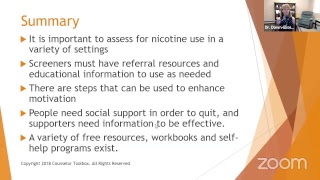
Dr. Dawn-Elise Snipes teaches clinical interventions for tobacco cessation, covering screening frameworks, nicotine replacement options, quit-date planning, and relapse prevention using DBT-derived coping skills. She addresses barriers to treatment and provides guidance for supporters and organizational referrals.
Questions this video answers
The 5 A's: Ask, Advise, Assess, Assist, Arrange.
Set a quit date within two weeks.
1-800-QUIT-NOW.
They usually peak within a week or two after quitting, but may persist intermittently for months.
Chapters
Alrighty, it looks like we are live. So welcome everybody to today's presentation. This is part two of Management of Tobacco Use. So remember we talked about how we're breaking it up and today we're really going to focus on interventions and things that clinicians can do and paraprofessionals can do to help people who are trying to stop using tobacco. Now, some of this will apply to people who are trying to stop using or help themselves as well. But we're going to talk about barriers to engagement, screening, preparing for change, practical interventions that we want to make sure that people are aware of, relapse prevention strategies to make sure that they are able to effectively change. Essential education that we may need to pass on to people, motivational interviewing techniques to help people who are not motivated or when their motivation starts to wane, and tips for supporters that we can give the loved ones and the family members and, you know, whatever of the person who's trying to quit. So one of the biggest barriers of engagement of people with tobacco issues is that we as clinicians often lack knowledge about how to identify smokers quickly and easily or we may not know how to deal with it. So we're like, well, I know you smoke, but I don't even have any idea what to do do about that. So I'm just going to leave it alone and you can talk to your doctor about it or whatever. That's not the right response. What we want to do is make sure, just like for co occurring disorders, it's no wrong door wherever they come in. We're assessing people and saying, you know, if you use nicotine products and you want to stop, there are options out there and I'm more than happy to help you. So we need to know how to identify those smokers and we'll talk about a screening measure, which treatments are effective. Now we're not prescrib prescribing treatments for the most part, unless you're actually a clinician. But knowing which treatments are effective can help you have open a discussion with people about nicotine replacement therapy and alternatives like bupropion and all those other things. We want to know how treatments can be delivered. You know, for example, nicotine replacement therapy, most people know about the gum and a lot of people know about the patch. But did you know it comes in a nasal spray? It also comes in a lozenge, gum patch, nasal spray and hard candy lozenge. So there are a lot of different ways that you can get the nicotine replacement in your system. And we need to know about the relative effectiveness of different treatments. And, you know, we talked about that a little bit on the last presentation. And the fact that nicotine replacement therapy by itself is definitely very, very helpful for people who are trying to quit using nicotine, replace replacement product or nicotine products. However, when you combine nicotine replacement products with either with additional nicotine replacement products or with other things like bupropion or other oral medications, it can significantly help the person, especially the person who has been using for a really long time and or is a heavy, heavy user. So, you know, it's important to understand the different treatments out there. So if you're working with somebody and you're the person that screens them, and maybe you're the person that sees them once a week or once a month, and they're starting to try to change and they're saying, you know, the doctor prescribed the gum for me and I've been using that, but it's just not enough. I can't do. That's okay. You know that that is not the only intervention. And they've found that for a lot of people, at least during the first couple of months, they may need multiple combined interventions. And we talked about those in part one. We can have inadequate clinic or institutional support for routine assessment and treatment of tobacco use. Not every place is going to treat tobacco use, but human resources departments, for example, should be able to have a clinic where people can do voluntary assessments or whatever if they want to. I'm not sure about all the laws about whether a human resource personnel can actually ask about smoking or not. Don't know. But, you know, there are a lot of companies that have a health and wellness champion that works in their human resources department who can provide information about the harms of nicotine and smoking and methods for stopping and all that kind of stuff. And they can also provide referrals for anyone who wants to stop using. And, you know, you may be thinking, well, what's the benefit to a, you know, trucking company that to implement this kind of a program, that's going to be more money they've got to spend. Well, yeah, but they. The health benefits from helping people stop nicotine products will come back to them in terms of lower health insurance premiums, reduced sick days, you know, maybe even potentially reduced turnover because you don't have people that are leaving because they are just incapacitated with something like emphysema. So there are a lot of health benefits to organizations, not even just in healthcare, in healthcare situations, whether it's mental health care or primary health care, or even those emergency walk in clinics. It's always good to have a protocol to, and we're going to talk about the 5A's in a minute to screen people that way. Maybe they have started thinking about maybe wanting to quit, but they don't know who to ask or they don't want to make an appointment with their doctor or whatever it is. If they're already in your office, take advantage and say, if you're thinking about it, I'm here. Or if you're thinking about it, here are some options. You can call the quit line. There are some other things that you can do that won't necessarily commit you to anything or cost you any money, but it can give you some information. A lot of times as clinicians, whether you're a nurse or a doctor or a mental health clinician, or even a teacher, you've got time constraints, you've got 18 other things that need to be done before the end of the day. And you're like, one more thing, I've got to screen everybody for tobacco use. I don't know how to do that. Well, think about it a little bit more simply. The screenings that we do are often take less than five minutes. So you know, how could you do that effectively with your, the people that you see? And you know, you got to figure out a way to work it in if you want to be able to screen. And another barrier for some people is lack of insurance coverage for tobacco use treatment. Now, under ACA policies, there are a lot of insurance policies that will cover a certain amount of tobacco cessation treatment, nicotine replacement products, etc. But it's important to recognize that that's not necessarily immediately accessible for anyone because they may still have to meet their deductible. So even though ACA is out there and it says that insurance has to cover it, and some of the policies I think say they have to cover it regardless of whether the person's met their deductible, which is great. But there are also people out there who don't have insurance. You know, they had to drop it because it was too expensive or for whatever reason. And we need to be able to figure out how can we serve that population. Talk with your local health department because they probably have ideas or resources that they can tap into to help people who don't have insurance access nicotine replacement therapy and intervention stuff. So the screening, I told you, it's fast. The five A's ask about tobacco or nicotine use and any more we really need to ask about nicotine because you've got vaping, you've got dip, you've got smoking tobacco, pipe tobacco. There's a lot of different things. So you don't want to just say cigarettes. And, you know, you want to make sure that you're getting every type of nicotine administration. So do you use any nicotine products? Advise quitting? You know, you probably are well aware that it's, you know, really beneficial to quit using nicotine, but, you know, I recognize that it is a really hard thing to do. Assess the person's needs and readiness for change. You know, if they look at you and they start, you can see that they're starting to tune you out. All right? They're not ready for change yet. And you can at that point say, you know what, if at any point you decide that you want to quit using nicotine products, I'm a great resource, so just come to me and we will see about what we need to do to get you set up with whatever tools you need. If they're ready for change and they, even if they're just saying, well, you know, I thought about it, but great, so let's assist in the quit attempt and start using some motivational interventions to help them identify all the reasons they want to change, deal with all their apprehensions, and start identifying resources that are out there. You're not going to do this in one session, I advise you, and it can be done. There are a lot of workbooks online that people can use, so you don't have to walk people through this the whole way. You can go online or if you're taking this as part of a class at all CEUs, you can go into your classroom and find a ton of different workbooks that will help people get ready to change. And the fifth a is arrange, arrange for any referrals. You know, make sure that they know what needs to happen. So for a lot of people, it's going to go really fast because you're going to ask about tobacco use, make your statement about how it's, you know, is helpful to quit, and then if they are in pre contemplation and not identifying it as something they're ready to change, letting them know that the door is open, you're there, should they try, decide they want to change. If you keep hounding them with it and go even further and start lecturing or whatever, you're going to be tuned out. There's just no point in doing that. And we're going to talk about some motivational interventions later. But, you know, it's important to make sure that the person knows that when they're ready, if they come to you, that they're not going to be henpecked into something that they're not ready to do. So Helping clients get ready. The clients that are ready, set a quit date within two weeks. And when I say clients again, if you're a human resources manager or wellness coordinator or a nurse or whomever, whomever you work with, those are your clients. So encourage them to set a quit date within two weeks. Doesn't have to be tomorrow, but we want to know that it's going to happen. If you set it much further out than that, then it can kind of come and go and, you know, whatever. Two weeks is a good amount of planning time. Encourage them to tell family, friends and co workers about quitting and request understanding and support. Because quitting nicotine is one of the hardest things to do. So there may be some moments of irritability or a lot of moments of irritability initially. So it's important to get support from other people and let them know that, you know what, this is going to be tough. But it's something that I really want to do. Encourage them to anticipate challenges to the upcoming quit attempt, particularly during the first few weeks. And I say 12 weeks. 12 weeks. For most people, the next first step is to remove tobacco products and smells from your environment. So have them avoid smoking in places where they spend a lot of time, like at work, at home, in their car. Make the home smoke free, tobacco free, nicotine free. Get rid of the smell. Rent a carpet cleaner. Clean your carpet, clean your upholstery, if you have any. Wash your drapes, wipe down the walls. There's a lot that you can do in order to help get rid of the nicotine smell. Change your air filters. That's super important. Change the air filters in your house in order to start getting the nicotine smell out there, which can be triggering. And if you use, or if the person uses vaping products that are scented like strawberry or whatever, it's important to also pay attention to those sensory triggers. So the first practical tool for smoking cessation is guess what? Cessation or abstinence. So this is really where we want to go. Not everybody is willing to go here right away. And that's okay. You know, everybody's recovery plan is a little bit different. Some people will want to gradually taper how much they're using. They may want to switch to lower nicotine products and Then taper how much they're using. They may want to quit cold turkey and use nicotine replacement products. You know, you need to talk to them about what they envision as being most helpful for them. Talk about any past quit experiences and have them identify what's helped and hurt in previous quit attempts and build on past successes. And a lot of this is covered in the workbooks, in the various workbooks out there that can help people quit. Make sure that they know that they can call the 1-800-quit now in order to get quitline support, in order to get support when they're having cravings, when they're nicotine replacement therapy, their NRT is not quite doing what they need to do and they don't know what the next step is. They can always call this line. They don't have to pay for it. Help them or make sure that they are identifying all of their relapse triggers and traps. And you do this with baseline and chaining, or you can. This is how I have a lot of my clients do it, going through the week, identifying any time they felt triggered to use or they wanted to use or had a craving. They need to note that time and identify, you know, what was triggering that urge to use. Did they smell it? Did they see somebody smoking? Was it just that time of day? You know, identifying those triggers. So we get an idea about how frequently they're triggered and what triggers them. Because what we want to do is start addressing those triggers, but also reducing the frequency that they're triggered. So some things that can trigger urges and cravings, negative affect, and that's a big garbage term that covers boredom, depression, anger, anxiety, guilt, anything. That's what we call an unpleasant emotion. Ok, so when you feel that way, what things help you feel better? What things can you do to feel better? What things have worked in the past. And they may have some great tools. They may be a little short on tools, and that's okay. You know, let's see what they're working with and try to build on what's already there. If there's a trigger or a trap, being around other tobacco users, figuring out how to handle that, it doesn't always work. You know, sometimes you're going to have to be around tobacco users. It's very, very rare. But every once in a while it does. Minimizing how often you're around people who are actively using nicotine products or who smell like nicotine or, you know, again, the flavored vaping stuff, if that's a trigger for you, avoid Being around any sensory triggers is the first thing. And when you can't, one of the things that we're going to talk about later that helps some people is to put like Vicks vapor rub or something under their nose so they're not smelling the nicotine product. Experiencing urges is a big trigger. You think, I've got to have a cigarette or I've got to go out and vape or whatever it is, okay? Developing tools, distress tolerance skills to ride the wave, get through that urge and come out the other end and other smoking cues and the availability of cigarettes. It's important that people learn strengths based coping skills. And that's kind of what I was talking about earlier. Identify ways that they have coped with distress or unpleasantness or urges in the past that have been at least partially successful and build on that. Anticipate and avoid temptation and trigger situations. So if you've got somebody who's getting ready to quit smoking and you know they can't anticipate that they're going to be around somebody else that, that smokes, you know, what can they do? How can they avoid the temptation if they know that they are going my uncle Jack's house, you know, I talked about him last time he smoked a pipe and whenever I went to his house it always smelled of his pipe tobacco. So if somebody's going into that environment where they can smell smoke, they're going over to a relatives or a friend's house, even if that person is not smoking in front of them, it can be a trigger. So what can they do? Again, putting the liniment under their nose. Certain aromatherapy concoctions can help not only with stress management, but also just to kind of give you something else to smell. Finding other things to do, making sure you keep your hands busy, keeping other things in your mouth like straws, toothpicks, you know, ideally not your hands, don't bite your fingernails. Accomplish lifestyle changes that reduce stress, improve quality of life and reduce exposure to smoking cues. So use the miracle question, or however you want to phrase it with the, with the client and say, when you become a non smoker, you know, what is going to be different? What's life going to look like? Or ideally, you know, you're quitting for a reason in order to improve your quality of life. So tell me, in your rich and meaningful life, in your ideal life, when you are non smoker, what's going to be different and why is it important to you to quit using? You know, maybe they want to be able to breathe better or you know, stop coughing every morning or whatever it is that they do. Learn cognitive and behavioral activities to cope with urges and improve mood. Now, I talked a little bit about it last time, but we're going to go through them a little bit more now. Dialectical Behavior Therapy has two acronyms, accepts and improve. And those things can be used as prompts for people when they start feeling the urge to use or they start feeling an unpleasant emotion, they can distract. This doesn't cope with things. It just helps them get through it while that emotion or that urge feels overwhelming until they can think more clearly about, okay, what's the best way to handle this situation? So Accepts stands for activities. That means get up and do something. Don't just sit there and think about it. Contributions kind of relates to activities. Volunteer, contribute something. So go help somebody else. Offer to, you know, take out the trash, whatever it is. Comparisons, you know, compare yourself to, you know, maybe people who are smoking. And you know, what's better now that you're not smoking. Emotions do the opposite. So if you're stressed out, the opposite of any of these dysphoric emotions is generally going to be happy. So do something that makes you happy. Listen to a comedian that you find particularly funny. Whatever it is that can get you into a different emotional window, push away. Just imagine yourself pushing away the thought that you have to use the nicotine product right now. Change your thoughts, you know, focus your thoughts on recovery, or focus your thoughts on something completely different instead of focusing your thoughts on that urge and sensations. That's the final one. Sometimes a really strong sensation will divert your attention. If you've ever had an injury and you've had to ice it, you know, when you've got ice on yourself, you are not thinking about much of anything else. You're thinking about when you can get that dagum ice pack off. Or at least that's me. So ice is one of those sensations you can use. You want to use a strong sensation that will focus your attention. Holding ice, snapping a rubber band is one. I don't like doing that one or suggesting that one because it can injure yourself. Loud music, cold shower, even a hot shower, just not so hot, you scald yourself thinking about different sensations that will direct your attention. Even going out and running really, really hard. You know, like interval training. Now, if you're stopping smoking, that might not be the best suggestion. Works really well for people who are depressed. But finding something that is going to divert your attention from your urgent. The other acronym, improve imagery. Using guided imagery, imagine yourself Getting through this without using or. And I kind of combine this with vacation that we're going to get to in a minute. Go on a mini mental vacation to your happy place. And I know you may be rolling your eyes now, but encourage clients to really use all of their senses to cognitively transport themselves to their ideal happy place. You know, what does it smell like? What do they hear? What do they see? And it's not just one thing. You know, if you walk into a room, you don't see just one thing. You see a lot of things. When you walk outside, you don't hear just one thing. You hear a lot of things. When I walk outside my office, I hear the birds, I hear the traffic, I hear the door shut behind me, I hear the wind, I hear. So encourage clients to really dig deep and write it down in a narrative. If they have difficulty with remembering this narrative, they can. When they're having a moment, they can read this narrative that takes them to their happy place or they can even record it. I mean, your mobile device has a voice recorder. So have them record it on their mobile device so they can listen to it. And again, they can kind of transport themselves to that place. Meaning. Find meaning in whatever's going on. You know, what is the meaning? Why are you trying to quit? What is the meaning in that? In order to encourage yourself. Prayer, including the serenity prayer, Relaxation. A lot of times people use nicotine products because they're stressed out. So if you can find a way to calm your stress reactions, it can help you. For a lot of people, that can be deep breathing, because that slows your heart rate down and causes your body to start sending out the relaxation neurochemicals. Go on a walk. You know, that's another thing that you can do because sometimes if you've got a lot of energy, you just need to get it out. You need to move around for a minute. Some people will meditate, some people will do yoga, Some people will journal. Encourage clients to really brainstorm what helps them relax. When they are feeling all tied up, encourage them to focus on one thing at a time. You know, you can start getting bombarded with things I need to, I really want to use. And then focusing on why they shouldn't use and this, that and the other. Just encourage them to kind of clear their head and identify one thing in their environment that they can focus on. Yeah, we're not focusing anything about smoking right now. We're focus. Focusing on one thing in the environment. For example, right here, I have a plastic yellow cup and, you know, I may focus on that for a minute and read everything that's printed on there and, you know, think about why people, why they chose to design it the way they did or whatever it is. But I'm going to focus on this thing in the moment. That has nothing to do with my urge to use or do whatever. We already talked about the mental vacation. And mental vacation can also mean just kind of checking out for a few minutes and maybe going to YouTube and watching stupid cat videos or whatever it is you do to check out and encouragement. Get encouragement, provide yourself encouragement. Be your best cheerleader, but also reach out to other people who can provide encouragement for you and help you get through a difficult moment. Create peaceful times in your everyday schedule, whatever that means for you. You know, if a peaceful time is putting on your headphones and turning on hailstorm, you know, more power to you, you know, that's what I do. But if your peaceful time is sitting quietly and meditating, that's fine too. Whatever it is that helps you kind of get regrounded. Try different relaxation techniques. Rehearse and visualize your relaxation plan. So if you're at work and you're in a meeting and you start to get really stressed out and have those cravings, you know, make sure that clients know how to handle this. You know, what can you do when you start, you know, you're somewhere where you can't just check out or whatever. What can they do? One of the things that I used to do when I was in graduate school, and I'd be stuck in a class and I don't sit still for long, very well at all, and I would start to get really antsy. And one of the things I would do to help myself relax while I was stuck there would be, I would start making lists of things, grocery lists, whatever, if I needed to, or writing down different relaxation words or just sketching, sketching chickens and butterflies and the few things that I can draw. So encourage clients to keep a list of things they can do to help them relax. Even if they are stuck in a public place. Remind clients that when they quit smoking, drinking coffee or tea may make them feel sad. If they used to smoke while they did that, you know, they would wake up in the morning and drink their coffee and have a cigarette, or after dinner, they have coffee and have a cigarette. Those are things to recognize. There's going to be a grieving process because smoking or using nicotine products had a benefit. You know, they did it, they liked it. Now they don't want the added baggage that it brings along. So they're trying to quit, but there was something about using the nicotine product that they really liked. And so they've got to go through the. This grieving process when they recognize that it's not something they're choosing to do anymore and come to acceptance of that. And yes, we can say focus on what you've gained by quitting, and that helps a little bit. But it's also important to encourage clients to recognize that it's a grieving process to it. You're kind of losing a best friend. So working through that and figuring out how the next chapter starts without this, you know, friend in it. Switch to decaffeinated coffee or tea for a while, particularly if smoking cessation or nicotine cessation is making you irritable or nervous because caffeine is just going to rev you up even more. You know, I am 100% decaf, so a lot of, well, the whole reason I drink coffee, decaf coffee, you know, it's pretty much just colored water, is partly for the taste, but not so much. But there is a cognitive component. There's just something relaxing about drinking coffee. I don't know why, but, you know, I can do decaf. Avoid foods that increase your urge to smoke. And you may be going, huh, things like sandwiches. You know, it's harder to smoke if you're having to use a knife and fork and all that kind of stuff. But if you can hold a sandwich in one hand and a cigarette in another, then that particular food may trigger you to smoke. So if there are foods that trigger you avoid them for right now, you can eventually add them back in as soon as you finished eating. Call a friend or take a walk or brush your teeth. Those things can help you not light up right after eating, which is something that a lot of nicotine users do. Other things that you can do include chewing on a toothpick, especially the cinnamon ones. Those can be really helpful for satisfying that fixation. To have something in your mouth but not using a nicotine product. Wash the dishes by hand after eating because you can't smoke with wet hands. Now, you know, this doesn't work quite as well for people who, who dip. But, you know, it is harder to dip and wash hands or with wet hands because you're having to hold the jar and stuff. But this is especially true for people who smoke or who vape because you don't want to be holding the E cigarette or anything when your hands are wet. Emergency options for distress Sometimes you're just going to be like, er, because of whatever's going on that day. So make sure clients have a list of emergency options that work for them. Not all of these are going to sound appealing to them. All of these sound appealing to me, which is why I included them on the list. But basically, we want people, when they're feeling distressed, to be able to get through 15 minutes. They can get through 15 minutes, then they can go, all right, I can do another 15 minutes. Instead of going, I've got to go. You know, I'm still abstinent and I can never smoke again. Well, that's a big, big hurdle. Let's just try to make it through 15 minutes because 15 minute increments add up. So have people start the step clock, if you will. What can they do to help them get through that first 15 minutes or the next 15 minutes? They can hold ice or put their hand in ice water, bite into a hot pepper or chew a piece of ginger root. Yeah, I mean, that really gets your taste buds kind of going funky, which will ruin the taste of any sort of nicotine product that you take in orally. Rub liniment or Vicks Vapor rub under your nose so you're having something else to smell. Peppermint also tends to excite certain neurotransmitters, so you may feel more relaxed. Take a cold bath or shower. Scream. You know, depending on where you're at, this may or may not be helpful. If you're at work, you may have to, you know, excuse yourself. Go down to your car, roll up the windows and, you know, just have a pillow or something in the car and scream into it really loud and then go back inside. Not that I've thought that through or anything, but, you know, you don't want people to be calling 911, but sometimes you just got to get it out and be like, oh, and then you can move on or you can scream, sing your favorite song. So again, go down to your car because your office mates don't want to hear you belting out Redneck Woman or something to the top of your lungs. But you can do it really loud and. And again, that energizes your senses and it gets you focused on something and it can help you actually start de escalating because you're breathing deeper when you're screaming or when you're scream singing, which is going to help slow your heart rate, stomp your feet a lot, and you can even do it in heavy shoes. But I do recommend strongly not doing it in heels. Number one, because you'll break your heels. Number two, because you could break your ankle. And number three, because you could either dent a wood floor or crack a tile floor. So, you know, heels, not so much. But heavy shoes, they're great because it takes more effort to stomp with heavy shoes and it's louder. Flatten cans or boxes for recycling as fast as possible. Sometimes when I'm having a bad moment, I will just go out into the garage and start flattening boxes and folding them up and everything so I can take them out to my garden, Rip an old newspaper or phone book apart. Or if you save up your bills or junk mail. And then when you start having a bad moment, you've got something easy to shred. Throw a tennis ball against a wall. Now, this will mark your wall, so you don't want to do it inside, probably, but you can throw it as hard as you want and just think about whatever you're thinking thinking about and kind of throw a temper tantrum and get it out. Crank up the music and move. You don't have to dance, you can just move. But the loud music will help distract you. Or if you're somewhere like at work, maybe you can just go into the stairwell and run up and down the stairs a few times to get yourself back in sync. So your heart's racing for a reason, not just because of anger. So like I said, these are the ones that work for me. I don't know what works for you. Encourage clients to brainstorm. This is a fun group activity to do. What can you do when you're feeling really stressed out? That just helps right away. We do need to make sure that we are educated and we can provide simple education handouts. You know, we don't want to get into long, hour long videos. We want to provide tidbits of information about the addictive nature of nicotine products, the effects of e cigarettes, relapse prevention strategies and the fact that any smoking, even a single puff or deeply inhaling secondhand smoke increases the likelihood of a relapse. We want to make sure that people, clients, as well as their support of others understand withdrawal symptoms and the fact that the symptoms peak usually within a week or two after quitting, but will persist, likely on and off for months. It gets better, but you know, it takes a while because again, your brain is resetting itself, if you will. There are also websites that people can go to that will help them identify how to handle withdrawal symptoms and triggers, but providing again, another handout that they can use that they can have handy is really helpful. Provide education about harm reduction approaches. What can they do if they're smoking right now? What's less harmful? And the research kind of keeps changing on that a little bit. Obviously cutting down smoking is going to help. So going from three packs a day to one pack is going to be better. Switching to lower nicotine based products that can help. And just talk with them about what they're willing to do. Discuss the benefits of using nicotine replacement products to reduce harm from smoking and the types of nicotine replacement that are available. And you can get these fact sheets online pretty much all the time. And I recommend that annually you go out and you find the most current nicotine replacement fact sheets, because new things are coming out all the time that may work a little bit better. And make sure you provide information for people about where to get help. Unless you're the one providing the help. Where do they get nicotine replacement products? Who do they go to to get the prescription for this? I mean, obviously if we're talking prescription, it's probably a doctor, but some things you can get over the counter or through a pharmacist now. So, you know, where do they have to go? What do they have to do? So I keep talking about toolkits and resources. The American Cancer Society, American Lung Association, CDC how to Quit Nicotine Anonymous Smokefree.gov Clear Horizons for Smokers Over 50 is a workbook designed to help smokers over 50 quit forever. Free Baby and Me is for pregnant smokers who have recently quit or who are thinking about quit quitting. And Smokeless Tobacco. A Guide for Quitting obviously applies to things other than cigarettes and pipes. So we've been talking about the client, in large part who is at least considering change. But sometimes you're going to have a client who is not interested in changing. And the reasons for that are varied. And if you look at Prochaska and DiClemente's model on motivation for change, you'll find that there are multiple different types of precontemplators, which is basically what the unwilling client is. So why are some people unwilling to quit? And each type of precontemplator is unwilling to quit for a different reason. Some people lack the information about the harmful effects. They just don't understand why it's such a big deal. Some people don't have the required financial resources. You know, they're afraid that they're not going to be able to access what they need. They may want to, but they don't think they can. Do it. For some reason, they may have fears or concerns about quitting. Maybe they tried before and they weren't successful and they're afraid to try again. Maybe they're demoralized because of a previous relapse. They were smoke free for a year and then they relapse. So we want to understand the reasons a person may be unwilling and help them dispel some of those concerns. We do want to focus on exploring the person's feelings, beliefs, ideas and values regarding nicotine use in an effort to identify ambivalence. Because a lot of people are ambivalent. It's like, yeah, I smoke, I know it's bad for me, but da da, da, da, da, okay, well, you know it's bad for you. So there's the ambivalence. You're smoking, you know it's bad for you. You know what things in your life might make it worth quitting? Express empathy by using open ended questions to explore the importance of addressing nicotine use in this person's life. You know, they may not think it's a big deal, they're just like whatever, you know, and help them explore their concerns about the benefits quitting, what might happen if they quit. Use reflective listening to seek a shared understanding. You know, so you, you're both on the same page. You know, they may not share your point of view, but you want to really understand their point of view, reflect their words or meaning. So if they say, you know, right now I'm a smoker, I know it's not the best for me, but it really helps me maintain my weight. Okay, so you would reflect something like, so you think smoking helps you with maintaining your weight? And they may say yes or well, obviously they would summarize what you hear the client saying. For example, what I've heard so far is that smoking is something you really enjoy, but you know, your boyfriend really does hate your smoking, so that's causing some conflict, you know, that points out some discrepancies there. Normalize their feelings and concerns about quitting and life without cigarettes and support their autonomy and right to choose or reject change. They don't have to do it. You know, you're there if they want to do it, but they don't have to. We're just, you know, talking here. Develop discrepancy by highlighting the difference between the person's present behavior and their expressed priorities. Values and goals reinforce and support change. Talk and commitment language. So if they start saying, you know, yeah, I've thought about change, that's awesome. You Know, why did you decide not to, or, you know, what was different? Then start talking about those change things and build and deepen their commitment to change by helping them. Once they start going, yeah, you know, maybe I'm ready to start again. Okay, you know, let's talk about options that might exist and what your concerns are so we can make it as painless as possible. You know, it's not going to be easy, but, you know, I want to help you be have the greatest chance of success. You can also roll with resistance by backing off. You know, if they're saying, nope, I'm not ready to use, not going to use, can't make me stop. Okay, that's fine. So use reflection, for example, saying something like, it sounds like you're feeling pressured about your smoking, or it sounds like you feel I'm lecturing you, so, you know, no problem. Express empathy that, you know, maybe they're worried about how they would manage withdrawal symptoms if they say, you know what, I've tried before and the withdrawal was just too bad, the cravings were too awful, I just can't do it. So empathy would help them understand that you are hearing how difficult it really was. And before you start lecturing or providing suggestions, ask permission to provide information. If somebody is not ready for change, if you start handing them stuff and going, well, take this anyway, then that basically says, I don't care what you think. You need to think the way I do. That's not going to help you. So you want to ask permission. You know, would you mind or would it be okay if I gave you this handout? Or another way you can do it is have handouts available in the lobby or in your office and tell people that they are more than welcome to help themselves to any of the handouts that are, that are there. You know, they don't have to ask permission. That empowers them to go over and look and see if there's anything they're interested in. Support self efficacy by helping the person identify and build on past successes. Offer options to achieve small progress, small steps, such as calling the quit line, reading about the benefits and strategies of change, maybe starting to change their smoking patterns, cutting back a little bit. That's great. You know, I'm not looking for everybody to go, oh, yeah, okay, I'm ready to quit, I'm going to stop cold turkey tomorrow. That doesn't work for everybody. Not everybody's willing to even consider that. Okay, what are you willing to do? And ask the person to share ideas about strategies for quitting what do you think might help you? And let's see how we can make that happen. Increase motivation with the five R's Help them identify the relevance to quitting. Why is it important in helping you achieve the kind of life that you want? Brainstorm rewards such as improved health, feeling better physically. Food is going to taste better. There is sense of smell is going to improve. You know, how when you have a cold, you know, if you haven't ever smoked, you may not make the connection. But like when you have a cold, you can't taste much or things taste funky because your sense of smell is off. Smell and taste are really connected. So a lot of people who use nicotine products don't have a good sense of smell, which means their sense of taste is also off. People who use chewing tobacco often have problems with their sense of taste as well. They're going to save money. They may feel better about themselves. Their home, car, clothing, breath will smell, smell better. They're setting a good example for their kids. They may perform better in physical activities. They may have improved appearance, including their skin and teeth and aging and all that kind of stuff. Those are just some of the obvious rewards to quitting. Encourage people to think about, you know, other things. Obviously they're reducing their cancer risk, reducing their risk of emphysema, and, you know, some of those other things as well. Encourage them to look at roadblocks that might keep them from quitting, such as their fear of withdrawal symptoms or failure, their fear of weight gain, lack of support, depression that accompanies quitting, the fact that they enjoy tobacco and they really don't want to give it up, being around other tobacco users and limited knowledge of effective options. So a lot of these you can address with an effective relapse prevention plan. Withdrawal symptoms can be mitigated with nicotine replacement therapy and some of the other drugs that are out there to help stop smoking. Fear of failure, you know, we want to look at what's causing that fear of failure and focus on successes. You can help the client develop a plan to prevent weight gain. A lot of times when people quit smoking or using nicotine products, one of the couple reasons they gain weight, number one, they used to smoke to help them relax and to help them feel less unpleasant. Well, when we eat, especially when we eat high sugar or high fat foods, our brain releases dopamine and other relaxation chemicals. And when we eat, it triggers the rest and digest system to kick in, which again floods our system with more of those relaxation chemicals. So eating can serve a similar purpose. Now it doesn't get rid of the stress. And there are other ways to deal with the stress, but that's one of the reasons that people turn to food so much when they stop smoking or using nicotine products. Another reason that they may do it is just the habit of hand to mouth. They want something in their mouth. So wanting something in your mouth is, like I said, there are alternatives such as toothpicks, gum, sugar free candy. You know, there are options that you've got out there, a pencil if you're really strapped for options. Encourage them to get support before they even launch on this so they're not doing it all on their own. Have them figure out ways to address their depression. Include happy things in their routine, but also address any triggers for depression. If they're smoking to self medicate depression or you know, if they've got some pre existing depression, they may need to address that too. Relapse risks are another thing that people have to look at, acute and long term. What things might trigger a relapse, we already talked about those and repetition motivation is going to wax and wane. Just kind of like the tides come in. Some days it's going to be like I got this. And other days it's going to be much more difficult. So encouraging people to regularly check in with themselves, remind themselves of the reasons they're changing, stick to their plan, encourage them to include motivational interventions in their recovery routine every single day. For supporters, people can be really supportive and it's important to have support. So we want to educate the family and the supporters and that includes us, you know, as clinicians or whoever's doing this assessment and intervention. Respect the quitters in charge. Ask the person whether they want you to regularly check in with how they're doing. And when you do check in with how they're doing, ask how they're feeling. Not so you still smoke free, you know, just how's it going? How you feeling? You know, check in to see how they're doing. And if they want to share the other, they will let the person know that it's okay to talk to you whenever they need to hear encouraging words. You're not going to ridicule them if they're having cravings or they think they're going to slip or whatever, or even if they have slipped, you know, it's better to talk about it and address it now. Nip it in the bud, so to speak. Help the quitter get what they need, such as hard candy to suck on, straws to chew on and Fresh veggies that are cut up and kept in the refrigerator. Spend time doing things with the quitter to keep their mind off smoking, especially in that first three month period. It's important to stay busy because the brain is rebalancing and everything and the cravings are going to be a lot stronger. Try to see it from the smoker's point of view or the quitter's point of view, whatever you want to say. So you understand how difficult it is. Make your home smoke free. Meaning that nobody can smoke in any part of the house. And that includes like right out on the stoop because you can still smell it. Remove all lighters and ashtrays from your home, wash everything that smells like smoke, use air fresheners, change your air filters and celebrate along the way. Because quitting is a big deal. You know, celebrate the first day that they're smoke free, celebrate the first week they're smoke free, celebrate the first month they're smoke free. And yet you see what I'm, what I'm getting at and I keep saying smoke free, but I mean nicotine free. So this applies to people who use smokeless tobacco and other things. Don't judge, nag, preach, tease or scold. We don't want people to do that when we make a mistake or are struggling to make a change. So don't do it to somebody else. Don't take the quitters grumpiness personally during their nicotine withdrawal. And remember I said the first two weeks are generally the worst and then it starts subsiding. But it could last. You know, some of these symptoms could and often do last for months. They get less, you know, they're not as intense, but they can last for months. So it's important to, you know, step back and go, all right, is this a reaction to them not having access to nicotine? And a lot of times, you know, if you're six months into it and all of a sudden the person gets really irritable with you for some reason, you may want to step back and go, was there some sort of relapse trigger that intensified this person's cravings? They may not often or always recognize the relapse trigger. So you know, that's where supportive people can be helpful if the quitter wants. We can sometimes see blind spots, we can sometimes see triggers that they missed. But don't offer advice or point out these things unless you already have a pre agreed arrangement that that's okay. If the ex smoker slips, don't assume that they're going to start back smoking like before do remind them how long that they were nicotine free. Help them remember all the reasons they quit. Continue to offer support and encouragement and remind them that they're still a quitter. I don't like that term, but you know, you can find a different term that's a little less pejorative. There's still someone who is smoke free, not a smoker. They just happen to pick up that one time. Don't scold, tease, nag, blame or guilt them still. So it's important to assess for nicotine use in a variety of settings, from mental health to physical health, and even in jails. It can be a great place to identify people who might be willing to start quit. Quitting screeners must have referral resources and educational information to use as needed. It doesn't do any good to do a screening and go, oh, sounds like you want to quit. Well, good luck. You need to make sure that whoever's doing the screening has the resources to help the person get to the next step. There are steps that can be used to enhance motivation and people who are not thinking about change or are not quite ready to take that big step yet. So motivational interviewing, motivational enhancement therapy are excellent add on skills to just understanding tobacco cessation procedures. People need social support in order to quit and supporters need information to be effective. So we can't just say, you know, you just got to be there for them. We need to help them understand the relapse process, the withdrawal process, the brain chemistry in manageable chunks. They don't need to know it on a graduate level, but provide enough information that they can be informed and helpful and make sure to have available a variety of resources. And there are many, many free resources, workbooks and self help programs that you can access online by just doing a simple Internet search. Or you can call the quitline and they can point you in the direction of some additional free resources. All right everybody, thanks for being with me and we will be back on Monday with the third and final part of this series.










