CTB Live Stream YouTube
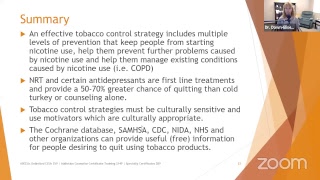
Dr. Dawn-Elise Snipes presents the tobacco treatment specialist curriculum, covering health education, tobacco use patterns, comprehensive control programs, and evidence-based treatment strategies.
Chapters
Hey there everybody, and welcome to today's presentation. Today we're going to be continuing the tobacco treatment specialist curriculum and talking about health education. Now, this is one of the required components of this curriculum. So I apologize that there are parts that are going to be a little bit dry, but I'm going to try to make them as enthusiastic as possible. So let's just go on. We're going to learn about the prevalence and patterns of tobacco use and the role of a comprehensive tobacco control program. We'll explore findings of national reports and explain factors that prevent tobacco use and dependence. We'll explain the health consequences of tobacco use and benefits of quitting, describe how tobacco dependence develops, summarize valid and reliable diagnostic criteria, describe the chronic relapsing nature of tobacco dependence, and provide information that is culturally sensitive and appropriate to learning style. Well, we'll learn how to do that and identify evidence based strategies for treatment. So let's start out with prevalence and patterns. And this first part, you know, bear with me, is, like I said, is a little dry, but we'll get into the fun stuff in a few minutes. Tobacco cigarettes. Nearly 90% of adult smokers began smoking before 18, and 11% of high school seniors report smoking in the last month. So what does that tell us? That tells us we need to focus our prevention efforts at the before age 18 group. Now, there is secondary and tertiary prevention that we need to focus on older folks. But it's definitely still important to be hitting the middle school age group and the high school age group with these prevention messages. Smokeless tobacco among adolescents is less common than cigarette smoking. Hookahs are no safer than other forms of tobacco smoking and may deliver even higher levels of toxic substances. So just because they're not actually smoking a cigarette doesn't necessarily mean it's safer. Flavored little cigars is another method of ingesting tobacco. Of middle and high school students who used tobacco products in 2014, more than 60% of them smoked Florida flavored little cigars. So the flavoring is one of those things that's kind of trendy. And e cigarettes, speaking of trendy, from 2011 to 2016, the percentage of 12th grade students who had ever used an e cigarette increased from 14.7 to 13.13%, which was down from a peak of 16% in 2015. So let's think about that. You know, 10%, 13%, 16%. You know, those, those all are just kind of random numbers, one in 10 students. So if you've got 30 students in a classroom, three of them or more are likely to be using e cigarettes. So that kind of puts it into perspective for you. For the first time in 2014, more teenagers used e cigarettes or vaped nicotine than smoked cigarettes, a Trend that continues. 8% of high school students reported vaping nicotine at least once in the past 30 days. Now remember, nicotine is one of those really, really addictive substances. So if they're vaping nicotine, they're really putting themselves in harm's way, even though it may be a little less harmful than smoking tobacco. American Indians and Alaskan Natives have a higher risk of experiencing tobacco related disease and death due to high prevalence of cigarette smoking and commercial tobacco use. The risk of developing diabetes among this population is 30 to 40% higher for smokers than non smokers. And this all comes from the CDC website, which you can find by clicking on the Hyperlink in this PowerPoint. More American Indian and Alaskan Native women smoked during their last three months of pregnancy, about 26% of them compared to other ethnicities. Cigarette smoking varies by Asian American subgroups as a result of a number of cultural, social, environmental, and individual factors. And cigarette smoking during pregnancy is less common among Asian American and Pacific Islander women compared to other racial or ethnic groups. Why do we care? Well, it gives us some information about use patterns so we can try to target our intervention efforts appropriately. Okay, we're going to move on to more fun stuff. Now. Explain the role of treatment for tobacco use and dependence within a comprehensive tobacco control program. That means more than just prevention. Control means primary prevention. We want to keep people from ever using. That's great, but there already are people using, so what do we do about them? Secondary prevention aims to reduce the impact of a disease or injury that has already occurred and prevent secondary problems. So, you know, if somebody's smoking and now they have emphysema, we want to reduce the impact of the emphysema in, in the rest of their life and help them stop smoking. Tertiary prevention aims to help people learn to live with issues. So the things that we want to really look at are preventing problems that are caused by use and of those problems that somebody already has, helping them figure out how to live their highest quality of life with them. My grandfather had emphysema and it was just one of those things. It wasn't going away. So instead of going, well, the ship has sailed on that. We needed to look at intervention efforts so he could still live his highest quality of life for the rest of his life. So it's important to know where to find information about research studies and guidelines on tobacco treatment. And there are tons out there. I mean, it can be kind of overwhelming, quite honestly, when you're looking at all the different guidelines. The Office on Smoking and Health is one place to get them. Health consequences of smoking, 50 years of progress. This is a report that the Surgeon General put out Cochrane reviews and we're going to talk about those a little bit later, but let me see if I can get it to come up right now. Come on. And tobacco, Nicotine and E Cigarettes, Consumer education. This is a handout or booklet put together by the National Institute of Of Drug Abuse, which is really helpful. So let me pull this window for Cochrane over here. Cochrane has a database of current best practices. So if you're trying to figure out the best practice for nicotine cessation during pregnancy, come to the Cochrane Database. And then you can search this one, you can see acupuncture and related interventions, antidepressants for smoking cessation, anxiolytics, benzodiazepines for smoking cessation, aversive smoking for smoking cessation. So pretty much anything somebody has tried, you know, any practice somebody's tried to get certified as, you know, legit is probably going to be in the Cochrane database. And they don't pull any punches. If the research is not supportive, they will say, yep, the research didn't support that this intervention had any effectiveness at all, or hopefully they say it did have effectiveness. But this is a great place to come and get the quick and dirty. And one thing that is really interesting about the Cochrane Database, this is the one on acupuncture. You can read it. And I'm showing you this because if you don't want to go through all the clinical and research mumbo jumbo, you just scroll down to the bottom and of course it's not going to be, not going to be in this one. A lot of them have a area that talks about basic common sense language reviews. Let me see. Tobacco. All right, Type in tobacco cessation. And Cochrane evidence review methods, results. And of course the other thing's not going to come up right now, but anyway, it is pretty concise. You're not going to have to go through the research and read hundreds of pages of research. They boil it down for you. Now, there are certain factors that prevent tobacco use independence. So if the average person starts using before the age of 18, then we really want to look at societal and environmental factors that can help prevent tobacco use use. Because if we have those in our environment, then Guess what? Those people may not start. So attitudes about tobacco use, what does your community, what is your culture? What does your media say about tobacco use? Is it heavily advertised? Is it in vogue to be vaping or to be smoking E cigarettes or to be smoking or smoking a pipe or whatever it is? If so, then that is going to contribute to use. If it is not in vogue, if there are very few places where you can actually smoke or vape and the attitudes are negative towards those behaviors, then people are less likely to pick them up. There needs to be a reduction in advertising and visual triggers. So, you know, back in the day you would walk in and a lot less today, but you would walk into places like Walmart and Target and those sorts of places and they had a cigarette counter and it was usually close to the front and you would have to walk by it. You would have to smell the tobacco products and stuff as you walked by, which could be very triggering for some people. Advertising of tobacco products in certain sports activities like race cars, race car driving, you know, you see that advertised in that, in that venue. So if we could reduce the advertising in some of those high demand venues, then it would reduce the triggers in the environment, Youth stress management and health promotion programs. So again, we want to look at why do people start using? Some because it's cool, some because of peer pressure. Well, okay, so let's look at peer pressure. Why do people conform to peer pressure? Sometimes they want to feel like they belong, sometimes they have low self esteem and they want acceptance. Well, if we can help people develop a strong self esteem and good strong boundaries and refusal skills, then they won't cave to peer pressure as easily. Other people start smoking to lose weight or to not gain weight. And so we want to look at teaching youth how to eat healthfully and not eat for stress, but also manage portions and all that other stuff. And people use sometimes smoke or use tobacco products to handle stress or to stay awake because they've got to cram for finals or have too much homework or whatever. So we need to help people develop good health promotion behaviors such as getting enough sleep, time management and taking care of themselves, as well as developing good coping skills to deal with stress and anxiety and all that stuff without having to smoke. What can they do instead? So you want to look at the reason they use and say, okay, well smoking is serving its purpose. What can they do instead? And then start teaching them those skills in order to compete with the idea that they need to smoke. Family based interventions can prevent children and adolescents from starting to Smoke. Adding a family based component to a school intervention may be effective now the hard thing that I've experienced when we've used family based interventions in any sort of school based intervention is getting the family there. So being creative about ways to get family involved where they're not having to come every single week for 16 weeks or something, which can be overwhelming for some parents. If they can watch videos on the school website, if they can have handouts and activities that the kid brings home that they've got to do as a family and the kid brings back for health class or something, all of those things can be helpful, can engage the family without creating barriers to completion because mom or dad has to work or has something else to do. The common feature of effective interventions is having encouraging authoritative parenting, which means showing strong interest and care for the person with rules and being aware and those sorts of things, but not being authoritarian. The do as I say, because I said so, thank you very much. Or neglectful or unsupervised parenting. So you don't want to be too strict, you don't want to be too lenient. You want to be aware and semi democratic if you will. Consequences of smoking and we all know these, but I got to go over them. Cancer, heart disease, stroke, copd, pregnancy complications including low birth weight and preterm babies. Diabetes, increased systemic inflammation which is related to also the development of certain autoimmune diseases as well as depression and even some cognitive problems. Increased sickness and absenteeism, erectile dysfunction and decreased fertility and osteoporosis. So there's a lot of things that you know. Tobacco gets into your system, nicotine gets into your system and some of those other chemicals and it can have far reaching effects on your entire body and being so what are the benefits of quitting? Heart rate and blood pressure return to normal. Your circulation improves because you don't have the constriction in your blood vessels, you produce less phlegm and don't cough or wheeze as often. It lowers your risk of cancer, heart disease and other chronic diseases more than if you had continued to smoke. Now you may never go back to baseline, but it will definitely lower the risks more than if you had continued to smoke. And while we're on the topic, they found that people who cut back on smoking as opposed to quitting didn't really experience the same drastic improvements in their health that people experienced who actually did quit altogether. And there are substantial gains in life expectancy if people who are under age 40 stop smoking cigarettes or using nicotine products, they reduce their chance of dying prematurely from smoking related diseases by about 90%. So it's not too late. And even if you're over 40, you know, it really helps cut down a lot of the problems that we often see in people and attribute to age related decline, like heart problems and poor circulation. So how does tobacco dependence develop? Well, first you have acquisition. And when somebody ingests this drug, it goes in and acts on all kinds of receptors in the brain, causing euphoria, increased arousal, and decreased fatigue. So they're happy, they're excited, and they're not tired anymore. You know, that's where a lot of people want to be. And so when they're stressed out, it makes sense why a cigarette, why nicotine might be rewarding. Now, once people start smoking, it doesn't take long for the brain to start adapting to that nicotine. Because think a lot of times people when they smoke is not one cigarette, you know, once a week or something. When they start smoking, they start smoking kind of regularly. So every time they take a drag on a cigarette, they're getting a hit of nicotine. So think about how many hits of nicotine you're giving your brain over the course of a year if you smoke even three or four cigarettes a day. That's a lot. So the brain starts adapting and goes, okay, you know, I need to protect myself from overstimulation, which means when the person doesn't smoke, the brain starts going into withdrawal. The brain's like, I can't function without that stuff in my system. I got used to it. And the person starts experiencing withdrawal symptoms, which increases the risk of relapse. Nicotine influences mood. When people smoke, they tend to feel happier and more relaxed. It's kind of ironic that they have increased arousal, but they also tend to feel more relaxed. At the same time, it influences their cognition. Some people think that they can concentrate better when they're smoking. And it also influences their body function because nicotine binds to receptors located on the excitatory glutamatergic receptors, which causes the release of dopamine. And dopamine is our pleasure chemical. We want dopamine. So glutamate is an excitatory neurotransmitter. So nicotine goes in and binds to this puppy and it tells your brain to start getting excited. And the way it binds, it also tells your brain to get excited and happy because whatever you're doing is pleasurable. So you've got glutamine and, or glutamate and dopamine. Both being released and the person is feeling euphoria, increased arousal and decreased fatigue. It also binds to the nicotine receptors located in the inhibitory GABAergic projections, which leads to the release of GABA. So remember I said it gets you stimulated, but it also helps you relax at the same time. Well, somehow nicotine goes in and binds to these glutamatergic receptors, but it also binds to the GABAergic receptors. And GABA is our main biological anti anxiety neurotransmitter. It is our calming neurotransmitter. And this may inhibit dopaminergic neurons. So it kind of pulls back on the dopamine a little bit. So you're not going to get high, you're not going to get this elation like you might get with other drugs. But you do feel better and you do feel more relaxed and happier. So what are the risk factors? Well, they've done a lot of research and in the report Preventing Tobacco use among Youth and Young Adults, a report of the Surgeon General, they found that relatively low socioeconomic socioeconomic status is associated with risk factor for developing use. And you say, well, why is that? Well, let's think about it. What other things are associated with low socioeconomic status? Stress. And what is one of the main ways that we see people coping with stress? Having a cigarette. So low socioeconomic status, especially the stress associated with it, may contribute high accessibility and availability of tobacco products. They're everywhere. They're in the convenience store, they're in the grocery store. You name it. If you want to get it, it's there. Perceptions by adolescents that tobacco use is normative or acceptable. So if there are youth that are seeing this stuff, they see it's still being sold. So what's the big deal? Or like with e cigarettes and vaping, that is sort of a in vogue thing right now. So people are going to be more likely to experiment with it or think that they look cool when they're doing it. Lack of parental support is a risk factor because kids are more likely to have a need for acceptance and structure from a peer group, especially if the parents aren't very involved. Low levels of academic achievement and school involvement can contribute to low self esteem, which can contribute to a desire to be accepted, which can contribute to using to gain acceptance. Lack of refusal skills, relatively low self efficacy, which means they don't feel like they are able to say no to tobacco products. Previous tobacco use and intention to use tobacco in the future is another risk factor. So even if they've used Only a couple of times. If they intend to use in the future, it means that they are a lot more likely to develop a habit than somebody who's never used. A low self image can contribute to use because they want to feel cool, they want acceptance, or they need the stress mediation or all of the above. And belief that tobacco use is functional or serves a purpose. It helps them calm down, it makes them relax, whatever. A lot of people have beliefs surrounding their tobacco use. So we want to look at those beliefs and see if they are really actually accurate. And if so, then what else can the person do besides using tobacco in order to get that purpose served? Okay, now diagnosis, it's important to be able to diagnose. And when they Switch from the DSM 4 to the DSM 5, the diagnostic criteria for most addictive behaviors changed quite a bit. There used to be substance abuse and substance dependence and yada yada. Now we have problematic substance use. So use of tobacco products over one year resulting in at least two of the following. Larger quantities of tobacco used over a longer period than intended. So going from one pack a day to three, and that can be, you know, well over a year. You may go from one pack a day to two packs a day. Unsuccessful efforts to quit or reduce intake when you try. Inordinate amount of time acquiring or using tobacco products. You know, so if you're sitting there and you're already in your jammies at night and you realize that you don't have any cigarettes, you get dressed and you drive your happy butt all the way down to the store to get cigarettes. Oh, that store's closed. You drive to the next store because you need your cigarettes. That would kind of qualify as an inordinate amount of time acquiring it. Cravings for tobacco, failure to attend to obligations due to tobacco use. Now, this one's easier to explain when we're talking about drugs, but think about it. And the biggest reason that people, quote, fail to attend to obligations due to tobacco use is financial. If they choose to spend their money on tobacco products, as opposed to spending their money on things like paying the bills. Continued use despite adverse social or interpersonal consequences. Your significant other says, I can't take it. You cannot. My stepmother forbid my father from smoking in the house. And then when he would come in from smoking, he would have to go into the bathroom and brush his teeth right away. So, you know, it caused a little bit of conflict. They managed to work it out, but it did cause conflict in their life. Forfeiture of social, occupational or recreational activities in Favor of tobacco use. Maybe you're a runner or you were a runner in high school and you started smoking and now you can't run anymore because your chest is all tied up. If you gave that up or if you decide that, you know what, it's just, I'm not going to run. I'd rather be a smoker. That would be a forfeiture of a recreational activity in favor of tobacco use and continued use despite awareness of physical or psychological problems directly attributed to tobacco use. So if you find out that you've got cancer that could have been caused by tobacco use, or you find out that you've got COPD or emphysema and you continue to smoke, you know, that would qualify here. Another criteria that people have to meet is tolerance for nicotine as indicated by need for increasingly larger doses of nicotine in order to obtain the desired effect. So, you know, half a cigarette doesn't do it anymore. You have to have a whole cigarette or two in order to get the desired effect or noticeably diminished effect from using the same amounts of nicotine. So you smoke one cigarette and you're like, yeah, no, that didn't quite do it for me. So that tolerance is when your body starts adjusting to it and you need more to get the same feeling and withdrawal symptoms upon cessation of use as indicated by the onset of typical nicotine associated withdrawal symptoms or more nicotine or a substituted drug is taken to alleviate the withdrawal symptoms. So people can have withdrawal symptoms and attenuate them by taking nicotine replacement products, or they can choose sometimes to use other drugs in its stead. As a clinician, if the person meets those criteria, and remember they only have to meet two in a year. But if they meet those criteria, they then you can also add the following specifiers. If they're in early remission, they haven't used tobacco products for three to 13 months. That's great, but they have to make it three months to get early remission. Sustained remission is over 12 months on maintenance therapy is if they're taking bupropion or transdermal nicotine, you know, the patch, or they're using gum or something like that, they're using some sort of nicotine replacement or other smoking cessation medication that is helping them not use, or if they're in a controlled environment, such as a hospital or correctional facility where smoking is forbidden, if you can't even access it, then it doesn't mean the dependence is gone. It just means that you're not using right now. Unfortunately, Nicotine is one of the hardest drugs to quit, so relapse is not uncommon and it is associated with drops in self efficacy. If somebody has a slip, which is a lapse, they smoke once, then they may start feeling guilty and have what we call post lapse guilt and feel like they don't have the ability to not smoke or their cravings are so strong they feel like they can't tolerate it. Another risk factor is if it's been less than one year since quitting. A lot of times for post acute withdrawal it takes up to a year for the brain to restabilize and everything and for people to get used to handling those smoking related triggers and not smoking in response to them. Other relapse risk factors include, interestingly enough, being female, white, overweight, low socioeconomic status, employed in good health, and having 1.25 get that stressful life events in the prior 12 months. Now I don't know what 0.25 stressful life events is, but yeah, that's the mean of all the people that were in the study. And this came from the study Probability and predictors of relapse to smoking results of the National Epidemiologic Survey on Alcohol and Related Conditions. So you know, that was a lot of good information. So we don't want to just target people who are in poor health because if they're in poor health because of smoking, then it's likely that they may be more motivated to quit. We want to look at people who are employed and in good health and female and white and it's only been a year or less since they quit. We want to make sure there's lots of support out there for them during that first year or two. Re exposure to the pharmacological effects of nicotine can also reinstate drug seeking behavior. And this can include secondhand smoke. So being aware if somebody's smoking in the car, if they're hanging the cigarette out the window, it doesn't mean that the person in the passenger seat is not being exposed to it. And just a little exposure can trigger those brain synapses again to go, oh, I remember that. The abstinence violation effect is something that people experience if they quit even for a little while and then they relapse, then they may attribute their relapse to internal, stable and global factors, which means internal saying I don't have the ability in myself to quit, I'm not able, I don't have the self efficacy, it's stable, I've never been able to quit, I'll never be able to quit. And global factors. This is a disease I have and there's nothing I can do about it. So we want to help people adjust their cognitions to, you know, there are some internal, there are some things that they do have control over, and there are some external factors that may contribute to it. Helping them recognize what they do have control over and what they don't. Helping them look at exceptions, using a lot of solution focused therapy to help them see when they've had successes in the past, and identifying specific factors that they can control. Yes, there are certain global factors that may exist, like they're female and they're always going to be female. But what else can they do that specific. What led up to this relapse and what can they do to prevent it from happening again? Now, it's important when we're engaging in health education, for tobacco cessation, drug prevention, anything to make sure that we're providing culturally responsive learning. So we want to provide information that is culturally sensitive and appropriate to learning styles of different people and abilities. So we'll talk about learning styles first. Auditory, kinesthetic, and visual. Some people learn by hearing. So if you're listening to this as a podcast or you're listening while the video is running in the background, you may be an auditory learner. Kinesthetic people learn by manipulating. So these are people who will do better if they're writing a relapse prevention plan, if they're writing down a treatment plan, if they're manipulating the information. And visual learners do a whole lot better if you just give them something to read. They're like, please don't lecture at me. Just give me a book. You know, it takes me half the time to read it. Just give me a book. We want to make sure that we provide information in all three of these formats, but definitely auditory and visual to everybody that we encounter. Active versus reflective is another dimension of learning. Some people learn on the fly and they have these aha moments. The light bulb goes off, you know, as they're speaking, as they're going through stuff, other people take in all the information and then, you know, put it all together, and then they have their light bulb moment. So making sure not to put reflective learners on the spot, give them information, let them take it home, ingest it, digest it, and have their aha moment and then talk about it. Next week, when you're working with adult learners, especially and older adolescents, things that we're telling them, anything that we're trying to communicate has to be relevant. You have to be able, in the first two minutes of your presentation, answer for them, why do I care? Like, in the beginning of this presentation, I pointed out that this is a required component of the curriculum for the tobacco treatment specialist training track. So, you know, that's why you might care. Why is it relevant to me at this point in time? We want to help people relate it to past experiences. So talking about experiences that they've had, quitting something before or changing their lifestyle, like if they decided to get in shape, you know what helped them stay motivated, if they decided to start taking better care of themselves or getting more sleep or whatever, help them relate the current behavior change to past experiences that they've been successful. Have them be actively involved. You don't want to have a group of people that are just sitting there twiddling their thumbs while you're talking at them. You know, I love, absolutely love being in the classroom where I can break every eight to 10 minutes and do some sort of breakout activity, because I like that engagement, I like that active involvement with my students. And most students prefer it too. Adult learners and older adolescents like a sense of self direction and personal empowerment. They don't like being told this is what you have to do. They like being told this is the situation and these are the options. So, you know, for people who are smoking, what are your options? I'm not going to tell somebody, you have to do this, this and this. I'm going to say, here's your menu of options. What do you think would work for you? What's worked in the past? Personal empowerment that we can build on. And people have to have immediate application of anything that they're doing because they put that stuff into their short term memory and then you're telling them why they care about it. So they're starting to make a little room in their long term memory where they might put it eventually. But when it's in that short term memory, you want to start solidifying those memory connections. So have them apply it when you're talking about relapse prevention strategies. You know, have them think about different times of day or triggers for their use. And what can they do that can attenuate those triggers? For example, if somebody always smokes right after dinner, you know, that's a trigger for them. So what's something they can do differently to avoid smoking right after dinner? Have them make that plan and then have them figure out how they're going to implement that plan starting tomorrow or today if it's not dinner time yet. We also have to be aware of cultural issues. Because when we're trying to get people to do something, we want to use the principle of reasoned action. People do things that are going to help them achieve their goals. They're not going to do things that are going to help you achieve your goals. They're going to do things that help them achieve their goals. So we want to look at, why is this important to you? And there are a lot of studies out there, interestingly enough, not very many on white people, but a lot of studies that are out there that look at cultural implications for Latino, Native Americans and African Americans. The Latino culture has a belief in familismo, collectivism, simpatica, personalismo, and respeto. So making sure that we attend to those. Now, what does that mean? Well, basically, familismo means a focus on the family. And this collectivism also does too, where they are going to do things that are in the best interest of their family. They don't want to harm their children. They don't want to use resources that the family could otherwise use. They want to improve their relationships within their family. They want to be able to maintain their own personal pride, and they want to have respect. Now, some of the factors that were found to be most salient in people wanting to quit were improving relationships with family, being able to breathe more easily, not wanting to harm children's health, setting a good example for kids, and having a better sense of taste, Though all of those things more strongly identified the people of Latino ethnicity who were interested in stopping smoking. Among white people, the effects of withdrawal from cigarettes, including weight gain and cost, were the two things that may either make them not want to quit or apprehensions that they have about quitting or reasons for quitting. So we want to make sure that, you know, people. According to this study, the white people in the study were more concerned about. They were concerned about gaining weight, and they were using nicotine products in order to control weight. So we want to help them figure out how else can you control that? And sometimes they're concerned about the cost of replacement. Other times they're concerned about the cost of continuing to smoke. Among Native Americans, tobacco is used for spiritual purposes and even for healing. So the cultural attitude to smoking differs substantially. So we don't want to go in there and go, you can't use tobacco anymore, ever, because that may not be culturally responsive or sensitive. Although Native Americans don't generally condone habitual, everyday use of tobacco. So if you've got somebody who is using who is tobacco dependent, Then we want to provide some resources for them. But it's important to get with the tribal leaders to figure out culturally responsive way to present this information. So evidence based treatment. I already talked about Cochrane Nicotine replacement therapy for smoking cessation increases the chances of not smoking or stopping smoking by 50 to 70%. So that's versus cold turkey or just counseling. So it really helps a lot to have nicotine replacement therapy in there. There is no overall difference in the effectiveness of different forms of nicotine replacement therapy, whether it's the spray, the lozenge, the gum, the patch. The choice of which form to use should reflect the patient's needs, tolerability and cost considerations. Patches are likely to be easier to use than gum or nasal spray or even the inhaler, but they cannot be really used for relief of acute cravings. And sometimes the adhesive on it can upset people's skin. Now, some reports in the Cochrane database have indicated that there's no benefit for using patches beyond eight weeks. But other reports in the Cochrane database indicate that there's a need for continued research on extended use of nicotine replacement therapy. So, you know the patches, a lot of that is going to be dependent on the person using them, whether they feel like they need the nicotine replacement therapy crutch, so to speak, for longer than eight weeks. NRT works with or without additional counseling. So it does increase your chances of stopping smoking by 50 to 70% now with additional counseling, and it's more effective at preventing relapse. So one of the things that they do with the NRT studies is they look at when somebody's using their nicotine replacement gum, for example, or their patch, how likely are they to stop and stay stopped? Well, high chances. But if that nicotine replacement therapy is withdrawn or when that nicotine replacement therapy is withdrawn, then there's a big difference between the people who had counseling and developed other skills and tools to use besides nicotine and those who didn't have counseling. And remember, nicotine replacement therapy is still nicotine. So you've still got those neurotransmitters going all wiki wonky. So quitting nicotine replacement therapy is not just like not taking Tylenol. Someday you're probably going to experience some withdrawal effects from stopping nicotine replacement therapy and need to wean down. NRT increases the chance of success by using a combination of the nicotine patch and a faster acting form. Because remember I said that patch doesn't relieve acute cravings. So that can help keep somebody kind of stable and Baseline. But if they get really stressed out and having, having really strong cravings, having the gum or the lozenge or the spray available can be beneficial. Another tip that's out there in evidence based treatment is to start using the nicotine replacement therapy shortly before the planned quit date in order to increase the chances of success. So if somebody gets used to using the gum before they decide, okay, I'm not going to use it all anymore, it can help them feel more empowered. Adverse effects from using NRT are related to the type of product, including skin irritation from patches or irritation on the inside of the mouth from the gum and tablets. Quitting by using bupropion or nortriptyline appears to be similar to that for nicotine replacement therapy. So some people prefer an over the counter antidepressant medication. It produces similar results to NRTs and they you can combine NRTs with things like bupropion, but the likelihood of quitting using bupropion appears to be lower than the likelihood of quitting using varenicline. So that's important to know. And you can look at this article. It was called Antidepressants for Smoking Cessation. There are certain antidepressants that work better. It's important that you're also able to discuss alternative therapies with clients. Some of them have used the NRS and haven't worked. I would encourage them to really talk with their doctor. They've come a long way in identifying upper levels of tolerance and the fact that a lot of heavy smokers, heavy users, really need higher doses of nrt, at least initially. But some people may not be willing to quit yet. So we want to look at some harm reduction strategies such as e cigarettes using nicotine replacement therapy, because remember, it does still have the nicotine in it, but it is less harmful than smoking tobacco. Hypnosis and acupuncture are also out there as possible alternative therapies. The Cochrane database reports indicate that neither one of these has been shown to be particularly effective. But part of it, in my belief, depends on the client's perception. If they believe it's going to work, something of a placebo effect. If they believe it's going to work, then it's probably going to be a lot more effective than if they're ambivalent or skeptical. Cigarette tapering is another alternative therapy. And people can taper initially by switching to lower nicotine cigarettes and then starting to taper the number of cigarettes they use by cutting out. Maybe they cut out the one that you they used to have first thing in the morning, and then they cut out the one that they have when they're driving to work or when they're in the car. And then they cut out the one that they have after dinner. So they're slowly cutting down the number of cigarettes that they have over the course of six months or so. This isn't something they do, like, do one thing one day and one thing the next day. Have them cut out one of their cigarettes, one of their routine cigarettes, and do that for a week and then cut out another one and do that for a week. That way they start building on their tapering. More information on these topics can be found at PubMed. And let me see if I can make that one come up. I love pubmed. It is a database that has pretty much every journal article that's been out there in any of the refereed journals. So you come here, you type in, you try to type in. Tobacco cessation, for example, and you come up with all these articles and you can do a review, free, full text, within the last five years, preferably on humans, because I don't really care about the rats that are addicted. And then you can start scrolling through and looking at the articles and the research studies that have been done. If you like research, this is a great place to be. If you don't like research, one of the things that you can do is instead of doing the full text, you can just do the abstract. An abstract gives you a quick and dirty summary of the research article. Now it's better to read the whole article to understand what's going on. But if research is not your thing, this is better than nothing. It's kind of the CliffsNotes version, if you will. The Cochrane reviews, we already talked about tobacco cessation guidelines. Just type that into any web browser and you will come up with guidelines from the va, from the Cancer Society, from the National Health Service. You will come up with more guidelines than you can shake a stick at. Samhsa, the Substance Abuse and Mental Health Services Administration has multiple different places. And they have this one page that's devoted to tobacco cessation, has general resources, research articles, webinars, behavioral interventions, NRT policies, assess, you know, pretty much anything you could want. That's a great place to go. And again, to find some of this, you would just type in tobacco cessation and SAMHSA into your web browser and it will pop up. You don't have to magically remember any of these URLs. You can also go to the SAMHSA store in order to find downloadable curricula as well as posters and those sorts of things. And you can also type in in any browser smoking cessation free resources and you will get resources from the National Health Service, the CDC and even some places in the in the au. An effective tobacco control strategy includes multiple levels of prevention that keep people from starting to use nicotine at all, that help them prevent further problems caused by nicotine use. So we don't want them to develop COPD or something and help them manage existing conditions caused by nicotine use. So if they do get copd, we want to help them manage that. Nicotine replacement therapy and certain antidepressants are first line treatments and provide a 50 to 70% greater chance of quitting than cold turkey or counseling alone. Because nicotine is a highly addictive substance and it does monkey with those neurotransmitters pretty strongly, especially dopamine. Tobacco control strategies must be culturally sensitive and use motivators which are culturally appropriate. So again, if you're working with somebody who is a white American, you may look at, you know, helping them see how it'll help them save money and making sure that you help them prevent weight gain and help them see how it may improve their appearance and, you know, they won't have the yellow fingers and other things. Most of the rewards in the two studies that they did talk about white Americans tended to be much more. What's the word I'm looking for? Appearance oriented. The Cochrane Database, samhsa, cdc, nida, the National Institute of Drug Abuse, the National Health Service and other organizations can provide useful free information for people desiring to quit using tobacco products. They have workbooks out there that you can print if it's somebody like you want to stop using. If you have a client who wants to stop using. There are workbooks out there. There are specialty workbooks out there for people with mental health issues, for people who are pregnant, for people who are over 50, for people who are veterans. You know, you can find pretty much any resource you want. Just put in the correct keywords when you do your Internet search. Alrighty. You have made it to the end of the health education portion of the tobacco treatment specialist curriculum. Congratulations and I will see you next week.










