CTB Live Stream YouTube
Dr. Dawn-Elise Snipes teaches how to treat people with both mental health and substance use disorders in primary care and community settings. She covers screening tools, medication-assisted treatment, mutual-help groups, and specific adaptations for homeless people, those involved in criminal justice, pregnant women, and trauma survivors.
Questions this video answers
SAMHSA TIP 42
August 8, 2018
MAST, SASSI (Substance Abuse Subtle Screening Inventory), CAGE
Four sessions (intro, two middle sessions, discharge)
Double Trouble, Dual Recovery Anonymous, Dual Disorders Anonymous, Dual Diagnosis Anonymous (12-step variants)
Chapters
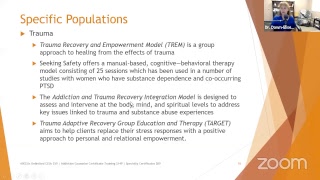
Hey there everybody, and welcome to part seven of treatment of persons with co occurring disorders. And this is based on SAMHSA tip 42. So today we're going to finally move into some really fun stuff and we're going to talk about special settings and specific populations for providing co occurring disorders treatment. So we're going to talk about providing treatment in acute care and other medical settings. And yes, treatment can be provided there. It's actually optimal to provide it there because the client's already there. So if they presented in the emergency room or their primary care physician, you know, why don't we just get them where they're at? So we're going to talk about providing treatments to clients with co occurring disorders in acute settings and sustaining programs with clients with co occurring disorders in acute settings. We'll also move on to talking about dual recovery mutual self help programs and specific populations such as homeless people with co occurring disorders, criminal justice populations, women and people with trauma. So primary care and mental health providers are often not familiar with substance abuse disorders, which can lead to unrealistic expectations or frustrations that can be inappropriately directed toward the client. So if they don't understand why the person is using, if they don't understand why the person can't stop, if they think it's a thing of willpower, if they don't understand the neurochemical changes, then you know, they can be setting themselves up to create a treatment plan that is inadequate for that particular client. So one thing that we as substance abuse clinicians need to do, or addictions clinicians is educate mental health clinicians as well as medical providers. Because you know, when I taught at the University of Florida and the program I went through, there was one class, that's it, one three hour class on working with people with substance use disorders. And that wasn't enough to help people, clinicians that are coming through understand the impact and the breadth of impact of substance use disorders. The same thing is true. And the University of Florida has a rock in medical school. But a lot of the doctors that were going through medical school there only had one, maybe two courses in addictions medicine. Now they could specialize in it, but if they were just going the general route, they really didn't have much training in addictions medicine either. So despite the fact that we think, well, these people have graduate degrees, they're licensed, of course they know, well, you know what they don't. We can't possibly know everything about everything, like I don't know fiddidly squat about speech pathology and you know, there are a lot of issues that I know that I don't know enough about to adequately treat. But it's important that we educate and it's important that we as clinicians continue to try to increase our knowledge. So services that can be provided in medical settings include screening, brief intervention and referral to treatment or sbirt. And I've got that hyperlinked here because it's actually a program through SAMHSA that helps people integrate screening and brief intervention into primary care practices so they can provide more holistic treatment to their clients. So in this particular thing, the Michigan Alcoholism Screening Test or the MAST test, it's a very short test the person can answer and it allows the clinician, mental health or medical, to assess whether that person may have an alcohol problem. And there are bunches of other screening tools out there. So you know, you want to look for substance abuse screening tools. You have the Substance Abuse Subtle Screening Inventory, the sase. You also have the cage, you have the mast. So there are a lot of different very short tools that can be used in the office to screen for any sort of substance use issue. You can provide crisis counseling in primary care and mental health settings. Single session treatment or motivational enhancement. Now motivational enhancement, I've done videos on before and you can find those on our YouTube channel, allceus.com YouTube but motivational enhancement is a four session cognitive behavioral approach to change. That's all it is, four sessions. So you have your introductory session, two intermediary sessions, and then your discharge session. They've shown that it actually does work really well with clients who are motivated for change to change their behaviors. And they've tested it on substance use, smoking cessation, a lot of other different behaviors, but that can be provided in an office. So if you're a primary care physician or a mental health clinician and you want to invite a substance abuse counselor into your office, or if you're a substance abuse counselor and you want to co locate with one of those two professions, that's awesome because you can provide a lot of very cost effective services that will provide rapid improvement. You can provide short term mental health and substance abuse treatment counseling. So if you happen to be licensed in both, you know, you can do this in a medical setting or if you're working in a mental health clinic, obviously you can provide short term substance abuse counseling. Now medication assisted therapy and or ambulatory detox. Obviously as licensed or certified addictions clinicians, we can't do that because we're not prescribers but physicians can get a license in order to dispense certain medication assisted therapy treatments such as Suboxone and buprenorphine. So if this is something they're interested in, physicians can also get trained so they can do ambulatory detox. There are a lot of substances that are very safe for ambulatory detox and that is when the client comes in maybe once a day to have their vitals checked and everything. But they're sleeping at home and they're staying at home instead of being in a detox hospital, so to speak. And we can provide psychoeducation in medical and mental health settings. So there's a lot of different services that we can provide in early intervention and you know, level one type treatment in primary care and outpatient mental health settings that can potentially prevent someone from getting to the point where they need residential care. We can also in these settings screen for people who already need a higher level of care and make that referral quickly in order to help that person start working towards their highest quality of life. In medical settings. We would facilitate linkages to more intensive services when necessary. We need to recognize that chronically ill clients enter periods of stability when little intervention is required. And that's true. Whether it's physical illness or mental illness or substance abuse issues, there are going to be periods of stability. And with substance abuse and addiction behaviors, we hope that period of stability starts and doesn't stop stop. But you know, there can be increases and decreases in motivation. So by being available as sort of a one stop shop for mental health, substance abuse and physical health, then whatever symptoms might be increasing for that person, they can get treated right there. Episodic use of services by clients with co occurring disorders means staff need to be flexible and realize that these clients are likely to return when they're in crisis. So if we provide them a good holistic, all encompassing service, when the client has a need, they will come back. But if they feel like if they get out of the system, then they won't be able to get back in. They may not want to discharge. But if they know that they're good out there and when they start having problems, all they've got to do is call up and we can get them back into the system. It really sets up a scenario where they're actually going to be lower utilizers of services because they will have more confidence that they've got that safety net. It's critical to incorporate program evaluation activities in mental health and medical settings that examine both process and outcome. So are we reaching the clients we wanted to target? Are those clients enrolling and completing services? Are those clients experiencing stability periods with medical, mental health and substance abuse? So we need to set those dashboard goals so we figure out if what we're doing is working or we may need to try a different approach. Each facility, each agency, each community is going to have its own unique needs. Another thing that people with co occurring disorders need in addition to access to primary care, mental health care and substance abuse treatment, is dual recovery support groups. Now, can they go to depression support groups and addiction support groups? Yes, but that's like going to a mental health counselor and a substance abuse counselor and not having them talk because these disorders, these issues interact. It is more helpful if a person can be enrolled in a support group program and a support system that understands the interaction between these issues that the person may have. Dual recovery groups often reduce stigma and prejudice. And what we're talking about here is stigma and prejudice against disorders. Sometimes you will go into a, you know, addiction support group meeting and they'll say, oh, we don't deal with mental health in here. Actually, a lot of times you'll hear that and you'll go in, the person will go into a mental health support group meeting and they go, oh, we don't deal with addictions in here. And it makes me want to pull my hair out. I'm like, there is so much that is similar between the two and if one starts to go wonky, the other one's going to follow close behind. So we need to address them both. So in dual recovery groups, there is a recognition that the people in there have both mental health and substance abuse issues, and that's okay. And it prevents them from getting. Well, it goes a long way to helping to prevent them from getting inappropriate advice. For example, I've heard in a lot of addiction support groups that taking any kind of medication is not helpful and they need to detox from it because even SSRIs create a dependence. And if you look in the big book, there's actually a passage in there that talks about using the recommendations of doctors. You know, you don't. It doesn't say that you can't be on psychotropic medications, but, you know, it's all up to interpretation. But we don't want people who need to be on psychotropic medication or who are struggling with depression or bipolar or schizophrenia to discontinue their medication. That's really bad. So, you know, we have that. And then in the mental health settings, somebody goes in for depression Recovery. And people may give them the advice that, well, once you deal with your depression, your addiction will just go away. You don't need treatment for that. That's just self medication. That's not true either because addiction changes the neurochemical balance. So there are issues with both. And we need to make sure that the group facilitators and the peers understand that it's more complex than that. So dual recovery programs that are out there and there can be some, you know, organic groups in your area that don't fall under these. But some of the more trademarked, if you will, dual recovery groups include Double Trouble, Dual Recovery Anonymous, Dual Disorders Anonymous and Dual Diagnosis Anonymous. So obviously Those are all 12 step programs. Some people have taken to adapting a cognitive behavioral approach similar to Smart Recovery to creating a dual recovery program. It is not Smart Recovery because Smart Recovery is very clear that they don't deal with mental health issues. But in certain areas there are clinicians that have created a cognitive behavioral dual recovery group. Check with your local United Way information and referral check. Check with your local residential treatment centers to see where the dual recovery groups are in your area. Another dual recovery group that I've never seen but probably still exists is called Support Together for Emotional Mental Serenity and Sobriety or stems. And it is a supported self help model for people with co occurring disorders. I looked online and I really tried to find information on this and I couldn't find it. So I don't know if it's gone defunct since this tip was written or what. But the take home is people with co occurring disorders need dual disorder support. It's ideal if they're getting it from a group that understands dual disorders. There are a lot of 12 step programs that do embrace dual disorders, but there are other options out there. So okay, now we're going to move on to specific populations. See, this one's going a lot faster than some of the other sessions that we did. People who are homeless. For most homeless clients with co occurring disorders, the impact of substance abuse and mental illness bears a direct relationship to their homeless status. Okay. And the ability to maintain housing is affected profoundly by substance abuse. I do want to put a caveat on that. Some people do have mental illness. Some people do have co occurring disorders, yet they are still able to make their own choices. They are not incapacitated, they are not unable to do what they need to do and they are choosing. Some people do choose to not be burdened by taxes and housing and bills and all that kind of stuff. Now that's not the majority of them, but there is a significant proportion of people who are homeless who are homeless by choice. And forcing them to take medication or to go into some sort of housing that we deem appropriate is not culturally responsive. So do be sensitive to that because when we're not, then we create a bad vibe with the homeless community in our area because they're like, well, that person just wants to commit everybody, or that person doesn't listen to what we want. So we want to be open and responsive. Approximately 70% of participants in a recent National Institute of Alcohol and Something association demonstration product projects identified substance abuse problems as the primary reason for people's homelessness in both the first and most recent episodes. And some clients I've worked with and have said, yes, substance abuse is the reason for my homelessness because I would rather use and live on the street than not use and have a home. Now does that break my heart? Yes. But is it my duty to tell them they're wrong? No, because they have the right to choose how they live. Supportive housing dramatically reduces the use of other public systems by people who are homeless and have severe and persistent mental illnesses. So if you've got people, which you will, who are homeless, who want housing, who need housing, then getting them into housing is going to be a huge step towards reducing the use of the emergency room and law enforcement and homeless shelters and a lot of other public services. So we want to find out who wants to have what we call a stable roof over our heads and then try to help them access that with a lot of people. And I may be jumping the gun here, maybe not. Okay, for people who are homeless, let's think about some of the issues that might impact them. If they've got co occurring disorders now, if they've got co occurring issues, if they've got an addiction, they can be subject to getting bad drugs. They can be subject to doing things that put them physically at risk in order to get their drugs. They can be susceptible to dirty needles, they can be exposed to people who have tuberculosis. Are a lot of health consequences of homelessness which can increase utilization if they've got mental health issues as well. There are a lot of mental health medications that are very, very sensitive to people's hydration levels and they need to be taken every single day in order to keep blood plasma levels stable. So if you've got somebody that's on one of those medications, which is, you know, really most of them, it's important that the person who is homeless not only has a access to their medication at the level that's prescribed every single day. But we also need to make sure that they have access to enough water and food in order to keep them hydrated and nourished, but especially hydrated. Where I used to work in the summer, the crisis stabilization unit would regularly see a huge spike in in admissions for people who were experiencing psychotic symptoms because their antipsychotics were not at the level that they should be. Because these people, some of them had housing but no air conditioning. And some of them were homeless, but they were getting dehydrated. Some people, and these aren't homeless people, but there are also people who go out to the beach or go out on the boat or whatever and get dehydrated and it monkeys with the plasma levels of their medications. But talking about homeless people here. So it's important that we make sure that the homeless population or people working with the homeless population are aware of special needs that these clients have. When you're providing housing, you can provide it contingent on treatment and drug free urine samples. And one of the programs that we used to have at my clinic was a great program and we did provide housing for people, I think it was for up to two years in order to help them kind of get on their feet after they'd gone through treatment. But they needed to attend treatment which was intensive outpatient and they needed to provide drug free samples or they would potentially lose their housing. So that was the trade off. That was the payment they had to make. They didn't have to pay any money. They had to pay in terms of treatment compliance and drug free urines. You can also have housing integrated with treatment, such as providing treatment at homeless shelters or at recovery residences. Level four recovery residences actually bring treatment services onto the premises and provide treatment there. So even a recovery residence can have treatment at it. Other services that may be needed by people who are homeless, we may need to teach them skills for maintaining housing. Now a lot of clients who are homeless have these skills and they don't need them. But there are some clients, especially people who became homeless or were runaways when they were young adolescents, who may not have some of the life skills that they need to maintain housing. We need to work closely with shelter workers and other providers of services to the homeless so we find out about new people that are in the community. Generally the homeless community doesn't wax and wane a lot. And you know, at least in Florida, there were periods during the year where people would travel down to Florida because it was too cold. Other other places and then during the summer they would travel out of Florida because it was too hot. So you may see seasonal migration, but people tend to come back to the same stops every single time along the way because that's where they know people. And this is their group of friends. Friends. They may not travel in a band of 20, but they know the people that go to XYZ Homeless Shelter in Michigan and XYZ Homeless Shelter in Florida. Okay. So we want to work with those providers to maintain contact with these people who are historically and obviously hard to keep in contact with. You can't just call their cell phone or send them a letter. When we provide treatment, we need to address real life issues in addition to housing, such as substance abuse treatment, legal, impending criminal justice issues, helping them get supplemental Social Security insurance and any entitlement funds that they may be entitled to. Any issues related to their children, including enrolling children in school, health care, housing. There are a lot of children who are living on the streets with their homeless parents. So we do need to pay attention to that and any healthcare needs that the person may have. So there are a lot of wraparound issues we need to pay attention to. And I know you guys get tired of hearing me saying it, but you need to pay attention to that. Maslow's hierarchy, that bottom level, the foundation of health and wellness is making sure that people are getting their biological needs met in a safe environment. Got to do that first before they can start focusing on things like self esteem and practicing assertive communication. Another special population is criminal justice. And there are a lot of reasons for this. Some people who have been in the criminal justice system for a long period of time have become institutionalized. And they know the jail, they know that system, and that's where they're comfortable. They know they get three hots and a cot. They know how it functions. And in some places, like where I came from, a lot of times people knew they had family members and friends who were in jail. So going to jail was not as impactful for them as it would be for somebody who's never been to jail and never been in that. In that situation. So we need to help people develop support systems on the outside. We need to help them develop the skills and tools they need to thrive on the outside, not just kick them out the prison gates and go, well, here's 10 bucks and good luck. Well, that's pretty much setting somebody up to come right back. So we want to make sure that there's aftercare subsequent to prison based treatment to ease any abrupt Transitions. Ideally, they will step down to something like intensive outpatient treatment and then aftercare, but if not aftercare and support group meetings. So they're going somewhere every single day to get support and ease this transition. Ideally a support group with people who have criminal justice histories who can help them, you know, make this transition and understand what it's like to be coming out of jail or prison is ideal. I have a dear friend of mine right now who is mentoring somebody who just got out of prison. And, you know, my friend had been in prison for a while, and it's really helping this his friend to ease this transition because a lot's changed since his friend was actually a free man. Okay. We need to recognize special service needs of the criminal justice population. A lot of times when they walk out of those doors, they can either go back to a dysfunctional environment from which they came, which is probably one of the reasons they went to prison in the first place, or we can help them figure out how to get housing, or they may not even have housing. So we need to recognize that. We need to recognize that life goes on outside of those prison walls for, you know, for everybody else. So when the person is released from jail or prison, they need to recognize that, or we need to recognize that. That there's going to be a huge accommodation period. And their girlfriends may have up and left, their kids may be eight years older, and that's a lot to adjust to. So we do need to help them with family counseling. We do need to help them with reintegration. We need to give positive reinforcement for small successes and progress. Well, that's true for everybody. Clarify expectations regarding response to supervision. So we need to let them know, what is it that your PO expects? Your probation officer or parole officer, what is it that I expect? And if you don't adhere to treatment program rules, what are the consequences? What will I do? So they don't think they can manipulate you into not telling their PO if something goes south. Use flexible responses to infractions, though. You got to consider the whole person. Are they doing their best? Are they trying? But. But you've also got to keep a lot of people who are coming out of jail criminogenic. Thinking is one of the traits of it, is being an expert manipulator. So it is really important to be flexible, but also to not be taken advantage of and have the will pulled over your eyes. Give concrete, not abstract directions. A lot of people who are in the criminal justice system have not all by any means, but enough that we need to consider it. They have some cognitive issues, partially due to fetal alcohol spectrum disorders. You know, if they, if their mother drank while she was pregnant with them, it can cause some brain damage, which contributes to an increased likelihood of being involved in criminal justice. So we do see a greater proportion portion of people in the criminal justice system with fetal alcohol spectrum disorders than we do in the free population. Design highly structured activities for the criminal justice population. What are we going to do? Why are we going to do it? What's the benefit? What's the mutually agreeable goal? We're working on and provide ongoing monitoring of symptoms. Unfortunately, a lot of prisons and jails will get somebody in who may be on psychotropic medication, antidepressants, mood stabilizers, whatever, and in order to save money, they will discontinue that medication. So the person becomes unstable. They were stable on their meds or relatively stable on their meds. Now they don't have the meds in their system which they need, and they're unstable. Well, then the person's time comes and they're released from prison or jail. They haven't been started back on their meds. And remember, a lot of these meds take four to six weeks to really take effect in the person's system. So you know, it's a problem because that first six weeks they are just really on pins and needles. And you might ask, well, why do they do that in the jail? Well, to save money. And the only way the person gets put back on medication in many jails, not all, is if they are a behavior problem. So if the person is not suicidal, homicidal, or actively aggressive when they're not on their meds, they're not going to get their meds. That's a problem. We do need to advocate for clients who are in the criminal justice system who were under our care and advocate for them to get their medication, Even if that means contacting the pharmaceutical company, getting them on a patient assistance program. So the pharmaceutical company will provide free meds while they're in jail? It happens sometimes, but anyway, I digress. That's obviously one of my little soapboxes. Another specific population is women. Specialized programs for women with co occurring disorders have been developed to address pregnancy and childcare issues as well as certain kinds of trauma. The mother baby unit that was in my organization, we had 15 rooms that could accommodate obviously 15 moms with their children. And that enabled a lot of women who had young children and pregnant women who had other children to enter treatment and be in a safe environment while they were pregnant and six months postpartum, which was wonderful because it allowed us to help that mother have a, you know, ideally have a baby that was born without drugs in its system or, and or work through that initial six months. That can be so trying and where there's such a high risk of postpartum depression. But women also have, you know, specialized issues in terms of mood hormone changes and trauma that aren't going to be the same for guys. So we do need to be aware of some specialized issues that women may face. Women who enter treatment sometimes risk losing public assistance, support and custody of their children, which means a lot of women will not go to treatment because they're afraid they're going to get the department of children and families involved, lose custody of their children and not be able to pay for anything to feed their children. So we need to look at what the consequences are and try to help women in a way that's meaningful to them. Before specialized programming, women only accounted for 20% of group attendance, yet made up 40% of the census in a large integrated co occurring disorders treatment program. So, you know, about half of them weren't actually going to group once they started doing specialized groups. More women were attending treatment for substance abuse. In Women should emphasize the importance of relationships, the link between relationships and substance use and the importance of relationships with children as a motivator in treatment. What we mean by that is emphasizing the fact that they can be the parent that they want to be and they know they can be when they're clean and sober. I have some asterisks here next to this bullet point because I do want to point out that the same can be true. Same can be true for men. You can emphasize to men that, you know, getting clean and sober is going to help them be the fathers that they want to be. So it's not just a woman issue here, but we do need to. With women we tend to be more focused on relationships than men, but that's a gross generalization. So you know, do just be cognizant and say parents here. The stigma attached to females who abuse substances functions as a barrier to treatment, as does lack of provision for children. So a lot of women I worked with had an inability until we started that program. And even then if they weren't pregnant, they couldn't get into it. So a lot of non pregnant women with children couldn't get into residential treatment because they had nothing to do with their kids and there was nowhere that they could put their kids for 45 days. So we need to look at options here, such as partial hospitalization programs that offer on site daycare that can provide services for this population. Women and men have different coping mechanisms and symptom profiles. Compared to men, women with substance use disorders have more mental health issues like depression, anxiety, eating disorders and PTSD and lower self esteem. So those are issues. That doesn't mean that men don't have any or all of those, but the percentage is higher, or at least we think the percentage is higher in women. Women with substance use disorders have more difficulty with emotional problems and men have more trouble with functioning, such as keeping a job, managing their money and legal issues. At least that's what the book says. In women, worsening symptoms of mental illness can result from hormonal changes that occur during pregnancy, lactation, discontinuing lactation, and medications given during pregnancy or delivery. So we do want to be aware of what's going on there. But also, and again, the asterisks are back. The stresses of pregnancy, labor and delivery and adjusting to bonding with a newborn can worsen mental illness symptoms as well as sometimes substance abuse symptoms in both parents, not just women, because they found that men can experience postpartum depression as well. Because there's a lot of adjustment that goes on. Women with co occurring disorders sometimes avoid early prenatal care, have difficulty complying with healthcare providers instructions, and are unable to plan for their babies or care for them when they arrive. Now a lot of this is when we're working with women with severe and persistent mental illness. If they've got schizophrenia that is not well controlled, if they've got cognitive deficits, there are things that can prevent women from being able to effectively plan for their babies. That does not mean, and I want to underscore that, that does not mean that all women with co occurring disorders can't plan for their babies. Because I have worked with a lot of women with co occurring disorders who did just that. They planned for their babies and actually did just fine. In fact, my cousin was using when she found out she was pregnant and she is just like one of the best moms I've ever seen. She's awesome. So it's important to understand that these are things we need to be aware of. But this does not necessarily describe every single client. When people are parenting, it can often retrigger their own childhood traumas. So we need to balance growth and healing with coping and safety and be alert to inevitable issues of guilt, shame, denial and resistance to dealing with those issues. So, you know, if a guy was abused when he was a boy. You know, it can trigger issues when his son or daughter is that same age. Or just bringing a baby into the world may trigger some of those issues. So we do need to be aware that this is more of a parent special issue than a woman special issue. Now, pregnancy, Many psychopharmacological drugs, as well as psychoactive substances can hurt the baby. If you've had a baby, you know, the doctors are like, you can't take anything. Mothers should be screened before delivery for any substances for which the baby may need to detox. That way they can prepare and nicu bed ahead of time instead of having a baby come out and suddenly start going through withdrawal symptoms and create a medical crisis. Some substances, such as opiates and methadone are considered to be not safe to detox a pregnant woman from. You need to wait until after she's had the baby. And there are white papers on treating pregnant women with opioid use disorders that really address all the reasons for this. But just be aware that it can kill the fetus if she detoxes from opiates or methadone while she's pregnant. So it needs to be, you know, the doctor needs to be aware of what's going on. Pregnant women should be made aware of any and all wraparound services to assist them in managing newborn issues, including food, shelter, medical clinics, and inoculations. Help with breastfeeding if necessary, and as well as programs that can help with the developmental or physical issues the infant may experience as a result of alcohol or drug exposure. In most places, this is called your early intervention program. And if a child is born to a mother who has a history of substance abuse, who was using it anytime during the pregnancy, even if the baby is born substance free, there's a risk that there may be some developmental delays. So oftentimes, the early intervention team should be called in as quickly as possible to do their assessment and start providing intervention services as quickly as possible. Postpartum or maternity blues affects up to 85% of new mothers. And it's more so if the woman is detoxing. And I used to feel so bad for the women in my program who were on methadone while they were pregnant. They gave birth, and then our doc detoxed them really quickly. I mean, he stepped them down really quickly from the methadone. And so not only were they tired from giving birth and having a baby that's up all the time, but they were also having all those hormone changes and detoxing and, you know, everything all at Once and you know, it was rough for every single one of them. Postpartum depression affects between 10 and 15% of new mothers and can begin up to four weeks postpartum. So it may not be as soon as you have the baby. It may be after about four weeks. One thing to recognize, and I have a whole video on postpartum depression and life in the NICU is another video I have, but a whole video on postpartum depression and recognizing postpartum psychosis on our YouTube channel. But ego dystonic scary thoughts where the woman has these thoughts of harming her baby or harming herself and they freak her out. I don't want to say that's okay because it really sucks for the mom, but that's not a sign of postpartum psychosis. And a lot of mothers have these scary thoughts and they think, oh my gosh, I'm such a bad mother because I'm having these thoughts. And you know, it's important for her to talk about them, but it's also important for us to be educated about the difference between postpartum depression and, and scary ego dystonic scary thoughts and postpartum psychosis and what they call ego syntonic scary thoughts. And this is when the woman is having these thoughts of harming her child or doing things to her child like bathing them in scalding water that make complete sense to her. She sees the baby is dirty and thinks he needs to be sterilized or something and they make complete sense to her. So we do want to listen to those things and even thoughts like the child would be better off dead because I'm not a good parent if this makes sense to her. We do want to be very, very alert to what's going on and refer to for a psychiatric evaluation. Postpartum psychosis develops about one out of every 500 to 1,000 births and is more common if the mom has had a psychotic episode in the past and that includes depression with psychotic features, schizophrenia, or has bipolar disorder. So if mom has had any psychotic issues in the past or bipolar disorder, we need to be extra alert with women. We need to identify and build on each woman's strengths. Avoid confrontational approaches. Supportive interventions are preferred for women and generally for people with co occurring disorders, especially in the early stages of treatment, because their mental health and their substance abuse issues are probably very tenuous at that point and we need to provide that support and encouragement because it hurts and it's hard. We need to teach coping strategies based on a woman's experiences with A willingness to explore the women's individual appraisal of stressful situations. So not telling them what to do, but saying, okay, what about this situation is stressful to you? What do you find threatening, scary, stressful, and what do you think the best way is to deal with it? You know, how have you dealt with similar situations in the past? Use a lot of solution focused, strengths based talk when you're working with women. Arrange to meet the daily needs of the woman, such as childcare and transportation, in order to increase treatment compliance and have a strong female presence on staff that promotes bonding among women. We want to encourage women to feel comfortable talking to one another, not to be jealous and envious and, you know, suspicious of one another. And so sometimes that takes some time because the environments that they grew up in may not have been very healthy. We need to offer program components that help women reduce the stress associated with parenting and teach parenting skills. This is again true for both men and women. We need to have programs for both women and children because we want to break this cycle of mental health and substance use issues. We want to provide interventions that focus on trauma and abuse because the rates that women experience trauma are pretty high. And if you have looked at the Adverse Childhood Experiences survey, you also know that the rates of trauma for anybody, regardless of gender, is really high. So we need to have a program that is grounded in a trauma informed approach. We want to foster family reintegration and build positive ties with the extended kinship or family if that's what the woman wants. If not, we want to foster family reintegration with whomever she defines as her family. We want to build healthy support networks with shared family goals and make prevention and emotional support programs available for children. Again, to stop this cycle and finally trauma, I said we need to have everything grounded in a trauma informed approach because the expectation is most people have experienced a trauma or more in their life. The Trauma Recovery and Empowerment Model, or trim, is a group approach to healing from the effects of trauma. Another approach that can be used is called Seeking Safety, which offers a manual based cognitive behavioral approach consisting of 25 sessions that's been used in a number of studies with women who have substance dependence and co occurring ptsd. The Addiction and Trauma Recovery Integration Model, or atrium, is designed to assess and intervene at the body, mind and spiritual level to address key issues linked to trauma and substance use and finally, target. The trauma Adaptive Recovery Group Education and Therapy program aims to help clients replace their stress responses with a positive approach to personal and relational empowerment. Now, these are techniques for dealing with trauma. A trauma informed approach involves much more than this and I encourage you to check out the videos on our website on Trauma Informed Care as well as SAMHSA's tip 59. I believe it's either 57 or 59 that goes over Providing Trauma Informed Care is an excellent read and is actually not overly dry and clinical. I found it to be a page turner, but maybe that's just me. Okay, so in summary, it is important to ensure that treatment is available to clients with co occurring disorders in acute care and other medical settings as well as traditional mental health settings. Dual recovery mutual self help programs are essential and they're tailored to meet the unique needs of the person with a co occurring disorder. Specific populations have unique issues which need to be accommodated in agency programming in order to facilitate their success, and these populations can include homeless persons with co occurring disorders, criminal justice populations, women and individuals who have experienced trauma. Like I said, there are a lot of more in depth videos on several of these topics on our YouTube channel allceus.com YouTube or if you prefer a podcast, you can subscribe to Counselor Toolbox Podcast on your favorite podcast player and download the same things as a podcast version. All right, thanks for being with us today.










