Cultural Competence Part 2 | Counselor Toolbox Episode 143
Dr. Dawn-Elise Snipes explores how client and clinician worldviews shape illness definitions, diagnoses, and treatment goals. She covers SAMHSA's Listen/Explain/Acknowledge/Recommend/Negotiate framework for intake, culturally informed assessment including community norms and diagnostic biases, and when to refer based on your own cultural gaps.
Chapters
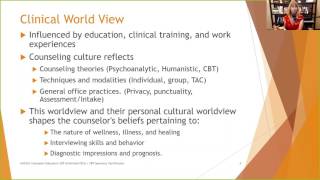
This episode was pre recorded as part of a live continuing education webinar on demand. CEUs are still available for this presentation through all CEUs register@allce.com counselortoolbox. I'd like to welcome everybody to Improving Cultural competence based on SAMHSA TIP 59 and this is part two of three. There is a lot of stuff in that TIP and TIP stands for treatment Improvement Protocol. It's put out by the Substance Abuse and Mental Health Services Administration. You can order the hard copy for free. You can read it online if you're interested in getting more information than what we have in the three hours of presentation that comprise the three parts of this series. In this presentation we're going to define clinical worldview, and it's something that I found relatively interesting. We'll discuss how our clinical worldview impacts treatment, case formulation and rapport development, explore questions to consider when developing the case formulation and treatment plan, and finish by learning how mapping the client's cultural views and influences can help us, as well as clients, develop insights into current struggles and clarify culturally relevant goals. And I'll start by saying this is a conversation that comes up a lot when I've been talking to different professionals. What do you call the people whom you work with? Clients? Patients? Consumers? I tend to like the word client because lawyers have clients and you know, a lot of different professions have clients. And a client, in my view, is someone who has the ability to choose which service provider to use. So, you know, it kind of puts them at a position of power in choosing whether or not to use my service or the service of the clinician down the road. Some places, especially your accreditation agencies, may prefer that you use the term consumer. And that's cool too. And some people with whom you work may have a different term that they prefer being used as referred to. So it's important to ask, or at least if you're referring to somebody as clients, helping them understand that that's not a term that's intended to be pejorative. And you know, if they feel that way, what would they prefer to be referred to as anyway? The term worldview refers to a set of assumptions that guides how we see, think about, experience, and interpret the world. So, you know, we talked about that last time to a great extent. And each of us has our own worldview based on the different cultural groups to which we belong, our geographic location, our family history, all kinds of things. Things have shaped how we perceive the world and approach the world. And what's important, our worldview is shaped by Significant relationships, our environment and our life experiences. So even if you have a similar background to somebody else, you may have a very different worldview. If you have different life experiences bearing that in mind, not assuming that everybody who came from your same hometown or whatever are going to have the same approach to life and things. Influences on your worldview, your values, attitudes, beliefs and behaviors. Obviously the concept of time, your worldview really influences what you consider punctuality. My stepfather was, my first stepfather was first generation Italian. And whether this is a cultural thing or it was just a hymn thing, he was much more lackadaisical about time. You know, if he said he was going to be there at 7:30, that could mean 7:30, 8:30, 9 o'. Clock. Usually it was within an hour and a half, but it wasn't 7:30 to 7:35 and we just got used to that so we could kind of prepare ahead of time. The definition of family is important to understand. How does your worldview help you define what family means? You know, family to me may mean something different than family to an adolescent who's been living on the street for the past four or five years. They may consider a lot of non blood relatives as their family and have want to have nothing to do with their blood relatives who they don't consider even part of their family anymore. So we want to ask who is your family? And if they don't know how to define that, you know, that's something we can talk about in treatment, but when we look at level of care guidelines, it does talk about incorporating family in treatment whenever not clinically contraindicated. So again, we need to ask them what do they consider, who do they consider family and how do they want family involved in their treatment process? Because that's going to be important. They may believe that family should be really involved. They may not want family involved at all. Your worldview influences your organization of priorities and responsibilities. Are you more family and group oriented or are you from a more individualistic worldview? Your orientation to self, family and community, when you make decisions, is it based on how it's going to benefit you and your goals, your family and your familial goals, or your community in general? We want to look at that because that's going to guide what our treatment goals really are. Their religious and spiritual beliefs are influenced by worldview and influence our worldview. It's important that we ask people about that, but not make them feel necessarily like there's something wrong with them. If they say I'm not spiritual and I'M not religious. I'm a nun, which is a new term, and we won't go there. I've got bunches of other classes coming up on cultural approaches to working with people from different spiritual backgrounds. But ideas about success, what one person defines as success may be very different. My best friend and I define success very differently. His definition about success is very much centered around how much money he makes, how big his house is, and what kind of car he drives. That's not so much how I define success. Not that his is wrong, but when we're talking about making decisions on a day to day basis about what's important and what makes us happy, we have different approaches and different things that are important to us. Our clinical worldview, and this was a really interesting part of the chapter that I hadn't really thought about in this way. I mean, I thought about it, but I hadn't really thought about it. Our clinical worldview is influenced by education, clinical training, and work experiences. So think about our counseling culture. What counseling theories you choose are going to have a definite approach or a definite impact on your interaction with clients? And I just picked three out of the psychoanalytic, humanistic, or cognitive behavioral. Very different approaches. And depending on your client's worldview, one may be much more appropriate than the other. Some people do not respond well to cbt. And as we talked about last time, for example, military and law enforcement tend to respond much better to CBT than necessarily psychoanalytic, which is, you know, free association and all that Freudian stuff. But there are a lot of people who respond really well to humanistic the thought that if they are able to talk and receive unconditional positive regard, they can clear their own blockages. Some people think that that's too slow and really want something that's more active and directive. So we want to pay attention to how our theories and our approach to counseling impacts and works with people. I got my master's degree in vocational rehabilitation. So there's a lot of emphasis in vocational rehab and rehab counseling in general. In terms of looking at the whole person, looking at what they need in terms of transportation, in terms of making sure that they can get to work, in terms of reasonable accommodations, which we don't talk about. Well, at least in the program that I went to for counseling for my doctoral program, when we were working, when I was working on my LMHC courses, we, we didn't look at that at all. We looked at counseling mental health thought processes. So we want to look at the differences in our approaches One's a more holistic approach, one's a more cognitive approach, not necessarily better or worse, but understanding how our own training impacts how we conceptualize people's problems. You know, I tend to, when I look at, to encase conceptualization, I tend to look at the whole person and I turn, tend to look at the stressors and any physiological factors that may be going on, like chronic pain that's contributing to it. Whereas somebody who came from a different training program may not have even been educated about how those things could impact thinking about that. Our techniques and our modalities. Some of us are very comfortable with individuals, group and technology assisted care. Other people may not be making sure that the techniques and modalities that we use that we think are effective in a counseling practice, in a counseling situation, fit and work for our clients. Not everybody is going to be comfortable with technology assisted care. Some people will prefer that over individual or group, and we talked about that in the first session. And our general office practices such as privacy, punctuality and assessment and intake, we really want to look at from the minute that client contacts our agency on the phone or walks in our door, what message are they getting about how much we respect them, how open we are to different points of view, how what? The power differential is one of the things that always frustrated me and my staff got tired of hearing about it. So new staff would have to be acculturated to working in our facility. But when a clinician would call a client back, number one, call them by their first name, which is not necessarily culturally appropriate, and then walk in front of them, leading them down to the clients wherever their office is indicated a distinct power differential. Now that may not be bothersome in some cultures. However, I felt it was important to at least have the clinician and the client walk side by side down to the counseling office so they didn't feel like they were being led into the principal's office or something where there was going to be a significant power dynamic and they had less control. I want them to feel welcomed and I want them to feel empowered. Punctuality is another thing. When people come into our offices, you know, if they're from a culture that is a little bit more free flowing with time management, how do we respond to that? If they're 10 minutes late, do you reschedule their appointment? What happens there? Likewise, if we run over and we run 10 minutes late, what does that communicate to the client about their stance in our mind and about their power in the relationship? So thinking about things as simple as, like I said, how you walk a client down to your office, what you say to them, how you greet them, what kind of arrangement your chairs have, whether the client will feel comfortable or not. Those are all important things to kind of look at and consider based on your population. Now everybody's. Wherever you work, your offices are going to be different. You're going to be dealing with different populations than necessarily I deal with. So I look at it in terms of the people that I serve. The worldview of the client and the worldview of the counselor need to work together. A client's worldview shapes their beliefs and ours too. You know, our worldview shapes our belief regarding the nature of wellness, illness, and healing. Like I said before, you could come from a training program that taught you that if you implement unconditional positive regard and you provide CBT skills and yada, yada, yada, the client will improve. You may have gone to another program that said, well, yeah, we need to provide that, but we also need to consider the Maslow's pyramid and make sure they're getting their basic needs met, they're getting enough nutrition, they've had a physical to rule out any physiological causes of their depression or anxiety, such as thyroid issues or something else. So the nature of illness, what causes depression varies greatly, probably Even among the 10 people that are in this class right now. So it's important to think about, where do you think depression comes from? What do you think causes anxiety? What do you think causes addiction? And I remember doing a paper on that my first semester in graduate school, and I found it so helpful to. To be able to articulate where I thought that came from. And, you know, four years later, I looked back at it and I said, oh, I knew so little. And I expanded upon it. But knowing my. Where I think this stuff comes from, I'm able to tell a client, this is what I believe. Now tell me what you believe. A lot of times if you ask them, what do you think causes depression? They're going to look at you like, well, you know, I've had a lot of really bad stuff happen in my life, and that's true. But if you give them a model of the different, so they can see that where there might be different causes of depression, or maybe you think there's only two or three, whatever it is, they will understand more. The question about where wellness and illness and healing come from. Are they a group that believes that healing comes from combination of physical and spiritual? That's important to know. Otherwise, you're, you Know, think of a three legged chair and if you're only reinforcing one of the legs, the chair is probably going to fall eventually. So we want to know what's important in the client's mind in terms of what's causing their current distress and what needs to be addressed to improve their current situation. Our interviewing skills and behavior is obviously going to be shaped by our worldview and their response to us is going to be shaped by theirs. So generally when somebody comes into a clinician's office, obviously there is a power dynamic. There's just no way to get around that. How you approach the client, whether they feel comfortable, all those things are going to impact how the two of you mesh and the behavior. In the initial, in the initial interview, the more aware we are of culture and the more culturally sensitive we can be, we're going probably to have better success at getting a good rhythm going, if you will, at establishing rapport. And diagnostic impressions and prognosis are also going to be greatly shaped by not only our worldview because what we think in our culture, whether it's a clinical culture, you know, we look at the DSM iv, we say this is. If they meet these criteria, then they've got XYZ diagnosis. Well, they could. Or they could have, you know, ABC diagnosis over here. Because there sometimes is some overlap depending on your point of view. Whether you look at health causes, whether you look at spiritual causes, whether you look at just, you know, DSM causes is going to shape whether you think somebody meets diagnostic criteria. And culturally, things that we may perceive as diagnosable, if you will, or symptomatic in one culture may be very culturally appropriate in the person's culture of origin to which they ascribe. We want to talk to them about what they see as problematic. They may say, I was referred here because of this, that and the other. Okay, so your boss told you you had to come because you were being loud and aggressive and something else. I don't know. So then I want to know, what is your perception of that problem? That's always my second question. What brings you here? What's your perception of the problem? What do you think causes it? And what do you think needs to happen in order for it to improve? And they don't always know those answers, but I want to have an idea of where they're coming from because, you know, it doesn't do much good if I just start telling them a lot of stuff if I don't know enough about them, need to get more information and they've lived in their skin for a lot longer than I've known them. So they're the experts on themselves. The worldview that we have and the worldview the client has influences the definition of normal versus abnormal behavior. So what one client may consider normal and we may consider abnormal, or vice versa. It's important to talk about the determination of treatment priorities may be different between two clinicians, let alone between clinician and client. So it's important for the client to be able to, if they feel comfortable, articulate what their treatment priorities are. Now, some cultures defer to the expertise of the clinician or the physician. They put us in a power role. And so you've got to figure out a way to work with those clients in a way that's meaningful to you, where you don't feel like you're just telling them what to do, but it's respectful of the fact that culturally they are deferring to you and going, you're the expert. Help me figure out how to get better. The means of intervention is also going to be important. We don't know them from Adam's house cat, probably when we're doing the initial intervention. And, you know, you can glean and make some assumptions, broad, gross assumptions, based on where you live, you know, generally the community around you, based on race, ethnicity, and other things, but you may or may not be right. So we have those schema, and then we've got to decide if those are right. When we're looking at interventions, which most of the time, when I'm working with clients, I will talk about what I think needs to happen, and then I ask them what their perception of that is, and if they think something different needs to happen, what they're comfortable with, and if they're not comfortable with something that I've recommended, then we might talk about why they're uncomfortable with it. Then consider what to do from there. For example, if I refer somebody to residential treatment, whether it's for mental health or substance abuse, if they're not comfortable with that, I want to understand why. Is it because they've got two children at home and they're a single parent and they don't know where their kids would stay, that's different than believing that residential is not an appropriate fit for them because they will not feel comfortable in group? So we want to look at the means of interventions that we suggest that we're comfortable with, make sure the clients are comfortable with them, willing to at least try them. If, you know, if we go down that road and what do they define as a successful outcome? And this is interesting because when I work with clinicians, especially new clinicians who haven't written treatment plans before, and obviously on a treatment plan you have a goal statement. Well, the goal is remission, for example, remission of depression as evidenced by or elimination of depression or improvement in mood as evidenced by. So as evidenced by what if your client is happy? What does happy look like to them? What does less anxious look like to them? How will we know? So we want to be able to work with the client to define what they are hoping for in their quality of life and not just put on them the antithesis of the DSM 5 diagnosis. So cultural awareness and non malfeasance Counselors must engage in self exploration, critical thinking and clinical supervision to understand their clinical abilities and limitations regarding the services that they're able to provide, the populations they can serve, and the treatment issues that they have sufficient training to address. So a couple of them that come up frequently, if somebody comes in to see you and you have had, you know, you are a great mental health counselor and they come in and they say, I'm a sex addict, can you treat them? Well, unless you've had training in that area, you likely don't have enough education to be able to ethically serve them without, and here's the caveat, without supervision while you're doing it. So sometimes, especially if you work in community mental health or if you're working in a detox unit and you're trying to help a client out, you may not be able to pick and choose the clients you treat and say, well, I don't have the training to address that. So you may have to get supervision from somebody who does have that training. Go through the treatment plan, talk about each session, you know, back to before you were licensed, type of supervision, other things that may come up. If you're dealing with something like LGBTQ issues, you may have a general understanding and you can work with that person on certain issues. But there may be certain issues, such as coming out or dealing with racial prejudice that you don't have. You don't feel you have enough training or knowledge to be able to be effective and supportive. So you may need assistance from either a supervisor or another counselor that can provide guidance on those issues. Cultural competence requires an ability to assess accurately one's clinical and cultural limitations, skills and expertise. Counselors risk providing services beyond their expertise, which is an ethical issue if they lack awareness and knowledge of the influence of cultural groups on client counselor relationships, clinical presentation, and the Treatment or process, or if they minimize, ignore, or avoid viewing treatment in a cultural context. So basically, that's a big, long spiel. There are a lot of situations. When I lived in Alachua, which is just outside of Gainesville, the Hare Krishnas had their national headquarters there, and there was a significant population of Hare Krishnas. I had a couple of Hare Krishnas come to me for treatment. I was working in private practice at that point, and the issues they were dealing with were significantly integrated with their culture. So it was important for me to get supervision because I knew that, you know, just spouting off random stuff that I learned in counseling wasn't necessarily culturally sensitive or appropriate. So we would talk, and if something would come up in session that I didn't know what their culture, how their culture perceived something, obviously I would ask them there, and that's. You can work with that. But at the outset, I let them know that I don't have a lot of education on the Hare Krishna culture. So if you want to see me, you know, we can work together, and I will get supervision, you know, to try to help you the best I can. But I want to make sure that that's out there at the beginning. Sometimes you're going to be working in a position where you would be asked to be working with someone for whom you don't have the training or expertise, and you don't want to abandon the client. You don't want to say, well, I can't see you, so good luck. We want to be able to provide referrals. But if you feel that it's so far afield and you won't be able to get supervision and you won't be able to provide ethical, effective services, then it becomes an issue. Tennessee House Bill 1840 came up, I believe it was last year, and it caused a big hubbub in the state of Tennessee because it said that, and I can't quote it exactly, that clinicians did not have to serve people if the client's views significantly conflicted with the deeply held beliefs of the clinician. And, you know, that could be taken way out of proportion. That was very broad language there. However, there is something important in there to point out the fact that if you are completely ignorant of somebody's culture, it may not be ethical to provide treatment to them unless it's just absolute necessity to prevent abandonment, etc. So there's a guideline there that we need to use our best judgment. We got into this field to help people, not hurt them, and we need to know when we are effective, you wouldn't find a physician who was an orthopedic surgeon trying to do brain surgery. You know, if somebody comes to them and they say, I've got a. I've got a brain tumor, they're going to refer to a brain surgeon. So it's important to understand our own professional limitations based on. Based on our knowledge. So learn at intake. SAMHSA likes acronyms as much as I do. I think L stands for listen to each client from his or her cultural perspective, including their perception of the problem and treatment preferences. Explain, preferably before listening to the client, the overall purpose of the interview and the intake process. I tell them what we're going to do from the beginning. I personally, and this may not work in your organization, or you may not agree with it ethically. I tell clients anything I write down, they can read. When we're going through the intake, one of the most unnerving things for me is when I'm talking to a physician, they're just sitting down there scribbling madly. I'm like, oh, Lord, what are they writing down? I don't want clients to feel that way. So I want them to know, at least in my office, they can read whatever I'm putting down in the intake, and if they disagree with it, we can talk about it. And I also explained to them at the beginning that at a certain point, I'm going to have to switch over to filling out these forms. And I'm not trying to be disrespectful. I want to know about them, which is why I spend the initial part, five minutes or so, getting to know them. But we have to keep on a time schedule, you know, for the organization, and I really want to make sure that they get the best services possible. So listen, explain, acknowledge client concerns, and discuss the probable differences between you and your clients. With one of the people that I worked with in Alachua who was a Hare Krishna. She came to me because she was having marital issues. And, you know, that was. Not only do I know nothing about their religion or little to nothing about their religion and their culture, how to advise her on marital issues was way over my head. So, you know, I put that out there at the beginning about what I knew, what I would try to do, and whenever something would come up. In counseling with any client, I own my perceptions, and I say, you know, this is my perception of what causes depression or what may be causing your depression. Let's talk about what your perception is. And, you know, if we have differences, that's okay, but so we're all on the same page. We want to take time to understand each client's explanatory model of illness and health. So if they feel, for example, that this current problem they're experiencing is a punishment by God, okay, you know, I'm not going to tell them, well, no, there's this other explanation for it. We're going to look at what they believe and how they believe it needs to be addressed. And that's just culturally appropriate. Recommend a course of action through collaboration with the client, including how much involvement he or she has in the planning process. Like I said, some cultures are not down with that whole mutual participation. They see you as the expert, they're paying you a bunch of money, they want you to fix them. I tell my clients at the beginning I can provide guidance, but I need some input from you on what's working in order to make this program work. So I try to maintain, if they want me to maintain that expert role, I can most of the time with the people I work with. They're happy to have a more collegial or interactive role and negotiate a treatment plan that weaves the client's cultural norms and life ways into the treatment goals, objectives and steps. What do they want? What does recovery look like for them? I don't want to put them into a drop down menu where everybody does this step or everybody does that step. What looks like, what looks normal and happy for you? So listen, explain, acknowledge, recommend and Negotiate and Respect. Another acronym, Understand and reflect how client. How respect is shown within a given cultural group through verbal and nonverbal communications. There are certain communicate certain cultures where just depending on how your if your toe is pointed at somebody or away from somebody, it's considered a sign of respect or disrespect. Understanding that with the culture within the cultural groups that you work is important. Understand how respect is shown to clients, whether direct eye contact all the time is appropriate. A lot of this you learned in basic multicultural when you were in grad school. Explanatory model. Devote time to understanding how clients perceive their presenting issues. And I crossed out the word problems. SAMHSA uses the word problems. That's cool if you're good with it. I personally like the word issues because it's only a problem if the client sees it as a problem and it could just be an issue. Problem seems pejorative and more diagnostic than I like. What do they see as the origin and impact of their issues and how do they think it's best to address them? What's the best course of treatment? They've probably done some research. Even if they've been asking their friend or their auntie or somebody. What did you do? Understand the sociocultural context. How class, race, ethnicity, gender, education, socioeconomic status, etc. Affect care, affect how they, how willing they are to go to receive services, how comfortable they feel in your office, what types of things they're going to participate in, what the cultural thoughts are about illness and wellness, etc. Power. Acknowledge the power differential between clients and counselors. Even if you try to make it as to minimize the power differential as much as possible, there's always going to be one. I mean, most of us have more education than our clients most of the time, which can be seen as a power differential. Even if you're working with somebody who has equal or higher education, they're telling you some of their deepest, darkest secrets. So they are empowering you in some ways, recognizing that no matter how you slice it, we do have power in the relationship and we want to acknowledge that and try to be as respectful as possible. Empathy. Express it verbally, non verbally, so the client feels understood by you, whether it's not making direct eye contact, giving them their silences, whatever is appropriate for that client. Talk about their concerns and fears regarding help seeking behavior and the initiation of treatment. What's your biggest concern or what do you think your biggest hurdle is going to be in participating in treatment? Congratulating them on having the courage to come into treatment. I generally do that regardless. And then, you know, asking them if they have any concerns or fears about participating in the process. And develop a therapeutic alliance and trust. Commit to behaviors that enhance the therapeutic relationship, recognizing that trust is not inherent, but must be earned. They're going to come to us. Some clients will see us as part of a larger oppressive system. Some clients will see us as people who are experts, who are there to help them. Some people will see us as people that may or may not be able to help them out. We have to earn their trust. All of us probably have a different approach to establishing rapport, but you probably wouldn't walk into someone's office, whether it's a physician or a psychiatrist or a cpa, and automatically just start putting all your private and important information out there without establishing some sort of trust to know that they're not going to harm you in some way. Considerations during assessment the patterns of substance use and treatment seeking behavior specific to people of diverse racial and cultural backgrounds. So we need to know how common is it for people in this general culture, obviously it's a broad schema. We don't know if they're fitting into it. But in general, in this culture, how likely are they to seek treatment? What types of treatment do they want? How can we be as socially and culturally responsive as possible? And the age of the people may also have a huge impact on what they see as oppression, appropriate treatment, what they see as whether treatment is appropriate at all, and what they see as appropriate treatment goals. What are their beliefs about treatment, including expectations and attitudes toward health care and counseling in general? Do they see it as something worthwhile? Do they think they would get more benefit from going to see their spiritual leader? We want to understand this. Some people are there because they're at their wit's end and they don't know where else to go. So let's understand what their concept of healing is and maybe we can help integrate some other people into the treatment team to make it more responsive to their cultural needs. Community perceptions of behavioral health treatment if you're in a community, whether that be, you know, maybe you're in a community that thinks that, you know, if you're going for mental health treatment, I don't know, you may be in another community where mental health treatment is widely accepted. Understanding what the community perceptions are, because that's going to shape partly your office and whether you have people coming and going through the waiting room or there's a back door they can go out and a private entrance. One of the clinics that I worked at, we worked with some high profile individuals who were not willing, didn't feel comfortable coming through the front door and through the lobby where there might be other clients waiting. So we did have a VIP entrance for people who felt uncomfortable and they could leave by the same, by the same entrance. Obstacles encountered by specific populations that make it difficult to access treatment, such as geographic distance from treatment services, transportation, child care, timing. If you have banker's hours and you've got somebody who works bankers hours, and especially if they're an hourly employee, and if they take time off, they don't get paid. That's a huge problem. If they're a single parent, they may have issues with child care. So we want to ask them, what obstacles, hurdles do you have getting here? One of the programs that I worked at was an evening intensive outpatient program and the buses stopped running at 7 o', clock, but our program ran till 9. So obviously we had to figure out, you know, if somebody was going to come to that program and they didn't have their own Transportation. How are they going to get to and from treatment? We don't want treatment to add additional stress. We want to empower them to problem solve, of course. But we do want to be sensitive to the fact that some people, you know, this was a substance abuse treatment program. Some of these people had lost their license because of drunk driving and you know, if they couldn't ride the bus, they didn't really have many other options. Patterns of co occurring disorders and conditions specific to people from a diverse racial and cultural backgrounds. Let's know what the patterns look like in the research. Is there a higher percentage of people from a particular culture with anxiety related symptoms? What are we looking at? Not that everybody's going to fit into that, which is. I don't like to rely on research because that's so generalized, but it gives us a place to start and then we can narrow it down and tailor it to meet the specific cultural and worldview needs of our clients and awareness of common diagnostic biases. And there are several in the tip that they talk about for cultural syndromes that would be considered quite appropriate in a given culture that would meet DSM diagnostic criteria potentially in other circumstances. So just be aware of what is normal normative cultural behavior during assessments. You also want to consider individual, family and group approaches specific to the racial and cultural backgrounds with diverse clients. Do they feel comfortable in a group setting? Maybe they feel com fine in group psychoed, but group therapy where you're doing trauma work or something, they're not down with that. That's cool. Maybe they don't feel comfortable in support groups with other people, but they feel comfortable in other situations. How do they feel about family therapy? Do they think the family should be involved or not? And culturally? Maybe they feel the family should be involved. But individually part of their issue comes with family right now. So they're not ready to embrace that. You know, we need to make that decision. Culturally appropriate peer support, mutual help and other support groups. Now let me see if I can get this to come up. The wellbriety movement for certain. Come on over here. Native American groups. Now there are hundreds of different Native American tribes and groups. So I don't want to say that this is going to fit for everyone because it's not. But there are people who would find this approach to recovery much more empowering and welcoming than a traditional 12 step approach. So you can go explore that on your own later. Traditional healing and complementary methods such as the use of spiritual leaders, herbs and rituals can be really important in the treatment process if they Believe, for example, that part of their problem is caused by a blockage in one of their chakras. Then acupuncture, acupressure may be important. There could be a need for having a spiritual leader help them deal with some of their issues as well. So ask them what things they think might help and not confine them to Western medicine's approach to counseling, continuing care and relapse prevention, and accessibility of care within their communities. If you have somebody come to you for treatment, that's great. However, once they discharge from treatment, or if they're only seeing you once a week, what resources are available in their community? If they're driving an hour to see you, then they go back to rural middle Tennessee. They may not have much in the way of support meetings or outreach or anything like that. So we want to ask them what's available in your community and be creative in helping them. Try to get connected with resources as much as possible, including technology, assisted care. Sometimes it may not be their first choice. However, if they know it's there and they can reach out to it in a crisis, then that's helpful. And treatment engagement and retention patterns. We used to do this at the first clinic that I worked at. Looking at do we have certain groups of people that historically discharge or terminate treatment prematurely? If so, why? In what way are we not meeting their needs and explore it from that point of view of improving retention and accessibility? Questions to consider for case conceptualization does the cultural group in question consider psychological, physical, and spiritual health as separate or unified? I guess my nonverbals were backwards on that. It's important to understand because if they consider it unified, then you're probably going to want to have physical and spiritual consults in terms of a multidisciplinary treatment. How are illnesses and healing practices defined and conceptualized? What are acceptable behaviors for managing stress? Some people would say, for example, meditation works. Other people are like, no, meditation doesn't work. You need to go on a run. Or in some cultures, they may say, you need to have a drink. Not necessarily the healthiest culture, but understanding what things that they've been taught for dealing with stress. How do people in this culture typically express emotions and emotional distress? Are they emotive or are they relatively restricted? What behaviors and practices do members of this culture consider to be preventative? What words are used to describe a particular problem? There are a lot of concepts that exist that are not recognized in the DSM 5 that are culturally appropriate expressions of emotion that might be pathologized in typical Western Approaches. How do members explain the origins or causes of a particular condition? Are there culturally specific conditions or concepts of distress? Are there specific physiological variations among this population? So do they respond differently to medications or substances, etc. What are the commonly misdiagnosed symptoms in this population? We don't want to pathologize something that is culturally appropriate. And where do people from this cultural group typically seek help? Again, I'll state it for like the sixth time. We're dealing with large schemas. We're not dealing with necessarily as individual, but it gives us a starting point to understand how we can be more inclusive and receptive to people from populations within our community. We want to know what traditional healing practices and treatments are endorsed by members of this group. Medication may be, it may not be. Group may or may not be. Prayer may or may not be. Are there treatments that would typically be unacceptable? Don't want to force something on them that they feel is unacceptable or shameful. Which counseling approaches are more congruent with the client's belief? What are some common health inequities for this population? You know, maybe they have a higher incidence of premature births. So we may want to look at how that might be impacting the person if they were potentially preemie. What are acceptable caregiving practices? Do members of this group value caring for family members? If they do, then the family may be more involved than if it's a more individualistic society where family may or may not be there. Are individuals with specific conditions shunned, the black sheep of the family, if you will. What are family member roles in providing health care and decision making? In discussing consequences for behaviors or issues, is this acceptable? Do we want to talk about what are the potential consequences or do we want to stay kind of in the moment? And is it customary for family members to withhold prognosis from the client? So in cultural groups that value the family as much as the individual, it's often helpful to address the substance abuse in light of its consequences to the family or the community by asking something like, how are your family affected by your issues? How do your family and community members feel when they see you struggling this way? For clients who value independence over family, it can be more effective to point out how their current behaviors and issues undermine their ability to manage their own lives through questions like how might your current thoughts and behaviors affect your ability to reach your goals? So there's a lot of you and your in that statement just figuring out how to phrase it in a way that's meaningful to Them. One of the first steps in acceptance and commitment therapy is to have clients identify their values and their goals. I do this as an activity usually in the second session. By examining how clients define what and who is important to them, we can start to gain an understanding of their worldview and work from there. So it's kind of on paper in black and white. I'm a visual learner, so, you know, I have them write down over here, this is where we're going. This is what you hope for. Behaviors we want to avoid addressing clients informally until we grasp the client's cultural expectations and preferences, such as calling them back by their first name, failing to monitor and adjust to the client's verbal pacing. If they talk slowly, if they like silences, we need to respect that. Obviously I tend to talk a little faster, so I would need to slow down and, you know, ramp it at the client's pace. We don't want to use counseling jargon. We don't want to make statements based on stereotypes or other preconceived ideas generate generated from experiences with other clients from the same culture. Broad schema, but individual client using gestures without understanding their meaning and appropriate context within a given culture. Think about skater culture. They have a lot of verbal or not non verbal gestures, but if you use it, you need to know what it means and what it communicates and if it's even respectful for an outsider to use those kinds of gestures. Ignoring the relevance of cultural identity in the client counselor relationship and neglecting the client's individual cultural background. What has shaped their personal worldview. We don't want to provide an explanation of current difficulties and how they can be resolved without including the client in the process to understand his or her explanations of the problems and how he or she thinks the problem should be addressed. Now, this can be more detailed or less detailed, depending on the client's preference for being involved in the treatment planning process. But we do want to get an idea and we don't want to downplay the importance of traditional practices and fail to coordinate these services as needed. So if they believe in faith healers and they think this is important in their recovery process, we want to incorporate that. If they believe that they need to go to confession, then you know, that's going to be something that we want to address in the process to help them feel like they are addressing the issue in a way that's meaningful to them. Feelings are expressed differently across and within cultural groups. So not every culture is emotive. Not everyone in a particular culture is emotive you know, some may be, but there may be some aspects or some sects of the culture that are not. So it's important to, you know, understand generally what happens and then kind of get an understanding of the client and the client's individual culture. Expression is influenced by the nature of a given event and the individuals involved in the situation. So what may seem comfortable and appropriate for them to do with their friends, they may not feel comfortable doing in a therapist's office. They may feel they've got to hold it together or vice versa. They may be more than comfortable crying and being emotive in your office, but when they're with their friends, they feel like they've got to have a stiff upper lip. A certain level of emotional expression can be socially appropriate within one culture, yet inappropriate in another. So can feelings be expressed directly? What feelings are appropriate? You know, sometimes anger is okay, but fear's not. Vice versa. So understanding what the culture expects, you know, do they expect you to be, you know, dominant, or are they accepting of more, less dominant behaviors? Some cultures may not perceive that emotional expression is a worthy course of treatment and healing at all. They may not want to deal with their feelings. They want to deal with the problems. And this can also be a temperament thing. People who tend to be more thinking, oriented, if you go back to your kirci, are going to want to problem solve more and address the issue and spend less time talking about their feelings and more time talking about problem resolution. Counselors should not impose a prescribed approach that measures progress and equates healing with the ability to display emotions. Some people are not going to feel comfortable, and it's not going to be culturally appropriate for them to be what we would consider emotive. That doesn't necessarily mean they haven't reached their recovery goals. We need to understand what their recovery goals look like for them. So this last thing is mapping the role of culture, and it's again covered in the tip. But one thing you can do is to get a put this up. I like projecting it using an old fashioned projector, projecting it up onto a whiteboard. And we talk about things that may be influencing their current worldview, legal and socioeconomic status. If they are in the criminal justice system, they may perceive you as part of a more oppressive system. Whatever their experiences have been. Socioeconomic status, how does that impact how they perceive you, how they perceive counseling, how they perceive their problems. But we can start getting all these cultures, these various micro cultures, if you will, out there so we can understand how they might weave Together to create this individual's worldview, Clinicians have to consider the impact of their clinical worldview as well as their personal worldview on treatment. The culturally aware counselor will reflect on the impact of everything from the decor in the lobby to clinic procedures and treatment selection have on the client and make every effort to respect and empower the client to achieve wellness as he or she defines it. It's important to consider the client's worldview when developing case formulation and mapping the client's cultural views and influences can help clinicians, us and and the clients develop insights into their current struggles and clarify culturally relevant goals. Do you have any questions? Do you have any comments? We covered a lot of stuff today and one of the things, and I'm just going to kind of keep talking in case you want to type something, give you a little time to type. One of the things that I really appreciated, like I said at the beginning about this part of this chapter, was the fact that they brought to our attention the impact that our clinical training and even the clinics that we were trained in, not just our academic training, really shape how we perceive diagnosis, how we should shapes how we perceive illness, recovery, health, yada yada, and what it should look like. For example, in substance abuse recovery, some people see recovery as harm reduction and include medication assisted therapies, methadone. Other people would, other clinicians, other clients would not necessarily define that as recovery if the person is still using medication assisted therapy. So that's a cultural worldview that we need to look at because I've had some clinicians working under me who were not willing to embrace methadone treatment even though we had a methadone clinic and we had clients coming over to our, to our programs from the methadone clinic. So we needed to talk about the worldview and the impact of the client and how that interfaced with the clinician. There were a lot of meta concepts in this particular presentation. So you know, I really, I'm not just saying this to say it. I like talking to you guys about the stuff that we cover and about stuff that you would like us to cover in these webinars. So please feel free to shoot me an email if you think of anything topics for discussion or you just want to bounce something around. That's awesome. Oops. Thank you, Ms. Scott. Okay, so Dr. Snipeslce.com if anything comes up. Meta concepts, things you wish I would have covered. Do have some stuff coming up in the third presentation. One of the interesting things and if you need to go, please feel Free. This is not a mandatory part of the presentation. In presentation three, we're going to look at the difference between addiction and substance abuse cultures and even and mental distress cultures versus recovery cultures. Let's see, in terms of office decor, try for a blend or keep it plain. I think you can make an argument for both. And the tip didn't really address that. I would. My experience has been in the clinics that I've worked in that if it is too intense in one direction, then it can be off putting. But either blend or plain can be acceptable. There are some people who are. If you use a blend, there are some people who may find that offensive. So plain may be the better choice. But that also depends on your worldview and who you are as a clinician because you know you aren't just a robot in there because that'll get help them understand you a little bit more too. But if you're open to respecting different points of view and reflecting that, that can be true too. I was just talking to my husband today about sort of the fragmenting, if you will, of counselors. So we have LPCs, CRCs, LCSWs, and what each means. Because most people don't understand the difference between a psychologist and an LPC and a clinical psychologist and a psychiatrist. Psychiatrist is easier, MD can prescribe, but in terms of what we can treat and the approach that we have and the clinical foundations and our philosophical approach to treatment and illness are very, very different. And there is some overlap among all of them, but there's also some very unique aspects of all the different fields. So I think it's helpful to have a multidisciplinary team available or at least somebody multidisciplinary team to consult in in the event you need it. So a qualified mental health professional can be someone just taking a simple intake with no training, which you can see where that could be, could become a problem because they may not have the background in cultural awareness. Gotcha. Licensed mental health provider. And around here, for example, in Tennessee, they changed it and they gave like people like 5 years to grandfather it in where LPCs can no longer diagnose or write treatment plans unless you have the MHSP designation in addition to your lpc. So you may have been diagnosing and writing treatment plans for 20 years, but you also had to, once that new test came out, you had to take and pass that or you lost your privileges for diagnosis and treatment planning. So things do change, whether it's for the better or for the worse, you can argue. But there are so many permutations and things that I think it gets really confusing to clients which is why I like to kind of go back to basics and put it in the client's court to figure out what they are looking for and what they think would help them. Alrighty everybody. Well I will see you On Thursday at 12 o' clock my time, whatever time zone you're in. Same time, same station. Email me if you have any other thoughts and it's been a great class. I enjoyed our post class discussion. If you enjoy this podcast please like and subscribe either in your podcast player or on YouTube. You can attend and participate in our live webinars with Dr. Snipes by subscribing@Allce.com Counselortoolbox this episode has been brought to you in part by allce.com, providing 24. 7 multimedia continuing education and pre certification training to counselors, therapists and nurses since 2006. Use coupon code counselortoolbox to get a 20% discount off your order this month.










