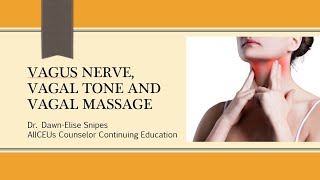
Dr. Dawn-Elise Snipes explains how the vagus nerve controls heart rate, digestion, and immune function, then demonstrates a simple massage technique: place your middle finger on the tragus and index finger behind the ear, then gently circle down the neck. Yoga and meditation also strengthen vagal tone.
Questions this video answers
1997
2005
July 14, 2021
The tragus and the concha.
Middle finger on the tragus and index finger behind the ear; use gentle circular motions and slide down the neck.
Chapters
Hey there, everybody, and welcome to this presentation on the vagus nerve, vagal tone and vagal massage. I'm your host, Dr. Donnellice Snipes. The vagus nerve is one of the most connected nerves in our body and has been proposed to mediate diverse physiological responses, including indirectly regulating body temperature, regulating heart rate and functioning, decreasing blood pressure, helping send the signal to your body that you're full or increasing satiation. And it's also been involved in the reduction of inflammation in acute, like after a bone break or surgery, and in autoimmune issues or chronic inflammation. The vagal nerve is a major component of the HPA axis, which is involved in coordinated neural, behavioral and and endocrine responses, including those responses of immunity, inflammation and heart rate. They have found in studies that vagus nerve stimulation can alter cardiovascular autonomic control in healthy humans. This is interesting. So people who have difficulty with autonomic functioning, their HPA axis disregulates. This is something that we see in patients with trauma histories as well as people with POTS and other conditions. And they've also shown that the vagus nerve tells the gut when it responds with from signals from the gut and tells the brain when you're satiated. But people who are obese or who eat high fat diets, that signaling is compromised. So the vagus nerve doesn't tell the brain in time that you are satiated. So people tend to overeat, which is kind of interesting. It also mediates responses including stomach acidity, blood sugar regulation. So those people with hypo or hypo hyperglycemia or diabetes, bile release and production, water and sodium balance and saliva and tear production. So it's got its little, you know, nerve endings in just about everything. Which is why understanding vagal massage and vagal stimulation can be helpful for people with anxiety disorders, with autonomic disorders, where they have tachycardia or their blood pressure suddenly drops. There are a lot of different ways that vagal massage and vagal nerve stimulation may be helpful. Vagal nerve stimulation, and this is the medical vagal nerve stimulation. And we're going to talk about the other approaches, including massage in a minute. But it's been associated with a significant improvement in cardiac function, quality of life scores and even exercise performance. Vagal nerve stimulation was approved by the FDA for the treatment of drug resistant epilepsy and depression in 1997 and 2005 respectively, and more recently was approved to treat migraine. So those are three things that are really common in our society that are approved that can be Treated with vagal nerve stimulation. It's currently under investigation for use to address inflammation and autoimmune issues, including Crohn's, rheumatoid arthritis, colitis, lupus, as well as post operative atrial fibrillation, cognitive impairment, opioid use disorders, diabetes and PTSD, and fear extinction. You can go to ClinicalTrials.gov and type in vagal nerve stimulation to find some of these really fascinating studies that they are doing right now in order to explore the applicability of vagal nerve stimulation for treatment. Now, auricular stimulation of the vagus nerve is different than vagal nerve stimulation where they do surgically implant a device that stimulates that vagus nerve, auricular means around the ear. And auricular stimulation of the vagus nerve can be helpful. The auricular branch of the vagus nerve innervates the skin parts of the ear and the outer ear canal, regarded as the main parasympathetic. Parasympathetic output of the automatic autonomic nervous system. Sorry, y'. All. The vagus nerve has an extensive distribution throughout the abdomen, heart, lungs, liver, adrenal medulla and the gastrointestinal tract. I told you this little bugger was kind of involved in everything. Auricular stimulation of the ear or the auricular branch of the vagus nerve can be electrically like with a tens unit or manually massage, stimulated through the skin, which may provide a therapeutic alternative with widespread clinical use, including heart rate variability, reducing inflammation and addressing depression. So the auricular branch of the vagus nerve is located in the tragus and the concha. Now think conch shell. Those shells you hold up to your ear that have that hollow inner core, you know, that's the concha is the inner part of your ear right here. And you can see it on the diagram better than you can see it on me. And the tragus is that little flap of skin right in the front of the ear. And that's where you have a lot of nerve endings for the vagus nerve. And then the main branch of the vagus nerve goes down right behind your jawbone and, and kind of right along this, this muscle in your neck, down kind of to your throat because it's also involved in, you know, your voice box and everything. But so when you're massaging, you can put a finger. I usually use my middle finger on the tragus and my index finger behind my ear. And gently. You don't need to press. This is not acupressure. You just gently Mass around in circles and then you can work your way down, just bringing both fingers together as you move down your throat again, not pressing hard, just gently massaging all the way down to your neck. And then you can repeat that. But a lot of people find that they find relief with just that. Other people find more relief by massaging the concha. Whatever works for you. You need to try out a few different things to see if it helps. Most people who try doing it report that they can notice a sensation when they do it. Other ways that you can improve your vagal tone, which is your vagus nerves ability to effectively respond and not over respond or under respond to to sensory input, include yoga, meditation and biofeedback. With yoga, you are getting yourself into a position and you are holding it. It is not easy. You know, you are using a lot of muscles and it can get a little uncomfortable sometimes as you are getting into those positions. But through slow breathing, you are training your vagus nerve to not over respond. You're training your vagus nerve to maintain that calm, relaxed state. Meditation is the same way with deep breathing and focused meditation. It helps kind of calm that vagus nerve and it helps you develop more conscious control over your, your breathing and your heart rate. You know, they are going to, when you're triggered, they're automatically going to be, you know, kicked off because that HPA axis goes into, goes into overdrive. But you are able, as you start developing more control or effective control of your vagus nerve, you are able to slow your breathing and consciously start slowing your heart rate, which is where biofeedback comes in. You know, people can use one of those little finger monitors that monitors your oxygen saturation and your pulse rate. So when you get stressed, you can practice that deep breathing and that relaxation or you can even practice the vagal massage and get to the point where you have, where you're able to gradually reduce your, your stress response, your breathing, your heart rate and by consequence probably your blood pressure. Most people don't have a blood pressure monitor handy to monitor that, but that is something else you can monitor pretty easily on your own with a over the counter blood pressure monitor. I hope this was helpful because a lot of people are talking about the vagus nerve and vagal tone and this can be one strategy that is helpful for developing a healthier vagal nerve.