Empowering Clients to Embrace Success
Dr. Dawn-Elise Snipes teaches clinicians how to help clients define success beyond money and status. The webinar uses exercises like comparing a fisherman to an MBA graduate to shift values toward meaningful living, then covers self-compassion, stress management, and concrete goal-setting to sustain recovery.
Chapters
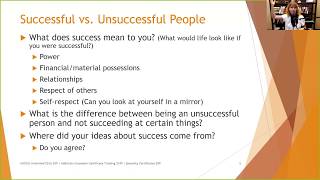
This episode was pre recorded as part of a live continuing education webinar on demand. CEUs are still available for this presentation through all CEUs. Register@allceus.com Counselortoolbox you I'd like to welcome everybody to today's presentation on empowering clients to embrace success. We're going to learn techniques to help clients describe successful versus unsuccessful people, develop compassion, manage stress, and use positive visualization. A lot of what we do as clinicians is trying to help them eliminate something bad, eliminate depression, eliminate anxiety. And what I really want them to do is not only believe and embrace their power to eliminate those things, but also to see what success looks like, to embrace happiness. And y' all know I use that term pretty broadly. It's as the client defines it. But I really want them to look towards it and, you know, think about embracing something. You're holding it, you're pulling it in, you're holding it tight. Instead of going, well, it might be out there, you know, I think I might be able to reach it. I want them to hold on for dear life like they were in a hot air balloon being pulled up in the air or something. So what does it mean in your mind to embrace success? And in order to kind of figure this out, I want you to think about a time in your past when you've set out to do something and embraced success. So thinking about things that we've done, you know, there are things that I've done and I've kind of done them halfway. And to that end, I wasn't really embracing success. So thinking about how my mindset in that particular situation impacted my motivation and in many ways, the work quality or the product quality, it was not good. It was halfway. My thoughts of success were halfway. It was like, well, you know, I'll give this a try. I think I can do it. Instead of I am going to make this work. Think about for our clients when they come into treatment, when they want to start getting better, whatever that means, when they want to start feeling happy again. Are they approaching it from a, you know, I'm not really sure if this is going to work or I am going to get that. I see that light at the end of the tunnel, that carrot at the end of the stick, whatever you want to use, and that is going to be mine. How does that affect how they interact with us and how fervently they participate in the counseling process? Embracing success increases empowerment and hope, which increases motivation. So we want to encourage people to, every time they have a success, you know, it doesn't have to be waiting until the end of the treatment plan. It could be going an entire day without crying. Well, let's embrace that. Let's go. Score. I had a good day today. Now, tomorrow may not be as good of a day, but that's okay. You know, we want them to not look at the totality and go, it wasn't perfect. We want them to look at the totality and say, it's getting better and embrace the fact that they're moving forward and get excited about the fact that we're making baby steps. And like I said, one of the things that some of my clients and I think probably some of yours have challenges with is when they have those back steps, and those are going to happen, even if they're doing all the right things. And it is so frustrating for people. And I'm not just going to say our clients, because I find it frustrating when I'm trying to do something and I backslide a little bit for whatever reason, and I feel like I've got to play catch up. But we want people to understand that life happens. And maybe you weren't as able to deal with stress today as you were yesterday because you didn't sleep as well, and you may not have had any control over that. Sometimes you just don't sleep as well. Encouraging people to be compassionate, we'll get to that with themselves when they're not perfect and really look at progress, not perfection. Embracing success also turns obstacles into challenges. So as an obstacle, I'm going to go, you know, I don't know. I don't know if I can do that. I don't know if I can climb that wall. When I look at it as a challenge, I'm going to say, all right, I'm going to get over that. I'm going to figure out how to do this and make it happen. Very different approach an obstacle, you kind of hit a brick wall and stop. Embracing success helps people focus on successes instead of failures. Now, a lot of our clients, when they come into. Come into treatment, they're struggling. They are not happy, they're not in a good place, or, you know, they probably wouldn't be in our office. So when people are in a dysphoric mindset, a negative mindset, if you will, a lot of times what they'll notice is the negative. They notice, you know, all the things that went wrong. When we went through a little period in July where we lost a lot of animals between a family of raccoons and a couple of Hawks. And when it would happen, instead of focusing on all the animals that survived, we focused on the one animal each day that ended up getting killed or stolen. So, you know, just giving you an example of in our normal day to day life for the normal, average, everyday person. And that term normal is so relative. But you know, for you, your neighbor and the guy down the street, anything can happen. And if you happen to be in a stressed out mindset, you're probably going to focus on more, focus on the negative. So encouraging people to focus on their successes instead of looking at, you know, last week I had four days that were really good and I had three days that were eh. The person may focus on the three days that were eh and say, you know what? I'm not getting better. You know, when is this going to work? When am I not going to be depressed anymore? A person who is embracing success would say, hey, I had four days that were really good. That's more than half of the days. So I'm making progress. So a lot of it is just putting a positive spin on what happens and encouraging people to give themselves credit, you know, for even the small things for getting out of bed in the morning. For some of our clients, that's a huge, huge task. For going to work, for practicing mindfulness. I mean, these are all successes. Every time they do something that is a slight behavior change or do something that is helping them work towards their goals, that's a success. It doesn't have to be something earth shattering. So encouraging them to give themselves credit for even the small things, or maybe especially the small things. I have my clients go through an activity where they start looking at successful versus unsuccessful people. And we start out by thinking of three successful people. And I would encourage you to kind of do this as we go along, but thinking of three successful people, and let's say Oprah Winfrey is one of them, so listing five reasons you perceive them as successful. And when she comes up, she's rich, she's powerful, she's famous. Those are usually three that come up and then, you know, two others. Does Oprah succeed at everything? And most people are realistic enough to say no. I mean, even. And you know, not to nitpick, but it was one that tended to be a big issue of conversation. She would lose weight and then she'd gain it back and then she'd lose weight again. So did she succeed at it every time? No, but she made the effort. How did she handle failures? Well, typically she went back and she figured out either was it important to work on this some more, or is this something that's really not that important right now? And I'm focusing on other things in my life. It's not negatively impacting my ability to live a rich and meaningful life. Now, if it is, she looks at it and she probably said, well, I need to figure out what went wrong and try it again. So viewing themselves as successful or viewing herself as successful probably enables her to have the confidence that, you know what? I have accomplished other things before. I've done things harder than this. Doggone it, I am going to do this, whatever this is. And I mean, she's done a lot of things, Starting her own magazine, having her own TV station. You know, she's done a ton. And she came came from adversity. So, you know, she's one of those preeminent successful people that a lot of people think about. But there are other people in our life that we look at who we perceive as successful. And they don't have to be celebrities. They can be your neighbor or somebody you're related to. And asking them, asking your clients to sit, really evaluate. How do these people that you think are successful succeed when they have failures? Because they do. How do they handle those? And again, how does viewing themselves as successful help them? And if they have difficulty with that last question, sometimes I turn it around and say, if they view themselves as failures, how do you think that would impact them? Do you think they would be where they are? And then we move over to unsuccessful people. And I have them. Again, think of three people you think of as unsuccessful. And, you know, a lot of times celebrities and stuff don't come up as readily. Here I have them list five reasons why they think those people are unsuccessful. Do they fail at everything? Yes. No. Maybe. Generally, unsuccessful people are successful at some things. And this is helping people separate single failures from global failures. Is the person a failure as a person, or are they a failure at a particular thing? We define success differently. You notice Oprah is one that comes up usually almost every time when I do these activities. Dr. Phil is another one. So I guess a lot of people have daytime TV watching, but we think of these people as being more prominent. But wealth, power, and fame tend to kind of define in many people's minds what success is. So we're going to look at that in a little while. But back to the unsuccessful people. Do they perceive themselves as unsuccessful? So if wealth, power, and fame are the definitions of success for some of the people in your group, you know, that's okay. That's their definition. They are entitled to their opinions. But I do present this particular story if it comes up. Hopefully it will. Here we go. And I'm going to read the story to you. It's not too terribly long, but it's so powerful. An American investment banker was at the pier of a small coastal Mexican village when a small boat with just one fisherman docked. Inside the small boat were several large yellowfin tuna. The American complimented the Mexican on his quality of his fish and asked how long it took to catch them. The man replied, only a little while. The American then asked, why didn't he stay out longer to catch more fish? The Mexican said he had enough to support his family and immediate needs. So the American followed up by saying, but what do you do with the rest of your time? The Mexican fisherman said, well, I sleep late, fish a little, play with my kids, take naps with my wife, stroll into the village each evening where I sip wine, play guitar with my friends. I have a full and busy life. The American scoffed, I'm a Harvard mba and I could help you. You should spend more time fishing and with the proceeds, buy a bigger boat. With the proceeds from the bigger boat, you could buy several boats. Eventually, you'd have a fleet of fishing boats. Instead of selling your catch to middlemen, you would sell directly to the processor, eventually opening your own cannery. You would control the product processing and distribution. You would need to leave the small coastal fishing village and move to Mexico City, then LA and eventually New York, where you'll run your expanding enterprise. The fisherman asked, how long will this take? The American replied, 15 to 20 years. The fisherman said, but what? Then The American laughed and said, well, that's the best part. When the time is right, you announce your ipo, sell your company stock to the public, become very rich and make millions. The fisherman says, okay, millions. Then what? The American said, well, then you're going to retire, move to a small coastal fishing village where you will sleep late, fish a little, play with your kids, take siestas with your wife, stroll to the village in the evenings where you could sip wine and play guitar with your friends. So I read that to them, and then we generally take a break and I ask them to think about what's the meaning of that story. And ultimately, I'm hoping they're going to come back with the notion that we need to appreciate the successes we have right now and appreciate what we have, not keep looking for the next thing and hoping and looking for happiness in the future, recognizing possibly that success is defined differently by different people. So encouraging people to really step back and go, you know, you think of success. American defined success tends to be have some component of money, power and prestige. However, if you define success as living a rich and meaningful life so you could be happy, what would that look like and is it different? Does it even involve being rich, powerful and prestigious? I ask clients to think about what does success mean to you? Because if they're going to embrace it, they need to know what they're embracing. You don't just walk up to some stranger and give them a big old hug and hold on for dear life. That's a certain problem. So what does it look like? Do you need to have power? Do you need to be powerful? And if so, in what way and in what aspects of your life? You may not need to be president of the United States or CEO of the company, but we all need and want a certain amount of personal power for certain. So encouraging clients to think about how much power do I really need and how much power do I really want? I had a man I used to work with and when I went to college he was my internship supervisor and then he became my clinical supervisor for licensure. And then we ended up being co workers after that. An opportunity for a promotion came up and I talked to him and I'm like, you know, Randy, are you going to apply for the director position? And he said, no, I have no desire to have that kind of headache and power. He was very happy and content and felt very successful doing what he did. And he did really well. So how much power do you really need and over what in terms of financial and material possessions? My daughter announced to me the other day that she is 13 right now and she said that when she's in college she plans on living in an RV so she doesn't have to, so she can travel between semesters and doesn't have to worry about property taxes and all kinds of other stuff. And she'd actually made out a pretty good plan. Is that what I envision for her? No, but she's one who doesn't need a lot of stuff to be happy. So encouraging people to look at how much stuff do you need to be happy and what does your stuff say about you? I have another friend who defines a lot of his self worth based on the size of his house and his, his vehicles and what he wears and making sure everything is name brand. So, you know, looking at, you know, the two of those, those two people are very dichotomous. What does success mean to You. And this is when we start getting into the nitty gritty in terms of relationships. And once people get past money, prestige and power, they don't think a lot more. But I want to have people look at, you know, what is meaningful to you in your life. Are you going to consider yourself successful if you are rich and powerful and are completely alone, bouncing around a 10,000 square foot mansion by yourself because you don't have any good friendships or family left anymore? And you know, a lot of times they're like no respect of others. Whose respect do you need? And again, we all want respect of other people, but we also recognize that we can't please everybody all the time. So encouraging clients to look at who is it important? Who in your life is important to get their respect because that's where you're going to devote your energy. So if Jim Bob over here doesn't respect you, but you know, Jim Bob is not crucial to your happiness and the relationships that are important, probably not worth investing a whole lot of energy in that you can re divert that energy to nurturing the relationships that are important. And self respect. What does success mean to you in terms of self respect? Can you look yourself in the mirror? Now some people will sacrifice self respect for money, prestige and power and they're fine with that. Other people recognize that, you know what, I would rather not have some of this stuff or sacrifice some of this other stuff so that I can look myself in the mirror. And so it's a matter of encouraging clients to really define what success looks like. What is the difference between being a successful person and not succeeding at certain things? And this goes back to that concept of globalization and over generalization. Sometimes clients who struggle with anxiety, anger issues and even sometimes depression have over generalized they've had a failure in their life or they're not, maybe they're not succeeding in their career. So that one slice of their success pie, it's all smushed. But the other seven, eight of their success pieces, pie is doing well. But they take that one smushed piece and go, well, this pie is no good anymore. They're generalizing that to everything going I'm a failure at everything I do. So thinking about that, how does that impact people emotionally, mentally, physically and socially if they just kind of give up and they go, you know, I'm a failure at everything I touch. And then we talk about where do your ideas about success come from? Because you know, I said earlier that a lot of times our notion comes from our culture, popular media, what our Parents, tell us what our communities tell us success is. You know, does success mean living in a gated community and you know, driving the nicest car and yada, yada yada, does that mean success to you though? And encouraging people to really look and question what success means, because a lot of our clients aren't rich, powerful and prestigious. So if that's how they define success, we're going to be fighting an uphill battle. I want them to see why they're awesome and how they're strong and how they have the power to achieve their goals just like anybody else that they perceive as successful. So we move on to developing compassion. And a lot of clients have difficulty with compassion. They tend to hold themselves to a higher standard than others and are more critical of themselves, which can impact your sense of success. If every time you do something and you know, take, you take a test and you get a B instead of an A and you're like, well, you're stupid, you should have gotten an A, that's going to erode at your self esteem, that's going to erode at your self confidence and your belief in your ability to succeed. If on the other hand, you look at it and you go, well, you passed, you got a good grade, probably could have done better, but this is not going to be a big deal in the big scheme of things. That would be a more helpful attitude towards developing compassion. When our kids come home and they bring their great, their grade reports, you know, most of us, I don't think, look at it and go, well, you didn't get straight A's, so you failed. Just go away, be done with me now. If they get straight A's, we're going to be screaming from the rooftops. But if they don't, we look at it and go, you know what? You did your best. Awesome, great job. Many people see compassion, especially self compassion. For some reason, if they give themselves compassion, they feel like other people are going to think they're lazy or stupid or they have a lot of negative attributes associated with being compassionate. If you tell somebody you did your best, that's okay. Is that a quitter's attitude? And this is something that often spurs a fair amount of discussion. And where do you draw the line? I mean, we don't want to give so much compassion that people don't try. But we also want to recognize that we all have different strengths. Asking clients to be compassionate with themselves and you know, if they're doing the best they can with the tools they have at any given time, Then, okay. And when people come into my office, you know, that's generally where we start. I'm like, you're at the starting point. You are trying to survive. You're doing the best you can with the tools you have. And then we move from there. We look at what tools they have and where they want to go and hopefully sharpen some of the tools they already have instead of reinventing the wheel. So what does compassion mean? And the definition varies for people. I throw out things like accepting that not every day is an A day, because those of us who expect to be 100% every day are probably going to be sorely disappointed. There are going to be some days that are C days. They are not even B days. And I know I will admit I have a bad habit or I have difficulty accepting that. And I have a certain amount of things I need to get done every day. And I have it laid out a week in advance. And I expect that if I get to the office, that stuff's going to get done. It doesn't matter whether it's an A day or an F day. And that's not realistic. I'm getting better about going, you know what I'm just going to call it, because trying to continue to do this is just making me miserable, and I'm not being effective. So being compassionate with myself, Cubby. Yeah. Refers to it as sharpening the saw and accepting the fact that sometimes you just gotta step back and take a break. Because if you do it now, you're gonna do it wrong, and you're gonna have to do it over, which is gonna take more time. If you stop and, you know, regroup and say, okay, today's not an A day, not getting as much done as I had hoped. Pick up here again tomorrow and then take care of yourself. Then you're sharper the next day. Compassion also means taking all factors into consideration. We've talked before about how clients tend to overgeneralize. They take one failure and they say, I suck. All right, let's look at it. Or they take one failed relationship and say, I just can't maintain a relationship. We want to look for exceptions in those cases, but we also want to look at what else was going on. You know, don't personalize it and think that it was you. It was 100% your doing that made this, whatever it was, happen. So take all factors into consideration. When, you know, I go out and I plant my garden, and, you know, sometimes it's hit or miss, but I have to learn it's not that I have a brown thumb. It's that I didn't take all factors into consideration, like cucumber beetles. So I learn, you know, something happens, it fails. I say, you know, well, that wasn't ideal. How can I prevent it from happening again? But I take all factors into consideration, not just automatically assuming it was me. So when, when clients come in and they're being hard on themselves or they've, you know, they backslid, they had, they did really good for two days, had two happy days, and then they had a not so good day, they were crying all the time. You know, I might say, well, is it you? Are you failing or are there other factors to consider? What else was going on? You know, and again, sometimes it's, they didn't get enough sleep that night, the night before. Sometimes they had multiple social stressors happen and they, you know, stuff started to pile on them again and they started to feel like they were drowning, feel overwhelmed. Well, you know, life is giving you variables, if you will, so we need to take those into consideration and go, okay, so, you know, when you don't get enough sleep, it's harder to deal with the stresses of the day and you may tend to feel more depressed. How do we deal with it? And it's important in a lot of things to take into consideration the other people that are involved, the situation. And you know, if you're dealing with something, you know, the product, you know, sometimes products fail. Does that mean you fail? No, it means whatever it was broke. And you have to take that into consideration. Being willing to ask for help without judgment. Now people who don't have a lot of self compassion a lot of times think they should know everything and that just sets them up for failure. So being willing to ask people for help if you don't know something or, and here's a big one, being willing to ask for help because you just don't have the energy. You're not on your A day. So asking, you know, your kids to do extra chores when you're sick or you know, asking your spouse to go to the grocery store on the way home from work because you just don't have the energy to do it, sometimes people beat themselves up for that. I should have been able to get all that done or I should have just sucked it up and moved on. That's not compassionate. That is pushing through and you're going to end up burning out and you're going to end up feeling more miserable. So encouraging clients to look at, how do you feel about asking for help. How do you feel about days when you can't get everything done and you need some assistance? Do you feel like you've let people down? Do you feel like you've let yourself down? And if so, let's take a look at that. Where's that message coming from? Is it coming from those people or is it coming from critical voices in your own head? Compassion means viewing success in the context of the present moment. And I usually precede the statement with, with all that's going on right now, you're doing awesome. So I want people to look at their life in totality, working on recovery, working on dealing with their depression or their anxiety. That's like one hour in session a week, and then maybe one hour a day. And, you know, as much time as they can find to do it the rest of the time. But our clients have different levels of how much time, energy, and ability they have to devote to it. So we want to say, with all that's going on right now, thinking about the holidays, we all get busy during the holidays. And, you know, sometimes, at least in my house, the house goes down a little bit, as far as, you know, dusting frequently, as I should, until companies coming over, of course. But, you know, some things start to fade past where I would want them to and, you know, if everything were perfect, you know, the house would be dusted, the windows would be washed, and yada yada. But during the holidays, there's so much going on with everything that's going on right now. This is a pretty good presentation. And, you know, if people can't accept it, then tough, diddly winks. Teach clients that phrase. Teach them to recognize their life is probably busy. And encouraging clients to recognize that everyone has strengths and weaknesses and synergy is the key. They're not the best at everything, and they're going to have weaknesses. They're going to need to ask for assistance with certain things. Like, we just had to have our water heater replaced. I know nothing about water heaters. That's not something I can do. You know, would I like to feel like I am female Bob Vila? Sure. But it's not the case. So I recognize that's not one of my strengths. I'm not going to beat myself up for failing to know how to change a water heater. I'm just going to call somebody who does because they probably don't know how to do counseling. So we all have our strengths and weaknesses and encouraging people to focus on their strengths. What do you bring to the table? Not what do you not have? But what positive things do you bring to the relationship table, to life in general? What do you contribute to life in the world? And sometimes it's a positive attitude and that's all they've got. But most of the time, people have unique skills, strengths and qualities. Encouraging them to recognize and build on that is going to be really important. Mindfulness, compassion is grounded in awareness of what you need. It's hard to be compassionate if you don't have any idea what you need. I mean, think about those days that yesterday was a perfect example. I didn't sleep well the night before. I got up, I came to work, I did what I needed to do, I went home and I was waiting to take my kids to martial arts. And I'm like walking around in the kitchen trying to find something else to eat. We had just eaten dinner and sort of mindless, well, very mindlessly. But then I checked myself and I'm like, you know what? It's. Right now I'm just eating to stay awake. I'm sleepy is what's going on with me. So I sat down in the easy chair and I took a little power nap for 10 minutes. And I felt well enough to at least get me through toting them to martial arts. But in order to be compassionate with myself and give myself what I needed and recognize my limitations, I had to be aware of them. Mindfulness helps people increase their awareness of when they need to back off or ask for help. If you wake up in the morning and you're sitting there drinking your morning coffee and reading the paper or whatever you do, and you're like, oh, it's going to be a long day, all right, you know, you're not on your A game, so you may need to figure out what are the have to's that need to get done today. And mindfulness also helps you increase the awareness of when you're succeeding. Because a lot of us, and you know, not just because somebody's in a negative mindset, they notice the negatives, but even if we're in a good mindset, Think about yourself. How many times do you take the positives for granted, take the good things you do, take your strengths for granted, minimize. And that's another one of those cognitive distortions, Minimize your strengths and abilities. So it's important to be aware of when you're succeeding and not take for granted that, you know what, today's been a good day or this morning. Sometimes you can't go a whole day yet because you know they're still still struggling to get some momentum going. But how was the, how was the morning? You know, if you can look at it and go, you know, it was a really good morning, I'm good with that. Now the afternoon, I'm starting to get really tired. It's going to be tough, but the morning was good. And two, with our clients, when they're recovering or dealing with whatever you want to say, depression or anxiety, they're probably going to get a lot more tired towards the end of the day. After lunch, it's hard to come back from that after lunch lullaby, partly because they may not have the neurochemicals to get them going, but partly because they are still using a whole lot of energy to be anxious, to be angry, to be stressed out. So we want to encourage people to be compassionate with yourself. Recognize that your energy levels will go up as your stress and anxiety goes down, but it's not going to happen overnight. A lot of times people extend compassion to others. Your kids, your spouse, your co workers. When they don't extend the same compassion to themselves in your own head, you're like, shoulda, coulda, woulda, asking clients really to reflect on what would happen if you extended the same compassion to yourself as you extend to other people. You know, I remember when I was in a suit, a supervisor, if people had a hard time getting their notes done, you know, we had high caseloads or something, I would cover their groups for them, couldn't do their notes for them. I would cover groups so they would have time where they could shut their door and do their notes. And I didn't think anything negative about it. I just recognized that with all that's going on, because we have increased caseloads right now, whatever you're not able to, you haven't been able to finish your notes. So I'll help, you know, compassionate thing to do. But when it came time for me to get my own paperwork done, I was like, really? You should have had this done last week. So saying that I'm not necessarily the best model for compassion. I'm working on it. I'm working on being more compassionate. But we also want to model that for our clients. If we're having an off day, let them know, you know, if this happens to be a topic in counseling or whatever, just letting them know that, you know, you're really tired today or something can be helpful for them because a lot of people will personalize. And if you seem disinterested or you seem off the mark, they may take it personally. And if you can be compassionate and say, you know what, I really wanted to be here for this session and you know, I'm glad you're here. Just want you to know ahead of time, you know, my kid was up all night with colic or something, so I'm a little sleepy. It's nothing personal and you know, again, I'm really excited for you to be here. It can help them understand kind of what's going on with you and it can help them develop some compassion for you as well as understand what's going on. Managing stress. Stress is another word for anxiety. Anxiety is a response to a threat. So in order for clients to embrace success, they have to believe they can do it. They have to feel empowered, they have to not feel threatened by that challenge. So we want to have people look at what is causing your stress about this situation. Fear of failure. You know, maybe you've been in therapy before and it hasn't worked and you know, you didn't feel like it did anything for you and you're still struggling and you're afraid that it's hopeless. Okay, so let's talk about that. How can we look at that as knowledge? How can we learn from that failure and move forward from it? Are they afraid of success? Maybe they've been in counseling before and they started feeling a lot better and it was great. And then they were out for six months and then they relapsed and they had another major depressive episode. Well, that can be pretty traumatic because they never wanted to feel that way ever again. So it can be kind of scary to think I want to feel better, but I'm afraid if I do, then and I fall again, people are going to look at me and go, well, you've been in therapy, you know what to do. You were feeling better, so what's wrong with you? We want to encourage them to recognize that each episode, you know, if you succeed, that's great, you're feeling awesome, but life is going to throw you curve balls sometimes. And sometimes we fall back and start falling back into old habits. Mindfulness can help prevent some of that. But if you start feeling yourself falling, falling backwards, mood wise, it doesn't mean you're a failure. It means something changed. So we need to look at what changed. Are they afraid of loss of control or rejection or being judged? And you know, this is more when we're talking about other things they want to embrace, like getting promotions or relationships or whatever that is. But encourage them to identify what anxiety points are keeping them from embracing success and going I got this. Do they have poor time management and lack of balance? If they are, you know, all over the place and they have the attention span of a gnat, which I do sometimes, so I get may keep them from being successful or achieving what they define as success. And lack of balance can do this, too. We went through that whole list of what does success look like to you? And I have them put it in a pie form and we talk about, you know, what happens when you spend. We'll do another pie and I'll have them break it down and show me how much energy they spend in each area. And generally, those pies don't look the same. So I want to ask them, you know, this is. These eight things are equally important, but you have in this pie, in your energy pie, you have one thing getting 50% of your energy, and then the other seven are divided among the rest. How is that working? Are you feeling successful overall? And, you know, there are times when they're going to have to portion out their energy. They've got a big project due or something, so work is going to take a little more effort. But then when that's done, there needs to be an ebb and flow so they can also focus on the other things that are meaningful in their life so they're not looking back five years later going, crap, I wish I would have spent more time with my kids. I wish I would have learned that hobby back then. And other things that can keep people from moving forward. Embracing success are ineffective goals. You know, they want to be happy. Well, that's great. I'm glad you want to be happy or they want to be successful. Wonderful. What does that mean? If they don't know what it means, you know, then that's kind of like trying to grab onto a ghost. There's nothing there to really grab onto. You're just going to go right through it. So they need to have something substantive to embrace if they want to embrace success. What does it look like? What are you working toward? What is the effect of stress on your success? And it's important for them to realize that it's not just stress related to this one goal, but it's stress in your life in general tends to drain energy because you're revved up, you're worried about this, you're anxious, you're angry, whatever feeling you have that we're going to call stress, when you're burning up all that energy with emotional reactions, you have less energy for doing the things that are going to help you move towards success. So it's important for people to maintain balance. And I always go back to the, to the act matrix. And I encourage them before you respond in any situation, you are here now, what things can you think, what thoughts can you have and what things can you do in response to this situation that is going to move you closer to a rich and meaningful life? What is success to you and what things, what response do you have in this situation that's in your repertoire that is going to either keep you stuck or just waste a bunch of energy you could have used to move towards your goals? And that's for everything. That's, you know, do I need to go to the store again today? I finally, my son's a teenager and the boy can go through 3 gallons of milk in a week. And I used to go religiously to the store, and now I've kind of learned. I'm like, you know, what if he goes two days without having milk? He's 17, it's not like his little bones are going to break. So I've portioned my time now to only going to using my energy to go to the store once a week. And, you know, they have to plan accordingly, but that helps reduce some of my stress. So I have more time and more energy to focus on the things that are meaningful, like spending time with him instead of just shopping for him. Using positive visualization, ask clients, does your definition of what success look like look the same as your definition of what life would look like if you were happy? And this is another one of those that you can pose at the end of a group or at the end of a therapy session and have them ponder on it, because I really want them to think about this in depth. My picture of success is this. And if you're into art therapy, you can do collages. That's cool. If you were successful, what characteristics would your life have? Then do another collage of if you were happy or when you're happy, what characteristics is your life going to have? And then compare the two and see if they are in sync or if they're opposed to one another. Maybe the success only has work stuff and power, and the happiness has recreation activities and kids and dogs and whatever. So we want to help people rectify the discrepancy by asking them, how can you be happy and successful? Because a lot of times it's a compromise. You know, you may want to be a CEO of a Fortune 500 company, and in your mind, that would be a way to really be successful. However, you also define Success as, you know, being available for your kids and being able to be at football games or dance recitals or whatever it is. So you've got to compromise and you've got to say, all right, Fortune 500 company, not going to happen till after the kids are out of the house. We're going to table that. Can I be happy and successful without doing that? Sure. You know, because there are other things in my life that make it rich and meaningful. I don't have to have the pinnacle of success in that one area. Encourage them to, when we're rectifying those differences, describing a happy and successful life. So we're going to put the two together now. So what needs to change in your life so you feel both happy and successful? And what's the first step to this change? For a lot of people, it's work, life, balance. You know, my husband. Oh, what was it? I think it was like Sunday night he got an email at 11pm and he was responding to it at 5 the next morning. And then he worked, you know, an entire 11 hour day after that. And because of the Internet, a lot of places are like that now. They expect you to be checking your email 24 7, 365 and you don't get downtime. So it draws you away from other things that are in your pie. So setting boundaries is often one of the first steps to change what will stay the same. Some things may be going great, so I'm not saying everything's messed up. We want to look at what's awesome that you've got right now. Encourage people to review, review that description daily, especially when they're, you know, making changes. So they keep that image in their mind of this is what's important to me and they don't get sidetracked on one thing or another. Encourage them to always refer back to the vision and answer the question, what can I do in this situation to continue moving toward my goals? So, you know, if they're offered a job opportunity that sounds really awesome, they're excited about taking it, but they also don't want to, you know, spend that much time away from their family. They have to ask themselves, you know, I'm here, I have this opportunity. What is reactions, actions and thoughts are going to move me closer to my goals. And in that case, it may not be taking that job, even though it would increase finances. So everything has to be taken into perspective in order to embrace success. Because again, success is not necessarily being the best at anything. It's being the best you, you can be and the you you want to be. So the goal of change is obviously success. We don't want clients to fail, but we need to be able to help them. Define what does success look like when you're not depressed? And you know, when you're writing your treatment plan, this is the first thing you do when you're working with them. You know, okay, your presenting issue is depression. So when you're not depressed, how am I going to know you're not depressed anymore? So happiness or not, elimination of depression as evidenced by what's it going to look like? And that is your goal statement. The problem is the depression. The goal is the elimination of depression as evidenced by, you know, not crying every day and a mood of a four or a five on a five point Likert scale, six out of every seven days or however they want to state it. And obviously we can help them make it measurable, but I want to know what that's going to look like. Having a success mindset empowers and motivates people to maintain focus on what's important. It helps them balance energy and priorities. Because there's always something else that comes along and if you're like me, you're like, ooh, shiny thing. And you got to kind of bring it back in and stay focused on the task at hand or the tasks. What's in your pie? A success mindset helps people recognize that success doesn't mean perfection. Failures are learning opportunities. You learned how not to do it, so let's try it again. And in my mind, success also means being willing to try it again. When we talk about success and failure in group, I often have people do an assignment where they find five quotes from prominent or successful people about failure or about success. But failure comes up more often. So they learn what it means to people who they think are successful. So they learn how people who have achieved a lot in life view failure and they start to understand that those people have failed and they may have failed a lot. And a success mindset increases appreciation, other strengths and encourages synergy. Instead of saying, I can do it, I got this all by myself. Success means being willing to ask for help. Are there any questions? Alright everybody, have a great weekend and I will see you next week. If you enjoy this podcast, please like and subscribe either in your podcast player or on YouTube. You can attend and participate in our live webinars with Dr. Snipes by subscribing@allce.com Counselor Toolbox this episode has been brought to you in part by allce.com, providing 24. 7 multimedia Continuing education, education and pre certification training to counselors, therapists and nurses since 2006. Use coupon code counselortoolbox to get a 20% discount off your order this month.










