Episode 45 10 Tips for Eating for Happiness
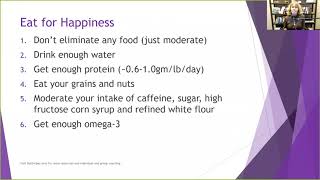
Dr. Dawn-Elise Snipes explains how nutrients like tryptophan, magnesium, and B6 build the neurotransmitters that regulate mood. Eat 0.6 to 1.0 grams of protein per pound of body weight, gradually cut back on sugary foods, and add omega-3s. Moderate your favorites instead of cutting them out entirely.
Chapters
Welcome to Happiness Isn't Brain Surgery with Doc Snipes. This podcast was created to provide you the information and tools Doc Snipes gives her clients so that you too can start living happier. Our website, Docsnipes.com has even more resources, videos and handouts, and even interactive sessions with Doc Snipes to help you apply what you learn. Go to Docsnipes.com to learn more. Hi everybody, and welcome to Happiness Isn't Brain Surgery with Doc Snipes Practical tools to improve your mood and quality of life. Today, we're going to be talking about 10 ways to eat for happiness. Now, when we come around to the New Year's, a lot of times people are starting to talk about New Year's resolutions and losing weight and getting in shape and getting healthier. So one of the things we want to talk about is eating. Because it just kills me when I see a lot of people start out the New year with some really rigid or kind of all or nothing fad diet that there's no way they're going to be able to keep to in the long haul, most likely. And then they get three weeks into January and they're just like, you know what, Screw it. So let's talk about ways to eat in order to support your mood, support your health and support your well being. The first thing I want you to see, and it's not important that you know all these terms, but I want you to realize that tryptophan is, is a protein and it's actually an amino acid and it's in all of our protein based foods. So tryptophan is really easy to get if you're getting any reasonable amount of protein. And protein is in everything. It's really low in vegetables and stuff. It's, you know, almost really high. It's almost exclusively protein and fats when we talk about meats and those sorts of things. But if you don't eat meat, that's not a big deal because you can get protein from other sources like beans and rice and vegetables. Tryptophan is taken in and it's converted using iron, magnesium, calcium, vitamin B6 and folic acid. These are all vitamins that need to be acquired. Well, they can be gotten from a multivitamin, but they're a lot more effective if they're acquired from your diet. A lot of these are more prevalent in vegetables and grains. Tryptophan using all those things is broken down to make 5 HTP, and we've all heard of 5 HTP because you can Buy it in the store. I'm not recommending that you do that. I'm just saying you can. Now, 5 HTP is broken down using vitamin C, vitamin B6 again, zinc and magnesium to make serotonin. And serotonin is one of those brain chemicals that we know is responsible for helping us feel calm and happy and at peace with the world. When you don't have enough serotonin, though, it's more than just your mood. Serotonin impacts like everybody system, it can start causing gut and heart problems. You have 80% of your serotonin is actually in your digestive system. So if your serotonin gets wonky, then you can start to feel depressed, but you can also get constipated. Or if you get really stressed, you can get, you know, stress symptoms in your gastrointestinal system. You can have sleep problems. If you don't get enough serotonin, you can't make melatonin, which is what helps you get to sleep. So not only are you and have difficulty winding down to go to sleep, but you don't have that sleep chemical or enough of it to give you good quality sleep. Another problem if you don't have enough serotonin is you'll have cravings for carbohydrates, alcohol, and maybe even certain drugs. So your body's trying to get the building blocks it needs in order to release these chemicals. When we eat carbohydrates, sugars and starches and things like that, our body releases serotonin and some and dopamine, which are two of our really feel good chemicals. So if your body's not making enough serotonin, it's going, I need more. So it starts getting craving carbohydrates because it wants to tap into those reserves. If you eat the carbohydrates, then your body's going to tap into the reserves and start secreting a little bit more. But what happens when you run out? And fibromyalgia and other pain conditions are also linked to a deficiency in serotonin. So, you know, our pain tolerance, our pain threshold goes down as our serotonin goes down. Which is one of the reasons why people, when they're depressed, tend to feel like they hurt all over and things feel more achy. Well, it makes sense because serotonin isn't there to modulate that pain response. So kind of to sum it up, we need serotonin. It is a big boy in our neurochemical makeup. We need it. If we don't have quality proteins, enough iron magnesium, calcium, vitamin B6, folic acid, vitamin C, zinc, and I guess those are the ones. Then we can't make serotonin. So it's important to have a good diet, not to just be eating coconut oil and coffee or whatever the case may be. So being aware of what you're eating, try to eat a nice colorful diet. So what do we do to eat for happiness? Unless there's a medical reason, consider not eliminating any food, just moderating it. If you love something, if you prohibit yourself from having it, then guess what's going to happen? You're probably going to crave it more. So for me, like chocolate, I love chocolate and coffee and soda. I love a lot of things that are not good for me. I try not to keep them in the house. If I have them in the house, then I'm more likely to mindlessly eat them and graze on them and eat them when I could have chosen a healthier option. When I want chocolate, I will go to the grocery store and I'll get a candy bar or I'll get a pack of M and Ms. Or whatever will satisfy that craving. I have that little bit, it's gone, I'm done, we're good. And I'm not going to sit there. I don't get a five pound bag of M and Ms. Because I know I'll eat the whole thing. Just know that. So I get a regular size. So moderating means maybe not keeping it where it is as accessible. Because even if you say I am only going to have five Oreos, how many times do you go back and get five more and then just two more and one more after that and then you start feeling bad about yourself. We are eating for happiness. That means we want to have food. So you know that we really like that we can kind of use as a reward. I don't like using food as a reward, but some of these things release dopamine, so it is a reward no matter how you look at it. So try to moderate it. Figure out ways you can cut back on it a little bit but still allow yourself to have it maybe once a week, like pizza. At our house we can have pizza once a week. My kids love pizza, so that's one of those things that I do. Pizza is not the healthiest thing in the world, but you know, at least it represents like every food group. And so we have that once a week. Drink enough water. When you're dehydrated, you tend to feel sluggish, fatigued, confused, tired, all symptoms of depression. So you can confuse dehydration with, oh, I feel like, you know, depression or the blues are coming on. If you're feeling, ugh, try drinking some water if you hate water. And I will tell you, I am not a huge water fan. I will keep a water bottle with me when I'm at the gym or when I'm at work. So I do drink more water. But if I'm just at home, I'm not going to think about, oh, let me get a glass of ice water. That's just not what I do. I'm spoiled and I tend to lean more towards. I'll put lemon flavoring in it or lime flavoring. Lemon juice, Lime juice and that gives it a little bit of flavor. If I'm really craving something with bubbles in it, but not artificial sweetener, I'll do club soda with lemon. And that gives me enough of a kick and a pick me up where I feel like I'm getting the treat, not being deprived. But I'm also doing something that's healthy for me. So drinking enough water prevents or helps prevent fatigue, dehydration. Just don't drink too much right before bed because then you're going to be up peeing all night and you're not going to get enough sleep and you're still going to end up feeling fatigued. So make sure you pay attention to when you're drinking. Get enough protein. And I said this on the last slide, anywhere from 0.6 to 1 gram per pound of body weight per day of protein is plenty and 1 gram per pound of body weight is more. For people who are growing and people who are like competitive bodybuilders, most of us need closer to the 0.6 grams. If you get a food app like spark people on your phone and you keep track of what you eat, you'll be surprised that it's rare, if ever, that you don't make your protein requirements unless you're a vegetarian. Vegetarians sometimes have a hard time making their protein without making a concerted effort to do so. So protein is usually not a problem. But do make sure it's a high quality protein. Eat your grains and nuts. That way you have those vitamins and minerals necessary to break down tryptophan to make serotonin. Now, serotonin is not your only feel good chemical. Dopamine is your reward chemical. That's also made from amino acids and norepinephrine is your focus and motivation and drive chemical, your get up and go and. And that's also made from proteins and broken down with vitamins and minerals. You can think about vitamins and minerals, kind of like spark plugs. Your body is the engine, the food that you eat is the gasoline and the spark plug is what kind of gets everything going. So you need all of them. Moderate your intake of caffeine, sugar, high fructose corn syrup and refined white flour. All of these things tend to give you a rush. In many of them it's a spike in blood sugar and then a crash that follows. And then you do it again and you get a rush. Not quite as high this time, but you crash even lower the next time and you're doing this downward spiral. Just the opposite of what you want to see the stock market do. So try to minimize or moderate these. I'm not saying you're going to cut them out because I know a lot of us are not going to. But paying attention. If you drink caffeinated beverages, try to drink half caffeine, half decaf coffee. Select caffeine free options when you can. If you are drinking a lot of caffeine, don't go cold turkey unless you have to. For some reason, you will get migraines, you will get a really bad headache for a couple of days. And if you're aware of that and you're good with it, you know, more power to. You may want to check with your doctor about what you can do to take the edge off, but you want to wean down. Same thing is true for sugar, high fructose corn syrup and refined flours. Our brains actually change in response to what we eat. So when people go cold turkey off of these, they actually go through a withdrawal period that results in cravings and depression because their body's used to having all these things coming in. The sugar and the corn syrup that triggers the release of dopamine. Well, when that's not coming in anymore and triggering the release of dopamine, that happy feel good chemical is just staying all locked up and people are going, oh, I don't feel so hot. So the take home message from that is don't go from 0 to 60 or from 60 to 0, however you want to look at it overnight. Gradually reduce things. Like if you're going to cut out high fructose corn syrup, then start buying products that are not made with high fructose corn syrup, like ketchup, that's one of your. And barbecue sauce, that's one of your big offenders, jelly. Look for things that are made more naturally. Try to choose alternatives instead of high sugar foods and get Whole wheat flour and whole wheat breads instead of white breads. Eventually, hopefully, kind of wean off the processed grains, but slowly. That can be like August that you're worrying about doing that. Just start out by trying to switch from plain old white bread. You can look online at the glycemic index and the glycemic load of different foods. What you want to do is try to stay away from foods that are going to that have a high glycemic index that are going to spike your blood sugar. Get enough omega 3s. Omega 3 fatty acids are helpful for depression as well as pain and aches and those sorts of things. Because I know I'm not in a good mood when I hurt. And after I hit 40, it seems like every year I get a different ache or pain somewhere. And, you know, that's just part of, you know, aging, that the system's getting a little bit older. But increasing the amount of omega 3s keeps things moving more fluidly and reduces pain, somewhat reduces some of the inflammation. And it has been shown to have an effect on your mood in a positive way. Another tip, get creative. If you're thinking, oh, I don't want to eat healthy because that's just rabbit food. That's what I hear around my house all the time. Get creative with what you do. I've finally managed to create a lentil loaf that my family will happily eat. And it took a while for me to get the recipe quite right without any meat in it because we're eating it instead of meatloaf. But if you get creative with your cooking, even if you're eating meat so you can start using different spices and trying different recipes, you have a surprise in store every time you eat. And most recipes that you find on Food Network or Allrecipes, they're really pretty easy to do and really pretty easy to follow. So experiment. Even if something sounds a little odd. I tried a sweet potato soup recipe a few weeks ago that I wasn't sure that garlic and ginger would really go together that well. But it turned out fabulously. So, you know, there are different options and you'll be surprised at how many different ways you can use foods. I've discovered 17 ways to use sweet potatoes besides just baked. Now, savor your food. Eat mindfully instead of eating while you're watching TV or while you're doing paperwork at your desk. I'm guilty of that one. Take time and sit at a table and focus on what you're eating when you're getting your food. Get what you think you want and then put half back, or think about what you think you want and then only get half if you're living in a family. And that would be frowned upon to put half back. But if you put half back, most likely you're not going to go back for seconds anyway. But if you do, then you're only eating as much as you would have in the first place. Another way to look at it. Close your fist and look at it. That's about how big your stomach is when it's not all stretched out. Next time you go to a restaurant and you get a big old plate of spaghetti or something, hold your fist up next to it and think how many times your stomach has to stretch to accommodate all that. And you'll realize that we're probably eating more than we need to use a salad plate. Trick your brain. If you're using a salad plate which is smaller than a dinner plate, and you fill it up, your brain thinks you're fuller than if you just have a little bit on this huge plate. Another way to trick your brain is to have multiple colors on your plate. For some reason, when the brain sees multiple colors, it feels like it's getting more food. If everything is different shades of white and brown, you know, it's all just kind of bland. It blends together. Then your brain's just like, that wasn't very much food. So the different flavors may trick your brain. They're not exactly sure why doing that makes people feel fuller, faster, but it does. And turn off the television. You know, there's nothing wrong with having a great conversation over dinner, but also try to focus on what you're eating. And television tends to engage our minds, so we're not focusing on what we're eating or the people sitting at the table with us. So try to turn that off. Remember that when you eat, it generally takes about 20 minutes from the time you get full for the signal to go to your brain that you're full. So if you're scarfing it down. And again, I'm guilty of this. You know, having two children, it was, you need to feed the child, and then you eat, and you hope you can eat your meal before the child starts screaming again. And most parents have been there, but. And even before that, I ate faster than I probably should have. But if you eat that fast, then you can eat two, three, six times as much as you really needed to eat before that signal gets from your stomach to your brain. You can eat in 20 minutes. You can put away a lot of food. So slow down. Cut food up into manageable bites and try an experiment. Try to see how small of a bite you can take and still get all the flavor of it and joy enjoyment out of eating it. Obviously you're not going to take a little micro bite, but you can probably take much smaller bites than you are right now. Consider drinking green tea. There are chemicals in green tea that are supposed to help with anxiety and depression. If you tend to be a little anxious anyway, you might go want to go with decaf green tea. But green tea also has the added benefits of having polyphenols in them or which are really helpful for getting rid of some of those free radicals and anti aging and all that kind of stuff. So green tea is a good thing. I like the peach flavored green tea instant green tea because I don't really like straight green tea, but that's a preference and my daughter drinks straight green tea all the time. And don't eat until you're stuffed, even if you're eating slowly. Eat even if you've been at the table for 40 minutes and you're just still plodding along. If you're still putting in food in your mouth and you know you're full but you just don't want to leave anything on your plate, you're probably going to feel bad afterwards, either physically bad or mentally bad because you know you ate too many calories or both. Eating till you're stuffed is just never rarely a good idea. You know, there's probably a time when it's a good idea, but even we just finished the holiday season, Thanksgiving and Christmas dinners, a lot of times people eat till they're over full and they're just like, oh, I shouldn't have eaten so much. Food should be something that is awesome that you look forward to because it's nourishing your body, not something you're like, okay, I'm going to overindulge and then for the next week I'm only going to drink chicken broth. No, it doesn't work that way. Let's moderate, let's spread out that dinner, let's have seconds later in the evening and then let's have leftovers for the next three days so you can enjoy it for three days instead of three hours. Okay, those are my tips for helping you try to eat for happiness instead of just to eat. If you like this podcast, please subscribe on your favorite podcast app. Join our facebook group@docsnipes.com Facebook or join our community and access additional resources, including live counseling or coaching. I'm sorry with me, Doc Snipes every Thursday at Doc Snipes. Thanks for tuning in to Happiness Isn't Brain Surgery with Doc Snipes. Our mission is to make practical tools for living the happiest life affordable and accessible to everyone. We record the podcast during a Facebook Live broadcast each week. Join us free@docsnipes.com Facebook or subscribe to the podcast on your favorite podcast player. And remember, Docsnipes.com has even more resources Members only videos, handouts and workbooks to help you apply what you learn. If you like this podcast and want to support the work we are doing for as little as $3.99 per month, you can become a supporter@docsnipes.com join again. Thank you for joining us and let us know how we can help you.










