Essential Skills to Recognize Crisis and Provide First Aid
Dr. Dawn-Elise Snipes teaches psychological first aid for anyone who encounters someone in crisis. Learn what counts as a crisis, how people react across physical and emotional domains, and why the first 4, 24, and 72 hours matter most for support. Practical guidance for teachers, clergy, first responders, and others on brief assessment and when to refer.
Chapters
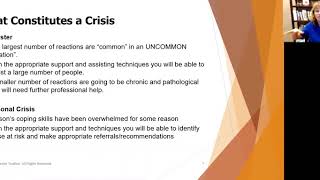
This episode was pre recorded as part of a live continuing education webinar on demand. CEUs are still available for this presentation through all CEUs register@allceus.com counselortoolbox you I'd like to welcome everybody to today's presentation on psychological first aid and triage, or triage and first aid, however you want to put it. And the goal of this presentation is to go over some things because psychological first aid is often used after traumas and after disasters. But it can really go a long way toward early identification of problems. Triage is the word that I'm using for it today. We really want to be able to equip school counselors, ourselves, employers, nurses, doctors, clergy, anybody who's working with people who might be able to identify a problem. We really want to help them identify be able to identify oncoming issues. Today we're going to explore applications for psychological triage and first aid in crisis situations. Now remember, a crisis is not always a mass disaster. People can have personal crises. We'll discuss the applicability of this approach for clinicians, reception staff, clergy, teachers and employers. So psychological trial triage and first aid is basically a method of becoming aware of and providing initial response to a crisis situation. That's all it is really simple. Think about, you know, when you get an injury, if you take care of it right away, if you triage it and get first aid, then it's not going to get worse. And that's really what we want to do. We want to identify things early and get the person the resources they need in order to prevent it from getting worse. A lot of times people experience crises and traumas and various other things and you know what, they don't end up having any long standing problems. They are able to cope with the coping resources that they have. But we want to make sure that they understand that there are outlets should they need them. And sometimes it's helpful to bring it to people's awareness that, you know, I noticed that you're struggling and they may be like, oh, I didn't realize it was coming out that much. So clinicians, of course, we do this on a daily basis. Reception staff can be aware of it. If a client calls in for an appointment and is in crisis, reception staff needs to know how to handle that. Now the person may not be in crisis in terms of, you know, they're suicidal or homicidal, but it is not uncommon for a client to call and be crying, be tearful beside themselves. And reception staff are often like, well, you know, I can make an appointment, but I don't know what to do. If we can equip them with some basic tools, it will help them become engaged with the client. It'll help get the client into your office, but it can also help diffuse any potential situations that may develop between when they talk to the receptionist and when they come in for an appointment. Clergy, teachers and employers come in contact with people in crisis every day. I wish that wasn't the case. I do. But that's just the reality. People are going to have crises in their lives. And again, this doesn't have to be something like community wide, huge and dramatic. It can be their dog died or they found out they're getting divorced or something like that. So one activity that I would encourage you to do is to take seven cards. On one card, write the name of your best friend. On the next one, your closest family member. On the next one, one of your favorite belongings. And then on one, something you enjoy an activity or a hobby. Another one will have an ability. Another one is just health, housing and financial security. So those are your seven cards. After you've written on each card, place them face down on the table and shuffle them around. And then close your eyes and pick three cards. These are three things you're going to lose. And you know, think about how are you going to feel from if you lose these sorts of things. And that will help give you a little bit of empathy and recognize the fact that again, it doesn't have to be a huge thing. It could be, you know, your best friend moves away, they don't even have to die, or you get into a huge fight and say you're never going to talk again. The point is to recognize that crises are different for everybody. So what constitutes a crisis? The largest number of reactions during a disaster are common reactions in an uncommon situation. So people are going to naturally probably get better without immediate intervention. But we do want to triage, go in, start talking to people and identify people who might have a more difficult time coping. And we want to help make sure that those people are going to get resources. With the appropriate support and assisting techniques, people are able to assist a large number of individuals who are affected by some sort of a disaster. So we can go along and a lot of times a comforting word, the compassion that we express. Just being there to hear people's pain and stories and whatever's going on is all they need. They don't need some miracle intervention. They just need somebody to listen and be compassionate and that helps them start moving forward again. Provide that unconditional positive regard for a smaller number of people. Their reactions are going to be chronic and pathological or unhelpful, and they may need further professional help. So we want to start looking at, you know, we have 100 people who are touched by a disaster. 85% of those people, if they get unconditional positive regard, a little reassurance and understanding, and maybe, you know, assistance with some basic necessities, they're going to be okay. It's not, but they're going to be okay. The other 15 people, you know, 10 of them may be struggling a little bit because they don't have the social support or they've already had a bunch of crises in their life. So they may need referral to eventual other resources. But just by being there, by listening, by engaging with people, those 85 people are going to do far better than they may have without some intervention. So we're able to touch lives more rapidly. And again, this isn't in depth intervention. This is letting people know that, hey, I'm here for personal crises. Basically, a person's coping skills have been overwhelmed for some reason and it can be dependent on that person what overwhelms their coping skills. With the appropriate support and techniques, you'll be able to identify people that are at risk and make appropriate referrals and accommodations. So we want to make sure that everybody who comes in contact with other people, which, you know, it's all of us, you know, we're not hermits, ideally have the skills and tools we need to identify people who are at risk of developing problems after some sort of a personal crisis. And we know how to make recommendations. If nothing else, everybody should know how to call United Way Information and Referral. You know, that is kind of the one stop shop, if you will, to get referrals in your local area. So if you don't know anything else, you can help people reach out to that. I regularly still consult United Way Information and Referral for resources. I had a client just recently who was in a domestically violent setting situation and needed help getting out. She needed help with the first and last month's rent to get into a new place and help with sheltering and children and other things. I went to United Way Information and Referral because I didn't know what those resources were here. So that is always a place that you can go. And I have never had a bad experience with them. So what's the role of the layperson, the non clinician? We want to help our receptionists, our techs, Those people be able to protect our clients or other people from danger, be direct and active in this process. Instead of kind of tiptoeing around going, are you doing okay? We want them to say, I see that you're struggling. Provide accurate information about what they're going to do, reassure the person, but not give false assurances, recognize the importance of taking action, and provide and ensure emotional support. So basically, we're teaching general active listening skills and the awareness of some signs that people may be struggling with some sort of a crisis that will help our, you know, clinicians and supervisors and those sorts of people to identify these problems early so the person doesn't become clinically depressed, develop a substance abuse issue, become violent, or any of those things. If we can intervene early. People typically rely on past strategies to cope with new, stressful situations. So if their past strategies have been helpful, we're going good. Past strategies have been unhelpful, then they may need more assistance. Past coping mechanisms can be functional or dysfunctional, and hardiness or resilience has been identified as a buffer. Now, if you remember, hardiness is the combination of commitment, control, and challenge. The person recognizes that there are things in their life that are going okay. There are things in their life that are important and worthwhile, and they're committed to those. They recognize what parts of this situation, as well as what parts of their life they have control over, and they view obstacles that get in their way, or they view the current situation as a challenge. It's not a barrier. It's not something that ends everything. It's a challenge because now, in order to get everything back, going smoothly, forward, they need to figure out how to deal with it. Children can be vulnerable because they have no experience or known patterns of actions as a response to the experience. So if the first time a child goes through a tornado, they may not understand what to do, and it may be really scary even if the tornado didn't come. If you have to, you know, get into your little shelters and bunkers, it can be really scary for people. I know the first time that I had to have my kids go down and shelter because there was a tornado warning, they were kind of freaked out, and they were older at that point because we had never been through anything like that before. So we do want to make sure that we're reaching out to people who may be experiencing things that they're not used to, common physical reactions. And I want you to think in terms of. Step outside of being a clinician for a minute. I want you to think in terms of if you are a receptionist, a tech, an employer or just a family member, what are some clues that you might have that any of these things were happening? So sleep difficulties, gastrointestinal, intestinal problems, stomach upset and nausea, eating disturbances, elevated heart rate, blood pressure and blood sugar, headaches, skin eruptions, reduced libido, increased aches and pains, and with extended stress, suppression of immune system. Alright, so let's think about some clues that we might see if you are. I'll take the role of an employer. If I'm an employer and I notice that my employee suddenly seems to be dragging in every day or a lot of the days, that might give me a clue that something's going on. It could be they're out partying, but it could be something else. So I might pay a little bit more attention. If they seem to be skipping lunch because they're just not hungry, that'll give me some clues. If they start complaining of headaches, that'll give me a clue. You can look for skin eruptions, that's more common in children and teenagers than adults, but it can happen. As an employer, I'm not going to know about their libido, thank you very much. But I may know about suppression of their immune system. If they're dragging in really exhausted all the time, they seem to be not eating lunch, having stomach problems, maybe more headaches, and then they start calling in sick more often. That tells me that there may be something going on. They may be struggling with some sort of a personal crisis. Now, does that mean I need to intervene and refer out? Maybe, maybe not. It depends on the intensity. Hopefully the place where I'm working has an employee assistance program so I can reach out to my employee and go, you know what, it seems like you've been struggling with something lately. And you know, I don't want to get too personal and into your business, but I wanted you to know that I was here and you know, I care and, and don't forget you've got this employee assistance benefit that you can see somebody for free for four sessions and yada yada. So these are the clues that I'm going to look for as a parent, you know, you're going to see some of those sorts of things in your potentially in children, when we're talking about reception staff, they may not see as many of the physical reactions, but they may notice if the person is coming in and they're sick more often or they're calling in and canceling their appointments more often. Common emotional reactions. Again, think what kinds of clues might you see in any of these different roles? Individuals may have difficulty identifying feelings due to lack of experience with emotional expression in their family or community. Not everybody talks about the F word, so they may not know how to communicate these sorts of things. They may also associate strong feelings with past traumas and believe that emotional expression is too dangerous. You know, I don't want to go there because I may lose control completely. And so if somebody seems to be emotionally withdrawn or sort of emotionally numb, we want to pay attention to that, especially if it's a difference from prior functioning. Feelings that can come out include fear, anxiety and vulnerability. Fear of reoccurrence or consequences, a sense of helplessness and hopelessness, depression, anger, irritability, guilt, being numb, withdrawn or disconnected, fear of being left alone. And this can apply to adults as well as children, and loss of a sense of safety. So again, what are some clues we might look for? I mean, a lot of this sounds like depression and ptsd. That's true. We would notice some of these things probably before other people would. But we're sitting there talking to the person once a week for an hour. So if you're just the supervisor or the pastor, what might you notice? You might notice that hyper vigilance, that increased startle reaction. The person may seem to be more irritable lately than normal. They may be flatter or seem more depressed. I mean, emotional reactions, a lot of times people carry and project on their person. So look looking at their nonverbals. And one of the things you can do when you're training staff is to have them look at different models. And you can role play, have, have people role play different feelings and emotional reactions to make sure that staff can pick up on subtle clues, overt anger. But if somebody is irritable and just cranky, you know, have them pretend like they're sitting in the waiting room and making grouchy faces at everybody who makes noise or something. You can see some people getting numb, withdrawn and disconnected. If your employees or, you know, whatever start withdrawing and they're not interacting with other staff members like they used to, they're just coming in, doing their work and leaving, and they don't want anything to do with anything else. They may be completely overwhelmed with whatever's going on in their personal life. There also could be something going on in a team. But there's all of these things are clues that something is amiss. Whether it's a crisis in their own life or some trouble on the floor or whatever. It's important for us to be aware of these things. So we can intervene If a staff person notices that a client or employee or whatever is exhibiting some of these emotional reactions. It's important that we try to provide some reassurance, we provide some compassion and those sorts of things and maybe some referrals because we don't want it to get any worse. And sometimes if your reception staff is noticing people are overly irritable or depressed or crying in the waiting room, one of the best things to do is to be able to help get them to some privacy if they're having a hard time controlling their emotions. And let the therapist know that you know, you've got a client who's in crisis, so don't run late. Common behavioral reactions after crises Family difficulties substance abuse Being overprotective of family and family can be defined in a lot of different ways. You can have, as Zachary points out, family doesn't have to be just two legged human family. Your four legged creatures can be very much a part of your family. And this is true whether it's a domestic animal or somebody's horse. If they have a strong connection to that animal, then if that animal passes or gets really sick, it could be devastating. So it's important to expand our view of what may cause crises. But when a person's in crisis, they can have family difficulties because they're becoming more withdrawn or more irritable or more depressed. They may abuse substances, they may be overprotective of those family members, they may isolate, they may be very alert at times and startling easily. So again that hyper vigilance, they may avoid places, activities or people that bring back memories. When my dog Kenny passed, I could not watch all dogs go to heaven or homeward bound for about a year. You know, it just those two shows reminded me of him and I just didn't want to expose myself to that. So being aware, if somebody starts showing a resistance to people, places or activities, then we want to ask what's going on? What's changed? You know, can I help you with something? They may not enjoy involvement in their old favorite activities and again, they may be agitated or crying easily. So as a clinician or as a receptionist in a clinician's office, we want to look for any behavioral reactions of crisis where somebody seems to be really struggling. And those are probably some of the most obvious ones that we can pick up on. If they are physically and they're non verbals or just communicating. I'm struggling here. In terms of clergy and employers, if we notice that the person you know, maybe they start sleeping at the office or looks like they're sleeping in their car. I've had both of those in my employees. You know, that's time. Those are times that you may want to intervene and go, hey, I'm noticing that some things have changed. You want to talk about it? If they're isolating and they didn't used to something to be aware of. Common behavioral reactions in youth. Now we don't see these as much in adults. So I separated this slide out. For youth, they can have childish or regressive behavior. We see that a lot when there's a stressor. And remember, crises are different. For a four year old, having a new baby in the house could be a crisis because they feel like they're losing mom and dad. For a 14 year old, there could be other things that trigger a crisis, like a breakup in their first relationship where they may regress some and start becoming, becoming more oppositional or regressive and not taking care of things and not doing what they're supposed to. They may act out, they may have bedtime problems. Obviously if this is more, if it's a trauma like a tornado or a hurricane or a death or a break in, a break in, even if you're not home, can be extraordinarily traumatic to people. Not just children, but they may have sleep onset insomnia. So when it's time to go to bed, all of a sudden they're wide awake again. Midnight awakenings, fear of the dark and fear of reoccurrence of the event during the night. So we want to provide youth ways to get grounded, oriented and feel safe. As clinicians, we want to help youth, help parents know how they can help youth. If you're a teacher and you notice that one of the kids in your class is suddenly regressing a lot, acting out, seeming tired a lot, again, it indicates there's some sort of something that's amiss and it's probably worth checking out. Referring to the school counselor, whatever your policy is your school. So the cognitive triad of trauma, your views about the world may change. You may start thinking the world's a dangerous place, people can't be trusted and life's unpredictable. Well, you know, life is unpredictable, but can you handle it? Views about self change as well, People can start thinking they're incompetent because they didn't handle the situation as well or because they didn't prevent the situation. I should have reacted differently. You reacted how you reacted in the moment. And cognitive processing therapy is really helpful at encouraging people to look back with hindsight and look at the big scope of things. Because when we're in trauma, when we're in crisis, we've got tunnel vision. We're not seeing all the other things that contributed to the decisions that we made at that point in time. Views about self also include, it's too much for me to handle, and I feel damaged. So we want to empathize with that. I'm not going to tell people, oh, yeah, you can handle this. You've got this. That's invalidating. That's not going to help them. I want to understand why they feel like it's too much for them to handle. And then we can start challenging those beliefs eventually. But in triage, we're hearing right now and we're providing support and going, you know what? If it's too much for you to handle, you've got somebody you can lean on, and then we can move forward from there. And trauma also impacts your views of the future. People think things will never be the same. What's the point? I'm never going to get over this. It's hopeless. And all of these things can kind of converge to create a crisis vortex, if you will. And we want to help people identify how crisis, how this particular incident affected their views of the world, their views of their self, and the views about the future, and then look at those objectively. And we do this in counseling, not in triage. In triage, we just want people to understand that individuals who go through crisis are going to have some changed viewpoints of things. And we don't want to contradict that. We want to empathize with it. We want to hear what they're saying and help them feel nurtured and supported. Common cognitive reactions, intrusive memories, nightmares and flashbacks, difficulty communicating, difficulty concentrating. And in children, this can present as behavioral problems. If a child's sitting in the classroom and they're having to concentrate for 20 minutes, 30 minutes, however long it is, and they just can't do it, then they often will engage in alternate behaviors, which causes some disruption in the classroom. Sometimes when people are still after a trauma, that trauma feels oppressive. It just comes flooding into their mind again. So they do things in order to try to distract themselves from what's going on. So we want to look at, is this behavioral problem new for this child? If so, what's causing it and how can we best intervene? Are they having difficulty concentrating so we need to break things down into smaller chunks? Are they unable to be still with themselves, because all of a sudden those thoughts and memories start flooding back. If so, what kind of referrals can we make to help them deal with that? People may have memory problems. The brain is really cool because during a trauma, especially an intense trauma, it secretes all kinds of chemicals, including the cortisol and the fighter, everything needed for the fight or flight reaction. But it also secretes certain chemicals that prevent the memory of the trauma from solidifying. And there are articles you can read on neurobiology of trauma that are really cool to work read through, but it explains, and it helps us explain to clients why they may not totally remember all the details of the trauma or why when they think back about it, the details seem to change and they can't get a grip on it. And they're like, it just happened an hour ago. How can I not remember this? That's your brain's way of protecting you. Your brain's going, you don't want to remember this. This kind of sucked. So awesome. The memories of the trauma may not be solidified, so you may not be haunted by them as much. But that also means other stuff going on at that point, point in time may also not be solidified as well. And if you're having sleep difficulties, that's also going to negatively impact memory. So we want to help people if they're struggling with something. What can you do in order to support your cognition right now? In order to support your memory, do you need to write more things down? Do you need more reminders in your phone? What can we do to help you? Because you're doing the best you can, what can we do to facilitate this? While your brain processes everything that's gone on so you can start going about a more normative life, they may have difficulty following complicated instructions. This is especially true right after a severe trauma. So write them down. If you're going to ask people to do things, don't give them four things to do in one sentence. Give them one thing to do and then another thing to do, just like you would for people who are having difficulty with cognitive functioning. Well, in trauma. We are in trauma. Our body is in fight or flee, not think about it. So all of those think about it. Memory consolidation, concentration, chemicals, those are doing other stuff. Right now. Your body is not worried about all these things. So we need to help people figure out how can they accommodate themselves. Just like when you have a broken leg, you use crutches. All right, what kind of crutch can we help you have for your memory and problem solving? And orientation right now, people may have a pessimistic attitude. And this is one of the biggest signs for other than clinicians. That gives you an idea that something may be going a little wonky. If the person has normally been pretty, you know, even keel, you know, not overly positive, but not super pessimistic, then all of a sudden they just seem to be a negative Nelly. Something changed. So we want to understand what changed. What's going on? Can you share with me, you know, what happened that seems to be making you feel like there's no hope in the world? We also see a lot of blaming. After a trauma, people want to blame somebody, they want to blame the perpetrator, they want to blame the, you know, if a bridge collapses, they want to blame the architects of the bridge. If, you know, whatever it is, they look for somebody to blame. And if they can't find a human person, they may look to blaming their higher power. But they're trying to figure out why this happened, how to know if it's going to happen again, and preferably how to prevent it from happening again. So blaming is kind of throwing that anger out. And sometimes blaming can move on to seeking revenge or justice, which is why a lot of lawsuits are often filed. And, you know, other things may happen. Common faith and spiritual reactions. Some people turn even more strongly to their faith during times of crisis. Other people start questioning their values and beliefs, thinking, how can an all powerful God let this happen? How could this possibly be? They may direct their anchor toward their higher power and say things like, if God loves us and if love bears all things, believes all things, hopes all things, and endures all things, then how can this happen? You know, if he loves us, then he should. Why is he letting this happen? And they may experience a loss of meaning, which again goes with that anger towards their higher power. I don't know why I'm doing this. If everything I did was to make my higher power proud of me, to revere my higher power, if I don't believe that entity exists anymore, then why do I do anything? What's the point? And this can turn into cynicism and self centeredness and other things. So we want to look at what is their spiritual reaction, what is their sense of connectedness to others after this kind of event? Sensory reactions, sensory input can elicit flashbacks or comforting memories. I encourage clients to really be aware of the things that are going on in their environment at this point in time. What are some sights, sounds, smells and things that may trigger comforting memories? What can they put in their environment. You know, if it's for children, sometimes it's a security blanket or a teddy bear or a picture of their mom and dad. What types of things can be, can be put in there? What types of sounds can they hear? We also want to be aware of things that elicit flashbacks. And we want to prepare parents if children are exposed to a trauma about certain things that may elicit flashbacks. There's a lot of things on the media, in the media, on tv, in the news, online, that can trigger flashbacks. But that's only part of it. You know, there are other things that can trigger flashbacks and we want people to be aware when every year, and I've shared this with you guys before, when it comes around to Christmas time. My stepfather experienced a trauma many, many years ago during Christmas. And seeing Christmas lights is a huge trigger for him. He's gotten to the point where he can deal with the Christmas tree and the Christmas presents and all that, but Christmas lights, which caused the fire, super traumatic for him. And this has been 40 years ago, but it's still extremely poignant and I want people to be aware of that. If you're aware that somebody, one of your employees has a prior trauma that revolves around a holiday or some sort of potential sensory trigger, trying to be aware of those things and conscious of them. If you have an, maybe not an employee, if you are working with somebody who was assaulted by a clergy member, if you have, I don't think you guys can see it in here. If you have any religious memorabilia up there, I have my rosary hanging on, on my bookshelf. You know, that would be something that I would probably take down for the time being in order to avoid triggering them. Sarah points out, is that is that she finds that after a crisis, children often take on the responsibility of protecting their family and come up with elaborate and often unrealistic plans for doing this. And parents don't realize how much kids are pressuring themselves. And parents are at the in the perfect place to do psychological triage and first aid. They can just like they clean up the boo boos on the knees, they can be there to help their child dress those wounds, so to speak. And it is important for parents to recognize that for children, all of a sudden the world turned upside down and it was really scary. But it's even scarier to think that especially since they can't take care of themselves, that something could happen to their parents. So then they start becoming very concerned about their parents demise, very concerned about it happening again. And their parents Getting hurt. And so it is important to ensure that parents have an open dialogue with their children after a crisis. And it's also important that, again, teachers be aware of these sorts of things, because sometimes parents aren't going to pick up on it, or you see the behavior more while the child's at school when they don't have eyes on parent. So it's important for teachers to be able to identify these things and communicate back with the parent that, you know, it seems like Johnny's struggling. Sometimes you'll even see some of these types of behaviors during a divorce because the child feels like it's their responsibility to try to keep the family together. The psychological footprint of a disaster is much larger than the medical footprint. Think about 9, 11. There were thousands of people that were injured, killed, affected that day physiologically. But there were millions of people that were affected psychologically because we saw it on tv. We recognized that, you know what, this world may not be as safe as we thought it was. So the psychological impact was huge compared to the medical impact. And we need to remember that when we see traffic crashes, especially particularly bad traffic crashes, medical footprint pretty small. The psychological footprint could be really big. All the first responders, anybody who directly observed what happened, you know, it can trigger stress reactions in a lot of people. An event is more traumatic when the person has prior experience with a similar event. If they've been through a tornado before, they're like, oh, here we go again. And all that stuff from the past that they may not have dealt with comes flooding forward. If the event happens next to a safe zone where the person's going, well, those types of things don't happen in my neighborhood or to people like me, if it impacts a large area. So an entire community, such as a flood, that can be more traumatic if it's unexpected. We like to feel like we're in control of situations. So when events are unexpected, then that leaves us feeling powerless to a certain extent if the event or repercussions from the event last a long time. After Hurricane Katrina, people were displaced from their houses, some forever. But a lot of people were still living in FEMA trailers a year, 18 months, two years later, and they were not in their hometown, they were still in a different state. So there was a lot of disruption. If the cause of the thing is unknown, if the event is poignant or meaningful or involves multiple losses, the. So if somebody passes on, for example, you know, you, heaven forbid you should, a child's one, a child's parent should pass away in a car Accident, okay, they lost that person. That's true. They also lost the stability, you know, a caregiver. So not only is it a person that's gone, but it's a caregiver that's gone. I guess a better example would be if you lost your spouse, you may have lost your best friend, you may have lost an income provider, you may have lost. You know, that person may fill multiple roles. And the more roles that person filled and the more repercussions you have. Maybe you have to move because you can't afford that house anymore. Now you're not only losing that person, but you're losing the house and your neighborhood and your friends that you hung out with. So that can make an event more traumatic if the victims in an event are similar to the person. So when I work with law enforcement, when they go on calls in which a child is injured or killed in some way, if they have children at home or they came from a big family, I mean, most of us have been around children, but some more than others. And if they have children of a similar age at home, it tends to impact them more. The person has experienced other stressors in the prior six months, so they're already worn down. If the person has a history of mental health issues or little resilience. If you have somebody with bipolar disorder, schizophrenia, and if social support is not received within 4, 24, and 72 hours, why the three numbers? Within four hours is your critical window? People are still really raw after critical event, four hours afterwards. So if you can provide that emotional support, that's going to help a lot. Within 24 hours, it still helps. It helps the person not feel so isolated. And 72 hours, you know, you're getting kind of out there. The person has started to, you know, suppress some of the memories and box it up and compartmentalize more. But support is still helpful at 72 hours. If the social support comes after 72 hours, it's a lot less impactful. So we really want to make sure that people, when they experience a crisis, have access to social support in those critical periods. Loss is associated with a crisis. And think in terms of crises, natural disasters, divorce or even retirement. Loss of loved ones, loss of their home, loss of material goods, loss of employment and income, loss of safety or security. Whether it was real or perceived, you know, a person felt comfortable in their environment. Loss of predictability, loss of social cohesion, connection and support. This is a big one. When people retire, that is a major adjustment because their work family is not a part of their life. Anymore. Loss of dignity, trust and safety. Loss of positive self image and self esteem. Those images and those thoughts about the world start to change. Loss of trust in the future. Loss of hope and loss of control. Even if you're not a total control freak, most of us like to be able to expect that our environment is somewhat predictable. So we want to make sure that we're considering all these different losses that people are experiencing as a result of the crisis. And again, remember, the more losses somebody experiences because of an incident, the more likely it is to be traumatic to them. Tips for Responders Active Understanding Sometimes you'll have somebody call up on the phone and you know, I still do occasionally, and they want to make an appointment, but they're going to tell you the whole story about what's going on. And if you can, active understanding is helpful at that point. Try not to interrupt the story until it's ended. Ask questions to clarify Establish a sequence of events now, your receptionist probably isn't going to do this, but a clergy member, an employer may be in a position. A supervisor may be in a position to ask a few questions. Try to avoid why or why not questions because those sound judgmental. And remember that silence is okay. Not telling people what to do or acting like you understand what they're going through is really important. One of the fastest ways to break that that alliance is to go or engagement is to say, I totally understand and the person's gonna be looking at you like, what? No, you don't. You haven't walked a mile in my shoes. Don't tell the person you know what you did everything that you could because you don't know what they feel like they should have done. The most important thing is for responders just to be present and to listen to the thoughts and feelings of the victim without any judgment or comment. And again, you may be going, well, that's kind of weird for a supervisor to do. But if you've been a supervisor before, you know, occasionally a staff member will be struggling with something and generally maybe other employees or something, you call them into your office and you go, hey, we need to have a chat. What's going on here? This is when all this comes out. You want to hear what's going on and understand the sequence of events. Be present, listen, and then offer any support or resources that are appropriate do's and don'ts. Avoid asking for in depth description of traumatic experiences. This is reserved just for clinicians and even clinicians in the first few sessions. We don't want to go, okay let's just go ahead and rip the scab off that wound right now. We want to make sure that people are psychologically prepared. So during triage, we don't want to have all the nitty gritty details. We want to know generally what's going on. If Sally's husband just left her, that's all we need to know. We don't need to know, oh, who did he leave you for? Why did he leave you? Did you know it was coming? That's not important. What's important is, is the fact that Sally is reeling right now because her husband just left her. When we do listen to people, you know, we're following the lead that they're providing in discussing what happened. We don't want to push them into additional details now. The caveat is if they start going too deep into detail, it's often helpful, especially for untrained lay people that are working with them, to be able to say, you know what? I hear you're really hurting right now. And it's going to be more helpful if you work with a clinician or something and help them understand and find a kind way to say, you know, I hear you're struggling and what you're going through I can't imagine. And I want to make sure you get the right assistance so they don't go into extreme depth right then and throw themselves into a further crisis. And a good SAMHSA has a treatment improvement protocol on trauma. I believe it's tip 59 that talks about, you know, how to work with people who've been in trauma and prevent them from going too deep too soon. So what assists in readjustment? Regaining a sense of safety and routine. When I managed the Hurricane Katrina recovery grant for Florida, that was one of the biggest things. I would visit the shelters and we would start helping people regain a sense of safety. And there was order and routine. Even though they were living in a shelter, there was order and routine to what was going on. So they felt like they had some control over the day to day activities and they could see how what they were doing now was going to help them get out of the shelter in short order, shortish order. Acceptance of the event and the losses associated with it is really important. Acceptance is a hard thing for a lot of people. That's the last stage of the grief process. And trauma involves grieving because trauma often involves a lot of losses and people need to grieve each loss. So helping people move toward acceptance through the denial, anger, bargaining and depression encourage people to identify, label and express appropriately their emotions. Adults need to do this too. Not necessarily in front of the children. Children are already kind of on edge enough. So if adults have really strong emotions, which they very well may, it's important for them to be able to get those out. But it's helpful often to do it apart from the children. Now there's a difference between, you know, getting, dealing with emotions apart from the children and being authentic with children. If the children are, you know, there and they're feeling stressed and the parent is feeling stressed, it's okay for the parent to go, you know what I'm saying? Really stressed. Because this is tough for us too. It's going to be okay, or whatever they want to tell the child. So we want to make sure that parents are authentic with the children, but don't expose the children to more than they really need to hear. Social support. A compassionate presence, a calm voice, listening, just active listening. We're not fixing. Being sure to say, I don't know if you don't know the answer to something, and being willing to help the person find the answer is another important trait in social support in this triage process and help people regain a sense of mastery and control over their life. So sit down and brainstorm solutions. You know, if the person has recently gotten divorced and, and now they've got to find a new place to live and you know, yada, yada, yada, there's a whole bunch of stuff that needs to be done. Help them figure out, okay, how can we just get this down on paper so you can see it and then you can organize it in a way so you can start tackling it one thing at a time. Connectedness also helps with readjustment. Help them connect with friends and loved ones if they're living in a shelter. Help them connect with people there and develop friendships. Help them connect with their pets if they've lost pets in a disaster. You know, try to help them find those pets if they have pets during a disaster. Ideally, try to get them to pet friendly shelters so they don't have to leave Fido behind because that is extraordinarily traumatic. Encourage them to connect with disaster resources and support services if there's been a disaster. And make sure people know what community resources and support services are out there, including support groups and individual counseling and food support and help with rent and first and last month's rent and security deposit if they need to move. Whatever things people need to make sure that they're getting their basic needs met. Resources are probably out there. You Just have to know where to find them. And again, united way information and referral. It's important to also provide basic information about common stress reactions after a trauma and help people understand what they may be going through and normalize it. You know, lots of people go through this and you know, initially you may have trouble sleeping, your stomach may hurt. Talk with them, hear their symptoms, normalize what they're going through so they don't feel like they're damaged or they're, they're a freak. For some reason they are having a normal reaction to an abnormal event. Coping strategies that are really helpful during this time include cognitive processing therapy and you can Google that. And there's a list in the manual for cognitive processing therapy called challenging questions. Super helpful list. Unhooking is another thing. If they are saying I am terrified right now, okay, we can talk about that. But also encourage them to unhook from their feelings and say I'm having the feeling or I'm having the thought right now that I'm terrified. I'm having the thought that things are never going to get better. I'm having the thought that because we can address thoughts, you know, I am is a much more permanent sort of situation versus I am having the thought. Teach distress tolerance techniques. Sometimes you're just not going to be able to make things better and people are going to have to learn how to distract themselves or tolerate the distress until it goes away. And dialectical behavior therapy has two acronyms, Accepts and Improves. Again, if you Google DBT and accepts and DBT and Improves, you will come up with all kinds of infographics that list those. Encourage people to actively seek assistance, support groups, friends, family, whomever. So they have social support and provide options to help them react constructively to environmental challenges and recognize potential for growth even in non disaster related things. So in a divorce, you know, that can be traumatic for somebody. Where's the potential for growth? If you lose your job, that can be traumatic. Where's the potential for growth? So have them see it as a challenge. Remember commitment, control and challenge. Have them see it as a challenge instead of a barrier. Encourage them to practice flexibility. And this is for both the survivors and the responders. People have limits in situations. There's only so much you have control over. So they need to recognize if they are limited by limited resources and that can be limited time, limited access to professional help, limited whatever. An atmosphere of chaos or discord, if it's in the middle of a disaster situation like after a tornado goes through, it could be very Chaotic. If you're in a shelter, shelters can sometimes be very chaotic too. So there are certain limits on how much help you can provide. If there are continued threats to safety, that's important too. And organizational and operational realities. With law enforcement and fire rescue, for example, they can't stay on a scene for 3, 4, 6, 12 hours and help people decompress. They need to handle it and move on to the next call. So there are some realities that they're going to have to face that there's only so much they can do in the time that they have. We want to empower people by providing reintegration information and helping them work toward meeting their own needs, returning toward normal routines and practical problem solving. As clergy, supervisors, counselors, all of us can help people establish these routines. If you're scheduling your employees, you know, you want to talk to this person who's in crisis right now and say, you know what, what kind of schedule will work best for you? Can I, maybe you can keep them on the same schedule for month so they don't have to worry about juggling those sorts of things in their head. And we want to promote resilience because everybody who experiences a traumatic event is touched by it. So encourage people to understand they have the ability to bounce forward to a new normal. It's not always a setback. It's not always an end of everything. It's an end of some things, but the beginning of something else. Encourage them to use bibliotherapy and write a story about what happened. You know, that's this chapter. All right, that story is coming to a close now. What does the next chapter hold? Brief assessment identifies people who are distressed or acutely affected and identifies high risk individuals and groups in order to quickly refer them to mental health professionals and help them access hospitalization and outpatient treatment if needed. Things you want to look for, and everybody needs to know these, every single person, not just clinicians. If somebody is unresponsive to verbal questions or demands, they just seem like they've checked out. If they have glassy eyes and a vacant stare, that's important. If they look like they're staring million miles away, if they're disoriented and seem to be walking around and doing things that are aimless and disorganized, and you'll see this in people in crisis, even at work, you know, be aware of that. And if they have strong emotional responses such as uncontrollable crying, hyperventilating, rocking, or being particularly irritable with others, then that could mean the person is in acute distress. That means right now, and we need to do something to help them diffuse the situation. When to refer. If the person is talking about harming themselves, saying they want to end it all, or go to sleep and never wake up again. If they're preoccupied with death, if they refuse to talk about future plans, and this is a big one, if they won't tell you about what they're going to do tomorrow, they say, well, let's just see if I make it through today. That's a huge warning bell. If they're giving away possessions or excessively using substances, driving under the influence, working under the influence, these are all things to be aware of. If they talk about harm to others, child abuse, spousal abuse. Not everybody's a mandatory reporter, but clinicians and clergy and I believe teachers are. So we do need to be aware of this. Loss of control, significant withdrawal, or unable to care for themselves. If they stop eating, they stop bathing. I've had employees who've gone through crises before who've come to work and I've had to send them home because they haven't bathed in about a week and they haven't changed their clothes in a couple of days. And, you know, I've had to do some interventions with them and, you know, get them back on the right path. But, you know, this does occasionally happen with employees. I'm sure it can happen in, at churches because people, when they're struggling, may go out, go and seek out their pastor. Remember that there's a cost to caring. We professionals who are paid to listen to the stories of fear, pain, and suffering of others may feel similar fear, pain, and suffering because we care. When we empathize, part of us goes down there with that person and it can be exhausting. We need to make sure that we take care of ourselves. So what can we do? Pay attention to cues from our family that we're becoming too involved. Prepare for worldview changes that may not be mirrored by others in our life. If we see things and then we're like, oh, this isn't right. Well, our loved ones weren't in session with us, so they weren't exposed to the same knowledge that we were exposed to, so they may not mirror the same changes. Pay attention to rekindling close interpersonal relationships. That's your social support. Participate in informal help and support. Increase leisure activities and pay attention to time management. Pay extra attention to your health and nutrition and practice good routines. When you're under stress, it's hard to get Good quality sleep. So it's really important to prevent those physical vulnerabilities. Make time for self reflection and insight. Practice receiving from others, gifts, help, kind words, anything like that. And find things to make you laugh each day. Laughter helps release endorphins which can help us recover from some of the trauma and exhaustion from working with people in crisis. And develop a resiliency plan. This should be for everybody, not just the first responder, employees, parishioners, responders. Everybody should have a personal resiliency plan that helps them figure out how to focus beyond the short term when things go wrong. What can I do, but what can I do now in order to make sure that I'm as strong and as you know, fortified as I can be if crisis comes my way? Encourage people to start understanding what triggers stress for them so they know what they need to address. The more stressed they are, the more difficult it will be to deal with trauma. So if they start identifying their stress triggers now and dealing with them, then if trauma comes their way, they're not going to be as worn down. Encourage people to know their personal unique stressors and red flags where they need further assistance. At what point is it that they need to go see the doctor? Encourage them to create a written menu of positive coping responses that they can consult when they're under stress. And identify five practical steps for daily stress reduction and self care. I used to have my staff create a personal resiliency plan and we would review it every year when I would do performance evaluations because I wanted to make sure that they were taking care of themselves and modeling for their clients what we're asking them to do. So many people in the community are in a position to provide early identification of someone in crisis. Many times people in crisis who receive support, connect with available resources and have adequate coping and health related behaviors will adjust perfectly fine without professional help. People who are alert to other people's distress can easily start experiencing compassion fatigue. It's not just counselors, it's law enforcement, it's ems, it's clergy, it's nurses. It's vital to remember that for a responder to be responsive, he or she must be healthy. We must be able to bounce. We don't want to be. You know, think about a tennis ball that's been popped. If you throw it on the ground, it doesn't bounce back. Well, that is a responder that isn't taking care of themselves. They're like a pop tennis ball. We want to be a bouncy tennis ball and make psychological triage a part of the routine of teachers, clergy, law enforcement supervisors so they can assist in reducing mental illness and substance abuse and increase individual welfare and economic stability in their communities. You can look for more information at the Psychological First Aid Field Operations Guide and the Guide from the Minnesota Department of Mental Health. If you enjoy this podcast, please like and subscribe either in your podcast player or on YouTube. If you want to attend and participate in our live webinars with Dr. Snipes, you can subscribe atoolbox. This episode has been brought to you in part by allce.com providing 24.7 multimedia continuing education and pre certification training to counselors, therapists and nurses since 2006. You can use coupon code counselortoolbox to get 20% off off of your current order. If you're a podcast listener, especially on an Apple device, it would be extremely helpful if you would review Counselor Toolbox. To do this on your Apple device, go to the Podcast app, search for Counselor Toolbox, select the icon for the podcast, tap the Reviews tab in the middle. You should then see an option to click Write a Review. We love to see five star reviews, so if there's anything we can do to make this podcast even better for you, please email us@supportlce.com.










