Happiness Isn't Brain Surgery: Emotion Regulation and Dialectical Behavior Therapy
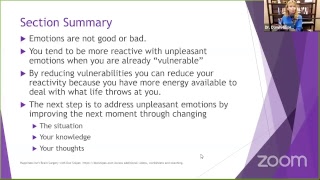
Dr. Dawn-Elise Snipes explains DBT's approach to emotion regulation: how sleep, hydration, nutrition, and stress create feedback loops that amplify mood swings. She defines emotion dysregulation as high vulnerability and slow recovery, then walks through concrete ways to reduce it by changing your situation, knowledge, and thoughts.
Chapters
It. Hi everybody and welcome to Happiness Isn't Brain Surgery with Doc Snipes Practical tools to improve your mood and quality of life. In today's presentation, we're going to talk about dialectical behavior therapy and emotional regulation techniques. This is going to be a five part series, so I want you to pay attention to what we're going to talk about in each particular section. And obviously the sections will be divided up so you come back and review them at your leisure. We're going to start out by talking about the basic premises of dialectical behavior therapy. Then we're going to move into learning about the HPA axis and that's basically your stress response system system. Then we're going to go on to understanding what emotion regulation is as opposed to emotion dysregulation and discuss why emotion regulation is important and how it can help you reduce your distress. And then finally we're going to wrap up by exploring emotion regulation techniques. So let's start at the beginning. What are the basic premises of dialectical behavior therapy? Dialectical theory says that everything is interconnected, reality is not static, and a constantly evolving truth can be found by synthesizing differing points of view. So what does that really mean though? So interconnectedness really means that whatever you're doing impacts everything else and the response of everything else impacts you. So when you walk into an environment that is maybe chaotic and noisy, think of a really busy restaurant or something that is going to impact you differently than if you walked into the library, most likely. So you want to pay attention to not only the interconnectedness in yourself, but also the interconnectedness with the environment. Now within yourself, your emotions, your thoughts and your physical being are all interconnected. Think back to a day that you were not feeling so well. How did that impact your mood and how did that impact your thoughts? Were you as attentive? Were you as patient? Were you as, you know, fill in the blank. Generally, when we're in pain or when we're sick, our mood tends to be a little bit more irritable and cantankerous, if you will. So paying attention to that and just understanding that if you wake up in the morning and you don't feel well, or you wake up in the morning and your back hurts, or you've got a headache that you're probably, probably already starting out with some stressors built up, you're not going to be as patient and tolerant. So prepare for that. Likewise, our thoughts impact our feelings and can impact how we actually feel. And maybe we don't Think about that too much. But if you're having a lot of negative thoughts, if you're having a lot of stressful thoughts, how does that affect your emotions? Well, I kind of gave it away. You probably tend to get a little bit more stressed and irritable and edgy emotionally. But physically, what happens when your thoughts start to become more negative? A lot of us take stressful thoughts and we feel them in our body. We get headaches, we get neck tension, we get backaches, we get belly aches, we crave certain foods. So it's important to understand that your thoughts impact your emotions and also your physical being now. So let's take that back to the beginning. If your thoughts make you feel painful or make you feel icky, how is that going to affect your physical feeling? How is that going to affect how you think, how you feel, and how you interact with others? So it's a system, and it keeps going, and it's a constant feedback loop. And it can either be a negative feedback loop or it can be a positive feedback loop. And that is up to you. But it's important to be aware of how you feel, what you bring to the table, and figure out what your next best step is. One activity you can do focuses on interconnectedness. And think about how your relationships impact your mood and how your mood impacts your relationships. And obviously, general relationships is going to be different than a relationship with a particular person. But I want you to focus in this particular activity more on a particular person or do it several times for different people. Because when you interact with certain people, most likely your feelings and moods and things tend to be more positive, enthusiastic, happy. Whereas when you interact with other people, it might be more stressful. For example, where I used to work, my immediate supervisor was just a gem of a man. And sometimes I'd interact with them and it would be stressful. But that's just part and parcel of him being my supervisor. But it was not a big deal. Now, his supervisor, our CEO, was a very intimidating woman. So my mood when I'd go in to talk with her was very different and much more, I don't want to say professional, but it was much more serious and a little bit freaked out. Whereas if I had to go in to talk, talk to Richard, I would just go over and knock on his door and I'd be like, hey, you got a second? So the way you interact with people impacts how they interact back with you as well. So, I mean, Richard was always much more relaxed with me. I don't know If I would have been more relaxed with Maggie, if she would have been been more relaxed with me. But understanding that we impact other people. If you go into a room and you're just in a God awful mood and you're grumpy to everybody, how are they going to respond to you? Most likely they're not going to be all kinds of joy and happiness. So if they respond in a similar fashion or they ignore you because they just can't handle that negativity right now, how does that impact your mood? So you impacted them and they in turn impacted you and they said, I don't want anything to deal with that. Another thing to consider is how your environment impacts your mood and your mood impacts your environment. If you're in a really dark, dreary, smelly, closed up, disorganized place, Obviously those are my buzzwords. If I'm in a place like that, it tends to make me a little bit more cranky and I have difficulty focusing. I get sleepy. I prefer to be in environments where it's bright and cheerful and there's a lot of activity and that makes me feel more energized and somewhat happier. Likewise, when my mood is not so good, I tend to focus less energy on keeping things organized and worrying about if the lights are turned on. So I can't create that dark, depressing environment if my mood is depressed because I'm not wanting or caring to devote the energy to turning on lights. So thinking about that, if your environment can impact your mood, if you're in a funk, maybe it would be helpful to improve that space, whatever that means for you. For me, that means turning on lights, making it brighter, getting some background noise going on, whatever it means for you, but being aware of the interconnectedness of that. How does your health or energy impact your mood? And how does your mood impact your energy? So we talked about that at the beginning. If your energy is low or if you're not feeling good when you wake up, you're just like, oh, I did not sleep well. Then how do you think the rest of your day is going to go? What's your mood going to be like? It may not be cranky, but I know those days I wake up and I'm tired, I didn't sleep well, I don't feel well, I'm just kind of blah at the very best. So my mood is not one of health and energized and all that kind of stuff. How does your mood impact your health and energy? And we talked about that a little bit on Physical. If you are in a happy mood, you tend to have greater immunity. They've actually done studies and found out that people who tend to be more stressed out and more depressed get sick more often. If you are in a happy mood, you probably feel more energetic, whereas if you're in a bad mood, you probably feel like you're carrying the weight of the world on your shoulders and it's just drudgery to move through each step of the day. Again, considering how that impacts you, it may be worth looking at paying more attention to taking care of your health and your sleep. And finally, how do your thoughts impact your feelings? You know, we talked about this already, but thinking about it with specific thoughts, if you tell yourself, I'm not good enough, how does that impact how you feel? How does that impact your mood? If you tell yourself, I'm lazy, I'm a slob, I'm never going to amount to anything, how does that impact your feelings? Likewise, if you turn that around and you go, you know, I'm all that in a bag of chips and, and I can get this done, and I'm smart and I'm competent and, you know, just give yourself a pep talk, it generally brings your mood up. But feelings can also impact your thoughts. So if you're having a bad day, unfortunately, the way we're wired, when you're in a negative mood, you tend to notice the negative things. So if you're in a bad mood, you tend to get going to tend to be more pessimistic if you don't check that and say, you know what, no, I'm not going to notice all the negatives. I'm going to notice a positive for every negative I pay attention to. That way you balance it out a little bit, and it tends to help improve your mood a little bit if you actually force yourself to focus on some of the positives. Take some time doing this activity and really pay attention to all the things in your environment, in your relationships and in your thoughts and feelings and health and how they interact. Because the cool thing is if you improve one area, it is kind of like putting a string on a blanket and it kind of unravels. If you improve one area, then you can unravel the negativity and distress in multiple areas at the same time. It is going to be a reciprocal effect. So to think again about how thoughts impact your feelings, think about a time you dreaded doing something, doing your taxes, doing your laundry, whatever it is for you, what was your mood like? Most of us, if we're dreading something aren't in the best of moods. How patient and tolerant were you toward other people? Were you kind of edgy and irritable and just shut up and go away so I can get this done? When you're acting like that, how did others seem to react to you and how did their reaction affect you? If they ended up snapping back at you, how did that impact you? When you're in that kind of mood, when you're dreading doing something and you're just dragging your feet, what's your environment like? Paying attention to what kind of vibe you're setting off not only for others, but also for yourself? Are you creating an optimistic empowerment environment? Once you've thought through that, then think again about how is this scenario different when you're looking forward to something? Now, I don't think any of us ever look forward to doing taxes. Well, maybe you do if you're going to get a refund. But there are things that most of us don't look forward to. So how can you change those situations that you're kind of dreading to make them less unpleasant? You may not be jumping for joy to go out and do it, but how can you make it less unpleasant? For example, when I had to take my graduate entrance exams, that's not necessarily everybody's favorite task to do. For some reason, I enjoy doing those. And I looked at it as a challenge to see how well I'd score and if I could beat what I expected my score was going to be. So I turned it into a game for myself. If you're going to a family gathering that you expect to be somewhat unpleasant, how can you make it less foreboding? What can you think about? Focus on who at the family gathering can you spend time with that maybe you would enjoy seeing again? What can you do at the family gathering that can help you avoid whatever the unpleasantness is? Because the unpleasantness probably surrounds two or three or a few people, not everybody there and everything going on. So try to figure out things that you can look forward to. It's not going to make it a complete panacea. You're not just going to love going to do it, but it will make it less drudgery so your mood will be better. If your mood's better, you're probably going to put off a happier vibe, if you will, which will make the relationships and make whatever that situation is go a little bit easier and it won't drain all your energy. Because when we dread things, we tend to spend a lot of Energy thinking to ourselves, I wish I didn't have to do this. And being angry about the fact that we've got to do something we don't want to do. So find the positives. Find something you can look forward to in every situation. Reality is ever changing. That's the second tenant of dialectical theory. What that means is what's true right now may not be true in the next moment. So let's look at some examples. If you've ever started exercising and gotten stronger. So what was true for you back in February may not be true for you now because you may be able to lift 15 pounds more. Have you ever gained or lost weight and changed a clothing size? So your reality six months ago was that you wore a size, whatever, but your reality right now is that you wear a different size. Reality changed. It's not anything to get all excited about. It's just accepting reality in the moment. Now we can also apply this to people. Have you ever known someone who was attentive and kind and, you know, maybe you were really good friends who suddenly started being neglectful and irritable? Now, what's that about? Are they still attentive and kind in this current reality? And in the current reality, you've got to figure out what is going on with that person. So you may decide that in the current reality, maybe they are having a lot of family troubles, or maybe they have gone down into an addictive sort of set of behaviors and they are not able to be the same person they were six months ago or even a month ago. That's the current reality. And you need to make your decisions on whether to interact with that person based on the current reality in order to protect your own emotions and feelings. Think about how your needs have changed over the last four years. Five years. Five years is a long time. What I thought I wanted and I needed five years ago was very different than what my goals and wants are right now. So thinking about that. And finally, truth can be found by synthesizing different points of view. So the easiest one is to think of a disagreement you had with somebody and what was your perception of what was going on? What was their perception? And was reality somewhere in the middle? I'll give you an example. I have teenagers at home and I will come home and they will have said they've done their chores, and I will look around and I will say, no, you haven't. Now, my reality is different than theirs. They think they have, I think they haven't. So what is the difference in the truth? Well, the truth is, they did what they felt they needed to do. I saw things that I thought they needed to do that they didn't do. So reality was the fact that we both had our own truths and combining them in the middle and then talking about, what does this look like? Because ultimately, I'm the one who judges their chores. So my truth is more important in that particular situation. But thinking about different people's perceptions. When my son was very, very little, you know, I would tell him to clean his room. And his definition of clean has always been different than mine. I'm a freak about floors. I'm a freak about baseboards. And he was more like, shove everything under the bed and into a pile and it's clean. And I'm like, no, that doesn't work. So talking about what your different truths are, what your different definitions of certain words and certain experiences are, this is also the reason when law enforcement goes to a crime scene, they interview multiple witnesses, and each witness saw something a little bit different. Because everybody's perception, everybody's truth is a little bit different. It doesn't necessarily mean they're lying. It means they saw, paid attention to, or interpreted what happened a little bit differently. So it's up to law enforcement and the courts and what have you to determine what the actual truth is by synthesizing all those points of view. Another example, think about a time you had to make a decision about something you were totally torn on, like whether to take a job or not. So if you play devil's advocate, you're basically synthesizing two different points of view. You're synthesizing the this is not a good idea point of view, and the this is a great idea point of view to come up with reality, which is generally somewhere in the middle where it's a good idea. But there are going to be some drawbacks. Another thing you can do is think about a time you had to make a decision, and your heart told you one thing, but your head told you something else. So what I want to do, but what I need to do, two different realities within the same person. You know, you can feel a little bit torn a lot of times, but taking. Listening to both of those voices, if you will, hearing them out and then combining them and going, okay, now what is the best choice of action based on my ultimate goals and objectives? So it's important to remember when we go into trying to control our emotions and trying to feel better and trying to understand what impacts us and makes us happy or sad and how we affect Other people, that everything is interconnected. Your feelings, thoughts and physical health all impact each other. Your mood and behavior impact your environment and your relationships. And all of those in turn impact you. So think about how your kids impact you, think about how your spouse impacts you, think about your boss impacts you. And think about how you impact them and how it's kind of a give and take relationship. You have the ability to control your thoughts. Your emotions are your body's natural reaction to a threat or you know something good. When you have happy emotions, it makes you want to do it again. But you can control your thoughts when you which impact your emotions. You can control your physical vulnerabilities. So things that make you more irritable, like pain or lack of sleep, being hungry. You can control things in your environment to a certain extent. I mean, sometimes you're going to be in places where the environment's the environment, but you can try to improve it, at least your little aspect of it. And you have the ability to control your relationships, how you interact and with whom you choose to interact. Reality is not static. It is what it is in this very moment. It is what it is now. In five minutes it may be different and then it'll be what it'll be. But we need to understand that reality can change and will change even if don't want it to. Needs, wants, and situations can change dramatically over time. So reality figuring out what's actually going on in this very moment is based in finding the truth. That truth can be found by synthesizing differing points of view at that exact moment. So in situations involving other people, put yourself in their shoes or heaven forbid, you might even ask them, tell me what is it you're thinking here and explore the point of view. Instead of trying to convince them that your way is right or your perspective is right, put yourself in their shoes and go, let me understand where you're coming from. And then you can start working on synthesizing your truth and their truth in situations involving only yourself. Examine it from a logical perspective of how it will help you achieve your long term goals and from an emotional perspective of what will ultimately make you happier. Synthesize both of those to figure out what the best choice is that will help you reach your long term goals and be happy at the same time. Welcome back to Happiness. Isn't Brain surgery with Doc Snipes practical tools to improve your mood and quality of life? This is the second module in five modules on emotion regulation. In this section we're going to define emotion regulation and identify why it's important important and how it can actually help you. In the last section, we reviewed the basic theory underlying dialectical behavior therapy. And now we're going to move on to talking about how to apply that theory to help you manage your emotions so you don't feel like you are overcome or overwhelmed with negative emotions. So before we can talk about emotion regulation, we have to talk about emotion dysregulation. And emotion dysregulation results from a combination of high emotional vulnerability, extended time needed to return to baseline, and an inability to modulate your own emotions. What does all that mean? High emotional vulnerability means you tend to be somebody who is more reactive. You get upset or bothered by more things than most people seem to. It doesn't mean it's bad or good. It just means you are more sensitive. You're much more reactive to your environment. An extended time needed to return to baseline means that once you get bothered or upset, you can't just turn it off. It takes you a little bit of time to calm down and get back to where you were. And an inability to regulate or modulate your emotions and. And that's kind of the crux of dysregulation, which means when you get upset, it's not like you can say, no, I'm not going to get upset about that. It just the feeling seems or feels like it overcomes you. Emotion regulation helps you figure out why all of this happens and develop tools in order to help start controlling those emotions so you feel like you're in control of your thoughts and your reactions and your urges. It's important to note that if you are emotionally reactive, you might have found that your environments up till now have often been invalidating when you've gotten upset. People have told you you're just getting way too upset about this or don't make a mountain out of a molehill or just get over it. And you found it very difficult to do that. So you stuffed your feelings inside and you quit letting people know how you felt about stuff. Because every time you put it out there, it was kind of like you got got your hand slapped and they said, no, that's not how you're supposed to feel. Well, you feel how you feel. And that's the first thing I want you to take away from this presentation right now. When you get upset, when you're happy, whatever it is you feel, how you feel, and that's okay. What you do with it is what is going to help you figure out whether you're going to interface well with others and be happy or if you're going to be stuck in that emotion. Emotions are a natural response. It's your body's way of telling you that either there's a threat and you need to fight or flee or. That was really good. Let's do some more of that. Once you understand that your emotions are just kind of an inborn reaction, then it's easier to deal with because how you should feel is irrelevant. Your body is telling you, based on information I have, this is either really good or not so good. And you need to do something. That's all emotions are. They are functional to you in reality at the moment. And I'm going to talk a lot about spiders in this one because I love spiders, but a lot of people don't like spiders. They don't know much about spiders. So when they encounter a spider, they get scared. Natural reaction. The body's going, that's a spider. I know enough about spiders to know that some of them are poisonous. So I need to get out of here, get away from this spider and neutralize the threat in some way. Whereas when I see a spider, I'm like, oh, cool. Because in my reality, I know that the number of spiders in my area that are actually poisonous to people are like four, and I know what they look like. And most of the time what I'm seeing are the bug catchers, and I think that's pretty helpful. I'd rather have a spider eat mosquitoes and gnats instead of me having to kill them with insecticide. So based on different realities, based on different knowledge, we have different reactions. Emotions function to communicate to others and influence and control their behaviors. When you're angry, how does that influence other people? It either gets them to submit or they fight back or they go away. Those are generally the three reactions to somebody who's angry. So you're influencing and controlling their behaviors when you're happy or when you're excited. You can also encourage them to do things. Think about how other people's emotions impact you. If somebody's having a really bad day and they're really angry, what's your reaction? If somebody is really depressed, on the other hand, what is your reaction? So you start to see how other people's emotions influence you and can affect your behaviors. Now what? Your behaviors are kind of dependent on you. Some people will try to comfort someone who's depressed. Other people will be like, yeah, not sure what to do with that. So I'm just gonna quickly back away and not. Not deal with this. Emotions also serve as an alert or an alarm, which motivate your own behaviors. Like I said, with the spider in in someone's reality who's not aware that most spiders are really harmless and quite helpful, they might be frightened because they don't want to get some sort of poisonous bite. So that fear motivates them to either kill the spider, which makes me sad, or back away from the spider and get away from the situation. Emotion regulation is the ability to influence how you experience and express emotions. So I said that you will feel emotions, it's just natural. It's one of those sort of knee jerk responses. It's automatic, designed to protect you. However, what you do with those emotions when you feel angry, you can stew on it and you can have negative thoughts and you can dwell on and you can remember every other thing in the world that made you angry in the past 24 hours, or 24 years for that matter, which probably doesn't do much to help you feel better. Or you can choose to accept the fact that you're angry in this moment about whatever it is, and figure out how to improve the next moment. Emotion regulation starts out by helping you mitigate unwanted emotions by reducing vulnerabilities. In the last module we talked about interconnectedness and how if you're tired or you're sick or you're in pain, you may be a little bit more vulnerable to being irritable and cranky and just not on your A game. So one of the first steps in emotion regulation is to try to make sure you're on your A game as much as possible. But when you're not on your A game to be aware that you're having a bad day, you're stressed out, you're tired, whatever it is, and make accommodations so you're not acting as if you're on your A game. You can't handle as much stress on those days when you're vulnerable, you need to cut yourself a little slack. So emotion regulation is about being aware and mindful of how you feel, what your strengths are on that particular day, in that particular moment, and taking the steps necessary so you can achieve your ultimate goals of being happy, being pleasant to other people, having healthy relationships, etc. Emotion regulation teaches that emotions in and of themselves are not good or bad. You know, kind of said that three different ways now. So hopefully you're hearing the fact that being angry is okay, being terrified is okay. That's your body saying you got to get up and do something. So instead of judging yourself and saying I shouldn't be upset about this. Saying I am upset about this and just accepting it instead of fighting with it. Suppressing emotions and telling yourself you shouldn't feel some way tends to make things worse because you're not identifying or addressing the message that your body's sending. Your body's going, there's a problem, and you're going, I can't hear it. I can't hear it. It's kind of like if the smoke alarm was going off and instead of paying attention to the smoke alarm and trying to figure out what was causing it to go off, you just put in earplugs and ignored it, what would happen? You know, sometimes nothing would happen, but sometimes you'd be in big trouble. So don't suppress it. When you have that alarm go off, it's time to pay attention and figure out what needs to happen to improve the next moment. None of us wants to stay angry or scared. Our main vulnerabilities sleep. And there's going to be an entire episode just on sleep. But sleep in and of itself can make you feel better or make you feel worse. During deep sleep is when your body balances all of your neurotransmitters that are responsible for helping you feel excited and happy and calm. And any of those emotions, they get all balanced out during your deep sleep. So if you're not getting good sleep, then you may have more difficulty regulating your emotions. Nutrition forms the building blocks of the neurotransmitters, the brain chemicals that help you feel your emotions, your happy ones and your excited ones and even your angry ones. So if you're not getting healthy nutrition, it's like trying to build a Lego house without having any of the little four block Legos. You're going to have some holes in there and it's not going to be very stable. May not even be able to build it at all. So it's important to try to eat relatively healthfully. I'm not talking go crazy with it. I mean, you can if you want to, but start with small changes. The first one being drink enough water. Your brain is 80% water. When you don't have enough water in there, the chemical reactions and the electrical signals that help your brain communicate between different parts and tell your body what to do, can't function effectively. When that happens, then you're going to have problems thinking clearly and sometimes even feeling happy. So get enough sleep, drink enough water, try to eat somewhat healthfully, have some colors on your plate, try to prevent illness. But when you are sick, just Recognize that, you know what, I've got the flu or I've got a cold, and today I'm not going to be 100% because my body needs energy to fix itself, to heal itself. So I'm going to, you know, give myself a little bit of a break. You wouldn't ask your child or your best friend to be 100% if they were sick, you'd give them a break. So give yourself the same if you're in pain. Now, some pain is caused by stress, and pain can cause stress. So it's important to try to figure out what you can do to mitigate that pain as much as possible. Whether it's taking anti inflammatories or ice or stretching or whatever your doctor tells you that you can do to help mitigate that pain. But also, unfortunately, accepting that sometimes we're just going to hurt a little bit. And once you stop trying to fight that and say I shouldn't hurt, it will be easier because everybody hurts a little bit sometimes. And you know, as you get older, you start aching and creaking and hurting a little bit more often. Doesn't mean anything's necessarily terribly wrong, it just is what it is. So you need to be kind to yourself that day. And stress, and that's just kind of a garbage term for I just got too much going on and I'm overwhelmed. But when you've got all that, you wake up and you're just, you're already kind of feeling discombobulated because you've got so much stuff going through your head and you're so stressed out and so overwhelmed. How do you think that's going to affect the rest of your day? So figure out what you can get rid of, figure out what has to be done, and figure out how you can be kind to yourself as much as possible while you're in this state because your body is on high alert, it's already expending a whole bunch of energy just trying to help you deal with the stress, the anxiety that you feel. Because you think certain things have to get done and you don't know how you're going to get them all done. So cut yourself some slack. One of the things that I see a lot of people mistakenly do is hold themselves to a high standard, think that they should be on their a game 100% of the time. None of us is on our a game 100% of the time. So once you accept that and you hold yourself to the same standard that you hold everyone else to, you'll Find that you have many fewer shoulds. I should do this, I shouldn't feel this way. You're just going to be okay with it is what it is. So one activity that can be kind of fun. I call it the reactivity solution. Think of yourself. You know, we've been talking about vulnerabilities, all those vulnerabilities we just talked about. And if you wake up one day and you've only got a little bit going on, you slept pretty well, you're eating pretty well, your energy is good, you're not sick, you're not in pain, you don't have much going on in terms of vulnerabilities. There's a few things you got to get done that are causing you a little stress, but not much. So how much more can you tolerate in terms of additional stressors for that day? You can actually put quite a bit more in there before you start to overflow the cup. And nobody wants to overflow the cup. Now. If you wake up one day and you're sick and you're in pain and you didn't sleep well because your nose was stopped up, and you've got six different meetings you've got to go to that day, your vulnerability glass may already be full, which means you don't have much room for any additional stressors. So think how full is your glass. How much room do you have for additional stress each day? And what can you do to make room for any additional stressors? You know, stuff's going to come up. So is there anything you can do to help yourself feel better, to reduce your stress to, you know, maybe it's a matter of eating something because your blood sugar is low, but what can you do to kind of lower your, your vulnerability level? So in order to do that, you need to know what works for you. How can you reduce each one of these vulnerabilities? Lack of quality sleep, poor nutrition, including hydration, pain and illness, and stress. What is it that you can do your life? So let's take lack of quality sleep, and I'll just give you some examples. You need to figure out what works for you. First and foremost, I tell people caffeine stays in your system for 12 hours. So the caffeine you drink at noon is going to be keeping you a little bit more alert at midnight. So if you go to sleep at nine, that means your first three hours of sleep are going to be good quality. So cut down on caffeine, especially after, especially after noon, and try to create a sleep routine doing the same three Things that get you ready for bed each night because that cues your body in that it's time to start making melatonin so you can sleep. Poor nutrition. Carry around a water bottle with you. If you have one with you, you'll tend to sip on it throughout the day. Even if you don't love water, you'll find that you drink a whole lot more. If you really, really can't stand it, having it chilled helps. And having some lemon in it, and I mean real lemon, not the lemon that comes in a jar, can help take the unpleasant taste out of it. Those are the best ways. Obviously, Crystal Light or Powerade or something can also be used. You want to avoid anything with sugar or caffeine or carbonation in order to maximize your hydration for pain. We've already kind of talked about that. Work on stretching. Pay attention to your bed. A lot of people find that because they have a poor mattress or they sleep in some sort of wonky position that they wake up and they're in more pain. So make sure you've got a good pillow and at least a decent mat. And, you know, try to keep the dogs out of the bed. When my daughter was little and she would come sleep in our bed, the child would run a marathon in the middle of the night. I don't think she moved near as much during the day, but she would turn around 360. She would be kicking me in the kidneys. You know, it was just one of those things that I knew if Hailey came in the bed that nobody was going to get a good night's sleep. Sometimes you can't avoid that, but being aware that it impacts your sleep and it also can cause you to sleep in weird kind of funky positions. If you're trying to, you know, cuddle a child or pet a dog or whatever you do when you're falling asleep, illness, do your best to prevent it. Make sure that you're eating a relatively healthy diet. Use those little wipey things on the cart when you go to the grocery store. But I try to keep one in my hand because the cart, yeah, everybody's hands are on those. But everybody's hands are also on all the products that you pull off the shelf and you look at. So, you know, during flu season, I tend to carry one of those around a little bit more. And what can you do to eliminate your stress? And only you know what your stressors are. So you're going to have to figure out, are there things that you can eliminate? Going back to the fact that emotions are Normal. Think about finding a spider crawling on the wall next to you. We've already talked about that spider. In that moment, your reality at the time, did the situation involve a threat to your safety or sense of control? Probably because you may not know what the spider is going to do, if it's going to catapult down with a web or it's going to bite you. So if you're afraid of the spider, if you think the spider is dangerous, then you're probably going to have a fear reaction. Think about a time you got angry because a friend disagreed with you. And it happens people disagree with you. And you can just get kind of a little attitude in that moment. Again, your reality at that point in time, did the situation involve a threat to your safety, sense of control, or self esteem? Now, if they said something nasty or said something that was demeaning or condescending, then that goes against your self esteem. So that's a threat. So anger or frustration or irritation, whatever level of anger you got, is a natural reaction. But what do you do with it? If you take that anger and you lash back out, how's that going to play out? If you lash out at that person, how are they going to respond? And then how are you going to respond? How are they going to respond? It probably is going to go downhill. So to change the reality, to change your emotions, you need to figure out how to either change your situation, change your knowledge, or change your thoughts. I'll give you another example. Going on a roller coaster. I'm terrified of roller coasters. I mean, logically I know that you're totally safe in them and nothing can happen, but I'm still terrified of them. So when I go to an amusement park, if I have to get on to a roller coaster, I'm scared to death. So I can either change the situation and choose not to get on the roller coaster so I don't have to be scared. I can change my knowledge, which I've already tried to do, and I've educated myself how safe they are, but that didn't seem to work in that particular situation. Or I could change my thoughts about the roller coaster. I could look at it as a test or as a growing experience. I've never chosen to exert the energy to do that. I just choose to change the situation. But that makes the anxiety go away in that particular situation. And riding roller coasters isn't a big part of my life. So that doesn't make me feel like I'm living like a hermit. It just makes me feel like I'm not going to ride a roller coaster. There are going to be other things that you're not going to want to avoid all the time. Maybe you're afraid of driving and getting on the interstate. See? Scares you to death. So you can change the situation and choose not to take the interstate. You can change your knowledge about how safe it is to drive on the interstate and what you need to do to increase your safety on the interstate. Or you can change your thoughts. And whatever thoughts you have that tell you that being on the interstate is a scary place, you can start challenging them and looking for reasons that being on the interstate might be more beneficial than going the back roads and figuring out why it is more effective in that particular situation to face your fears. Emotions are not good or bad. You tend to be more reactive with unpleasant emotions when you're already vulnerable. So if you're already tired, sick, painful, all that stuff, by reducing vulnerabilities, you can reduce your reactivity so you're not already kind of edgy, so you'll have more energy available to deal with what life throws at you. The next step Once you've reduced your vulnerabilities and gotten yourself as close to 100% as you can for that day, the next step is to address unpleasant emotions by improving the next moment you feel, how you feel in the moment. But in order to stop feeling that way, you either change the situation, change your knowledge about the situation so you can feel better about it, or change your thoughts about the situation. It.










