Happiness Isn't Brain Surgery Tuesday
Dr. Dawn-Elise Snipes explains how triggers work: sensory cues, times, people, and thoughts that condition us through observation and experience. Learn to identify your triggers, eliminate the avoidable ones, and use environmental cues to build stress-tolerance skills instead.
Questions this video answers
Every Saturday.
Subscribe or join via docsnipes.com (podcast and Facebook group addresses given as podcast@docsnipes.com and Facebook group@docsnipes.com in the transcript).
Chapters
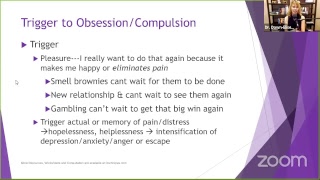
Welcome back to part two of Happiness. Isn't Brain surgery with Doc practical tools to improve your mood and quality of life? We're going to continue in this section to talk about triggers and cravings. We'll explore how triggers develop, learn ways to recondition them. And we talked a little bit about that in the first segment. And learn how triggers can prompt obsessive thoughts and compulsive or escape behaviors, which is what a lot of us are really watching this presentation for, is to understand, you know, why do triggers make me suddenly get depressed and feel stuck in that depression? Or why do triggers make me want to go out and use or smoke or go gambling or whatever it is your escape, whatever your escape behavior is. So where do triggers come from? We talked about the fact that triggers are visual. Things you see, things you, things you smell, things you taste, but also times of day, people that happen to be in your presence. And there are a variety of other thoughts that you might have, such as all or nothing thinking. That can trigger depression, anxiety, and potentially the desire to escape. So where do these come from? Well, some of them are inborn, like we learned, but a lot of them are conditioned and we can get them from experience through trial and error. For example, and remember how in the first segment we talked about some things can be positive for one person and negative triggers for another person. So let's look at that for a second. In this particular scenario, if you have brownies, it may produce a positive feeling. You associate that with holidays, you like brownies. Whatever. If you are diabetic, hypoglycemic, or gluten intolerant, then eating brownies may cause a blood sugar crash or an upset stomach. So it could be a negative trigger. So every time you see or smell brownies, you start either getting excited about getting to have brownies or wanting to get away from it and going, no, not something I want to eat today. Another example would be getting good sleep. If you get good sleep and you have more energy and a better mood, then you're going to be more inclined and more motivated to make sure getting good sleep is a priority for you. If, on the other hand, you get good sleep, but it means you're spending a lot less time with your friends because your friends all go out after work and nobody gets up at six in the morning like you do, then it can be less rewarding and it can be more of a negative trigger because you're like, get good sleep would be great, but I really enjoy spending time with my friends more. So you need to look at the power of the reinforcer. We can also condition stimuli through learning. If, for example, a child's dad drinks after a hard day and gets less angry, you know, just kind of turns into this chill dude sitting on the sofa, then the child may learn, hey, you know, when I get stressed, having a few beers might be the way to go. On the other hand, if the dad drinks after a hard day and gets a hangover and gets grumpy the next day, or turns into a really angry drunk person, then the child is going to think, you know what, alcohol is a really scary drug, or it has a lot of negative effects. I don't see the point. So when they see alcohol or are exposed to it, they're not going to be as inclined to want to drink it. The other example, if dad exercises after a hard day, helps him relieve stress, he comes home, he's in a great mood, then the child might go, okay, there's something to this exercise thing after all. On the other hand, if dad exercises after a hard day and overdoes it, can't move the next day, and every morning after he works out, he gets up and he's sitting at the breakfast table and he's just out cranky pants, then kids are going to go, you know what? Exercise. Yeah, I see how it makes dad act. Why would I want to do that? We learn by observation that if you do this activity or have this thought, it produces a good thing or it produces a bad thing, and then that tells us, do I want to do that? The other way we learn or condition stimuli is just through education. So if you go to a course that teaches you that mindfulness increases awareness and helps you reduce stress, you might be like, yeah, that's what I want to do. Score, I want to go there. But if you also learn that mindfulness can be really stressful. If you have a hard time controlling what we call monkey mind, you know, your mind's all over the place. You've got add something like that, Then you might think about mindfulness and go, you know what? No, that's not something. That sounds like something I want to try. So the way instructors, teachers, people who are educating you about anything, parents, pastors, present, it can help you decide or can set the tone in your mind about whether it's something you want to pursue or something you don't want to pursue. Another example, education itself. If you go to school and you have a really awesome primary school experience, then you may want to go on to college and graduate school. On the Other hand, if you struggle all through school, then you may not want to go on to graduate school or college because that's just not a good fit for you. So it's important to understand the way we interact with things in our environment and the way we experience experiences. Help us decide, if you will, what we're going to be motivated to do. Another example, sunlight increases vitamin D and improves mood. And so if I tell somebody that they might be like, great, I'm going to get 15 minutes of sunlight every day or whatever. So educating them that that is an intervention for depression may motivate them to want to try it. On the other hand, if, you know, like in my family's case, we have family member after family member after family member who's had skin cancer. So I hear about sunlight and I'm like, yeah, it might increase vitamin D, but, you know, at what risk? So when I hear about the benefits of sunlight, I also hear about the negatives, and the negatives stand out more for me. So I am less likely to be basking in the sun every day. You know, a few minutes here and there, no big deal, not going to be out sunbathing. So we have all these triggers, but how do they make us have obsessive thoughts or engage in compulsive behaviors? Well, the first thing to realize in is a trigger reminds you of something. It brings up a memory. And if the memory is strong and strong and positive, then you are going to keep thinking about it. So think about if you smell brownies and you love brownies, and you can't wait for them to be done, or even you're thinking about making brownies when you get home and you start really salivating over them and you just can't wait until they're done. That's sort of an obsessive thought. You're continuing to think about it over and over and over again and getting more and more excited and motivated to access whatever that is. New relationships are often the same way. When you're in a new relationship and you know you have to go to work or something, you just can't wait to see that person again, and they're on your mind constantly. And, you know, it's not necessarily a bad obsessive thought, but it's constantly there. You're thinking about it a lot. It doesn't become bad until it starts interfering with other aspects of your life, but it can be kind of obsessive. Gambling and addictive behaviors are the same way because you start thinking about whatever that escape behavior is and how good it made you feel, and then you start romanticizing it and really wanting to feel that way again. So the obsessive thoughts can come around or center around engaging in something that provides pleasure or makes pain go away. And then the compulsion is the only way to stop this thought is to engage in that behavior. So once I eat the brownies or see this person or get a big win, then I'll have some relief from this thought because I'll be satisfied for a little bit of time. The trigger can also be an actual memory of pain or distress that produces a sense of hopelessness and helplessness, which can intensify depression, anxiety, anger, or addictive behaviors. A trigger can trigger pleasant memories or like in the case we talked about in the first segment, in the case of my stepfather, when, when he encounters Christmas lights because his family was in a house fire on Christmas Eve, that trigger reminds him of the pain of losing his family in the house fire, intensifies the hopelessness and helplessness, and he gets stuck in this feeling of depression and hopelessness. So understanding that triggers can get you stuck in obsessive thoughts. And even today, 40, 50 years later, he still goes over in his mind, what could I have done differently? What should I have done differently? And you know, he doesn't have any compulsive behaviors that he engages in to stop those obsessive thoughts. He has other coping skills. But for a lot of people, they might develop unhealthy reactions in order to make those unpleasant thoughts stop that reminded them of something that was like the worst day in their life. Knowing triggers for the behavior to be eliminated, whether it's depression, anxiety, anger, outbursts, or addictive behaviors, can help prevent you from being triggered and moving on to obsessive thoughts or the behavior. So if you know the things in general, it's going to be an ever evolving list. But if you have a general idea of, you know, the big ten things that really get you anxious or really tick you off, how many of those can you eliminate? Think about it ahead of time. How can you eliminate them? If you can't eliminate them, how can you deal with them? Make a plan ahead of time so they're not as impactful on you. Because if you can do that, then you won't move on to the obsessive thoughts and get stuck in that sense of being powerless. Knowing positive triggers can help create a change plan that increases triggers for positive emotions and those which prompt you to use the new skills. You generally can't be miserable and happy at the same time. Now there's that weird little bittersweet thing where it's happy and sad kind of at the same time, but that's better than clinically depressed. So know the things that make you happy and do those. So you wake up in the morning and you've got a smile on your face before you walk out the door. It's a good start to the day. And if you're doing something that makes you happy, it's harder to continue to stay upset because you're focusing on that thing that makes you happy. And use triggers that prompt you to use your new skills. Mindfulness. The stress tolerance skills. What can you put in your environment that reminds you to breathe, that reminds you to be mindful that reminds you to maybe eat if that happens to be something that you forget to do and you get low blood sugar? Figure out ways to improve the good things and enhance and increase the frequency of the good things in your life. All of these segments are put together on our podcast that is released every Saturday. So you can subscribe to the podcast@docsnipes.com you can also join our Facebook group@docsnipes.com Facebook or subscribe to the podcast on your favorite podcast player.










