Hoarding and Conquering the Clutter
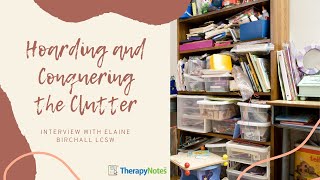
Dr. Dawn-Elise Snipes talks with Elaine Burchall, founder of the Canadian National Hoarding Coalition, about hoarding disorder, its causes, and how to overcome it. Burchall shares practical tools from her book Conquer the Clutter and explains different types of hoarding and what drives the behavior.
Chapters
I'd like to welcome everybody to today's presentation. We are going to be talking about hoarding, Hoarding and Conquering the Clutter with Elaine Burchall. Overcoming hoarding, which is a mental disorder recognized by the American Psychiatric association, requires more than pop psychology and a 30 gallon garbage bag. In the new book, Conquer the Clutter, social worker Elaine Burchall, founder of the Canadian National Hoarding Coalition and co author Suzanne Conkright provides practical strategies for regaining control. You can find more information from Elaine at www.hoarding.ca to learn more and to buy her book. You can also find her book, Conquer the Clutter on Amazon. So welcome to you today, Elaine.
Thank you. Thank you for the invitation.
So let's talk a little bit. I don't know much of anything at all I should be ashamed to say about hoarding. So tell me a little bit about how common is hoarding disorder.
Very, very conservatively. It's 5. We can prove 5 to 6%. But I can't go anywhere and mention the word hoarding where I'm not getting a self referral. I'm concerned about a loved one or my neighbor or I think a friend of mine is. So I know that we haven't proven the real depth of this, the real prevalence rate.
Right. And I know one of the things that we are going to talk about a little bit later is what prompts people to become hoarders, because that is a really big number that you're talking about. So what is the difference? You know, my husband, bless his heart, still has boxes of notebooks and textbooks and stuff from high school. And, you know, we're way past that. Our children are actually out of high school now. But, you know, he's probably not a hoarder. He's probably just a clutterer. So what is the difference between hoarding and cluttering?
So basically it's a question of proportion and where the need comes from with cluttering. Many people live with clutter and they undo it and they do pretty well for a while and then they kind of lose ground and things build up a little and then they get on top of it. So cluttering is basically when you do have what most people would describe as a few more things than you actually need and they're in the way, but you have a far easier time on a regular basis to maintain it. And you don't invest emotional, you don't make any emotional investment in your things, in the number of things that an individual living with hoarding disorder does. Okay.
So let me ask you a little bit. One of the organizations I volunteer with is called arc, and it is an organization that unfortunately is called out on a regular basis to intervene in animal hoarding situations. So is animal hoarding different than object hoarding?
Very different. Very different. So maybe a little later on we'll go through the different types. But just thank you so much for raising animal hoarding. No one does. Thank you, thank you, thank you. Because the person themselves is usually inadvertently causing severe distress, not just to themselves, but to animals who are basically through misguided attachment, misguided needs, holding those animals hostage. And I know that's a strong word, but they are. And it's confounding because of the, the love and the devotion and the, well, meaningless that the people have animal hoarding. There's no easy, simple hoarding situation. It's a complex disorder coming from a confluence of vulnerabilities. But animal hoarding is easily the most complicated. There are five psychiatric subtypes, sub systems that explain to the best we can, animal hoarding. So it is complex.
Right, okay. And I know we'll get back to that in a second, but you alluded a little bit to the difference between hoarding and cluttering is it's partly emotional attachment to the things why it happens to the degree that it's happening. Are there any clear signs that people can look at and go, hmm, I think I may have, or my loved one may have crossed the line and they may be a hoarder?
Absolutely. I'm going to refer you to Tools and Tips because the tools for self identifying are. I've developed many and they're on my website, Hoarding ca. So if someone is concerned about whether they are or they want to kind of take a first scan at someone, the situation someone they love is living with and they know them well enough to do that, go to Hoarding CA and look at the quiz. It's under the resource tab. And the quiz's name is Are youe A Hoarder in the Making? Now, I developed that tool for people who don't feel ready to maybe self declare or they would feel exposed. And it actually is a text version of the Criteria in the DSM 5, the diagnostic manual Mental Health Disorders. And so it is a valid tool. You're going to come out of that not with just any old answer. You're going to come out with a rating of your risk and then recommendations given the risk level that you rate what your next step would best be.
Okay, so you alluded earlier to the fact that there are multiple types of hoarding. Can you differentiate the five types of hoarding for us?
Absolutely. When you look at hoarding, it's a continuum of relationship, basically. All right, and vulnerabilities. So you're going to hear, if you read literature, you're going to hear it described by other names. But I started to develop a standard for, for the language to describe hoarding that relates to some other verifiable scientific standard. So when you're talking about standard hoarding, and the reason I call it standard hoarding is because it meets the standard. There are three criteria. Maybe we could talk about next. And under standard hoarding, there are basically three subtypes. The first is indiscriminate hoarding. Indiscriminate hoarding is where someone is highly cued, highly triggered by all manner of things, and really everything you can think of can and is hoarded. Beauty is in the eye of the beholder. With indiscriminate hoarding, generally it's the more I have, the closer it is around me, the better I feel. Discriminate hoarding is different. It is being triggered and cued. Immediate attachment to certain categories of things that have high attraction value and high reward value for acquiring. All right, That's a lesser degree of the more I have, the better I feel. Here's the difference, though. It's not collecting, all right? Because the numbers that the person feels necessary to acquire, they couldn't possibly display. They couldn't possibly invite people in to enjoy and show something that they're very proud of. All right? So there's that. There's a lack of a piece that is normally attached to collecting. The third is combined. Combined is when things have really gotten out of hand. And generally when you start to deconstruct those piles, you find that it most likely is a discriminate hoarder who life is really overwhelmed. And they all manner of things from daily life have started to be piled on and mixed in. So that's combined. The second type of hoarding, the second category of hoarding is Diogenes syndrome. Diogenes syndrome is a syndrome in itself, but it's highly related with hoarding. With hoarding, I'm sorry. And we generally find it among our senior population only because seniors are more likely to be attached or put in contact with social support systems, programs and that kind of thing. And so it comes to light and it's hallmarked by abject self neglect and squalor. You can't imagine the conditions these elderly people are in and they are quite often highly at risk from health and safety and really non compliant with elderly any of their medications that help to support them. The third category of hoarding is animal hoarding. And as I said before, there are five subtypes of psychiatric models. Jeannie Lewis did some work on this, some research on this, so there is a podcast that she put out if people want to know more in depth about that. And also it's covered in the book as well. Conquer the clutter. Okay.
Yeah. And when you were talking about Diogeny syndrome, did I say that right?
Yeah.
And animal hoarding. Several of the cases that AHRQ has gone to lately have involved elderly people retired. In all of these cases so far, they've been women who wanted to help the strays in their community. And it just, it got out of control and there were literally hundreds of animals, some in squalor. We. I will not get into the details because it's heartbreaking, but the people really. It was coming from a place of love, but it got out of control and they didn't know how to get out of it. And we had to go in with masks on because even the air quality in the house was the ammonia levels. So there is a lot of overlap, I would think, between the different categories of hoarding.
There. There often can be. I've had. I've had situations, not many, but I've had one situation. 127 animals in a double wide trailer, none of which, including dogs, none of which were allowed out. Yeah. And I've been called in by the Ontario SBCA to work remotely with people where a person had a house fire with 301 animals in it.
Oh, wow.
Yeah, yeah.
And we'll get down to the grief and loss in a few minutes. But you had alluded to the fact you wanted to talk a little bit about three criteria for being diagnosed with hoarding.
If people are wondering whether something is a hoarding situation, go back to the criteria. This is not a subjective decision. This is an objective, measurable decision. First and foremost, there must be what most people would describe as an excessive accumulation, and I like to say a failure to resolve it. Sometimes in other definitions you'll hear discard. I don't use the word discard because passing things on can also be an objective. So failure to resolve proportionately. Now that is not, you know, the trite little saying one thing in, one thing out. If you can do that, you are nowhere at this point in your life on the continuum of hoarding. But the person fundamentally just has lost or didn't develop enough. That check and balance system where they become aware that it's beyond their ability to manage and generally they're in a state of being overwhelmed. So excessive accumulation, failure to resolve proportionately second criteria, some or all of the living spaces can't be used for their intended purpose. That's important because when you start to make adaptations to your living conditions, to living in your environment, you can't maintain an adequate level of safety, health wise and mobility wise and fire wise. All right? The third criteria is either somebody is distressed actively, or if they aren't distressed actively, if they knew the, the true conditions of the environment, they would have a legitimate reason cause to be concerned. That can be your neighbors who don't know what they're living beside on top, you know, underneath, and they are at the same risk or more because they don't take precautionary measures. So they don't know to be ready for increased risk. Could be your mortgage company, your home insurance, it could be bylaw, property standards, the fire department, children's services, if there are children involved, services for the elderly, if elderly are living alone in these conditions or with another family member who hoards. So there are many ways for living in a community, living in society. We get benefits from that. All right? And we don't have an absolute right to. It's my place, it's my say. If you raise the risk level sufficiently, you are, without maybe realizing it, putting your community at risk as well.
Right, right. Is it possible? And this isn't something that, you know, we talked about prior to this, so you may not have an answer, but I'm thinking of a couple of things. People that I've worked with who in some aspects of their life, they are ultra controlling and you know, they keep things like their email is completely cleared out every single day and yada yada. But other aspects of their life, it almost appears that they're hoarding. You know, is. Is that common or just going with your gut instinct?
No, no, no. About 50 names just flashed through my mind. There is nothing that says that an individual who hoards is dirty or that the environment is dirty, that they are damaged, flawed individuals who don't function well. The number of physicians I've had, a few practicing psychiatrists, the number of lawyers I've had is astounding. Teachers represent probably a third of my client group, historically, translators, also researchers. There's nothing that says that the individual cannot be an extremely high functioning individual. I've even had a judge. All right, Extremely High functioning individuals in their professional life, but when they come home. One of the stories in the book, for instance, is about an award winning lawyer, all right, who came home to his environment and had to climb up two feet to get in the door. A practicing psychiatrist who had a double plus garage, 70 to 80% three dimensionally full of unopened shopping channel boxes. They also went bankrupt because hoarding is not an inexpensive habit.
True, true. So why do people hoard? You just listed a bunch of people who, you know, the general population would think these people are not stressed about money. You know, what would cause somebody to hoard.
So there are three paths to being at higher risk. We don't actually know what causes it. We haven't, we just haven't found that, that magic answer yet. All right? But we do know that it can be a confluence of vulnerabilities, stressors and circumstances that fuel. Now I've come, I don't have scientific evidence for this, but I have 19 years of working with people, all right, And I train all across North America. I counsel as far away as Hong Kong and Germany and Britain remotely. So a lot of people I have come to think of hoarding almost as an opportunistic disorder where you probably need to have some level of predisposition. And that is played out in some of the research that has been done. For instance, the three paths there are. Genetics is one. We do know that there are three chromosomes with markers in common in some types of hoarding. We don't know enough about that. But that is an interesting correlate. The other thing too though is there is a fourth chromosome. John Hopkins University Press did a collaborative study of familial pattern of OCD and hoarding and they found a correlate with a marker on chromosome 4 14. If you look at that genetic predisposition now, not everybody who has that is going to ward There still is that square, that four part square that says X number of people will have it recessive and have it dominant. Right? And certainly that does play out in families. I see that all the time. If you look at the power of modeling behavior on top of that, it's very hard. If you are raised with family values, family fears, family stories, modeling behavior is very powerful with people. It's hard to hit a target if you don't know what the target looks like. The second path is a defined list of other comorbidities that coexist at their own prevalence relationship prevalence rate with hoarding disorder they usually pre existed even if the person didn't realize it. And the reason I say that is I thought I was imagining things. A few years ago, I had a number of people who either had clear vulnerability, clear behaviors for adult ADD and adhd, and they also hoarded. I had other people who hoarded and as I got to know them better, that there's that ADD and ADHD again, like, maybe you don't tick enough boxes to qualify for the disorder, but you're certainly living with many of the challenges. So I went down and I took a summer course that Harvard offers and it was paired up with Beth Israel and John Brady was the presenter. He certainly knows more than enough about adult ADD and ADHD. And I learned that there's a 20% correlation between ADD and ADHD and hoarding. So the other, some of the other more common comorbidities are, of course, ocd, Obsessive Compulsive Disorder, Obsessive Compulsive Personality Disorder, ADD and adhd, depression and anxiety. If you think of the number of people in North America, in the world, who half the Western world is depressed and anxious, right. You've got addictions. Now, the thing about addictions is that it is one of the comorbidities that preempts any successful, consistent, sustainable success working on the hoarding until it has been better dealt with and managed. It just. It just seems to take over. You've got schizophrenia, you've got autism. I don't see a lot of autism in my practice, but I have seen quite a few individuals with Asperger's, which is on. Was attached on that continuum. There's social anxiety. Social isolation alone is also comorbid. And there are other dementia, Alzheimer's. Obviously, the more cognitive deterioration we have, the more things break down as far as strategic thinking and strategic behaviors.
And I would think as cognition starts to break down, there's also an increasing level of fear in people because they recognize it's usually not lost on them that they are starting to lose some of their function and they're starting to forget more frequently. So it would make sense that they might want to have more familiar objects around to.
That could be. And the third one. The third one is one that is particularly alarming because I really don't believe very many people are exempt or safe from it. And that is when you just aren't the most organized individual or you really have to fight to stay on top, which in this day and age is no small measure to do that. Because think of the amount of unsolicited paper alone that comes into our environment every week, unsolicited. So whatever we add to it with newspapers and flyers and magazines and recipes and research or whatever your ilk is. All right, so you fight to stay organized. You fight not to become overwhelmed by it. And then something happens, and something happens to all of us. That's just part of the human condition. It's either a major event that just knocks you destabilized, or it's a series of smaller events, maybe less serious, but they're in a compressed period of time and you don't have time to restabilize in between. And I think there's a reason maybe, that saying bad things come in threes, but, you know, was the foundation for that. Because as I apply that rule to people's lives that I'm working with, it's amazing how that third punch that life presents, all right, is the one that brings people to their knees. And when you get into a state of overwhelmed, the whole executive function part of your brain is like walking through mud up to your knees. You can't go from A to B to C to D, all right? It just, it's not working for you. And so you need really good self care, really good physical care, mental health care, in order to reclaim your. Your ability to function well enough to sort things out.
Right, Right. And there are so many people. I'm going to jump ahead a little bit. There are so many people right now who are struggling with a lot of those things, with depression, anxiety, and just feeling completely overwhelmed due to coronavirus and lockdown. I'm wondering what your thoughts are. I mean, I know there's no research about it yet because this is totally new, but I'm wondering what your thoughts are in terms of hoarding during this period, if it's getting worse and what it's going to look like over the next six months to two years as people struggle. I know my husband's grandparents lived through the Great Depression, and I still see a lot of not hoarding, but there are very clear rules in their house about how much food has to be there, how much food you could eat at a sitting in order to make sure that they are safe. And there's been a lot of talk lately about disruptions in food supply and stuff. So I'm wondering what you think, the news and this current situation, what impact it's having on people who either currently hoard or who are at risk of hoarding.
Absolutely. So there is such a thing as adaptive hoarding. Okay. What we have been talking about is maladaptive hoarding Adaptive hoarding is what individuals who went through the Depression do, All right? They certainly have a respect for thou shalt not waste, but they don't carry it to the extent that maladaptive hoarding does, because things are used. The availability is respected. They use things up. There's no beyond the expiry date. All right, it's used. And yes, they may buy in bulk, but that is a stock. It is not storage. Two years later and you're still imagining, believing that you are safe because you have this stuff. Well, if you open it and eat it, that is not what is going to make you safe. It's going to make you sick. And so adaptive hoarding is different. Many people conflate the behaviors of hoarding from family rules that dated in the Great Depression. All right, so rationing is one thing, but rationing doesn't say that you have out of fear. It comes from a different place. Respect is one thing. Awareness is a certain level of caution. Caution is one thing. Fear is a different place, because caution is, okay, what do I need? How much storage do I have? How am I going to manage this? What is our consumption? And also economics at the same time. They're managing their finances as well because they know that when they need to replenish this, they need to have the funds to do that, right? So there's, there's that balance, you see where that balance is, that an innate balance in adaptive, in hoarding, it all looks like the same thing, but it comes from a place of fear. And when you're afraid, there is never enough. There is no off switch, all right? Because the stuff is filling a void in you. It's not a functional behavior, and you overspend, and then maybe you don't have the finances. I've got a client right now who we got the whole back part of the house, two or three big bedrooms in the back. And she's not a wealthy woman. And they were clear. And now in my last counseling session with her, she said, just as we were getting ready to hang up, she said, oh, I have to tell you something. She said, that whole back bedroom is full of hand sanitizer, wipes, and toilet paper. Like full, full. I can hardly get in the door. So you see where that fear response. Other people bought X number of other additional roles, right? It comes from a different place and goes on to a different extent. But the one thing that is happening is that people these days, even if they don't hoard those feelings you're talking about, they certainly, certainly are having a more common experience as the individuals who hoard live with chronically.
And I've been seeing that in some of my clients. They're not to the level of, you know, maybe hoarding yet, but there is a lot of fear and anxiety. And, you know, they do have, you know, 500 personal masks at home, and they more than they could probably use during this pandemic. But they got. They wanted to make sure they had more than enough because they were expecting not to be able to get it. So there is a lot of fear right now. But I was just curious on whether you thought that there would be an increase in people who become, you know, cross into meeting the criteria for hoarding, you know, over the next six months or so while things are still relatively destabilized.
Watch out for path number three, and that is overwhelm. Maybe you're not chronically disorganized, but this is a new awareness of how this world is one. All right? And so whatever's happening somewhere else, we have had a major lesson in we are not immune from what is happening everywhere else, which can raise a certain additional alarm. And so if you are in that state of just being overwhelmed, either through isolation, look at all the different variables there are with this, this situation. And it's not going to get a lot better as far as our feelings and our caution when the stay at home is lifted, because then we have the right to be out in some degree of it, right? And so watch out for that, because when you're vulnerable, when you feel overwhelmed, it's not just an individual who hoards who has their executive functions start becoming like fudge. All right? This is a normal human condition. We are all susceptible to that. So the question I would ask so you don't end up way down path number three before you realize it is, how are you maintaining and taking care of your physical health and your mental health? How are you doing that? Because even when you are staying at home and you're more isolated, you don't have the stimulus, you don't have the resources. There still are ways, and I would ask people every single day to set three goals, all right? One is find the joy, the fun and the play in every single day. That's your fuel. The second goal is remember you are a growing, learning, developing human being, and your mind is happier and in better shape if you remember what you are good at and do a little more of it. Something you wanted to know more about. You have all the time in the world now to research it, to know More about it or something you love to do. Bake, knit, cook, word puzzles. Get better at it. All right. And the third is honest to goodness, just boring old work. Set aside maybe 15 minutes, half an hour every day to maintain your environment, because when that starts to get out of shape, it's insidious how that is, like boulders on your shoulder. You don't even really become aware of it, usually until it's way past your normal level.
We have something in our house that I've always sort of pseudo lovingly called flat surface. Itis. And you know, itis means inflammation. And whenever flat surfaces in my house are cluttered, it drives me absolutely bonkers. So as my kids grew up, if I came into a room, I'd say flat surface, it has got to go. Because that's, for me, that is the beginning of starting to feel out of control. I've also talked to a lot of people lately, and it's not really. And it kind of plays on what you were saying, but maybe they are taking care of their house. Maybe they're not, you know, their environment, But a lot of people are not bathing. It's just like they get up in the morning, they don't get out of their jammies. They laze around the house all day long, or maybe they even work from home all day long. But I've talked to countless people who have said, I can't remember whether it's been two or three days since I last took a bath. And in our culture, that is, to me, an indication that people are really struggling. Their circadian rhythms are probably getting a little bit out of whack. So that also may. And I'm asking, I'm not stating that may be an indication that somebody is starting to get to that point of overwhelmedness.
I love that. That, that flat surface. Itis. That is the first. That is like a wonderful alarm bell that goes off because that is where it starts first. Flat surfaces, one of the things. I'm doing a podcast every Wednesday morning. It's free on Saturday. People have to email me to get access to it, though, because of this, unfortunately, the zoom bombing. And so it's Elaine Burchallording CA. It's Wednesday mornings, 11 o' clock until noon, and it's free. It's an ask me anything. Send me your questions ahead of time, and I will answer them. But I also do an education piece on it. And what one of the things I'm asking my folks to do when they start to realize, you know, nothing really matters, what day is this again, or that was just, you know, and the news comes in, you know, the death rates, the incident rates, the all the tragedies that happen, you know, suddenly they're like in tears. You know, they're having so much more emotionally loaded at a time. You can't carry that load. I ask people, look every night, take a bath or a shower and wash off that day and that way and tell yourself, tomorrow's a new day. I carry nothing with me. Okay, from this day. Tomorrow is a fresh start. Whatever went well, I still know how to do that. I can still do it. Whatever went poorly, it's gone. I don't carry it today. And it's just kind of a visual kinesthetic kind of tool to use something that is right there and available just to give yourself a message of sustainability. Sustainability.
I love that imagery. And even going further with that more than in addition to being kinesthetic, you've also got. When we take a bath, most people, or a lot of people use something, whether, you know, it's soap or perfume or powder or whatever it is afterwards that smells good, that soothing, that's calming. So it also can be a lift to people's senses to get them back into a pleasure, chemical inducing sort of mental space. So we've talked about anxiety being a trigger or one of the factors that may contribute to the development of hoarding. And I would imagine for some people, grief and loss may also contribute to the development. But also in recovery from hoarding disorder, or however you want to phrase it, I imagine there's also a certain amount of grief and loss that goes with it when they are trying to let go of some of those attachments.
Yes, absolutely. That's one of the reasons why normally, wherever possible, I am out on site with the client in the environment where the hoard exists. And we are. I'm doing the counseling as we are actually handling the things and making decisions and talking about the meaning that has been applied to this item and the attachment. So the three attachment patterns, sentimental. That's grief based. Okay. Intrinsic is moral based. It's a sin to waste. This thing has immense transferable use. Okay? Everything has transferable use. Yes, that's true, but maybe not in these numbers and aesthetic. All right? That's where that part of the brain, the amygdala, just triggers, like crack cocaine, you know, you didn't even know the thing existed. And two seconds later, it's like, I can't live without this. And it's not. I'm not. I don't mean to make fun of anyone. It's just that's where your brain, those are the chemicals that are happening in your body. That's what your brain is receiving, that kind of fuel. And then based on that experience, you assign an exponentially important meaning to that thing. Okay, but if you just wait half an hour, those hormones are going to be somewhere else. So take a deep breath and don't decide things so quickly based just on feelings because feelings aren't facts. Feelings are hormonal response to a trigger or a vulnerability that you have to something. And so just put that other side, you know, the left brain, right brain, balance, decision. You don't have to decide right now. And can I go through some of the tips and tools that I want people to really know about that are free available? All right.
Please share.
So. So let's do tools first. Okay. Quiz Are youe a Hoarder in the making on www.hoarding.ca obviously my book. I wrote this book with sue who is a fabulous project manager, fabulous technical writer. She saved the world from 262 pages of dangling participles and run on sentences. And so the book has 27 tools and there also is on Johns Hopkins University Press website another 47 that we couldn't include in the book because it would make the book too big and conquer the clutter was written for people who aren't sure they hoard. Kind of know they do hoard but don't want to talk about it. But they would like to on their own start working on it. There are no resources in their area hoarding informed resources and even if they were, they can't afford them. Loved ones of individuals who hoard and professionals like yourself who it's not there. It's not their job to become a hoarding expert but then they discover in their client base that somebody hoarding and they want to start off with a really good practical research based best practice advice. And so that's what the book was written for. And there Johns Hopkins has asked sue and I to write a therapist guide as well. There's been such great response to the book. A free podcast every Wednesday morning from 11 until noon Eastern standard time. Go to Elaine E L A I N E B I R C H A L Ling ca Let me know you're interested and I will send you the invitation with the meeting ID which probably will change every week and the password that will change every week. Do's and don'ts for coaches that's in hoarding Ca if you love somebody or or you want to kind of try to help them. You want to know what the do's and don'ts are before you start. Because you can ruin your relationship, all right. And derail your. Well, meaningless by the wrong start and the wrong advice. The conscious acquiring process, how to put that trigger that vulnerability? You have to. Oh, what a great idea. You know, I'm bored. I think I'll go to the dollar store. This conscious acquiring process, it's too complicated to talk about right now, but it's in Conquer the clutter Strategies to Identify, manage and overcome Hoarding. There's a declutter checklist as well if you really want to. After you've taken that are you a hoarder in the making quiz, maybe you want to get this housing checklist, clutter checklist, and just go through your home and see where the risk exists in your home. Tips. Permanent place strategy. You pick something up and you think, oh, I should put this away. Where do you do that? Close your eyes, hold on to the thing and ask it, okay, if I was looking for you, where would the first place be? I'd look for you. And that is always its permanent place because that is always where you're going to look for. That's organic, that's natural to you. If you can't put it away there because you can't get there because of the clutter or there's too much, there's something else in its place, that's okay, so long as you are not creating a safety hazard or a health hazard. Put it as close to that space as possible. And as you work your way around, whatever time that takes, you'll solve that problem then. All right, the sorting process, the 1 to 10 relationship. Think of all of your objects, all of your possessions on a continuum from 1 to 10 in 3 chunks. 1, 2, 3 is. I can't imagine life without it. It's that important to me. 4, 5, 6 is, gee, if I had enough space, I'd rather like to. But I understand some of this may have to go. I don't want to. 7, 8, 9, 10 is. What is that silly thing still doing here? All right, I thought it was gone. Remember too, that things should be kept where they are intended to be used. And so that's just a natural flow of things. And to increase the probability that you'll maintain, putting it away, it's not just a of waste, one off act. Try to make that place no more than 3, 4 steps at the most from where you use it. There's something magic about that fourth step that promotes a belief in most people that it's okay to put it down just for now. There is no just for now. If you've got clutter, just tell yourself there is no just for now. Okay, Just do it now. It never gets easier. And the four box system of sorting things out, find a spot. If you can get four boxes and those four boxes are discard. Keep, recycle, donate. There are two more boxes that are possible if absolutely necessary. If it's the only way to do it. Okay. But think long and hard about these two, because they're thankless. One is sell. Nobody's going to pay you what you think this is worth. You'll probably end up offended. All right. And then the last one is regift. Sometimes people have bought gifts for people or they have really nice things that they don't want to just donate. And so of those people you would normally give a gift to, make a list, put their name on it. Pick one small area where you can store those things with these things and the person's name on it, and the next time you give that person a gift, that's where you shop from first.
Totally makes sense. Those are awesome tools. And you said they were in a lot of these are in your book. And I will also be putting in the show notes for this, the link to your website, and how to reach out to you in order to participate in your podcast at Elaine burchallording ca. So that provides a ton of tools. The other final question I wanted to ask for counselors who are listening to this podcast, if they are working with somebody who has hoarding issues, are you available for consultation or do you only work directly with clients?
I absolutely am available for consultation. And because my goal is to build capacity, those consultations are free for peers and they can reach me. My office phone number is 613 492-0700.
Okay. And I will. Is that on your website, your office phone number?
The office phone number is on the website.
Okay.
Yeah, yeah.
So it's okay if I put that in the show notes, too?
Absolutely. Yeah. And so if. If they dropped me an email, though, and they are a therapist or they are a professional working with individuals, if they send me an email to my email address, I'll give them my cell number.
Okay, perfect.
Because that's with me everywhere. My third arm.
I know how that is. Well, thank you so much for being with me today, Elaine, and I really appreciate everything that you're doing bringing to light the issues that people with hoarding disorder face. And as I said earlier, it's one of those issues that is kind of near and dear to my heart in terms of of animal hoarding, because I work with that on a seemingly daily basis. So I appreciate everything you do, and I look forward to maybe talking with you when you get that therapist guide out.
That's great. Thank you so much for the invitation.
Thank you. Between writing notes, filing insurance claims, and scheduling with clients, it can be hard to stay organized. That's why I recommend Therapy Notes. Their easy to use platform lets you manage your practice securely and efficiently. Visit therapynotes.com to get two free months of TherapyNotes by just using the promo code CEU when you sign up for a free trial@therapynotes.com.










