Introduction to Multicultural Counseling Issues
Dr. Dawn-Elise Snipes covers cultural competence for counselors, from recognizing destructive assumptions to reaching proficiency. The webinar walks through racial-cultural identity models, how communication styles and family roles shape treatment, and why diagnosis and assessment change across cultures.
Questions this video answers
SAMHSA TIP 59
3% currently (at time of lecture) and projected to grow to 20% by 2050.
566 federally recognized tribal entities.
Chapters
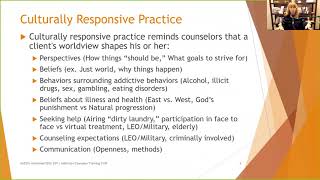
This episode was pre recorded as part of a live continuing education webinar on demand. CEUs are still available for this presentation through all CEUs. Register@Allce.com Counselortoolbox you I'd like to welcome everybody to today's presentation. We are beginning our series on cultural competence. Today's webinar is really going to cover the general aspects of cultural competence. We're not going to get too deep into any particular culture. We're going to review some of those terms that may sort of escape you, or maybe they don't, and see where we go from there. This is based on the Substance Abuse and mental Health Administration's TIP59. So if you type in SAMHSA TIP59, you can read the whole document online. So today we're going to define assumptions about cultural competence, define race, ethnicity, and culture. And what I really want you to take from that is not to get as caught up in what the different definitions are, but really to realize that there are a lot of different aspects of people and where they come from and their history and their learning that are going to impact the interventions that we use with them, how they will interface with us as clinicians and our race, ethnicity and culture will impact them. We'll explore the problems with limited cultural competence and explore the ways culture impacts the choice of therapeutic approaches, the involvement of family, and the appropriateness of self help and or group counseling. Now we're just going to briefly touch on that last aspect because we're going to go into depth on that when we do each individual class as we go through things. So the assumptions that we want to think about. Why is cultural competence important? Well, cultural competence helps us provide effective services. Counselors cannot sustain culturally responsive treatment without an organization's commitment to it. So we can do our best, but we need to have some organizational buy in in order to actually implement culturally responsive treatment. We need to have an understanding of race, ethnicity and culture, including our own, in order to appreciate the diversity of human dynamics and to treat all clients effectively. By incorporating cultural competence into treatment, we improve therapeutic decision making and offer alternative ways to define and plan treatment. So again, these are just a laundry list of rules. I'm going to go through them real quick. Assumption number four is that consideration of culture is important at all levels of operation. Individual, programmatic and organizational assumption number five, culturally congruent interventions cannot be successfully applied when generated outside a community or without community participation. We need to actually ask people what helps for you? How could we tailor this to better meet your needs? Instead of assuming that we know what's going to work. And assumption number six, Public advocacy of culturally responsive practices can increase trust among the community, agency, and staff. So once we start talking about the fact that this is an issue and we're open to modifying treatment and we want to try to be as efficient and effective as possible, people start listening and going, oh, so you're not going to try to fit me into your little pigeonhole? No, that's not the way it works for culturally responsive treatment. Not all clients identify with or even desire to connect with their culture of origin, if you will. And, you know, that can kind of vary. We belong to multiple cultures, but people will adhere to it or get away from it, depending on what they want. Culturally responsive services offer clients a chance to explore the impact of culture, acculturation, discrimination, and bias and how these impacts relate to or affect their mental and physical health. So when we talk about cultural, we want to look at, you know, if you have given up your primary culture or a culture that you ascribe to for the dominant culture, how has that affected you? If you've become acculturated, if you are of another culture other than the dominant culture, how does that impact you? How does that expose you to discrimination and bias? And how do these things relate to how you're feeling right now? Remember that stereotypes, you know, throughout these courses, we're going to talk in generalities, and, you know, I want to make sure that people understand that stereotypes are endpoints in which a decision has been made. So if I make a stereotype about a person or a group of people, I've made my decision. All people in that category are like this and bada bing, door closed. Generalizations are beginning points from which to explore. So if we say, in general, native Americans prefer blah, blah, blah, well, that's true in general, maybe that's true. But we want to explore with each individual and as the culture changes, which cultures do change in addition to people, you know, we need to modify our generalizations, but generalizations just give us a broad base to go, okay, this is what I may be dealing with, but I don't know. So let me test it and see if this fits here. The Affordable care act necessitates enhanced culturally responsive services and cultural competence among providers. They didn't really say how to do that or how they were going to measure it or what the consequences were if you weren't. But they are stepping up and recognizing that there are significant health disparities between cultures. Limited cultural competence is a significant barrier that can translate to ineffective provider consumer communication. You know, if the client comes in and they're apprehensive or they're not trusting of the provider, it can impact provider, communic provider consumer communication. If we are communicating in different languages, if you're using an interpreter, things may not go as smoothly. If you are working with somebody who is of a different age, you may have to alter how you communicate or it won't be received correctly. So we want to make sure that we're paying attention to that so we can communicate as effectively as possible. It can result in delays in appropriate treatment and level of care. If we assume that this is just normal for this population or something, or we assume that in the general population this is how it is, so that person's probably just fine, we can delay appropriate treatment. It can also result in misdiagnosis. There are a lot of culture bound symptoms, culture bound syndromes that are in the DSM that we can look at that are culturally appropriate things that may not require a diagnosis, but they may be similar to diagnoses that we might normally get. So we want to make sure that we correctly label and differentially diagnose. There's lower rates of treatment compliance when we have limited cultural competence because clients may feel misunderstood, they may feel judged, or we may make inappropriate treatment recommendations, such as recommending somebody for group therapy. Who is not going to participate in group therapy. My grandmother, bless her soul, you know, she was, she grew up in the Great Depression and you know, she was an older woman, she just recently passed, but she was not one to share her business with other people. So putting her in a group and going, you're going to sit in a group with 12 other people and air your dirty laundry? That wasn't going to go over you. You know, she would go to confession, she would do that, she would talk about it with her sisters, but she wasn't going to tell complete strangers about all the stuff that was going on in her house. So we want to make sure that we are sensitive to age and culture when we make our treatment recommendations that will help improve outcome. Culturally responsive practice reminds counselors that a client's worldview and, you know, ethnicity, race, culture all shape a client's worldview shapes his or her perspectives about how things should be and what goals to strive for. Think about how your goals and your perspectives on how things should be and what you need to strive for are different than your parents, than your grandparents. And, you know, that's just an age thing. Think about how your perspective of things how, how things should be and the goals to strive for are different. Maybe if you're from an urban area like New York or Washington, D.C. your goals and values may be different than somebody who's Amish or who grew up in a rural area. It shapes your beliefs about why things happen. So when we're trying to understand, why did this happen to me? How did I get here? When we're trying to help clients grieve, when we're trying to help them make sense of something that happened that kind of shook up their world, their culture is going to play a big part in helping them come to an understanding of how did this come to be? Behavior surrounding addictive behaviors such as alcohol, illicit drugs, sex, gambling, and eating disorders are going to be different among cultures. Back in the Greek and Roman times, you know, they had the big houses where they would purge after they'd had a big meal, and that was just normal back then. Thankfully, that's not technically that way now. Some cultures are more open to the use of alcohol and actually kind of promote it. Other cultures may be more promoting of illicit drugs, especially hallucinogens and marijuana. So understanding that certain cultures may have a relationship with what we would normally consider addictive substances or behaviors, it may be not an addiction for them. It may be a religious ritual. It may be something that's part of their culture. It may be not healthy or helpful for that person. So then we need to look at, how are we going to help you navigate this issue you're having, maybe alcoholism with your culture. How are the two of those things going to intervene or intertwine? Their beliefs about illness and health are affected by their culture. The Eastern medicine versus Western medicine, for example, have very different ideas about illness and health. Some people view illness as a punishment from God. Some people view it as a natural progression. So we want to understand what their perspective is on how did you come to be in this state, whatever that state is, Their ability and willingness to seek help will be affected by their culture. And I mentioned the elderly before. Law enforcement and military are notoriously closed systems. They don't tend to share with the rest of the people. They don't believe that a lot of us will understand where they, they're coming from or what they've gone through, or that we can help them because we haven't been through that. So they may not be willing to go to a practitioner who doesn't have a similar background to them. Some people, especially Generation Z, which came after Generation X and the Millennials, Generation Z really prefers Virtual treatment, Skype, video sessions, texting. They would really rather not come into group or have to hold to a specific appointment. So they tend to like things on the fly as well. So those are just some things that we're going to be talking about. Culture also expect culture also influences counseling expectations. I'm having difficulty talking today people, I'm sorry, the law enforcement and military again that's what I did my specialization on for my doctorate. So you know, they're near and dear to my heart and I come from a family of law enforcement and military and they tend to not like counseling. They tend to not think it's going to help. They tend to think it's a show of weakness, yada yada. And that's not all, but there is, you know, that culture there. The criminally involved, the may also not have positive expectations of counseling a lot of times because they're being forced in there and they've been forced in before and it's been a waste of their time. So we want to hear them and we want to hear what their concerns are and try to figure out how can we work together to make this a beneficial relationship. And the communication styles, how open they are, what methods they use, whether they're high context communicators which pays more attention to non verbals and what's going on around and how something said more than what is said. And then low context communicators who focus more on the words. So we want to look at all these different things, the continuum of cultural competence. And again I'm just going to kind of run through these so you understand and you can kind of figure out where you are. Cultural destructiveness obviously stage one, it's the beginners at best. The behavioral health organization and or the clinician negates the relevance of culture in the delivery of services. It's like culture's not important. Somebody comes in, they've got depression, we're going to treat them this way on an individual level. Counselors also operate from the stance holding a myopic view of effective treatment thinking. For example, dialectical behavior therapy is always effective with this particular condition. Stage two, cultural incapacity. The organizational culture may be biased and clients may view them as oppressive. And agency functioning with cultural incapacity expects clients to conform to generalized services. You come, we'll put you through an assessment. You will do our 30 day residential program. You'll go to these groups just like everybody else does. So we're not individualizing treatment. We're not considering is group treatment really most Appropriate for this person. On an individual level, counselors ignore the relevance of culture while using the dominant client population and or culture as the norm for assessment, treatment planning, and determination of services. Stage three is cultural blindness. Now, theoretically, we're getting a little bit better here. The core belief that perpetuates this stage is that all cultural groups are alike and have similar experiences. All cultural groups experience oppression. All cultural groups experience yada yada. The individual counselor upholds the belief that there are no essential differences among individuals across cultural groups. So this is still looking at using the same services, negating culture. You know, I don't see a whole lot of improvement as we're going through these stages until we get up to the later stages. Finally, cultural pre competence organizations at this stage begin to develop a basic understanding and appreciation for the importance of sociocultural factors in the delivery of care. They start recognizing that single parents may need child care assistance. They start recognizing that people who you're working with who have a DUI need to ride public transportation. So groups that go to 8:30 at night, which is after the buses stop, those aren't real helpful. So we start looking at what our clients needs are. At an individual level, counselors acknowledge a need for more training specific to the populations that they serve. Stage five is cultural competence and proficiency. Organizations are aware of the importance of integrating services that are congruent with diverse populations, such as integrating treatment or into the treatment team, at least maybe a spiritual leader or something. On an individual level, the clinician recognizes the vital need to adopt culturally responsive practices. You may not know what all of them are, but you know that when you see clients who are from a different culture that they are going to have different experiences and have, you know, positive and negative, and they're going to be bringing different thoughts, beliefs and values to the table. So in order to help them live in a way that's authentic, we need to understand that. Now going along with that is the racial cultural identity development model. Now this is really looking at both the counselor and the client as people, not as working in a relationship. But where are you at in terms of your racial cultural identity? In conformity, the person shows a preference for the dominant culture and a disdain for the culture of origin. And they prefer a counselor from the majority. So if you're working with a client who is conformant, they're going to want counselor from the majority group. Dissonance, confusion and conflict over the contradictory attitudes towards self and others of the same group and different groups, they may prefer counselors from a minority group and counselors may prefer clients from a minority group and perceive their problems as being related to cultural identity issues. The next stage is resistance and immersion. They actively reject the dominant culture and and appreciate the attitudes of their own group. It's like, okay, we're going to start bonding here. Prefer a counselor from the same racial or ethnic group and perceive personal problems as the result of oppression. The next stage is introspection. They start questioning the harsh attitudes and rigidity of the beliefs from the last stage. But conflicts between loyalty and responsibility towards one one's original cultural group start coming, keep coming up. But then there's also that dominant cultural group and they're trying to figure out where they fit. They prefer counselors from their own group, but are open to counselors who share a similar worldview. Finally, synergistic articulation and awareness, that's a really long term self fulfillment with regard to their cultural identity. These clients can objectively examine and accept, reject the values of other groups. And the same thing for the counselor. You know, we're able to figure out what we believe and we're able to hear the values from other people. Now obviously in a counseling relationship, we're not going to reject our clients views. We're going to help them figure out, you know, what those views are and what they mean to them. But we can understand when our values are in conflict with theirs and look at what impact that might have at this stage. The person has a desire to eliminate all forms of oppression and they prefer counselors with a similarity in worldview, attitudes and beliefs rather than getting so hung up on racial or ethnic identity. So we're all of the same mindset at this point. You're looking at people who share the desire for empowerment and understanding and authenticity is what I take from that. So thinking about where you are in terms of your own cultural identity, the types of clients you like to work with, and how that impacts the clients that you work with. And then also thinking about your clients in terms of assessing where they see their problems are coming from and how comfortable they are going to be working with with you, depending on where you are in your identity development and the culture and race and ethnicity that you represent. So race is a social construct that describes people with shared physical characteristics. The perception that people who share physical characteristics also share beliefs, attitudes, values and ways of being can have a profound impact on people's lives, regardless of whether they identify with the race to which they are ascribed by themselves or others. So for example, I'm a white female, you know, there's no surprise there. However, you know, people see me and they assume that I have certain beliefs, values, attitudes, and ways of being just because of the way I look. So that has a significant impact on my life, you know, and if I don't conform to the, to the norm, then then I've got to kind of navigate that. Racial categories also do not easily account for the complexity of multiracial identities. 3% of the United States residents are multiracial right now, and by 2050, that's expected to grow to 20%. So people who are from multiracial families may experience even more conflict and even more question about, you know, what exactly are your beliefs, values and attitudes? Many subgroups of white Americans of European, Middle Eastern or North African descent have had very different experiences when immigrating to the United States. So just because we're white Americans doesn't necessarily mean that we share all the same value, values and beliefs and stuff. The racial designation black encompasses a multitude of cultural and ethnic variations and identities, including African, Caribbean, African Bermuda, and West African, among others. So we want to make sure that we're not just assuming the cultural identity. African American culture embodies elements of Caribbean, Latin American, European, and African cultural groups. Asian Americans comprise about 43 ethnic subgroups, speaking more than 100 languages and dialects. And you want to talk about communication problems, so you need to be sensitive to what's going on with your client. You need to be aware of what their culture and ethnicity are. And Native Americans, a term that describes both American Indians and Alaskan natives. There are 566 federally recognized American Indian or Alaskan native tribal entities, and they all have their own unique cultures. Ethnicity refers to the social identity and mutual sense of belonging that defines a group of people through common historical or family origins, beliefs, and culture. It differs from race in that groups of people can share common racial ancestry, but have very different ethnic identities. So they can share the same genetics, they can look the same, but they may have a very different historical origins, family origins, or belief systems. So we don't want to just assume because they look a certain way, they're going to believe a certain way. Ethnicity, unlike race, is an explicitly cultural phenomenon based on shared cultural or family heritage, well as shared values and beliefs rather than shared characteristics. So when you're doing your assessment and you're going through and you've got to ask the question about race, ethnicity, and that's why, because race and ethnicity are not the same thing. Culture is not definable as a particular entity to which people belong or don't belong. People belong to multiple cultural groups, each with its own set of cultural norms. You may think about this in terms of. Sometimes you may use the word roles, and we're going to talk about that in a second. The word culture can be applied to describe the ways of life of groups formed on the basis of age. For example, baby boomers have a very different culture than the Millennials, who have a very different culture than Generation X or Generation Z. Generation Z are those people who grew up and they've had an electronic device in their hand, so since they were able to hold things. Whereas Generation X may have started growing up before all of the mobile devices became so prominent. The computers were there, but the mobile devices weren't. As prominent professions also have their own sort of culture. Lawyers, therapists, factory workers, cops, firefighters, they have their own culture. And it's important to kind of be aware of that and what that means, you know, because lawyers may have a very different view and outlook of the way things should be and what they should strive for than maybe somebody who is a career criminal, socioeconomic status. People who are poor, middle class, and wealthy have different things that they worry about, different things that they strive for, different stressors that they endure. If somebody has a disability, people who are deaf, a lot of people who are deaf really embrace the deaf community and are quite insulted if you indicate to them, well, you could get a cochlear implant or something. Why would I want to give up my deaf culture? So we want to make sure that we're sensitive to how people identify themselves and not just assume because they're different from us that they are unhappy. People who are blind, people who are in wheelchairs, people who have schizophrenia are all treated differently and have their own issues. You know, people who have schizophrenia are on antipsychotics, which can make life really difficult because it can be slowing or dampening sometimes sexual orientation. So we have LGBTQ2IK, which stands for Lesbian, Gay, Bisexual, Transgender, Queer, Questioning, Intersex Allies, and kink. And that really encompasses the different sexual orientations of people. And each area has its own unique characteristics. Geographic location, New York City, Nashville, and Clarksville. If you're not familiar with Clarksville, it is a military town. It's almost all army military. It's really. Yeah, centered around the military base. Nashville, Country Music Center, New York City. You know, you have art, and when I think of New York City, I think of Hustle and Bustle and art and culture and all that kind of stuff, but they're very different. And the people in those places live very different paces of life and very different lifestyles and a lot of times have very different goals. You know, I'm. I have a farm, and I love my farm in New York City. People would never have a goal of striving to raise all of their. All of their produce on their own land. That's just not what is in their culture. They're working towards other goals. Geographic location, I covered that one. And membership. Twelve step organizations have their own kind of culture. Sororities and fraternities have their own culture. We had our own songs, we had our own rituals. Clubs. Any other clubs that you belong to, you know, there's a lot of them. The Rotary Club is one. I can think of sports people who are on the football team in high school. That is their own little culture there. Think of, oh, golly, on Married With Children, whatever his name was, Al. Al Bundy just kept reliving being the star quarterback. And that was kind of a focus of his life. And religion, the religion that you ascribe to will obviously affect your beliefs. So we want to think about how all of these things, you know, when somebody comes into our office, they probably have elements of a lot of these things, and how do those things intertwine and mesh in order to create the person that we're seeing before us? And how is that going to combine and mesh with us? As a therapist, cultural identity describes an individual's affiliation or identification with a particular group or groups. So thinking about what group or groups you identify with, cultural identity arises through the interaction of individuals and cultures over the life cycle. So it changes within cultures. There are also subcultures. So, you know, for example, within Christianity, you have all kinds of different subcultures within different towns. You know, living in Middle Tennessee or living in the southeastern United States, people think that we have a certain set of customs and beliefs. But there are subcultures. Like Nashville is very different than Louisiana, which is very different than Gainesville, Florida. So we want to be aware of that. People often reevaluate their cultural identities and sometimes resist, rebel, or reformulate them over time, such as in high school. You know, you were developing your identity then, and you're looking around at what culture you wanted to belong to. When you got to midlife, you may look back and go, you know, I've been doing this adulting thing for a long time. I'm just going to completely drop it and switch careers or change gears or do something different and empty nest. You know, if you've been a parent for 1820 some odd years and then all of a sudden you're still a parent, but you don't have the kids at home anymore. Your goals and everything change. The need to be home to make supper every night may not be as great. All of the things that you normally do in your routines may get shaken up. So you want to reevaluate. What do I do now? Elements that constitute a culture. And not every culture has all of these elements that are unique to them. But there are some identity development. You identify yourself as a cop, as a parent, as a therapist, as whatever rites of passage, broad role of sex and sexuality. We have our own images, symbols and myths, stories that kind of support our culture. And even thinking back to my sorority, there were traditions that we passed along from generation, if you will, to generation, religion and spirituality. You know, we have our own readings, we have our own belief systems, the view, use and sources of power and authority. Each culture may have a slightly different view of all those things. Now, multiple cultures can share similar views. I mean, it doesn't mean that if one culture has this particular view that nobody else can have it. So there are, that's, you know, how we can blend so well. But it's important to be aware of what your clients think about the uses of power and authority. Because we are in power and authority as clinicians. The role and use of language, ceremonies, celebrations and traditions. Are they important? Which ones are important? How do you work that? Learning modalities and acquisition of knowledge and skills may be different between cultures. Some people may prefer to use an oral tradition, some people may prefer to write it down. Interpersonal interaction differs between cultures. How you talk to each other, what's okay when you have to be formal, when you have to be informal. Assumptions, prejudices, stereotypes and expectations of others. Every culture has them about their own culture and about other cultures. So ideally, we want to try to get rid of those and change the stereotypes into generalizations, reward or status systems. There's hierarchies in every culture, migration patterns and geographic location. If you look across the United States, and we're going to look at one towards the end, if we've got time, different. Like, for example, there's a place or a swath of the United States that is typically referred to as the Bible Belt and that can be reflective of the culture of those particular areas in those states. Concepts of sanction and punishment, social groupings and perspectives on the role and status of children and families. Are they to be seen and not heard? Are they to be integrated? Is it important for One parent to be home. Is it important for children to be involved in multiple extracurricular activities? You know, your culture is going to dictate that to a certain extent, or at least they're going to have ideas about it, and then you can choose to accept or reject them. Patterns, perspectives on gender roles and relationships. Some cultures still hold very traditional gender roles, while other cultures have become more flexible. The means of establishing trust, credibility and legitimacy. It's going to be different between people and between cultures. So it's important to, you know, kind of take it slow. If most people, if you ask, what do I need to do to get your trust, they're going to look at you like, I don't know, be trustworthy. But it's important to understand. And by being culturally responsive, that's one way of establishing trust. By saying, help me understand you and your points of view, and by embracing that instead of condemning that, is a means of starting to establish trust and credibility. With some cultures, you know, punctuality and that sort of thing may be looser or more strict than in other cultures. So kind of being aware of that. Coping strategies for mediating conflict or solving problems. Some cultures believe that a spiritual leader should do it. Some believe a lawyer should do it. Some people think they should work it out among themselves. We want to understand, how do you mediate your conflict? Sources for acquiring and validating information, attitudes and beliefs will vary. Where do you get your information? How do you find out more about this particular culture? The view of the past and future and the group's individual sense of place in society and the world is obviously going to vary by culture. In some places, Christianity is really dropping really fast. But in certain places, especially in Sahara Africa, it is just booming right now. So the perspective on Christianity, for example, the place in society, in the world, where's that going to be in 50 years? Impacts the culture. And the people who embrace that culture are going to want to see their culture thrive. History and other past circumstances that have contributed to a group's current economic, social, and political status within the broader culture also affects the culture. So, for example, Native Americans, how has their history impacted or contributed to their current state within the larger culture in America, and how does that affect things? Culture can be seen as a frame through which one looks at the world or a lens. You know, think about each culture you have being another lens or another transparency that you put up that kind of colors it or shapes it a little bit. A repertoire of beliefs and practices that can be used as needed. A narrative, story Explaining who people are and why they do what they do. So if you look at somebody's culture, you know, when they act a certain way or react a certain way, you know, it may be not what you would do in your culture, but if you look and say, you know, where did that come from? You may be able to understand from the narrative a set of institutions defining different aspects of values and traditions or a set, a series of boundaries that use values or traditions to delineate one group of people from another. So how people kind of set themselves apart. The Baptists from the Methodists, from the Catholics, for example, there are boundaries, there are differences in the groups. Speak with clients about their worldviews, values and traditions and seek training and consultation to gain specific knowledge about clients cultural beliefs and practices. Where I came from in Florida, it was the national headquarters for the Hare Krishnas. And so many of my clients were Hare Krishna. So it took me a while to learn some of their cultures and traditions. And when I'd have a client from that culture, then it was important for me to reach out to my contacts there to help me understand how to navigate it a little bit more. Cross cutting factors Verbal and nonverbal communication. We all communicate. It's just how we do it and what's appropriate, how much eye contact, how close can we get, what's appropriate to say? My son is still learning that whole filter thing. Appropriate personal space, social parameters for, and displays of physical contact. You know, certain cultures, you know, especially like people who grew up my grandmother's age, public displays of affection were not okay, that's not something that you were going to do. And you know, some cultures today are just, you know, they're all about showing their love. So there are different parameters of what's acceptable, the use of silence. Some are more comfortable. Some actually need that silence as a show of respect that, yes, you heard me and you're digesting what I'm saying. Preferred ways of moving meanings of gestures, degree to which arguments and verbal confrontations are acceptable. Some cultures are very, we need to get along and they want to make peace. Other cultures are fine with verbal confrontations and it's just families talk and they assert themselves and they may be loud, but it's not, it's okay. It's socially sanctioned. It's not hateful or hurtful. The degree of formality expected in communication and the amount of eye contact expected. The relative importance of nonverbal messages varies greatly from culture to culture and high context. Cultural groups place a much greater importance on nonverbal Cues and the context of verbal messages. We are going to talk about a lot of this ad nauseam in the upcoming sessions when we focus on each different culture. But it is important to understand some of the basics, especially of the nonverbals. A behavioral health service provider who listens only to the literal meaning of words can miss clients actual messages. Well, that's true all the time. However, high context cultural groups even more, you need to pay attention to the nonverbals. And that also may mean that they're not appropriate for telemental health unless it's video based counseling. And even then, if you have a lag, if you don't have super high Internet going both ways, or if you're doing an encrypted video stream, it's going to slow it down. You are going to probably not have the greatest experience with high context cultural group people. Assuming that a client has a particular expectation or expression of nonverbal and verbal communication based solely on race, ethnicity or cultural heritage is a big mistake. So we want to ask them what are you comfortable with? What would you prefer? Geographical factors can also have a significant effect on clients culture. Clients coming from a rural area, even if they come from different ethnicities, can have a great deal in common. So where I came from was right outside of Gainesville, Florida, which in and of itself is a suburb if you will. I mean it revolves kind of around the University of Florida, but there's not a lot of, it's not a mecca of anything. But we lived in a suburb of that. It was a rural area, you know, had a farm, there was a nice, you know, place to have a couple kids. We moved to Lebanon, Tennessee, which is about 35 miles outside of Nashville. And it's the same way, you know, we have neighbors around, but we also have acreage so we can have farms and donkeys and all that stuff. So we have a lot in common with in both places. You know, I came here and I felt right at home and could talk to my neighbors. And you know, our ways of interacting and supporting each other are very similar because it's rural to rural, but that's not always the case. For example, somebody who comes from New York, Nashville and Miami, all of those are big metro areas that have a lot of hustle and bustle and all that stuff and excitement and whatever. But they're very different cultural cultures and what they expect, the way they interact, the types of things they enjoy. So paying attention to those sorts of things because I mean Miami being on the beach, obviously the beach is more of a focus there. And somebody who. I have a friend who moved here from New York and he's stationed in Clarksville now, and he just misses the snow so much. But he misses a lot of things about New York City lifestyle, which was a much faster pace. And family and kinship concepts and attitudes toward family are culturally defined and can vary in a number of ways, including the relative importance of particular family ties. And so when we're talking about family with our clients and involving family and treatment, what does that mean? Some clients don't think that family's important in this whole thing. It's like, you know, I've got a problem, I need to fix it, and, you know, we're just going to leave them. Other families see the identified patient or see illness in the system as illness in the whole system. Illness in the family, there's not an identified patient so much. Some families see the identified patient but believe it's their responsibility to help that person out. So we need to understand, where do you see family as belonging or working, whatever words you want to use in your treatment and recovery process. The family's inclusiveness can vary. It may be just blood relatives, it may be just immediate blood relatives, or it may be your sister's. I don't know. I have a very small family, but really extended kinships. I won't even go down that road that are involved in family. So if you have an intervention or if you have some sort of family meeting, there's going to be 27 people there, as opposed to my family, where we'd have three. How hierarchical the family is. Some families tend to be more egalitarian. Other families tend to be either maternally driven or paternally driven and extremely hierarchical in nature. So we want to understand where does this client fit in. If we're working with an adult client who has, you know, kind of diverged from the way the family expected him to grow up or whatever the career they expected him to take, that might have a significant impact on him. If it's a very hierarchical family and he was always told he was going to follow in his father's footsteps, then, you know, there might be a lot of angst there. Where, you know, in other situations, the family might be, ah, choose what you want, what's going to make you happy. And it's more up to the child, who is now an adult, to make decisions. So, and family holidays, who visits who. You know, there's a lot of stuff that can really become problematic if you have different understandings of what's Appropriate in that family hierarchically. You know, if you tell your client, well, how about you go to your wife's family's for Christmas, and you go to your families for Thanksgiving? That should make everybody happy. And that might not be it. So we need to understand what's going on in that family and how family roles and behaviors are defined. Who's responsible for what. In recent years, there's been an uptick in the number of men who've been staying home and raising the children, as opposed to the woman staying home and raising the children if they were able to have, you know, just be a one career household. So how does that work? How do people feel about that? What does their culture say about them staying home? I remember one Bernie Mac episode my daughter was watching, and Bernie Mac was raising his sister's kids, and he's a comedian, so even in the show, he was a comedian, but so he was home during the day, and he was, you know, raising the children and taking them to school and doing that stuff. And he went to a work party with his wife, and his wife was a vice president of a big company, and all of the house husbands started congregating, and Bernie was like, I'm not too sure about this. Now I have a career. I'm doing my thing. But it was interesting to see the different attitudes people had in that episode towards house husbands as opposed to men who worked at a job outside the house. In some cultural groups, family is limited to the nuclear family, Whereas in other groups, the idea of family includes many other blood or marital relations or even really good friends of the family. You know, we can have 17 uncles coming in. Family dynamics may change as the result of internal or external forces such as acculturation. So if family X moves over here and two generations later, the youth from that generation are fully acculturated, but grandma and grandpa still are not wanting to be acculturated. There may be some challenges in the family dynamics there and communications, and the grandparents may feel disappointed or hurt that the youth are rejecting their culture of origin. And likewise, the youth may feel rejected because grandma and grandpa can't understand why they have these other differing beliefs. So we want to look at acculturation as a big issue. Socioeconomic status in the United States is related to occupational prestige. If you have a higher socioeconomic status, you probably have a higher or more prestigious job. Not always. You know, if you have a higher education, you typically have a higher socioeconomic status. Again, not always. And you typically. If you have a higher socioeconomic status, that goes along with having a higher income level, socioeconomic status affects culture by a person's ability to accumulate material wealth. And that also means the ability to, like, have a house and put food on the table and that sort of thing. Access opportunities. If somebody who is of low socioeconomic status gets offered a job that's, you know, two states away and they'd have to move, they may not be able to afford to move. Whereas somebody of a higher socioeconomic status, the world is their oyster. And, you know, yeah, it might be expensive to move, but if they're offered the right job, they could do it. And it also affects your ability to use resources. So certain resources are available based on socioeconomic status. Acculturation. There are many forces at work that pressure a person to alter his or her cultural identity to, to conform to the mainstream culture concept of proper identity. People may feel conflicted about their identities, wanting to fit in with the mainstream culture, while also wanting to retain the values of their culture of origin. So religion's an example. If somebody grows up from, and they come from a highly religious family, but they are not adopting as much of a religious tone in their life, or they're not meshing with that culture as much, you know, they may be a little bit conflicted. Sorting through these conflicting cultural expectations and forming a comfortable identity can be an important part of the recovery process. Many studies have found that increased acculturation is associated with higher rates of substance use disorders and mental health issues. So the more somebody becomes acculturated and, and leaves their culture of origin and joins that mainstream culture, the more likely they are to have problems. Generally, the more acculturated a person is, the more likely that mainstream interventions will be effective. Well, that makes sense. If they've become, if they're embracing more of the mainstream culture, then stuff we would normally use with the mainstream culture is probably going to be more effective. Sexuality is also impacted by culture. Attitudes towards sexuality in general and towards sexual identity or orientation are culturally defined. So thinking about the different subgroups that have something to say about sexual identity and orientation, whether it be based on age, religion, geographic area that they live in, whatever that will impact our clients in their expression of their sexuality. Each culture determines how to conceptualize specific sexual behaviors. What's okay, what's not okay, the degree to which they accept same sex relationships, and the types of sexual behaviors that are considered acceptable. If you want more of a detailed thing, we do have a class coming up in January. But in the meantime, if you go to a provider's introduction to substance Abuse treatment for lesbian, gay, bisexual and transgender individuals. You can get a publication from SAMHSA for free that goes over dealing with some of these issues. Now, I will warn you, it was published in 2001, so there are some parts of it that are woefully out of date, but it's a good starting place and perspectives on health, illness and healing. Like I mentioned Eastern medicine versus Western medicine before and you know, I'm happy, but my personal preference is that people are becoming more open to Eastern medicine approaches in the west and starting to embrace some of those concepts. But you know, typically Western medicine and especially Western medicine practitioners tend to be very closed off to Eastern medicine. For example, different culture, cultural groups, Groups differ in how they define and determine health and illness. Some cultures really view mental health as a symptom of something wrong with the body, period, and it's going to be treated by a medical professional. Cultural groups differ in who is able to diagnose and treat an illness. Sometimes it's a religious practitioner, sometimes it's a medical doctor. You know, there's a variety of people, their beliefs about the causes of illness, whether it's caused because you did something wrong and it's a punishment or because you ate something or because your chakras are out of alignment or whatever the case may be. And their remedies are obviously going to be different based on what they think is causing the problem. There are complex rules about which members of a community or family can make decisions about health care across cultural groups. So in those hierarchical families, even if the identified patient is an adult, but you know, their parents may still need to give the nod for in their culturally, not legally, but culturally, their parents may still need to give the nod for certain treatments. Any mental disorder or symptom is only considered a disorder or problem by comparison with a socially defined norm. So we want to look at their culture, say, is this normal in that culture? You know, it may not be typical, and I don't like the word normal, but is this typical in our culture? Maybe not. Is it typical in their culture? And if so, then we might look at it from a different standpoint. Finally, religious traditions and or spiritual beliefs are often very important factors for defining an individual's cultural background. The American Religious Identification Survey, and you can Google that there's a ton of really cool information on this site, but reported that 47% of the respondents who identified culturally as Jewish were not practicing Jews. So, you know, you've got a lot of people out there who identify as Jewish. You know, they're filling out that demographic sheet and they're handing it to you. But they're not practicing Jews. So those beliefs you would ascribe to Judaism may or may not be applicable to that particular client. So we want to know how much do they practice the religion which they ascribe to. Let's see if I can get there really quick. Religion is organized with each religion having its own set of beliefs and practices designed to organize and further its members spirituality. So each religion has certain goals or objectives. Spirituality on the other hand. And a lot of people kind of get this confused when we start doing spirituality groups. I'm like it's not religion. Spirituality is typically conceived of as a personal matter involving an individual search for meaning. And it doesn't require affiliation with any religious group. Spirituality is what gives your life meaning, what orchestrates, what controls the world. What do you believe about how things happen? And I know we're running short, but I did want to show you this, the religious landscape study. You can look. There's all kinds of data in here, but for example, in Tennessee, 81% Christian. I said we were in the Bible belt. But then you have 14% that are unaffiliated or religious nones. Those are more secular people. They're not necessarily atheists, but they're secular. They just aren't affiliating at all. On the other hand, if you go back to Washington, you only have 61% who are Christian and 32% consider themselves as unaffiliated or nones. What does that mean for treatment? Well, that may mean that people who are in Tennessee who are not affiliated with feel more kind of out on the on the fringes as opposed to people who are in Washington where there may be more secular activities and more things that happen during church time on Sunday. So I'll let you peruse that on your own culture. Race and ethnicity are not the same thing. So but we want to really pay attention to what are our clients worldviews. Culturally responsive services take into account the needs and preferences of the individual based upon the cultures plural to which he or she identifies. It's important not to culturally assign a client based only on race, geographic location or religious orientation because not all clients choose to identify with their expected cultures. So we don't want to assume increased acculturation is associated with poor mental health outcomes. And culture can have a huge impact on treatment compliance and affects both individual therapy approaches and modalities. So insight oriented may be better with certain clients, whereas other approaches may be better with other clients. The appropriateness of group therapy, the appropriateness and degree of family involvement, and the fit between the therapist and client. Like I said, there are certain cultures that really prefer to have someone of their culture in order to communicate with because they even speak a slightly different language. I know when my husband was still on the road, I spoke in ten codes quite fluently. Those are the codes they use when they're talking on the radio. So a resource that you can find is the Cultural Orientation Resource center, which is funded by the U.S. department of States Bureau of Population, Refugees and Migration. You can Google that and find more resources about culturally responsive counseling. All right, thank you all for sticking with me. I apologize for tripping over my tongue so much today. And do you have any questions? I don't have any pictures of my cats, but that's my boo boo. And in response to the person whose parents live on a farm in Clarksville, I love that area. There's a park out there that I go hiking sometimes because it's a little bit more hilly, I won't say mountainous, but hilly, than out where I'm at. And it's, it's beautiful land. Alrighty y'. All. I will see you on Tuesday. And I'm not sure what we're covering on Tuesday, but I'll have it figured out by then. Have an awesome weekend. Thank you for being here today. You. If you enjoy this podcast, please like and subscribe either in your podcast player or on YouTube. You can attend and participate in our live webinars with Dr. Snipes by subscribing@Allce.com Counselortoolbox this episode has been brought to you in part by allce.com, providing 24. 7 multimedia continuing education and pre certification training to counselors, therapists and nurses since 2006. Use coupon code counselortoolbox to get a 20% discount off your order this month.










