Is it Dementia? What You Need to Know About Cognitive Function
Dr. Dawn-Elise Snipes covers cognitive changes in aging: what's normal slowing versus dementia, why anxiety and minor depression go untreated, and why older adults need lower medication doses. Cognitive decline is partly preventable with activity. Benzodiazepines carry serious risks.
Questions this video answers
21 suicides per 100,000.
At least 10–20%.
Not recommended for use for more than six months in older adults.
About 3–9%.
60–80% can be expected to respond well.
Chapters
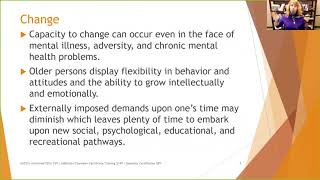
This episode was pre recorded as part of a live continuing education webinar on demand. CEUs are still available for this presentation through all CEUs. Register@Allce.com Counselortoolbox you I'd like to welcome everybody to today's presentation on mental health and the elderly. This is the first in a series of three that we're doing today, that we're doing this week on working with older adults. In this presentation, we are going to very quickly go over normal life cycle tasks and there are other classes that I have that cover the developmental tasks of people who are adult and through old age. So we're not going to go super in depth on that, but we want to touch on that. We'll look at some issues with cognitive capacity with aging, change, human potential and creativity, coping with loss and bereavement, mood disorders, Alzheimer's disease, schizophrenia in late life, prevention, and helping the person live well. Then we'll move on to an overview of treatment for older adults and an overview of services and service delivery settings. And then we're going to wrap it all up with identifying a couple issues that face family and caregivers. Obviously in an hour we can't do justice to any of these topics. This is just a high level overview and it's based on the American Psychiatric Association's best practice for working with older adults. Normal aging is a gradual process that ushers in some physical decline. You know, we just start running a little slower. It's just the way it happens, such as decreased sensory abilities, vision and hearing. I know, I've got my readers now. Decreased pulmonary and immune function. So people who are older tend to get sick a little bit easier. So I mean, this flu season around, and we all know that young children and the elderly are most at risk of getting the flu. And it's worse for them if they get it, potentially. So we want to be kind of aware of that. But the fact is that overall they live a very happy, normal, productive life. It's not like you hit a certain age and just start going way downhill. It doesn't have to be that way. Important aspects of mental health for people who are aging include stable intellectual functioning. Your intellectual functioning actually tends to increase some in your later years, partly because you're not, you know, dedicating your entire life to watching Barney and, you know, going to work and, you know, all work and no play. A lot of people in their senior years tend to develop more hobbies and learn more things. And they, since they have fewer time demands, there is a greater capacity for change. And as people get older, things change. And the older you get, the more things seem to change. You know, you have some physical capacities that are declining. You have some changes in your relationships. You know, your kids move out and maybe you've got grandkids or great grandkids. I mean, there's a lot of changes. But people who are older have the capacity to adjust to these changes. And productive engagement with life is the third thing that as clinicians, we want to look at and make sure that people who are retired or who are older are productively engaged, whatever that means for them. What does it mean to have a fulfilling life? Does it mean sitting on the couch and watching your stories all day, or does it mean what does it mean for you? My grandmother, it was really, she didn't do a whole lot. She was very much a homebody. She enjoyed puttering around the house and watching her stories. But she went out and she played bingo four nights a week. And bingo was her thing. She just lived to go play bingo. So that was her productive engagement with life. She was great with the grandkids. She was great with the great grandkids. And the family made sure that they were going over because as she got older, she wasn't able to drive as much. So the family that lived locally made a point of going over and spending time with her. And those of us who didn't live locally made a point of trying to reach out to her calling, mainly because she didn't do the Internet in order to stay. In order to stay engaged. So as clinicians, these are sort of the three things, the three pillars that we want to focus on for ensuring that our clients who are older adults are achieving and having their highest quality of life. Cognitive decline is often partly preventable. Some of the processing is going to slow down a little bit, but it doesn't mean that dementia has to set in or anything like that. Slowing or some loss of cognitive functions takes place most notably in information processing. So like I said, it takes you a little bit longer to digest stuff, but doesn't mean you don't get it. Selective attention and problem solving ability now as you get older, and I can tell you just watching my grandmother, she used to get flummoxed a lot, especially as she got older, her problem solving abilities started to go down. But I think part of that with her was she didn't engage a whole lot outside of the. Outside of the house. I work with another amazing woman who is in her late 70s right now who runs our animal rescue, and she is sharp as a tack. And she goes every year and does bike riding excursions across, you know, different countries and whatever. So I think a lot of it has to do with the individual. So we don't want to assume that people are going to slow down a bunch. And this is also an important thing to take into consideration. If you're working with someone who's either in, in home care or for some reason, for a physical reason, they're in a nursing home situation, we want to make sure that they have enough intellectual stimulation and social stim because, you know, they, they don't necessarily slow down. Prevention and early intervention should focus on encouraging different problem solving tasks, picking up new hobbies, trying different kinds of puzzles, word games, sudoku, whatever makes them happy. I remember with my grandmother we used to play Chinese checkers and gin rummy. And you know, that's not something that's going to expand your mind significantly, but it were the, it presented different ways to use your brain. Just like when you're doing math tasks, you're using one part of your brain and when you're doing creative tasks, you're using a different part of your brain. We want to challenge it in different ways. Maintaining physical activity, partly to improve blood flow. If the person who is older maintains physical activity, it increases the oxygenation of the blood. It increases the blood flow to the brain, it increases the oxygenation. It helps prevent or stave off some symptoms of cognitive decline. So I mean, think about when you're not feeling well or if you're really sluggish, you didn't sleep well. Sometimes if we are not getting enough blood up to that brain, you can feel foggy headed and have difficulty concentrating. I know even for me, when I get neck tension, if my neck is all tied up, even if it's just because I was out gardening all day long the next day, you know, it's harder for me to think a little bit more clearly because I swear I don't have as much blood going up to my brain. But I digress. We want to help people stay active. And part of staying active, you know, it doesn't have to be silver sneakers. It can be going out on a walk, it can be playing with grandkids, but physical activity is important and maintaining a good sleep routine. As people get older, they tend to have to get up and go to the bathroom a little bit more. But we want to look at what things can we do to mitigate any middle of the night wake ups and improve the sleep routine for the person who is older. Now, a lot of people who are older don't sleep as much as some of us who are younger. And that's okay. It's more about the quality, quality of sleep than the quantity. But we do want to address some of those issues. Their capacity to change is phenomenal, and it can occur even in the face of mental illness, adversity, and chronic mental health problems. People who are older and I think part of it, and this is just me kind of spitballing, but I think somebody who has lived for 50, 60, 70 years has so many more experiences to draw on that they do have the ability to be more flexible when things come up. They do have a greater capacity to change because they have more tools in their toolbox. They have more experiences from life. Older persons display flexibility in behavior and attitudes and the ability to grow intellectually and emotionally. So let's encourage it instead of just assuming that Grandma wants to do this same thing over and over again. You know, get her to go out roller skating or whatever. Maybe roller skating is a bad idea, but encourage older people to take on new challenges and new activities and new things that they want to do. It can be as sedate or as active as they want to, but the key is to continue growing. Just because you retire, just because you're older, doesn't mean life stops sometimes. That's the liberating time. Externally imposed demands upon one's time may diminish, which leaves plenty of time to embark upon new social, psychological, educational, and recreational pathways. I know my mother, for example, is. She's never home whenever I call her house. She lives in North Carolina, and she's never home because she's always out volunteering or doing this or doing that and stuff. She never did. When she was raising me, she was a single parent. She didn't have time to do that. And she was very dedicated to her career. So, you know, now that she's in her retirement phase of life, she's experiencing and exploring new things that are meaningful and empowering to her. So Erikson's theory said that there was this stage of ego integrity versus despair, and it kind of spanned a really long age group. What they found is that ego integrity versus despair can actually be broken down into two little subcategories. The first, first phase is retirement and liberation, where the person, you know, has feelings of freedom, courage, and confidence. They're retiring. They don't have to get up and go to the grind anymore. They can do what they want to do. Or maybe they retire from one job. And my husband and I always joke, because we're never going to actually retire. We're just not capable, I think, of sitting at home or not having somewhere to be. But we're going to move on to a second career or a third career, or in his case, a fourth career. So it's a liberating time where you can figure out, okay, I've still got, you know, a quarter of my life in front of me. What do I want to do? Those at risk for faring poorly are individuals who typically don't want to retire and they're being forced out the door. Airline pilots, law enforcement officers, firefighters. You know, some of those professions where there may be harder age limits. Military. Military is another big one. Or who are compelled to retire because of poor health or who experience a significant decline in their standard of living. So it can be just the act of retirement. And we're going to talk about, you know, think about what work provides for you. If you're an extrovert, that provides your energy and your. All the people that you interact with, and how much time do you spend at work. So when that's not there anymore, who do you interact with? What do you do? But it can also be a financial hit when you have to retire, if you have to retire because you don't have that paycheck coming in anymore. So there can be a significant decline in the standard of living. You know, no more Maseratis and trips to France on the weekend. It's now, you know, a Toyota and a trip to Alabama or something. You know, staying a little bit more domestic. So it's important to look at what changes when this person retires. And if we start working with them early, how can they mitigate anything that they may see as problematic in this phase of their life? How can they plan for that? Ideally, they've been working with an investment person, or they have a good financial head on their shoulders, so they've planned ahead so they won't take a significant hit to their standard of living. And then the second phase is the summing up and the swan song, which is what Cohen called it. This is really what I look at or thought of in terms of ego integrity versus despair. This is the time when people tend to appraise their life's work, ideas and discoveries and share them with family or society. They want to sum up late life and present something and say, I made a difference. So if they look back and they go, you know, I never accomplished anything, they may be at risk for depression or other problems. A lot of times when we're talking about working with older adults. We focus on issues around loss and bereavement because we think, wow, this person's got a lot of losses. You know, my stepfather, for example, He's I think, 86 now. And, you know, he was in the media for many, many years. And so every time there's a broadcaster that passes on or something, you know, I think, oh, Walter, must. That must have been somebody that he knew. And generally it was. So, yeah, there are some losses. But studies on aging reveal that most older people generally don't have a fear or dread of death in the absence of being depressed, encountering serious loss, or having been recently diagnosed with a terminal illness. So, you know, if they're already depressed and then friends start dying or they experience losses, then it's going to be harder to cope with. If there's a major serious loss of some sort, like the death of a spouse, you know, there could be some repercussions that need to be dealt. Dealt with. And then when people are diagnosed with a terminal illness, I mean, that just kind of yanks their control away. So, you know, having to figure out, how do I deal with this? What steps am I going to take? And, you know, some of the why me? And things that everybody goes through when they're diagnosed with a terminal illness, those are things that we've got to look at addressing with the older person if they're facing any of these issues. When people get older, like I said, they face a lot of losses. Social status, you know, if you are a CEO of a company and then now you're not, you're retired, you know, what are you, if you defined yourself by your occupation, if you are a professor. And then I was talking to one of my old department chairs the other day, and he's now a professor emeritus, which basically means, as he put it, I'm retired, but I still show up every once in a while. I'm like, okay, well, whatever works for you. But social status tends to change. It doesn't necessarily decline, but it changes. So we want to help people figure out what this new social status is for them and what do they need in terms of social status and for that status, you know, whether it was being a professor or a doctor or lawyer or whatever it was, what did that mean to them? And now that it's not there, you know, a lot of people who are professors or doctors or lawyers go into mentoring and find a lot of reward working with younger people who are embarking on that career. But so brainstorming you know, how can you kind of regain that social status or capitalize on it? You may not be a department chair anymore, but how can you capitalize on all the experiences you had and share it? They may have a loss of self esteem as they are no longer in the same social status. If they start having health problems, if they start being less able to, to be independent, that can take a huge hit on some people's self esteem. So we want to take a look at what's going on with that and how does the person feel about themselves and their current condition? You know, my grandmother is the perfect example because she was just wickedly independent. And when she had to go into an assisted living facility, it was something that she fought tooth and nail and she was very angry about. She understood why it had to happen, she understood what was going on, but she didn't stop her from being angry. And it wasn't so much angry at the family, but angry at the situation because she now wasn't able to live in the house that she lived in with my grandfather for 35 years. So these are all things that we want to keep in mind when we're working with people. What is it that about this loss that is pivotal to you? Physical capacities, you know, whether it's your eyesight or your hearing or both, your ability to, the speed with which you can run a mile, you know, all of those things may decline over time. Or some people start developing heart conditions or something else which minimizes what's going on. Death of friends and loved ones. You know, that one we kind of talked about, it happens. And some people are just like, well, it was their time to go, you know, I'm okay with it. Other people are like, oh, I'm going to be next. So it's a matter of working with that older person to figure out how do you feel about this? How do you come to terms and that level of acceptance. Will they have to work through the grief process for all of these? Sure. You know, any loss, you've got to work through that grief process. Sometimes it's, you know, real fast, sometimes you get hung up. But there's always going to be a certain amount of denial, anger, bargaining, depression than acceptance. So what does acceptance look like? What other things might older adults lose? And I see somebody said, no more IT department to support you. So that's true. Since our world is so technology oriented and a lot of our connection with others is digital, when you don't have that, it can feel sort of scary and isolating. Not to you know, have that resource, thankfully or not. I guess with my husband being a computer forensic examiner, whenever anybody in our family has a problem, they call him. Okay. And somebody suggested when there's multiple deaths, especially multiple deaths in succession, you know, within a six month period or something, that can be more impactful than if it's just, you know, the occasional death or passing. So looking at how many losses has the person experienced? Looking at their independence, what is it that they've lost? Is it the ability to drive? Is it the ability to read things as clearly? Sometimes your vision gets. People's vision gets so bad that even with readers they have a difficulty reading or they need hearing aids. One of my friends just had to get hearing aids and he's not adjusting to that so well. He refers to them as his old, old man headphones, but they've got Bluetooth, he says. So on this topic, with loss and bereavement, persistent bereavement, and obviously this is the loss of someone, or serious depression is not considered normal. We don't want to just say, well you know, that's going to happen when somebody dies, yada yada, no, you know, we want to help the person figure out what's going on. Bereavement is an important and well established risk factor for depression. At least 10 to 20% of widows and widowers develop clinically significant depression during the first year of bereavement. Without treatment, such depressions tend to persist, become chronic and lead to further disability. And you remember in the DSM 5 they took out that bereavement exception. So if they're bereaved but they're also clinically depressed, we can diagnose them with clinical depression. But what about mood disorders? What about mental disorders? Older adults are encumbered by many of the same mental disorders as our other adults. However, the prevalence, nature and course of each disorder may be very different. So you don't want to assume what depression looks like for a 20 year old. It's going to look the same for a 65 year old. Just like you wouldn't assume that depression in an 8 year old would look the same as for a 20 year old. So we want to look at developmentally where this person's at. What's the word I'm looking for? Culturally, how do they display the symptoms of depression? Many older patients tend to deny psychological symptoms and present with somatic complaints which amplify physical symptoms and distract patients and providers from attending to underlying depression. A lot of people, and I hope this is changing by the time we get to the place where I'm ready to retire. But a lot of people from my grandmother's generation especially, it was not okay to talk about depression and mental health stuff. So they would talk about their abdominal upset or their headaches or their fatigue and the physical complaints and the doctor, and often would present to medical practitioners, not mental health practitioners, because they wanted it to be something medical that could be relatively easily fixed. They experience symptoms of depression and anxiety that don't meet the full criteria for depressive or anxiety disorders. So don't rule out depression or anxiety, nos or persistent depressive disorder. And even if it doesn't meet the criteria for any of those, does that mean it doesn't deserve treatment? Heck, no. If the person is presenting, if the person is symptomatic and says, this is not okay, I'm not having a good quality of life, the earlier we intervene, the greater the chances of that person making a full recovery and preventing further problems. Mental disorders have a high comorbidity with other medical issues. So we do need to on focus, ferret that out, which is where working with a gerontological specialist will really help. So you can ask, are these depressive symptoms because the person has low blood pressure and their cardiac issues, side effects from medications and, you know, it could be all of those plus depression because of having to deal with all that stuff. So we want to be able to figure out the forest for the trees so we can help the person best address their issues. Medication side effects are huge because the older adult clears medications from their system a lot more slowly than younger people, so they can build up to toxic levels. And we'll talk about that later. I think today, maybe tomorrow, that things like benzodiazepines can very quickly build up to toxic levels in the body of an older adult and cognitive decline, like we said, it's going to happen a little bit. Things may slow down. But they found, the research has indicated that if people keep active and keep mentally engaged, they will stay sharper for longer. The cognitive decline is slowed down. So if you kind of think of it like a muscle, even though your brain's not a muscle, if you work it out, it's going to stay more functional for you. The large unmet need for treatment of mental disorders among this population reflects patient barriers under diagnosis and primary care. A lot of times primary care physicians hear the somatic complaints and they start treating the somatic stuff without going, hmm, wonder if this could be depression or anxiety, the tendency to emphasize somatic problems. So even if the Primary care physician says, well, do you think it could be depression? The person may say, I'm not depressed. I have these physical symptoms. And the person may be resistant to looking at mental health issues, and they may be reluctant to disclose any psychological symptoms, such as panic attacks or anxiety, etc. For fear of judgment, for fear of what happen, for fear of getting put in assisted living. So we want to open that dialogue and empower people to be able to talk about what's going on and understand what you know. What are the criteria? What would you have to say in order to be committed? Basically, so people understand that if you tell your doctor that you're having depressive symptoms or panic attacks, you know, a lot of people do, it doesn't mean that you're not safe. Provider barriers such as lack of awareness of the manifestations of mental disorders in older adults, complexity of treatment, and a reluctance to inform patients of a diagnosis. So because patients often kind of resist that mental health thing, sometimes providers don't want to go, well, I think you're depressed because they know or they feel going to be a fight to get the person to actually look at that kind of stuff. And samhsa, while I'm on it, has a couple of great publications that you can get. One is the SAMHSA News that talks about treatment that works best for older adults. And there's another one called Get Connected. And yeah, there you go. Linking older adults with medication, alcohol and mental health resources. This has handouts in it. It has a lot of stuff that can be used for outreach, prevention, that sort of stuff. As always from samhsa, it's free. Go online, you can order it. Mental health system delivery barriers, such as time pressures and reimbursement policies and working with Medicare and, you know, capitation and all that kind of stuff. For the person who is already kind of struggling, regardless of age, dealing with all this can be overwhelming. And since a lot of agencies don't historically necessarily deal with Medicare, it could be more challenging when they go to their local community mental health center than for the younger person because they have an insurance that that facility is not used to working with. And stereotypes about normal aging can also make the diagnosis and assessment of mental disorders in late life challenging. For example, many people believe that senility is normal and therefore may delay seeking care for relatives with dementing illnesses. They assume people are going to slow down and start getting forgetful and all that kind of stuff. I mean, I'm forgetful, I'm not that old, I'm forgetful. But to Assume that just because someone is older that they are going to become more forgetful, especially exponentially so is a wrong assumption and it can prevent people or delay people from getting treatment. Interestingly, I always thought it was depression. That was my own bias. Interestingly, the research shows that anxiety disorders are the most prevalent mental health disorders in older adults. Benzodiazepines are not recommended for use for more than six months in older adults because of their long acting compounds. Like I said, it builds up in their system. For some people, especially with reduced liver function, it may be a lot faster than that. For my grandfather, a couple weeks on a particular benzodiazepine and he was already showing significant stupor and cognitive decline and all kinds of bad mojo. So it's important that people who are older are working with a physician who is familiar with, with the specific prescribing guidelines for people who are older. Insomnia and sleep disturbance play a large role in the clinical presentation of older depressed patients, which again, just because they're not sleeping as much isn't necessarily a problem. But if they're not sleeping well, if they're not getting that good quality sleep, then they may, just like the rest of us, start evidencing symptoms of depression and even increased anxiety. So we want to help people identify ways to address their sleep complaints. Sleep complaints over time in community residing Older people have been found to vary with the intensity of depressive symptoms. So they're positively correlated. The more sleep complaints, the more depressive symptoms. That's a great place for us to intervene and to work with a multidisciplinary team. But to help people look at their sleep hygiene, what's keeping them awake. And you know, sometimes for older people, you know, they may have aches and pains and kinks and this and that, okay, you know, maybe they need a referral to a physical therapist or they, you know, we can work with their doctor to figure out how to help them be more pain free so they can sleep better. But we do need to put an emphasis on sleep. Evidently, problem solving therapy has a 50 to 60% success rate for depression. Treatment gives older adults the tools to cope with stressors. So we want to look at cognitive behavioral therapy and problem solving therapy with this population. Older persons, people over 65 have the highest suicide rates of any age group. The suicide rate for individuals 85 and older is 21 suicides per hundred thousand. So it's important to be aware that there is a risk of suicide for this age group, a significant risk if depression is not attended to minor depression. Depression NOS exists in around 8 to 20% of older adults, but is not recognized as a disorder in the dsm. You know, this minor depression, as they call it, doesn't rise to the level of any of the diagnostic criteria. In the DSM. Minor depression is associated with 51% more days lost from work than is major depression. So that minor depression that, oh, I just, I don't have it with me in me to go to work today, you know, I'm kind of depressed, I'm just not feeling it, you know, it can erode a person's social support system, it can erode their self esteem, it can erode their energy, and eventually it can develop into major depressive disorder. The key is we really need to be attuned to these minor depressive symptoms and help people be attuned to these symptoms and realize, oh, this isn't normal and figure out what can I do? I don't have to feel this way. Minor depression can be an indication of persistent depressive disorder or a response to an identifiable stressor such as a loss of some sort or a change of some sort. You know, sometimes, you know, older adults are very capable of change and very capable of adaptation, but it may take a minute. So we want to take a look at it and figure out what does this change mean to this person and how can we help them embrace it. Dementia precox was an early term given to schizophrenia. Schizophrenia can develop later in life. It's not just that, you know, early 20 to 30 year old onset, it can develop in the 60s. Older adults who are having hallucinations or delusions should be screened for schizophrenia as well as Alzheimer's and a variety of other issues which might cause cognitive impairment that we're going to talk about later this week. There are many causes of cognitive impairments besides Alzheimer's. So just because somebody starts having cognitive impairments, people start going, oh my gosh, you know, so and so has Alzheimer's or whatever. Not necessarily. So let's take a look at what else could it be? And the differential diagnosis obviously isn't what we're going to do as mental health clinicians, but we can help educate the patient and quell some of their anxiety about going and getting it evaluated to figure out what are we dealing with here. Mild cognitive impairment is not unusual and generally does not meet accepted criteria for Alzheimer's. So we want to put that out there right away. Mild cognitive impairment, not unusual, you know, and some of it can even be reversed. So let's not start Freaking out quite yet. If somebody has Alzheimer's, they're also going to have problems with memory, language, object recognition. Like they'll see something like this and they won't be able to name it. It's glasses that, I don't know what that is. Executive functioning, you know, managing their day to day activities, psychosis, agitation, depression and wandering. So there's a whole lot of symptoms that go into Alzheimer's. Misuse of alcohol and prescription medications appears to be a more common problem among older adults than abuse of illicit, illicit drugs. Well, that makes sense. Alcohol and prescription medications. You know, most older adults can get those really easily. Alcohol, you know, you can get at the store. But a lot of physicians are more than happy to prescribe medications. You know, not all, but some. And you know, a lot of older adults have multiple physical problems. So it's not unusual to end up with a whole cabinet full of painkillers and sleep aids and, you know, things that could be abused. Benzodiazepine use represents an area of particular concern for older adults given the frequency with which these medications are prescribed at inappropriately high dosages and for too long, again because the body doesn't clear it, it builds up in the liver, can have a lot of bad side effects. The rate of alcohol use disorders or heavy drinking in older adults is about 3 to 9%. Decreased tolerance to alcohol among older individuals may lead to decreased consumption of alcohol with no apparent reduction in intoxication. So think about that for a second. When they're drinking, you know, somebody who has consumed alcohol all their life, you know, not saying they're alcoholic, they just have consumed alcohol. It now, now maybe they can drink a beer and have the same level of intoxication as they used to have after a six pack. So that's kind of over exaggerating, but you get my point. So it's important to look at the degree of impairment caused by the alcohol and not just assume that because they drank X amount of alcohol they're going to have this level of impairment. Prevention. You know, ideally we want to get in there early and prevent these problems from even happening and make sure that people can identify problems early. So primary prevention prevents that problem from ever occurring. We keep people from getting depressed. Wouldn't that be grand? Well, it doesn't always happen that way. Secondary prevention prevents the problem from causing related issues and excess disability. So, okay, they developed an episode of depression or anxiety. All right, so let's prevent that anxiety from developing into agoraphobia with panic. Let's prevent that anxiety from developing into causing problems in relationships. You can see where I'm going. We want to take that anxiety and go, okay, that's what we've got. See what we can do to keep it from negatively impacting other areas of your life until we can start treating it. Tertiary prevention prevents the problem from getting worse and manages an ongoing condition. Some people will have generalized anxiety disorder, persistent depressive disorder, physical conditions. Alright, so that's what you got. How do we manage it to keep it from getting worse and to keep it from causing problems in other areas of your life? Part of the way we do this is by helping the person live well. We want to encourage physical activities. Based on the results of some studies, Exercise or regular physical activity may play a role in living better with any sort of disease. So encourage people, regardless of their age, but especially older adults, to choose activities that they enjoy and ideally do them with someone else. You know, even if they have some sort of cognitive deficit, Parkinson's or Alzheimer's or Huntington's disease, that doesn't mean they can't engage in physical activities. Physical activities is most likely going to still help them prepare meals that maintain a balanced diet and are low in fat and high in vegetables. So give the body the building blocks it needs to make the neurotransmitters and keep everything functioning. Create a daily routine that promotes quality sleep and engagement with others. Identify situations that may be too stressful for a person with dementia. So, you know, if you're working with an older adult and they do have symptoms of some level of dementia, you know, it's up to us as either caregivers or professionals working with them to help identify situations that may be too stressful, that may trigger an anxiety reaction or trigger meltdown of sorts. Work together to find what helps the person relax and focus on the person's strengths and how they can remain as independent as possible. You know, the goal is almost never, let's just see how we can get you into an assisted living facility. The goal is to help them capitalize on their strengths and maintain the level of independence that they want for as long as possible. We can help people with tasks in order to help them stay independent for as long as possible. They may need assistance with keeping appointments, remembering words or names, you know, putting little notes up around if they need it, recalling familiar places or people. You know, a lot of times older adults can remember stuff from six years ago, but they may not be able to remember stuff from six days ago. So you might say, yeah, this is your little cousin Susie, or Your niece Susie, remember when she came over to your house after she was born. And approach referred to as reminiscence therapy. But if you can get the person to go back to a place where their memory is still intact, then they can kind of work forward from there, and it starts to click in a little bit better. They may need help managing money, keeping track of medications and when to take medications. There are some. There's one service I saw advertised on tv. I have no idea how expensive it is, but they'll actually take all your medications and prepare them in these little packets that have the date and time written on them, which is great for an older adult who has difficulty remembering and managing all the pills. You also have the little pill boxes that you can use if you have somebody who can set out a week's worth of medications all at once. But they may need help keeping track of this, planning and organizing some of this. As a person gets older, they may need help, you know, thinking things all the way through without getting stressed out about it. My grandmother, you know, from after the point that my. My grandfather died, she'd get really anxious whenever anything went wrong. And we're like, okay, grandma, you know, just take a breath. We got this. You got the money. We just need to figure out what's the first thing that needs to be done. And as soon as she could kind of get her composure and we'd walk her through it, then she knew what she needed to do, and she could do it just fine. Thank you very much. And transportation is the other thing. As people's faculties decline, their vision, sometimes cognitively, they may not be able to drive. So keeping in mind transportation needs of the individual, what source of public transportation is available for the person? How can they get to the places that they want to? Like my grandmother would always walk to. Bingo. It was. It was only, like, two blocks down the road. So what types of things can we help the person with if they need help getting to the grocery store? A lot of times, if you contact your local United Way information and referral or your local Area Council on Aging, they'll have a list of different organizations that have volunteers that will provide transportation assistance. So these are all things that we can do. And yes, a lot of it is like case management. The key to remember is that older adults have the tools. You know, we just have to help them kind of access some of those tools and keep track of some of the stuff that seems overwhelming, you know, because, I mean, think about how much faster things move today and how much more Convoluted things are today, intricate things are today than they were back in 1920. You know, we've got computers, we've got electronics, we've got. I mean, I know to turn on my tv, we have three different remotes, and I just hand them to my daughter and I'm like, turn the TV on for me. And she's like, okay, ma, whatever. But, you know, and again, I'm not that old. So imagine somebody who had never grown up with any of that and they're having some declines in information processing speed. It may feel like they're never gonna get there, whatever, whatever they're trying to achieve. So as support persons, we can help. We can help them figure out exactly what needs to be done. With my grandmother, she didn't need anybody to do it for her. She just needed somebody to walk her through the problem solving steps. You know, get her calm down so she could think clearly. Then she was perfectly fine doing it. We want to learn what to expect in the middle stages of any sort of cognitive impairment. So we can be prepared if we have somebody who's expecting, experiencing cognitive decline. Know what signs to look for. Try to use a calm voice when responding to repeated questions. Now, if you've had a two year old or if you've worked with somebody who's older who may just ask the same question over and over again, sometimes it can get really frustrating. You're like, I just answered that every once in a while. You know, my teenagers will do that. I'm like, really? I just answered that five minutes ago. And regardless of the age, if you use a snippy voice or a condescending voice, it's not going to have a good result. If you use a calm voice and just kind of take a breath and go, they're doing the best they can, and answer it again, you're going to be a lot better off. Sometimes when working with people that are experiencing cognitive decline, you want to respond to the emotion instead of the specific question, because the person may just need reassurance. You know, is this the right thing to do? Am I supposed to turn the oven on 350 or whatever the case may be. And it may not be that they're questioning whether it needs to be turned on 350. They just want reassurance that, yeah, turning it on 350 is exactly what you need to do. Use simple written reminders. If the person can still read, if they still have the ability to the vision to be able to read, and try to keep reminders to A minimum, so there's not stuff everywhere. But have like a flowchart in the kitchen of what needs to be done each each day. If you notice changes, check with the doctor to rule out other physical problems or medication side effects. Especially after a person starts or stops any kind of medication, whether it's blood pressure medication or psychotropic medication, Pay attention for changes, especially negative changes in their ability to process information, their memory, their coordination, anything like that. And then you can go back and talk with the doctor and go, I'm noticing this is going on. You think it's a side effect of medication or physical, or you think it's cognitive. What might be some special considerations for treating the older adult? So if you're thinking about working with older adults, what might your agency or you as a clinician need to consider before embarking on opening an older adult program? Okay, so one of the things to consider is different ways to connect older adults to other older adults if they don't have family. And it always breaks my heart, especially around the holidays when, when you've got older adults who don't feel like they've got anywhere to go. So what does your community have in terms of senior centers and social support for people who are older so they can connect with people who share similar experiences? That's definitely something to consider because, you know, counseling is one thing, but, you know, we want to be able to encourage them to embrace life. And part of that is social services. Spiritual care may be something that you want to take a look at, knowing what resources are out there to help them deal with end of life decisions to help them deal with. You know, when friends pass, you know, talking with them about, or being open to talking with them about their spirituality and what they may need. They may not be belong to a church or a congregation or whatever they call it in their religion, or, you know, they may be spiritual but not religious. So who could help you or do you need help? Other things to consider are just the age of the people working with them. A lot of times people who are older tend to respond easier. Not that they won't respond to younger people, but they tend to respond a little easier to people who are closer in age to them. When I was in Florida, we opened an older adult program, an outreach program, and Ms. Jean and Ms. Barb were the two women that were in charge of going out and connecting with older adults. And they were able to do it in a way that was received a lot better than, for example, when I would go out being a 20 something clinician. So they were able to go out and go, yeah, I've been there. You know, I've had two husbands pass on me and yada, yada, yada. And they were able to connect on other levels. And they were also able to destigmatize the process. They were able to say, you know, I've been through this. And, you know, it's. It's unfortunate, it's not pleasant to go through, but it's not shameful to be depressed. It's not shameful to have anxiety or an addiction or whatever the case may be. Special considerations in selecting appropriate medications is another thing. You want to make sure you're working with a psychiatrist who you know or physician who is familiar with prescribing to older adults. Physiological changes due to aging may cause differences in the way the older adult absorbs, distributes, metabolizes, or excretes medications, psychotropic or otherwise, but especially psychotropic. So what you expect may not be the outcome that you get. They may absorb a whole lot more really fast. It may not distribute the way you expect it to. So it's important to work with educated physician. Older adults have increased vulnerability to side effects of medication, including tardive dyskinesia. So if they're taking these medications, even at an appropriate dosage, they tend to be more susceptible to side effects. So as clinicians, we can be aware of looking for signs of side effects and helping the patient advocate for themselves. We need to be aware of the impact of polypharmacy. They may not be able to quit any of the medications they're on because they've got six different physical health conditions and depression to boot. Okay, that's fine. But as a clinician, I need to think about how are those different medications impacting that person's energy level, their motivation, their mood, their willingness or desire to interact with others, etc. And how can I mitigate any of the negative effects? You know, like I said, the person may not be able to quit taking any of the medications, but we do need to look at the side effects of the medication and say, all right, this is an unfortunate side effect of this medication. How can I help you live your highest quality of life while still being on it? We want to look at interactions with other comorbid disorders. If somebody has, for example, fibromyalgia and they start to develop significant depression or anxiety, it's probably going to make the fibromyalgia worse. The fibromyalgia gets worse. The depression and anxiety is going to get worse. So you know, that's just a quick example. But recognizing the impact, if they have even something like copd, you know, that prevents as much oxygenation, they may not be getting enough oxygen, which may contribute to depression. So they may need to see their doctor about increasing their oxygen levels or whatever and barriers to compliance. What would keep an older adult from coming into your clinic or from complying with the treatment plan? And again, I'm thinking right off the top of my head, transportation may be one and also access to groups of like people. You know, Generally someone who's 70 years old is going to have different concerns and issues pressing than someone who is 27. So you don't want to put one 70 year old in a group with nine other 27 year olds. Probably not going to be the best fit if that's the only fit. You know, you got to make do with what you got. But ideally you have some groups that are age appropriate. In general, pharmacological treatment of depression in older adults is similar to that of other adults, but the selection of medications is more complex because of the side effects and interactions with other medications for co commitant somatic disorders. So SSRIs tend to be equally effective as tricyclic antidepressants with fewer side effects. That's true for older adults as well as everybody else. But it's important since older adults are more susceptible to side effects. 60% to 80% of older patients with moderate to severe unipolar depression can be expected to respond well to antidepressant treatment. Now, if that number is still accurate, you know, that's a much, much, much bigger treatment effect than you see in younger adults. Where you sit where a lot of the research recently is showing only about a 35% response rate. So whether it's placebo effect or the medication itself, it seems to be doing something. So SSRIs tend to be a first line treatment for older adults with unipolar major depression. Cognitive, behavioral and problem solving therapy both seem to be effective. CBT modifies thought patterns, improves skills and alters emotional states that contribute to the onset of their mental health issues. Problem solving therapy postulates through improving problem solving skills, the patient can cope with stressors a little bit more effectively. The two of these are not mutually exclusive. You can use them both with patients. Now, when you're choosing a treatment setting, you want to kind of pay attention to what's needed. Landscape for Aging tries to tailor the environment to the needs of the person through a combined focus on health and residential requirements. So even if it's not a residential program, if it's a drop in program, for example, the people are going to be there for four or six hours. So we want to tailor the environment to the needs of the person. Are they going to need a place where they may occasionally be able to lay down? Are they going to need, you know, what types of things might they need to help them feel comfortable and empowered and stimulated without being overstimulated? Long term care has come to refer to a range of services for people with chronic or degenerative illness or disabilities who require support over a prolonged period of time in institutional or community based settings. So long term care does not necessarily mean an assisted living facility. It could mean that they need somebody to come in every day and check in on them, help them bathe, have, you know, or it could mean going into a 24 hour facility. Primary care represents a pivotal setting for the identification and treatment of mental disorders in older people. Many older people prefer to receive mental health treatment in primary care. So what does that mean for us? Well, that means we have an opportunity because if we can pair with some primary care physicians who work with older adults and provide services in their office, we're going to be more likely to have good luck than if the person has to leave and make an appointment with us and yada yada, yada, because they're familiar with the primary care's office and they tend to trust the primary care physician. Nursing home, support groups and adult daycare are all options to provide caregivers a break. Adult daycare centers, although heterogeneous in orientation, generally provide a range of services during standard bankers hours, including assessment, social and recreation services for adults with chronic and serious disabilities. You can Google adult day centers in your area and find that there's probably one or more in your area. You can also look at the national association of Area Agencies on Aging in order to find other resources that are available not only for the older person, but for caregivers. And this link here is a link from the Alzheimer's.org that provides you sort of a checklist. If you're looking at selecting a center for adult daycare or for residential care, what kinds of questions should you be asking? Because a lot of us don't even have a clue what kinds of questions we need to ask. And finally, we've been talking about the older adult, but a lot of times there's a caregiver involved somewhere. My grandmother, bless her heart, was very independent right up to the very end. So we never had anybody Living with her, giving her 24 hour care, etc. But we were all involved in making sure she was getting to her doctor's appointments and this and that, and talking amongst ourselves about declines we were seeing and concerns that we had. Care partners and it's different for children versus spouses, but in some ways it's the same. So, you know, that's a whole webinar we could do. Regardless. The care partner is often going to experience denial that this is happening. You know, they remember the person who was spry as anything. Then comes the fear, stress and anxiety about the progression of the cognitive decline. Challenges in providing future care. What are we going to do when mom can't live alone anymore? Or my uncle had Alzheimer's. My aunt was thinking pretty much from the beginning, what am I going to do when I can't provide his care anymore? And then how am I going to deal with that guilt about putting him in a facility? Then there's issues of anger and frustration toward the diagnosis and a loss of control over the future. And potentially there can be some resentment about how role as a caregiver is impacting your life. You know, I didn't plan on taking care of this person. I didn't plan on having mom move back in with me, yada yada. So people need to deal with their frustration when things like that happen. And grief and depression, sadness or a sense of loss over the relationship may also lead to feelings of hopelessness. So seeing how things are never going to be quite the same anymore and seeing that your loved one is probably, you know, closer to passing on than you probably wanted to admit, you know, caregivers may really have to come to terms with a lot. So there's a lot of stuff that caregivers need to address of their own, stuff not just trying to take care of their loved one. Normal aging is a gradual process that ushers in some physical decline, such as decreased sensory abilities and decreased pulmonary and immune function. Decline in cognitive capacity with aging is partly preventable. Older adults display flexibility in behavior and attitudes and the ability to grow intellectually and emotionally. Losses with aging include social status, self esteem, physical capacities, and independence, and death of friends and loved ones. Anxiety disorders are the most prevalent mental health disorders in older adults. And it's important to remember that there are many causes of cognitive impairment besides Alzheimer's. So we need to look at what's causing it, and I think that's tomorrow's webinar. Mild cognitive impairment is not unusual and generally doesn't meet accepted criteria for Alzheimer's or even schizophrenia late in life. So we want to make sure people understand that it's possible. It's just a very benign situation. We want to focus on the person's strengths and how they can remain as independent as possible. Encourage quality sleep, daily routines and proper nutrition. Use cognitive, behavioral and problem solving therapies to help people deal with emotional issues. Older persons clear medication from their system more slowly and are more susceptible to side effects of many medications, so it's important to use a physician who's educated in working with older adults and day treatment. Drop in centers are available throughout the country for respite care as well as to facilitate interaction and allow caregivers to work. So caregivers can deal a little bit with the change that they're experiencing by relying on some outside resources. And it's important that we remember that caregivers often have their own emotional, financial and social needs that need to be addressed when caring for a parent or spouse. Alrighty. Are there any questions? It. All right everybody, I will see you tomorrow for part two. If you enjoy this podcast, please like and subscribe either in your podcast player or on YouTube. You can attend and participate in our live webinars with Dr. Snipes by subscribing@allce.com Counselor Toolbox this episode has been brought to you in part by allce.com, providing 24. 7 multimedia continuing education and pre certification training to counselors, therapists and nurses since 2006. Use coupon code counselortoolbox to get a 20% discount off your order this month.










