John M's EXPERT Guide to 12 Step Recovery
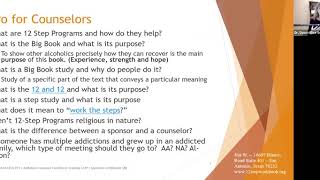
Dr. Dawn-Elise Snipes and John M., host of Soberspeak, explain how 12-step programs work and share practical tools for staying sober: sponsorship, meetings, service work, and how to handle PAWS and medication. John discusses family dynamics and how to find meetings that fit.
Questions this video answers
February 23, 2019
May 29, 1989
1935, Akron, Ohio (as stated by speaker)
register@allceus.com
soberspeak.com
Chapters
This episode was pre recorded as part of a live continuing education webinar on demand. CEUs are still available for this presentation through all ceus register@allceus.com counselortoolbox. Hey there everybody. I'm Dr. Donnelly Snipes and I'd like to welcome you to overview of the 12 Steps and an interview with John M. From Soberspeak. Today we're going to learn more about 12 Step programs, the Big Book and the 12 in 12. And we're going to hear from Soberspeak podcast host John M. About a variety of tools from the trenches to help classes clients get and stay clean and sober and how clients can get started in 12 step programs. So we're going to just start out with some beginning information because a lot of you listening may not be super familiar with 12 step programs. You've heard of them, you've heard of Alcoholics Anonymous, you've heard of Narcotics Anonymous, but you're not really sure what it is. So we're going to talk a little bit more about that. 12 step programs are mutual help groups that bring together people who have gotten into recovery as well as encouraging people who want recovery to join. The basis of membership is the desire to change. 12 step programs are a great place to start for people, and it's also a great place for people to continue to go back to forever if they want to, because they will have fellowship with other people who've walked the same path and hopefully emerged on the other end in recovery. 12 step programs help people by walking them through a process of introspection and behavior change. Now, it's not exactly like counseling, but it starts out Step one is getting honest and admitting powerlessness over this current situation and deciding that you are going to do something for change. And we're going to go through the steps in a few minutes, but you'll see how it's a progressive movement toward empowerment of taking back one's life and taking control of one's life again. The Big Book is the basic text of the 12 step programs and it was designed to show other alcoholics and people with addictions precisely how they can recover. And it's the main purpose of the book. There are a lot of stories in there about people who have hit their bottom, if you will, and decided that they were going to embark upon the recovery journey. Clients can find stories in there that they can relate to and they can see that people who've been in their situation, who've hurt just as bad as they have actually have found recovery and a Happy, healthy, fulfilling life. So the Big Book provides a lot of experience, strength and hope. And it reinforces the notion that if you work the program, you can get a lot out of it. Now, there's a couple caveats here with 12 step programs. And there are 12 step programs called dual Recovery Anonymous and Double Trouble. But some people will also require professional assistance, professional counseling, because they've got trauma issues, they've got bipolar disorder, they've got really bad anxiety, whatever the case may be. 12 Steps does not necessarily provide everything that everyone needs, but it does provide everything that some people need. And it provides a lot of stuff that most people need. You want to look at it that way. No one intervention is going to work for every single person, for every single issue, all the time. That's just not the way things work. So considering the 12 step program as an adjunct treatment, if you're working with a client already, or it could just be somewhere for somebody to start if they're not thinking that they need counseling or they're not quite ready to go to counseling yet, 12 steps can be helpful. There are 12 step programs for just about everything out there. There's Sex and Love, Addicts Anonymous, there's Gamblers Anonymous, Debtors Anonymous, Alcoholics Anonymous. There's even a small faction of a group called Emotions Anonymous, which I really like the EA program because it is designed to help people that experience a lot of emotional dysregulation and encourages them to recognize that sometimes that dysregulation is, is a little bit out of their control because that's how they're wired right now. Their HPA axis is especially sensitive or something. But it does give them tools to start learning how to deal with that and find a place where they are more comfortable and they're not driven and controlled completely by their emotions all the time. Look into ea. It's, it's a really great tool for any mental health clients that are out there, as well as a lot of substance abuse clients, because people who have substance abuse issues are often trying to self medicate or numb emotions that feel overwhelming and overpowering. A big book study is one of the things we do with the big book. And we used to do big book studies a lot in the clinics that I worked at. I love big book studies. It's a study of a specific part of the text that conveys a particular meaning. If you want to find a story about somebody who was a doctor who by all rights seemed to have everything going for him and developed an issue with alcohol and became an Alcoholic and then recovered. You can find that. You can find stories about just about anything that you want to relate it to. You can find stories about people who've gotten out of jail and recovered their life. You can find stories about people who've left violent relationships. There are a lot of things in there, and it provides hope for people. The 12 in 12 is a book that is designed around the 12 steps and the 12 traditions. And it's another book that's an adjunct to the big book. It's kind of like your daily missile is an adjunct to your full Bible or something, if you will. So I'm just gonna bring this over here right now. And this is from the Debtors Anonymous website, obviously. Now, I told you that the 12 steps helps people walk in a. Or work in a very organized fashion towards recovery. So let's look at how this happens. Step one. We admitted we were powerless over whatever the addiction is, that our lives had become unmanageable because of this. We can't go on this way anymore. We need a change. Our lives. You know, everything seems to be falling apart. And at the root of it, or seemingly at the root of it at least, is these behaviors. We came to believe that a power greater than ourselves could restore us to sanity. Some people take that to mean God. Some. Some people call that a higher power. Other people call it karma or the universe. Or in our treatment program, we used to call it good, orderly direction or the bigger picture that helped restore us to sanity. Because if you look at the bigger picture and you think about where is it that I'm really trying to go, you can make better decisions. Rather than reacting impulsively, we made a decision to turn our will and our lives over to the care of God as we understood him. Now, again, God in this context can be a spiritual being or it can be good, orderly direction. So we're turning our will and our lives over to this plan that we've got. If you are working with somebody who's atheist or agnostic or just doesn't want to be in a spiritual program, that's fine. Or a religious program, that's fine. We're turning our will in our lives over to the direction of this plan. We're going. Think about it as I tell my clients to think about it, as if they're going on a vacation or a journey and this is a road trip. And they are making every decision based, every turn they make, every stop they make is planned and designed to help them get towards that ultimate goal. This is where we're going. We're looking towards this ultimate goal and trying to figure out how do we achieve that goal of recovery and a rich and meaningful life. So people have admitted that the problem is overwhelming and it's ruining their life. They believe that there is a way out of it, there is hope. They've made a decision to figure out how to do the next right thing to find that rich and meaningful life. The next step is making a certain and fearless moral inventory of ourselves. So people start looking back over all the things that they've done that they may need to make amends for. They also start looking at all the characteristics within them that they may need to tune up a little bit. A lot of people have really are really good people with really awesome characteristics that have gotten buried under this addictive behavior. So how can we nurture the true self to come out again? And while the addictive self is being eliminated, if you will, we admitted to God, ourselves and another human being the exact nature of our wrongs. Again, think about good, orderly direction. Because some people are not even spiritual, thinking about the universe's energy or something. Whatever it is, you need to admit to yourself and another human being the exact nature of your wrongs to figure out. Okay, now that it's out there, all my cards are on the table. I need to deal with them and figure out how to deal with them. Step six is we're entirely ready to have God remove all of these defects of character. Okay? So we're entirely ready to make a plan, good, orderly direction to remove all these defects of character. We're going to figure out. And we're entirely ready to do the hard work to to do the next right thing to achieve our goals. We humbly asked him to remove our shortcomings. We recognize that we don't have all of these skills right now. We're going to have to work towards them. So we humble ourselves and recognize that, hey, you know what? We're not perfect. We don't know everything. So at this point, we have to be willing to ask for help. We have to be willing to seek the guidance from other people, other entities, whatever it is. We made a list of all persons we had harmed and became willing to make amends to them all. So that's pretty self explanatory. We made direct amends to such people wherever possible, except when to do so would injure them or other people. So you're trying to deal with all the baggage and all the chaos that was created during the addiction so you don't carry around that guilt. So you're able to repair those relationships. Relationships. And restore that healthy social support system. We continue to take personal inventory. And when we were wrong, promptly admitted it. Well, that's pretty self explanatory. We sought through prayer and meditation. To improve our conscious contact with God as we understood Him. Praying only for knowledge of his will for us. And the power to carry that out. So stated in a more secular fashion. Sought through prayer through sought through meditation. To improve our conscious contact. And our awareness of our goals and our path and our direction. That mindfulness that we talked about. Thinking only about knowledge of what we're supposed to do. And staying focused on the path in front of us. And putting one foot in front of the order. One foot in front of the other. And believing that we have the power to carry that out. Number 12 is having a spiritual awakening as the result of these steps. And remember, spiritual awakening. If you've seen any of my courses on spirituality. Spirituality is the development of awe and awareness and wonder and fascination with the world. It doesn't necessarily have anything to do with a higher power. So having a spiritual awakening, Having lifted all of this stuff. All of these problems and resentments. And everything else that you've been carrying around. For the entire time you were in your addictive behavior. Having liberated yourself from all of that. Having empowered yourself by seeing that you have a clear direction to a rich and meaningful life. That's the spiritual awakening. So having had a spiritual awakening as a result of these steps. We try to carry this message to others who share the same issues in order and to practice these principles in all of our affairs. Continue doing what you did in order to help you get to where you are. The 12 steps you can see is very logical. And can be very helpful for a lot of people. Now, the 12 traditions. The common welfare should come first. And personal recovery depends on the unity of the group. In the 12 step program, this mutual support, There has to be unity. It can't just be everybody there for themselves. And nobody helping one another out. We know that in addictions, people need social support. People need one another. For our group purpose. There is but one legitimate ultimate authority. And he may express himself. In our group consciousness. Our leaders are but trusted servants. And they do not govern. So in this group, the ultimate authority is the spiritual awakening. The only requirement for membership is a desire to stop the behavior that is problematic. Each group should be autonomous. Except in matters affecting other groups. Or the 12 step program as a whole. Each group has but one primary purpose. To carry its message to the person who is still suffering with that problem. The 12 step group should never endorse, finance or lend the 12 step name to any related facility or outside enterprise because it starts getting wonky at that point. Every 12 step group ought to be fully self supporting, declining outside contributions. It's important that the group is self sustaining, that everybody that comes to the meetings, everybody in the group has a horse in the race. Because people are more likely to follow through and do what needs to be done and be committed if they have stake in the game. The 12 step program should remain forever non professional. But our service centers may employ special workers. 12 step programs are not counseling. 12 step programs are mutual self help. And that's wonderful. Counseling is counseling. Counselors don't run 12 step groups. People who are in recovery, people who are suffering run the 12 step groups. 12 step program programs ought never be organized, but we may create service boards or committees directly responsible to those that they serve. There's always an opportunity for people to get involved. But sometimes, you know, there are special things, special events. There are planning committees for them and that's cool, but there's not that hierarchical structure that you see in churches or businesses or things like that. 12 step programs have no opinion on outside issues. Hence the 12 step name should not never be drawn into public controversy. They're not going to comment on medication assisted therapy publicly. They're not going to comment on politics publicly. They are there to help the person who is struggling. Our public relations policy is based on attraction rather than promotion. We need always maintain personal anonymity at the level of press, radio and films. Anonymity is the spiritual foundation of all of our traditions, ever reminding us to place principles before personalities. When we're anonymous, then our principles and what we do are what we're known for as opposed to our name. Those are the 12 traditions. And it's important to consider everything that you do as a reflection of the 12 step program when you're in the 12 step program. Alrighty. What is a step study and what is its purpose? A step study is when you work with generally an individual works with a sponsor and actually goes in depth into each one of those 12 steps. The purpose is to help them acquire that spiritual awakening. In order to do that, you have to work the steps. You have to go through the process. I'll show you here. This is one of my favorite workbooks and you can find it online at 12stepworkbook.org It's a 12 step workbook by Al Kohalek who who goes stepping and it provides a whole lot of information. The 12 steps, 12 traditions. Talks about what the 12 steps are and how it works, talks about who alcoholic is, and then eventually gets down here to going through the steps themselves. And it gives people activities to help them work through each step. For example, the admitting powerlessness. Some of the questions that the person would be expected to answer when they're doing their step one study would be, how has this problem placed you, your important relationships in jeopardy? And give an example. How have you lost self respect and or reputation due to this problem? How has this problem impacted your home life? Has it caused you any type of illness? What pain or fear do you associate with changing this area? Because you know what? It's scary to think about giving up something that has helped you survive until now. What pleasure do you get out of not changing? Okay, so that's very motivational in nature, recognizing that everybody does things when they have a benefit. So we need to understand what's the benefit of this behavior to the person so we can figure out how to help them meet that same need in a more healthy way. What will it cost you if this does not change? And what are the benefits you could gain by having this changed? And there's a lot more questions in here, but basically a person sits down with their sponsor and they're given this assignment and they take the assignment and spend a while going through it. And you know, most people will go through the 12 steps. It can be done in 40 days the first time through. But most people go through the 12 steps multiple times because each time you go through it, you remember a little bit something new or you've changed a little bit, but not the person hasn't quite morphed into the person that they want to be yet. There are a lot of activities that you can do in 12 steps and in step studies. Aren't the 12 step programs religious in nature? No, they're spiritual. And I talked about that a little bit earlier. The 12 step program wants to encourage people to embrace the wonder and awe and realize their connectedness with the universe and how they impact everybody else and how everybody else impacts them and see the hope of a rich and meaningful life. That is the spiritual awakening, that sense of awe and wonder. That's only a thing I can come up with. That's what the 12 step programs are about. It doesn't have to be about a particular higher power, or any higher power for that matter. It can be good, orderly direction. What's the difference between a sponsor and a counselor? A sponsor is someone who has been through it, who has achieved sustained recovery and who is willing to help someone work through the steps towards sobriety toward recovery. A counselor is a professionally trained clinician that diagnoses problems and can help people work toward recovery. So a sponsor can do a lot of things, you know, helping a person work toward their recovery, but the person themself is the one that is self diagnosing and identifying the treatments that are necessary in treatment. A counselor is more involved in the diagnosis and selection of possible treatment options. If someone has multiple addictions and grew up in an addicted family, which type of meeting should they go to? Aa na Al Anon Part of it depends on where you're at. There are and which meetings that you go to. Some meetings you may go to and you know, if you go to some AA meetings, they'll say we don't talk about drugs here. If you go to some NA meetings, they'll say you don't talk about alcohol. Alcohol here. The Big Book actually says it recognizes that one easily leads to the other. Therefore it shouldn't be off the table because we need to help the person address the addictive behavior. But it's important to recognize that.
Some.
Meetings are not going to be as welcoming of multiple addictions. Al Anon is the 12 step program for people who are in relationships or or are in families with a person with an addiction. If you grew up in that sort of environment, then you also may have some codependent characteristics about yourself. A lot of that will also be handled or addressed in the 12 step programs. So Al Anon is really for people who for the most part don't have an addiction but are in a relationship with someone with an addiction or whereas the other 12 step programs are really able to handle both the codependency issues as well as the addiction issues. I've seen people go to 12 step meetings and Al Anon it's not off the table. It's just what works for the individual person. How do 12 step programs feel about people on prescribed psychotropic medication? And the hyperlink here is to an article. Well, I'll just pull it up. It's from the AA member medications and other drugs. And what they say is the Big book says we are convinced that a spiritual mode of living is the most powerful health restorative. But this does not mean that we disregard human health measures. Though God has wrought miracles among us, we should never belittle a good doctor or psychiatrist. Their services are indispensable in treating a newcomer and in following his case afterwards. So the big book's not against counseling. The big book's not against treatment. The big book does believe, as most of us probably believe, that it's more than about having something done to you. The person has to have that spiritual awakening, that desire to recover, that hope and that courage to face the stuff that they need to face and that ability to shed all of the guilt and anger and resentment and other stuff and get in touch with that hope, health and happiness. How do 12 step programs feel about medication assisted therapy? And here's another one that I'll open. MARA International is the Methadone Anonymous Recovery Internet Association, I believe is what MARA stands for. This article from the American Society of Addiction Medicine basically says that medication assisted therapies, if they're used as prescribed, are there to help people to recover from Alcoholics Anonymous and psychiatric medication. In September of 2010, it became clear, just as it is wrong to enable or support any alcoholic to become re addicted to any drug, it is equally wrong to deprive any alcoholic of medication which can alleviate or control other disabling physical and or emotional problems. There is going to be contentious debate about this issue probably forever being aware of the different sides of it. MARA International Medication Assisted Recovery Anonymous is there for people who want the 12 step fellowship, but they are using medication assistance. Vivitrol, Suboxone, Methadone, any of those things. How do 12 step programs feel about treatment? You know, that 28 day residential or whatever the big book says we favor hospitalization for the alcoholic who is very jittery or be fogged. More often than not, it is imperative that a man's brain be cleared before he is approached and that he has then a better chance of understanding and accepting what we have to offer. We need to help people detox. We need to help people get started on the right path. And most of the time, most treatment anymore is 30 to 90 days at most. And that's really still a pretty extended detox. People aren't clearing everything out of their system for, you know, in three days. So the 28 day programs, we're really encouraging people to just start working on that step one. And that's what I used to do in my program. I was like, in this first 30 days until your fog is lifted, just want you to work on admitting powerlessness and developing hope that something's better. So actually steps one through three, but other than that, you know, the rest of that can be taken care of, you know, later in later phases of treatment or when you discharge to a 12 step program. Of course, an alcoholic ought to be freed from his physical craving for liquor. And often this requires a definite hospital procedure remembering that certain substances are actually life threatening to detox from. So we certainly don't want to deter people from taking advantage of detox. And if people are also on other psychotropic medications, there can be a lot of other issues in the early recovery period that need to be handled medically and or clinically. If someone has a lot of trauma issues or co occurring mental health stuff, it may be necessary because their neurotransmitters are going to be kind of really out of whack because of using substances, among other things. Residential treatment or intensive outpatient treatment may be necessary for a duration in order to help them get into that clear headed place where they can focus on sustained recovery and they can actually actively participate in the 12 step programs. Alrighty. In a few minutes we're going to talk with John M. And we're going to learn more about tools from the trenches. I'd like to welcome everybody back. We are going to spend a little bit of time talking with John M. From the soberspeak podcast. Welcome John.
Thank you, Don. Thank you for having me. I was just listening to a couple of counselor toolbox sessions over the past few weeks.
Alrighty. So you know what we are and what we're all about and you know, soberspeak is really designed to encourage people to embrace the 12 step recovery program. And so we're going to talk a lot about that today and some of the tools from the trenches that you might be able to share with clinicians who are working with people who are struggling with addictions. Maybe they're not quite ready to embark on addictions treatment or they're thinking about joining a 12 step program but don't know where to start. And you know, hopefully we'll get some answers for them here today.
Glad to share some experience, strength and hope and I will give a little disclaimer on the front end. You know, I love Alcoholics Anonymous. It's kind of my thing, so to speak. It's been real good to me, but I don't represent AA, so to speak. But I am an example that Alcoholics Anonymous can't work in people's lives.
Sure. And you know, I have some really good friends and family members who've gone through 12 step programs, not just Alcoholics Anonymous and had wonderful success. So I know that these 12 step programs can work for people. And in the first part of this class I talked about another program Emotions Anonymous, which I really, really love and personally used and I've used with some of the people that I've worked with, and it has been very helpful. Finding an EA meeting is a little bit challenging, but the EA literature is super awesome. But let's go ahead and start talking about tools that soberspeak podcast. You interview people who are in recovery in order to help provide the experience, strength, and hope. And in the first part of this webinar, I talked about how the big Book has a lot of stories in it that are designed to do just that as well, in order to help people realize, you know what, I'm not alone. There are other people who've walked in this path before and have hurt just as much as I have and have found recovery and have had that spiritual awakening. So there is hope. So what kind of tools have you heard from your speakers, from your personal experience, whatever that people find really helpful in relapse prevention? You know, they go to treatment or whatever, somehow they detox, and then they make that decision that they don't want to use anymore. So what are some of the best things that they can do in terms of helping prevent relapse?
Yes. So, first of all, and by the grace of God, I have been sober since May 29th of 1989. If I happen to make it to this May, one day at a time, I will have been sober for 30 years. And yeah, and, you know, that's one of those things. And I hear people say that sometimes, but it's. It's not something that, you know, like when I make a great presentation at work and somebody says, that is fantastic, you know, you kind of go, well, thank you very much. Yeah, but other. But when somebody says, that's fabulous, you've been sober for, you know, an extended period of time, you kind of feel like inside, like, ah, you know, this is truly the grace of God. And I'm not trying to be overly humble about that. It just, it is. But in terms of our relapse prevention. Okay, so getting back to the stories that you talked about on the front end, you know, the reason that Alcoholics Anonymous came to be in the first place was because Dr. Bob and Bill W. Were able to sit down with each other and they were able to talk to each other to say, yes, I am one of those. Yes, I am like that as well. And the people that I see, you know, and this is just my experience and my viewpoint on it, and you talk to a hundred different people, you're going to get 100 different answers. As you know. But. But what I see in the program is that the people that come in and they don't have to go back out again or they just somehow they stick with it are the folks that, who just said, you know, this is it, the jig is up for me. And they're able to plug into the program, you know, they'll do the things that they're told to do. Like, I just did a fifth step with a guy last night, right? And what he did is he got in, he said, tell me about the first step. What does it say in the big book of Alcoholics Anonymous? Tell me about the second step. Let's go over your conception of God. Let's do a third step, let's do a fourth step, let's do this fifth step. And they get into the program and they follow the process. And even though they sometimes don't believe in the process, they will get in, they'll work that, they'll work it and somehow get sobriety. You know, I was. My first meetings were in 1986 and I went in and out of the program for three years. I picked up at least a dozen what they call desire chips, which is just where you come in and you pick up a chip and say, yes, I want to stay sober for 24 hours. I mean, toward the end, nobody was even clapping anymore, right? It's just like, oh no, you know, here he is to get another desire chip. I went home when I was drunk one night, I threw them in the trash. And so, but something. The only thing that I did right Donnellyce was I kept going back. I kept going back into the program. And this last time, I have a sponsor. He's been my sponsor now for 29 and a half years. Tell him he's a temporary sponsor. I'm going to give him a little bit of a chance, right? The last time that I came back in, he took me aside and he said, hey, have you ever worked the steps? I said, ah, I could have had a V8, right? So he took me through the steps and for me personally, that was the last drink I've ever had. And it's. It's truly a miracle. So a short. So the less the long story, the short story to relapse prevention is doing what people tell you to do. And we can't do this alone, right?
And I showed the viewers, for the ones who are watching the video, a workbook that is online that I really, really like. It's called alcoholic goes 12 stepping. It's alcoholic. And yeah, it's a really awesome 12 step workbook, if you will, and helped the people who are watching and listening understand a little bit more about what it means to work a step. And you know, we went through some of the questions that people might answer when they're working the first step to help them see how the 12 steps really can work. To help people recognize their powerlessness, but also inspire hope.
Yeah. And the 12th step, for those who aren't familiar with all the 12 steps, is really the one that specifically addresses carrying the message to other people. And back in the beginning, that is truly how this started. Right. It was one person carrying a message to the next one. And you know, this not only works as, you know, for alcoholics, I mean, it works for overeaters, it works for sex addiction, it works for shopping issues, it works for everything gambling. You know, the idea is that you recognize that you are powerless and then you take that message to somebody else and you help them along the way.
And by helping them, you're also helping yourself because you're keeping it ever present in your mind what you have to do on a day to day basis. You're remembering instead of getting. And it's kind of leading into our next question for you, remembering not to get caught up in the day to day minutiae. I've worked with a lot of people and you know, even some of my family members, when they were going to 12 step meetings, they went for a certain period of time and after they picked up their one year chip or their two year chip, they were like, you know what, I don't need to go anymore. Or they would start getting slack. And they went from 90 and 90 to one every 30. And it just, it doesn't work when you don't, when you're not consistent. So what suggestions have worked for people that you know to help them maintain a recovery focus? And remember that the meetings are important, this big book is important and continuing to work that recovery lifestyle is important.
Right? Well, you know, let me put it this way. I get a lot of phone calls and a lot of people visiting with me. And you know, they're, they're struggling with, maybe they're not struggling with so much sobriety, but they're struggling with, like you said, the day to day minutia of oh, you know, my spouse says this or the job's doing this or you know, my, I have some health issues, whatever the case may be. And it really always comes back to there's some, what you call the mechanics and the tenth step and the tenth step is, you know, continue to take personal inventory. And when we were wrong, promptly admitted it. But there's some language in that 10th step in the big book on page 84 and 80 that talks about how when these things crop up, we had once, you know, and by the way, I'm going to talk about spiritual things. I'm going to talk about God here. And everybody has their own conception of that. And I'm not on a mountaintop telling you to follow the God that I do. But there is God and spirituality that is talked about in the alcoholic, in Alcoholics Anonymous. And people find it in their own way. But it says that we had once asked God to remove these things. We talk to somebody else if we need to talk to them, to get it off our chest and not to let it fester within ourselves. And then kind of goes back to that first point we were talking about. And then we go and look for somebody else that we can help. And that's usually always the answer in the end is how do I not get caught up in day to day minutia or. Well, I look to other people. I look to see how I can help them and I look to get out of myself. And sometimes, you know, it may not be with another drunk. It could be, you know, we talked a little bit about hospice before this started. I've done some, a lot of work with hospice. I've gone to nursing homes many times over. I work with the youth and my children. And by the way, I'm not saying all that to say, look what a great guy I am. I promise, believe me, I have a warehouse of issues that I work on. I'm doing that to say that, you know, I am just one of these guys that I have to do that to stay focused because I'm just that sick. I just, I just need those sorts of nudges along the way.
And in early recovery, especially relying on a good sponsor, it's. It breaks my heart when I see people get involved in the, in the 12 step program. They're going to meetings, but they don't have a sponsor. They just kind of show up, they sit in the back and they go home. I'm like, you're not working the program, you are just showing up. Showing up is better than nothing. But a sponsor is really going to help people remember that. You know what, you got to make a meeting. You can't. You know, it's been a week since I've seen you at a meeting. What's going on, obviously later down the Line, hopefully in early recovery, you're not going a week without a meeting, but sponsors. And once you start establishing yourself at a particular meeting, because most people go to the same meetings all the time, then you develop that fellowship. And then people start asking, you know, where's John? Why hasn't he been here? And you realize that you do have an impact on other people, which goes along with that spiritual awakening. Recognizing that you are important. And so knowing that you've got the fellowship and that people you know are going to be looking for you and knowing that a sponsor is going to be there to kind of hold you accountable sometimes both of those can also be helpful to not getting too caught up and forgetting to do what you need to do in order to stay clean and sober.
Yeah, it's like that show Cheers without the alcohol. You know, you go to a place where everybody knows your name and they miss you if you aren't there.
The next thing I wanted to ask you about post acute withdrawal syndrome. And we know that pause for short can last for a year or more in some people. And, you know, as the person gets further away from their last use, the symptoms are not as bad. And the frequency of the cravings and that kind of stuff come less, come less frequently. But what do you tell people, you know, if sponsors that you're working with or people that you talk to, what do you tell them about post acute withdrawal syndrome?
Yeah. Well, first of all, you know, I'm not a doctor, as you know, but I can tell you from experience what I see, which is really what you're asking. You know, first of all, for me personally, the withdrawal symptoms that I went through were, you know, I used to say, I'm not an alcoholic because I don't have this, and I'm not an alcoholic because I don't have that. But I began, in the end, starting to have withdrawal symptoms. Now I know people that go through DTs and things of that nature. I never went through that. I definitely went through the shakes and the physical withdrawals. But everyone is a little bit different, right? I mean, you have people that have come in and they just started drinking two, three years ago, and it just picked up very quickly. You have other people who have been drinking for 40, 50 years, and then they come in late stages in life and they're trying to get sober. The answer usually comes down to, you know, you just keep going back to meetings. Now some people are going to need medical treatment. Medical treatment. And, you know, like I said, aa, we're not doctors. And so, you know, we'll say, hey, go get some medical treatment, detox on your own, right. And then come here and we can help you through the steps. But you know, it's interesting with Dr. Bob and Bill in the beginning, Bill Wilson. Once again, for those of you who don't know who Bill Wilson is, he was the gentleman who started, for lack of a better word, Alcoholics Anonymous. And Dr. Bob was the first person that he ended up carrying the message to. And that's where AA sprung, so to speak, back in Akron, Ohio in 19, 1935, I believe. Go ahead.
Just to interject for people who don't know, if somebody asks if you're a friend of Bill W. Sometimes that's a covert way of asking whether you're in a 12 step program.
That's correct. In fact, I know buddies of mine who used to go on ships and they didn't know what it was like cruises. And if you go on a cruise, you usually see Friends of Bill W. Meeting. And they, they kept asking me, they go, who is this friend, this Bill W. Guy? He has so many friends. We're all. And then they'd go to a meeting and go, oh, this is not what I was looking for. So.
Right.
But it is. Yes, friends build of you. But Bill, when he came into, you know, he didn't, there was no Alcoholics Anonymous. Right. He just got a, quote, bright light. Right. He had an actual spot, spiritual experience in a hospital. And the, the, basically the, the, the desire was removed from him almost immediately. And then though there was Dr. Bob and Dr. Bob struggle with months and months and I believe even into a couple of years with that mental obsession, you know, wanting to go back to it. And once again, what he would do every time when he got a, when he got into one of those spots is he would reach out to another alcoholic. So everyone's a little different in how that mental obsession manifests itself, and everyone's a little different in how those physical symptoms manifest themselves. But by all means, if somebody needs to get medical treatment, they need to get that. And then we can kind of come in and help an Alcoholics Anonymous from that point on.
And I think one of the most important things you said there was when you start having those cravings again, or if you're feeling fatigued and lethargic and irritable and all those things that could lead into potentially cravings and a relapse, go to a meeting. You're recognizing that people who quit using aren't going to just go through one detox there are going to be little mini detoxes for the first year or so. And. And recognizing that when they're having those bad weeks or bad days, that that is one of the times to go to the meeting. Like, you know, I'm sure you're. You've heard the saying, when do you need to go to a meeting? When you want to go to a meeting and when you don't want to go to a meeting.
That's right. That's right. And I also just so, you know, kind of look at this as a. Just how the book describes it, as a threefold illness. Right. The first part is that physical part to where. And the physical part is where when I take a drink, the drink takes a drink, and the drink takes a man or a woman. So in other words, once I start, I never know when I'm going to quit. There is a physical allergy, as it's called, that is set off within my body. But the second part to the illness is the mental obsession. And the mental obsession really is, you know, it's like when you put your hand on a stove and you don't want to go, why would I go back and keep putting my hand on that stove if I never took that first drink in the first place? Well, I wouldn't be concerned about the allergy. And then the third part of the illness is the spiritual part, which basically means that I'm born and I'm resentful, selfish, dishonest, and afraid, walk around restless, irritable, and discontent. So in the book, it talks about when the spiritual malady is overcome, then we straighten out mentally and physically and.
Exactly, exactly. And earlier I had talked about when people are able to shed all of those resentments and deal with all of the grief and guilt and, you know, all of this thinking. Thinking stuff is when they can really embrace the wonder and awe and the spiritual awakening of the hope of a rich and meaningful life and in recovery.
Yes.
A lot of the people that go to meetings may still be living in an environment, the same environment that is replete with alcohol use and. Or drug use and dysfunction in a variety of sort of ways. And for a lot of people, moving is not an option. So what types of things have you heard, whether it's something that you did or you've heard from other speakers on your podcast, to deal with these dysfunctional environments in order to keep moving forward?
Yeah. So there is a whole chapter in the book Alcoholics Anonymous that is devoted to this. It's called the Family afterwards. Right. And There was a friend. There was a friend of mine who I recently had on the podcast, and he said, it's eight miles into the woods and it's eight miles out of the woods. In other words, you know what, what happened within living a life of alcoholism into the family members and such around people did not happen overnight, and it's not going to get settled overnight either. So these are case by case scenarios. If there's a safety issue involved, that's a completely different thing. You know, you want to remove from someone from that particular situation. But, oh, gosh, I've seen it all over the map. Sometimes people get in and they start to get well, and their spouses or their family members start to see that they're getting well and their family changes, and the spouses and the. And the family members get involved in al anon. Other times, spouses and family members are not a fan, so to speak, of Alcoholics Anonymous, and their spouse starts to change and get better. And quite honestly, they've gotten used to having that individual not in a healthy manner, so to speak. And when they start to change, it's a very uncomfortable process and they start to break away. But there's a line in the big book that says, job or job, job or no job, wife or no wife, the alcoholic can get sober nonetheless. And you could put husband or no husband in there as well. You got to think this was written in the 1930s, so it was a different time, but nonetheless. So to answer your question, how do you go back into a situation like that? It just depends. And it's a case by case scenario. From everything that I've seen, like I said, sometimes it works out, sometimes it doesn't. But you just got to use that spiritual guide inside and say, should I stay here? Is this the right place to be? And you think sometimes, you know, hey, listen, they put up with me for 20 years, you know, all my shenanigans. I'm going to stay here for at least a year, see how this works out, and then I'll make a decision at that time. But, you know, there's a. There's a kind of a guideline, if you will, in Alcoholics Anonymous is you don't do anything major for a year. And, you know, some people keep that, some people don't. It's not in the book. It's just kind of. It's come out of treatment over the years, but it's a good guideline. But once again, where safety is concerned, that's a different issue.
Right? And there are Going to be some issues. I know in my own family, I had a family member who was in recovery and was living, you know, at home and somebody else in the family was still an avid drinker and was not going to remove alcohol from the house come hell or high water. So, you know, that was a very challenging situation because the person in recovery was viewed as the identified patient, if you will. It's your problem, it's not my problem. So you've got to figure out how to deal with it. And substance abuse in general, and addiction in general tends to have a family component. You know, a lot of times we say it's a family disease because when the person is in their addiction, the family adjusts to some sort of normal to deal with that. And then when the person finds recovery, the family has to readjust. So it's really important, like you said, on a case by case basis, but to be. For people to be aware of what their needs are. Like you said, just continually reassess and ask yourself, is this where I need to be right now?
That's correct. That's correct.
Go ahead.
Yeah, I was gonna say, you know, everyone. So I was single when I got sober. I'm married now, but I was single when I got sober. And you know, the, the types of. So I didn't. And I was an only child, so I didn't have like a ton of familial, like, type relationships that I had to be real concerned about. But one that I did have an issue with or I needed to make sure that I repaired in some form or fashion was with my mother, who had raised me. Like I said, I was an only child. And we had been together, just me and her, since I was 6 years old. And my mother was. She had anorexia, she had bulimia, she had true, true obsessive compulsive disorder. And no one ever talked about that back then. I didn't know what was going on. To me, it was just very, very strange. She had schizophrenia. She had these words. I don't even know how to. I don't know what this is called. But she had. Would have words like death that would just rifle through her head. And she, she couldn't stop talking about those things. She, you know, we would talk about suicide. She would. On a consistent basis at the kitchen table. So it was very dysfunctional. So in my particular case, I got out and there's a. Oh, gosh. I could, I could talk for an hour about this, but I don't want to take up all the time. But I had to kind of figure out, number one, how to make amends to her. And I went through that process and then I had to figure out what was my relationship with her going to look like moving forward and should I even have a relationship. And I know that there's a lot of listeners out there, I'm sure, that have to struggle with, okay, there's some gray area here. Right. There's nothing like black and white about this, you know, and how do I do the next right thing or this particular relationship is concerned. And maybe they're not under my roof, but there are people that where it is uncomfortable and I'm going to need to do something because I feel spiritually drawn toward that.
Right, right. And you need to find your own peace.
That's right.
Really, what it comes to when we are in our addiction, we lose the trust and sometimes the support of our significant others. What strategies or suggestions have you found or do you find comforting in the big book for trying to regain the trust of the people in your life to make amends and repair those relationships?
Yes. So once again, it's eight miles into the wood and it's eight miles out. Some. Some people, in fact, I was just talking to a guy last night, the one that I told you about, I was doing that fist step with, and said, listen, you know, they're mad and they're mad for a good reason. You gave them a lot of information to be mad about and this is going to take some time and they're not going to trust you right away. I mean, I wouldn't, you know, I mean, they're going to be thinking you're going back out. And so the way that you build that trust, it's like the saying of the way that you build self esteem is that you do esteemable things. And the way that you build trust is that you do trustworthy things. And people will know by your actions, by your consistent actions over extended period of time, they will know that you can be supported again, but trust it again. And I see this on a consistent basis. You see people that come in and they say, wow, I didn't have a relationship with my son or my daughter or my grandchildren. They weren't even going to let me in the house. They thought I'd steal their pills or something like that, or I was always going to be drunk. But now that they see me that I'm getting well, people could just sense it. Right. But even though they sense maybe that you're getting well seen this time and time Again, well, there's a lot of resentment and baggage built up from many, many horrible examples and bad behavior over the years. And it's not like they're just going to forget that. So in my opinion, you know, you just have to give it time. And in fact, I will counsel people all the time and say. They say, well, they don't really want to talk to me. Well, I understand, and I wouldn't want to talk to you either. But maybe what you can do is you just continue to send that birthday card or you just continue to make that weekly call, even though it lasts for five minutes maybe or two minutes. Maybe they don't want to have a conversation with, with you on the phone. Maybe eventually they'll want to have a five minute conversation or a ten minute conversation if they ask you to leave them alone. I mean, leave them alone. Maybe that's what they need at this time. So it always comes down to a case by case scenario. But that trust and support of significant others or just family members in general, in my opinion, what I've seen can take some significant time to, to repair.
And sometimes those people have to be willing to have a spiritual awakening of their own and be willing to shed some of that, or at least table some of that resentment and maybe guilt and anger and anything else that's there.
That's correct.
Now, finding the right meeting, and this is something that a lot of people don't really think about. They just think, okay, I'll go to a meeting and every meeting is the same. And that's just so not the case. Where I first started cutting my teeth in addictions counseling in Gainesville, there were a lot of meetings. But in order to find a meeting that had any amount of old timers, any amount of people with sustained, good, long, sustained sobriety, we had to drive about 45 minutes to find one of those meetings. And you know, sometimes you'll go to a meeting that has a lot of old timers and it's not a good fit for you. So what do you tell people if they go to a meeting, you know, the first meeting they go to, and they're like, oh, that's not for me, whatever. What kind of information, if you want to use that or advice, can you give people about how to find the right meeting for them?
Right? So, quote, right meeting, unquote, is, you know, as, you know, just. It means different things to different people. And you're right. I mean, some people will just gel with a group immediately and others will, you know, others will go to that same meeting and go, this is not for me. So it's, it's like finding the quote right church, you know, I mean everybody has got a right synagogue or wherever you're going, right? It's finding that. That group that you mess with. So the idea though is that there are tons of meetings. I guess it depends on where you live right now I'm fortunate. I live in the Dallas Fort Worth metroplex and you know, we have all kinds of meetings. In fact, I just went to a meeting to new at noon today and there were probably, I don't know, 60 people are there or so. And it was a good mix of people. In other words, there was old timers, there was people that were new, there were people that were in between both men and women. And so there was. It's a very good mix. But finding that is not always easy. But the, but to me, the intent is just as long as you want to be there, you will find. It's like knock and you will find. Seek and you will. Then the door will be open. No knock and the door will be open. Seek and you will find.
The.
The idea is just to keep seeking and you will find what you need. But sometimes it takes a little bit of work. And as you know, there's online meetings and you know, and, and you need to get a network, right. Maybe you go to a meeting that you don't particularly enjoy, but you can call John or you can call Susan, you know, whoever it is that you're gonna call and just have meetings with them and stay plugged into the program somehow some way. I have a secret Facebook group for soberspeak that which use a lot of people in there and they chat back and forth and they're able to get support that way.
Right? And like you said, sometimes online, depending on where people are, if it's two in the morning and you've got kids that are sleeping and you just really need a meeting going to in the rooms.com or some other online meeting that's a good fit for you can be a good tool.
That's correct. Now you know, and I will say that in my opinion it is a good tool. But there's nothing that replaces those in person meetings where you can put your arms around somebody and look somebody in the eye and talk to them about how they're doing. And that's the place where you find people that you can help. Right? You know, at my church they're always going, hey, we're going to go out to this community and help. We're going to go find people to help. In aa we have them. They're just like falling in the door and they need help. Right. So you don't even have to go anywhere.
Right. And I mean neurologically there actually is a lot of support for that. The face to face interaction is where, you know, some of those bonding chemicals are actually stimulated. So there is more reinforcement, more reward and sometimes more comfort in a face to face meeting than just text based, which can be very cold sometimes. So a lot of counselors just, they may want to refer their clients to 12 step meetings, but they don't know how does somebody start? Do you just look online on the AA website and find a meeting and show up and then what happens? So what kind of happens for the new people?
Right, right. So that's pretty much how it's, it's been now. I mean, now when I first got sober, that was not happening. Right. I mean, you'd have people calling in to intergroup and you know, sometimes we go out on what we call 12 step calls, which means you're going into somebody's home and talking to them. But the vast majority of people that find Alcoholics Anonymous nowadays, best I can tell, I mean, I don't have any sort of access to secret information or anything like that. The best I can tell the folks walking through the door going online to alcoholicsanonymous.org if you go to AA.com, you're gonna go to American Airlines, right? But then you go to alcoholicsanonymous. I think it's alcoholicsanonymous.org if I'm not mistaken. If I'm wrong on that, forgive me.
But Google will figure it out.
Yeah, yeah, Google will figure that out. And so they, they, they find it online, they come into a meeting and when someone first comes in, every group, every group is autonomous in the way they run their groups, right? They can, they can do whatever they want. But there is, generally speaking, on the front end of the meeting. Now I don't want this to scare away people because they don't, a lot of times they don't like to come in if they're going to be called out. But they will, you know, we will say, you know, is there anybody here for their first meeting or is there anybody here returning who would like to get a desired ship? And you know, there's some banter that goes back and forth and we in our group at least hand out a list with different names and phone numbers and we'll talk to you after the meeting and Just make sure that, you know, you know what the meetings are about, but people. In fact, the meeting I was in today, the guy was there. He was there for a second meeting, and he said, wow, this is not what I thought it was going to be like at all. I had a preconceived notion of what Alcoholics Anonymous was, but it wasn't like that. He goes, you guys are just like me. This is really weird.
So basically, what I'm hearing, you know, you go, you find a meeting that you're gonna try out, which may not be your forever meeting, but, you know, you got to start somewhere. And you go in. When you first get in, you just take a seat. And as the meeting begins, then the person chairing the meeting will ask if there are. Is anybody who's new.
Generally speaking, in most meet. In most meetings, yes, that. That is the case. But, you know, I can't speak for every single meeting out there.
And when people start going to meetings, they. They generally want to go to go to an open meeting first.
Are you. Are you asking me, or is that.
That was more of a question than a.
Okay. Well, I would say okay. So I could say, by the way, the difference for those listening between a closed meeting and an open meeting is a closed meeting is for alcoholics only. And I wanted to go to closed meetings because I was so ashamed of being alcoholic. I didn't want anybody know I was an alcoholic. I didn't want to run into anybody. You hear people all the time talking about, I was looking in the park, I was out in the parking lot, I was going to see if there was anybody going in that possibly I knew because I want anybody to see me now, which is, there's irony in that, because why would they be going into the meeting if, you know, they didn't have the same issue you do? But. And an open meeting is open to anybody can do it. Most open meetings are speaker meetings, you know, where you'll sit down and somebody will share. Now, they don't always ask in a meeting like that if there's somebody there for their first meeting. Sometimes they will, sometimes they won't. But I personally, when I was first getting sober, especially wanted to go to closed meetings.
Okay. Okay, good advice. So, finally, how does your podcast, soberspeak, provide the experience, strength, and hope? And, you know, we've talked about a lot about them, but why are they so important to people in recovery? And, you know, why is it so essential for people to stay plugged into the big book and things like your.
Podcast Stories are powerful. It's pretty much what it comes down to. And when people listen, I get comments. I get people to contact me on Instagram, again, contact me on Facebook, Twitter, and they actually write into the show via our email. And all the time, what I hear over and over again. Let me back up. When I first started this podcast, I thought it was going to be like, my buddies, right? People like me who would be listening in, and we'd all be able to talk about the. You know, the podcast and such. But what. What I've found is that the majority of people listening are some people who have never attended an Alcoholics Anonymous meeting. And there are a lot of people who are al. Anon that want to understand what's going on from a. An alcoholic perspective. And there are people that are brand new in the program. And so I get these messages on a consistent basis that say, I had no idea that I would relate to this so much. I guess I am one of you. And all I can say to them basically is, hey, go to a meeting. You know, you may. You may not be. That's. That's for you to decide. Nobody else is going to decide that for you, but the stories and the experience. So that's the experience and strength. And then the hope is that, hey, I once was like you. I came to Alcoholics Anonymous and I found something that is indescribable. I worked these steps. I did what they said. I got plugged in, and now my life is much, much different. I mean, if you take a snapshot my life before I got to Alcoholics Anonymous, in a snapshot of where I am now, I mean, I'm not. Like I said earlier, I'm not perfect, and I have all sorts of issues that I have to deal with, but my life is greatly improved. It has breadth, breadth and depth and weight. And there's. There is. I would not, you know, if I found out I was going to be checking out tomorrow for whatever reason, I would not want to change anything about my life. I'm where. I'm where I want to be living the life I want to live, and. And I have friendships with people that I want to be friends with, and I have a great family around me. And now I realize it could all go to pot in a second. Right? All I got to do is go back out to tomorrow and pick up that drink, and it would all go downhill. But that's why the experience, strength, and hope for me are important.
Awesome. Awesome. Is there anything else that you want to share with our listeners.
No, I think, I mean, for the most part, I have covered it all. I just, you know, I love aa. I mean, it's pretty much what it comes down to. And I am. I just, it's, it's, it's really offered me a life beyond my wildest dreams. And I will say silverspeak.com if you want to go there and listen to our pocket is, by the way, just so you know, on my end. Right. I want everybody know this. It is strictly service work for me. It's not about a money thing whatsoever. I truly just want to spread the word about Anonymous.
That's awesome. That's awesome. So that's soberspeak.com in order to listen to some of the episodes. And I'm assuming that people can subscribe on any podcast player?
Yes, correct. We're on all the directories.
Yeah, yeah, I'm, I usually, if I'm gonna listen to stuff, I listen online because, I don't know, just one more app is more than I can handle, I think, but.
And you can listen on YouTube as well. So we're out there. So, you know, if somebody wants to do it, I. Online.
Fabulous. Fabulous. Okay. Well, thank you for being here with me today, and I look forward to listening to more episodes at Sober Speak.
Thanks for having me, Donna.
Lace. Thanks. Bye. Bye. If this podcast helps you help your clients or yourself, please support us by purchasing your ceus@allce.com or getting your agency to sponsor an episode. A direct link to the on demand CEUs for this podcast is@allce.com podcastceus that's allce.com podcastceus to sponsor an episode of Counselor Toolbox and reach over 50,000 clinicians per week, go to allce.com sponsor. Thank you.










