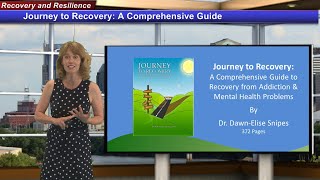
Dr. Dawn-Elise Snipes wrote a 400-page workbook on recovery from addiction and mental health problems. It covers eleven topics from addiction basics through relationships and coping skills. Individual copies cost $19.99 on Amazon, with group discounts available, plus an optional 12-hour training for $950.
Questions this video answers
Almost 400 pages.
$19.99 per copy.
$950 (plus purchase of at least 100 books).
12 hours.
inforecoveryandresilience.org
Chapters
Hi and welcome to Journey to Recovery. I'm pleased to announce that our book, Journey to A Comprehensive Guide to Recovery from Addiction and Mental health problems by Dr. Donnelly Snipes is now available at Amazon.com this book was designed to aid patients as well as clinicians and agencies in accessing usable, solution focused tools to help you through the recovery process from both addictions, mental health issues and co occurring disorders. In the book, you'll start out by understanding addiction. You'll understand not only the process of addiction, but also the differences between behavioral and chemical addictions. You'll look at co occurring disorders and understand how mental health issues like depression, anxiety and those sorts of things will also impact your recovery from addiction and addictive disorders. Then we move on to motivation. You can't do anything unless you're motivated to do it. So we'll talk about how to increase motivation and how to identify why you're motivated to do something. Once you're motivated, then it's time to start setting goals. So we'll start with a basic primer on how to set successful, achievable goals. And then we move on to Stop Swimming Upstream. This is my favorite chapter. It is one that covers temperament and learning style. This isn't something that we talk about very much but is so important to enduring recovery. Next we look at mindfulness. You're motivated, you've got good goals. You know what makes you tick. Now you have to get grounded and focused. So your mindfulness chapter will help you work on that. In chapter seven, we talk about physical and biological needs. If you've watched any of my other videos, you're aware that I use Maslow's philosophy that we have to have a good physical foundation first because a hungry, sick, tired person who's in pain doesn't really give a squat about working on their depression or their self esteem. So we're going to talk about your physical needs and how nutrition, exercise, sunlight and sleep can really help you feel better and improve your mood and improve your outlook. Then we move on to creating safety both around you, which is what normal people think of, but also inside your own head. Safety from those negative tapes, from those ugly words that you tell yourself probably on a regular basis. Chapter 9 We move on to feelings, emotions and reactions. This is where we really start looking at things like anger, fear, depression. What do they do? What's their purpose? Why are you experiencing these things and what can you do about them? Chapter 10 takes that a step further and we start talking about coping skills. Now up until now you've been coping with life on life's terms as best as you can. We want you to look at the coping skills that you use and fine tune them a little bit. Let's not reinvent the wheel. Let's figure out how to make what already works for you work better. And then finally we move to relationships. Because we know that one of our greatest buffers against stress and one of our greatest assets in recovery is healthy relationships. So looking at what is important to you in a relationship, what makes a healthy relationship versus a toxic or codependent relationship, and how can you increase the number and quality of the healthy relationships in your external circle? Then finally putting it all together, we've moved up the hierarchy. We've gotten the physical needs, we've looked at the emotional needs, the safety needs, and the relationship needs. Let's put all those together and figure out what your recovery program really looks like. This book is almost 400 pages, so don't expect it to be an easy overnight 1, 2, 3, you're fixed sort of thing. But if you go through it, just like when you go through the steps or you go through therapy, it's a process. Hopefully you will find some tools in here that will help you strengthen your recovery. Individual copies can be purchased on Amazon.com for $19.99 and discounts are available for agencies or groups. If you contact us at inforecoveringresilience.org Additionally, Dr. Donnelly Snipes, that's me. Can provide a 12 hour face to face continuing education presentation to train your line staff in using this curriculum in your treatment programs. I worked in community mental health for almost 15 years and I know that budgets are really tight, so a lot of times we have techs and line staff facilitating groups instead of licensed clinicians. This book is designed to sort of bolster what the techs and the line staff already are doing in order to help them facilitate a real high quality group. The cost for that training would be $950 plus the purchase of at least 100 books. So really it's not that expensive when you look at how much it costs to put a licensed clinician in every group. Also, fundraising. If you have the Face to Face training, you can sell seats to the training and your agency can buy the book in bulk and resell them to your patients. It's not huge as far as fundraising goes, but it can help for your scholarship slots in your facility. Thank you and I look forward to talking to each and every one of you. You can reach us again@inforecoveryandresilience.org.