Live Interactive Webinar
Recorded live webinar from Dr. Dawn-Elise Snipes in the "Journey to Recovery" series focused on sleep as an adjunct intervention. The talk reviews sleep function and stages, links sleep/circadian disruption to mood, cognition and physical health, summarizes hormonal and nutritional influences, warns about stimulants/sedatives, and closes with practical sleep-hygiene strategies for clients and clinicians.
Questions this video answers
12–14 hours per 24-hour period.
10–11 hours per night.
Approximately 7.5–9 hours per night.
About 1.5 to 1.8 hours of deep sleep (theoretical).
Approximately 300–500 micrograms (0.3–0.5 mg).
Chapters
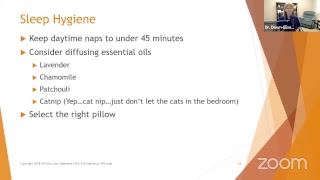
All right, so then I move that. Alrighty, everybody, let's go ahead and get started. Maybe. I'd like to welcome everybody to today's continuing series on Journey to Recovery. Today we're going to be talking about the adjunct intervention of sleep. Now, on Tuesday, we talked a lot about circadian rhythms and exercise, and we're obviously hitting the physiological interventions that we can look at. Sleep is one of those that's so important. And it really builds on that notion that we were talking about on Tuesday of helping clients ensure that their circadian rhythms are stabilized. Because good circadian rhythms will ensure good sleep, which will ensure a lot of other good stuff that we're going to learn about. Okay, so we're going to go over the function of sleep. We're going to review those sleep cycles. And they don't mean a whole lot, but it is interesting to know. And it's basically, you want to condense it to light sleep and deep sleep, which is what your fitness tracker often does. We want to figure out how much is enough. And you'll realize that most of us are sleep deprived. And we'll also identify how lack of sleep contributes to feelings of depression, anxiety and irritability. And we'll learn some techniques for sleep hygiene at the very end. Again, please feel free to share your tips and tricks and insights as we go through this presentation. So why do we care? Well, people whose circadian rhythms are off have a difficult time getting restful sleep. And when people are sleep deprived, the threat response system, the HPA axis, stays activated. When that is activated, then it's important to recognize that cortisol levels are going to be higher. When cortisol levels are higher, we're going to be less likely to get good sleep. So it's this downward negative spiral. People whose circadian rhythms are off often report being tired at all the wrong times, like in the middle of the day, but then they're like wide awake right when it's time to go to sleep. So that tells you that their cortisol is being secreted in the wrong intervals. You know, we really want to see cortisol levels going down towards the end of the day. A lot of times they can confuse sleep and hunger cues. Our body and part of it is just kind of the way we were raised. But our body sends out signals that tells us to eat when our blood sugar gets low. When our blood sugar gets low, we tend to feel lethargic. So sometimes when we're sleepy, our blood sugar actually may not be low, but we may eat in response, a lot of shift workers tend to eat in order to stay awake, and then they eat in order to get sleepy. So eating is kind of integral to their life. Sleep is a time that we rest and restore. Adequate sleep improves memory and learning, increases attention and creativity, and aids in concentration and decision making. So let's think about the symptoms of depression or the symptoms of child behavior problems in school. Memory and learning, they're difficult in depression. And when you've got child behavior problems, attention and creativity problems present in depression, present with child behavior problems, and concentration and focus and sometimes good decision making, difficult when people are depressed and difficult for children who are having difficulty in the classroom. Now, again, I'm not saying that sleep is the only thing that is causing these disruptions for children that are in the classroom or causing depression, but it is certainly a factor that we need to look at, and it is certainly a modifiable factor. And that is one of those things. We can't change our genetics. We can't change some things in our life. I mean, if you live in Alaska, you can't change the fact that six months out of the year, it's dark. You can't change that. So sleep is a modifiable factor. Toxins that accumulate in the brain are thought to be cleared out during sleep. And as we go through the day, adenosine, they speculate, builds up in our brain, and that contributes to us feeling sleepy. And then as we sleep, that adenosine is cleaned out, healing and cell repair takes place during sleep. So, you know, I've never really looked to see how long it takes for my different, you know, cuts and bumps and bruises to heal. But I do know that when I'm, you know, working out hard, if I'm not getting enough sleep, it takes longer to get through that soreness. And it takes longer before I'm ready to lift again, as opposed to if I'm getting good sleep and hydration. Sleep helps maintain the balance of hormones in the body. And this is not just sex hormones, but sex hormones are there. Ghrelin and leptin regulate our feelings of hunger and fullness. It's regulated during sleep. It's regulated by your circadian rhythms. So if your circadian rhythms are out of whack and contributing to poor sleep, then your sense of when you're hungry and when you're satiated may be all out of whack. And insulin, which is responsible for the regulation of glucose in the blood, is also controlled and regulated by our circadian rhythms, as well as ensuring that We've got good sleep. You're not getting good sleep. Your circadian rhythms are not going to work. This is important. When we were working with clients who are diabetic, for example, or when we're working with clients who are hypoglycemic or who just tend to be more food sensitive. This can contribute to problems with their mood, their concentration and all that stuff. One thing to recognize is our brain, believe it or not, is one of the biggest users of blood glucose, any system in the body. Which explains why when you sit in a training for eight solid hours, and part of it's just because you're not moving, but part of it is because if you're thinking really hard, you're probably burning through a whole lot more blood glucose than you would be if you were just, you know, surfing Netflix. So that's another thing that's important. And they found when they've done studies with children who have attention difficulties, that making sure that they have adequate levels of stable blood sugar, you know, they're getting a good protein snack periodically so their blood sugar levels stay stable. Their behavioral outbursts and difficulty concentrating tended to go down so easy intervention. Obviously that's something a registered dietitian needs to do, but it is something that we can steer parents toward, and that's also something we can steer ourselves toward. If we find that we tend to get crankier or have more difficulty concentrating in the afternoon, and it's not just because the caffeine is wearing off, then we can also look at what do we need to do to balance or to maintain a more stable blood sugar. I know if I eat a really high carbohydrate breakfast, especially simple carbohydrates, which occasionally I will, you know, lots and lots of fruit or something, I tend to hit the wall a lot sooner than I do if I have a more balanced breakfast. Okay. Sleep deficiency is also linked to a higher risk of cardiovascular disease, stroke, diabetes and kidney disease. They've actually. Well, this isn't recent. This was back when I was doing my dissertation. They had started attributing or calling heart disease a work related injury for law enforcement officers because of their high stress levels, but also because of the shift work and disruption of the circadian rhythms and sleep problems. They tended to have much higher levels of cortisol, which contribute to a lot of these issues. Sleep deprivation, like we already said, is correlated to difficulty learning, irritability and fatigue and loss of energy. Go figure. If you're exhausted, you're exhausted. So these sleep cycles, and remember I said it's good to know, but it's not crucial. What we do need to figure out or pay attention to is light sleep versus deep sleep. But stage one sleep is when you drift in and out of light sleep and can be easily awakened. That's usually what you do when you're watching TV or something. Stage two, brainwaves slow. With intermittent bursts of rapid brain waves. Your eyes stop moving, your body temperature drops. Remember I kept saying on Tuesday that to sleep, our body temperature has to go down, we have to cool off. So you know if it's hot where you're sleeping or if you're having hot flashes or you exercise right before bed, it's going to take longer for you to get to these later stages of sleep because your body needs to cool down and the heart rate begins to slow down. Well, theoretically, during this period, you're sleeping, so you're not thrashing around and moving, and you're cool so you're not kicking off the covers. This stage usually lasts for about 20 minutes. Stage three sleep, also known as deep sleep or delta sleep, is marked by very slow delta brain waves. And there's no voluntary movement. You're difficult to wake. Allegedly, this stage lasts for approximately 30 minutes. And the largest percentage of deep sleep comes in the early part of the total night's sleep pattern. And if you look at my sleep charts, that's not what it says. So you got to think about if clients are using a fitness tracker and they're looking at their sleep and their light sleep versus their deep sleep and they're not getting any deep sleep or very little, that's a problem. Or if their deep sleep tends to be like later, towards the end of their sleep pattern, that also may indicate that their circadian rhythms are a little bit off because that deep sleep should be happening earlier. So are they having too many stimulants? What's going on that is preventing them from getting into that deep sleep early in their sleep process, and then rapid eye movement. Sleep is characterized by temporary paralysis of your voluntary muscles, fast irregular breathing, inability to regulate body temperature, and faster brain waves resembling the activity of a person that's awake. Most of your dreams occur during REM sleep. Now we go through REM sleep. Even if you don't remember your dreams, you go through REM sleep. But it is important to recognize that we do go through these sleep cycles throughout the night. Theoretically, they're about an hour and a half each. But again, if you look at your sleep monitors, that won't always pick it up Your fitness trackers aren't a, obviously are not a technical measure of your sleep because it's not measuring your brain waves, it's measuring your activity. For people to get an accurate assessment of how they're sleeping, they really need to go in for a sleep study. But again, the fitness tracker can give you some good information about how much they're tossing and turning and moving. Okay, now I did say that most of us are sleep deprived. Well, let's think about kids. Let's start with kids because you know, when my kids were young, I told you my son was a champion sleeper. Oh my gosh. My daughter really didn't sleep much at all. So knowing what different children do, but also knowing what their peers did when they went to school and how much sleep they were getting, because you know, moms talk, talk. It's important to realize that a lot of children are really sleep deprived. So let's just jump up, you know, your newborns, your kids that are still taking naps, your kids that are in daycare, they're going to get a lot of sleep. But it is important if you've got a one to three year old child to know that they need 12 to 14 hours of sleep. So you know, if you're not putting them down for bed until 8 o' clock and you're getting them up at 6 in order to take them to daycare, and then they're only getting a two hour nap, they're sleep deprived. So they might have more difficulty learning, more behavioral difficulties, more difficulty with emotion regulation. When we get into school age 5 to 12 years old, they still need 10 to 11 hours of sleep. Now 12 years old is sixth grade roughly. And I know when my kids were in elementary school and even up to 18 years old, they're still needing eight and a half hours of sleep, you had to fight a little bit to get them in bed at a reasonable hour. So when they had to get up for school because their circadian rhythms are a little different, kids tend to be able to stay up a little later and tend to naturally want to sleep in later. And that's not how our schools are set up. So we need to artificially kind of jerk that circadian rhythm back. But you know, just looking at the numbers here, 5 to 12 year old children need 10 to 11 hours of sleep. That means if they have to be up at 6am to get ready for school, they have to be in bed by 8 o'. Clock. I don't know a lot of elementary school kids that were asleep by 8 o' clock every single night. So it's something to consider because even small amounts of sleep deprivation over a long period of time can add up then over 18 years old. So let's jump to us 7.5 to 9 hours of sleep per night. Y' all know I love my sleep, so I don't sacrifice that. But for example, I get up at 4am which means I'm going to bed at 8. And that's important for me in order to be able to function and feel my best and recover from working out and all that kind of stuff. So when you figure out, when you're helping clients figure out their sleep schedule, it's important for them. If they have a die hard time, they have to be up, well then figure out what time that is and count backwards eight hours or eight and a half hours because most of us don't fall asleep like as soon as we get into bed. Now the deep sleep that we really need theoretically is 1.5 to 1.8 hours of deep sleep. Now that's not what you're looking at on your fitness trackers. Your fitness tracker usually combines stage three and four sleep. So you're looking at probably three to four hours of deep sleep if you're looking at a fitness tracker in order to identify if you're getting enough of that restful sleep. Because I know if I only get 1.5 hours of deep sleep, according to my fitness tracker, I feel like I got hit by a truck. So helping clients figure out what works for them. Some people need more, some people don't need as much. Interestingly, a study just recently came out that showed that people who got more than nine hours of sleep, adults who got more than nine hours of sleep, were similarly at risk for health and mental health problems, as were people who got less than six hours of sleep. So there's this sweet spot in there in order to get enough sleep, but not so much that you're throwing your circadian rhythms out of whack. I also speculate that the people that were sleeping more than nine hours a night were probably maybe experiencing high levels of stress, poor sleep quality and or depression. So they really didn't go into looking at what was different about the group that slept more than nine hours in that study. I would have been interested. Okay, so hormones, I talked about them earlier, we're going to talk about them a lot right now. Estrogen, believe it or not, is supposed to improve the quality of sleep, reduce the time to fall asleep and increase the amount of REM sleep. That we get now, I'll just leave that out there. Too little or too much testosterone will also affect overall sleep quality. So our sex hormones affect sleep quality. All right, so let's back up here. What happens when our HPA axis is activated? When we're under stress? Cortisol is released. When cortisol is released, it tells the body it is not time to sleep. So we're not. It's not time to be calm and it's not time to procreate. So we're going to suppress serotonin, we're going to suppress melatonin, and we're going to suppress the sex hormones. So when stress is high, our sex hormones as well as, you know, some of our monoamines are going to be low, which is bad. So when those things are low, then our sleep can be impaired. It's a cascade effect. Cortisol prevents restful sleep. It's your stress hormone. If it's going through your body, it's like this constant little fire alarm in the back of your head going, pay attention, pay attention. There might be something. I remember when I used to run a 24 hour facility. Oh my gosh. I didn't sleep well because there was a little part of me that, that was almost always expecting to be awakened in the middle of the night. So I never wanted to get too deep into sleep. I mean, I wanted to, but a part of me didn't. So my cortisol levels stayed higher. Thyroid hormones which are too high can cause insomnia. So if you've got somebody who has hyperthyroid, they may not be getting enough sleep. And if they have two low, you can have fatigue and lethargy. A lot of times doctors will do a differential diagnosis when somebody presents with symptoms of depression. A differential diagnosis for hypothyroid. Interestingly, they don't often do a differential diagnosis for hyperthyroid if somebody presents with anxiety. But I digress. Okay, so just to review some of that nutrition that we talked about. So we've already identified that sleep is affected by light levels. We know that sleep is affected by stress. We also need to know that sleep is affected by nutrition. Tryptophan, if you go back to last week, tryptophan is an amino acid, a protein that's used to make serotonin. Serotonin is used to make melatonin. Melatonin functions to help you feel sleepy. It helps you drift off to sleep if you don't have enough tryptophan or if your cortisol levels are high and your serotonin is suppressed, then you're probably going to have more difficulty getting to sleep and staying asleep. Now, some people talk about melatonin supplements and I'm just going to put my little two cents in here for that. Again, I would never ever recommend that to a client because that's something only a doctor should do. The Sleep foundation, if you go on their website and read about melatonin supplementation, they actually indicate that the amount of melatonin that most people are taking is way too much. 300 micrograms to 500 micrograms, or a third to a half of a milligram of melatonin is plenty to mimic what your body would normally do. So people who are taking 5 and 10 milligrams, I don't do my math well, but that's way more than you really need. Now, is it harmful? There are studies either way that can show that too much melatonin can have some effects on the body. So again, that's important for people to discuss with their doctor and how long they should or it's safe to take. Melatonin is also important. Another little side of thing, a lot of our sleep aids that are out there are based in antihistamines, a lot of them are based in diphenhydramine. And there's one other antihistamine I can't remember right now, but there's recently been research that's come out that has shown a really strong link between regular ingestion of antihistamines, especially the sleepy ones like Benadryl and whatever the one is that used to be a Nyquil that just knocked you right out and the development of dementia later in life. Pretty strong correlation. So a lot of doctors have backed off from recommending certain over the counter sleep aids and have moved towards recommending melatonin. But that's a medical decision. Okay. Other things to consider. Caffeine is a stimulant with approximately a six hour half life. Okay, so what does that mean? That means roughly, and it's not a smooth steady decrease, but means roughly six hours after you drink your last cup of coffee or diet soda or whatever it is that has caffeine in it, half of that caffeine will be out of your system. So if you drink a big old cup of coffee from Starbucks at noon, it's still in your system at 11:30 and maybe even a little past 12. So if you went to bed at 8 o', clock, that caffeine is still disrupting the quality of your sleep from 8 o' clock until 12 or even a little later, potentially. So getting caffeine out of your daily life can really help with sleep. Or just having it in the morning so, you know you've got a 12 hour clearance period can really help. When people decide that they're going to quit caffeine, a lot of times they will get headaches, they will have lethargy, they will have a lot of side effects. So a lot of times doctors and dietitians will recommend that they gradually cut back on their caffeine, going to, you know, 50, 50 caffeine and then 75% decaf, 25% and do that over the course of six to eight weeks so the body doesn't jolt because we do get addicted to caffeine. Nicotine is another stimulant. It has a shorter half life. But how many people smoke right before bed? If they are smoking, you know, to relax after bed? I know my mother used to always have a couple of glasses of wine and smoke while she was watching tv and that would happen right up until bed. Well, nicotine is a stimulant and it takes four hours to get out of the system. So if she quit smoking at 9 o', clock, it was still impacting her until 1am Interesting thought. Antihistamines, like I talked about earlier, do make you drowsy, which is why they're there for sleep aids. But they contribute to poor quality sleep. They help you drift off. But that sleep that you get is typically very light and unsatisfying. Alcohol blocks REM sleep and can cause sleep apnea. So if you've got somebody who is a bad snorer, even if they don't have true sleep apnea, it's important for them to recognize that alcohol can actually impair their sleep even more. Tara points out that melatonin can make people feel weird. I know when I take melatonin, if I take too much, if I take a whole milligram, I feel hungover the next day, or I'll wake up at 1 o' clock in the morning and I'll think it's, you know, time to get up. And then all of a sudden, three or four hours later, I hit the wall and I want to go back to bed again. So melatonin and I don't seem to jive really well. But everybody needs to figure out what their needs are in terms of dosing for any sorts of medications like that. And also look at the interaction. There are other studies that show that melatonin interacts with SSRIs. So if you have a client who's on an SSRI, taking melatonin may actually not be effective at all because they found that patients who are taking SSRIs tend to have higher levels of melatonin anyway. So just interesting little things and, you know, just knowing, having people be mindful of how different things impact them. Just because melatonin works for one person doesn't mean it's going to work for another. Now, it does work pretty well. The studies have shown melatonin does work pretty well for shift workers and to help with jet lag, but that's a different presentation. So nutrition. Eat a high protein dinner to ensure you have enough tryptophan in your body when you're going to sleep, preferably several hours before you lay down. And make sure you're getting enough vitamins like selenium, vitamin D, calcium, vitamin A, magnesium and zinc. Why? Because all of these vitamins are required in order to make tryptophan into serotonin and serotonin into melatonin. So if you don't have all of the ingredients, you can't make a good sauce. So sleep allows the brain to focus on rebuilding and repairing. It's not worried about what's going on. It's not worried about focusing on the tv. It's out. And this is the time when it's time to restore. Animals deprived entirely of sleep lose all immune function and die in just a matter of weeks. Now, most of us are never deprived entirely of sleep, but think about people who work shift work. Think about firefighters who may go, you know, 48 hours and only catch a couple of cat naps here and there. Think about soldiers who are, you know, in the field and they're not getting quality sleep at all. They may catch a couple of cat naps if they're on maneuvers, but many times they're up for 24, 48, 72 hours, and thankfully they don't do it as much anymore. But think about medical residents who would be up for 72 hours and operating on you. This is not the kind of person that I want operating on me if they haven't had sleep in 72 hours, prisoners. Because obviously it would be unethical to do this to anybody else, and it is unethical to do it to prisoners. But the study indicated that prisoners deprived of sleep entirely often develop psychotic symptoms. So a lot of times they were looking. In this particular study, they were looking at prisoners of war who were deprived of sleep for days on end. New parents deprived of sleep have Difficulty with memory and concentration. So if any of you have ever had kids and you've had that mom or dad brain, you had a reason for it. You had an excuse. And actually there's another brain that you get. My mom's on chemo right now, and evidently you get chemo brain. So fogginess that occurs, and whether that's because of all the toxins in the body or because the chemotherapy somehow is disrupting sleep, I'm not sure. But it is interesting to be aware of all the different things that can contribute to difficulty concentrating, apathy, fatigue, and symptoms of depression. Muscle growth, tissue repair, protein synthesis, and growth hormone, which, if you watch tv, you see those commercials for growth hormone to be the new youth elixir. But I digress. They release mostly or in some cases only during sleep. So for people to have adequate levels of human growth hormone and muscle repair and stuff, Think about the presidents. If you look at the presidents when they take office, well, not all of them. Some of them look like they were pretty tired when they took office. But look at them when they take office and look at them when they leave. A lot of presidents, you see the impact of not only the stress, but also the lack of sleep and schedule that they have to go through. Other rejuvenating aspects of sleep are specific to the brain and cognitive functions. While we're awake, neurons produce adenosine, which is cleared out when we go to sleep. But that buildup, like I said, leads us to feel tired. Circadian rhythms. If you weren't here on Tuesday, we're just going to hit those really quick because those are important to help us sleep. If your circadian clock is out of whack, then it's going to be secreting the cortisol to tell you to wake up at the wrong time. Patterns of brainwave activity, hormone production, cell regeneration, and other biological activities are linked to this cycle, which is not exactly 24 hours, which is why we have to kind of try to manually set it so it doesn't get wonky on us. The normal circadian clock is set by a light, dark cycle. And if you remember, that's because of the SCN in the hypothalamus. Circadian rhythms allow organisms to anticipate and prepare for precise and regular environmental changes in order to capitalize on environmental resources. As mammals, we typically are hunter gatherers. So when are you going to hunt and gather at midnight? Probably not. What you're going to find to hunt and gather is there during the day. At night is when, when you sleep because it's not as productive. So it's a survival mechanism that we have, if you will. Circadian rhythm disorders can be caused by many factors, including shift work. If you work 7pm to 7am for three months and then all of a sudden you're switched to working 7am to 7pm Your body thinks when it's awake it's time to sleep and vice versa. But they found even shifts of as little as three hours can cause people some difficulty in their circadian rhythms for up to a month. It takes about a month for your body to reset its circadian rhythms. Pregnancy can upset circadian rhythms. Time zone changes. Certain medications that make you drowsy at the wrong time or suppress cortisol. Changes in routines, such as staying up late or sleeping in. Some people love to sleep in. Doesn't mean you can't ever sleep in. But you do need to be cognizant of how that's going to affect you. Naps. As long as I'm on circadian rhythms. When you take a nap, they find that an afternoon nap increases levels of norepinephrine in the brain. 300%, I believe. So a short power nap in the afternoon is good for increasing concentration. But if you get into that deep sleep, then it throws your circadian rhythms out of whack. So you don't want to take long naps during the day. Medical problems such as Alzheimer's and Parkinson's disease and mental health problems can also alter circadian rhythms. Insufficient sleep causes difficulty with energy allocation and disrupts your normal hormonal rhythms. But excessive sleep does the same thing. You can even get sleepier when you're getting too much sleep because of lack of movement and light. So think about our clients who are clinically depressed, who get up and they're not happy to be up, and they stagger. If we're lucky, they get out of bed, they stagger into the living room, plop down on the sofa, keep the blinds drawn, and watch tv. You know, I think all of us have had a depressive moment there where we may have, you know, gone a day or two where we didn't open the windows and maybe didn't even change out of our jammies. That's, you know, obviously not clinical depression. That's a depressive episode. But think about how it made you feel, how hard it was to keep going, and how you never felt like you woke up. Well, a lot of these symptoms are also symptoms of depression. So, you know, is the person depressed or is the person sleep getting too much Sleep and too little quality sleep, something that we can look at. Kryptophan is used to make serotonin, which is used to make melatonin. When serotonin and melatonin levels rise, other hormones, your excitatory hormones like norepinephrine and glutamate go down. So when serotonin goes up, focus and motivation may go down. Which is why some people when they start taking SSRIs, say they lose all motivation to do anything. Other people when they start taking SSRIs are like, oh my gosh, I finally feel like I've got energy. So it depends on kind of what's out of whack. But it is important to recognize that norepinephrine will go down. Too much or too little serotonin impacts. Mood and symptoms of depression and sleep deprivation are very similar, including altered feeding and sleeping habits, fatigue and difficulty concentrating. Sleep hurdles. We're getting to the fun stuff. Stimulants, including caffeine, we talked about those. But where, where else do we find stimulants? Decongestants like pseudoephedrine, It's a stimulant. Diet pills, I think they still exist. Pre workout supplements are typically loaded with caffeine, nicotine, ADHD medications, even certain vitamins. You know, multivitamins now have some energy blends in them I think is what they call them. So it's important to recognize where you're getting your stimulation from. A lot of the drinks like Monster and those others that are supposed to help the energy drinks really don't have as much caffeine as you would think. But they have things like taurine and niacin that also have stimulatory activities on your central nervous system. So caffeine is not the only stimulant. That's the takeaway here. Be aware of everything that you're ingesting and how it affects you. Sedatives, your antianxiety medications, any of your anxiolytics, your Valium, you know, whatever, barbiturates, any of your sedatives like your Lunesta and your sleep aids, pain medications, I'm going to jump down there are also sedating. They tend to slow respiration, they stop pain, but they slow everything else down. Which is why people you know are foggy headed and want to sleep all the time, but typically don't get great sleep when they're taking opiates. Benadryl is also a sedative that can affect quality sleep, as is alcohol. Physical conditions. Remember what I said about that HPA axis, your threat response system. If the body thinks, if the brain thinks that you are in jeopardy for some reason, that you are vulnerable for some reason, then it's going to keep your cortisol levels higher. Maybe not way higher, but it's going to keep your cortisol levels higher. So what things might cause that to happen? Well, pain, for one. Any kind of pain. If you had a really good workout and every time you move you're like, oh, my gosh, that hurt. That's pain. If you have a headache, if you have poor ergonomics when you're sleeping and your neck's getting all kinked up, that can keep you from getting good sleep. When you're pregnant, it's difficult to get comfortable and get good sleep. So paying attention to ergonomics in the bedroom, in your mattress and things like that can help. But we also want to help people address pain issues that are going to keep them at least mildly more awake than if they were pain free. Pregnancy, PMS and postpartum, anything that changes that estrogen level can affect temperature regulation. Changes in estrogen levels impact serotonin levels, and any of these things can also cause general discomfort, which can keep you from getting good sleep. Apnea is a huge one. And you know, if my uncle, we used to kind of joke that you could hear him literally across the entire house when he would sleep because he snored so strongly. Some people have not gotten tested for apnea, which they probably should, but if somebody snores a lot, there's a chance that they might have sleep apnea, which really impacts sleep quality, how much they sleep, oxygenation of the blood, and all of those things will significantly impact mood allergies, sinus congestion. You know, if you can't breathe, it's hard to sleep. You know how it is when you're sick. But if you've got allergies that make you cough, I know I do to animals and I let the animals in my bed, which is probably a bad, you know, thought, but it's what I do. So if I have, you know, the animals in my bed and I'm petting them or grooming them, then I may cough that a lot that night. So it's important if you've got somebody who has these allergies to try to remove, you know, remove the animals from the bedroom so they're not inundated with allergies. They can also get HEPA filters for the bedroom, change their sheets frequently, get the dust mite pillow covers, you know, Whatever it is that they need to do. Restless leg syndrome. Yeah, you got restless legs, it's going to keep you restless. Enough said. And head injury, interestingly, especially to the front part of the brain, can also cause difficulty with sleep. So think about these high school athletes that are out there playing football and they may get head injuries or people who are in car crashes. It can cause sleep problems. Your stress hormones, cortisol and thyroxin can create agitation, insomnia, and even sugar cravings. Why is that? Well, because cortisol tells your body to release glucose because it's time to fight or flee. So if your body's releasing glucose, it wants to get it from somewhere else. You know, it needs to replenish that store, so you're going to start craving it. It makes sense. Low levels of cortisol and thyroxine can be associated with inability to handle stress, extreme fatigue, low libido and mood instability. And we've talked before about hypocortisolism, remembering that when people are too stressed for too long, eventually the body starts conserving energy for when it believes it's just a true emergency. So when those people get triggered for whatever reason, they go from 0 to 120. There's no middle ground. It's not mildly upset. They are upset, which is that mood instability. Emotional dysregulation, we talk about. So controlling sleep will help. If somebody's getting good sleep, then they're going to eliminate one reason for their body to have high levels of cortisol, which can help with emotion regulation. Estrogen increases norepinephrine and serotonin, but decreases dopamine. And dopamine is our pleasure chemical. So, you know, estrogen is not really my friend because I like dopamine, but I do like norepinephrine too. So it's a toss up. But remember when we've talked before about neurotransmitters, it's like making a good marinara sauce. You have to have an adequate balance for you, whatever it is, for you. Of all these different neurotransmitters. And as they alter, as one gets a little stronger and another one gets a little weaker, you know, that causes certain sensations and certain reactions, and that's just totally normal. The other hormone we haven't talked about is progesterone, which balances estrogen, promotes sleep and has a natural calming effect. Abnormal levels of progesterone, which sometimes you find in women who are pregnant with, sometimes you find in people with pcos, or sometimes you find in people who are taking birth control can have insomnia and irritability. Light levels. As light increases, so do our motivating chemicals like norepinephrine. Melatonin goes down. As light decreases, we get sleepy. So like we talked about with circadian rhythms, it is important for clients to consider having bright lights that they can expose themselves to first thing in the morning. You know those 6,000 Kelvin 150 watt equivalent bulbs, you know the spotlights. And in the evening expose themselves to lights that do not have the blue in them. They have the blue filters on their television screens and on their mobile devices and the intensity is 25 watt equivalent or less. That may not be realistic, but it is definitely helpful. Physical cues, alarm clocks, eating meals, coming home from work and certain routines can help us set our circadian rhythms. So our body knows that okay, in an hour we're going to get ready for bed or whatever's going on. So it is helpful to add those physical cues to train your body when it's time to start getting ready for sleep. Lack of exercise can also contribute to sleep problems because exercise helps reduce cortisol levels and it increases serotonin, the double whammy. And it can even help in reduce if you don't do it too much. It can help in reducing aches and pains which keep people awake. So you know, obviously we're not talking about going and powerlifting. We're talking about moderate exercise to help balance out the muscles. Stress keeps people from sleeping. Racing thoughts. One of the things I suggest to people is get one of those and they are ugly. You can get a handheld one that has a red light on it, a red light night light of some sort and keep a pad and pencil by their bed. So if they wake up or they can't get to sleep because they've got all these things going through their mind, they need to remember to do this tomorrow or that tomorrow they can just turn on that red light, night light, which is enough to see by and scroll out what they need to. Then it's on paper, they don't have to remember it so they don't have to ruminate about what's going on. Other ruminations like what happened earlier that day or something can keep people awake. So having people develop distress tolerance skills in order to accept what's going on and instead of ruminating, accept and improve the next moment. And high levels of fight or flight hormones, stress. So which is one of the reasons they're starting to recommend that people not watch the news or be on social Media within about two hours before bed. Because a lot of people tend to get themselves really riled up when they do certain activities like that. Okay, so sleep hygiene. Carolyn asked, where do you have clients start? Well, you know, I ask them, where do you want to start? What are you willing to do if you are willing to address your sleep? You know, let's start looking at what you can do. Creating a wind down ritual that's not intrusive for most people. If you tell them they have to be in bed at 8 o' clock every night or 10 o' clock every night, that could feel constraining. But if you just say, let's create a wind down ritual where you're doing the same three things each night before bed, you know, within like roughly an hour. People are willing to do that a lot of times. Really reduce or eliminate exposure to blue light at least an hour before bed. And this includes your tv, computer, phone, some light bulbs, any fluorescent lights. And it's probably not really realistic to have dimmable bulbs in your bathroom. But when you're getting ready for bed, if you're in there with that morning spotlight, it is waking you up a little bit. So maybe brushing your teeth and getting ready for bed before your sleep routine starts could be helpful. Go to bed at roughly the same time each night. Most people are willing to do this. You know, they're not willing to do it every night. They want to have the occasional Saturday night where they stay out to 2 in the morning. Cool, you got to live. But roughly the same time every night. Now this is really hard for again, shift workers, especially shift workers whose shifts change all the time. Eliminate as much light as possible. If they're willing to wear a sleep mask, that's great. Now some people who have trauma histories are not going to be willing to wear a sleep mask. And that's totally cool. They feel much too vulnerable when they can't just open their eyes and immediately see what's going on. Same thing with earplugs. Some people are willing to put in earplugs to eliminate as much noise as possible. Others need to be able to hear what's going on around them. Encourage people to not exercise like hard exercise. I'm not talking about stretching or take a hot bath within two hours of bed. And some people are like, well, I like to take a hot bath to relax. Well, that's awesome. Just do it earlier in the day, you know, right after dinner instead of right before bed in order to help your muscles relax and everything. That way your body has A time to cool off from that hot bath before it's time to sleep. Keep the room cool. 72 is ideal. Now, I can't do that during the summer. I can't do that. I am too, as my best friend would say, frugal. Now he would say cheap as crap, but whatever. I'm not going to keep my whole house at 72 degrees in the night. So what can you do? You can have fans on. That helps. As long as the fan doesn't make noise that keeps you up. There are certain mattresses, the memory foam mattresses, the old fashioned ones, actually hold in heat when you lay on them in order for them to conform to your body, they had to warm up in order to get malleable. And then they would hold heat all night long. Over the past couple of years, they've come out with gel toppings for those memory foam that disperse the heat. So you're not holding all that heat in all night long. But anything you can do to keep the room cool. One of my other friends suggests she sleeps with her feet outside of the covers. You know, the whole rest of her is covered up, but she sleeps with her feet hanging out because a lot of our heat is dissipated through our feet and our head. So if you're cold, keep your socks on. If you're hot, take them off. Consider using a cooling pillow again, one of those gel pillows. Or you can even get pillows, pillow toppers that you can put in the refrigerator and put on your pillow before you go to sleep so it's cooling and relaxing. And avoid anything that might get you upset within two hours of bed. Don't do your bills right before you go to bed. And try to do things that are relaxing and soothing. That's your me time. And you know, if you've got kids, you're going, what's that? That me time. But you can get it. It's a matter of figuring out what you can do to work with the rhythm of your household. So if your kids are up until 8 and you know you like to go to bed at 9, what can you do as a family that is calming and sedating? Because if you're doing things with them that are calming and sedating, you're also helping them develop good sleep habits. So that's the long version of there's a lot of things people can try. I encourage them to pick one thing, do it for a week or even two weeks until it feels kind of natural, and then change something else. That way they can see what may happen. Now a Couple of things like eliminating or changing the light bulbs that they can do. That's not something they have to repetitively do. Putting on the blue light filter on their mobile device, that's something they can do and they can try. But anything that's going to involve changing their routine, just do one every week or two in order to make the transition easier. I really encourage people, although I can't prescribe it, I really encourage them to consider paying attention to their caffeine and stimulant intake. But, you know, that's something that, you know, people have to decide on their own. Reduce or eliminate caffeine at least six hours, preferably 12 before bed. Drink the majority of fluid during the day. Some people will come home and they eat a big dinner and then they're just downing fluid the rest of the evening, whether it's wine or beer or water. Not that I'm suggesting alcohol, but it happens. And then they have to get up 1, 2, 3 times during the night to go pee. And that doesn't help your sleep at all. Keep an air purifier in the room. If you have allergies, Keep animals off the bed. Make the bedroom a place of relaxation and sleep. They suggest not bringing stressful stuff into your bedroom. If you have to have a discussion with your significant other, try not to do it in the bedroom because then that bedroom is associated with negative energies. Keep that red light notepad by your bed to write down anything that pops up in your head. And weighted blankets. Now, these are really helpful for people with sensory integration issues, but a lot of us find it's comfortable, which is why, you know, even for dogs, the thunder vests are so comforting because they're confining. So weighted blankets can help some people get to sleep. And if you look online, you can actually find lightweight weighted blankets. And basically what they are are two sheets that are sewn together and then they have channels in them that beads are put in in order to give the weight to it. That way you don't have, you know, a whole bunch of fleece over top of you. But the, the beads can provide that pressure that help people relax a little bit. Keep daytime naps to under 45 minutes. And in response to Yalls questions on here, consider diffusing essential oils. And again, remember, you don't have to. And in many cases it's recommended that you not actually apply them to yourself. You can put them in the little wax tarts. You can get an essential oil diffuser. There are a lot of different ways to get Essential oils out there. Lavender is one that works for a lot of people. Lavender has been found to increase estrogen levels. So if your estrogen level is already high, you might find that lavender doesn't work for. For you. Chamomile is another one. And lavender and chamomile together are good, too. Patchouli. Some people hate it, some people love it. It's just kind of what works for you. Catnip. And this is not an inexpensive essential oil to get, but if you like that woody aroma, catnip can be really relaxing. It's kind of like a patchouli light. Now, the cats will get stimulated by it, but humans actually find it very calming. Another one that's not on here is valerian root. That can be very calming. Tea tree oil and eucalyptus are both sort of medicinal and antifungal. They have a lot of good properties to them. Antibacterial. Some people find that they're really helpful for relaxation. Other people find that they have enough of a sort of minty smell that it tends to wake them up more. I encourage people to go, you know, to a local health food store wherever they can smell essential oils and just take a whiff, see what they think. What is the first thing you think of when you smell the smell? For example, lavender doesn't do much for me. I'm not crazy about it. But rosemary, on the other hand, I'm all over it. It just is one of the best smells in the world. And finally, select the right pillow. If your neck is not supported or if it is overly supported and all kinked up, then you're probably not going to sleep as well. If it is too soft, if it is too allergenic. Pillows are really important and to the point where you may want to have one that you keep with you. So when you travel, you've got the right pillow. So insufficient quality sleep contributes to fatigue, difficulty concentrating, reduced reaction time, and apathy. During sleep is when researchers think the brain rests and rebalances all those neurotransmitters. So if you've got somebody who's experiencing a mood disorder or impulsive behaviors, part of it, not all of it, but part of it could be due to insufficient quality sleep. Over time, sleep deprivation can cause changes in neurotransmitter levels and immune functioning. Most people could benefit from auditing their sleep quality. Reduce reduce the light at night, reduce noises, reduce their bathroom trips. Reduce wake ups because of allergies or being too hot or because the dog's sitting on the bed biting his butt. And stop caffeine, preferably 12 hours before bed. If clients are only willing to change one thing this month to start being happier, more energetic, and clearer headed, sleep might be a place to start that's tangible. If we start talking about cognitive behavioral stuff, yeah, it might work. It might help. There might be some strategies that provide some immediate bang for their buck. But sleep can also help. And not addressing this means that we're creating or we're leaving a vulnerability there. It's kind of like if you're at home and you turn on the water for the faucet and there's very little water pressure, and you're like, well, you know, there are things you could do. You could go out and you could turn up the water pressure at the main place, wherever that is. You see, I don't deal with things around my house much that would increase the water pressure in the house. But you haven't figured out what caused the water pressure to go low to begin with. And you may have an insidious leak. Sleep is like an insidious leak. So there are obviously lots of additional resources that are in the PDF that's in your classroom. So if you want to look at those, you know, more power to you. I found them really interesting, but sleep is kind of my thing. So are there any questions? Well, peachy keen. So everybody have an awesome, awesome weekend and I will see you on Tuesday.










