Live Interactive Webinar
Dr. Dawn-Elise Snipes explores guilt: what it is, where it comes from, and how it harms relationships and the body. She teaches specific exercises like the backpack metaphor, guilt thermometer, and reframing techniques that therapists can use with clients and groups.
Chapters
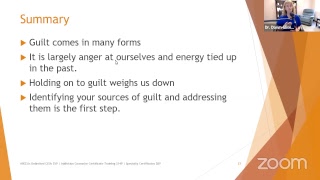
Alrighty. So let's go ahead and get started. I'd like to welcome everybody today's presentation. We're going to continue the Journey to Recovery series and we're going to be talking about guilt and interventions to help clients work with guilt. Today we're going to define it, explore the impact of guilt, because a lot of people don't really realize all of the repercussions of feeling guilty some of the time or all of the time. And we'll identify some activities to help people deal with guilt and start recognizing it and figuring out what to do with it. So guilt is basically anger at yourself and comes from an old English word that means delinquency. I don't like that word. I don't like guilt either. Merriam Webster's Collegiate Dictionary defines it as feelings of culpability, especially for imagined offenses, or from a sense of inadequacy and self reproach. Okay, so if we have clients that feel culpable for things, and sometimes it is something they did or something that they didn't do that they should have done and they feel responsible, you know, there are things that they may need to do to address that for this sense of inadequacy. You know, we really want to help them look at that and recognize how they are adequate and lovable as human beings, albeit imperfect, and deal with those feelings of self reproach that keep them stuck in this loop of depression or anxiety or despair. It is important to note that nowhere does it say that guilt is necessarily related to things people actually did wrong. A lot of people feel guilty for stuff that isn't necessarily wrong or maybe they didn't even do so. We'll look at that as we go through. So some questions that I'm asking, but we also want to ask our clients, how does guilt impact people's attitude, optimism and emotions? How does it impact their self esteem, their health, and their relationships? So I mean, I know that's what four different questions actually multiple, if you want to break the first one up. But when people feel guilty about things, you know, they feel culpable, they feel angry with themselves, they feel less than deserving. So we can see how this can feel impact people's self esteem and lower their self esteem. When people are feeling guilty and angry at themselves, remembering that anger and defensiveness, as Camille points out, activate that HPA axis when, when we activate that threat response system, it has that cascade effect on our health. It keeps us from getting quality sleep because it keeps us on edge. It can alter the availability of serotonin, it can alter the availability of sex hormones. All of these things can impact mood. And when we feel guilty, and especially if we're feeling guilty and our self esteem is getting lowered, how is that going to impact our relationships? You know, it can lead to withdrawing because we feel guilty. We don't feel like we should be loved, we don't feel lovable. Or it can lead to people who are desperately looking for validation from someone else because they feel so guilty about all this stuff. They're looking for somebody to tell them they're okay. You know, you have both extremes. So what can guilt do? And this is, these are questions I throw out at the beginning of class. I usually have it written on the whiteboard when people walk into group. That way they can be theoretically pondering it while they're getting situated and getting their coffee or whatever they're doing. So I put those questions up there. And then we talk about what can guilt do? It can make you become over responsible trying to make life right. If you did something wrong or if you failed to do something, you may overcompensate so you never do that again or never fail to do that again. It can make people over conscientious where if they made a mistake in the past, they may be Johnny on the spot and then some. And it can be overwhelming and it can dominate their life and create some imbalances. It can make you overly sensitive if you feel guilty. And this goes back to what Camille said about being defensive. If you feel guilty about things that you think you did that were wrong or you should have done and you were in the wrong, then you may be overly sensitive to perceptions of criticism and other people's opinions. Instead of being able to say, I'm okay, I'm imperfect, but I'm okay. It can immobilize you and interfere with decision making because when you feel guilty about a choice you made in the past, then it's harder to make choices in the future because you're going, if I do this, what are the ramifications going to be? Am I going to feel guilty later? So sometimes people can get stuck because in the past they made a decision based on the information they had at the time, which was incomplete, and then they felt guilty for it later. You know, this is especially true. You know, if you're a parent, you can think about this. When you've given your kids advice about something and you know, later on down the road you realize maybe that wasn't the best advice to give them. You can feel Guilty. There are a lot of. I mean, we can feel guilty all the time if we really wanted to, but it's not healthy. It can create codependency. When people feel guilty, they can take on responsibility for other people's mistakes. And that's where codependency comes in. There's a difference between helping people out when they need help. Codependency is when you are covering up for other people's mistakes, when you are not letting them experience their own consequences, and when you are doing things for them that they could do for themselves. A person who feels guilty is often trying to. They may take on responsibility for something that's going on. They may feel guilty that this person relapsed and feel like it's their fault somehow. So there's some bad boundaries. But they also may feel guilty for something that they didn't do or did do in the past, and they're trying to be perfect in the future. So in order to be perfect, they're trying to help this person out, but they take it to an extreme. Guilt can overshadow the other array of feelings available for people who feel guilty a lot. It can just keep you from being able to feel happy. If you feel guilty about every single thing you did, and if you're constantly looking back in retrospect and going, shoulda, coulda, woulda, then it's going to be hard to feel happy. So we need to help people. You know, guilt is anger about something in the past. We need to help them get their energy in the present. Guilt can mislead people because should have done something or could have done something. Well, in hindsight, maybe, maybe we can look back and go, well, that would have been an option. In the moment. We may not have had all that information. We may not have had all of that. So we could be misled. Where guilt is saying, well, you should have known this, and if you go back in time to what you knew and what you felt in that situation, there may have been no way in the world that you should have known that. So guilt can mislead you and make you feel guilty for things that you know you just didn't have all of the information for. But as somebody asked, Tom asked, is there a positive aspect to guilt? Yes, there is. Guilt can motivate change. Because remember I said at the beginning, sometimes we feel guilty for things that we did that we really shouldn't have done, or things that we should have done that we didn't do. We all fall short. Sometimes we all make mistakes and we can feel guilty. Guilt can be used. Remember I think we've talked before about how anger and anxiety, our emotions that we feel, is our body telling us, our brain telling us there might be a problem and you need to do something. Not there might be a problem and you need to dwell on it. There might be a problem and you need to do something. So guilt tells us, well, there might be a problem with that choice that you made. So how can you learn from it and what do you need to do to keep it from happening in the future? It is a motivating, it can be a motivating emotion. And guilt. And we're going to talk about that some in a little while. Christina points out that guilt can be associated with our conscience. Guilt or fear of guilt can keep us from doing things. That's kind of that little Jiminy Cricket that's sitting on our shoulder that's going, you know, do you really want to do that? So guilt can be partly our conscience monitor, but it can be an overbearing conscience monitor sometimes. So where does guilt come from? Well, it comes from a lot of places, but we find that for a lot of people, guilt comes from when they were wee little children and we learned to feel guilty when we were growing up. So go back with me with Erickson's stages of psychosocial development, autonomy and shame. This is the potty training period here. This is where the child is saying, can I do things for myself or do I need the help of other people? If they determine they can do things for themselves, they can figure out how to put on their own pants and they can figure out how to use the potty, then they're going to develop a sense of self efficacy and they're going to feel proud. If they are criticized or overly controlled or not even given the opportunity to assert themselves, they may start to feel inadequate in their ability to survive and may become overly dependent on others, which is, you know, this is shame. We're not quite to guilt yet, but think about it. Kids once when they feel shameful, when they feel ashamed of who they are, they may feel guilty for being a burden or not living up to the expectations of their caregivers. So we want to make sure that in this early period, children are given the opportunity to assert themselves and they can start choosing their clothes a little bit and doing the things that they can do for themselves. Even if they don't do it the way we would have. They put stripes with polka dots or something. We need to allow them to start exploring and expressing Then the next stage is initiative versus guilt. And this is when you're talking, you know, preschool, kindergarten, the question is, am I good or bad? And if they resolve this crisis and determine that they're a good person, when I take initiative, I'm welcomed, I'm accepted, and this is a good thing, then they just develop a sense of purpose and acceptability. When they try to take initiative and they're squashed, they're told, don't do that, go sit down, be quiet, don't ask questions. Then children start to feel guilty for being inquisitive or for trying things. And then they become somewhat paralyzed. When efforts to engage in physical and imaginative play are stifled by caregivers, children may think that their self initiated efforts are a source of embarrassment. So when caregivers are always telling them, you know, no, go away, I'll play with you later, I don't want to do that, or you know, we've seen some of these behaviors, occasionally we're going to have other things to do, we got to pay the bills, we got to finish making dinner. But if the child is regularly getting that message that your needs are not important or your needs are a bother, then they may start feeling guilty. If the parents treat the child's questions as a nuisance or embarrassing, then the child may feel guilty for asking questions. And we all know this phase and you know, three, four years old, there's the why stage. Why does this happen? Why did she say that? Why did he do that? I don't know. But we need to learn how to respond and turn it back and be more Socratic and say, why do you think it happened? Or let's look it up. Thankfully, now that there's the Internet, you know, back in when I was little, there was no Internet, so my mom had to just kind of pull things out of thin air. But now that there's Internet, we can look things up pretty readily. Children who are over directed by adults may struggle to develop a sense of initiative and confidence in their own abilities. So we want to look for these patterns in our adult clients or, or our adolescent clients. We want to look for patterns where they don't try to do things that for themselves that they can do because they feel like they're ashamed, they feel like they're not going to be able to do it. They don't have a sense of self efficacy. We need to bolster that efficacy through. Setting small goals and helping them achieve them. And then initiative versus guilt. We need to help them develop a sense of purpose and acceptability so they realize that their thoughts are acceptable, their wants are acceptable. I mean, within reason. We have to set boundaries. But. And that they do have a purpose. And when they take initiative to, you know, try to make a new friend, or they take initiative to try to get people to play kickball or whatever, it is, that sometimes, hopefully most of the time, that's going to be met with a welcoming gesture instead of go away. But if it isn't, then we need to help our adult clients figure out how to develop that sense of purpose and acceptability. And this, in my opinion, may be one of those places where social anxiety really starts. If they are told they shouldn't go bother people or they shouldn't do this, they may feel guilty for taking any initiative to reach outside the family, to. To establish social connections. So let's talk about aces really quick. Remember, aces are your adverse childhood experiences. So let's think about how the following conditions can make a child feel overly controlled or like a nuisance or an embarrassment. How can the following conditions prompt or cause the development of guilt in children? Now, before we go into these, I want you to remember back to Piaget that children at this age, children who are under 12, with some variations here, but younger children, tend to think very egocentrically. They take things personally. Dad left because I wasn't good enough, or mom sad because I did something. And they also tend to think dichotomously because they haven't developed that formal operation and the ability to think abstractly. So they tend to think in all or nothing terms. So my parent either loves me or my parent hates me. So when my parents angry with me, they must hate me. You know, I did. I made a bad mistake. I did something. So they must hate me. Instead of understanding, they also can't think abstractly to say, you, you know, maybe, you know, mom or dad or big brother doesn't want to play with me right now because they've got homework to do or they've got to make dinner. They can't think past the I want to play. And they said no. So, you know, obviously as children get a little bit older, into later elementary school, they develop more skills to be able to take other people's perspectives. But I do want you to think in terms of this and help people remember how important it is. Like April points out, to focus on the positives, focus on giving ourselves praise for things that we do right, focus on taking credit for things that we do right, not minimizing our accomplishments and maximizing our failures. That's a Setup for misery. So anyway, a child who grows up in an environment where there's substance abuse, how can that create guilt? Well, in a substance abusing household, a lot of times that family is focused on maintaining the status quo. They're focused on making sure that the person with the addiction is not angry, is not using or is not spending all the money. They, the enabler in the family is covering up for the person with the addiction. The person with the addiction is focused on their addiction and not going through withdrawals. So the kid is just kind of out there in la la land going, hey, anybody even know I'm here? Which can contribute to a sense of guilt because nobody's responding to the child. They may not even, they may be telling them to go away, or they may just not even be responding. So the kid's like, hello. And children may have added responsibilities, as Catherine points out, that in other households they wouldn't have. I remember, you know, one of the families I worked with, the mother was recovering from alcoholism and the child up until he was nine years old, you know, from the time he could put himself to bed to the time he was nine, which was when she was in treatment, he would recount, you know, with regularity, tucking her in on the sofa because she would pass out drunk and he would have to get himself up in the morning and get himself ready for school and feed himself breakfast and, you know, all these things and then make sure she got up so she could take him to school. So there's, there are a lot of boundary issues in those sorts of situations which add a lot of stress to the child. So we're thinking about, and when the child is not able to fulfill some of these adult roles that they are sometimes thrust into, they can feel guilty. If you have a 11 year old that is trying to raise his or her, you know, younger siblings, because mom and or dad are addicted to something or emotionally unavailable, physically unavailable, and the younger siblings start getting in trouble at school or start getting sick or whatever, that older sibling that has taken on the parental roles can start to feel very guilty, can feel like they failed in some way. Parental divorce, I mentioned it earlier. A lot of times kids, if it's not presented well or if it's a particularly nasty divorce, children can take this very personally and they can feel abandoned by one parent and they can feel guilty for making a parent leave or not being able to be good enough to keep that parent from leaving. Mental illness, you know, the people in the household with mental illness are often not able to be emotionally present for a child. So they may experience a lot of those times when they are dismissed, when they are not able to be given the attention that they deserved, when they are made to feel guilty or feel guilty for having needs. Not saying that people with mental illness are doing this intentionally, but I am pointing out that sometimes when there's mental illness in the household, the household is focused on the person with the mental illness and trying to keep that person stable. If there's domestic violence in the household, obviously children can feel like it may be their fault for making that parent angry. Children can feel like it's their fault for not protecting the victimized parent. So that can create guilt later in life. They may feel incapable of protecting anyone in future relationships and emotional, psychological or physical abuse or neglect. Obviously, if something is happening negatively to that child, or on the other hand, they're not getting the, the resources and they're not getting their needs met, then we can see how the child again is trying to understand why is this happening. And in a child's mind, you know, they can't go, well, you know, mom or dad has this, you know, disease, mom or dad has this issue going on. Mom or dad are stressed out, you know, they'll get over it, or you know, let me see if I can do what I can. In a child's mind, if they are not getting their needs met, then it means that they are unworthy. It means they are inadequate. So we need to pay attention to making sure children feel heard and get their needs met. Okay, so other sources of guilt. Toxic guilt is this nagging feeling of pervasive non specific badness as if your whole life has something wrong with it. We've all probably worked with people who've had toxic guilt. They feel guilty about everything. They just, they're almost always seemingly in this mode of atonement because they don't feel like they're good enough. They feel like they're always letting people down, which is a sign of guilt. If they feel like they're letting people down, then they feel guilty for it. They're trying to atone. It often has roots in early childhood mistakes that parents or teachers treated as a big deal. You know, you made a little mistake and they just, oh my gosh. Then the child felt ashamed and guilty and then may be afraid to try again. Religious training is another one. And don't get me wrong, religious training is great in some cultures and presented in some ways, but just like anything else, it can be taken way to the extremes. And just as an example you have the seven deadly sins, gluttony versus abstinence. It's either all or nothing. And what we want children to learn is moderation. You know, we want them to start to learn these things. Sloth, you know, being lazy versus diligence. Well, it's good to be diligent sometimes, but sometimes you got to relax. You got to take a break. So we want them to learn balance and not feel guilty for having balance in their life. Greed versus generosity. Yeah, we want people to be benevolent, but we need to help people learn these principles. Existential guilt is guilt you feel for having a negative impact on the environment, on other people. Guilt that you feel for having more than someone else does. And either one of these you can see in others who may overcompensate or may seem to overcompensate because they feel guilty for living in a mansion or whatever. And then we have existential guilt for survival. People who survive a car wreck or a plane crash or survive, you know, something in war and their buddies didn't. There can be guilt for surviving. So we want to help people deal with these sources of guilt so they can recognize what they have control over. You know, if you feel like. If you feel guilty every time you throw away a plastic bag because it has a negative impact on the environment, okay, what can you do instead? So we want to start looking at problem solving instead of just holding onto this guilt going, I've got a huge carbon footprint. I suck as a human being. Okay, so you've got a huge carbon footprint. I've got a huge foot. There's not much I can do about my foot, but there's something I can do about my footprint. And we go from there. When toxic guilt gets mixed up with existential guilt, people often suffer from a feeling that they're responsible for everyone else's pain. Remember that toxic guilt is that sense of pervasive badness. Well, if you feel pervasively bad for having a negative impact and for having more than other people, then you're going to feel guilty a lot of the time. And yes, healthy emotional boundaries are very important in these situations. To start recognizing, what am I responsible for? What can I do? I cannot change global warming, but I can change my impact on the Earth. In my little section of the world, you know, there are things I can do, and then there are things that are just going to be beyond what I may be willing to do. And I've got to figure out how to live with that. Other sources of guilt, the shoulda coulda, Woulda, game. I shoulda, coulda, woulda, but didn't. And we'll do this in group and I'll start out saying something and it goes around the circle and it's just kind of fun. But I want people to think of things and it's amazing how quickly they think of things they feel guilty for. I shoulda, coulda, woulda, but didn't go to the gym this morning. I shoulda, coulda, woulda, but didn't call my friend last night. And we go around the circle and I'll just make notes of everything people say and then we'll talk about whether that is something that is worth feeling guilty about and what level of guilt. We use a guilt thermometer. One being, yeah, I should have, but eh, no big deal. 10 being I should have done that and I feel really, really horrible. And then the second time we go around the circle is I shouldn't have, but did. I shouldn't have had that second piece of cake. I shouldn't have lied to my boss that I was sick. I shouldn't have called in sick, even though I was. And we all know people who feel guilty calling in sick and I shouldn't have gone out drinking all night long because now I'm at work and hungover. So there are things the shouldn't haves represent, choices that we make. Shoulda, coulda, woulda may indicate a choice or it may indicate an oversight. But things we do that we shouldn't have done, that was a choice. So we want to look at why was that choice rewarding at that point in time and in the big scheme of things, how big of a deal is it? And yes, we want to, I want to say it was Albert Ellis, but I could be wrong. Somebody, one of those really big guys, talked about the fact that using should, could or would, that just sets us up for misery. We want to say I can, I will, I did. And that gives us. Or I choose not to. That gives us an opportunity to feel empowered. Ok, so one of the things that we can do is the psychological flexibility matrix. So we want to have people identify situations that trigger guilt. And you know, if you've done one of the other exercises, then you have a lot of those already at your fingertips that you can do. The go around the circle, the shoulda, coulda, woulda game to identify some of these guilt triggering things. And then you go through this and identify behaviors. You know, you did this. It is what it is. This is radical acceptance. You forgot your friend's birthday. All right, so now what do you do? How do you use your energy to move toward what's important in your life? You know, what do you do? What kind of thoughts can you have? If you have these thoughts that tell you, keep telling yourself that you're a crappy friend and you're a horrible person, that doesn't move you towards your goals of happiness and, you know, whatever that, that moves you away, that pulls you down underneath the quicksand. We want to talk about what behaviors, what can they do to move forward, what's important and what thoughts they need to have. What thoughts that they can address, those automatic thoughts that we talk about in cognitive behavioral that can help them feel positive about what they're doing and forgive themselves. One activity you can do is I call it guilt slips. I'm not real creative with my names. Identify. Have each client identify what they feel guilty about and write each thing they feel guilty about on a slip of paper. And you can tear into little sheets so you're not using lots of lots and lots of paper. Review the list and throw away the ones that are not in your control. Now, I live on a farm, so, you know, this one's kind of cool. There's no names or anything on it, so there's no phi. And my chickens can't read anyway. We put everything into a big bin and it goes into the compost pile. Makes me feel a little better. But we write down our guilts and I usually participate in this too because, you know, over a 24 hour period, I can acquire some guilts. Then we review our slips of paper and we throw away the ones that are not in our control. You know, they are just. They're out there and put that in the compost pile. Then we review what's left, those things that are still in our control, and identify what we've done to atone for those sins. You know, if you forgot your friend's birthday last year, I've told you guys this one before when I was in college, my father's birthday was on May 30, and I called him one year on June 30. I completely lost a month. You know, I was, you know, very happy with myself for remembering to call and everything. And I called him. I'm like, happy birthday, Daddy. And he's like, that was last month. Oh, my gosh. I was devastated. I felt awful. And we want to, you know, I wanted to atone for that and I wanted to figure out how to make it better. Now, you know, he didn't. He Wasn't one that was all fired up about holidays and stuff. So, you know, he was just happy. I eventually called and he understood. Thankfully, he was an understanding man. So I had atoned for that. But I still to this day have a little bit of guilt I hold on to for it. And I have to remind myself that he was, you know, okay with it once he understood what happened. And, you know, I apologize profusely. So I was able to throw that one away. So what's left? So we've gotten rid of the ones that are not in our control. We've gotten rid of the ones that we've atoned for. We've learned from, you know, we've done what we can. Then we have some that are left that we feel guilty for that are just kind of still hanging out there. And I have people, they can put them in an envelope or a jar and take out one each day and decide how they're going to take that out of their guilt bucket or out of their guilt economy, if you will. And we're going to talk about economy in just a minute. Another thing you can do, and this is a fun one, most people have a backpack around the house somewhere. They've either got kids and there's a backpack, or, you know, they have a backpack from somewhere else. Have them get their backpack out and that list of things that they still have yet to deal with, count them up. You know, they can count those slips of paper or if they wrote it on a single sheet of paper, count up their gilts, and then they need to put in their backpack a can, a stone or a brick, whatever they've got. Most people have cans of vegetables and stuff around so they can do it easily. For every guilt, they need to put one can in their backpack, and then they need to put the backpack on and carry it around for the whole day. Now, if you're dealing with this with kids, you don't want to use big cans because that would hurt their back. Use smaller stones and they'll still get the point. Think about how much guilt weighs you down and zaps your energy. How much harder is it just to get up off the sofa carrying all that weight on your back? And I mean, for those of you who have ever been pregnant, you know how much effort it takes to get up off. Off the couch. So you do want to look at that. And then next, identify which guilts you can either forgive, fix, or let go. Not everything can be completely fixed. You know, not saying something to someone before they passed away that you really should have said, you can't necessarily fix that as you might want to. So how are you going to deal with it? You know, how are you going to figure out how not to hold on to the guilt and to forgive yourself for doing that? Because sometimes you can't get other people's forgiveness. They're either not there or they're not willing to give it, and that's their choice and that's their right. But at a certain point, once you've done everything you can do to make up for the mistake, you've learned from it, yada, yada, you've got to figure out how to forgive yourself or you're going to feel guilty. But as people identify which guilt that they can forgive, fix or let go, then they take those out of their pack and there may be two or three that are left, and they're just like, I don't know what to do with these. That's something to discuss in session. So, you know, I just started talking about forgiveness and, you know, some people really don't like this word because they feel like it's giving up power. I forgive somebody, then it means it was okay. Now, forgiving, forgiving yourself or forgiving someone else means choosing not to allow energy to remain stuck in the past, to use that energy to move forward towards your goals, to becoming a better person, to becoming a happier person, whatever it is. So I do this sort of energy economy, or guilt economy, if you will, and I go to the party store and I'll get those little gold tokens that they have, and I give each client 20 tokens and then I tell them, okay, for everything that you feel guilty for, you know, this is another way of going over those guilts for everything that you're still holding on to guilt for. I, I want you to put one token in the past. And, you know, so we have three piles, one token in the past for every guilt, and then what they're left with is the energy they have. Each token represents their energy. That's how much energy they have in the present to do what they need to do and to move towards their goals and being a happy, healthy person. A lot of times they're looking at that present pile and they're going to, oh, I don't have a lot of energy to deal with stuff. Now looking at this other pile here, and it's getting bigger and bigger by the moment. Then we talk about, okay, identify ways to forgive yourself, learn from it, or move forward. And depending on what you feel guilty for, there are going to be different ways to handle it. And they will talk about that in group. And each time they identify a way to resolve a guilt, they move that token from the past to, to the present pile. Okay, great. So hopefully we start getting them to have a bigger pile in the present and then finally, hopefully we've gotten all the tokens out of the past, but we've gotten most of them at least they have this big old pile of tokens in the present. And you say, all right, well, you're not just going to sit there with a whole bunch of energy and do nothing. So what are you going to do with all this energy you freed up to help you move towards your goals, towards a rich and meaningful life? And what is it that you want out of life? How can you use this freed up energy to be a better friend, a better parent, a better employee, a happier person, whatever it is. So this one takes a while. It usually takes a two hour group to do this one. But it can be a really powerful group as people are talking about it and really seeing the impact. You can do it in individual therapy. You know, obviously this is not something that takes a group. So if you have a client struggling with guilt, it's very concrete so they can see what you're talking about. Another activity is to set a no guilt allowed rule for when you're relaxing or taking care of yourself. Reminding clients that if they start to feel guilty, to ask themselves if what they're doing is wrong. I know, you know, I will feel guilty if I'm sitting on the sofa and I'm watching TV and I'm not doing anything. You know, I'm not crocheting, I'm not folding laundry, I don't have something on a stove. I feel terribly guilty and I have to ask myself, do I have something to be guilty for? Is what I'm doing wrong? Is it wrong to take an hour just to turn my brain to jelly? And you could argue that, but in my mind, in my opinion, no. You know, we all need time, as Covey would say, to sharpen the saw. We need to rest, we need to relax, we need to have fun. There's lots of things that I could be doing on any given day. But there's also balance in life. You know, I could be in the office seven days a week, 12 hours a day, but that wouldn't lead me to a fulfilling life. So I need to remember to set a no guilt allowed rule. So, you know, when it's the weekend, I can say, you know what? I'm not going to work today. People can keep a guilt journal, keep a log of everything that makes you feel guilty for a week or for a month, and then have people look for patterns. Maybe it's the critical voice of their father that's saying, you never live up to my expectations or you'll never be anything. Or maybe they're overcompensating for something they did wrong in the past. Like, you know, they didn't treat their dog really well when they were a kid. So now, you know, every stray they find they're bringing into their house. Another way you can look at guilt. And all of these really cover the same concept, but they're just different ways of presenting it. The right and wrong game. I give everybody three slips of paper. Again, very compostable. And I have each person write something on each slip that they've done wrong that they've done wrong, that they feel guilty for. We put all of those slips of paper in a box. You know, I get lots of boxes, so I've always got an empty box around. Then we pass it around the box around and have them draw out, one at a time, slips from that box. So it may not be their guilt that they're pulling out. Hopefully it's not. And then the person reads it out loud. You know, I canceled a date last Saturday, last Saturday because I was too tired at the end of the day or something. Okay, fine. So then the whole group votes. Was that the right thing to do or the wrong thing to do? Okay, that's fine then, you know, because you're going to have some people say, yeah, you should feel guilty for that. And other people go, no, you know, that's perfectly fair. Then we want to theorize other reasons why it might be right to do what was done. You know, if the person canceled the date, what are some reasons why that might be, you know, the best choice, why that might have been an okay thing to do, where guilt really doesn't have a place. And I try to avoid using the word should, but, you know, that gets a little bit difficult. So this gives us an opportunity to discuss all of these shoulds, because there's usually varying opinions on what you should and shouldn't feel guilty for. So people are starting to find their own voice and figure out who. What is it that I believe about what I should feel guilty for? Another thing that's fun to do is we write a Bill of Rights. And oftentimes we do this as a group, and then I print it out and I give it to them. The next day, the next group day. But what is your Bill of Rights? What do you have the right to do? So on the left side, we write down our guilt. The things that we feel guilty for that we probably have every right to do, like sleeping in on Saturday. Okay, so your Bill of Rights, I have the right to sleep in. And then, you know, on our Bill of Rights, when we do it, I have people put a justification for that to remind themselves why it's okay. You know, they work hard all week. There's plenty of food for the kids to make their own breakfast that one day, whatever it is. So they have the right to sleep in, because these are things that they need to mentally tell themselves when they start feeling guilty, going to the gym, when my inbox is full. Well, my inbox is always full. And I'm going to be more effective if I clear my head. And I have the right to take care of myself. So we just keep going through those. Oh, and this one's actually poignant today. I have the right to not answer my phone. With the advent of social media and Instagram and Snapchat and texting and phones and everything else, and phones that you carry with you, you know, back in my day, we had the ones that were attached to the wall that didn't go anywhere. So if you wanted to call somebody, you had to find a wall with a phone. You know, today it's in your pocket. And so people are constantly in contact, and it can be overwhelming to be constantly bombarded with all that input for a lot of people. So it's important for people to be able to say, I have the right to choose with whom and where and when I share my energy. I don't have to answer my phone. I don't have to respond to a text message. I don't have to do these things. But it's up to that person to figure out. Each person has to figure out where their boundaries are with that. Do they set an autoresponder? Do they, you know, make it so they're invisible when they go on Instagram so people can't see that they're actually on Instagram? You know, what is it that they need to do in order to effectively set that boundary so they can say, you know what? This is my me time. I don't. I can't deal with anybody else's input. This is really, really true for introverts, because introverts can get overwhelmed by too much stimulation. So it's important for people to realize what is my stimulation tolerance. And when can I? How do I need to set boundaries and not feel guilty for it? Positive affirmations are other things that we can. Before I move on to that. Yes, Judy, many teenagers, not just yours, can't comprehend that we have a choice. You know, if your Instagram is making you miserable, you have the choice to put the phone down. If social networking is making you miserable, you have a choice to turn off the computer. If you're getting too many messages or you're doing something else, you have the choice to not respond. I'm bad about that, I will admit. If I have my phone with me, even if I'm out in the garden and I'm covered from head to toe in mud and I get a text message, I will look at it to see, you know, if it's something that needs to be responded to, knowing full well that that's very, very rare that it has to be responded to right then. But I have learned over time, if I need my me time out in the garden, I leave my phone inside because I just need to detach. And a lot of young people are finding that they actually benefit from going to places, you know, when they take vacations, if you will, going to places that have no Internet because they don't have the self control to not answer the phone, to not get on the Internet, it just kind of nags at them because it's like brushing your teeth. It's one of those things that they do all the time and when they're not doing it, they're going, what am I supposed to be doing with my hands? So, you know, figuring out again for that person what are healthy boundaries, how do they need to set them and making sure that they communicate with other people that you know, after 5:00, I'm not going to answer my phone. If they feel they need to, I'm not going to answer my phone because that's my family time or that's my me time. But people don't think, well, you were ignoring me. Well, you know, I need personal time and that's in this day and age is going away very quickly, which is very stressful for a lot of again for a lot of introverts, for extroverts too. But like I said, introverts tend to need a little bit more down quiet, non stimulation time. Ok, so back to positive affirmations. This is a great exercise for when people feel guilty because we're helping them remind themselves why they are awesome, what is wonderful about them. Yes, they've made mistakes, we've all made mistakes, but what is good about them? Because we want to balance. And if you remember from a few classes ago, we. When we receive negative input about something, criticism, or we feel guilt or we feel whatever. Negative input. For every one negative input. The way our brains are wired, we need five positive inputs to balance it out. I believe that was on a Psychology Today blog that I read, but it was an actual study they were citing. For every one negative, we need five positives. So if people have 20 guilts, then they need 100 affirmations to overcome that. That's a lot of affirmations. Encourage people to start giving themselves positive affirmations, reminding themselves that I did a good thing today. It doesn't have to be huge. Giving themselves credit where credit is due. A lot of us have been raised to feel guilty for giving ourselves credit or for thinking highly of ourselves because we've been taught that it's boastful. So it is important to help people figure out if they feel guilty for positive affirmations. If they feel guilty for going, yeah, I did that and thank you very much, I'm very good at it. Why do they feel that way? Why do they feel guilty taking credit where credit is due and working through that issue so they can be more compassionate and welcoming themselves? They wouldn't feel bad, you know, giving somebody else credit for something. So why do they feel bad giving themselves credit? Oops. Reframing. Have people just think, what if I didn't feel guilty about this? How would my life be different if I didn't feel guilty for, you know, having a lot of money when some people don't have a lot of money? How would my life be different? What are the possibilities? What could I do with all this freed up energy? When we reframe, we are not encouraging people to deny or ignore their feelings of guilt or the events that took place. We are actually putting them in a solution focused frame of mind that opens their mind to the possibilities that may exist. Have them reframe their perspective of the situation. You know, what's positive about this? You know, what did I learn? How did I grow from this? Or how else could I view this situation? For people who like narrative therapy, encouraging clients to write a story about what happened, and there are prompts that I give them. If I have a client who really likes to write when this happened, whatever it was that you feel guilty about, what were your needs and motives? What or who was the catalyst for the behavior? Was it something you wanted to do or were you doing it at the behest of someone else? Does the catalyst remind you of something from your past? Or were you recreating or overcompensating for trauma? Looking back at, you know, maybe when they were little, they felt guilty because one of the. One of their caregivers walked out. So now in their current relationships, they're constantly feeling guilty every time they feel like they've made the slightest mistake in their relationship because they're afraid that person might walk out again. You know, we want to look at how are you possibly recreating traumas from your past? Did your actions reflect your true values? If you did what you did and you had head, heart, and gut honesty, then okay. But if it doesn't reflect your true values, go back and think about what led up to your actions. How did you get away from living authentically? How did your actions affect you and others? Who did you hurt? And make sure to include yourself on the list. Looking back, what healthier beliefs, thoughts, feelings and actions would have led to a more desirable result? So we want to say, all right, this bad thing happened. Let's look at what caused it. Sort of backward chaining, if you will. Try to figure out all the precipitating factors. What is the meaning of this behavior? Why did you choose it? Why was it most rewarding in the moment? Now, looking back with hindsight, what could we have done differently? So in the future, when something like this happens, we have a plan. How did you feel about yourself and others involved before, during and after the incident? And what have you learned from your experience? And how might you act differently today? So we want to have people really go from what happened all the way to how can I prevent this from happening again? Other questions to have people ponder. How were your feelings and mistakes handled growing up? Who was hard on you? And how do you replay that scenario today? A lot of times we'll find that that's that critical inner voice that the person is constantly hearing, or they have given voice to it, and now they have taken the role of that person and they constantly criticize themselves. Another activity we do is called who said? Have people evaluate the standards by which they're judging themselves. Who said you have to be good at sports? Who said that you have to constantly have a clean house? Who said, who said that you have, you know, you get my point. And then have people ask themselves, you know, are these my values? Were they my parents values? Are they my spouse's values? My church's? Where are these values coming from? Reminding themselves that other people's judgments have more to do with them than you. The benefit to being judgmental and making people feel guilty, you know, is sometimes it makes people feel better about themselves. If I'm judgmental of this person over here, I'm kind of pushing them down so I feel more powerful or I feel like they're more on the same level with me. So we both feel guilty about something. Ask people if they expect perfection, would they forgive someone else for the same actions? Why would they treat themselves differently? You know, if you forgive your best friend for this and you'd say, you know what, all right, you made a mistake, let's move on, and you really, truly are okay with that. Why can't you do that for yourself? Why are you willing to forgive other people but not yourself? And how does it benefit you to continue to punish yourself? Some people are afraid that if they forgive themselves that they'll make the mistake again. So we want to help them explore that thought. So ways to avoid feeling guilty. Don't over commit or over promise, because then you're going to have to back out or you're going to fail or not do things well and you'll feel guilty. Don't procrastinate that way. You can live up to your promises. Say no to perfectionism. You're not going to be perfect. Nobody is. And if you feel guilty, then it's going to. Or if you're not perfect, then it's going to create guilt. Look at the big picture. Look beyond yourself for all the contributing factors. You may have chosen not to do something. Maybe you forgot to call your friend on their birthday. That's just an easy one to remember. You can feel really guilty about that you're focusing on, I should have remembered to call this person. But when you back up, you realize that on the day of that person's birthday, your kid had pneumonia, your dog was sick, you had to go to work and pay the bills or something. I don't know. There were 16 other things going on that were really important to you. Not that this person's birthday wasn't really important, but you kind of got overwhelmed. So we want to encourage people to look realistically at what was going on. Don't associate with people who blame shame or judge. Don't use guilt as a way to manipulate yourself or others. And yeah, we can use guilt to manipulate ourselves, telling us we should. If we're constantly shooting ourselves, then, you know, that's how we're manipulating ourselves into doing something. Set realistic standards and don't live in accordance with anybody else's. Standards. You know what you want, you know where you want to go, you know what your values are. Live in harmony with those, not with what other people say you should do and ask and communicate. Don't assume you know how others feel about something. If you're, you know, you've had the flu and you're sick and you can't make your kids ball game and you feel really guilty about it, yeah, you know, you could continue to beat yourself up, but do you feel guilty for not making the game or you feel guilty because you think your child is upset? Well, if you feel guilty because you think your child is upset, let's ask the child. You know, apologize, do whatever you need to do. But a lot of times kids are going to go, yeah, you know, it happens. Or, you know, you had a fever of 104 and we're puking your guts out. I didn't want you there anyway. Guilt resolved. So we do need to ask people, before we feel guilty for, you know, making somebody else feel bad, we need to know, how did they feel about the situation? Guilt comes in many forms. It's largely anger at ourselves and energy tied up in the past. Holding onto it just weighs us down. So encourage people to start identifying their sources of guilt and addressing them one by one. It takes a while. You know, we're not going to just suddenly go poof, you know, your 23 guilts are gone. It's going to take a while. But as people start dealing with them, they'll also start learning how not to bank them anymore and they'll start working. When they feel guilty, they're able to deal with it and let it go. So it's a free flow of energy. Alrighty. Are there any questions? Okay, everyone, thank you for participating so much in today's class and I will see you next week.










