Live Interactive Webinar
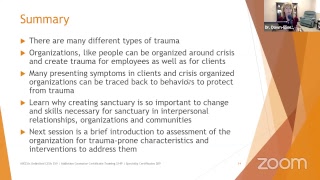
Dr. Dawn-Elise Snipes introduces the Sanctuary model, which addresses how trauma affects individuals, staff, and organizations. The webinar covers common trauma sources like abuse and violence, trauma-driven behaviors including aggression and self-injury, and core skills needed to create shared safety in homes, schools, and workplaces.
Chapters
Alrighty everybody. Well, welcome to this presentation on Introduction to Restoring Sanctuary. This is part one of two and we'll be going through both today if you want to stick with us. But they will also be available on our YouTube channel, allce.com YouTube this presentation is based in part on the book Restoring A New Operating System for Trauma Informed Systems of Care by Sandra L. Bloom. Now, like I said, this is just a really high level brief overview. Even the two hours, this book is intense and it's in depth and it is so good. And I'm not being sponsored in any way, shape or form by Restoring Sanctuary or Sandra Bloom or whatever. I just happen to have found the book and the method and think it is really so worth our time to look at and consider from an organizational perspective. At the end of part two, I provide you information about how to reach out to the Sanctuary Institute if you want in depth training for your organization on it. But you can get the book Restoring Sanctuary on Amazon. You may be able to find it at your local library. So definitely, if you are interested in trauma informed care, this is one of those must haves in your library. So in this segment we're going to review types of trauma. We're going to define sanctuary, explore where to create sanctuary. You know, how do we do it? Where do we do it? What are we talking about here? Identify why it is important to change and kind of start learning about the impact of trauma. So let's start with the types of trauma and I want you to think about trauma in a macro level, if you will. Trauma is not just what impacts the clients that are coming to see us. Trauma is what impacts the community from which the clients come. Trauma impacts the community in which our staff lives. Trauma impacts our staff and trauma impacts our organization. So let's think about this. Types of trauma. Physical, emotional, sexual abuse. Victimization or witness. Well, victimization, you know, that's pretty cut and dry. We know it happens what happens in our community, it happens to our clients. And it's probably the statistics say it's happened to at least 25% of our staff members. So we need to be aware that there is that history of trauma. But over and above that, we also have secondary victimization where we witness it. Either we're seeing it happen, you know, exposure to domestic violence or exposure to some sort of abuse or neglect, or as clinicians, we are exposed to it through our sessions, through being empathic, through hearing about these traumatic experiences over and over and over again. So if you are in a helping profession, it is Almost impossible not to be exposed to some level of trauma. Now does that mean you're going to develop trauma symptoms? Not necessarily. And we're going to talk about how to prevent that and what sorts of tools can be used to help clinicians and staff members protect themselves as well as significant others and just our clients. But it's important to recognize and validate the fact that we, people, human beings, are traumatized on a regular basis, sometimes depending on what your field of work is. If we're thinking about emergency room physicians, if we're thinking about first responders, if we're thinking about mental health clinicians, you know, all of us tend to see people on the very worst day of their life, or we hear about the very worst day of their life every day. So it can be traumatizing, it can be draining. Other types of trauma include neglect. And this can be neglect in a way that prevents the person from moving forward. You know, we typically think about neglect as a parent failing to meet the basic needs of a child. And yes, that's one type of neglect. But we also can experience neglect when we don't get our needs met in other ways. When we don't get our needs met in the community. You know, there's not the resources there that we need in the organization where as line staff are regularly silenced and not paid attention to, and their needs and their wants and what their clients need and want is neglected by senior management. Now this doesn't happen everywhere, but in crisis organized organizations you will see this a lot more. And this is what promotes a trauma prone work environment or a trauma prone organization. A household member with addiction or significant mental illness can be a type of trauma because that person may be not emotionally available. They may be doing things to themselves that could potentially kill themselves. So there's always a question, is this person going to be alive? There's a lot of things that can be traumatic. It can be devastating to watch someone with mental illness or addiction decompensate. So whether it's a household member or again, from a mental health perspective, if we're watching our clients, clients come in and they may, they're typically symptomatic when they come in. And that can be really stressful for us because when they come in and they are highly symptomatic, that's a crisis point. And we need to help get them stabilized. But we need to do more than just stabilization. Gaslighting is another type of trauma where one person tries to make someone else think that they're crazy, say no, that didn't happen or it's all in your imagination. And I've seen this in organizations where supervisors will gaslight their supervisees. I've seen this in families. I've seen this a lot. So we do need to be aware of gaslighting and making sure that we are not. That we are being honest with one another constantly. And there's an open flow of communication. Accident, illness, medical procedure or birth trauma, Any sort of medical trauma can provide a traumatic incident for somebody. When my son was born, you know, he was born at 29 weeks, that was very traumatic because he was in the NICU for six weeks afterwards. So I wasn't able to take my baby boy home. You know, there were a lot of things with that. When you have a car accident and somebody's in the intensive care, that's traumatic. When you have a client who overdoses, that's traumatic. So those are the types of traumas that individuals may experience. Historical trauma. Now we're going to talk a lot about this in future presentations. One of the things to recognize with historical trauma is when a trauma occurs, you know, whenever it occurs, it changes the way that person acts and interacts with people henceforth and forevermore. If they don't resolve that trauma in a way that is helpful and productive, if they are protecting themselves, if they are still organized around that trauma, then they are going to be less able to attach and be emotionally available for their children, for their friends. And then that is going to lead to poor attachment issues and poor relationship issues in that generation who is going to grow up and have future problems with attachment. And those things, those behaviors, those reactive behaviors that the original person developed in order to protect themselves from trauma that gets passed on through learning, you know, this is how you cope with other people. Maybe it's through aggression or anger or some sort of violence that gets taught. So people learn, but they don't learn anything else. They don't know anything else. This is what's normal in their household. So this is where historical trauma comes in. It's not necessarily. Although some people say it might be passed on genetically, we do see a strong element of social learning that occurs and a strong element of neurological changes that take place as a result of. Once the original person stops being able to form healthy attachments, then anyone who should be attached to them henceforth and forevermore isn't able to develop that healthy attachment. And the ability to form healthy attachments in that family may be broken until we interrupt the cycle. Natural and man made disasters is another type of trauma. You know, I was really involved in the recovery efforts for Hurricane Katrina way back when. We've had Hurricane Harvey, we just had Hurricane Florence that came through. Those were devastating, devastating hurricanes. And there were a lot of other devastating hurricanes that have come through. But those are the three most prominent in my mind right now. And these things can cause people to lose their homes, to lose their pets, to lose their family members, sometimes to lose their jobs because you know, the place that they used to work is now underwater or no longer exists. So they don't have a job, they don't have a house, they're living in a shelter. There's a lot of trauma involved with it, in addition to not knowing how the rest of their family who lives in the same area is doing. Because there's a lot of displacement. Phone lines are usually down. You know, it's difficult to communicate. You don't know if Aunt Sally actually made it out of her house or out of her assisted living facility. So there's a lot of stress and a lot of trauma. And just living, living in a shelter while you've got a roof over your head and you're still getting nutrition, it's a traumatic environment. It's a very stressful environment for adults as well as children. If that person, adult or child had a pre existing mental health or substance abuse issue, it may be exceptionally traumatic to them. Natural. And we talked about that forced displacement. And this is a little bit different than the natural and man made disasters. Because forced displacement can also include having someone be sent to jail or having children taken out of the house and put in foster care so the child feels they have no control. All of a sudden a caregiver is gone for some reason or another. And that can be very traumatic. And a lot of times children don't understand. Another way that forced displacement occurs is when there's a divorce, especially a particularly contentious divorce where one parent gets full custody and then the child is not able to see the other parent. So there's a grief and trauma reaction that may occur there. Military and community violence produces trauma. Because if you don't feel safe where you're living, if you don't feel safe when you go to sleep, that's traumatic. If you don't feel safe walking out your front door, that's traumatic. And traumatic grief or separation because of death, a loved one going to jail, divorce. You know, we kind of talked about those with forced displacement too. Things that happen that quote, aren't supposed to happen, that result in some sort of a loss can create traumatic Grief. And again, there are lots of videos on traumatic grief. We've done a couple on also eus.com YouTube and we'll do some more for the trauma informed care curriculum. But it's important to recognize that traumatic grief is a little bit different, more complicated in some ways than what you would call typical grief. Like when Grandma, who is 97 years old, passes away quietly in her sleep. That's much more expected a lot of times than if a parent dies in a car accident when they're 46 or something. An estimated 70% of adults in the United States have experienced trauma. So remember I said there's the people who've experienced it directly, but there's also people who have experienced secondary victimization, secondary trauma. These can include employees, caregivers, and providers, not just clients. So people who are interacting with. With people who've been traumatized have also been traumatized themselves sometimes. Well, this means you can relate, possibly. But it also means that as employees, caregivers, and providers, we may also have dysfunctional ways of responding to stress and trauma that recreate an unsafe environment or the perception of an unsafe environment for the client who is struggling with their own trauma issues. Traumatized individuals are likely reenacting out their own trauma dynamics and are often the ones running the environments in which people are supposed to recover from trauma. So we used to kind of joke when I was in my master's program about why we got involved in the field that we got into. And there was kind of a running joke that we all did it in order to figure out how to treat ourselves or a family member. And, you know, in most cases, that's probably true because mental health problems are really not uncommon. So realizing that there is something you can do to help is a motivating factor for a lot of us who got in the field. That's not a problem. We want to. If you have your stuff checked at the door and you have healthy coping skills and you've resolved your own issues, which is why therapy is good for everybody, then you can be exceptionally effective. But it is important to recognize when your trauma issues are infringing on your current work with clients. Now, organizations, you know, we keep talking about individuals and how trauma affects the clients, trauma affects the clinicians, yada, yada. How does trauma affect the organization? You know, if you think of the organization as sort of a living, breathing entity that's vulnerable to stress, particularly chronic stress, think about an organization that you've worked at that had chronic stress. You know, you were constantly having funding changes, you Were constantly having employee turnovers. There was animosity between the higher level supervisors and the line staff. That's a stressful organization. So how do line staff adapt? When they feel nervous, when they feel anxious that it's not a safe place to work because they don't know how much longer they're going to have a job, or because they don't know when they're going to get written up because they don't trust that senior management has their back. How do they react? And they typically react in some very unhealthy ways. Organizations can be traumatized, and the result of the traumatic experience can be devastating. And sometimes the trauma to the organization can be something like losing a supervisor or losing a particularly valuable employee where everybody recognizes this loss. It's like, oh, my gosh, John's not there anymore. I remember when I was in my first few years of practice, the man who had been the supervisor of the unit that I worked on for many, many years. And he was a supervisor when I was an intern. And then he was my first supervisor. All of a sudden they cut his position and it was gone. And so we were all. We all felt like we were reeling from that because he was such a grounding force in that organization and in that department that without him, we felt kind of like we were flailing. And we also were worried that we would meet the same end that he did because he just walked in one morning and they're like, okay, we cut the funding for your position. We're not filling it anymore. So the rest of us were going, well, when are they going to do that to us? So the experience can be devastating. What happened? We ended up having a lot of turnover in line staff because they didn't want to wait for that other shoe to drop. And it created a lot of chaos and stress among the staff as well as the clients because of all the anxiety and turmoil in the organization. So organizational sources of trauma. We kind of already talked about this. Physical, emotional, or sexual abuse, primary or secondary victimization. You can have sexual harassment. I know of an organization who just recently fired their CEO because of very blatant sexual harassment. But there can also be emotional abuse where supervisors and this same supervisor actually would boast about the fact that he had managed to make every single person who worked for him cry at some point. And I'm like, why are you boasting about that? That's not a good thing. That means to me that it wasn't a safe environment in some way for those people. Neglect, as I said, in an organization translates to senior management not providing the necessary tools, resources, or emotional or physical safety. Now, physical safety, we're talking about lighting in the parking lots. We're talking about a safe, you know, physically safe work environment. We're talking about an environment where people are not worried that they're going to be attacked by clients or staff members. But we're also talking about emotional safety where there is the ability for everybody to have a voice and to be respected for their point of view. Now, not everybody gets their own way that's, you know, part of a democracy and part of an organization. But they have a voice and they're not criticized or talked down to or called names for asserting their opinion or talking about how they feel about a particular situation. And there is an outlet for all staff to be able to communicate how they feel about certain things. Team members or clients with addictions or significant mental illness can also create trauma in an organization. Especially, you know, like I said, if there's a relapse of some sort, gaslighting can happen a lot. Historical trauma can be translated into the organization. Historical trauma in the organization. If there's trauma, you know, 10 years ago, you know, we'll go back to the organization I worked for when mark's position was dissolved. Then everybody. From then on, you know, the stories got passed from generation to generation of employees about, you know, you can't. You don't ever know with this organization when they're going to do away with one position and create an additional vice president. So it's always kind of a guessing game. You don't ever know when funding is going to get cut. You don't ever know when this happens. So things that happened in the past continue to get communicated and maintain high levels of anxiety because the expectation is that the organization is still the same. Man made and natural disasters can traumatize an organization because that fire rips through the building. We had a building one time, the piping had just been redone and it sprung a leak and it flooded the entire building. And this was before we went to electronic medical records. So we also lost a lot of our medical records because they were paper. So we had a lot of data that was lost. We had a lot of problems. We couldn't open. I think it was almost two months before we passed inspection to reopen the building. So people who used to work there or who did work there didn't have a job, you know, they were laid off for a period of time, and that created trauma. People who were clients at our organization had to be referred elsewhere because we didn't have memorandums of understanding in place where, you know, if for some reason something should happen to our building, we could timeshare with other organizations in order to still provide continuity of care. So there was a lot of stuff that happened. And I have a video on allce.com YouTube called something like Disaster and ethical obligation. Because I believe it is so important to plan for disasters in order to maintain continuity of care and prevent trauma to traumatization of clients as well as staff members. Forced displacement in an organization can happen due to involuntary transfers, programs being closed and terminations whether they're voluntary or not. And that affects everybody when somebody is all of a sudden gone. Community violence, when there are things that happen, we may get a bad reputation in the community because of what happens at our facility. And that can traumatize the organization further. And then traumatic grief or separation because of death, jail or separation of some sort. Now, thinking about, you know, if your employee or your client goes to jail, if somebody in your organization dies, that's traumatic to the whole organization. I mean, that's why when somebody at an organization dies, a lot of times the majority of people at the organization turn out for the funeral or the wake. So we've talked about how trauma is present and how it can impact. And you're starting to get an idea that this is probably a bigger issue than you had really thought. So let's talk about the impact of trauma. Exposure to trauma and adversity in childhood are central to the development of most mental illness. When they go back and do a retrospective analysis of people who developed mental illness in their lifetime, they found that the majority of people were exposed to trauma. Now, that doesn't mean that every person who was exposed to trauma developed mental illness. Some of them, the people had really healthy attachments, had the supports necessary, and resolved it just fine. But the people who were exposed to trauma, who didn't have those resources, ended up developing mental illness symptoms later in life. Early attachment determines how people interpret and interact with the world. Early attachment is that attachment with the primary caregiver that says you're safe. There is a safe place that you can go. There is somebody who's got your back, somebody who's going to help you out usually, well, I don't even want to go there. It's the primary caregiver, whoever the child spends the most time with, whoever provides the child with diaper changes and food through their formative months, that's the person with whom that child attaches. Okay, well, if this attachment is good, if the child is cold and they cry and the caregiver helps them get warm, if they're scared and the cry and the caregiver tends to them, if the caregiver is responsive, then the child learns that there is somebody who's going to meet their needs. If the caregiver is unresponsive, causes a problem biologically, it creates a stress response because the child's going to, I'm cold, I'm scared, I'm something, I am vulnerable in some way. Now, obviously they're not saying all those words because they're like three weeks old, but their amygdala, the primitive part of their brain that tries to keep them alive, is going, this is not a safe environment. So this means that stress chemicals and the HPA axis, the threat response system, as I call it, gets turned up because. And the child becomes more distressed and more anxious and will have difficulty sleeping. When our threat response system is turned up, we don't sleep well. I mean, it's like a soldier in a foxhole. He ain't gonna get really good deep sleep because he is listening. It's like a new parent. When the baby comes home, we don't sleep well because every time the baby rolls over or makes that little noise on the monitor, we wake up going, okay. Is the baby okay? Because we are on a level of higher alert. So the baby starts having difficulties sleeping, difficulties relaxing because their stress hormones are so high. Eventually this can lead to a situation called hypocortisolism, where the body is saying, you know what? I can't keep running this high. I can't keep myself revved up this much anymore. So I'm going to start conserving energy. And this is when you see people who tend to be flatter, more depressed, but they also tend to dysregulate a lot easier because they hold on to their excitatory neurochemicals until they think there's a threat, a really severe threat, and then they go from 0 to 240. And that is a really overly simplified explanation. But it's important to recognize that one of the things that we see in a lot of clients is that emotional dysregulation and a lot of this comes from prolonged stress, prolonged excitation of that stress response system. So their body just does that because there's no middle ground. There's no room for middle ground because they only have the energy to respond to the most extreme stressors emotionally when the person is on higher alert, you know, Just think about it. When you're stressed out, when you're edgy, when you're revved up a little bit, there are going to be more things that trigger your anxiety and your anger and your frustration and it's going to be harder to regulate. There may be an inability to grieve and anticipate the future because you're constantly in this state of chaos. When we are in a state trauma prone state, when we are in a high excitation state, our brain actually does something kind of cool. It's kind of frustrating, but kind of cool because it secretes certain chemicals that keep us. Yes, that's right. It keeps us from solidifying memories because we don't want to remember the worst day of our life. We don't want to remember all of those details. So those chemicals are happening. But. But it also keeps us from solidifying those experiences and integrating them so we can effectively anticipate the future. Because everything, you know, whatever happened during that trauma period is still kind of fluid cognitively. When you're revved up, you're stressed out, you're not getting enough sleep. People tend to have a more negative attitude. They tend to view the world as more unsafe. They tend to see things from an unsafe perspective. Instead of seeing the glasses half full, they see it as half empty, so to speak. Their schemas, the way they interpret the world, start getting informed by this negative attitude and negative perception. And the more negativity people see, the more negativity they expect to add to this trauma in childhood. And this is all the way up to about age 11 or 12. Trauma in childhood is affected by children's cognitive abilities. And if you think back to Piaget stages up until this stage, they are still using concrete operations where they have to be able to see it. They have difficulty thinking abstractly and they're egocentric. So it's all about me, whatever happened. If you know a caregiver left, then it must be something I did. If it rained on Tuesday, it must be because I wished that it was going to rain on Tuesday or something. Children tend to think that they've got a lot more control and responsibility for the things that go on around them than they really have. So they can't think abstractly and they think in terms that are very all about me and all or nothing. You know, I either my parent either loves me completely and is there to protect me, or I can't trust a single person. There's no middle ground. There's no, well, sometimes my parent is there, but when they're depressed, they're not able to be there for me. Children can't think that way. That's just not how they're wired at that age. So what they see is a parent who, it doesn't seem to ever be there, and they can't figure out what would make the parent be there. So biological changes, emotional changes, cognitive changes, all of these add up and work together to make social changes. People will start having difficulty with empathy. Nobody has empathy for them. They have difficulty having empathy for others. And that's not because they're trying to be mean. That's just because it hurts too much to empathize with other people. They don't feel validated, they don't feel heard or respected. So sometimes people just create a wall and go, you know what? I can't, I can't. I can barely deal with my own stuff. The other side of that is people who over empathize because they're trying to be there for other people. They're trying to understand where that other person is coming from because they think, well, if John is upset right now, maybe I should be upset and then I'll be accepted. So it can go either way. Trust typically goes out the window. One of the things that happens when people experience trauma is they feel unsafe. They feel victimized for a reason, for, for some reason. They may lose trust in themselves, trust in their own intuition, trust in their own thought processes. They may lose trust in their power. They may lose trust in the organizations and community that was supposed to protect them. They may lose trust and faith in those people who were closest to them. You know, it happens now, when it's properly resolved, trust actually builds. But we're talking about the impact of impact of trauma. Initially, trust is kind of shaken. Communication may become very poor during trauma, partly because people have difficulty thinking cognitively. On a higher level, when they're in stress, a lot of times people have a hard time stepping back and getting out of that emotional mind. Boundaries may be difficult and people may have difficulty with authority. Now think about this. When you're under stress, when you're feeling unsafe, when you're feeling disempowered, how likely are you to respond submissively to authority when everything else seems to be going to hell in a handbasket? It makes sense that people are going to try to control anything that they possibly can, which may make them resistant to authority. Now again, in some cases, complete submission and deference to authority is the safest reaction. So you may see either extreme with people who've experienced trauma and we'll talk about exploring symptoms in terms of their function a little bit later. Behavioral urges, knowledge, emotion and physiological reactions, I call it, you keep these things are stored and either assimilated or accommodated. So this information is stored in the amygdala and we hope eventually translated into higher order processes where it makes sense. But as long as it's stored in that amygdala, it's always there and kind of floating around. So these urges to protect themselves, these urges to lash out in order to push people away who are unsafe may be kind of floating around there. When exposed to highly stressful situations, the brain is flooded with neurochemicals that make it difficult to remember and integrate what what's going on. So poorly integrated urges, information, emotion and physiological reactions can cause hyper vigilance, body memories and flashbacks. This is your body's way of going, I've got this extra stuff floating around here and it hasn't been integrated yet and I don't know what to do with it. I have this feeling, I don't know what caused it and I don't know what to do with it, but it feels icky and it's associated with some sort of trauma and being unsafe. I don't know what to do with it. I have this knowledge out here that doesn't fit your schema and I don't know what to do with it because maybe a parent, maybe a caregiver who is supposed to care for me and protect me, actually hurt me and I don't know how to integrate that. So maybe I shouldn't trust anybody ever. I don't know. So anytime in the future when that person encounters a authority figure who's supposed to caretake for them that information from the past, where somebody who was responsible for that duty in the past hurt them, they're going to remember that and they may be more protective, they may have more difficulty accepting help or being open and available to that person. Trauma also causes us to develop adaptive coping responses. We want to see behaviors, no matter how unhelpful they seem in the moment. We want to recognize them often most of the time, as creative ways of coping with stress with the tools that that person had at that point in time. You know, when you're six years old, you don't have a whole lot of coping skills, so you're going to do whatever you can to protect yourself. And if that works, guess what? You are going to keep doing it. So that is how habits get formed because that behavior is reinforced. I keep talking about stuff getting stuck in the amygdala. Think about assembling a piece of furniture. I've put together a bunch of furniture in my years and I hate doing it because always have pieces left over and integrating experiences. Integrating trauma is like putting together that furniture. You don't want to have parts left over because if you do, that means that furniture you put together is unstable. If you fail to integrate experiences, that means that the schemas that you have and the representations that that person has may be unhelpful. They may not be as sturdy and supportive as they could be. So let's look at and let's think about some of the most common presenting symptoms as ways that people use to cope with violence. Now, trauma is violence in most cases. And even if you're thinking about man made disasters or acts of God, natural disasters, that is violence. The wind violently rips buildings apart, that is violence. That is a lot of chaotic energy. So expand your definition of violence and think about in what ways does this particular person's symptoms help them stay safe, and in what ways is this particular situation reminding them of a time when they weren't safe before and triggering the use of that behavior? So aggression, whether it's verbal aggression, being yelling, screaming, punching, or not punching, but yelling, screaming, calling names, something like that, or physical aggression where you're actually punching someone, punching a wall, or being physically aggressive to yourself, all of those can be ways of coping with violence. Pushing other people away, avoiding other people, you know, trying to gain power over them by making them feel like they're being pushed down through verbal violence or through name calling. I'm not saying that's the way to do it. Trust me, you know, this is not the healthy coping skill. But I want you to look at what, what's the benefit? In what way does this behavior help the person? Or could it have in the past helped the person stay safe? So not everybody's aggressive. Okay, so what about self injurious behavior that's aggressive, but it's aggressive towards oneself. And examples of this can be cutting addictions and eating disorders. Cutting is the most obvious example. Self injurious behavior for cutting, when there's a trauma, you're out of control, you're not safe. When someone is cutting or injuring themselves, they have an element of control over how much pain they're in and whether they continue or whether they stop, they have complete control over the trauma. Cutting can also be used in order to distract from internal trauma. You know, those thoughts and flashbacks and everything that are Just so terrifying. When people are cutting, it brings them into the moment so they can't focus on that, which is another reason why we may see it. Addictions are used in much the same way. Addictions are ways of escaping trauma, escaping those feelings, escaping those flashbacks. It numbs it for a little while and helps people cope with the memories of whatever it was that happened. Addictions are self injurious because it injures the body, it injures relationships, it injures, you know, a lot of things. And eating disorders are again, self injurious because a lot of times people are starving or purging or over exercising or doing a variety of things that are injurious to their own body, but they're able to control it. And one of the key features of eating disorders is that need for control. Because they can control what goes in their body. They can control whether they respond to hunger cues or not. They can control a lot of things in terms of that one aspect of their life. So they may focus on their eating or their body shape at the expense of everything else, because that is the only thing they can feel like they can control in their life. High risk behaviors are another way of coping with violence and memories of trauma because it produces a rush of dopamine and adrenaline. It gives people the feeling of elation, which they may not be feeling if they are struggling with trauma and hypocortisolism. High risk behaviors are also sometimes self injurious and kind of a way of thumbing your nose and going, well, screw it, you know, if I'm supposed to die, I'm supposed to die. And you know, that high risk behaviors always make me nervous because they can indicate that the person doesn't have, doesn't care if they live or die. So being aware, what's the benefit of the high risk behavior? Is it an adrenaline and dopamine rush that gives the person a sense of control and thumbing their nose at, you know, caution? Or is it that they don't care if they live or die? We don't know. Depends on the client. Antisocial behaviors. And this is. We talked a little bit about empathy earlier. When people are exposed to trauma, when people feel like even their primary caregivers didn't have their back, they may not develop empathy when they're growing up, or even if they do develop empathy when they're knee high to a grasshopper. If the trauma occurs a little bit later, they may just kind of shut down and it becomes about doing what makes them happy. At the time, and, you know, to heck with everybody else. And I say this in terms of behaviors. You notice I don't say antisocial personality disorder because a lot of times people with antisocial behaviors have experienced experience trauma. And once they process and integrate that trauma, those behaviors dissipate. The same thing with borderline behaviors that I love you or I hate you and turning on a dime and impulsivity and instability in relationships and their sense of self. Those are all very understandable symptoms that happen after a trauma. You know, one minute you're trusting somebody, and the next minute you realize that they are one of the most dangerous people in your life. One minute you're telling somebody, you know, you're telling a parent that something bad happened to you, and the next minute they're calling you a liar. So you don't know who you can trust. So that trust. Then the person starts learning to not trust themselves, which means any indication that somebody else may not be trustworthy, all of a sudden, that needle goes from love to hate, trust to distrust. There is no middle ground. And remember, when traumas initially happen, and a lot of people with borderline behaviors, their traumas did happen early in life, Their thinking was very dichotomous, all or nothing. So their thinking about the current situation is probably very similar to their thinking about that situation, because they're still. Part of them is still stuck back in that traumatic incident and trying to protect themselves. And creating drama and chaos can also be ways that people cope with violence. Creating drama can either bring attention to people or distract from them. When I ran the residential unit, there was always, it seemed like at least one person on the unit who. This was kind of their M.O. when they started feeling uncomfortable, when they started feeling vulnerable or distressed, they would create drama so people would stop looking at them. People would stop focusing on their issues because it was really painful and they didn't want to go there and start focusing on other people. So creating drama can be a way of saying, oh, this is. This is really uncomfortable, and I don't know that I can do it. And that's instead of punishing the drama, being empathetic with the person and going, wow, it seems like you're really scared right now, and recognizing again, the function of the behavior as it serves to protect the person. So we've talked about the impact of trauma. We've talked about the fact that there are lots of traumas and they impact everybody or most everybody. So why is sanctuary important to change? The impact of traumatic experiences is so profound because it tends to freeze people in time, like I just said, trapping them in a seemingly endless feedback loop of destructive repetition that's conveyed from one generation to the next via disruptions in attachment relationships. Sound familiar? The focus of attention changes from exclusively trying to control the child's behavior or the misbehavior of the client or the staff member, to the true complexity of the child, of the dynamics and injuries that are caused by the trauma. So we need to switch our focus instead of going, okay, Johnny keeps getting out of his seat, we need to figure out how to make him stay in his seat. We need to say, johnny keeps getting out of his seat, we need to figure out why he's getting out of his seat and how to help him be a little bit more rule following. Creating sanctuary refers to the shared experience of creating and maintaining safety within any social environment. And in order to really do this, you really need a community wide buy in. And this is one of the reasons that the sanctuary model is really difficult to implement, because you have to have buy in from the top most levels, including the board of directors of an organization, because it involves an entire culture shift. It's not just a technique that a clinician uses. You're having to change the entire culture of the organization. And I don't usually think that that's a wonderful thing to do. However, I can definitely see the benefits. Having worked in multiple different organizations that have been pretty toxic, I can see how changing that environment could be so incredibly liberating and validating and nurturing not only to clients, but also to staff, which reduces turnover, improves outcomes, improves productivity. There's lots of financial benefits to it too, for any of you C level executives listening. So creating sanctuary. We want to help people learn how to create sanctuary at home. We want to make sure that clients know how to create a safe environment at home. And that again is a attitude and a paradigm shift. It's not just about making sure that the doors lock. There are a lot of other skills that we'll talk about that go into, and most of them we're going to talk about in the next segment that go into creating safety. We want to make sure that it's safe at school and at work. I regularly hear students at my kids dojang talking about, you know, so and so got beat up at school today or so and so tried to commit suicide. And it just breaks my heart because that tells me that they're feeling the results or the effects of a lack of safety in the school and in the environment because of the traumas that they're experiencing. We want to make sure that hospitals and medical clinics and doctor's offices are trauma informed. So many people, when they are, the types of trauma they're exposed to, involve someone or something intruding into their space. So we want to make sure that hospitals, clinics and doctor's offices empower clients and give them a sense of physical safety and ask permission before doing anything invasive or intrusive. Public buildings, it's another place we want to create sanctuary, make sure people feel safe when they walk into a courthouse, when they walk into a mall, when they walk into a movie theater, that they feel like they're in a place that is physically and emotionally safe. They're not going to get criticized, they're not going to get held against their will, they're not going to get harmed in any way, shape or form. Correctional and court systems. We want to make sure that they are open. And I've worked with some really amazing judges, and I've worked with some judges that were more old school, and I've worked with some really amazing probation officers and some who were really overworked. We wanted to look at that. But it's important to recognize that a lot of times people who have experienced trauma develop behaviors to protect themselves that end up getting them in the correctional or court system. The court system also needs to be open, empowering and safe. Child welfare is a place where children are usually taken. You know, we have that forced displacement by a child welfare worker. They're put into a foster home, which may or may not be a really great placement. They are taken from a bad environment, but they're taken forcibly. So, you know, they are neglected. They have poor attachment issues. You know, there's lots of stuff going on. But then they're also completely disempowered when they are removed, placed, there's the child doesn't feel like he or she has any say. So we want to make sure that we create sanctuary in child welfare as much as we can. And there are techniques for that as well. And in neighborhoods, we want to make sure that people feel safe in their own house, but we also want to make sure that they feel safe walking to their car where they feel safe and not judged when they're out working on their lawn. And sanctuary means it's a happy, relaxing place. A lot of homeowners associations really destroy the concept of sanctuary because they're very punitive, they're very critical, and they're very hyper vigilant to any infraction on any sort of the rules, regardless of what may be going on with that individual at that point in time. So if John Smith was living in an environment with a HOA and he had a heart attack and needed a triple bypass and didn't get his lawn mowed for, you know, six weeks, it would be a little bit rangy to say the least. But you know, in a sanctuary situation, the community would go, oh my gosh, John Smith had a triple bypass. What can we do to help? In many neighborhoods with hoas, John Smith would just continue to get cited for his infractions for his grass being too tall. So we do want to try to create safety in neighborhoods and sanctuary in neighborhoods. So what are the necessary skills? And there is so much more, and I know I keep saying that, but I don't want you to think that listening to a two hour summary is going to provide you the tools to implement a sanctuary environment. My goal is to give you information so you are encouraged to go out and get that book and then start thinking about ways that you as a person can create sanctuary in your home, that you as a person can create sanctuary in your neighborhood, in your work organization, and if you're a supervisor, ways you can create sanctuary in your department. Even if you don't have buy in from the levels high above, there are a lot of things that you can do and paradigm shifts that you can embrace that don't necessarily require super high level buy in. But once your department starts showing so much, much improved benchmarks and everything and happier staff and less turnover and all that, it may be contagious. But I digress. So necessary skills, safety and self care, because people deserve it. So we need to make sure that staff as well as clients know what it means to create safety for themselves. You know, everybody's idea of what a safe environment is a little bit different based on their learning experiences. So what does it mean to you to be safe and how can you make that happen? And self care? What does it mean to take care of yourself? What do you need in order to reduce some of those biological vulnerabilities? What do you need in terms of sleep, in terms of nutrition, in terms of downtime and relaxation? Because you deserve it. When people are exposed to trauma, a lot of times their safety skills kind of go out the window because they're like, well, I clearly didn't protect myself that time, so I don't know how to protect myself. Or they don't recognize sources of stress that are happening because they're so used to being stressed out all the Time, one example, and this kind of goes in safety and self care. When I used to run a 24 hour facility, I never got a good night's sleep, never did, because I never felt like it was safe to get completely, you know, down into a deep sleep. Because I was always afraid that somebody was going to call and go, the midnight shift, person didn't show up or, you know, a client's in crisis. So it was difficult for me to ever feel safe enough to completely relax, to go to sleep. One thing you can do on an organizational level is have rotating calls, rotating on calls so people do have a chance to get some sleep and self care. You know, making sure that you're doing things to take care of yourself, to sharpen the saw. As Covey says, emotional regulation and distress tolerance are imperative for everybody. We need to be able to tolerate distress when it happens, feel it, acknowledge it radically, accept it, tolerate it until we can get into our wise mind with distress tolerance skills and then choose the best next step in order to improve the moment. Our feelings are there for a reason. Our feelings are our brain's way of going, okay, we've been here before, don't want to be here again, so that's okay. We want to thank our brain for that and go, okay, thanks for the heads up that there might be a problem. Let me check it out. Cognitively, we need to remember that trauma impacts people's attitudes and perceptions and perspective and often turns them much more negative and suspect, which means they tend to evaluate things as more negative and suspect. Cognitively, people who experience trauma often have more of a sense of helplessness, so they don't have as much self efficacy. They don't believe that they have any power to help themselves or to stay safe. And they may be ineffective at problem solving because when they get upset, they go from 0 to 260. And at 260, just like when you're driving, and I've never driven this fast, but if you're driving at 200 miles an hour in the Indy 500, you're not focusing on, you know, the birds in the sky. You're doing your best to keep that dagum car from crashing into a wall or somebody else. So problem solving isn't big on the list at that point in time. So we want to remember that people who are under high levels or even moderate levels of chronic stress often have difficulty problem solving because their brain is using energy for self preservation, not for higher cognitive processes. So we need to make sure that people have the skills to address any of these problems, people need communication skills. The first and one of the most important communication skills is mindfulness. You can't communicate what you don't know. So if you don't know how you feel, you can't tell somebody how you feel. If you don't know what you need, you can't communicate what you need. If you are not mindful of what's going on in the situation, then you are going to have difficulty assimilating it and communicating your perception of the situation to other people. So we want to help people develop mindfulness. Once they know the situation and you know they're mindful and aware, then they need to be able to communicate assertively where they're not disparaging others, where they are saying, this is my opinion, and their opinion is important, and your opinion is important. So assertiveness skills are really crucial to trauma resolution because when people learn to communicate assertively, they're able to communicate what their needs are so they can have a better chance of getting those needs met. Because if you don't communicate them, needs probably ain't going to get met because most people can't read your mind. So assertiveness skills and then boundary setting is the third and really, really important one. And that kind of goes hand in hand with assertiveness because it's important that people can say, these are my thoughts. You don't have to agree with them, but they're my thoughts, and I'm not going to change them to please you. I may alter them if you present me some information that makes me reconsider, but I'm not going to alter them just to please you. They are my thoughts, they are my feelings, and I have a boundary here. And you are welcome to have your thoughts and your feelings, and they are very valid, too. Judgment skills are also important. Again, mindfulness comes in here because you can't make an effective judgment if you're not aware of the situation. You know, if you're driving down, down the road and it starts pouring rain and you literally cannot see the car in front of you, you're probably not going to be able to make a good judgment about when to stop, which is why you probably pull over until the rain subsides a little bit. You need to be able to tune in so you're not out there in la la land thinking about the past, regrets, guilt, worry in the future, any of that. You want to be able to tune in to what's going on so you can make the best judgment at that point in time when you're aware, when you're mindful, when you're tuned in, then you can more effectively problem solve. But again, a lot of people who've been exposed to trauma have not ever been taught or developed effective problem solving skills. So that's something that we can help them with. And grieving and envisioning people need to be able to grieve whatever they lost. And losses are not just tangible things like houses or pets or friends or family members. It can also be grieving the loss of your sense of safety, grieving the loss of hopes and dreams, grieving the loss of, you know, what you thought was going to happen six months from now, but also being able to say, okay, that didn't happen. So as I'm writing the end of this chapter or the end of this season, we're going to let this particular idea go because it's not happening anymore and envision what's going to happen in the premiere of next season. What do you envision happening? Because you want to keep, you know, if you're thinking about being a screenwriter, you want to keep your viewers coming back. Just like you want to be excited to live in your life, you want your viewers excited for the season premiere. So, okay, we got to get rid of a favorite character here or we've got to close out this storyline, which, you know, everybody really loved. What is the next storyline that's going to open that can really excite the person or the viewers? So there are many different types of trauma organizations. Just like people can be organized around crisis and always reacting to crisis and really tense because the more crises happen, the more people tend to get rigid and stressed out and okay, this is how it has to be. And try to control everything to prevent another crisis. Well, that level of oppressive control can also create trauma for employees, which can put them in bad moods, but it can also make them leave, which can also create trauma for clients. Many presenting symptoms in clients and crisis organized organizations can be traced back to behaviors that were developed to protect from trauma. So an organization that becomes rigid and very top down probably did so out of crises that happened. And this is how they are organized and functioning now. Many people who act a certain way probably became that way because they developed these behaviors to protect themselves from prior trauma and those behaviors were rewarded. And this is how they know how to protect themselves. Right now we need to learn why creating sanctuary is so important to change. And we need to understand skills necessary for sanctuary in interpersonal relationships, organizations and communities. So those skills we just talked about, you know, I didn't talk about how to make those happen. I just talked about what they were. Like I said, it's a process of becoming a sanctuary organization. In the next session, we're going to have a brief introduction of the assessment of the organization for trauma prone characteristics and interventions, a couple that can be used in the sanctuary model in order to start addressing those issues. So I look forward to talking to you on part two.










